


 |
市場調查報告書
商品編碼
2122806
地工織物:市場佔有率分析、產業趨勢與統計、成長預測(2026-2031)Geotextile - Market Share Analysis, Industry Trends & Statistics, Growth Forecasts (2026 - 2031) |
||||||

※ 本網頁內容可能與最新版本有所差異。詳細情況請與我們聯繫。
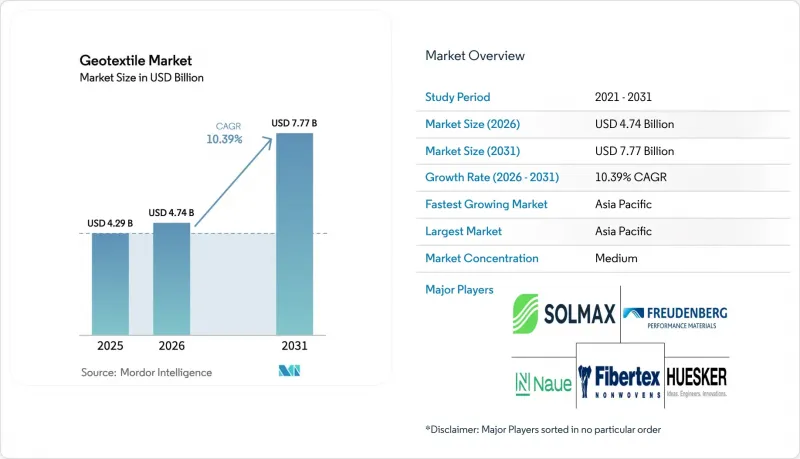
地工織物市場預計將從 2025 年的 42.9 億美元成長到 2026 年的 47.4 億美元,然後在 2031 年達到 77.7 億美元,2026 年至 2031 年的複合年成長率為 10.39%。
本報告按材料(聚丙烯、聚酯等)、織物類型(機織、不織布、針織)、功能(分離、排水、過濾等)、應用(道路建設和路面維修、侵蝕控制等)以及地區(亞太地區、北美地區、歐洲地區、南美地區、中東和非洲地區)進行細分。市場預測以美元計價。
全球地工織物市場趨勢及洞察
在公路和高速公路基礎設施項目中擴大採用範圍
美國2026財政年度聯邦預算撥款1,113億美元用於公路建設,其中72億美元用於橋樑更換。這鞏固了未來多年對用於隔離和加固的地工織物的需求。在印度,一項涵蓋8500公里國道建設的合約於2025年簽署,該合約將採用地工織物層來緩解季風地區的地層下陷。在中國,4,200公里公路於2026年初獲得批准,江蘇和浙江兩省軟黏土地區的公路路段現已強制使用地工合成材料進行地面加固。在東協地區,交通走廊的碎石路基下正在使用不織布過濾層來抑制細顆粒的移動。合約模式正從最低價競標轉向基於績效的契約,並結合擔保和遠端監控,這使得擁有整合設計平台的供應商更具優勢。
水資源管理設施對過濾和廢水處理的需求日益成長。
2025年,歐盟公共產業投資180億歐元用於雨水處理設施的維修;德國和荷蘭的廢水處理標準強制要求使用地工織物覆蓋的穿孔管道,以延長其使用壽命至50年。美國環保署(EPA)在2025年透過清潔水州輪調基金投入了68億美元。許多處理設施正在人工濕地中使用地工織物過濾層,以達到懸浮固體含量限制標準。印度的「飲用水生命線計畫」(Jal Jeevan Mission)正在乾旱地區擴大地工織物支撐的滲濾廊道的規模;澳洲的墨累-達令河流域現代化計畫正在資助安裝針刺地下排水管,以遏制鹽度上升。這些項目正在重新定義地工織物,使其不再只是一種通用紡織材料,而是一種能夠顯著降低營運成本(OPEX)的工程系統。
聚丙烯和聚酯的價格波動與原油價格相關
由於歐佩克+減產,石腦油供應緊張,預計2026年第一季亞洲聚丙烯價格將達到每噸1,150美元,較2025年第四季上漲18%。在歐洲,由於煉油廠停產和天然氣價格飆升,聚酯短纖維價格已達到每噸1,420歐元(1,530美元)。加工商通常將銷售價格鎖定12至18個月,但樹脂採購按月進行,因此價格上漲超過15%將對利潤率造成壓力。沒有避險手段的中小型加工商面臨現金流緊張的困境,導致專案延期和織物規格降低。
細分市場分析
到2025年,聚丙烯將佔銷售額的57.38%,預計到2031年將以11.33%的複合年成長率成長,因為運輸公司優先考慮的是耐鹼性土壤性能而非再生材料含量。聚酯纖維受供不應求的限制,但對於需要高拉伸強度的應用(例如尾礦壩加固)仍然至關重要。聚乙烯在暴露於強紫外線輻射的掩埋覆蓋層中佔據著獨特的市場,其優異的可塑性使其價格合理。椰子纖維和黃麻等天然纖維在南亞和東非被用作短期侵蝕控制措施。先導計畫旨在2028年實現30%的可再生原料佔有率,但在全面推廣之前,仍需彌合25%的成本差距。
聚丙烯的疏水特性可防止路基因潮濕而強度降低,將中國和印度高速公路路面的使用壽命延長至多20年。聚酯的斷裂伸長率超過50%,可在需要極高應力吸收的路堤層中保持牽引力。聚乙烯的抗紫外線性能確保其可用於暴露的海岸護坡,使用壽命超過50年。天然纖維符合緩坡的生物分解要求,但其抗張強度低於20 kN/m,因此應用受到限制。
到2025年,在未鋪砌道路和鐵路路基等高荷載加固應用中,機織地工織物將佔45.26%的銷售額,這些應用要求抓取拉伸強度達到1400牛頓或以上。預計到2031年,不織布將以11.54%的複合年成長率快速成長,滿足掩埋和排水應用對滲透性達到1×10⁻³米/秒或以上的要求。針織地工織物用於特殊的護坡施工,透過3D互連增強土壤保持能力。結合機織紗線網格和不織布過濾網的混合產品也正在湧現,可同時滿足安定器和軟土地基的要求。
歐盟關於掩埋回填的法規實際上強制要求使用不織布排水層,這將在2030年之前持續推動市場對非織造排水層的強勁需求。亞太地區的礦業公司正在升級尾礦壩的施工材料,採用強度超過100 kN/m的織物,這是標準針刺非織造不織布無法達到的強度。同時,印度2025年的道路鋪設指南允許在低流量道路上使用紡粘不織布,這將加速農村道路網路的成本削減。
區域分析
預計到2025年,亞太地區將佔全球銷售額的39.58%,以11.89%的複合年成長率超越其他地區,這主要得益於中國高速公路建設的蓬勃發展以及印度「巴拉特馬拉」(Bharatmalla)建設項目,該項目正在推進聚丙烯隔板的標準化。在東南亞,預計到2025年,跨境高速公路建設的投資將達到180億美元,屆時將使用不織布過濾材料,以最大限度地減少細顆粒的擴散。由於可用於新開發的土地有限,日本和韓國正將重點轉向維修和海岸侵蝕控制項目,這些項目更傾向於使用高強度聚酯織物。
在北美,《基礎建設投資與就業法案》以及加拿大335億加幣的預算撥款正在提振市場。 2026會計年度預算為美國高速公路撥款1,113億加元,儘管由於人手不足和授權延誤,部分採購可能會推遲到2027年,但長期需求預計仍將保持穩定。在墨西哥,地工織物供應正被納入承包工程總承包(EPC)合約中,以縮短聯邦高速公路的建設工期。
在歐洲,到2030年必須鋪設4000萬至5000萬平方公尺的排水層。德國聯邦環境署(UBA)提高了透水性基準值,推動對針刺不織布的需求成長。同時,英國要求鋪設保護層,以防止樹根和囓齒動物挖掘。在南美洲,巴西耗資450億雷亞爾的PAC公路和沿海港口計畫發揮主導作用。在中東和非洲,沙烏地阿拉伯的NEOM高速公路網和阿拉伯聯合大公國的沙漠道路穩定計畫正在推動這項計劃。
其他好處:
- Excel格式的市場預測(ME)表
- 3個月的分析師支持
目錄
第1章:引言
- 研究假設和市場定義
- 調查範圍
第2章:調查方法
第3章執行摘要
第4章 市場狀況
- 市場概覽
- 市場促進因素
- 在公路和高速公路基礎設施項目中擴大採用範圍
- 水資源管理資產對過濾和廢水處理的需求日益成長
- 加強全球掩埋和污水法規
- 加速投資以降低礦業廢石壩的風險
- 根據歐盟掩埋指令,必須設置回填層。
- 市場限制因素
- 聚丙烯和聚酯價格的波動與原油價格相關
- rPET被挪用於飲料包裝,導致PET供應短缺。
- 新興市場設計和工程人才短缺
- 價值鏈分析
- 波特五力分析
第5章 市場規模與成長預測
- 材料
- 聚丙烯
- 聚酯纖維
- 聚乙烯
- 其他材料
- 按布料類型
- 織物
- 不織布
- 針織
- 按功能
- 分離
- 引流
- 過濾
- 加強
- 保護
- 透過使用
- 道路建設和路面維修
- 侵蝕
- 引流
- 鐵路建設
- 農業
- 其他用途(採礦、海岸和水道保護等)
- 按地區
- 亞太地區
- 中國
- 印度
- 日本
- 韓國
- 泰國
- 馬來西亞
- 印尼
- 越南
- 其他亞太國家
- 北美洲
- 美國
- 加拿大
- 墨西哥
- 歐洲
- 德國
- 法國
- 英國
- 義大利
- 西班牙
- 北歐國家
- 其他歐洲國家
- 南美洲
- 巴西
- 阿根廷
- 哥倫比亞
- 其他南美國家
- 中東和非洲
- 沙烏地阿拉伯
- 阿拉伯聯合大公國
- 卡達
- 南非
- 奈及利亞
- 埃及
- 其他中東和非洲國家
- 亞太地區
第6章 競爭情勢
- 市場集中度
- 策略趨勢
- 市佔率/排名分析
- 公司簡介
- ACE Geosynthetics
- AFITEXINOV
- AGRU America Inc.
- Amcor plc
- Asahi Kasei Advance Corporation
- Carthage Mills
- CMC
- Fibertex Nonwovens A/S
- Freudenberg Performance Materials
- HUESKER International
- Industrial Fabrics, Inc.
- KayTech
- Mattex Geosynthetics
- Naue GmbH & Co. KG
- Officine Maccaferri Spa
- Owens Corning
- Solmax
- Thrace Group
第7章 市場機會與未來展望
According to Mordor Intelligence, the geotextile market size is expected to grow from USD 4.29 billion in 2025 to USD 4.74 billion in 2026 and is forecast to reach USD 7.77 billion by 2031 at 10.39% CAGR over 2026-2031.
This report is Segmented by Material (Polypropylene, Polyester, and More), Fabric Type (Woven, Non-Woven, and Knitted), Function (Separation, Drainage, Filtration, and More), Application (Road Construction and Pavement Repair, Erosion, and More), and Geography (Asia-Pacific, North America, Europe, South America, and Middle-East and Africa). The Market Forecasts are Provided in Terms of Value (USD).
Global Geotextile Market Trends and Insights
Growing Adoption in Road and Highway Infrastructure Projects
The FY2026 U.S. federal budget earmarks USD 111.3 billion for highways, including USD 7.2 billion for bridge replacement, cementing a multi-year pull for separation and reinforcement fabrics. India awarded 8,500 kilometers of national highways during 2025, embedding geotextile layers to curb settlement in monsoon regions. China cleared 4,200 kilometers of expressways in early 2026 and now mandates soil-reinforcement geosynthetics for soft-clay corridors in Jiangsu and Zhejiang. Across ASEAN, connectivity corridors use non-woven filtration layers beneath crushed-stone bases to stem fines migration. Contracts have shifted from lowest bid to performance-based deals that bundle warranties and remote monitoring, favoring suppliers with integrated design platforms.
Rising Demand for Filtration and Drainage in Water-Management Assets
EU utilities spent EUR 18 billion on stormwater upgrades in 2025, codifying geotextile-wrapped perforated pipes in German and Dutch drainage norms to prolong service life to 50 years. The U.S. EPA disbursed USD 6.8 billion under the Clean Water State Revolving Fund in 2025, with many plants adopting geotextile filtration layers in constructed wetlands to meet suspended-solids limits. India's Jal Jeevan Mission scales infiltration galleries lined with geotextiles across arid states, while Australia's Murray-Darling Basin modernization finances subsurface drains wrapped in needle-punched fabrics to curb salinity. These programs reposition geotextiles as engineered systems that deliver measurable OPEX reductions rather than generic textile inputs.
Crude-Oil-Linked Volatility in Polypropylene and Polyester Prices
Polypropylene is projected at USD 1,150/ton in Asia during Q1 2026, 18% above Q4 2025 after OPEC+ cuts squeezed naphtha supply. European polyester staple fiber hit EUR 1,420/ton (USD 1,530) on refinery outages and high gas prices. Fabricators lock customer prices for 12-18 months but procure resin monthly, eroding margins when spikes exceed 15%. Smaller converters without hedging instruments face cash-flow stress, leading to project delays or downgraded fabric specs.
Other drivers and restraints analyzed in the detailed report include:
- Stricter Global Landfill and Wastewater Regulations
- Accelerating Investment in Mining Tailings-Dam De-Risking
- rPET Diversion to Beverage Packaging Tightening PET Supply
For complete list of drivers and restraints, kindly check the Table Of Contents.
Segment Analysis
Polypropylene held 57.38% of 2025 revenue and is growing at an 11.33% CAGR to 2031 as transportation agencies prioritize alkaline-soil resistance over recycled content. Polyester is constrained by rPET scarcity and remains indispensable for high-tensile applications like tailings-dam reinforcement. Polyethylene occupies niche in UV-intensive landfill caps where conformability justifies its premium. Natural fibers such as coir and jute fill in short-term erosion control across South Asia and East Africa. Bio-based polypropylene pilots target 30% renewable feedstock by 2028, yet must close a 25% cost gap before scaling.
Polypropylene's hydrophobicity prevents moisture-induced subgrade weakening, extending pavement life by up to 20 years on Chinese and Indian motorways. Polyester's elongation at break above 50% retains traction in embankment lifts requiring extreme strain absorption. Polyethylene's UV stability secures use in exposed coastal revetments where service life exceeds 50 years. Natural fibers meet biodegradable mandates on gentle slopes but remain limited by tensile ceilings below 20 kN/m.
Woven commanded 45.26% revenue in 2025 for high-load reinforcement of unpaved roads and rail beds that demand more than 1,400 N grab tensile strength. Non-wovens are the fastest risers at 11.54% CAGR through 2031, answering landfill and drainage specs that require more than 1X10⁻³ m/s permeability. Knitted geotextiles handle specialized revetments where 3-D interlocking boosts soil retention. Hybrid lines combining woven yarn grids with non-woven filter webs emerge to meet ballast and soft-soil dual requirements.
EU landfill caps effectively prescribe non-woven drainage layers, creating sticky demand through 2030. Asia-Pacific miners are upgrading to woven fabrics rated at >=100 kN/m for tailings dams, a strength unattainable for standard needle-punched webs. India's 2025 pavement guidance, however, opens light-traffic roads to spunbond non-wovens, triggering a cost-down swing for rural corridors.
Complete Report Scope:
- By Material
- Polypropylene
- Polyester
- Polyethylene
- Other Materials
- By Fabric Type
- Woven
- Non-woven
- Knitted
- By Function
- Separation
- Drainage
- Filtration
- Reinforcement
- Protection
- By Application
- Road Construction and Pavement Repair
- Erosion
- Drainage
- Railworks
- Agriculture
- Other Applications (Mining Operations, Coastal and Waterway Protection, etc.)
- By Geography
- Asia-Pacific
- China
- India
- Japan
- South Korea
- Thailand
- Malaysia
- Indonesia
- Vietnam
- Rest of Asia-Pacific
- North America
- United States
- Canada
- Mexico
- Europe
- Germany
- France
- United Kingdom
- Italy
- Spain
- NORDIC Countries
- Rest of Europe
- South America
- Brazil
- Argentina
- Colombia
- Rest of South America
- Middle-East and Africa
- Saudi Arabia
- United Arab Emirates
- Qatar
- South Africa
- Nigeria
- Egypt
- Rest of Middle-East and Africa
- Asia-Pacific
Geography Analysis
Asia-Pacific generated 39.58% of 2025 revenue and is outpacing peers at 11.89% CAGR on China's expressway surge and India's Bharatmala builds that standardize polypropylene separation layers. Southeast Asia invested USD 18 billion in 2025 for cross-border highways, specifying non-woven filtration fabrics to minimize fines migration. Japan and South Korea, with limited greenfield land, pivot to rehabilitation and coastal erosion works that prefer high-strength woven polyester.
North America is buoyed by the Infrastructure Investment and Jobs Act and Canada's CAD 33.5 billion allocation. FY2026 budgets earmark USD 111.3 billion for U.S. highways, sustaining long-cycle demand despite labor and permitting delays that push some procurement into 2027. Mexico bundles geotextile supply into turnkey EPC deals to compress timelines on federal corridors.
Europe mandates add 40-50 million m2 of drainage layers through 2030. Germany's UBA pushes permeability thresholds that tilt demand toward needle-punched webs, while the UK enforces protection layers to block root and rodent puncture. South America is led by Brazil's BRL 45 billion PAC roads and coastal ports. The Middle-East and Africa is paced by Saudi Arabia's NEOM highway grid and UAE desert road stabilization.
- ACE Geosynthetics
- AFITEXINOV
- AGRU America Inc.
- Amcor plc
- Asahi Kasei Advance Corporation
- Carthage Mills
- CMC
- Fibertex Nonwovens A/S
- Freudenberg Performance Materials
- HUESKER International
- Industrial Fabrics, Inc.
- KayTech
- Mattex Geosynthetics
- Naue GmbH & Co. KG
- Officine Maccaferri Spa
- Owens Corning
- Solmax
- Thrace Group
Additional Benefits:
- The market estimate (ME) sheet in Excel format
- 3 months of analyst support
TABLE OF CONTENTS
1 Introduction
- 1.1 Study Assumptions and Market Definition
- 1.2 Scope of the Study
2 Research Methodology
3 Executive Summary
4 Market Landscape
- 4.1 Market Overview
- 4.2 Market Drivers
- 4.2.1 Growing Adoption in Road and Highway Infrastructure Projects
- 4.2.2 Rising Demand for Filtration and Drainage in Water-Management Assets
- 4.2.3 Stricter Global Landfill and Wastewater Regulations
- 4.2.4 Accelerating Investment in Mining Tailings-Dam De-Risking
- 4.2.5 Mandatory Capping Layers Under EU Landfill Directive
- 4.3 Market Restraints
- 4.3.1 Crude Oil Linked Volatility in Polypropylene and Polyester Prices
- 4.3.2 rPET Diversion to Beverage Packaging Tightening PET Supply
- 4.3.3 Design-Engineering Talent Gap in Emerging Markets
- 4.4 Value Chain Analysis
- 4.5 Porter's Five Forces Analysis
- 4.5.1 Bargaining Power of Suppliers
- 4.5.2 Bargaining Power of Buyers
- 4.5.3 Threat of New Entrants
- 4.5.4 Threat of Substitutes
- 4.5.5 Degree of Competition
5 Market Size and Growth Forecasts (Value)
- 5.1 By Material
- 5.1.1 Polypropylene
- 5.1.2 Polyester
- 5.1.3 Polyethylene
- 5.1.4 Other Materials
- 5.2 By Fabric Type
- 5.2.1 Woven
- 5.2.2 Non-woven
- 5.2.3 Knitted
- 5.3 By Function
- 5.3.1 Separation
- 5.3.2 Drainage
- 5.3.3 Filtration
- 5.3.4 Reinforcement
- 5.3.5 Protection
- 5.4 By Application
- 5.4.1 Road Construction and Pavement Repair
- 5.4.2 Erosion
- 5.4.3 Drainage
- 5.4.4 Railworks
- 5.4.5 Agriculture
- 5.4.6 Other Applications (Mining Operations, Coastal and Waterway Protection, etc.)
- 5.5 By Geography
- 5.5.1 Asia-Pacific
- 5.5.1.1 China
- 5.5.1.2 India
- 5.5.1.3 Japan
- 5.5.1.4 South Korea
- 5.5.1.5 Thailand
- 5.5.1.6 Malaysia
- 5.5.1.7 Indonesia
- 5.5.1.8 Vietnam
- 5.5.1.9 Rest of Asia-Pacific
- 5.5.2 North America
- 5.5.2.1 United States
- 5.5.2.2 Canada
- 5.5.2.3 Mexico
- 5.5.3 Europe
- 5.5.3.1 Germany
- 5.5.3.2 France
- 5.5.3.3 United Kingdom
- 5.5.3.4 Italy
- 5.5.3.5 Spain
- 5.5.3.6 NORDIC Countries
- 5.5.3.7 Rest of Europe
- 5.5.4 South America
- 5.5.4.1 Brazil
- 5.5.4.2 Argentina
- 5.5.4.3 Colombia
- 5.5.4.4 Rest of South America
- 5.5.5 Middle-East and Africa
- 5.5.5.1 Saudi Arabia
- 5.5.5.2 United Arab Emirates
- 5.5.5.3 Qatar
- 5.5.5.4 South Africa
- 5.5.5.5 Nigeria
- 5.5.5.6 Egypt
- 5.5.5.7 Rest of Middle-East and Africa
- 5.5.1 Asia-Pacific
6 Competitive Landscape
- 6.1 Market Concentration
- 6.2 Strategic Moves
- 6.3 Market Share/Ranking Analysis
- 6.4 Company Profiles (includes Global-level Overview, Market-level Overview, Core Segments, Financials as available, Strategic Information, Market Rank/Share, Products and Services, and Recent Developments)
- 6.4.1 ACE Geosynthetics
- 6.4.2 AFITEXINOV
- 6.4.3 AGRU America Inc.
- 6.4.4 Amcor plc
- 6.4.5 Asahi Kasei Advance Corporation
- 6.4.6 Carthage Mills
- 6.4.7 CMC
- 6.4.8 Fibertex Nonwovens A/S
- 6.4.9 Freudenberg Performance Materials
- 6.4.10 HUESKER International
- 6.4.11 Industrial Fabrics, Inc.
- 6.4.12 KayTech
- 6.4.13 Mattex Geosynthetics
- 6.4.14 Naue GmbH & Co. KG
- 6.4.15 Officine Maccaferri Spa
- 6.4.16 Owens Corning
- 6.4.17 Solmax
- 6.4.18 Thrace Group
7 Market Opportunities and Future Outlook
- 7.1 White-space and Unmet-Need Assessment
- 7.2 Rising Awareness about Water Conservation in the Manufacturing Sector

 地工合成侵蝕控制產品:市場佔有率分析、產業趨勢與統計及成長預測(2026-2031 年)
 水土流失和徑流防治市場規模、佔有率和成長分析:按產品類型、應用/最終用途、服務類型和地區分類-2026-2033年產業預測
 2026年全球侵蝕與泥沙控制市場報告
 地工織物市場:按材料、產品類型、功能和應用分類-2026-2032年全球市場預測
 全球地工織物市場規模、佔有率、趨勢和成長分析報告(2026-2034年)
 2035年環保侵蝕控制市場分析及預測:依類型、產品類型、服務、技術、組件、應用、材質、製程及最終用戶分類
 地工織物市場-全球產業規模、佔有率、趨勢、機會及預測(依材料類型、產品類型、應用、地區及競爭格局分類,2021-2031年)
 地工織物市場規模、佔有率和成長分析(按材料類型、技術類型、應用和地區分類)-2026-2033年產業預測PET 和聚丙烯基地工布市場-全球產業規模、佔有率、趨勢、機會及預測,按類型、技術、應用、地區及競爭情況細分,2020-2030 年預測侵蝕和泥沙控制市場-全球產業規模、佔有率、趨勢、機會和預測(按產品類型、應用、地區和競爭細分,2020-2030 年)