


 |
市場調查報告書
商品編碼
2119106
地工合成侵蝕控制產品:市場佔有率分析、產業趨勢與統計及成長預測(2026-2031 年)Geosynthetic Erosion Control Products - Market Share Analysis, Industry Trends & Statistics, Growth Forecasts (2026 - 2031) |
||||||

※ 本網頁內容可能與最新版本有所差異。詳細情況請與我們聯繫。
據 Mordor Intelligence 稱,2025 年地工合成侵蝕控制產品市場價值為 22.8 億美元,預計到 2031 年將從 2026 年的 24.2 億美元成長至 32.9 億美元,預測期(2026-2031 年)複合年成長率為 6.35%。
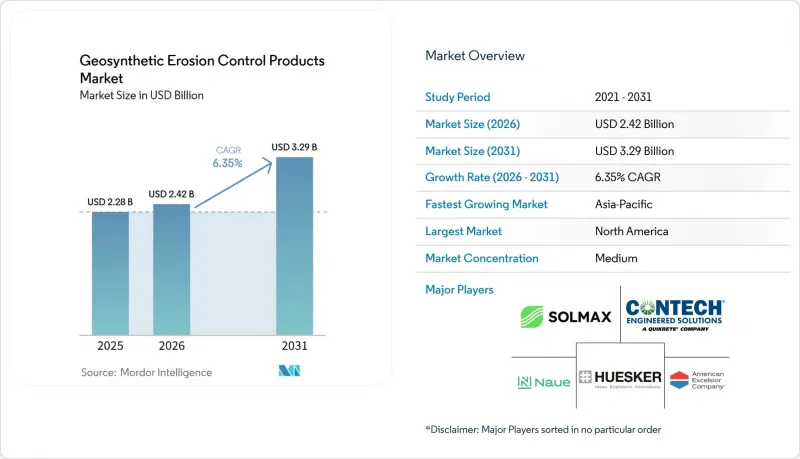
本報告按產品類型(侵蝕控制毯、地工格室等)、材料(聚丙烯、聚乙烯等)、產品形式(捲材等)、應用領域(道路和高速公路建設等)以及地區(亞太地區、北美地區、歐洲地區、南美地區、中東和非洲地區)進行細分。市場預測以美元計價。
全球地工合成侵蝕控制產品市場趨勢及洞察
施工許可證中強制執行侵蝕防治措施
地工合成侵蝕控制產品市場正受到相關法規的推動,這些法規將侵蝕和泥沙控制列為專案必要項而非可選項。美國環保署 (EPA) 的一般施工許可證要求施工方在符合條件的場地(包括擾動超過一英畝土地的項目)設計、安裝和維護有效的侵蝕和泥沙控制措施。該許可證於 2025 年 4 月進行了修訂,將其適用範圍擴大到聯邦管轄的土地,並計劃於 2027 年 2 月 16 日到期。此框架支撐了用於平整土地、水道保護和地基加固工程的地工合成材料毯、地工合成材料墊及相關系統的需求。州級許可證的要求通常包括聯邦要求之外的額外文件和產品性能記錄。此外,聯邦公路管理局 (FHWA) 和地工合成材料協會 (GMA) 正在透過行動應用程式提供現場施工指導,這凸顯了對施工品質文件記錄日益成長的重視。
擴建公路、堤防和水力發電基礎設施
地工合成侵蝕控制產品的市場與民用基礎設施項目的規模和時間密切相關。美國聯邦公路管理局2026會計年度的預算達726億美元,其中申請撥款641億美元,預付撥款85億美元。此外,《基礎設施投資與就業法案》在2026會計年度之前的五年內,為聯邦補貼的道路項目提供總計3,500億美元的資金支持。在道路平整工程中,邊坡、中央分隔帶、排水溝和路堤等區域的土壤會裸露,因此承包商在整個施工過程中都會使用侵蝕控制材料。在道路維修和拓寬工程中,空間有限的路段可能需要進行邊坡平整,在這種情況下,印度中央道路研究所的產品是首選。此外,在易滑坡地區的道路工程中擴大使用地工合成,使得承包商即使在有限的工作空間內也能快速安裝。印度中央道路研究所的研究也指出,在易發生山崩且對生態系統敏感的山區道路工程中,地工合成的使用日益增加。
合成聚合物和天然纖維原料的價格波動
地工合成侵蝕控制產品的市場持續受到聚丙烯、聚乙烯、椰殼纖維、黃麻和麻等原料價格波動的影響。聚丙烯和聚乙烯屬於石油化學產品,其價格會隨原油、石腦油和丙烯的市場狀況而波動。 2025年6月以色列-伊朗衝突期間,聚合物原料價格上漲,但供需關係在2025年7月趨於穩定,聚丙烯市場也隨之平靜下來。小規模製造商可能會在專案競標中加入價格調整條款,這會將大部分價格風險轉移給買方,並影響公共採購流程。天然纖維材料的價格也仍然容易受到南亞和東南亞季風模式以及小規模農戶收割週期的影響。這些成本波動會降低缺乏一體化原料供應鏈和避險能力的中型供應商的定價柔軟性。
細分市場分析
到2025年,防侵蝕毯將佔地工合成防侵蝕產品市場佔有率的26.46%,成為最大的產品類型。這一地位反映了其能夠適應不同坡度、氣候和植被恢復期的邊坡。承包商無需專業人員即可在緩坡上快速鋪設防侵蝕毯,使其適用於需要同時滿足法規要求和植被恢復的公路和商業用地開發項目。地工織物滿足過濾和分離需求,而水力防侵蝕產品則適用於難以鋪設捲材產品的場地。地工格室則用於陡坡路堤和礦山復墾場地,這些場地需要對路堤材料進行3D約束。
這些分類使供應商能夠提供從臨時表面防護到更持久的結構加固等一系列產品。組合使用這些產品,企劃團隊可以根據降雨量、坡度、土壤條件、場地交通、預期植被和所需防護時長等因素選擇產品,而不是將所有裸露地面視為單一的工程條件。在典型的場地中,侵蝕控制毯可以快速覆蓋,直到植被生長。在更複雜的場地中,類似的規範制定流程會促使人們採用更適合場地暴露情況和結構要求的地工格室、地工織物或液壓施工產品。
預計到2031年,草皮加固墊市場將以7.25%的複合年成長率成長,在所有產品類型中成長最高。其應用範圍正在不斷擴大,涵蓋防洪、河道襯砌和海岸護岸工程等領域,這些領域都需要在高水力應力下加強植被。在適當的項目中,這些系統可以替代或補充剛性防護方法。 2026年2月,美國Excelsior公司推出了「Recyclex TRM」系列產品,該系列產品採用100%再生纖維,纖維比重超過1,可防止在水力作用下漂浮。此產品實例展示了製造商如何在新規格中將再生材料的使用與水力性能相結合。
2025年,聚丙烯持續保持領先地位,佔據地工合成侵蝕控制產品市場39.27%的佔有率。其優異的抗紫外線性能、化學穩定性、機械強度以及具有成本競爭力的生產過程支撐了其市場地位。這些特性使得聚丙烯適用於廣泛應用於基礎設施走廊和公路工程的捲材產品。聚酯在高強度地工地工格網背襯草皮加筋墊中仍扮演重要角色。聚乙烯則用於地工格室牆體結構和其他需要其獨特材料性能的應用領域。然而,在侵蝕控制領域,這些材料的應用範圍均不及聚丙烯廣泛。
成熟的聚丙烯供應鏈也確保了產品在不同施工區域的供應。當承包商需要在多個工地採用一致的規格時,這種供應至關重要,因為熟悉的材料可以透過現有的生產和分銷管道進行採購、安裝、檢驗和更換,而無需改變專案的基本工作流程。其技術特性使其能夠在各種氣候條件和施工環境中使用。雖然這種既定的地位並不意味著不需要其他聚合物,但這解釋了為什麼聚丙烯仍然是許多標準防侵蝕設計中的標準材料,尤其是在項目需要熟悉的性能特徵、成熟的生產方法、便捷的分銷網路以及在常見施工和加固應用中久經考驗的良好記錄時。
預計到2031年,天然纖維將以7.03%的複合年成長率成長,成為市佔率最高的材料類別。在地工合成侵蝕控制產品市場,對天然纖維的需求主要集中在交通基礎設施項目(這些項目正在逐步從合成網過渡到天然纖維)以及需要可生物分解材料的修復場地。天然纖維基質與本地物種種子結合使用,可在單一施工過程中促進土壤穩定和植被生長。 2025年9月,Naue GmbH & Co. KG公司推出了「Secumat Green 3D Mesh」產品,該產品採用生物基和可再生材料,例如生質塑膠長絲、椰子纖維和黃麻。該產品旨在為植被提供長達10年的支撐,之後即可生物分解。
區域分析
2025年,北美佔全球銷售額的35.21%,並持續維持其最大區域市場的地位。聯邦和州政府雨水管理法規的實施促進了該產品在建築工地的應用。同時,《基礎建設投資與就業法案》(IIJA)在2025會計年度向聯邦公路撥款620億美元,使聯邦公路管理局(FHWA)2026會計年度的預算達到726億美元。如此規模的道路投資增加了市場對整體公路工程邊坡和路堤的地工合成材料侵蝕控制產品的需求。美國土木工程師學會(ASCE)逐步淘汰塑膠侵蝕控制材料的框架為交通運輸機構更新採購要求提供了指南。在加拿大,管道相關需求有所貢獻;在墨西哥,採礦回收活動的需求也增加了市場需求。這些應用將區域需求基礎擴展到美國公路建設之外。
預計到2031年,亞太地區將以7.17%的複合年成長率成長,成為成長最快的區域市場。在中國,JTG/T 3332-2026標準於2026年7月1日生效,取代了2012年版《公路用地工合成材料材料標準》。修訂後的標準涵蓋公路建設中的路基加固、排水、邊坡防護和品質檢驗,凸顯了產品性能和品質記錄在公共道路建設中日益重要的地位。在日本,2026年4月,政府將地工合成水泥基複合墊技術列為新技術資訊系統(NETIS)的建議技術。同時,在印度,滑坡易發地區的道路建設為侵蝕控制和邊坡穩定材料創造了新的應用場景。因此,道路、水利和海岸工程建設的需求正在推動全部區域地工合成侵蝕控制產品市場的發展。
在歐洲,由於環境法規和綠色建築要求對基礎設施規範產生影響,市場需求保持穩定。永續性是該地區材料選擇的關鍵因素,可生物分解和可回收產品備受青睞。這一趨勢正推動地工合成侵蝕控制產品市場轉型為天然纖維。在南美洲,道路擴建、礦場修復以及地形多樣地區的農業基礎建設推動了市場需求。在中東和非洲,基礎建設和採礦活動帶來了新的專案機會。然而,承包商對產品的理解仍有差異。 2025年6月,Naue任命TeMa南非公司為其在南非和撒哈拉以南非洲地區的代理商。此次任命將改善先前覆蓋範圍有限的地區基本客群的本地產品可得性和技術支持,幫助企劃團隊使用需要本地設計和安裝指導的系統。
其他好處:
- Excel格式的市場預測(ME)表
- 3個月的分析師支持
目錄
第1章:引言
- 研究假設和市場定義
- 調查範圍
第2章:調查方法
第3章執行摘要
第4章 市場狀況
- 市場概覽
- 市場促進因素
- 建築許可證中強制性侵蝕防治措施
- 擴建公路、堤防和水力發電基礎設施
- 用於保護免受氣候變遷引發的洪水、斜坡和沿海地區災害的支出
- 對可生物分解和可回收利用的侵蝕控制產品的需求日益成長
- 省力型軋延產品安裝系統
- 數位化監測和基於結果的專案規範
- 市場限制因素
- 合成聚合物和天然纖維原料價格的波動
- 安裝過程中造成的損壞和性能波動。
- 承包商缺乏相關知識以及規範前後不一致。
- 碎石護坡、混凝土、水力噴播以及與傳統土木工程的競爭。
- 價值鏈分析
- 波特五力分析
第5章 市場規模與成長預測
- 依產品類型
- 防侵蝕毯
- 草坪加固墊
- 地工格室
- 地工織物
- 水力侵蝕控制產品
- 其他產品
- 材料
- 聚丙烯
- 聚乙烯
- 聚酯纖維
- 天然纖維
- 其他材料
- 按產品形式
- 軋延產品
- 模組化產品
- 散裝和液壓注射型產品
- 其他產品類型
- 透過使用
- 道路和高速公路建設
- 邊坡穩定
- 海岸線和海岸線的保護
- 採礦和掩埋
- 農業和園林綠化
- 雨水管理
- 其他用途
- 按地區
- 亞太地區
- 中國
- 印度
- 日本
- 韓國
- 東南亞國協
- 其他亞太國家
- 北美洲
- 美國
- 加拿大
- 墨西哥
- 歐洲
- 德國
- 英國
- 法國
- 義大利
- 北歐國家
- 俄羅斯
- 其他歐洲國家
- 南美洲
- 巴西
- 阿根廷
- 其他南美國家
- 中東和非洲
- 沙烏地阿拉伯
- 南非
- 其他中東和非洲國家
- 亞太地區
第6章 競爭情勢
- 市場集中度
- 策略趨勢
- 市佔率和排名分析
- 公司簡介
- ABG Limited
- ACF West, Inc.
- American Excelsior Company
- BonTerra Limited
- BontexGeo Group
- Carthage Mills
- Contech Engineered Solutions LLC
- Fibertex Nonwovens A/S
- HUESKER International
- Naue GmbH & Co. KG
- Nedia Enterprises, Inc.
- Officine Maccaferri Spa
- Officine Maccaferri Spa
- Solmax
- Strata Geosystems
- Tensar, A Division of CMC
- Thrace Group
- Western Excelsior Corporation
第7章 市場機會與未來展望
According to Mordor Intelligence, the geosynthetic erosion control products market size was valued at USD 2.28 billion in 2025 and is estimated to grow from USD 2.42 billion in 2026 to reach USD 3.29 billion by 2031, at a CAGR of 6.35% during the forecast period (2026-2031).
This report is Segmented by Product Type (Erosion Control Blankets, Geocells, and More), Material (Polypropylene, Polyethylene, and More), Product Form (Rolled Products and More), Application (Road and Highway Construction and More), and Geography (Asia-Pacific, North America, Europe, South America, and Middle-East and Africa). The Market Forecasts are Provided in Terms of Value (USD).
Global Geosynthetic Erosion Control Products Market Trends and Insights
Mandatory Erosion-Control Measures in Construction Permitting
The geosynthetic erosion control products market receives demand support from regulations that make erosion and sediment management a project requirement rather than an optional purchase. The EPA Construction General Permit requires operators to design, install, and maintain effective erosion and sediment controls on covered sites, including projects that disturb 1 acre or more. The permit was modified in April 2025 to extend coverage to Lands of Exclusive Federal Jurisdiction, and it is scheduled to expire on February 16, 2027. This framework supports demand for blankets, mats, and related systems used in grading, channel protection, and stabilization activities. State permit conditions require additional documentation and product performance records beyond federal requirements. The Federal Highway Administration and the Geosynthetic Materials Association have also made field-installation guidance available through a mobile application, increasing the focus on documented installation quality.
Highway, Embankment, and Hydraulic Infrastructure Expansion
The geosynthetic erosion control products market is closely tied to the scale and timing of civil infrastructure work. The Federal Highway Administration budget for fiscal year 2026 reached USD 72.6 billion, including a USD 64.1 billion request and USD 8.5 billion in advance appropriations. The Infrastructure Investment and Jobs Act also supports a 5-year federal-aid highway program totaling USD 350 billion through fiscal year 2026. Highway grading exposes soil across slopes, medians, drainage channels, and embankments, so contractors use erosion-control materials throughout construction sequencing. Rehabilitation and widening work may require slope grading in constrained corridors, which favors products from the Central Road Research Institute in India. Also, the growing use of geosynthetics on road projects in landslide-prone areas allows contractors to install quickly in a limited workspace. Research from India's Central Road Research Institute also noted the growing use of geosynthetics on road projects in landslide-prone, ecologically sensitive hilly terrain.
Synthetic Polymer and Natural-Fiber Raw-Material Price Volatility
The geosynthetic erosion control products market remains exposed to price fluctuations in polypropylene, polyethylene, coir, jute, and hemp. Polypropylene and polyethylene are petrochemical materials, and their prices can move with crude oil, naphtha, and propylene market conditions. Polymer feedstock prices rose during the June 2025 Israeli-Iranian conflict before demand and supply conditions stabilized the polypropylene market in July 2025. Smaller fabricators may include escalation clauses in project bids, shifting more price risk to buyers and affecting public procurement processes. Natural-fiber materials also remain sensitive to monsoon patterns and smallholder harvest cycles in South and Southeast Asia. These cost movements can reduce pricing flexibility for mid-tier suppliers that lack integrated raw-material supply or hedging capacity.
Other drivers and restraints analyzed in the detailed report include:
- Climate-Driven Flood, Slope, and Coastal Protection Spending
- Preference for Biodegradable, Recycled, and Efficient Installation Systems
- Installation Damage, Uneven Familiarity, and Competing Methods
For complete list of drivers and restraints, kindly check the Table Of Contents.
Segment Analysis
Erosion control blankets accounted for 26.46% of the geosynthetic erosion control products market share in 2025, making them the largest product category. Their position reflects their ability to serve slopes with varied gradients, climates, and vegetation-establishment periods. Contractors can deploy blankets quickly on moderate slopes without specialized labor, making them suitable for highway and commercial grading projects where compliance and vegetation establishment must progress together. Geotextiles address filtration and separation requirements, while hydraulically applied erosion-control products support sites where rolled installation is difficult. Geocells are used on steeper embankments and mining reclamation sites that require three-dimensional confinement of infill material.
These categories give suppliers a product range that addresses temporary surface protection and more permanent structural stabilization. Their combined use shows how project teams match products to rainfall, grade, soil condition, site access, expected vegetation, and required protection duration, rather than treating all exposed ground as a single engineering condition. On routine sites, erosion control blankets provide rapid coverage while plant cover develops. In more complex locations, the same specification process can direct projects toward geocells, geotextiles, or hydraulically applied products that better match exposure and structural requirements.
Turf reinforcement mats are projected to advance at a 7.25% CAGR through 2031, the highest rate within the product type classification. Their use is expanding in flood defense, channel lining, and coastal revetment work that requires vegetated reinforcement under higher hydraulic stress. These systems can replace or complement hard-armor approaches in suitable projects. American Excelsior introduced the Recyclex TRM family in February 2026 with 100% recycled fibers and fiber-specific gravity above 1 to prevent flotation during hydraulic events. This product example shows how manufacturers are combining recycled-content claims with hydraulic performance in new specifications.
Polypropylene captured 39.27% of the geosynthetic erosion control products market share in 2025 and remained the leading material. UV resistance, chemical stability, mechanical strength, and cost-competitive manufacturing support its position. These features make polypropylene suitable for rolled products used across infrastructure corridors and highway programs. Polyester remains relevant in high-tensile, geogrid-backed turf reinforcement mats. Polyethylene is used in geocell wall structures and other applications that require its specific material properties. However, neither material has matched polypropylene's breadth of use in erosion control.
The established polypropylene supply chain also supports product availability across diverse construction regions. This availability matters when contractors need repeatable specifications across multiple sites, as a familiar material can be procured, installed, inspected, and replaced through existing manufacturing and distribution channels without changing the basic project workflow. Its technical characteristics support use across a wide range of climatic conditions and construction settings. This established position does not eliminate the need for other polymers, but it explains why polypropylene remains the reference material for many standard erosion-control designs, particularly when projects require familiar performance characteristics, established fabrication methods, readily available distribution, and a record of use across common construction and stabilization applications.
Natural fibers are forecast to grow at a 7.03% CAGR through 2031, leading the material classification. Within the geosynthetic erosion control products market, demand for natural fibers is concentrated in transportation projects that are moving away from synthetic netting and in restoration sites that require biodegradable materials. Natural-fiber matrices can be combined with native seeds to support soil stabilization and vegetation establishment in a single installation sequence. Naue GmbH & Co. KG introduced Secumat Green 3D Mesh in September 2025 using bio-based and renewable materials, including bioplastic filaments, coconut, and jute. The product is designed to support vegetation for up to 10 years before biodegradation.
Complete Report Scope:
- By Product Type
- Erosion Control Blankets
- Turf Reinforcement Mats
- Geocells
- Geotextiles
- Hydraulically Applied Erosion Control Products
- Other Products
- By Material
- Polypropylene
- Polyethylene
- Polyester
- Natural Fibers
- Other Materials
- By Product Form
- Rolled Products
- Modular Products
- Loose-Fill and Hydraulically Applied Products
- Other Product Types
- By Application
- Road and Highway Construction
- Slope Stabilization
- Coastal and Shoreline Protection
- Mining and Landfills
- Agriculture and Landscaping
- Stormwater Management
- Other Applications
- By Geography
- Asia-Pacific
- China
- India
- Japan
- South Korea
- ASEAN Countries
- Rest of Asia-Pacific
- North America
- United States
- Canada
- Mexico
- Europe
- Germany
- United Kingdom
- France
- Italy
- NORDIC Countries
- Russia
- Rest of Europe
- South America
- Brazil
- Argentina
- Rest of South America
- Middle-East and Africa
- Saudi Arabia
- South Africa
- Rest of Middle-East and Africa
- Asia-Pacific
Geography Analysis
North America accounted for 35.21% of global revenue in 2025, maintaining its position as the largest regional market. Federal and state stormwater enforcement supported adoption across active construction sites, while the Infrastructure Investment and Jobs Act (IIJA) deployed USD 62 billion in federal highway funding during fiscal year 2025, and the fiscal year 2026 Federal Highway Administration (FHWA) budget reached USD 72.6 billion. This level of road investment increased the market's exposure to geosynthetic erosion control products for slope and embankment applications across highway projects. The American Society of Civil Engineers (ASCE) framework for eliminating plastic-based erosion-control materials provided transportation agencies with a basis for updating procurement requirements. Canada contributed pipeline-related demand, while Mexico added demand from mining reclamation activities. These applications broadened the regional demand base beyond U.S. highway construction.
Asia-Pacific is forecast to expand at a CAGR of 7.17% through 2031, making it the fastest-growing regional market. China implemented JTG/T 3332-2026 on July 1, 2026, replacing the 2012 highway geosynthetics specification. The revised standard covers subbase reinforcement, drainage, slope protection, and quality acceptance in highway construction, increasing the importance of product performance and documented quality for public road work. Japan received a government designation for geosynthetic cementitious composite mat technology as a New Technology Information System (NETIS) Recommended Technology in April 2026, while India's roadwork in landslide-prone terrain created additional use cases for erosion-control and slope-stabilization materials. Therefore, road, hydraulic, and coastal construction needs support the geosynthetic erosion control products market across the region.
Europe continues to record stable demand, as environmental compliance and green construction requirements influence infrastructure specifications. The region favors biodegradable and recycled-content products, guided by sustainability criteria in material selection. This trend supports the natural-fiber direction within the geosynthetic erosion control products market. In South America, demand is linked to road expansion, mining reclamation, and agricultural infrastructure in areas with variable terrain. The Middle-East and Africa offer new project opportunities through infrastructure and mining activity, although contractor familiarity remains uneven. Naue appointed TeMa South Africa as its representative for South Africa and sub-Saharan Africa in June 2025. This appointment improved local product access and technical support for a regional customer base with limited coverage, helping project teams use systems that require local design and installation guidance.
- ABG Limited
- ACF West, Inc.
- American Excelsior Company
- BonTerra Limited
- BontexGeo Group
- Carthage Mills
- Contech Engineered Solutions LLC
- Fibertex Nonwovens A/S
- HUESKER International
- Naue GmbH & Co. KG
- Nedia Enterprises, Inc.
- Officine Maccaferri Spa
- Officine Maccaferri Spa
- Solmax
- Strata Geosystems
- Tensar, A Division of CMC
- Thrace Group
- Western Excelsior Corporation
Additional Benefits:
- The market estimate (ME) sheet in Excel format
- 3 months of analyst support
TABLE OF CONTENTS
1 Introduction
- 1.1 Study Assumptions and Market Definition
- 1.2 Scope of the Study
2 Research Methodology
3 Executive Summary
4 Market Landscape
- 4.1 Market Overview
- 4.2 Market Drivers
- 4.2.1 Mandatory Erosion-Control Measures in Construction Permitting
- 4.2.2 Highway, Embankment, and Hydraulic Infrastructure Expansion
- 4.2.3 Climate-Driven Flood, Slope, and Coastal Protection Spending
- 4.2.4 Preference for Biodegradable and Recycled Erosion-Control Products
- 4.2.5 Labor-Saving Rolled Product Installation Systems
- 4.2.6 Digital Monitoring and Performance-Based Project Specifications
- 4.3 Market Restraints
- 4.3.1 Synthetic Polymer and Natural-Fiber Raw-Material Price Volatility
- 4.3.2 Installation Damage and Performance Variability
- 4.3.3 Limited Contractor Familiarity and Specification Inconsistency
- 4.3.4 Competition from Riprap, Concrete, Hydroseeding, and Conventional Civil Works
- 4.4 Value Chain Analysis
- 4.5 Porter's Five Forces Analysis
- 4.5.1 Threat of New Entrants
- 4.5.2 Bargaining Power of Suppliers
- 4.5.3 Bargaining Power of Buyers
- 4.5.4 Threat of Substitutes
- 4.5.5 Competitive Rivalry
5 Market Size and Growth Forecasts (Value)
- 5.1 By Product Type
- 5.1.1 Erosion Control Blankets
- 5.1.2 Turf Reinforcement Mats
- 5.1.3 Geocells
- 5.1.4 Geotextiles
- 5.1.5 Hydraulically Applied Erosion Control Products
- 5.1.6 Other Products
- 5.2 By Material
- 5.2.1 Polypropylene
- 5.2.2 Polyethylene
- 5.2.3 Polyester
- 5.2.4 Natural Fibers
- 5.2.5 Other Materials
- 5.3 By Product Form
- 5.3.1 Rolled Products
- 5.3.2 Modular Products
- 5.3.3 Loose-Fill and Hydraulically Applied Products
- 5.3.4 Other Product Types
- 5.4 By Application
- 5.4.1 Road and Highway Construction
- 5.4.2 Slope Stabilization
- 5.4.3 Coastal and Shoreline Protection
- 5.4.4 Mining and Landfills
- 5.4.5 Agriculture and Landscaping
- 5.4.6 Stormwater Management
- 5.4.7 Other Applications
- 5.5 By Geography
- 5.5.1 Asia-Pacific
- 5.5.1.1 China
- 5.5.1.2 India
- 5.5.1.3 Japan
- 5.5.1.4 South Korea
- 5.5.1.5 ASEAN Countries
- 5.5.1.6 Rest of Asia-Pacific
- 5.5.2 North America
- 5.5.2.1 United States
- 5.5.2.2 Canada
- 5.5.2.3 Mexico
- 5.5.3 Europe
- 5.5.3.1 Germany
- 5.5.3.2 United Kingdom
- 5.5.3.3 France
- 5.5.3.4 Italy
- 5.5.3.5 NORDIC Countries
- 5.5.3.6 Russia
- 5.5.3.7 Rest of Europe
- 5.5.4 South America
- 5.5.4.1 Brazil
- 5.5.4.2 Argentina
- 5.5.4.3 Rest of South America
- 5.5.5 Middle-East and Africa
- 5.5.5.1 Saudi Arabia
- 5.5.5.2 South Africa
- 5.5.5.3 Rest of Middle-East and Africa
- 5.5.1 Asia-Pacific
6 Competitive Landscape
- 6.1 Market Concentration
- 6.2 Strategic Moves
- 6.3 Market Share (%)/Ranking Analysis
- 6.4 Company Profiles (includes Global Level Overview, Market Level Overview, Core Segments, Financials as available, Strategic Information, Products and Services, Recent Developments)
- 6.4.1 ABG Limited
- 6.4.2 ACF West, Inc.
- 6.4.3 American Excelsior Company
- 6.4.4 BonTerra Limited
- 6.4.5 BontexGeo Group
- 6.4.6 Carthage Mills
- 6.4.7 Contech Engineered Solutions LLC
- 6.4.8 Fibertex Nonwovens A/S
- 6.4.9 HUESKER International
- 6.4.10 Naue GmbH & Co. KG
- 6.4.11 Nedia Enterprises, Inc.
- 6.4.12 Officine Maccaferri Spa
- 6.4.13 Officine Maccaferri Spa
- 6.4.14 Solmax
- 6.4.15 Strata Geosystems
- 6.4.16 Tensar, A Division of CMC
- 6.4.17 Thrace Group
- 6.4.18 Western Excelsior Corporation
7 Market Opportunities and Future Outlook
- 7.1 White-Space and Unmet-Need Assessment

 地工織物:市場佔有率分析、產業趨勢與統計、成長預測(2026-2031)
 水土流失和徑流防治市場規模、佔有率和成長分析:按產品類型、應用/最終用途、服務類型和地區分類-2026-2033年產業預測
 2026年全球侵蝕與泥沙控制市場報告
 地工織物市場:按材料、產品類型、功能和應用分類-2026-2032年全球市場預測
 全球地工織物市場規模、佔有率、趨勢和成長分析報告(2026-2034年)
 2035年環保侵蝕控制市場分析及預測:依類型、產品類型、服務、技術、組件、應用、材質、製程及最終用戶分類
 地工織物市場-全球產業規模、佔有率、趨勢、機會及預測(依材料類型、產品類型、應用、地區及競爭格局分類,2021-2031年)
 地工織物市場規模、佔有率和成長分析(按材料類型、技術類型、應用和地區分類)-2026-2033年產業預測PET 和聚丙烯基地工布市場-全球產業規模、佔有率、趨勢、機會及預測,按類型、技術、應用、地區及競爭情況細分,2020-2030 年預測侵蝕和泥沙控制市場-全球產業規模、佔有率、趨勢、機會和預測(按產品類型、應用、地區和競爭細分,2020-2030 年)