


 |
市場調查報告書
商品編碼
2122746
智慧路燈:市場佔有率分析、產業趨勢與統計及成長預測(2026-2031 年)Connected Street Lighting - Market Share Analysis, Industry Trends & Statistics, Growth Forecasts (2026 - 2031) |
||||||

※ 本網頁內容可能與最新版本有所差異。詳細情況請與我們聯繫。
根據 Mordor Intelligence 預測,連網路燈市場規模將從 2026 年的 25.6 億美元成長到 2031 年的 48.2 億美元,在預測期內複合年成長率將達到 13.49%。
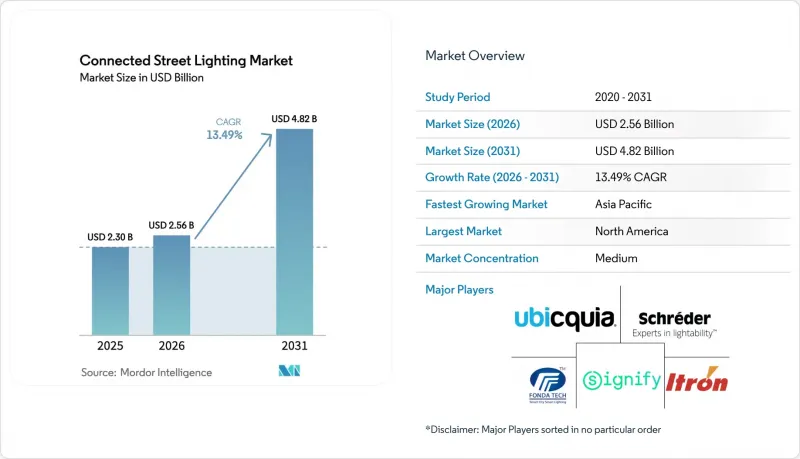
本報告按組件(硬體、軟體、服務)、連接方式(射頻網狀網路(Wi-SUN、IEEE 802.15.4g)及其他)、應用(智慧調光/基於策略的調度及其他)、最終用戶(市政當局、地方政府、電力公司/配電系統營運商及其他)和地區進行細分。市場預測以美元計價。
全球智慧路燈市場趨勢及洞察
不斷上漲的電費和強制性的節能措施進一步提高了維修的經濟可行性。
具備控制功能的連網LED路燈在大規模專案中取得了顯著成效,例如降低能耗和維運成本,從而增強了其推廣應用的商業價值。芝加哥部署的29萬盞路燈每年可節省870萬美元的電力成本,五年內獲得公用事業公司3700萬美元的補貼,到2022年9月,二氧化碳排放量總合減少了13.46萬噸。智慧照明平台中的收益管理指標功能有助於合規並簡化報告流程,無需昂貴的變電站計量設備。安大略省2025年電網規劃指南強調在專案選擇過程中採用“非輸電線路策略”,將自適應照明定位為公用事業公司和市政當局靈活的需量反應工具。採購團隊正擴大將配備控制器的照明設備與補貼資格和脫碳進度追蹤掛鉤,進一步強化了聯網照明在市政能源政策中的作用。隨著城市努力保障預算並實現氣候目標,這些趨勢正在支持智慧路燈管理系統市場的持續需求。
加速智慧城市計畫建設,並透過公私合作促進採購,將降低地方政府的財政風險。
官民合作關係(PPP)使城市能夠轉移績效風險,並將節能效益轉化為多年可預測的收益。塞爾維亞的波熱加計畫採用能源服務合約(ESCO),被認為是缺乏初始投資資金但需要現代化改造並獲得檢驗成果的小規模市政當局的實用模式。印度的「智慧城市計畫」正在大力投資主要道路照明、智慧交叉路口和連網電線桿,透過大規模競標,加速快速發展的大都市地區的數位基礎設施建設。這些模式也吸引了那些傾向於長期、類似公共產業的現金流且有已證實節能效益支持的基礎設施基金。隨著多方合約的成熟,績效保證、遠端監控和開放資料條款正逐漸標準化,從而降低了供應商的風險擔憂,並提高了貸款合格。這種結構性轉變正在推動智慧路燈管理系統市場的穩定成長,即使在資金限制可能阻礙升級改造的情況下也是如此。
高昂的初始成本、複雜的競標程序和資金籌措給小規模市政當局帶來了過重的負擔。
部署連網照明設備和控制器會增加資本密集度,使得小規模的城市難以在單一預算週期內消化這筆費用。績效保證型契約和按可用性付費的公私合營模式將節能運轉率轉移給私人公司,但檢驗和監控要求可能會延長採購週期。市政當局正在考慮採用照明即服務 (LaaS) 模式,以消除初始設備成本,並過渡到可預測的月度費用,同時實現可量化的營運和維護 (O&M) 成本降低。電力公司對非有線解決方案的支持,使得即使在原本會批准網路升級的地區,自適應照明也更具吸引力。然而,必要的文件工作和部門間的協調可能會延遲核准流程。儘管智慧路燈管理系統具有長期成本節約的潛力,但小規模市政當局面臨的競標負擔增加,是阻礙其短期應用的因素。
細分市場分析
至2025年,硬體將佔智慧路燈管理系統市場的62%,而軟體和服務將以13.65%的複合年成長率成長。這主要歸功於城市採用集中式管理系統,這些系統能夠實現遠端控制、韌體更新和碳排放計算儀錶板。諸如Interact等城市平台以及類似的SaaS服務正在改變支出模式,從初始投資轉向按終端使用付費,並透過安全的API實現與交通號誌、電動車充電樁和公共安全資訊的整合。在大規模營運中,營運商每天處理數百萬條遙測訊息,為每個燈具創建數位孿生模型,並改善整個照明系統的服務規劃和可用性指標。軟體佔有率的成長也反映了城市永續性計畫中鼓勵衡量收入等級和檢驗排放報告的措施。隨著插座標準化(如ANSI C136.41和Zhaga Book 18)的推進,硬體相容性將提高,價格競爭將加劇,軟體差異化在智慧路燈管理系統市場中的重要性將進一步提升。
儘管服務領域仍佔據相當大的佔有率,這主要得益於包含安裝、試運行和多年履約義務的承包公私合營(PPP)契約,但隨著價值重心轉向分析和自動化,其成長已落後於軟體領域。預測性維護能夠大幅降低維運成本,透過將被動的現場服務轉變為計畫性維護,整合工作並縮短維修時間。隨著智慧路燈管理系統產業利用應用程式介面(API)和標準化資料模型在市政府各部門間共用訊息,這些趨勢持續推動著軟體即服務(SaaS)和整合服務的支出成長。 2026年至2031年間,與碳排放計量和揭露相關的政策獎勵將促進軟體主導成長,有助於維持分析功能的溢價。這種格局增強了持續收入,並保護供應商免受智慧路燈管理系統市場硬體利潤率壓縮的影響。
2025年,包括Wi-SUN和IEEE 802.15.4g在內的專有射頻網狀網路將佔據55.5%的連接佔有率,但隨著城市優先考慮簡化部署和運營商級運轉率,蜂窩網路控制預計將以13.73%的複合年成長率成長。在華盛頓特區,部署75,000個燈級蜂窩控制器降低了部署複雜性,實現了即時監控,並免去了閘道器的安裝和維護。諸如LwM2M之類的標準設備管理架構提高了大型分散式終端叢集的可靠性和生命週期管理。在遠距離、低吞吐量通訊足夠且頻段管理切實可行的情況下,LoRaWAN仍然是首選,尤其是在安裝空間有限且需要低功耗終端的區域。專案業主會權衡訂閱費用和閘道器營運成本,在智慧路燈管理系統市場,當人員限制和時間表是關鍵決策因素時,蜂窩網路解決方案通常是首選。
射頻網狀網路在公共產業領域繼續發揮至關重要的作用,該領域更傾向於採用具有確定性運作和長期穩定運行記錄的專有網路。一些特殊應用情境包括:在無線性能容易下降的管道中實現電力線路通訊;以及在無需街道級覆蓋的校園環境中應用Wi-Fi和短程通訊技術。儘管不同地區仍存在多種技術混用的情況,但互通性和認證正在減少廠商鎖定,並支援透過單一內容管理系統(CMS)管理各種裝置。隨著標準的日趨成熟,越來越多的城市開始採用雙介面控制器,以確保廠商選擇和生命週期升級選項。這維持了智慧路燈管理系統市場的採購競爭。這種平衡既保證了現有射頻網路的連續性,又實現了「蜂窩優先」的橫向擴展,從而最佳化了總體擁有成本(TCO)。
區域分析
截至2025年,歐洲在部署規模方面將維持65%的領先優勢,這反映了過去十年間協調一致的維修和政策支援。這些努力已將互聯控制系統確立為公共產業的合規工具和營運基礎。這一佔有率在智慧路燈管理系統市場中佔據重要地位,買家優先考慮TALQ認證,以便在較長的資產使用壽命內管理多供應商安裝。布魯塞爾和國家高速公路上的專案表明,標準化介面如何確保控制器和燈具之間的CMS互通性,從而降低整合複雜性。隨著互聯LED專案的擴展,歐洲的部署已證實可顯著且可衡量地節省能源並減輕維護負擔。不斷發展的網路安全和資料存取法規正在影響採購趨勢,基於開放標準建構的平台更受青睞。
亞太地區是成長最快的地區,預計複合年成長率將達到14.12%,這主要得益於政府對城市發展和不斷擴張的特大城市主要道路照明的投資。印度的「智慧城市計畫」正在大力投資智慧照明,推動城市規模的採購和多用途應用。在澳洲和紐西蘭,公共產業主導的部署正在穩步推進,主要城市計劃用第二代LED燈和智慧控制系統取代現有照明設備,以進一步提高能源效率並改善營運。供應商正在利用雙插座控制器平衡蜂窩網路和低功耗廣域網路(LPWAN)覆蓋,並根據當地需求客製化產品設計,以確保供應商的選擇。這些措施和技術的結合正在推動智慧路燈管理系統在維修和新建專案中得到廣泛應用。
在北美,大規模市政和公用事業項目正利用官民合作關係(P3)模式開展大型企劃,重點關注故障檢測、減少現場維修和分析維護。芝加哥的多年期計畫除了減少二氧化碳排放外,還強調提高能源效率和提供補貼,這為其對其他城市的價值提案奠定了基礎。華盛頓特區的城市現代化改造透過採用蜂窩網路控制和擴展基於照明基礎設施的數位服務,提高了公平性和運轉率。離網太陽能發電系統也被用來防止銅線盜竊,並加速高風險路段的修復工作。在中東,路燈升級正在為大規模的智慧基礎設施項目奠定基礎,新的合約明確規定了智慧交通功能和人工智慧驅動的資產管理。杜拜的多年期全區照明計畫展示如何透過大規模部署符合標準的LED燈和控制系統來提高能源效率和可靠性。這些趨勢表明,在不同的資金籌措模式和政策環境下,智慧路燈管理系統的市場基礎正在不斷擴大。
其他好處
- Excel格式的市場預測(ME)表
- 3個月的分析師支持
目錄
第1章:引言
- 研究假設和市場定義
- 調查範圍
第2章:調查方法
第3章執行摘要
第4章 市場狀況
- 市場概覽
- 市場促進因素
- 電費上漲和強制性節能措施
- 透過公私合作模式加速智慧城市計畫和採購
- 快速過渡到蜂窩控制,實現即插即用
- 透過與 Zhaga-D4i、DALI-2 和 TALQ 的互通性,提高了廠商中立性。
- 數據驅動營運、故障定位和預測性維護。
- 5G、感測技術以及「以路燈為平台」的城市服務。
- 市場限制因素
- 高昂的初始成本、複雜的競標程序、資金籌措
- 傳統基礎設施整合以及多個供應商之間互通性的差距
- 網路安全、資料管治和主權問題
- 高密度都市區射頻(RF)標準細分與頻段限制
- 宏觀經濟因素對市場的影響
- 產業價值鏈分析
- 監理情勢
- 技術展望
- 波特五力分析
第5章 市場規模與成長預測
- 按組件
- 硬體
- 軟體
- 服務
- 連結性別
- 射頻網狀網路(Wi-SUN,IEEE 802.15.4g)
- 蜂窩網路(NB-IoT、LTE-M、4G/5G)
- LoRaWAN
- 電力線路通訊(PLC)
- Wi-Fi / IEEE 802.15.4
- 透過使用
- 智慧調光和基於策略的調度
- 自適應自主照明(感測器驅動)
- 實現交通和安全分析
- 能源分析與資產管理
- 環境和微氣候監測
- 公共 Wi-Fi 和通訊回程傳輸
- 最終用戶
- 地方政府/地方政府
- 電力公司和配電系統營運商
- 能源服務公司(ESCO)
- 官民合作關係(PPP模式)
- 私立校園和工業區
- 按部署模式
- 雲
- 現場
- 按地區
- 北美洲
- 美國
- 加拿大
- 南美洲
- 巴西
- 阿根廷
- 其他南美國家
- 歐洲
- 德國
- 法國
- 英國
- 義大利
- 西班牙
- 俄羅斯
- 其他歐洲國家
- 亞太地區
- 中國
- 日本
- 印度
- 韓國
- 澳洲
- 其他亞太國家
- 中東
- 沙烏地阿拉伯
- 阿拉伯聯合大公國
- 土耳其
- 其他中東國家
- 非洲
- 南非
- 埃及
- 肯亞
- 其他非洲地區
- 北美洲
第6章 競爭情勢
- 市場集中度
- 策略趨勢
- 市佔率分析
- 公司簡介
- Signify NV
- Itron, Inc.
- Fonda Technology Co., Ltd.
- Flashnet SA(Lucy Group)
- Ubicquia, Inc.
- Schrader SA
- Dimonoff Inc.
- LED Roadway Lighting Ltd.
- Rongwen Energy Technology Group Co., Ltd.
- ST Engineering Telematics Wireless Ltd.
- Lucy Zodion Ltd.
- Trilliant Networks, Inc.
- CIMCON Lighting, Inc.
- Sensus USA Inc.(Xylem)
- LACROIX Group SE(Citylone)
- Umpi Srl
- Current Lighting Solutions, LLC
- Telensa Ltd.
- Tvilight BV
- Quantela Inc.
第7章 市場機會與未來展望
According to Mordor Intelligence, the connected street lighting market size is projected to reach USD 4.82 billion by 2031, reflecting a 13.49% CAGR over the forecast period, from USD 2.56 billion in 2026.
This report is Segmented by Component (Hardware, Software, Services), Connectivity (RF Mesh - Wi-SUN and IEEE 802. 15. 4g, and More), Application (Smart Dimming and Policy-Based Scheduling, and More ), End User (Municipalities and Local Governments, Electric Utilities and Distribution System Operators, and More), and Geography. The Market Forecasts are Provided in Terms of Value (USD).
Global Connected Street Lighting Market Trends and Insights
Rising Electricity Prices and Energy Efficiency Mandates Compound Retrofit Economics
Networked LED streetlights with controls have delivered measurable energy and O&M cuts in large programs, which strengthens the business case for scale. Chicago's 290,000 fixture rollout reduced annual electricity expenses by USD 8.7 million and generated USD 37 million in utility rebates over five years, while carbon reductions totaled 134,600 metric tons by September 2022. Revenue-grade metering in smart lighting platforms supports compliance and streamlined reporting, eliminating the need for costly substation instrumentation. Ontario's 2025 grid-planning guidance emphasizes non-wires strategies during project screening, positioning adaptive lighting as a flexible demand-response tool for utilities and municipalities. Procurement teams increasingly link controller-capable luminaires to rebate eligibility and decarbonization tracking, reinforcing the role of connected lighting in municipal energy policy. These dynamics underpin durable demand in the smart street lighting management systems market as cities aim to protect budgets and meet climate targets.
Acceleration of Smart City Programs and PPP Procurement De-Risks Municipal Balance Sheets
Public-private partnerships enable cities to shift performance risk and transform energy savings into predictable payments over multi-year terms. Serbia's Pozega project under an energy service structure is cited as a practical template for smaller municipalities that lack upfront capital but need modernization and verifiable outcomes. India's Smart Cities Mission directs sizable funding to corridor illumination, intelligent intersections, and connected poles, which sustains high-volume tenders and accelerates digital infrastructure in fast-growing urban clusters. These models also attract infrastructure funds that prefer long-duration, utility-like cash flows anchored in verified energy reductions. As multi-party agreements mature, performance guarantees, remote monitoring, and open-data clauses become standard, which reduces perceived vendor risk and advances bankability. This structural shift supports steady growth in the smart street lighting management systems market where fiscal constraints would otherwise stall upgrades.
High Upfront Costs, Complex Tendering and Financing Disproportionately Burden Smaller Municipalities
Network-ready luminaires and controller rollouts add capital intensity that is difficult for small cities to absorb within one budget cycle. Performance-based contracts and availability-payment PPPs move energy-savings risk to private operators, but they can extend procurement timelines due to verification and monitoring requirements. Municipalities evaluate Lighting-as-a-Service to eliminate upfront equipment costs and shift to predictable monthly fees backed by quantifiable O&M savings. Utility alignment around non-wires solutions makes adaptive lighting more attractive where network upgrades would otherwise be approved, although documentation needs and cross-department coordination can slow approvals. Even with long-term savings, smaller towns face elevated tendering overhead, which tempers near-term adoption in the smart street lighting management systems market.
Other drivers and restraints analyzed in the detailed report include:
- Rapid Shift to Cellular Controls for Plug-and-Play Deployments Sidesteps Mesh Gateway Overhead
- Interoperability via Zhaga-D4i, DALI-2, and TALQ Improving Vendor Neutrality Unlocks Multi-Decade Asset Life
- Cybersecurity, Data Governance, and Sovereignty Concerns Elevate Compliance Overhead and Slow Vendor Selection
For complete list of drivers and restraints, kindly check the Table Of Contents.
Segment Analysis
Hardware captured 62% of the smart street lighting management systems market in 2025, while software and services are growing at 13.65% CAGR as cities adopt central management systems that enable remote control, firmware updates, and carbon-accounting dashboards. City platforms such as Interact and similar SaaS offerings have shifted spending from upfront capital to per-endpoint fees, allowing integration with traffic signals, EV chargers, and public safety feeds through secure APIs. At scale, operators manage millions of telemetry messages per day, which supports digital-twin models of each luminaire and improves service planning and availability metrics across fleets. Software's share expansion also reflects policy that favors revenue-grade metering and verifiable emissions reporting in city sustainability plans. As sockets standardize via ANSI C136.41 and Zhaga Book 18, hardware becomes more interchangeable, which pressures pricing and elevates the role of software differentiation in the smart street lighting management systems market.
Services remain substantial as turnkey PPP contracts bundle installation, commissioning, and multi-year performance obligations, though growth trails software as more value shifts to analytics and automation. Predictive maintenance drives measurable O&M savings, converting reactive truck rolls into scheduled interventions that consolidate tasks and reduce time to repair. These trends continue to draw spend toward SaaS and integration services as the smart street lighting management systems industry uses APIs and standardized data models to share insights across city departments. Over 2026 to 2031, software-led gains are reinforced by policy incentives tied to metering and carbon disclosure, which helps sustain premium pricing for analytics features. This mix strengthens recurring revenue and cushions vendors against hardware margin compression in the smart street lighting management systems market.
Proprietary RF mesh, including Wi-SUN and IEEE 802.15.4g, held a 55.5% connectivity share in 2025, while cellular controls are forecast to grow at a 13.73% CAGR as cities value simpler rollouts and carrier-grade uptime. In Washington, D.C., 75,000 lamp-level cellular controllers reduced deployment complexity while enabling real-time monitoring, eliminating gateway installation and maintenance. Standard device-management frameworks like LwM2M improve reliability and lifecycle control for large distributed endpoint fleets. LoRaWAN remains favored where long-range, low-throughput links are sufficient, and spectrum management is practical, particularly in site-constrained corridors that need battery-friendly endpoints. Project owners weigh subscription fees against gateway overhead, with many choosing cellular when workforce constraints and timelines dominate decision criteria in the smart street lighting management systems market.
RF mesh retains a role in utilities that prefer privately managed networks with deterministic behavior and long operational experience. Niche use cases include power-line communication in conduits where wireless performance is impaired, and Wi-Fi or short-range variants for campus settings that do not require street-scale range. The mix of technologies persists across regions, but interoperability and certification reduce lock-in and allow mixed fleets to be managed via a single CMS. As standards mature, more cities adopt dual-socket controllers to preserve choice in vendor selection and lifecycle upgrades, which keeps procurement competitive in the smart street lighting management systems market. This balance ensures continuity for existing RF networks while enabling cellular-first scale-outs that deliver the best total cost of ownership.
Complete Report Scope:
- By Component
- Hardware
- Software
- Services
- By Connectivity
- RF Mesh (Wi-SUN, IEEE 802.15.4g)
- Cellular (NB-IoT, LTE-M, 4G/5G)
- LoRaWAN
- Power-Line Communication (PLC)
- Wi-Fi and IEEE 802.15.4
- By Application
- Smart Dimming and Policy-Based Scheduling
- Adaptive and Autonomous Lighting (Sensor-Driven)
- Traffic and Safety Analytics Enablement
- Energy Analytics and Asset Management
- Environmental and Microclimate Monitoring
- Public Wi-Fi and Communications Backhaul
- By End User
- Municipalities and Local Governments
- Electric Utilities and Distribution System Operators
- Energy Service Companies (ESCOs)
- Public-Private Concessionaires (PPP Models)
- Private Campuses and Industrial Parks
- By Deployment Model
- Cloud
- On-Premises
- Geography
- North America
- United States
- Canada
- South America
- Brazil
- Argentina
- Rest of South America
- Europe
- Germany
- France
- United Kingdom
- Italy
- Spain
- Russia
- Rest of Europe
- Asia-Pacific
- China
- Japan
- India
- South Korea
- Australia
- Rest of Asia-Pacific
- Middle East
- Saudi Arabia
- United Arab Emirates
- Turkey
- Rest of Middle East
- Africa
- South Africa
- Egypt
- Kenya
- Rest of Africa
- North America
Geography Analysis
Europe held a 65% installed-base lead in 2025, reflecting a decade of coordinated retrofits and policy support that elevated connected controls as a compliance tool and operational backbone for utilities. This share underscores a significant portion of the smart street lighting management systems market, with buyers prioritizing TALQ certification to manage multi-vendor fleets over long asset lives. Projects in Brussels and on national highways demonstrate how standardized interfaces ensure CMS interoperability across controllers and luminaires, reducing integration complexity. Field results from European deployments show large and measurable energy savings and maintenance reductions as connected LED programs scale. Compliance with evolving cybersecurity and data access rules is shaping procurement, which favors platforms built on open standards.
Asia-Pacific is the fastest-growing region at a projected 14.12% CAGR as governments align investment for urban upgrades and corridor illumination across expanding megacities. India's Smart Cities Mission channels significant funding to connected lighting, which stimulates city-scale procurement and multi-application use cases. Australia and New Zealand continue utility-led rollouts, with major cities planning second-generation LED replacements combined with smart controls to deepen savings and improve operations. Vendors adapt product designs to local requirements by balancing cellular and LPWAN coverage with dual-socket controllers to preserve vendor choice. This policy and technology mix strengthens adoption in the smart street lighting management systems market across both retrofit and greenfield deployments.
In North America, large municipal and utility programs focus on fault detection, truck-roll reduction, and analytics-driven maintenance while tapping P3 structures for megaprojects. Chicago's multi-year program highlights energy and rebate outcomes alongside CO2 reductions, which reinforces the value proposition for other cities. Washington, D.C.'s citywide modernization uses cellular controls and expands digital services on top of the lighting backbone to improve equity and uptime. Off-grid solar systems are also part of the toolkit to deter copper theft and speed restoration in high-risk corridors. In the Middle East, street lighting upgrades anchor larger smart infrastructure programs, with new contracts specifying intelligent transportation features and AI-enabled asset management. Dubai's multi-year district lighting plan demonstrates how standards-based LED and controls are applied at scale to deliver energy and reliability gains. These patterns together indicate a broadening base for the smart street lighting management systems market across varied funding models and policy environments.
- Signify N.V.
- Itron, Inc.
- Fonda Technology Co., Ltd.
- Flashnet S.A. (Lucy Group)
- Ubicquia, Inc.
- Schrader S.A.
- Dimonoff Inc.
- LED Roadway Lighting Ltd.
- Rongwen Energy Technology Group Co., Ltd.
- ST Engineering Telematics Wireless Ltd.
- Lucy Zodion Ltd.
- Trilliant Networks, Inc.
- CIMCON Lighting, Inc.
- Sensus USA Inc. (Xylem)
- LACROIX Group SE (Citylone)
- Umpi S.r.l.
- Current Lighting Solutions, LLC
- Telensa Ltd.
- Tvilight B.V.
- Quantela Inc.
Additional Benefits:
- The market estimate (ME) sheet in Excel format
- 3 months of analyst support
TABLE OF CONTENTS
1 INTRODUCTION
- 1.1 Study Assumptions and Market Definition
- 1.2 Scope of the Study
2 RESEARCH METHODOLOGY
3 EXECUTIVE SUMMARY
4 MARKET LANDSCAPE
- 4.1 Market Overview
- 4.2 Market Drivers
- 4.2.1 Rising Electricity Prices and Energy Efficiency Mandates
- 4.2.2 Acceleration of Smart City Programs and PPP Procurement
- 4.2.3 Rapid Shift to Cellular Controls for Plug-and-Play Deployments
- 4.2.4 Interoperability via Zhaga-D4i, DALI-2, and TALQ Improving Vendor Neutrality
- 4.2.5 Data-Driven Operations, Fault Localization, and Predictive Maintenance
- 4.2.6 Lamp-Post-as-a-Platform for 5G, Sensing, and City Services
- 4.3 Market Restraints
- 4.3.1 High Upfront Costs, Complex Tendering and Financing
- 4.3.2 Legacy Infrastructure Integration and Multi-Vendor Interoperability Gaps
- 4.3.3 Cybersecurity, Data Governance, and Sovereignty Concerns
- 4.3.4 Standards Fragmentation and Spectrum Constraints in Dense Urban RF
- 4.4 Impact of Macroeconomic Factors on the Market
- 4.5 Industry Value / Supply-Chain Analysis
- 4.6 Regulatory Landscape
- 4.7 Technological Outlook
- 4.8 Porter's Five Forces Analysis
- 4.8.1 Threat of New Entrants
- 4.8.2 Bargaining Power of Suppliers
- 4.8.3 Bargaining Power of Buyers
- 4.8.4 Threat of Substitutes
- 4.8.5 Competitive Rivalry
5 MARKET SIZE AND GROWTH FORECASTS (VALUE AND VOLUME)
- 5.1 By Component
- 5.1.1 Hardware
- 5.1.2 Software
- 5.1.3 Services
- 5.2 By Connectivity
- 5.2.1 RF Mesh (Wi-SUN, IEEE 802.15.4g)
- 5.2.2 Cellular (NB-IoT, LTE-M, 4G/5G)
- 5.2.3 LoRaWAN
- 5.2.4 Power-Line Communication (PLC)
- 5.2.5 Wi-Fi and IEEE 802.15.4
- 5.3 By Application
- 5.3.1 Smart Dimming and Policy-Based Scheduling
- 5.3.2 Adaptive and Autonomous Lighting (Sensor-Driven)
- 5.3.3 Traffic and Safety Analytics Enablement
- 5.3.4 Energy Analytics and Asset Management
- 5.3.5 Environmental and Microclimate Monitoring
- 5.3.6 Public Wi-Fi and Communications Backhaul
- 5.4 By End User
- 5.4.1 Municipalities and Local Governments
- 5.4.2 Electric Utilities and Distribution System Operators
- 5.4.3 Energy Service Companies (ESCOs)
- 5.4.4 Public-Private Concessionaires (PPP Models)
- 5.4.5 Private Campuses and Industrial Parks
- 5.5 By Deployment Model
- 5.5.1 Cloud
- 5.5.2 On-Premises
- 5.6 Geography
- 5.6.1 North America
- 5.6.1.1 United States
- 5.6.1.2 Canada
- 5.6.2 South America
- 5.6.2.1 Brazil
- 5.6.2.2 Argentina
- 5.6.2.3 Rest of South America
- 5.6.3 Europe
- 5.6.3.1 Germany
- 5.6.3.2 France
- 5.6.3.3 United Kingdom
- 5.6.3.4 Italy
- 5.6.3.5 Spain
- 5.6.3.6 Russia
- 5.6.3.7 Rest of Europe
- 5.6.4 Asia-Pacific
- 5.6.4.1 China
- 5.6.4.2 Japan
- 5.6.4.3 India
- 5.6.4.4 South Korea
- 5.6.4.5 Australia
- 5.6.4.6 Rest of Asia-Pacific
- 5.6.5 Middle East
- 5.6.5.1 Saudi Arabia
- 5.6.5.2 United Arab Emirates
- 5.6.5.3 Turkey
- 5.6.5.4 Rest of Middle East
- 5.6.6 Africa
- 5.6.6.1 South Africa
- 5.6.6.2 Egypt
- 5.6.6.3 Kenya
- 5.6.6.4 Rest of Africa
- 5.6.1 North America
6 COMPETITIVE LANDSCAPE
- 6.1 Market Concentration
- 6.2 Strategic Moves
- 6.3 Market Share Analysis
- 6.4 Company Profiles {(includes Global level Overview, Market level overview, Core Segments, Financials as available, Strategic Information, Market Rank/Share for key companies, Products and Services, and Recent Developments)}
- 6.4.1 Signify N.V.
- 6.4.2 Itron, Inc.
- 6.4.3 Fonda Technology Co., Ltd.
- 6.4.4 Flashnet S.A. (Lucy Group)
- 6.4.5 Ubicquia, Inc.
- 6.4.6 Schrader S.A.
- 6.4.7 Dimonoff Inc.
- 6.4.8 LED Roadway Lighting Ltd.
- 6.4.9 Rongwen Energy Technology Group Co., Ltd.
- 6.4.10 ST Engineering Telematics Wireless Ltd.
- 6.4.11 Lucy Zodion Ltd.
- 6.4.12 Trilliant Networks, Inc.
- 6.4.13 CIMCON Lighting, Inc.
- 6.4.14 Sensus USA Inc. (Xylem)
- 6.4.15 LACROIX Group SE (Citylone)
- 6.4.16 Umpi S.r.l.
- 6.4.17 Current Lighting Solutions, LLC
- 6.4.18 Telensa Ltd.
- 6.4.19 Tvilight B.V.
- 6.4.20 Quantela Inc.
7 MARKET OPPORTUNITIES AND FUTURE OUTLOOK
- 7.1 White-Space and Unmet-Need Assessment

 全球智慧路燈市場規模、佔有率、趨勢和成長分析報告(2026-2034)
 互聯出行:市場佔有率分析、產業趨勢與統計、成長預測(2026-2031 年)
 互聯智慧照明市場預測至2034年-全球分析(按組件、連接技術、照明類型、控制與智慧、應用、最終用戶和地區分類)
 智慧互聯路燈市場規模、佔有率及成長分析:按服務類型、連接技術、應用、最終用戶、安裝類型、照明技術和地區分類-2026-2033年產業預測
 2026年全球智慧路燈(附野生動物感測器)市場報告2026年全球智慧燈具市場報告
 智慧路燈市場-全球產業規模、佔有率、趨勢、機會和預測:按組件、照明技術、應用、地區和競爭格局分類,2021-2031年
 全球智慧燈市場