


 |
市場調查報告書
商品編碼
2119350
互聯出行:市場佔有率分析、產業趨勢與統計、成長預測(2026-2031 年)Connected Mobility - Market Share Analysis, Industry Trends & Statistics, Growth Forecasts (2026 - 2031) |
||||||

※ 本網頁內容可能與最新版本有所差異。詳細情況請與我們聯繫。
根據 Mordor Intelligence 預測,互聯出行市場預計將從 2025 年的 889.2 億美元成長到 2026 年的 989.3 億美元,到 2031 年達到 1,731.2 億美元,2026 年至 2031 年的複合年成長率為 11.84%。
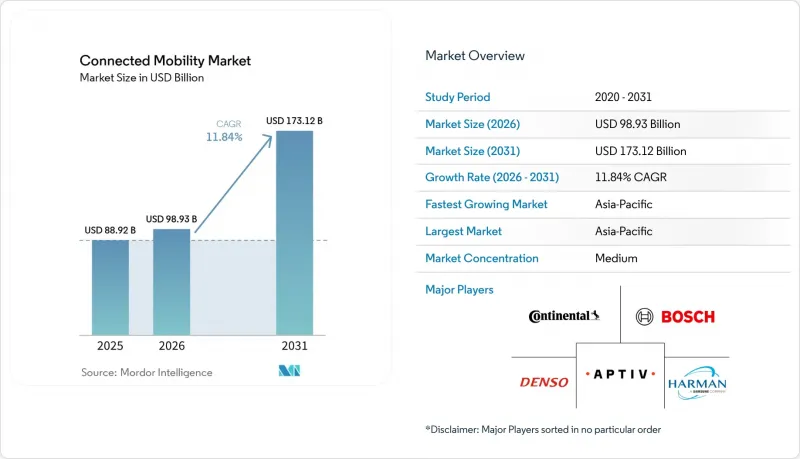
本報告按解決方案(硬體、軟體、服務)、車輛類型(乘用車、輕型商用車、巴士等)、應用(車隊管理、資訊娛樂和導航、遠距離診斷等)、最終用戶產業(汽車原始設備製造商、車隊營運商、出行服務供應商等)和地區進行細分。市場預測以價值(美元)表示。
全球互聯出行市場趨勢與洞察
安全標準、緊急呼叫系統 (eCall) 和高級駕駛輔助系統 (ADAS) 要求
根據歐盟委員會授權條例 (EU) 2025/1871,歐盟當局必須拒絕為不符合更新後的下一代 eCall 規範的車輛頒發型式認證。該期限要求原始設備製造商 (OEM) 更新其車載資訊控制單元的規範,並確保與網際網路協定多媒體子系統 (IP-MMS) 相容。在英國,從 2025 年 9 月起,所有新註冊車輛都必須配備下一代 eCall 系統。通訊系統的升級必須在 2027 年 3 月之前完成,現有的基於 2G 的服務計劃在 2029 年至 2030 年間逐步淘汰。此外,歐盟通用安全法規強制要求從 2026 年 7 月起在所有新車上安裝高級駕駛員分心警報系統,這將進一步增加對車載感測器和處理能力的需求。中國擬議的 SAE L3 和 L4 級自動駕駛系統要求計劃於 2027 年 7 月生效,屆時現有指南將轉化為具有法律約束力的硬體和軟體要求。
5G部署和低延遲V2X服務
目前,專用短程通訊(DSRC) 技術向蜂窩車聯網 (V2X) 技術的過渡正按監管時間表進行。美國聯邦通訊委員會 (FCC) 已強制規定,在 2026 年 12 月 14 日之前,所有在 5.9 GHz 高頻寬使用短程通訊的技術都必須停止運作。這項變更要求道路管理部門、汽車製造商 (OEM) 和車主完成向蜂窩車連網服務的過渡。 Kapusch Trafficcom 和北卡羅來納州收費公路管理局於 2026 年 2 月在三角高速公路上運作了蜂窩車聯網收費系統。 Verizon Business 於 2025 年 6 月推出了其 Edge Transportation Exchange 平台,早期用戶包括亞利桑那州商務部、德拉瓦交通部和美國大眾汽車集團。在中國,2025 年 10 月進行的 5G-Advanced 應用展示表明,電信業者之間可以即時共用感測器數據,這將影響中國未來汽車平台的設計。隨著實際營運先導計畫與商業基礎設施之間的差距,互聯出行市場正從中受益。這種轉變也改變了採購決策,因為汽車製造商現在可以指定可量產的模組,而無需為有限的示範項目購買互聯硬體。對於道路營運商而言,在同一網路框架內實現收費、預警和交通管制功能,為其投資提供了營運上的合理性。因此,對於尋求迭代部署合約的供應商來說,互通性、網路覆蓋範圍和設備認證是關鍵的考量。
網路安全漏洞與召回風險
網路安全事件如今對汽車製造商構成直接的財務和營運風險。 2026年7月,加州大學聖地牙哥分校的研究人員揭露,至少有220萬輛汽車的安全系統使用通用的藍牙認證金鑰。此漏洞可能允許5公尺範圍內的第三方在沒有車主鑰匙的情況下解鎖車門、鳴笛或阻止車輛啟動。 2026年8月,美國網路安全和基礎設施安全局(CISA)針對受影響的Acrisure硬體發布了ICSA-26-216-01建議。汽車安全研究小組也報告了影響2024款鈴木Swift滾動碼無鑰匙無鑰匙進入的捕獲-重播漏洞。聯合國第155號法規和ISO/SAE 21434標準要求將網路安全管理作為供應商的資格要求,這可能會提高中小型零件供應商的合規門檻。
細分市場分析
2025年,硬體將佔互聯出行市場收入的39.10%。這一比例反映了車載資訊控制單元(TECU)的高出貨量,以及北美和中國OEM平台中V2X(車聯網)通訊模組日益增強的整合度。預計2026年,受歐盟新乘用車產量的推動,車載資訊控制單元的年出貨量將達到1,500萬至1,800萬台。硬體包括車載資訊控制單元、V2X(車聯網)模組和邊緣運算閘道器。隨著處理能力因區域特定的電氣和電子架構而轉向高效能中央處理器,邊緣閘道的重要性日益凸顯。因此,車載互聯設備的需求將持續支撐互聯出行硬體市場規模。 OEM生產計劃需要這些組件擁有穩定的供應、檢驗和較長的使用壽命,這限制了其透過標準化來降低價值的速度。此外,硬體供應商必須適應各種不同的通訊網路、電氣架構以及各國特定的監管要求。即使軟體在未來成為更重要的差異化因素,這些條件也將確保工程支援繼續發揮作用。然而,模組標準化預計將對硬體利潤率造成壓力。供應商需要將設備與安全軟體、生命週期服務或專有的車輛資料功能結合。
軟體市場預計到2031年將以13.21%的複合年成長率成長,成為所有解決方案類別中成長最快的領域。聯網汽車平台和無線分發系統是軟體的主要細分市場。集中式運算提供了必要的網路設計,以協調整個車隊的更新。沃爾沃的「HuginCore」方案表明,結構化的分發層可以從單一代碼庫更新多個車型年份的220萬輛汽車。 2025年5月,哈曼透過Eclipse基金會開放原始碼了其“互聯服務平台”,旨在擴展第三方應用開發,而不是保護封閉式的中間件層。 2026年2月,SAE International發布了一份關於連網V2X(車聯網)服務的資訊報告,該服務正在推動協定整合。隨著應用程式介面(API)和開放中間件的日益普及,服務也正向訂閱模式轉變,客製化整合工作正在減少。預計硬體仍將保持其營收主導,而軟體和服務將隨著時間的推移而日益重要。這種構成比並非只是用代碼取代設備,因為硬體供應商仍然需要滿足車輛可靠性、網路安全和認證方面的嚴格要求。更重要的是,軟體將使每個已安裝的設備在車輛的整個生命週期中支援更多功能。這種關係促使原始設備製造商 (OEM) 優先考慮那些能夠讓他們在統一的安全控制下管理更新、診斷、訂閱和第三方應用程式的平台。
2025年,乘用車在互聯出行市場收入中佔比高達55.31%。這一地位得益於歐盟新乘用車近乎普及的車載資訊系統、北美高階汽車的高滲透率以及中國電動汽車對車載資訊系統的整合。乘用車在互聯出行市場中的佔有率也反映了汽車製造商將嵌入式硬體轉化為持續數位服務的策略。通用汽車(GM)報告稱,其OnStar業務在2026年第二季的收入達到8億美元。 Super Cruise的訂閱用戶在年中超過85萬,年度訂閱收入較去年同期成長70%。緊隨其後的是重型和輕型商用車。由於印度AIS-140法規和美國電子日誌記錄器(ELD)法規的要求,車載資訊系統正逐漸成為商用車隊的強制性合規要求。
預計到2031年,兩輪和三輪車輛的複合年成長率將達到13.43%,在所有車輛類型中增速最高。電動車在最後一公里物流的應用、政府對互聯互通的要求以及原始設備製造商(OEM)的投資是推動這一成長的主要因素。印度提案的AIS-230標準將強制要求從2028年10月起生產的新型二輪車、乘用車和商用車具備車對車(V2V)通訊功能。在2026年巴塞隆納世界行動通訊大會(MWC Barcelona 2026)上,哈曼與高通技術公司合作推出了「Ready Ride」解決方案,將高度擴充性的遠端資訊處理控制單元、蜂巢式調變解調器和OEM後端整合於二輪車領域。 Kinetic Engineering與Jio Things合作,為其電動二輪車產品線添加了新一代遠端資訊處理和車隊性能監控功能。這些應用將互聯互通的範圍從高階電動滑板車擴展到更廣泛的車隊應用領域。公車產業的投資步伐與中國和歐洲的智慧城市交通基礎設施投資步伐一致,但速度慢於兩輪和三輪車輛。即使在公共交通部署中,對路線可視性、乘客資訊、維護監控和安全通訊的需求仍然存在。公車的採購週期通常受市政預算和基礎設施調整的影響,這可能導致部署延誤。與二輪車輛相比,這種差異凸顯了供應商為何需要針對每種車型量身訂做成本結構和資訊服務,而不是提供單一的連接方案。
區域分析
預計到2025年,亞太地區將佔全球互聯出行市場收入的32.45%,並在2031年之前以13.87%的複合年成長率成長。中國在亞太地區佔據最大的市場佔有率,這得益於其500多個運作中的蜂窩V2X(車聯網)示範區、電動汽車(EV)項目以及5G-Advanced基礎設施。韓國和日本正在為與駕駛輔助法規和自動駕駛示範實驗相關的高附加價值項目做出貢獻。印度是亞太地區成長最快的國家,AIS-140支援商用車輛追蹤。計劃於2028年10月生效的AIS-230要求已經開始影響原始設備製造商(OEM)的產品規劃。印度和東南亞的兩輪和三輪電動車隊需要在高密度都市區取得電池狀態數據、充電數據和路線最佳化資訊。為了滿足這項需求,哈曼、高通和GeoTab正在開發相應的平台。
預計北美將成為2025年該地區銷售額的第二大貢獻者。該地區的成長主要得益於對商用車隊遠端資訊處理的需求,而這又受到美國電子記錄法規以及從專用短程通訊(DSRC)轉變為蜂窩車聯網(V2X)技術監管的推動。監管轉變要求道路基礎設施營運商和原始設備製造商(OEM)平台在聯邦通訊委員會(FCC)規定的2026年12月14日截止日期前共同完成過渡。 Stellantis參與了美國運輸部於2026年8月進行的5G聯網汽車試驗,旨在實現即時安全通知。在加拿大,企業車隊遠端資訊處理業務支撐著穩定的需求。在墨西哥,C-V2X模組正被整合到交付給墨西哥國內和美國客戶的車輛中。因此,該地區的互聯出行市場受益於兩個因素:監管方面的替代需求以及商用車隊中已有的成熟應用。
在歐洲,車載資訊系統(5G)的應用已趨於成熟,預計到2025年,歐盟生產的幾乎所有新乘用車都將整合車載資訊系統。連接歐洲數位設施(CEF Digital)已撥款超過30億歐元(33.9億美元),用於在2.6萬公里高速公路沿線部署5G走廊。到2025年,丹麥的5G覆蓋率將達到83.4%,挪威將接近100%。 BMW、博世和RISE在2026年4月舉行的5GAA北歐活動上展示了跨國道路施工預警資料的共用。南美洲、中東和非洲雖然在總合銷量中所佔佔有率較小,但得益於政府主導的車輛數位化和售後車載資訊系統市場,這些地區的市場發展勢頭良好。 2026年2月,Powerfleet公司獲得了一份契約,負責追蹤數千輛南非政府車輛,這表明公共採購在非洲可以成為重要的市場需求。儘管這些地區的互聯出行市場佔有率仍然較小,但公共部門車輛的需求可望增強當地的服務基礎設施。政府車輛合約有助於當地的安裝商、互聯服務提供者和軟體合作夥伴在私人車輛採用類似工具之前累積營運經驗。這一趨勢意義重大,因為購車者仍然對硬體成本和持續的資料通訊費用高度敏感。這也解釋了為什麼在這些區域市場發展的早期階段,車輛數位化專案可能比消費者連結更為重要。
其他好處:
- Excel格式的市場預測(ME)表
- 3個月的分析師支持
目錄
第1章:引言
- 研究假設和市場定義
- 調查範圍
第2章:調查方法
第3章執行摘要
第4章 市場狀況
- 市場概覽
- 市場促進因素
- 安全標準、緊急呼叫系統 (eCall) 和高級駕駛輔助系統 (ADAS) 要求
- 5G部署和低延遲V2X服務
- 軟體定義車輛(SDV)和電動汽車資料架構
- 車輛運營最佳化和基於里程的保險
- OEM訂閱與車載應用生態系統
- 用於即時車輛推理的邊緣人工智慧
- 市場限制因素
- 網路安全漏洞與召回風險
- 高成本的多頻段V2X和連線成本
- 跨境資料在地化和隱私合規性
- V2X標準的碎片化與頻段管治
- 產業價值鏈分析
- 監理情勢
- 技術展望
- 宏觀經濟因素對市場的影響
- 波特五力分析
第5章 市場規模與成長預測
- 透過解決方案
- 硬體
- 車載資訊控制單元(TCU)
- 連接模組(蜂窩網路、GNSS、Wi-Fi、藍牙)
- V2X 通訊模組
- 邊緣運算閘道器
- 智慧天線和通訊設備
- 其他連接硬體
- 軟體
- 互聯汽車平台軟體
- 車隊管理軟體
- 車載資訊服務平台軟體
- 空中下載 (OTA) 軟體平台
- 車輛數據管理和分析軟體
- 互聯行動管理平台
- 服務
- 連線服務
- 託管式遠端資訊處理服務
- 系統整合與部署
- 諮詢和支援服務
- 維護和生命週期服務
- 硬體
- 按車輛類型
- 搭乘用車
- 輕型商用車
- 大型商用車輛
- 公車
- 二輪車和三輪車
- 透過使用
- 車隊管理
- 資訊娛樂和導航
- 遠距離診斷
- 預測性保護
- 基於里程的保險(UBI)
- 車輛安全保障
- 空中下載 (OTA) 更新
- 交通行動服務(MaaS)
- 按最終用戶行業分類
- 汽車原廠設備製造商
- 車隊營運商
- 行動服務供應商
- 物流/運輸公司
- 政府和智慧城市管理部門
- 按地區
- 北美洲
- 美國
- 加拿大
- 墨西哥
- 南美洲
- 巴西
- 阿根廷
- 其他南美國家
- 歐洲
- 德國
- 英國
- 法國
- 義大利
- 西班牙
- 其他歐洲國家
- 亞太地區
- 中國
- 日本
- 印度
- 韓國
- 其他亞太國家
- 中東和非洲
- 中東
- 沙烏地阿拉伯
- 阿拉伯聯合大公國
- 土耳其
- 其他中東國家
- 非洲
- 南非
- 奈及利亞
- 其他非洲國家
- 中東
- 北美洲
第6章 競爭情勢
- 市場集中度
- 策略趨勢
- 市佔率分析
- 公司簡介
- Continental AG
- Robert Bosch GmbH
- Denso Corporation
- Aptiv PLC
- Harman International
- ZF Friedrichshafen AG
- Visteon Corporation
- Valeo
- Geotab Inc.
- Samsara Inc.
- Verizon Connect
- Trimble Inc.
- Powerfleet, Inc.
- Webfleet Solutions
- Targa Telematics
- OCTO Telematics
- Sibros Technologies
- ECARX
- ACTIA Group
- Telit Cinterion
- Solera Holdings LLC
第7章 市場機會與未來展望
According to Mordor Intelligence, the connected mobility market size is expected to increase from USD 88.92 billion in 2025 to USD 98.93 billion in 2026 and reach USD 173.12 billion by 2031, expanding at a CAGR of 11.84% over 2026-2031.
This report is Segmented by Solution (Hardware, Software, and Services), Vehicle Type (Passenger Vehicles, Light Commercial Vehicles, Buses, and More), Application (Fleet Management, Infotainment and Navigation, Remote Diagnostics, and More), End-User Industry (Automotive OEMs, Fleet Operators, Mobility Service Providers, and More), and Geography. The Market Forecasts are Provided in Terms of Value (USD).
Global Connected Mobility Market Trends and Insights
Mandatory Safety, eCall, and ADAS Requirements
European Union authorities must refuse type approval for vehicles that do not meet updated next-generation eCall specifications under Commission Delegated Regulation (EU) 2025/1871. This deadline requires OEMs to update telematics control unit specifications and Internet Protocol multimedia subsystem compatibility. The United Kingdom requires next-generation eCall in all new vehicle registrations from September 2025. Its telecommunications upgrades are required by March 2027, while the earlier 2G-based service is scheduled for retirement during 2029-2030. The European Union General Safety Regulation also requires advanced driver-distraction warning systems for all new vehicles from July 2026, creating additional demand for onboard sensors and processing capabilities. China's draft requirements for SAE Level 3 and Level 4 automated driving systems are scheduled to take effect by July 2027, turning earlier guidance into enforceable hardware and software requirements.
5G Rollout and Low-Latency V2X Services
The shift from dedicated short-range communications to cellular vehicle-to-everything technology now follows a regulatory timetable. The Federal Communications Commission required operations using dedicated short-range communications in the upper 5.9 GHz band to cease by December 14, 2026. This change requires road agencies, OEMs, and fleets to complete their transition to cellular vehicle-to-everything services. Kapsch TrafficCom and the North Carolina Turnpike Authority launched a production cellular vehicle-to-everything tolling system on the Triangle Expressway in February 2026. Verizon Business launched its Edge Transportation Exchange platform in June 2025, with early users including the Arizona Commerce Authority, the Delaware Department of Transportation, and Volkswagen Group of America. In China, demonstrations of 5G-Advanced applications in October 2025 showed real-time sensor sharing across operators, influencing future platform design for vehicles produced in the country. The connected mobility market benefits as live deployments reduce the gap between pilot projects and commercial infrastructure. The transition also changes procurement decisions because vehicle manufacturers can specify production-ready modules, rather than reserving connectivity hardware for limited demonstrations. Road operators gain an operational reason to invest when tolling, warnings, and traffic coordination can use the same network framework. This makes interoperability, network coverage, and device certification central considerations for suppliers seeking repeatable deployment contracts.
Cybersecurity Vulnerabilities and Recall Exposure
Cybersecurity incidents now create direct financial and operational risks for vehicle manufacturers. Researchers at the University of California, San Diego disclosed in July 2026 that security systems installed in at least 2.2 million vehicles used a shared Bluetooth authentication key. The issue could allow someone within 5 m to unlock doors, activate horns, or prevent a vehicle from starting without the owner's key fob. The US Cybersecurity and Infrastructure Security Agency issued advisory ICSA-26-216-01 for the affected Acrisure hardware in August 2026. The Automotive Security Research Group also documented a capture-replay weakness affecting rolling-code keyless entry in the 2024 Suzuki Swift. UN Regulation No. 155 and ISO/SAE 21434 make cybersecurity management a supplier qualification issue, which can increase compliance barriers for smaller component suppliers.
Other drivers and restraints analyzed in the detailed report include:
- Software-Defined Vehicles and EV Data Architectures
- Fleet Optimization and Usage-Based Insurance
- High Multi-Band V2X and Connectivity Costs
For complete list of drivers and restraints, kindly check the Table Of Contents.
Segment Analysis
Hardware held 39.10% of the connected mobility market revenue in 2025. Its position reflected high shipments of telematics control units and rising integration of vehicle-to-everything communication modules across North American and Chinese OEM platforms. New European Union passenger-car production is estimated to generate 15-18 million telematics control unit shipments annually in 2026. Hardware includes telematics control units, vehicle-to-everything modules, and edge computing gateways. Edge gateways are gaining relevance as zonal electrical and electronic architectures move processing into high-performance central units. The connected mobility hardware market size, therefore, remains supported by necessary onboard connectivity equipment. OEM production programs require a stable supply, validation, and long operating life for these components, which limits how quickly standardization can erode their value. Hardware suppliers also need to accommodate different communication networks, electrical architectures, and country-specific regulatory requirements. Those conditions preserve a role for engineering support even as software accounts for a larger portion of future differentiation. Yet module standardization is expected to place pressure on hardware margins. Suppliers need to pair devices with secure software, lifecycle services, or proprietary vehicle data capabilities.
Software is projected to expand at a 13.21% CAGR through 2031, the fastest rate among solution categories. Connected vehicle platforms and over-the-air delivery systems are the central software subsegments. Centralized computing provides the network design needed to coordinate updates across an entire fleet. Volvo's HuginCore approach demonstrates how a structured delivery layer can update 2.2 million vehicles across multiple model years from a single codebase. HARMAN open-sourced its Connected Services Platform through the Eclipse Foundation in May 2025, seeking to expand third-party application development rather than protect a closed middleware layer. SAE International published an information report on network vehicle-to-everything services in February 2026, supporting protocol convergence. Services are also moving toward subscriptions, while tailored integration work is declining as application programming interfaces and open middleware become more common. The solution mix is expected to favor software and services over time, although hardware retains revenue leadership. Hardware suppliers must still meet strict vehicle reliability, cybersecurity, and certification requirements, so the change is not simply a replacement of devices with code. Instead, software enables each installed device to support more functions throughout the vehicle's life cycle. This relationship gives OEMs a reason to favor platforms that can manage updates, diagnostics, subscriptions, and third-party applications with consistent security controls.
Passenger vehicles accounted for 55.31% of connected mobility market revenue in 2025. Near-universal embedded telematics in new European Union passenger cars, strong attachment in North American premium vehicles, and telematics in Chinese electric vehicles supported this position. The connected mobility market share of passenger vehicles also reflects OEM strategies that turn embedded hardware into recurring digital services. General Motors reported USD 800 million of OnStar business revenue in the second quarter of 2026. Super Cruise subscriptions exceeded 850,000 by midyear, while annual subscription revenue increased by 70% year over year. Heavy and light commercial vehicles held the next-largest shares of demand. India's AIS-140 requirements and US electronic logging device rules establish telematics as a compliance need for commercial fleets.
Two and three-wheelers are projected to expand at a 13.43% CAGR through 2031, the highest rate among vehicle types. Electric vehicle use in last-mile logistics, government connectivity requirements, and OEM investment are supporting adoption. India's proposed AIS-230 standard would require vehicle-to-vehicle communication in new two-wheelers, passenger vehicles, and commercial vehicles produced from October 2028. HARMAN presented Ready Ride with Qualcomm Technologies at MWC Barcelona 2026, combining a scalable telematics control unit, a cellular modem, and an OEM backend for two-wheelers. Kinetic Engineering partnered with Jio Things to add next-generation telematics and fleet-performance monitoring to its electric two-wheeler range. These deployments extend connectivity beyond premium electric scooters to broader fleet use. Buses follow smart-city transit investment in China and Europe, but at a slower pace than the two- and three-wheeler categories. Public transit deployments still create demand for route visibility, passenger information, maintenance monitoring, and safety communications. Their purchasing cycles often depend on municipal budgets and infrastructure coordination, which can delay deployment. The contrast with two-wheelers shows why suppliers need cost structures and data services suited to each vehicle class, rather than a single connectivity package.
Complete Report Scope:
- By Solution
- Hardware
- Telematics Control Units (TCUs)
- Connectivity Modules (Cellular, GNSS, Wi-Fi and Bluetooth)
- V2X Communication Modules
- Edge Computing Gateways
- Smart Antennas and Communication Devices
- Other Connectivity Hardware
- Software
- Connected Vehicle Platform Software
- Fleet Management Software
- Telematics Platform Software
- Over-the-Air (OTA) Software Platforms
- Vehicle Data Management and Analytics Software
- Connected Mobility Management Platforms
- Services
- Connectivity Services
- Managed Telematics Services
- System Integration and Deployment
- Consulting and Support Services
- Maintenance and Lifecycle Services
- Hardware
- By Vehicle Type
- Passenger Vehicles
- Light Commercial Vehicles
- Heavy Commercial Vehicles
- Buses
- Two and Three Wheelers
- By Application
- Fleet Management
- Infotainment and Navigation
- Remote Diagnostics
- Predictive Maintenance
- Usage-Based Insurance (UBI)
- Vehicle Safety and Security
- Over-the-Air (OTA) Updates
- Mobility-as-a-Service (MaaS)
- By End-User Industry
- Automotive OEMs
- Fleet Operators
- Mobility Service Providers
- Logistics and Transportation Companies
- Government and Smart City Authorities
- By Geography
- North America
- United States
- Canada
- Mexico
- South America
- Brazil
- Argentina
- Rest of South America
- Europe
- Germany
- United Kingdom
- France
- Italy
- Spain
- Rest of Europe
- Asia-Pacific
- China
- Japan
- India
- South Korea
- Rest of Asia-Pacific
- Middle East and Africa
- Middle East
- Saudi Arabia
- United Arab Emirates
- Turkey
- Rest of the Middle East
- Africa
- South Africa
- Nigeria
- Rest of Africa
- Middle East
- North America
Geography Analysis
Asia-Pacific accounted for 32.45% of connected mobility market revenue in 2025 and is projected to grow at a 13.87% CAGR through 2031. China held the largest country position in the region, supported by more than 500 active cellular vehicle-to-everything pilot zones, electric vehicle programs, and 5G-Advanced infrastructure. South Korea and Japan contribute high-value projects linked to driver-assistance rules and autonomous mobility trials. India has the strongest country growth path within Asia-Pacific because AIS-140 supports commercial fleet tracking. The proposed AIS-230 requirement, effective October 2028, is already influencing OEM product plans. Two- and three-wheeler electric fleets in India and Southeast Asia require battery health data, charging-session data, and dense-urban route optimization. This need is prompting targeted platform work from HARMAN, Qualcomm Technologies, and Geotab.
North America was the second-largest regional revenue contributor in 2025. The region combines commercial fleet telematics demand created by US electronic logging rules with the regulatory migration from dedicated short-range communications to cellular vehicle-to-everything technology. The Federal Communications Commission deadline of December 14, 2026, requires road infrastructure operators and OEM platforms to complete the conversion together. Stellantis participated in a US Department of Transportation 5G connected-vehicle test for real-time safety notifications in August 2026. Canada supports steady demand through enterprise fleet telematics. Mexico embeds cellular vehicle-to-everything modules in vehicles supplied to domestic and US customers. The regional connected mobility market, therefore, benefits from regulatory replacement demand and established commercial fleet use.
Europe has mature adoption, with near-universal embedded telematics in new European Union passenger-car production in 2025. The Connecting Europe Facility Digital allocated more than EUR 3 billion (USD 3.39 billion) for 5G corridor deployment along 26,000 km of highways. Denmark recorded 83.4% 5G availability in 2025, and Norway approached 100%. BMW, Bosch, and RISE demonstrated cross-border roadwork-warning data sharing at the 5GAA Nordic event in April 2026. South America, the Middle East, and Africa held smaller combined revenue positions but are supported by government fleet digitization and aftermarket telematics. Powerfleet secured a contract in February 2026 to track thousands of South African government vehicles, showing that public procurement can provide a volume base in Africa. The share of the connected mobility market in these regions remains small, although institutional fleet demand can strengthen the local service base. Government fleet contracts can help local installers, connectivity providers, and software partners build operational experience before private fleets adopt comparable tools. This pattern matters, as vehicle buyers remain highly sensitive to hardware costs and ongoing data charges. It also explains why fleet digitization programs can be more important than consumer connectivity in the early development of these regional markets.
- Continental AG
- Robert Bosch GmbH
- Denso Corporation
- Aptiv PLC
- Harman International
- ZF Friedrichshafen AG
- Visteon Corporation
- Valeo
- Geotab Inc.
- Samsara Inc.
- Verizon Connect
- Trimble Inc.
- Powerfleet, Inc.
- Webfleet Solutions
- Targa Telematics
- OCTO Telematics
- Sibros Technologies
- ECARX
- ACTIA Group
- Telit Cinterion
- Solera Holdings LLC
Additional Benefits:
- The market estimate (ME) sheet in Excel format
- 3 months of analyst support
TABLE OF CONTENTS
1 INTRODUCTION
- 1.1 Study Assumptions and Market Definition
- 1.2 Scope of the Study
2 RESEARCH METHODOLOGY
3 EXECUTIVE SUMMARY
4 MARKET LANDSCAPE
- 4.1 Market Overview
- 4.2 Market Drivers
- 4.2.1 Mandatory Safety, eCall, and ADAS Requirements
- 4.2.2 5G Rollout and Low-Latency V2X Services
- 4.2.3 Software-Defined Vehicles and EV Data Architectures
- 4.2.4 Fleet Optimization and Usage-Based Insurance
- 4.2.5 OEM Subscription and In-Vehicle App Ecosystems
- 4.2.6 Edge AI for Real-Time Vehicle Inference
- 4.3 Market Restraints
- 4.3.1 Cybersecurity Vulnerabilities and Recall Exposure
- 4.3.2 High Multi-Band V2X and Connectivity Costs
- 4.3.3 Cross-Border Data Localization and Privacy Compliance
- 4.3.4 Fragmented V2X Standards and Spectrum Governance
- 4.4 Industry Value-Chain Analysis
- 4.5 Regulatory Landscape
- 4.6 Technological Outlook
- 4.7 Impact of Macroeconomic Factors on the Market
- 4.8 Porter's Five Forces Analysis
- 4.8.1 Threat of New Entrants
- 4.8.2 Bargaining Power of Suppliers
- 4.8.3 Bargaining Power of Buyers
- 4.8.4 Threat of Substitutes
- 4.8.5 Competitive Rivalry
5 MARKET SIZE AND GROWTH FORECASTS (VALUE)
- 5.1 By Solution
- 5.1.1 Hardware
- 5.1.1.1 Telematics Control Units (TCUs)
- 5.1.1.2 Connectivity Modules (Cellular, GNSS, Wi-Fi and Bluetooth)
- 5.1.1.3 V2X Communication Modules
- 5.1.1.4 Edge Computing Gateways
- 5.1.1.5 Smart Antennas and Communication Devices
- 5.1.1.6 Other Connectivity Hardware
- 5.1.2 Software
- 5.1.2.1 Connected Vehicle Platform Software
- 5.1.2.2 Fleet Management Software
- 5.1.2.3 Telematics Platform Software
- 5.1.2.4 Over-the-Air (OTA) Software Platforms
- 5.1.2.5 Vehicle Data Management and Analytics Software
- 5.1.2.6 Connected Mobility Management Platforms
- 5.1.3 Services
- 5.1.3.1 Connectivity Services
- 5.1.3.2 Managed Telematics Services
- 5.1.3.3 System Integration and Deployment
- 5.1.3.4 Consulting and Support Services
- 5.1.3.5 Maintenance and Lifecycle Services
- 5.1.1 Hardware
- 5.2 By Vehicle Type
- 5.2.1 Passenger Vehicles
- 5.2.2 Light Commercial Vehicles
- 5.2.3 Heavy Commercial Vehicles
- 5.2.4 Buses
- 5.2.5 Two and Three Wheelers
- 5.3 By Application
- 5.3.1 Fleet Management
- 5.3.2 Infotainment and Navigation
- 5.3.3 Remote Diagnostics
- 5.3.4 Predictive Maintenance
- 5.3.5 Usage-Based Insurance (UBI)
- 5.3.6 Vehicle Safety and Security
- 5.3.7 Over-the-Air (OTA) Updates
- 5.3.8 Mobility-as-a-Service (MaaS)
- 5.4 By End-User Industry
- 5.4.1 Automotive OEMs
- 5.4.2 Fleet Operators
- 5.4.3 Mobility Service Providers
- 5.4.4 Logistics and Transportation Companies
- 5.4.5 Government and Smart City Authorities
- 5.5 By Geography
- 5.5.1 North America
- 5.5.1.1 United States
- 5.5.1.2 Canada
- 5.5.1.3 Mexico
- 5.5.2 South America
- 5.5.2.1 Brazil
- 5.5.2.2 Argentina
- 5.5.2.3 Rest of South America
- 5.5.3 Europe
- 5.5.3.1 Germany
- 5.5.3.2 United Kingdom
- 5.5.3.3 France
- 5.5.3.4 Italy
- 5.5.3.5 Spain
- 5.5.3.6 Rest of Europe
- 5.5.4 Asia-Pacific
- 5.5.4.1 China
- 5.5.4.2 Japan
- 5.5.4.3 India
- 5.5.4.4 South Korea
- 5.5.4.5 Rest of Asia-Pacific
- 5.5.5 Middle East and Africa
- 5.5.5.1 Middle East
- 5.5.5.1.1 Saudi Arabia
- 5.5.5.1.2 United Arab Emirates
- 5.5.5.1.3 Turkey
- 5.5.5.1.4 Rest of the Middle East
- 5.5.5.2 Africa
- 5.5.5.2.1 South Africa
- 5.5.5.2.2 Nigeria
- 5.5.5.2.3 Rest of Africa
- 5.5.5.1 Middle East
- 5.5.1 North America
6 COMPETITIVE LANDSCAPE
- 6.1 Market Concentration
- 6.2 Strategic Moves
- 6.3 Market Share Analysis
- 6.4 Company Profiles (includes Global Level Overview, Market Level Overview, Core Segments, Financials as available, Strategic Information, Market Rank/Share, Products and Services, Recent Developments)
- 6.4.1 Continental AG
- 6.4.2 Robert Bosch GmbH
- 6.4.3 Denso Corporation
- 6.4.4 Aptiv PLC
- 6.4.5 Harman International
- 6.4.6 ZF Friedrichshafen AG
- 6.4.7 Visteon Corporation
- 6.4.8 Valeo
- 6.4.9 Geotab Inc.
- 6.4.10 Samsara Inc.
- 6.4.11 Verizon Connect
- 6.4.12 Trimble Inc.
- 6.4.13 Powerfleet, Inc.
- 6.4.14 Webfleet Solutions
- 6.4.15 Targa Telematics
- 6.4.16 OCTO Telematics
- 6.4.17 Sibros Technologies
- 6.4.18 ECARX
- 6.4.19 ACTIA Group
- 6.4.20 Telit Cinterion
- 6.4.21 Solera Holdings LLC
7 MARKET OPPORTUNITIES AND FUTURE OUTLOOK
- 7.1 White-Space and Unmet-Need Assessment

 全球智慧路燈市場規模、佔有率、趨勢和成長分析報告(2026-2034)
 互聯智慧照明市場預測至2034年-全球分析(按組件、連接技術、照明類型、控制與智慧、應用、最終用戶和地區分類)
 智慧路燈:市場佔有率分析、產業趨勢與統計及成長預測(2026-2031 年)
 智慧互聯路燈市場規模、佔有率及成長分析:按服務類型、連接技術、應用、最終用戶、安裝類型、照明技術和地區分類-2026-2033年產業預測
 2026年全球智慧路燈(附野生動物感測器)市場報告2026年全球智慧燈具市場報告
 智慧路燈市場-全球產業規模、佔有率、趨勢、機會和預測:按組件、照明技術、應用、地區和競爭格局分類,2021-2031年
 全球智慧燈市場