


 |
市場調查報告書
商品編碼
2122740
二氧化鈦:市場佔有率分析、產業趨勢與統計、成長預測(2026-2031)Titanium Dioxide - Market Share Analysis, Industry Trends & Statistics, Growth Forecasts (2026 - 2031) |
||||||

※ 本網頁內容可能與最新版本有所差異。詳細情況請與我們聯繫。
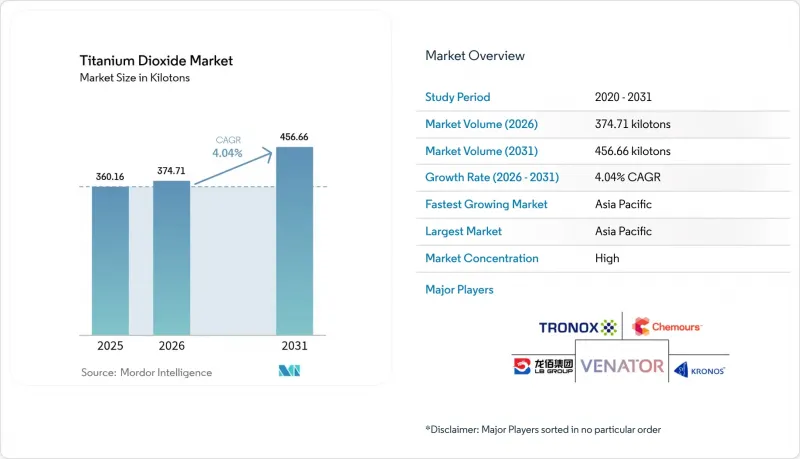
根據 Mordor Intelligence 預測,二氧化鈦市場將從 2025 年的 360.16 千噸成長到 2026 年的 374.71 千噸,然後從 2026 年到 2031 年以 4.04% 的複合年成長率成長,到 2031 年達到 456千噸。
本報告按礦物等級(金紅石型、銳鈦礦型)、工藝(氯化法、硫酸法)、應用領域(油漆和塗料、塑膠、造紙和紙漿、化妝品及其他應用)、終端用戶行業(建築、汽車和運輸、包裝及其他)以及地區(亞太地區、北美地區、歐洲及其他地區)對礦物行業進行分類。市場預測以噸為單位。
全球二氧化鈦市場趨勢與洞察
亞太地區對水性建築塗料的需求激增。
中國、印度和印尼對揮發性有機化合物(VOCs)的監管日益嚴格,加速了塗料從溶劑型轉向水性型的轉變,從而推動了該地區對金紅石顏料的需求成長。各地區的塗料生產商都在改進分散技術以達到相同的遮蓋力,這支撐了二氧化鈦市場的持續成長。印度和印尼的基礎設施獎勵策略進一步提振了需求,而當地的氯化物生產能力則確保了供應穩定。化合物生產商優先考慮降低氣味和創造更安全的工作環境,這有助於承包商接受這些產品。儘管原物料價格有所波動,但這種轉變仍構成了一種結構性利好。
歐洲汽車塑膠朝向更輕、更高光澤度方向發展
歐盟對車輛平均二氧化碳排放量的嚴格規定,使得減重成為設計策略的核心。將二氧化鈦添加到聚丙烯和聚碳酸酯飾件中,可以獲得媲美塗層金屬板的高光澤表面,同時顯著降低重量,使車輛重量每減輕10%,燃油效率就能提高5-7%。豪華汽車製造商正在採用諸如TIOXIDE TR48之類的防水等級產品,即使在高溫加工條件下,這些產品也能分散且不損失光澤。這些特殊等級的產品價格較高,且因法規限制而被替代的風險極低,因此二氧化鈦市場不僅在銷售上,而且在價值上也在不斷成長。
歐盟將二氧化鈦列為“致癌性”,導致標籤成本上升。
歐盟法規2025/4強制規定,凡含1%或以上二氧化鈦的粉末配方均須貼上致癌警告標籤。塗料、塑膠溶膠和印刷油墨供應商正面臨合規成本上升的困境,因為他們必須修改配方、重新設計包裝並接受法律審查。英國和北美法規的差異使全球產品組合管理更加複雜,並迫使企業採用雙重標籤策略。小批量生產推高了單位成本,並抑制了DIY通路的自願性需求。歐洲法院於2022年裁定該危險標籤無效,但預計2025年的科學重新評估將推翻該裁決,這將進一步加劇二氧化鈦市場的不確定性。
細分市場分析
到2025年,金紅石型二氧化鈦將佔據二氧化鈦市場77.60%的佔有率。這主要得益於其高屈光(2.7)和優異的耐候性。在戶外建築塗料、汽車面漆和聚合物母粒領域,長期保持光澤至關重要,而金紅石型二氧化鈦的這一優勢尤為突出。此外,具有光催化性能的雙功能型二氧化鈦為自清潔表面開闢了新的應用前景,進一步鞏固了其市場主導地位。
銳鈦礦滿足了剩餘的需求,其複合年成長率高達4.32%,主要得益於醫藥添加劑和光催化建築材料等細分市場的成長。表面改質的銳鈦礦可延長食品接觸紙的保存期限,並賦予其高品質辦公用紙特有的藍色色調。
由於硫酸法採用低品位鈦鐵礦,且資本投入較低,預計2025年將佔二氧化鈦市場64.30%的佔有率。然而,隨著監管機構加強對酸性硫酸廢水的監管,採用氯化法的產能正以4.53%的複合年成長率快速成長。氯化法工廠主要使用高品位二氧化鈦爐渣或天然金紅石,生產雜質含量低的金紅石顏料,在高檔塗料和母粒領域獲得更高的價格。據Chemores公司稱,其獨特的低溫氯化製程(350–450 度C)可降低30%的能耗並提高產量。
印度新興製造商正採用氯化技術,以達到與歐美供應商相媲美的品質水平,並應對不斷變化的廢水排放法規。北美和歐洲正在分階段開展瓶頸消除項目,旨在無需新增投資即可從現有氯化設施中額外提高5-15%的產量,並在區域產能關閉的情況下(例如Tronox的Botrec工廠)維持供應平衡。因此,製程相關的成本差異仍然是二氧化鈦市場競爭的重要因素。
區域分析
亞太地區佔全球二氧化鈦市場佔有率的34.70%,預計也將維持最高成長率,到2031年複合年成長率將達到4.78%。中國在全球二氧化鈦產能中佔據絕大部分,其出口與建築基礎設施領域不斷成長的國內需求保持平衡。政府指南提高顏料品質並減少硫酸法製程產生的廢水,這迫使生產商轉向氯化技術並符合西方標準。
北美二氧化鈦市場持續受到耐用消費品、航太塗料和包裝薄膜的驅動。成熟的環境法規有利於氯化法生產,而企業對環境、社會和治理(ESG)的承諾也推動了低碳顏料生產流程的研發。歐洲市場則受到雙重限制:一是「第二類致癌性」的強制性標示規定,二是對來自中國的進口產品徵收明確的反傾銷稅。這些措施推高了當地的生產成本,同時也刺激了高階產品的開發,以支撐更高的價格。
在中東和非洲,受建築領域大型企劃的推動,新的發展潛力正在湧現。波灣合作理事會(GCC)的「冷屋頂」法規以及旅遊設施的增加,正在促進高反射率塗料的應用。然而,該地區國內二氧化鈦產量仍然很低,導致對進口的依賴性增強,也使其更容易受到運費波動的影響。
其他好處
- Excel格式的市場預測(ME)表
- 3個月的分析師支持
目錄
第1章:引言
- 研究假設和市場定義
- 調查範圍
第2章:調查方法
第3章執行摘要
第4章 市場狀況
- 市場概覽
- 市場促進因素
- 亞太地區對水性建築塗料的需求激增。
- 歐洲汽車塑膠朝向更輕、更高光澤度方向發展
- 層壓紙板包裝在電子商務物流的成長
- 抗紫外線冷屋頂塗料在中東建築業的推廣
- 印度採用氯化法生產二氧化鈦產能的在地化
- 市場限制因素
- 由於歐盟將二氧化鈦列為致癌性致癌物,導致標籤成本增加。
- 鈦鐵礦和金紅石原料價格波動對利潤率的影響
- 其他白色顏料的競爭壓力
- 價值鏈分析
- 貿易分析
- 波特五力分析
第5章 市場規模與成長預測
- 按年級
- 金紅石
- 銳鈦礦
- 透過流程
- 氯化物定律
- 硫酸鹽法
- 透過使用
- 油漆和塗料
- 塑膠
- 紙漿和紙漿
- 化妝品
- 其他用途(皮革、紡織品、橡膠)
- 按最終用戶行業分類
- 建造
- 汽車和運輸業
- 包裝
- 消費品
- 其他
- 按地區
- 亞太地區
- 中國
- 印度
- 日本
- 韓國
- ASEAN
- 其他亞太國家
- 北美洲
- 美國
- 加拿大
- 墨西哥
- 歐洲
- 德國
- 英國
- 法國
- 義大利
- 北歐的
- 其他歐洲國家
- 南美洲
- 巴西
- 阿根廷
- 其他南美國家
- 中東和非洲
- 沙烏地阿拉伯
- 阿拉伯聯合大公國
- 南非
- 埃及
- 其他中東和非洲國家
- 亞太地區
第6章 競爭情勢
- 市場集中度
- 策略趨勢
- 市佔率分析
- 公司簡介
- Cinkarna Celje
- Evonik Industries AG
- Grupa Azoty SA
- Hangzhou Harmony Chemical Co.,Ltd
- INEOS
- ISHIHARA SANGYO KAISHA, LTD.
- Kemipex
- Kronos Worldwide, Inc.
- LB Group
- Precheza
- Shandong Jinhai Titanium Resources Technology Co., Ltd.
- TAYCA Co., Ltd.
- The Chemours Company
- Titanos
- Tronox Holdings Plc
- Venator Materials PLC
- Zhejiang TITAN Design & Engineering CO., Ltd
第7章 市場機會與未來展望
According to Mordor Intelligence, the titanium dioxide market size is expected to grow from 360.16 kilotons in 2025 to 374.71 kilotons in 2026 and is forecast to reach 456.66 kilotons by 2031 at 4.04% CAGR over 2026-2031.
This report Segments the Industry by Grade (Rutile and Anatase), Process (Chloride and Sulfate) Application (Paints and Coatings, Plastics, Paper and Pulp, Cosmetics and Other Applications), End-User Industry (Construction, Automotive and Transportation, Packaging, and More) and Geography (Asia-Pacific, North America, Europe, and More). The Market Forecasts are Provided in Terms of Volume (Tons)
Global Titanium Dioxide Market Trends and Insights
Surge in Demand for Waterborne Architectural Coatings in Asia-Pacific
Escalating volatile-organic-compound regulations across China, India and Indonesia are accelerating substitution of solvent systems by waterborne paints, driving incremental rutile pigment offtake in the region. Regional coating lines are upgrading dispersion technology to achieve hiding power parity, underpinning continuous volume growth for the titanium dioxide market. Infrastructure stimulus programs in India and Indonesia compound demand, while localized chloride-route capacity secures supply resilience. Formulators emphasize lower odor and safer worksite conditions, bolstering acceptance among contractors. The shift is adding a structural tailwind despite feedstock price swings.
Shift Toward Lightweight, High-Gloss Automotive Plastics in Europe
Stringent EU fleet-average carbon-dioxide limits have placed lightweighting at the center of design strategies. Incorporating titanium dioxide into polypropylene and polycarbonate trim delivers high-gloss surfaces that rival coated metal panels yet weigh markedly less, achieving a 5-7% fuel-efficiency gain per 10% vehicle weight reduction. Premium OEMs adopt hydrophobic grades such as TIOXIDE TR48, which disperse at high processing temperatures without loss of brightness. The titanium dioxide market gains not only in volume but in value because these specialty grades command premium pricing and carry minimal regulatory substitution risk.
EU Classification of TiO2 as Suspected Carcinogen Raising Labeling Costs
European Regulation 2025/4 mandates cancer warnings on powder formulations containing more than or equal to 1% titanium dioxide. Coating, plastisol, and printing-ink suppliers face reformulation, new packaging artwork, and legal reviews, inflating compliance costs. Divergent rules in the United Kingdom and North America complicate global portfolio management, requiring dual labeling strategies. Short-run manufacturing batches raise unit costs, dampening discretionary demand in DIY channels. Although the European Court annulled the hazard label in 2022, the ruling was reversed in 2025 after scientific reassessment, reinforcing uncertainty for the titanium dioxide market.
Other drivers and restraints analyzed in the detailed report include:
- Growth of Laminated Paperboard Packaging for E-Commerce Logistics
- Uptake of UV-Resistant Cool-Roof Coatings in Middle-East Construction
- Volatility in Ilmenite/Rutile Feedstock Prices Impacting Margins
For complete list of drivers and restraints, kindly check the Table Of Contents.
Segment Analysis
Rutile commanded 77.60% of the titanium dioxide market in 2025, reflecting its higher refractive index (2.7) and superior weatherability. This supremacy is entrenched in outdoor architectural coatings, automotive topcoats, and polymer masterbatches where long-term gloss retention is critical. Dual-function grades integrating photocatalytic traits are unlocking new self-cleaning surface opportunities, further entrenching the rutile's lead.
Anatase, accounting for the demand balance, is advancing at a faster 4.32% CAGR thanks to niche growth in pharmaceutical excipients and photocatalytic building materials. Surface-modified anatase grades extend shelf life in food-contact papers and offer distinct bluish undertones valued in premium office papers.
The sulfate route delivered 64.30% of the titanium dioxide market size in 2025 by leveraging lower-grade ilmenite and smaller capital footprints. Nevertheless, chloride-based capacity is expanding at 4.53% CAGR as regulators intensify scrutiny of acidic sulfate waste streams. Chloride plants use high-TiO2 slag or natural rutile and generate primarily rutile pigment with lower trace impurities, enabling higher pricing in premium coatings and masterbatch segments. Chemours reports that proprietary low-temperature chlorination at 350-450 °C can reduce energy use by 30% and improve yield.
Emerging producers in India are adopting chloride technology to achieve quality parity with Western suppliers and to hedge against evolving effluent norms. Incremental debottlenecking projects across North America and Europe aim to squeeze 5-15% extra output from existing chloride assets without greenfield spending, keeping supply balanced despite regional capacity closures such as Tronox's Botlek facility. Process-driven cost differentials, therefore, remain central to titanium dioxide market competitiveness.
Complete Report Scope:
- By Grade
- Rutile
- Anatase
- By Process
- Chloride
- Sulfate
- By Application
- Paints and Coatings
- Plastics
- Paper and Pulp
- Cosmetics
- Other Applications (Leather, Textiles, Rubber)
- By End-user Industry
- Construction
- Automotive and Transportation
- Packaging
- Consumer Goods
- Other End-user Industries
- By Geography
- Asia-Pacific
- China
- India
- Japan
- South Korea
- ASEAN
- Rest of Asia-Pacific
- North America
- United States
- Canada
- Mexico
- Europe
- Germany
- United Kingdom
- France
- Italy
- Nordics
- Rest of Europe
- South America
- Brazil
- Argentina
- Rest of South America
- Middle-East and Africa
- Saudi Arabia
- United Arab Emirates
- South Africa
- Egypt
- Rest of Middle-East and Africa
- Asia-Pacific
Geography Analysis
Asia-Pacific controls 34.70% of the titanium dioxide market and delivers the fastest 4.78% CAGR through 2031. China alone houses a major portion of global TiO2 capacity, balancing exports with rising domestic architectural and infrastructure demand. Government directives to upgrade pigment quality and curb sulfate-process effluent are pushing producers toward chloride technology, replicating Western standards.
North America's titanium dioxide market remains driven by durable goods, aerospace coatings, and packaging films. Mature environmental regulations favor chloride output, and corporate ESG commitments spur research and development into lower-carbon pigment pathways. Europe's market is shaped by dual constraints: Category 2 carcinogen labeling and definitive anti-dumping duties on Chinese imports. These measures elevate local production costs but also encourage premium-grade innovation to justify higher price points.
The Middle-East and Africa present emergent potential propelled by construction megaprojects. Cool-roof mandates in the Gulf Cooperation Council and rising tourism facilities spur high-albedo coating uptake. Domestic TiO2 production remains negligible, driving import dependency and exposure to freight fluctuations.
- Cinkarna Celje
- Evonik Industries AG
- Grupa Azoty S.A.
- Hangzhou Harmony Chemical Co.,Ltd
- INEOS
- ISHIHARA SANGYO KAISHA, LTD.
- Kemipex
- Kronos Worldwide, Inc.
- LB Group
- Precheza
- Shandong Jinhai Titanium Resources Technology Co., Ltd.
- TAYCA Co., Ltd.
- The Chemours Company
- Titanos
- Tronox Holdings Plc
- Venator Materials PLC
- Zhejiang TITAN Design& Engineering CO., Ltd
Additional Benefits:
- The market estimate (ME) sheet in Excel format
- 3 months of analyst support
TABLE OF CONTENTS
1 Introduction
- 1.1 Study Assumptions and Market Definition
- 1.2 Scope of the Study
2 Research Methodology
3 Executive Summary
4 Market Landscape
- 4.1 Market Overview
- 4.2 Market Drivers
- 4.2.1 Surge in Demand for Waterborne Architectural Coatings in Asia-Pacific Boosting Rutile TiO2 Pigment Consumption
- 4.2.2 Shift Toward Lightweight, High-Gloss Automotive Plastics in Europe
- 4.2.3 Growth of Laminated Paperboard Packaging for E-Commerce Logistics
- 4.2.4 Uptake of UV-Resistant Cool-Roof Coatings in Middle-East Construction
- 4.2.5 Localization of Chloride-Route TiO2 Capacity in India
- 4.3 Market Restraints
- 4.3.1 EU Classification of TiO2 as Suspected Carcinogen Raising Labeling Costs
- 4.3.2 Volatility in Ilmenite/Rutile Feedstock Prices Impacting Margins
- 4.3.3 Competitive Pressure from Alternative White Pigments
- 4.4 Value Chain Analysis
- 4.5 Trade Analysis
- 4.6 Porter's Five Forces Analysis
- 4.6.1 Bargaining Power of Suppliers
- 4.6.2 Bargaining Power of Consumers
- 4.6.3 Threat of New Entrants
- 4.6.4 Threat of Substitute Products and Services
- 4.6.5 Degree of Competition
5 Market Size and Growth Forecasts (Volume)
- 5.1 By Grade
- 5.1.1 Rutile
- 5.1.2 Anatase
- 5.2 By Process
- 5.2.1 Chloride
- 5.2.2 Sulfate
- 5.3 By Application
- 5.3.1 Paints and Coatings
- 5.3.2 Plastics
- 5.3.3 Paper and Pulp
- 5.3.4 Cosmetics
- 5.3.5 Other Applications (Leather, Textiles, Rubber)
- 5.4 By End-user Industry
- 5.4.1 Construction
- 5.4.2 Automotive and Transportation
- 5.4.3 Packaging
- 5.4.4 Consumer Goods
- 5.4.5 Other End-user Industries
- 5.5 By Geography
- 5.5.1 Asia-Pacific
- 5.5.1.1 China
- 5.5.1.2 India
- 5.5.1.3 Japan
- 5.5.1.4 South Korea
- 5.5.1.5 ASEAN
- 5.5.1.6 Rest of Asia-Pacific
- 5.5.2 North America
- 5.5.2.1 United States
- 5.5.2.2 Canada
- 5.5.2.3 Mexico
- 5.5.3 Europe
- 5.5.3.1 Germany
- 5.5.3.2 United Kingdom
- 5.5.3.3 France
- 5.5.3.4 Italy
- 5.5.3.5 Nordics
- 5.5.3.6 Rest of Europe
- 5.5.4 South America
- 5.5.4.1 Brazil
- 5.5.4.2 Argentina
- 5.5.4.3 Rest of South America
- 5.5.5 Middle-East and Africa
- 5.5.5.1 Saudi Arabia
- 5.5.5.2 United Arab Emirates
- 5.5.5.3 South Africa
- 5.5.5.4 Egypt
- 5.5.5.5 Rest of Middle-East and Africa
- 5.5.1 Asia-Pacific
6 Competitive Landscape
- 6.1 Market Concentration
- 6.2 Strategic Moves
- 6.3 Market Share Analysis
- 6.4 Company Profiles (includes Global level Overview, Market level overview, Core Segments, Financials as available, Strategic Information, Market Rank/Share for key companies, Products and Services, and Recent Developments)
- 6.4.1 Cinkarna Celje
- 6.4.2 Evonik Industries AG
- 6.4.3 Grupa Azoty S.A.
- 6.4.4 Hangzhou Harmony Chemical Co.,Ltd
- 6.4.5 INEOS
- 6.4.6 ISHIHARA SANGYO KAISHA, LTD.
- 6.4.7 Kemipex
- 6.4.8 Kronos Worldwide, Inc.
- 6.4.9 LB Group
- 6.4.10 Precheza
- 6.4.11 Shandong Jinhai Titanium Resources Technology Co., Ltd.
- 6.4.12 TAYCA Co., Ltd.
- 6.4.13 The Chemours Company
- 6.4.14 Titanos
- 6.4.15 Tronox Holdings Plc
- 6.4.16 Venator Materials PLC
- 6.4.17 Zhejiang TITAN Design& Engineering CO., Ltd
7 Market Opportunities and Future Outlook
- 7.1 White-space and Unmet-Need Assessment
- 7.2 Increased Use of Ultrafine Titanium Dioxide in Cosmetics and Cool-Roofing

 歐洲二氧化鈦市場:市場佔有率分析、產業趨勢與統計及成長預測(2026-2031)
 二氧化鈦市場報告:趨勢、預測及競爭分析(至2035年)
 二氧化鈦市場:2026-2032年全球市場預測(依等級、功能、製造流程、形態、應用及分銷通路分類)
 二氧化鈦市場-全球產業規模、佔有率、趨勢、機會、預測:按等級、應用、區域和競爭格局分類,2021-2031年
 全球二氧化鈦市場:依等級、製程、應用和地區分類-預測至2031年
 金紅石市場:按類型、應用、終端用戶產業和地區分類超細二氧化鈦粉末市場:按表面處理、等級、應用和最終用途產業分類,全球預測(2026-2032年)鋰鋁鈦磷酸鹽電解液市場(按電池類型、應用、最終用途、形態、生產過程、純度、電導率範圍和動作溫度分類),全球預測,2026-2032年
 2026-2034年全球二氧化鈦市場規模、佔有率、趨勢和成長分析報告全球二硼化鈦市場規模、佔有率、趨勢和成長分析報告(2026-2034年)