


 |
市場調查報告書
商品編碼
2119825
歐洲二氧化鈦市場:市場佔有率分析、產業趨勢與統計及成長預測(2026-2031)Europe Titanium Dioxide - Market Share Analysis, Industry Trends & Statistics, Growth Forecasts (2026 - 2031) |
||||||

※ 本網頁內容可能與最新版本有所差異。詳細情況請與我們聯繫。
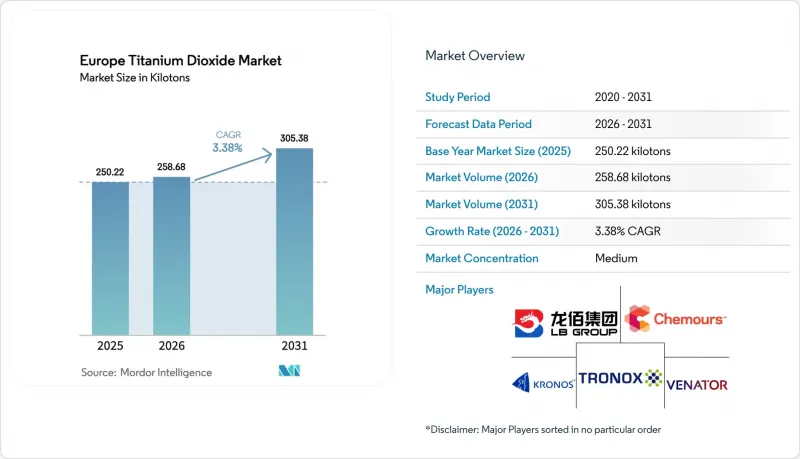
據 Mordor Intelligence 稱,2025 年歐洲二氧化鈦市場規模為 250.22 千噸,預計到 2031 年將從 2026 年的 258.68 千噸成長至 305.38 千噸,預測期(2026-2031 年)的複合年成長率為 3.38%。
本報告按礦物等級(金紅石型和銳鈦礦型)、生產流程(硫酸鹽法和氯化法)、應用領域(油漆和塗料、塑膠、紙漿和造紙、化妝品和個人護理以及其他應用領域(例如製藥))和地區(德國、英國、法國、義大利、西班牙、北歐國家、俄羅斯和其他歐洲國家)進行細分。市場預測以噸為單位。
歐洲二氧化鈦市場趨勢與洞察
高性能油漆和塗料的需求是由建築業的需求所驅動的。
建築塗料約佔歐洲塗料市場的56%,其中二氧化鈦(TiO2)是確保塗料遮蓋力和耐候性的關鍵成分。歐盟的「翻新浪潮」計畫旨在2030年將建築排放量減少40%,該計畫為高遮蓋力的外牆塗料提供補貼,以減少塗料在整個生命週期中的用量。儘管法國的電力成本在2024年同比下降了40%,降至58歐元/兆瓦時,但仍比2019年的水平高出80%,因此塗料配方師更傾向於使用富含耐用二氧化鈦的配方,而不是使用更便宜的填料。德國的綠色建築獎勵計畫優先考慮能夠分解氮氧化物的光催化塗料,由此形成了一個細分市場,該市場要求二氧化鈦含量超過3%才能符合ISO 50001標準。芬蘭製造商Technos已要求在18個月內逐步實施反傾銷稅,並警告稱,中國產二氧化鈦價格的急劇上漲可能會延誤使用水性塗料的翻新工程。
輕質高耐久塑膠的出現推高了二氧化鈦的含量。
汽車產業向玻璃纖維增強聚烯的轉變以及超薄、高不透明度包裝薄膜的普及,正在推母粒中二氧化鈦的濃度。大眾汽車和Stellantis公司規定,在德國和法國生產的電動車的內裝材料中,二氧化鈦的含量需達到2%至4%,以滿足其色牢度要求。預計到2024年,再生聚合物產品線的產量將達到8.9萬噸,這些產品線也依賴二氧化鈦將廢舊原料混合成均勻的白色基底。歐盟一次性塑膠法規正在推動使用更薄的薄膜,這要求更高的顏料含量以保持其展示效果。氯化物顏料每噸會產生高達329公斤的廢棄物,在符合REACH法規的汽車供應鏈中,氯化物顏料正擴大取代硫酸鹽顏料。
毒性意識提高和 REACH/CLP 分類更嚴格。
歐洲化學品管理局 (ECHA) 於 2021 年針對二氧化鈦 (TiO2) 發布的吸入危害標籤,現已強制要求所有二氧化鈦含量超過 1% 的粉末產品標註致癌性警告,這削弱了消費者對牆面塗料和化妝品的信心。德國於 2022 年禁止在食品中使用 E171,進一步加劇了公眾的擔憂,促使 AURO 等品牌推出不含二氧化鈦的塗料,儘管代價是遮蓋力降低。包括 Lavera 在內的化妝品製造商也紛紛效仿,並於 2024 年推出了不含二氧化鈦的粉底液,儘管 SCCS 同年已確認對皮膚安全。法國和德國的職業安全法規現已強制要求在粉末生產過程中使用呼吸防護設備,這增加了合規成本,並迫使塗料製造商轉向液態分散體。綠建築認證越來越傾向於以碳酸鈣部分取代二氧化鈦,這可以減少 15-20% 的蘊藏量沉積,但會降低視覺亮度。
細分市場分析
到2025年,金紅石型二氧化鈦將佔據歐洲二氧化鈦市場62.12%的佔有率,這主要得益於其優異的遮蓋力和耐候性,滿足了外牆塗料和塑膠的需求。奈米和超細顏料預計將以4.96%的複合年成長率成長,主要受自清潔塗料和製藥業需求的推動。即使產量下降,也能透過維持高價位來保障獲利。氯化法生產的金紅石型二氧化鈦由於粒徑分佈較窄、雜質含量較低,價格比硫酸法生產的同類產品高出10-15%。這些特性深受汽車OEM廠商的青睞,可用於實現高光澤飾面。儘管替代壓力法正推動通用型內牆塗料轉向碳酸鈣填料,但金紅石型二氧化鈦在歐洲的應用市場規模預計仍將穩定成長。
由於其表面能能夠促進氮氧化物(NOx)的氧化,銳鈦礦在光催化外牆材料中仍扮演重要角色。維也納科技大學(TU Wien)在2024年的一項測試中證實了這項功能,該測試確認了40%至60%的污染物去除率。然而,由於Venator公司位於杜伊斯堡和斯卡利諾的生產設施關閉,經濟逆風導致採用硫酸法製備銳鈦礦的新投資受到抑制。 VTT的纖維素「CELLIGHT」概念在所有等級的產品中都展現出長期的市場潛力,但在不透明度、紫外線阻隔性和化學惰性方面存在功能缺陷,而二氧化鈦(TiO2)是唯一能夠同時具備這些特性的材料。因此,儘管金紅石基產品預計將保持其核心市場佔有率,但奈米級產品有望透過滿足歐盟更嚴格的生態標籤要求下的特殊應用需求,阻止利潤被稀釋。
其他好處:
- Excel格式的市場預測(ME)表
- 3個月的分析師支持
目錄
第1章:引言
- 研究假設和市場定義
- 調查範圍
第2章:調查方法
第3章執行摘要
第4章 市場狀況
- 市場概覽
- 市場促進因素
- 高性能油漆和塗料的需求是由建築業的需求所驅動的。
- 輕盈耐用的塑膠推動了二氧化鈦含量的增加。
- 採用氯化法過渡到優質等級,以符合永續性標準。
- 歐盟的「翻新浪潮」正在推動光催化自清潔外牆的普及。
- 超細金紅石在醫療設備和藥物傳輸塗層的應用
- 市場限制因素
- 毒性識別和更嚴格的 REACH/CLP 分類
- 鈦鐵礦、金紅石和能源價格的波動
- 氯氣替代率的下降趨勢正在加速,這威脅到透過氯化物途徑穩定供應氯化物。
- 價值鏈分析
- 波特五力模型
第5章 市場規模與成長預測
- 按年級
- 金紅石
- 銳鈦礦
- 透過生產過程
- 硫酸鹽
- 氯化物
- 透過使用
- 油漆和塗料
- 塑膠
- 紙漿和紙漿
- 化妝品和個人護理
- 其他用途(藥品、紡織品、食品色素等)
- 按地區
- 德國
- 英國
- 法國
- 義大利
- 西班牙
- 北歐國家
- 俄羅斯
- 其他歐洲國家
第6章 競爭情勢
- 市場集中度
- 策略趨勢
- 市佔率和排名分析
- 公司簡介
- Argex Titanium Inc.
- Cinkarna Celje dd
- CNNC HUA YUAN TITANIUM DIOXIDE CO., LTD is
- Tronox Holdings plc
- Evonik Industries AG
- Russkiy Titan
- Grupa Azoty
- ILUKA RESOURCES LIMITED
- INEOS
- ISHIHARA SANGYO KAISHA, LTD.
- Kerala Minerals and Metals Ltd.(KMML)
- Kronos Worldwide Inc.
- LB Group
- Precheza as
- Shandong Dongjia Group
- Tayca Corporation
- Tayca Europe
- The Chemours Company
- Tronox Holdings plc
- Venator Materials PLC
第7章 市場機會與未來展望
According to Mordor Intelligence, the Europe titanium dioxide market size was valued at 250.22 kilotons in 2025 and estimated to grow from 258.68 kilotons in 2026 to reach 305.38 kilotons by 2031, at a CAGR of 3.38% during the forecast period (2026-2031).
This report is Segmented by Grade (Rutile and Anatase), Production Process (Sulfate and Chloride), Application (Paints and Coatings, Plastics, Paper and Pulp, Cosmetics and Personal Care, and Other Applications (Pharmaceuticals, and More)), and Geography (Germany, United Kingdom, France, Italy, Spain, Nordics, Russia, and Rest of Europe). Market Forecasts are Provided in Terms of Volume (Tons).
Europe Titanium Dioxide Market Trends and Insights
Construction-Driven Demand for High-Performance Paints and Coatings
Architectural coatings retain a roughly 56% share of Europe's paints segment, making TiO2 indispensable for opacity and weather resistance. The EU Renovation Wave, aimed at a 40% cut in building emissions by 2030, channels subsidies toward high-hiding-power facade coatings that lower life-cycle paint use. France's electricity costs, while down 40% year-over-year to EUR 58/MWh in 2024, are still 80% above 2019 levels, nudging formulators to favor durable TiO2-rich recipes rather than cheaper extenders. German green-building incentives prioritize photocatalytic coatings that decompose NOx, a niche requiring TiO2 loads of more than 3% to comply with ISO 50001. Finnish producer Teknos has requested an 18-month phase-in of anti-dumping duties, warning that sudden cost spikes on Chinese TiO2 would slow waterborne repaint projects.
Lightweight Durable Plastics Boosting TiO2 Loadings
The automotive shift to glass-fiber-reinforced polyolefins and the proliferation of thin, high-opacity packaging films are increasing TiO2 concentrations in masterbatches. Volkswagen and Stellantis specify 2%-4% TiO2 in interior trims to meet color-fastness targets in electric vehicles manufactured in Germany and France. Recycled polymer lines, accounting for 89 kilo tonnes of 2024 output, also rely on TiO2 to blend post-consumer feedstocks into a uniform white base. EU single-use plastic rules are driving the use of thinner films, which require higher pigment loadings to maintain shelf appeal. Chloride-route pigment, which generates at most 329 kg of waste per tonne, increasingly displaces sulfate grades in REACH-compliant automotive supply chains.
Toxicity Perception and Tightening REACH/CLP Classification
ECHA's 2021 inhalation-hazard label on TiO2 now forces any powder product exceeding 1% content to carry a cancer warning, denting consumer confidence in wall paints and cosmetics. Germany's 2022 ban on food-grade E171 amplified public concern, encouraging brands like AURO to unveil TiO2-free paints despite lower opacity. Lavera and other cosmetics players followed by launching TiO2-free foundations in 2024, even though SCCS confirmed skin safety the same year. Occupational safety mandates in France and Germany now require respirators in powder units, which increases compliance costs and nudges coatings producers toward liquid dispersions. Green-building labels further reward partial TiO2 substitution with calcium carbonate, cutting embodied carbon 15%-20% at the expense of visual brightness.
Other drivers and restraints analyzed in the detailed report include:
- Shift to Chloride-Process Premium Grades for Sustainability Compliance
- EU Renovation Wave Spurring Photocatalytic Self-Cleaning Facades
- Volatile Prices for Ilmenite, Rutile and Energy
For complete list of drivers and restraints, kindly check the Table Of Contents.
Segment Analysis
Rutile controlled 62.12% of the Europe titanium dioxide market in 2025 thanks to superior opacity and weather fastness required in exterior paints and plastics. Nano and ultrafine pigments are projected to grow at a 4.96% CAGR, driven by self-cleaning coatings and pharmaceutical demand, which supports premium prices that cushion revenue despite their smaller tonnage base. Chloride-route rutile is priced 10%-15% higher than sulfate rivals due to its tighter particle distribution and lower impurity levels, attributes that are highly valued by automotive OEMs for achieving high-gloss finishes. The Europe titanium dioxide market size for rutile applications is forecast to expand steadily even as substitution pressure nudges commodity interior grades toward calcium carbonate extenders.
Anatase retains relevance in photocatalytic facades because its surface energy accelerates NOx oxidation, a function validated by TU Wien's 2024 tests, which showed 40%-60% pollution removal. Yet economic headwinds stifle new sulfate-anatase investment after Venator mothballed its Duisburg and Scarlino units. VTT's cellulose-based CELLIGHT concept illustrates a long-term threat across all grades but faces functional gaps in opacity, UV shielding, and chemical inertness that TiO2 uniquely provides. Thus, rutile should hold core share while nano segments erode margin dilution by capturing specialty demand under stricter EU ecolabels.
Complete Report Scope:
- By Grade
- Rutile
- Anatase
- By Production Process
- Sulfate
- Chloride
- By Application
- Paints and Coatings
- Plastics
- Paper and Pulp
- Cosmetics and Personal Care
- Other Applications (Pharmaceuticals, Textiles, Food Colorants, etc.)
- By Geography
- Germany
- United Kingdom
- France
- Italy
- Spain
- Nordics Countries
- Russia
- Rest of Europe
List of Companies Covered in this Report:
- Argex Titanium Inc.
- Cinkarna Celje d.d.
- CNNC HUA YUAN TITANIUM DIOXIDE CO., LTD is
- Tronox Holdings plc
- Evonik Industries AG
- Russkiy Titan
- Grupa Azoty
- ILUKA RESOURCES LIMITED
- INEOS
- ISHIHARA SANGYO KAISHA, LTD.
- Kerala Minerals and Metals Ltd. (KMML)
- Kronos Worldwide Inc.
- LB Group
- Precheza a.s.
- Shandong Dongjia Group
- Tayca Corporation
- Tayca Europe
- The Chemours Company
- Tronox Holdings plc
- Venator Materials PLC
Additional Benefits:
- The market estimate (ME) sheet in Excel format
- 3 months of analyst support
TABLE OF CONTENTS
1 Introduction
- 1.1 Study Assumptions & Market Definition
- 1.2 Scope of the Study
2 Research Methodology
3 Executive Summary
4 Market Landscape
- 4.1 Market Overview
- 4.2 Market Drivers
- 4.2.1 Construction-driven demand for high-performance paints and coatings
- 4.2.2 Lightweight durable plastics boosting TiO2 loadings
- 4.2.3 Shift to chloride-process premium grades for sustainability compliance
- 4.2.4 EU Renovation Wave spurring photocatalytic self-cleaning facades
- 4.2.5 Ultrafine rutile use in medical-device and drug-delivery coatings
- 4.3 Market Restraints
- 4.3.1 Toxicity perception and tightening REACH/CLP classification
- 4.3.2 Volatile prices for ilmenite, rutile and energy
- 4.3.3 Accelerating shift away from chlorine threatens chloride-route security
- 4.4 Value Chain Analysis
- 4.5 Porter's Five Forces
- 4.5.1 Threat of New Entrants
- 4.5.2 Bargaining Power of Buyers
- 4.5.3 Bargaining Power of Suppliers
- 4.5.4 Threat of Substitute Products
- 4.5.5 Degree of Competition
5 Market Size & Growth Forecasts (Volume)
- 5.1 By Grade
- 5.1.1 Rutile
- 5.1.2 Anatase
- 5.2 By Production Process
- 5.2.1 Sulfate
- 5.2.2 Chloride
- 5.3 By Application
- 5.3.1 Paints and Coatings
- 5.3.2 Plastics
- 5.3.3 Paper and Pulp
- 5.3.4 Cosmetics and Personal Care
- 5.3.5 Other Applications (Pharmaceuticals, Textiles, Food Colorants, etc.)
- 5.4 By Geography
- 5.4.1 Germany
- 5.4.2 United Kingdom
- 5.4.3 France
- 5.4.4 Italy
- 5.4.5 Spain
- 5.4.6 Nordics Countries
- 5.4.7 Russia
- 5.4.8 Rest of Europe
6 Competitive Landscape
- 6.1 Market Concentration
- 6.2 Strategic Moves
- 6.3 Market Share(%)/Ranking Analysis
- 6.4 Company Profiles (includes Global level Overview, Market level overview, Core Segments, Financials as available, Strategic Information, Market Rank/Share for key companies, Products & Services, and Recent Developments)
- 6.4.1 Argex Titanium Inc.
- 6.4.2 Cinkarna Celje d.d.
- 6.4.3 CNNC HUA YUAN TITANIUM DIOXIDE CO., LTD is
- 6.4.4 Tronox Holdings plc
- 6.4.5 Evonik Industries AG
- 6.4.6 Russkiy Titan
- 6.4.7 Grupa Azoty
- 6.4.8 ILUKA RESOURCES LIMITED
- 6.4.9 INEOS
- 6.4.10 ISHIHARA SANGYO KAISHA, LTD.
- 6.4.11 Kerala Minerals and Metals Ltd. (KMML)
- 6.4.12 Kronos Worldwide Inc.
- 6.4.13 LB Group
- 6.4.14 Precheza a.s.
- 6.4.15 Shandong Dongjia Group
- 6.4.16 Tayca Corporation
- 6.4.17 Tayca Europe
- 6.4.18 The Chemours Company
- 6.4.19 Tronox Holdings plc
- 6.4.20 Venator Materials PLC
7 Market Opportunities and Future Outlook
- 7.1 White-space and Unmet-need Assessment

 二氧化鈦:市場佔有率分析、產業趨勢與統計、成長預測(2026-2031)
 二氧化鈦市場報告:趨勢、預測及競爭分析(至2035年)
 二氧化鈦市場:2026-2032年全球市場預測(依等級、功能、製造流程、形態、應用及分銷通路分類)
 二氧化鈦市場-全球產業規模、佔有率、趨勢、機會、預測:按等級、應用、區域和競爭格局分類,2021-2031年
 全球二氧化鈦市場:依等級、製程、應用和地區分類-預測至2031年
 金紅石市場:按類型、應用、終端用戶產業和地區分類超細二氧化鈦粉末市場:按表面處理、等級、應用和最終用途產業分類,全球預測(2026-2032年)鋰鋁鈦磷酸鹽電解液市場(按電池類型、應用、最終用途、形態、生產過程、純度、電導率範圍和動作溫度分類),全球預測,2026-2032年
 2026-2034年全球二氧化鈦市場規模、佔有率、趨勢和成長分析報告全球二硼化鈦市場規模、佔有率、趨勢和成長分析報告(2026-2034年)