


 |
市場調查報告書
商品編碼
2122685
微晶蠟:市場佔有率分析、產業趨勢與統計、成長預測(2026-2031)Microcrystalline Wax - Market Share Analysis, Industry Trends & Statistics, Growth Forecasts (2026 - 2031) |
||||||

※ 本網頁內容可能與最新版本有所差異。詳細情況請與我們聯繫。
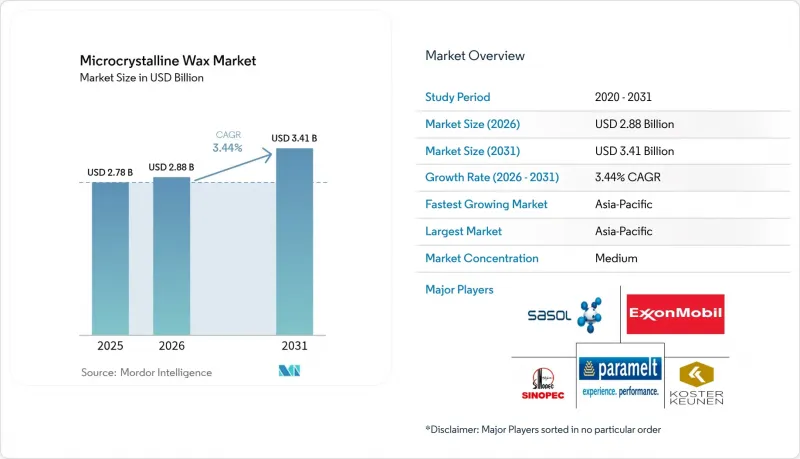
根據 Mordor Intelligence 預測,微晶蠟市場規模將從 2025 年的 27.8 億美元成長到 2026 年的 28.8 億美元,然後在 2031 年達到 34.1 億美元,2026 年至 2031 年的複合年成長率為 3.44%。
本報告按類型(軟質和硬質)、應用(化妝品和個人護理、蠟燭、黏合劑、包裝、橡膠及其他應用)和地區(亞太地區、北美、歐洲、南美以及中東和非洲)進行細分。市場預測以美元計價。
全球微晶蠟市場趨勢與洞察
擴大化妝品和個人保健產品製造地
亞太地區的契約製造生產商正在擴大唇膏、潤唇膏和高階護膚品的生產,其中微晶蠟在改善熱帶氣候下的質地、防止汗液引起的分解以及穩定乳液方面發揮關鍵作用。中國和印度的大規模OEM工廠正利用其低廉的人事費用和強大的供應鏈,推動可與植物油無縫混合的軟性等級產品的大規模消費。美國FDA和歐盟的批准簡化了跨境運輸,使品牌能夠在不影響合規性的前提下,將生產集中在少數大型工廠。印尼、越南和菲律賓不斷成長的中產階級消費推動了新唇膏產品兩位數的成長,進一步支撐了區域需求。儘管倡導「清潔美妝」的品牌正在試驗混合植物蠟,但它們仍然依賴結晶質蠟來保持色彩品質和產品穩定性。因此,即使在日益成長的永續發展壓力下,結晶質蠟市場仍保持著強勁的銷售量。
醫藥和醫療領域的需求不斷成長
製藥研發人員正利用結晶質蠟來建構緩釋基質,以確保在 8 至 12 小時內實現均勻的劑量釋放。微晶蠟的化學惰性使其可直接與活性成分壓片,無需額外的阻隔包衣,從而縮短研發週期。隨著美國、德國和日本等老化市場慢性病盛行率的上升,市場對採用蠟基顆粒技術的長效鎮痛和內分泌治療藥物的需求日益成長。 ICH Q12 下的全球監管協調正在推動跨區域應用的增加,並降低蠟基製劑的邊際成本。因此,合約研發生產機構 (CDMO) 正在簽訂長期供應契約,以確保品質規格的一致性,從而推動了對高純度硬蠟組分的穩定需求。
原油供應波動會影響原料的供應。
地緣政治緊張局勢和歐佩克減產導致真空殘渣油長期短缺,迫使煉油商優先生產利潤更高的燃料油而非特種蠟產品。現貨價格飆升導致微晶蠟原料成本上漲高達22%,擠壓了沒有長期提貨合約的獨立調配商的利潤空間。西歐和東非等依賴進口的經濟體正面臨最嚴重的供應中斷,因為運費溢價加劇了價格波動。擁有原油貿易部門的大型綜合公司可以透過避險來減輕影響,但小型公司則面臨斷貨風險,並可能損害客戶信心。中期來看,多元化發展合成蠟和生質能衍生蠟可以部分緩解影響,但擴大生產規模仍需要大量資金和時間。
細分市場分析
自2025年初以來,硬質蠟的成長勢頭強勁,預計到2031年將以4.01%的複合年成長率成長。同時,軟質蠟保持其主導地位,在2025年佔總銷售額的61.45%。 1型層壓蠟(使用溫度為度C度C)用於保護相紙;2型塗佈蠟(使用溫度為81 度C)用於增強食品接觸板;3型固化蠟(使用溫度為90 度C)用於保護變壓器繞組。這些精細的晶體結構即使在持續高溫下也能提供優異的介電強度和抗彎折性能,這些特性越來越受到電動車電容器製造商的重視。
基於差示掃描量熱法、針刺測試和環球軟化點試驗的實驗室規程確保了批次間的一致性,並符合 ISO 22007 精度標準。正在進行的研究和開發探索了奈米二氧化矽摻雜技術,旨在將彈性模量提高 18%,同時不影響黏度,從而在電磁干擾屏蔽塗料領域開闢新的細分市場。同時,柔軟性等級產品在口紅、潤唇膏和紙板層壓等應用領域佔據了大部分銷售量佔有率,這些應用對柔軟性和保油性要求極高。亞太地區代工填充廠的快速擴張為柔軟性等級產品的穩定生產提供了保障,鞏固了基準需求,即使硬質等級產品的加值創新不斷湧現。
區域分析
預計到2025年,亞太地區將佔全球銷售額的46.85%,並將在2031年之前以3.82%的複合年成長率持續成長,這主要得益於兩大因素:煉油廠投資和消費品製造業的發展。印度計劃在2030年將其煉油能力提高80萬桶/日,從而擴大對當地蠟生產商的原料供應。在中國,垂直一體化的石化聯合企業,加上日益成長的化妝品消費需求,正在確保其成本優勢。日本和韓國則專注於為電子產品生產高純度硬質蠟,並利用其嚴格的製程控制和先進的品管(QC)基礎設施。東南亞國協憑藉其關稅優勢和靠近原料產地的地理優勢,正在吸引契約製造,從而增強區域自給自足能力。
北美憑藉其專業的配料商和專注於研發的精煉商,保持著技術領先地位。 FDA對食品接觸應用的批准以及USP對藥用級產品的認證,確保了可預測的監管路徑,從而支撐了下游消費的穩定成長。美國國家實驗室正在研發新一代生物基蠟混合物,而墨西哥蓬勃發展的汽車組裝和包裝產業叢集也刺激了對黏合劑和塗料的需求。加拿大當局透過確認純化結晶質對人體健康的風險極低,正在提高公眾對該產品的社會接受度。
在歐洲,嚴格的永續性法規與特種產品創新之間正尋求平衡。品牌商面臨MOAH和MOSH純度要求,這促使供應商實施線上GC-FID監測系統並採用雙氫化製程。德國正在推進一個循環碳項目,該項目利用FISCHER-TROPSCH法將廢棄生質能氣化並轉化為蠟中間體;荷蘭則正在進行先導計畫。東歐的煉油商正在改造加氫裂解裝置,以從當地原油供應中提取附加價值,從而增加當地供應。此外,巴西個人保健產品出口的快速成長以及沙烏地阿拉伯在特種化學品領域的投資框架,分別預示著南美洲和中東及非洲市場的新成長跡象。
其他好處:
- Excel格式的市場預測(ME)表
- 3個月的分析師支持
目錄
第1章:引言
- 研究假設和市場定義
- 調查範圍
第2章:調查方法
第3章執行摘要
第4章 市場狀況
- 市場概覽
- 市場促進因素
- 擴大化妝品和個人保健產品生產基地
- 醫藥和醫療領域的需求不斷成長
- 熱熔膠中用微晶蠟取代黏合劑
- 石油煉製中生物基原料的轉型與發展
- 用於永續包裝的低溫食品接觸塗料的發展
- 市場限制因素
- 原油供應波動影響著原料的供應。
- 高階化妝品中礦物衍生成分面臨監管阻力
- 對船舶排放蠟殘留物有嚴格的規定
- 價值鏈分析
- 波特五力模型
- 價格分析
- 貿易分析
第5章 市場規模與成長預測
- 按類型
- 靈活的
- 難的
- 透過使用
- 化妝品和個人護理
- 蠟燭
- 黏合劑
- 包裝
- 橡皮
- 其他用途
- 按地區
- 亞太地區
- 中國
- 日本
- 印度
- 韓國
- 東南亞國協
- 其他亞太國家
- 北美洲
- 美國
- 加拿大
- 墨西哥
- 歐洲
- 德國
- 英國
- 法國
- 義大利
- 西班牙
- 俄羅斯
- 北歐國家
- 其他歐洲國家
- 南美洲
- 巴西
- 阿根廷
- 其他南美國家
- 中東和非洲
- 沙烏地阿拉伯
- 南非
- 其他中東和非洲國家
- 亞太地區
第6章 競爭情勢
- 市場集中度
- 策略趨勢
- 市佔率和排名分析
- 公司簡介
- Alfa Chemicals
- Alpha Wax
- Blended Waxes Inc.
- The British Wax Refining Company Ltd
- Calumet, Inc.,
- Clarus Specialty Products
- Exxon Mobil Corporation
- Indian Oil Corp. Ltd.
- Industrial Raw Materials LLC.
- Koster Keunen
- Kerax
- NIPPON SEIRO CO., LTD.
- Paramelt BV
- Sasol
- Sonneborn LLC
- The International Group Inc.
第7章 市場機會與未來展望
According to Mordor Intelligence, the microcrystalline wax market size is expected to grow from USD 2.78 billion in 2025 to USD 2.88 billion in 2026 and is forecast to reach USD 3.41 billion by 2031 at 3.44% CAGR over 2026-2031.
This report is Segmented by Type (Flexible and Hard), Application (Cosmetics and Personal Care, Candles, Adhesives, Packaging, Rubber, and Other Applications), and Geography (Asia-Pacific, North America, Europe, South America, and Middle-East and Africa). The Market Forecasts are Provided in Terms of Value (USD).
Global Microcrystalline Wax Market Trends and Insights
Expanding Cosmetics and Personal-Care Manufacturing Bases
Asia-Pacific contract manufacturers scale up lipstick, balm and premium skin-care production, and microcrystalline wax enhances texture, prevents sweating and stabilizes emulsions under tropical temperatures. Large OEM hubs in China and India leverage lower labor costs and robust supply chains, raising bulk consumption for flexible grades that blend seamlessly with plant oils. FDA and EU approvals simplify cross-border shipping, allowing brands to consolidate output in a few mega-facilities without compromising compliance. Rising middle-class spending in Indonesia, Vietnam and the Philippines sustains double-digit growth in lip-color launches, further anchoring regional demand. Brands pursuing "clean beauty" narratives trial plant wax blends yet still rely on microcrystalline fractions to maintain payoff quality and product stability. Consequently, the microcrystalline wax market continues to secure volumes even as sustainability pressures intensify.
Growing Demand from Pharmaceutical and Medical Applications
Drug formulators adopt microcrystalline wax to build sustained-release matrices that ensure dose uniformity across 8-12 hour windows. Its chemical inertness allows direct compression with active ingredients, avoiding additional barrier coatings and shortening development timelines. Chronic disease prevalence in aging markets such as the United States, Germany and Japan elevates demand for long-acting pain management and endocrinology therapies, both of which leverage wax-based pellet technology. Global regulatory harmonization under ICH Q12 boosts cross-regional filings, lowering marginal costs for wax-enabled formulations. Contract development manufacturing organizations (CDMOs) therefore lock in long-term supply contracts to secure consistent grade specifications, reinforcing steady offtake for high-purity hard wax fractions.
Crude-Oil Supply Volatility Impacting Feedstock Availability
Geopolitical tensions and OPEC production curbs periodically tighten vacuum-resid availability, leading refiners to prioritize higher-margin fuels rather than specialty wax streams. Spot price spikes raise microcrystalline feed costs by up to 22%, compressing margins for independent compounders lacking long-term offtake contracts. Import-dependent economies in Western Europe and East Africa face the sharpest disruptions, since freight premiums amplify volatility. Integrated majors with captive crude trade desks cushion the impact through hedging, but smaller players risk stock-outs that erode customer trust. Over the medium term, diversification into synthetic and biomass-derived waxes offers partial mitigation, yet scaling remains capital intensive and time consuming.
Other drivers and restraints analyzed in the detailed report include:
- Substitution of Paraffin with Microcrystalline Wax in Hot-Melt Adhesives
- Shift Toward Bio-Based Feedstock Upgrading at Refineries
- Regulatory Pushback on Mineral-Based Ingredients in Premium Cosmetics
For complete list of drivers and restraints, kindly check the Table Of Contents.
Segment Analysis
Hard-type grades opened 2025 with stronger momentum, forecast to climb at a 4.01% CAGR to 2031 while flexible grades maintained 61.45% revenue dominance in 2025. Type 1 laminating wax at 65 °C safeguards photographic paper, Type 2 coating wax at 81 °C fortifies food-contact boards, and Type 3 hardening wax at 90 °C protects transformer windings. These fine-crystal structures impart superior dielectric strength and resist slump under sustained heat, attributes increasingly valued by electric-vehicle capacitor makers.
Laboratory protocols relying on differential scanning calorimetry, needle penetration and ring-and-ball softening point testing ensure batch homogeneity, meeting ISO 22007 precision benchmarks. Ongoing R&D explores nano-silica doping that lifts modulus by 18% without sacrificing viscosity, opening new niches in EMI shielding coatings. Flexible grades, meanwhile, dominate lipstick, balm and board-laminating volumes where pliability and oil-binding are critical. Rapid expansion of APAC contract filling plants underpins consistent throughput for flexible fractions, anchoring baseline demand even as hard-grade innovations lift value capture.
Complete Report Scope:
- By Type
- Flexible
- Hard
- By Application
- Cosmetics and Personal Care
- Candles
- Adhesives
- Packaging
- Rubber
- Other Applications
- By Geography
- Asia-Pacific
- China
- Japan
- India
- South Korea
- ASEAN Countries
- Rest of Asia-Pacific
- North America
- United States
- Canada
- Mexico
- Europe
- Germany
- United Kingdom
- France
- Italy
- Spain
- Russia
- NORDIC Countries
- Rest of Europe
- South America
- Brazil
- Argentina
- Rest of South America
- Middle-East and Africa
- Saudi Arabia
- South Africa
- Rest of Middle-East and Africa
- Asia-Pacific
Geography Analysis
Asia-Pacific commanded 46.85% revenue in 2025 and is projected to expand at a 3.82% CAGR through 2031 on the twin engines of refinery investment and consumer-product manufacturing. India plans to add 800,000 barrels per day of refining capacity by 2030, broadening feedstock access for local wax producers. China's vertically integrated petrochemical complexes, coupled with lifestyle-driven cosmetics uptake, secure cost leadership. Japan and South Korea concentrate on high-purity hard grades for electronics, leveraging tight process controls and advanced QC infrastructure. ASEAN nations attract contract manufacturing owing to tariff advantages and proximity to raw-material supply, reinforcing regional self-sufficiency.
North America retains technological leadership via specialty formulators and R&D-oriented refiners. FDA clearances for food-contact use and USP listings for pharmaceutical grades provide predictable regulatory paths, supporting steady downstream consumption. The United States develops next-gen bio-based wax blends within national labs, while Mexico's expanding auto-assembly and packaging clusters stimulate adhesive and coating demand. Canadian authorities confirmed negligible human-health risk from refined microcrystalline fractions, bolstering public acceptance.
Europe balances stringent sustainability rules with specialty innovation. Brands face MOAH and MOSH purity mandates, prompting suppliers to install inline GC-FID monitoring and adopt double-hydrogenation routes. Germany champions circular-carbon projects that gasify waste biomass into Fischer-Tropsch wax intermediates, whereas the Netherlands pilots marine-biogenic feedstock. Eastern European refiners retrofit hydrocrackers to capture value from regional crude flows, raising local availability. Elsewhere, Brazil's booming personal-care exports and Saudi Arabia's specialty-chem investment frameworks hint at incremental pockets of growth in South America and Middle-East and Africa, respectively.
- Alfa Chemicals
- Alpha Wax
- Blended Waxes Inc.
- The British Wax Refining Company Ltd
- Calumet, Inc.,
- Clarus Specialty Products
- Exxon Mobil Corporation
- Indian Oil Corp. Ltd.
- Industrial Raw Materials LLC.
- Koster Keunen
- Kerax
- NIPPON SEIRO CO., LTD.
- Paramelt B.V
- Sasol
- Sonneborn LLC
- The International Group Inc.
Additional Benefits:
- The market estimate (ME) sheet in Excel format
- 3 months of analyst support
TABLE OF CONTENTS
1 Introduction
- 1.1 Study Assumptions and Market Definition
- 1.2 Scope of the Study
2 Research Methodology
3 Executive Summary
4 Market Landscape
- 4.1 Market Overview
- 4.2 Market Drivers
- 4.2.1 Expanding Cosmetics and Personal-Care Manufacturing Bases
- 4.2.2 Growing Demand from Pharmaceutical and Medical Applications
- 4.2.3 Substitution of Paraffin with Microcrystalline Wax in Hot-Melt Adhesives
- 4.2.4 Shift Toward Bio-Based Feedstock Upgrading at Refineries
- 4.2.5 Growth of Low-Temperature Food-Contact Coatings for Sustainable Packaging
- 4.3 Market Restraints
- 4.3.1 Crude-Oil Supply Volatility Impacting Feedstock Availability
- 4.3.2 Regulatory Pushback on Mineral-Based Ingredients in Premium Cosmetics
- 4.3.3 Tight Marine Discharge Regulations on Wax Residues
- 4.4 Value Chain Analysis
- 4.5 Porter's Five Forces
- 4.5.1 Bargaining Power of Suppliers
- 4.5.2 Bargaining Power of Consumers
- 4.5.3 Threat of New Entrants
- 4.5.4 Threat of Substitute Products and Services
- 4.5.5 Degree of Competition
- 4.6 Price Analysis
- 4.7 Trade Analysis
5 Market Size and Growth Forecasts (Value)
- 5.1 By Type
- 5.1.1 Flexible
- 5.1.2 Hard
- 5.2 By Application
- 5.2.1 Cosmetics and Personal Care
- 5.2.2 Candles
- 5.2.3 Adhesives
- 5.2.4 Packaging
- 5.2.5 Rubber
- 5.2.6 Other Applications
- 5.3 By Geography
- 5.3.1 Asia-Pacific
- 5.3.1.1 China
- 5.3.1.2 Japan
- 5.3.1.3 India
- 5.3.1.4 South Korea
- 5.3.1.5 ASEAN Countries
- 5.3.1.6 Rest of Asia-Pacific
- 5.3.2 North America
- 5.3.2.1 United States
- 5.3.2.2 Canada
- 5.3.2.3 Mexico
- 5.3.3 Europe
- 5.3.3.1 Germany
- 5.3.3.2 United Kingdom
- 5.3.3.3 France
- 5.3.3.4 Italy
- 5.3.3.5 Spain
- 5.3.3.6 Russia
- 5.3.3.7 NORDIC Countries
- 5.3.3.8 Rest of Europe
- 5.3.4 South America
- 5.3.4.1 Brazil
- 5.3.4.2 Argentina
- 5.3.4.3 Rest of South America
- 5.3.5 Middle-East and Africa
- 5.3.5.1 Saudi Arabia
- 5.3.5.2 South Africa
- 5.3.5.3 Rest of Middle-East and Africa
- 5.3.1 Asia-Pacific
6 Competitive Landscape
- 6.1 Market Concentration
- 6.2 Strategic Moves
- 6.3 Market Share(%)/Ranking Analysis
- 6.4 Company Profiles (includes Global level Overview, Market level overview, Core Segments, Financials as available, Strategic Information, Market Rank/Share for key companies, Products and Services, and Recent Developments)
- 6.4.1 Alfa Chemicals
- 6.4.2 Alpha Wax
- 6.4.3 Blended Waxes Inc.
- 6.4.4 The British Wax Refining Company Ltd
- 6.4.5 Calumet, Inc.,
- 6.4.6 Clarus Specialty Products
- 6.4.7 Exxon Mobil Corporation
- 6.4.8 Indian Oil Corp. Ltd.
- 6.4.9 Industrial Raw Materials LLC.
- 6.4.10 Koster Keunen
- 6.4.11 Kerax
- 6.4.12 NIPPON SEIRO CO., LTD.
- 6.4.13 Paramelt B.V
- 6.4.14 Sasol
- 6.4.15 Sonneborn LLC
- 6.4.16 The International Group Inc.
7 Market Opportunities and Future Outlook
- 7.1 White-space and Unmet-Need Assessment

 2026-2030年全球微晶蠟市場
 漿果類水果蠟市場規模、佔有率和成長分析:按蠟類型、漿果類型、應用、最終用戶、配銷通路和地區分類——2026年至2033年行業預測
 蠟:市場佔有率分析、行業趨勢和統計數據、成長預測(2026-2031 年)
 蒙坦蠟市場:按類型、形態、等級、應用、終端用戶產業和分銷管道分類-2026-2032年全球市場預測蠟市場:2026-2032年全球市場預測(依產品類型、製造流程、實體形態、應用及分銷通路分類)Montan Wax:市場佔有率分析、產業趨勢與統計、成長預測(2026-2031)
 蠟市場機會、成長要素、產業趨勢分析及2026-2035年預測
 蠟市場規模、佔有率和趨勢分析報告:按產品、應用、地區和細分市場預測(2026-2033 年)
 蠟市場報告:按類型、形態、應用和地區分類 2026-2034 年
 合成蠟市場:按類型、應用和地區分類