


 |
市場調查報告書
商品編碼
2120508
蠟:市場佔有率分析、行業趨勢和統計數據、成長預測(2026-2031 年)Wax - Market Share Analysis, Industry Trends & Statistics, Growth Forecasts (2026 - 2031) |
||||||

※ 本網頁內容可能與最新版本有所差異。詳細情況請與我們聯繫。
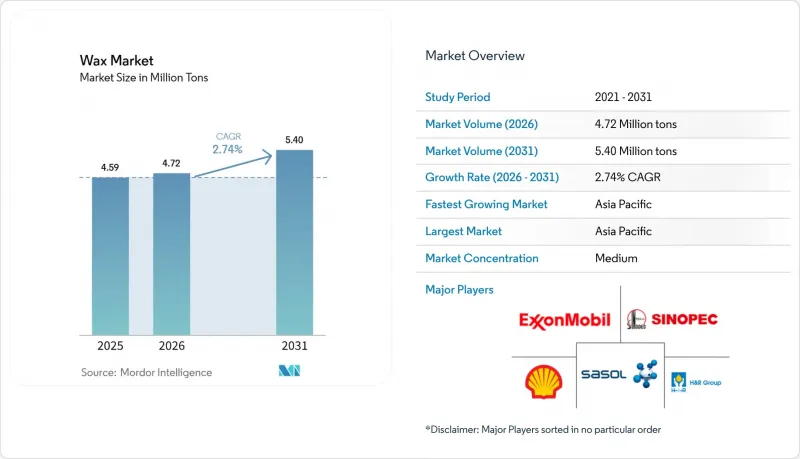
根據 Mordor Intelligence 預測,蠟市場規模將從 2025 年的 459 萬噸和 2026 年的 472 萬噸成長到 2031 年的 540 萬噸,預測期(2026-2031 年)的複合年成長率為 2.74%。
本報告按類型(石蠟和礦物蠟、合成蠟、天然蠟)、應用(蠟燭製造、包裝、化妝品、其他)、等級(食品級、工業級、其他)、形態(固體、粉末、乳液/液體)和地區(亞太地區、北美、歐洲、南美、中東和非洲)進行細分。市場預測以噸為單位。
全球蠟市場趨勢及洞察
亞太地區的電子商務蓬勃發展,推動了對熱熔包裝材料和FT蠟的需求成長。
亞太地區的快速工業化導致蠟的消耗量顯著成長。預計到2025年5月,中國石蠟月出口量將達到70,800噸,顯示包裝製造商的下游需求強勁。沙索公司於2024年8月推出了“SASOLWAX LC100”,瞄準高階電商包裝市場,該產品碳足跡降低了35%。科萊恩公司於2025年4月推出了以米糠為原料的“Ceridust 1310”,該產品在確保印刷油墨性能的同時,還能提升永續性指標。由於目前尚無針對蠟的嚴格法規,ISO 9001認證和品牌碳排放報告已成為供應商選擇的重要考量。
歐洲潔淨標示化妝品市場加速向植物來源和蜂蠟的轉變。
歐洲品牌正在調整配方,以去除合成烴,這導致對小燭樹蠟、巴西棕櫚蠟、米糠蠟和葵花籽蠟替代品的需求增加。 Licocare RBW Vita 能夠複製巴西棕櫚蠟的硬度和光澤,同時將碳足跡降低 80%,並幫助高階品牌實現其範圍 3 目標。蜂蠟仍然具有多功能性,但純素產品線的激增正在推動對替代品的需求,而蜂蜜產量的波動也使供應計劃變得更加複雜。歐盟將於 2028 年 10 月起禁止在沖洗化妝品中使用微塑膠,這促使配方選擇轉向天然調質劑。雖然歐盟法規 1223/2009 和 REACH 法規的合規成本不斷上升,但這些法規也推高了認證級產品的售價。
歐盟的 REACH 法規加強了對玩具和化妝品中 PAH(含石蠟的酒精)的監管。
自2026年4月起,REACH法規修訂版將限制黏土靶、玩具和含石蠟化妝品中多環芳烴(PAHs)的含量為50毫克/公斤。源自鬆散蠟的石蠟本身PAH含量較高,導致氫化處理成本增加,每噸成本增加100至200美元。科萊恩不含PFAS的添加劑產品組合符合這些變化,使公司在高階產品製造商中擁有競爭優勢。該法規也適用於歐盟法規1935/2004下的食品接觸油墨,過渡測試現已納入供應商審核流程。不受REACH法規約束的亞洲出口商仍維持成本優勢,但跨國公司正日益協調各地區的法規,以簡化合規流程。
細分市場分析
預計到2025年,石蠟將佔全球產量的58.12%,這主要得益於中國200萬噸的年產量以及每公斤1.50至2美元的成本優勢。天然蠟的複合年成長率(CAGR)為3.45%,是所有類型中成長最快的。這主要是因為歐洲品牌在推行潔淨標示的同時,更傾向於使用植物來源蠟。合成FT蠟和聚乙烯蠟則佔據了高性能細分市場,例如黏合劑和塗料。 SASOLWAX LC100於2024年上市,其碳足跡減少了35%,使其在高階包裝市場更具吸引力。科萊恩的米糠基Licocare系列是天然蠟低碳創新的典範,凸顯了市場正穩定地擺脫對純礦物蠟的依賴。
儘管中國石蠟出口佔有率維持了蠟市場的流動性,但歐盟更嚴格的多環芳烴(PAH)法規正在推動石蠟與精製結晶質的混合。石蠟因其卓越的香味在蠟燭製造領域仍佔據主導地位,但大豆蠟和椰子蠟的混合物正在逐漸在純素產品線中佔據市場佔有率。結晶質蠟用於特殊橡膠和化妝品,由於其熔點在55-100°C之間,價格較高。巴西棕櫚蠟的年產量為17,844噸,這使得天然蠟供應商在價格談判中擁有優勢。綜上所述,這些趨勢表明,未來十年石蠟的市場佔有率將緩慢但穩定地下降。
2025年,蠟燭產量佔總產量的60.32%,但預計到2031年,化妝品領域將以3.68%的複合年成長率快速成長,這主要得益於不含PFAS和純素產品的重新配方。包裝領域受亞太地區電子商務的推動,大量採用富含蠟的熱熔系統。在橡膠應用領域,輪胎配方中大約使用1份石蠟(phr)以防止臭氧裂解。化妝品級蜂蠟、巴西棕櫚蠟和堪地里拉蠟因其乳化性能和光澤效果,價格為每公斤8-12美元。
熱熔膠需求的成長帶動了對窄分子量分佈聚乙烯和費托合成蠟的需求增加。蠟筆、拋光劑和電絕緣材料為結晶質蠟提供了小眾但穩定的市場。科萊恩的Ceridust 1310將米糠蠟融入印刷油墨中,凸顯了跨應用創新。如今,注重健康的蠟燭全年銷售,固態蠟仍然佔據主導地位,從而推動了對高熔點石蠟的需求。化妝品行業的顯著成長表明,與美容應用相關的蠟的市場規模將進一步擴大。
區域分析
預計到2025年,亞太地區將佔全球蠟產量的45.54%,並在2031年之前以3.27%的複合年成長率成長,為該地區最高增速。這主要得益於中國200萬噸的產量以及強勁的電商包裝需求。中國石油天然氣集團公司(中石油)的蠟生產設施平均運轉率率高達90%,凸顯了供應的可靠性。印度的國內蠟燭和化妝品產業叢集正開始逐步取代進口,但仍依賴來自中國和中東的散蠟。
北美受惠於頁岩氣帶來的成本優勢。與亨利樞紐價格相當的乙烷價格維持了聚乙烯蠟市場的競爭。高階蠟燭和自有品牌包裝的銷售提振了市場需求,而墨西哥已確立了其作為低成本加工商的地位,為美國的汽車和電子商務管道供貨。隨著乙烷裂解裝置的持續擴張,該地區的蠟市場預計將繼續享有結構性的投入成本優勢。
歐洲面臨諸多挑戰。 REACH法規中的多環芳烴(PAH)限制迫使供應商投資加氫工藝,導致每噸損益平衡點提高150美元。儘管德國和法國的潔淨標示計劃推動了對天然蠟的需求成長,但由於煉油廠關閉(例如殼牌退出其蠟化業務),本地供應日益緊張。南美洲嚴重依賴巴西17,844噸的巴西棕櫚蠟產量作為出口收入來源,而巴西石油公司(Petrobras)則從其日產185.1萬桶原油的煉油系統中回收副產品石蠟。儘管中東和非洲原油資源豐富,但仍是蠟的淨進口地區。沙烏地阿拉伯在2023年進口了2,077噸蠟,凸顯了原料供應與專業加工能力之間的不匹配。
其他福利
- Excel格式的市場預測(ME)表
- 3個月的分析師支持
目錄
第1章:引言
- 研究假設和市場定義
- 調查範圍
第2章:調查方法
第3章執行摘要
第4章 市場狀況
- 市場概覽
- 市場促進因素
- 亞太地區的電子商務蓬勃發展,推動了對熱熔包裝材料和FT蠟的需求成長。
- 歐洲潔淨標示化妝品市場加速向植物來源和蜂蠟的轉變。
- 由於北美乙烷裂解裝置的擴張,PE蠟的成本曲線正在下降。
- 隨著健康潮流的興起,蠟燭優質化和全球對石蠟的需求不斷成長,市場正在擴大。
- 以天然蠟取代飽和脂肪的生物基油凝膠
- 市場限制因素
- 歐盟的 REACH 法規加強了對玩具和化妝品中使用的石蠟中多環芳烴 (PAH) 的限制。
- 原油和天然氣價格的波動給合成油和石蠟產品的利潤率帶來了壓力。
- 純素化妝品配方變更:用油性成分取代蜂蠟。
- 價值鏈分析
- 波特五力模型
第5章 市場規模與成長預測
- 按類型
- 石蠟和礦物蠟
- 合成蠟
- 天然蠟
- 透過使用
- 蠟燭製造
- 包裝
- 化妝品
- 黏合劑
- 橡皮
- 其他
- 按年級
- 食品級
- 工業級
- 化妝品級/醫藥級
- 按形式
- 固體的
- 粉末
- 乳液/液體
- 按地區
- 亞太地區
- 中國
- 印度
- 日本
- 韓國
- ASEAN
- 其他亞太國家
- 北美洲
- 美國
- 加拿大
- 墨西哥
- 歐洲
- 德國
- 英國
- 法國
- 義大利
- 西班牙
- 其他歐洲國家
- 南美洲
- 巴西
- 阿根廷
- 其他南美國家
- 中東和非洲
- 沙烏地阿拉伯
- 南非
- 其他中東和非洲國家
- 亞太地區
第6章 競爭情勢
- 市場集中度
- 策略趨勢
- 市佔率和排名分析
- 公司簡介
- BASF SE
- BP plc
- Calumet, Inc.
- CALWAX
- China Petrochemical Corporation
- CLARIANT
- Evonik Industries AG
- Exxon Mobil Corporation
- H&R GROUP
- Honeywell International Inc.
- Ilumina Wax doo
- Koster Keunen
- Moeve
- NIPPON SEIRO CO., LTD.
- Petrobras
- Petro-Canada Lubricants Inc.
- Sasol Ltd.
- Shell plc
- Strahl & Pitsch LLC
- The International Group, Inc.
第7章 市場機會與未來展望
According to Mordor Intelligence, the wax market size is projected to expand from 4.59 million tons in 2025 and 4.72 million tons in 2026 to 5.40 million tons by 2031, at a CAGR of 2.74% during the forecast period (2026-2031).
This report is Segmented by Type (Paraffin and Mineral Wax, Synthetic Wax, and Natural Wax), Application (Candle Making, Packaging, Cosmetics, and More), Grade (Food Grade, Industrial Grade, and More), Form (Solid, Powdered, and Emulsions and Liquids), and Geography (Asia-Pacific, North America, Europe, South America, Middle East and Africa). The Market Forecasts are Provided in Terms of Volume (Tons).
Global Wax Market Trends and Insights
Asia-Pacific E-commerce Boom Boosting Hot-Melt Packaging and FT Wax Demand
Asia-Pacific's wax consumption is growing significantly owing to rapid industrialization in the region. Monthly Chinese paraffin exports hit 70,800 tons in May 2025, evidence of strong downstream demand from packaging converters. Sasol introduced SASOLWAX LC100 in August 2024, cutting the product's carbon footprint by 35% to target premium e-commerce packaging. Clariant's rice-bran-based Ceridust 1310, launched in April 2025, secures printing-ink performance with improved sustainability metrics. With no stringent wax-specific regulation, ISO 9001 certification and brand carbon reporting now influence supplier selection.
Clean-Label Cosmetics in Europe Accelerating Plant and Bee-Based Wax Shift
European brands are reformulating to exclude synthetic hydrocarbons, spurring demand for candelilla, carnauba, rice-bran, and sunflower wax alternatives. Licocare RBW Vita reduces the carbon footprint by 80% compared with carnauba yet replicates hardness and gloss, helping premium brands meet Scope-3 goals. Beeswax retains multifunctional appeal but faces substitution as vegan lines proliferate, and fluctuating honey output makes supply planning complex. The EU microplastics ban in rinse-off cosmetics, effective October 2028, tips formulation choices toward natural texturizers. Compliance costs rise under EU Regulation 1223/2009 and REACH, but these same rules underpin higher selling prices for certified grades.
European Union REACH PAH Limits Tightening on Paraffin in Toys and Cosmetics
From April 2026, the REACH amendment caps polycyclic aromatic hydrocarbons in clay targets, toys, and paraffin-bearing cosmetics at 50 mg/kg. Slack-wax-based paraffin carries higher inherent PAH content, prompting investments in hydrotreating that add USD 100-200 per ton to cost. Clariant's PFAS-free additives portfolio dovetails with these changes, positioning the company favorably among premium formulators. The restriction spills into food-contact inks under EU Regulation 1935/2004, where migration testing now forms part of supplier audits. Asian exporters not bound by REACH retain a cost edge, yet multinationals increasingly harmonize across regions to simplify compliance.
Other drivers and restraints analyzed in the detailed report include:
- North America Ethane-Cracker Build-Out Lowering PE-Wax Cost Curve
- Candle Premiumisation and Wellness Trend Expanding Global Paraffin Demand
- Crude and Gas Price Volatility Squeezing Synthetic and Paraffin Margins
For complete list of drivers and restraints, kindly check the Table Of Contents.
Segment Analysis
Paraffin held 58.12% of 2025 volume, anchored by China's 2 million-ton output and a cost advantage of USD 1.50-2.00 per kg. Natural grades are rising at a 3.45% CAGR, the highest among types, as European brands favor plant-derived waxes for cleaner labels. Synthetic FT and polyethylene waxes fill high-performance niches in hot-melt adhesives and coatings. SASOLWAX LC100, unveiled in 2024, lowers carbon footprint by 35%, expanding premium packaging appeal. Clariant's rice-bran Licocare series demonstrates low-carbon innovation in natural waxes, underscoring a steady shift away from pure mineral grades.
China's share of paraffin exports keeps the wax market liquid, but tightening PAH norms in the EU incentivize blends with purified microcrystalline fractions. While paraffin remains king in candle making due to superior scent throw, soy and coconut blends nibble at share in vegan lines. Microcrystalline fractions service specialty rubber and cosmetics, fetching premiums for 55-100 °C melting points. Brazil's 17,844-ton carnauba output gives natural wax suppliers bargaining power in price negotiations. Collectively, these dynamics foreshadow a slow yet steady erosion of paraffin's wax market share over the next decade.
Candle making absorbed 60.32% of 2025 volume, yet cosmetics will expand the fastest at 3.68% CAGR through 2031, driven by PFAS-free and vegan reformulations. Packaging, powered by Asia-Pacific e-commerce, benefits from wax-rich hot-melt systems. Rubber applications rely on paraffin at roughly 1 phr in tire formulas to counter ozone cracking. Cosmetic-grade beeswax, carnauba, and candelilla deliver emulsification and gloss, justifying prices of USD 8-12 per kg.
Hot-melt demand lifts polyethylene and FT fractions with narrow molecular-weight distributions. Crayons, polishes, and electrical insulation represent niche but sticky outlets for microcrystalline grades. Clariant's Ceridust 1310 brings rice-bran wax into printing inks, spotlighting cross-application innovation. Wellness-inspired candles, now sold year-round, pull high-melting-point paraffin, keeping solid waxes dominant. Cosmetics' superior growth trajectory nonetheless signals that the wax market size linked to beauty applications will capture incremental value.
Complete Report Scope:
- By Type
- Paraffin and Mineral Wax
- Synthetic Wax
- Natural Wax
- By Application
- Candle Making
- Packaging
- Cosmetics
- Adhesives
- Rubber
- Other Applications
- By Grade
- Food Grade
- Industrial Grade
- Cosmetic and Pharmaceutical Grade
- By Form
- Solid
- Powdered
- Emulsions and Liquids
- By Geography
- Asia-Pacific
- China
- India
- Japan
- South Korea
- ASEAN
- Rest of Asia-Pacific
- North America
- United States
- Canada
- Mexico
- Europe
- Germany
- United Kingdom
- France
- Italy
- Spain
- Rest of Europe
- South America
- Brazil
- Argentina
- Rest of South America
- Middle East and Africa
- Saudi Arabia
- South Africa
- Rest of Middle East and Africa
- Asia-Pacific
Geography Analysis
Asia-Pacific controlled 45.54% of 2025 global volume and is forecast to expand at a region-leading 3.27% CAGR through 2031, propelled by China's 2 million-ton output and robust e-commerce packaging. Utilization at CNPC's wax units averages 90%, underscoring supply reliability. India's domestic candle and cosmetic clusters start to displace imports, yet still rely on slack wax cargos from China and the Middle East.
North America benefits from a shale-gas-driven cost edge: ethane at Henry Hub parity keeps polyethylene wax competitive. Premium candle sales and private-label packaging bolster demand, while Mexico positions itself as a low-cost converter feeding U.S. auto and e-commerce channels. Continued ethane cracker expansions suggest that the region's wax market will enjoy a structural input-cost advantage.
Europe confronts headwinds: REACH PAH limits push suppliers to invest in hydrotreating, raising break-evens by USD 150 per ton. Clean-label initiatives in Germany and France boost natural wax uptake, but refinery exits-such as Shell's Wesseling pivot-tighten local supply. South America relies heavily on Brazil's 17,844-ton carnauba crop for export revenues, while Petrobras captures byproduct paraffin from its 1.851 million bpd refining system. Middle East and Africa remain net importers despite abundant crude: Saudi Arabia imported 2,077 tons of wax in 2023, highlighting a mismatch between feedstock availability and specialty processing.
- BASF SE
- BP p.l.c.
- Calumet, Inc.
- CALWAX
- China Petrochemical Corporation
- CLARIANT
- Evonik Industries AG
- Exxon Mobil Corporation
- H&R GROUP
- Honeywell International Inc.
- Ilumina Wax d.o.o.
- Koster Keunen
- Moeve
- NIPPON SEIRO CO., LTD.
- Petrobras
- Petro-Canada Lubricants Inc.
- Sasol Ltd.
- Shell plc
- Strahl & Pitsch LLC
- The International Group, Inc.
Additional Benefits:
- The market estimate (ME) sheet in Excel format
- 3 months of analyst support
TABLE OF CONTENTS
1 Introduction
- 1.1 Study Assumptions and Market Definition
- 1.2 Scope of the Study
2 Research Methodology
3 Executive Summary
4 Market Landscape
- 4.1 Market Overview
- 4.2 Market Drivers
- 4.2.1 Asia-Pacific e-commerce boom boosting hot-melt packaging and FT wax demand
- 4.2.2 Clean-label cosmetics in Europe accelerating plant and bee-based wax shift
- 4.2.3 North America ethane-cracker build-out lowering PE-wax cost curve
- 4.2.4 Candle premiumisation and wellness trend expanding global paraffin demand
- 4.2.5 Bio-based oleogels replacing saturated fats with natural waxes
- 4.3 Market Restraints
- 4.3.1 European Union REACH PAH limits tightening on paraffin in toys and cosmetics
- 4.3.2 Crude and gas price volatility squeezing synthetic and paraffin margins
- 4.3.3 Vegan-cosmetic reformulations substituting beeswax with oleochemicals
- 4.4 Value Chain Analysis
- 4.5 Porter's Five Forces
- 4.5.1 Bargaining Power of Suppliers
- 4.5.2 Bargaining Power of Buyers
- 4.5.3 Threat of New Entrants
- 4.5.4 Threat of Substitutes
- 4.5.5 Degree of Competition
5 Market Size and Growth Forecasts (Volume)
- 5.1 By Type
- 5.1.1 Paraffin and Mineral Wax
- 5.1.2 Synthetic Wax
- 5.1.3 Natural Wax
- 5.2 By Application
- 5.2.1 Candle Making
- 5.2.2 Packaging
- 5.2.3 Cosmetics
- 5.2.4 Adhesives
- 5.2.5 Rubber
- 5.2.6 Other Applications
- 5.3 By Grade
- 5.3.1 Food Grade
- 5.3.2 Industrial Grade
- 5.3.3 Cosmetic and Pharmaceutical Grade
- 5.4 By Form
- 5.4.1 Solid
- 5.4.2 Powdered
- 5.4.3 Emulsions and Liquids
- 5.5 By Geography
- 5.5.1 Asia-Pacific
- 5.5.1.1 China
- 5.5.1.2 India
- 5.5.1.3 Japan
- 5.5.1.4 South Korea
- 5.5.1.5 ASEAN
- 5.5.1.6 Rest of Asia-Pacific
- 5.5.2 North America
- 5.5.2.1 United States
- 5.5.2.2 Canada
- 5.5.2.3 Mexico
- 5.5.3 Europe
- 5.5.3.1 Germany
- 5.5.3.2 United Kingdom
- 5.5.3.3 France
- 5.5.3.4 Italy
- 5.5.3.5 Spain
- 5.5.3.6 Rest of Europe
- 5.5.4 South America
- 5.5.4.1 Brazil
- 5.5.4.2 Argentina
- 5.5.4.3 Rest of South America
- 5.5.5 Middle East and Africa
- 5.5.5.1 Saudi Arabia
- 5.5.5.2 South Africa
- 5.5.5.3 Rest of Middle East and Africa
- 5.5.1 Asia-Pacific
6 Competitive Landscape
- 6.1 Market Concentration
- 6.2 Strategic Moves
- 6.3 Market Share/Ranking Analysis
- 6.4 Company Profiles (includes Global-level Overview, Market-level Overview, Core Segments, Financials, Strategic Info, Market Rank/Share, Products and Services, Recent Developments)
- 6.4.1 BASF SE
- 6.4.2 BP p.l.c.
- 6.4.3 Calumet, Inc.
- 6.4.4 CALWAX
- 6.4.5 China Petrochemical Corporation
- 6.4.6 CLARIANT
- 6.4.7 Evonik Industries AG
- 6.4.8 Exxon Mobil Corporation
- 6.4.9 H&R GROUP
- 6.4.10 Honeywell International Inc.
- 6.4.11 Ilumina Wax d.o.o.
- 6.4.12 Koster Keunen
- 6.4.13 Moeve
- 6.4.14 NIPPON SEIRO CO., LTD.
- 6.4.15 Petrobras
- 6.4.16 Petro-Canada Lubricants Inc.
- 6.4.17 Sasol Ltd.
- 6.4.18 Shell plc
- 6.4.19 Strahl & Pitsch LLC
- 6.4.20 The International Group, Inc.
7 Market Opportunities and Future Outlook
- 7.1 White-Space and Unmet-Need Assessment

 2026-2030年全球微晶蠟市場
 漿果類水果蠟市場規模、佔有率和成長分析:按蠟類型、漿果類型、應用、最終用戶、配銷通路和地區分類——2026年至2033年行業預測
 微晶蠟:市場佔有率分析、產業趨勢與統計、成長預測(2026-2031)
 蒙坦蠟市場:按類型、形態、等級、應用、終端用戶產業和分銷管道分類-2026-2032年全球市場預測蠟市場:2026-2032年全球市場預測(依產品類型、製造流程、實體形態、應用及分銷通路分類)Montan Wax:市場佔有率分析、產業趨勢與統計、成長預測(2026-2031)
 蠟市場機會、成長要素、產業趨勢分析及2026-2035年預測
 蠟市場規模、佔有率和趨勢分析報告:按產品、應用、地區和細分市場預測(2026-2033 年)
 蠟市場報告:按類型、形態、應用和地區分類 2026-2034 年
 合成蠟市場:按類型、應用和地區分類