


 |
市場調查報告書
商品編碼
2122655
產品生命週期管理(PLM)軟體:市場佔有率分析、產業趨勢與統計及成長預測(2026-2031)Product Lifecycle Management (PLM) Software - Market Share Analysis, Industry Trends & Statistics, Growth Forecasts (2026 - 2031) |
||||||

※ 本網頁內容可能與最新版本有所差異。詳細情況請與我們聯繫。
根據 Mordor Intelligence 預測,產品生命週期管理 (PLM) 軟體市場預計將在 2026 年達到 501.7 億美元,並在 2031 年擴大到 739.1 億美元,2026 年至 2031 年的複合年成長率為 8.06%。
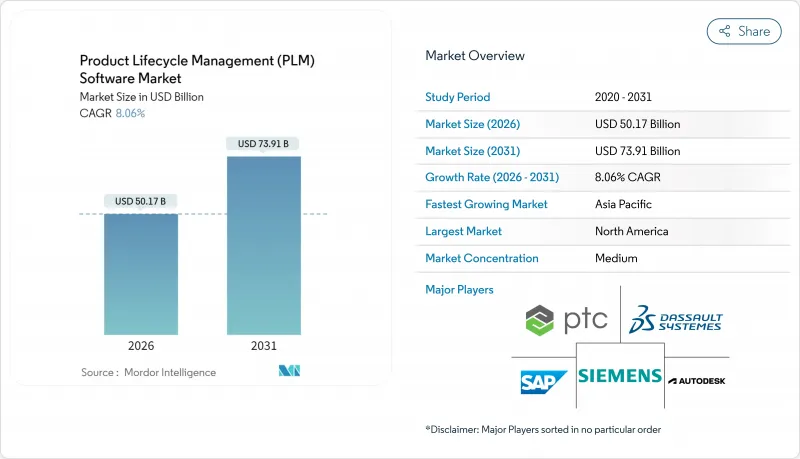
本報告按部署模式(本地部署、雲端部署)、解決方案類型(協作式PDM/CPDM、MCAD整合PLM等)、組織規模(大型企業、中小企業)、最終用戶產業(汽車與交通運輸、航太與國防等)以及地區進行細分。市場預測以美元(USD)為單位。
全球產品生命週期管理 (PLM) 軟體市場趨勢與洞察
一級製造商採用「雲端優先」策略
雲端原生PLM架構降低了對專有資料中心的依賴,並縮短了全球評審週期。西門子報告稱,在2025會計年度第四季度,雲端業務年度經常性收入(ARR)達到其軟體ARR(53億歐元,約合56.7億美元)的49%,顯示其正迅速轉型為SaaS模式。 PTC預測,隨著Windchill+SaaS的普及加速,2026年ARR將成長7-9%。雲端技術的廣泛應用得益於按需運算,它允許生成式設計工作負載在無需過度配置硬體的情況下進行擴展;此外,供應商的即時存取也顯著減少了設計變更指令(ECO)的延遲。
端到端數位線程執行緒的需求日益成長
一條連續的數位線程將需求、CAD、模擬、製造指令和現場數據連接起來,從而實現封閉回路型回饋。美國國家標準與技術研究院 (NIST) 於 2024 年發布了一項框架,建議採用 STEP AP242 及相關模式來整合產品生命週期管理 (PLM)、企業資源規劃 (ERP) 和製造執行系統 (MES) 資料。德勤和西門子已成立“數位線程和數位孿生聯盟”,旨在為航太和汽車行業的客戶實用化這些框架。早期採用者報告稱,透過滿足監管機構要求的詳細成品可追溯性,減少了廢品,加快了設計迭代速度,並提高了審計合應對力。
傳統CAD系統與現代PLM系統之間持續存在的互通性差距。
在涵蓋 CATIA、NX、SolidWorks 和 Creo 等多種軟體的混合 CAD 環境中,資料移轉到雲端儲存庫時經常會出現資料轉換錯誤。根據 ITI 研究顯示,仍有 30% 至 40% 的遷移需要手動修正,延長了專案週期。西門子於 2025 年 1 月收購了 Altair,旨在實現 HyperWorks 模擬和 Teamcenter 之間的更緊密整合,但 STEP 等中性格式的採用情況仍然不盡相同。
細分市場分析
到2025年,本地部署將佔總收入的56.66%,這表明託管技術資料和傳統合約仍然是許多專案的基礎。 PLM軟體市場的雲端部分預計到2031年將以10.96%的複合年成長率成長,這主要得益於彈性運算能夠吸收模擬處理量激增帶來的壓力,並支持全球設計評審。雲端部署的PLM軟體市場規模預計將從2026年的217.5億美元成長到2031年的366.1億美元,凸顯了向SaaS模式不可逆轉的轉變。西門子指出,到2025年底,雲端年度經常性收入(ARR)佔其軟體訂閱收入的49%,證實了雲端技術在頂級製造商中的主流應用。
混合拓樸結構正逐漸成為一種切實可行的折衷方案。雖然高度敏感的智慧財產權 (IP) 仍然受到防火牆的保護,但供應商入口網站、數位孿生分析和高效能模擬正在向雲端遷移。 Autodesk 預計,在中型製造商採用付費使用制授權模式的推動下,2025 會計年度製造業收入將成長 15% 至 16%。國防和製藥產業預計仍將繼續採用本地部署,但隨著雲端供應商獲得 FedRAMP 和 ISO 27001 認證,成長將進一步轉向 SaaS,從而重塑整個產品生命週期管理 (PLM) 軟體市場的支援和升級經濟模式。
協作式產品資料管理 (PDM) 憑藉其在版本控制、變更管治和物料清單 (BOM) 層級管理方面的核心作用,在 2025 年保持了 48.26% 的市場佔有率。然而,數位化製造和 MES-PLM 整合是快速成長的領域,複合年成長率 (CAGR) 高達 9.32%。由數位化製造解決方案驅動的產品生命週期管理 (PLM) 軟體市場規模預計將從 2026 年的 81.3 億美元成長到 2031 年的 127.5 億美元。西門子將 Opcenter MES 整合到 Teamcenter 中,透過在生產計劃中反映設計變更,減少了因工單過期造成的損失。羅克韋爾自動化透過整合 FactoryTalk 和 PTC Windchill 也實現了類似的協同效應。
如今,模擬和分析附加元件通常以雲端微服務的形式提供,進一步增強了整合套件的吸引力。 Ansys 推出了可與 Windchill 和 Teamcenter 配合使用的雲端原生求解器,將多重實體場檢驗所需的時間從數週縮短至數天。雖然 MCAD 整合在汽車底盤設計中仍然至關重要,但在需要韌體和硬體協同演進的電子產業,應用生命週期管理 (ALM) 的重要性日益凸顯。將 PDM、MES 和模擬功能捆綁在單一合約中的供應商正在提高客戶留存率,並鞏固其平台在整個 PLM 軟體市場中的競爭優勢。
區域分析
預計到2025年,北美將維持35.28%的市場佔有率,這主要得益於汽車、航太和工業機械產業成熟的產品生命週期管理(PLM)基礎設施。該地區PLM軟體市場佔有率的提升反映了其雄厚的數位轉型預算以及對新型網路安全標準的早期採用。美國製造商正利用雲端研發稅額扣抵抵免政策,加速向軟體即服務(SaaS)模式的轉型。加拿大航太叢集正藉助公私合作聯盟推進先導計畫,該項目將PLM與現場感測器數據整合。
亞太地區仍是成長最快的地區,預計到2031年將達到10.44%的複合年成長率。中國的「十四五」規劃正積極津貼國內PLM(產品生命週期管理)技術的應用,以減少對國外工程工具的依賴。印度的數位化製造舉措正推動國內OEM廠商和全球一級供應商透過基於SaaS的PLM系統整合設計和生產數據。越南和泰國的東協電子產業中心正在將PLM技術與5G工廠網路結合,以加速PCB(印刷電路板)的設計迭代,從而實現大規模生產。
預計歐洲市場需求將十分旺盛,尤其是在德國、法國和英國。企業永續性報告指令 (CSRD) 強制要求的環境報告正在推動產品生命週期管理 (PLM) 套件中生命週期評估 (LCA) 插件的普及,汽車和航太產業的總承包商正在升級其系統,以管理氫動力系統和城市空中運輸(UAM) 專案。東歐的契約製造正在進入歐盟價值鏈,並實施輕量級 PLM 解決方案,以滿足客戶的審核要求。
儘管產品生命週期管理 (PLM) 軟體市場在南美洲、中東和非洲仍處於發展階段,但前景廣闊。一家巴西的靈活燃料汽車製造商正在實施 PLM 系統,以適應乙醇和汽油兩種燃料車型的設計。沙烏地阿拉伯的「2030 願景」正在資助建造一條數位化產業走廊,PLM 系統將統籌模組化設施的建設。一家非洲電信設備翻新公司正在考慮實施基於雲端的 PLM 系統,以最佳化備件物流。雖然絕對銷售額仍然較低,但不斷成長的待開發區投資正在推動整個產品生命週期管理 (PLM) 軟體市場實現兩位數的成長。
其他好處:
- Excel格式的市場預測(ME)表
- 3個月的分析師支持
目錄
第1章:引言
- 研究假設和市場定義
- 調查範圍
第2章:調查方法
第3章執行摘要
第4章 市場狀況
- 市場概覽
- 市場促進因素
- 一級製造商採用「雲端優先」策略
- 端到端數位線程執行緒的需求日益成長
- 監管機構正在推動產品可追溯性和永續性報告。
- 利用生成式人工智慧的副駕駛縮短了設計變更請求的周期。
- 中小企業價值鏈的微訂閱PLM軟體包
- 低程式碼 PLM 平台正在推動自訂工作流程的採用(未充分報告)。
- 市場限制因素
- 傳統CAD和現代PLM之間仍然存在互通性差距。
- 多租戶SaaS中的網路安全與智慧財產權外洩問題
- 開放原始碼數位孿生技術堆疊的擴展正在蠶食付費授權的收入。
- 貿易政策驅動的半導體出口限制正在擾亂PLM升級週期(未充分通報)。
- 產業價值鏈分析
- 監理情勢
- 技術展望
- 波特五力分析
- 宏觀經濟因素對市場的影響
第5章 市場規模與成長預測
- 依部署類型
- 現場
- 雲
- 按溶液類型
- 協作式 PDM/cPDM
- MCAD整合PLM
- 仿真與分析
- 數位製造和MES-PLM
- ALM/SLM
- 按組織規模
- 大公司
- 中小企業
- 按最終用戶行業分類
- 汽車和運輸業
- 航太/國防
- 電子與高科技
- 工業機械和重型設備
- 建築、工程及施工
- 生命科學和醫療設備
- 消費品/零售
- 其他終端用戶產業
- 按地區
- 北美洲
- 美國
- 加拿大
- 墨西哥
- 歐洲
- 德國
- 英國
- 法國
- 義大利
- 西班牙
- 俄羅斯
- 其他歐洲國家
- 亞太地區
- 中國
- 日本
- 印度
- 韓國
- 澳洲和紐西蘭
- 其他亞太國家
- 南美洲
- 巴西
- 阿根廷
- 其他南美國家
- 中東
- 沙烏地阿拉伯
- 阿拉伯聯合大公國
- 土耳其
- 其他中東國家
- 非洲
- 南非
- 奈及利亞
- 其他非洲國家
- 北美洲
第6章 競爭情勢
- 市場集中度
- 策略趨勢
- 市佔率分析
- 公司簡介
- Siemens AG
- Dassault Systems SE
- PTC Inc.
- SAP SE
- Autodesk Inc.
- Oracle Corporation
- IBM Corporation
- ANSYS Inc.
- Aras Corporation
- Arena(SaaS by PTC)
- Infor Inc.
- Hexagon AB
- Bentley Systems Inc.
- Altair Engineering Inc.
- Propel Software
- IFS AB
- HCLTech xLMCloud
- Accenture Industry X
- OpenBOM
- Propulsion-PLM
- Centric Software
- CONTACT Software
第7章 市場機會與未來展望
According to Mordor Intelligence, the product lifecycle management (PLM) software market size reached USD 50.17 billion in 2026 and is projected to advance to USD 73.91 billion by 2031, reflecting an 8.06% CAGR during 2026-2031.
This report is Segmented by Deployment Type (On-Premise, and Cloud), Solution Type (Collaborative PDM / CPDM, MCAD Integration PLM, and More), Organization Size (Large Enterprises, and Small and Medium Enterprises (SMEs)), End-User Industry (Automotive and Transportation, Aerospace and Defense, and More), and Geography. The Market Forecasts are Provided in Terms of Value (USD).
Global Product Lifecycle Management (PLM) Software Market Trends and Insights
Cloud-First Adoption Among Tier-1 Manufacturers
Cloud-native PLM architectures reduce reliance on proprietary data centers and shorten global review loops. Siemens reported that cloud annual recurring revenue reached 49% of its EUR 5.3 billion (USD 5.67 billion) software ARR in fiscal Q4 2025, illustrating the velocity of SaaS migrations. PTC forecasts 7-9% ARR growth for 2026 as Windchill+ SaaS deployments accelerate. Elevated cloud uptake stems from on-demand compute that scales generative-design workloads without hardware over-provisioning, while real-time access for suppliers slashes engineering change-order latency.
Growing Need for End-to-End Digital Thread
A continuous digital thread links requirements, CAD, simulation, manufacturing instructions, and field data, enabling closed-loop feedback. NIST published a 2024 framework urging adoption of STEP AP242 and related schemas to knit PLM, ERP, and MES data together. Deloitte and Siemens formed the Digital Thread and Twin Alliance to operationalize such frameworks for aerospace and automotive clients. Early adopters report lower scrap, faster design iterations, and audit readiness as regulators request granular as-built traceability.
Persistent Interoperability Gaps Between Legacy CAD and Modern PLM
Hybrid CAD estates spanning CATIA, NX, SolidWorks, and Creo introduce data-translation errors when ported into cloud repositories. ITI documented that 30-40% of migrations still need manual remediation, inflating project timelines. Siemens' acquisition of Altair in January 2025 targets tighter integration of HyperWorks simulation with Teamcenter, yet neutral formats such as STEP remain unevenly adopted.
Other drivers and restraints analyzed in the detailed report include:
- Regulatory Push for Product Traceability and Sustainability Reporting
- Generative-AI Copilots Trimming Engineering Change-Order Cycles
- Cyber-Security and IP Leakage Concerns in Multi-Tenant SaaS
For complete list of drivers and restraints, kindly check the Table Of Contents.
Segment Analysis
On-premise installations accounted for 56.66% revenue in 2025, a reminder that controlled technical data and legacy contracts still anchor many programs. The cloud segment of the PLM software market is growing at 10.96% CAGR to 2031, propelled by elastic compute that absorbs simulation spikes and supports global design reviews. The PLM software market size for cloud deployments is set to expand from USD 21.75 billion in 2026 to USD 36.61 billion in 2031, underscoring an irreversible shift toward SaaS. Siemens noted that cloud ARR equaled 49% of its software subscriptions by late 2025, confirming mainstream acceptance among Tier-1 manufacturers.
Hybrid topologies have emerged as a pragmatic compromise. Sensitive IP remains behind firewalls while supplier portals, digital twin analytics, and high-performance simulation burst to the cloud. Autodesk credits Fusion 360 for 15-16% manufacturing revenue growth in fiscal 2025 as mid-market fabricators adopted pay-as-you-go licensing. On-premise deployments will persist in defense and pharma, yet as cloud vendors attain FedRAMP and ISO 27001, growth will keep tilting to SaaS, reshaping support and upgrade economics across the Product Lifecycle Management (PLM) Software market.
Collaborative PDM maintained 48.26% revenue share in 2025 thanks to its core role in version control, change governance, and BOM hierarchy management. However, digital manufacturing and MES-PLM integration is the breakout segment, advancing at 9.32% CAGR. The Product Lifecycle Management (PLM) Software market size attributable to digital manufacturing solutions is anticipated to climb from USD 8.13 billion in 2026 to USD 12.75 billion in 2031. Siemens knitted Opcenter MES into Teamcenter to propagate engineering changes to shop-floor schedules, trimming scrap tied to outdated work instruction. Rockwell Automation achieved similar synergy by aligning FactoryTalk with PTC Windchill.
Simulation and analysis add-ons, now often delivered as cloud micro-services, reinforce the pull of integrated suites. Ansys introduced cloud-native solvers that handshake with Windchill and Teamcenter, compressing multi-physics validation from weeks to days. MCAD integration remains necessary for automotive chassis engineering, while application lifecycle management strengthens in electronics where firmware and hardware must co-evolve. Vendors bundling PDM, MES, and simulation under one contract gain stickiness, fortifying platform moats across the PLM software market.
Complete Report Scope:
- By Deployment Type
- On-Premise
- Cloud
- By Solution Type
- Collaborative PDM / cPDM
- MCAD Integration PLM
- Simulation and Analysis
- Digital Manufacturing and MES-PLM
- ALM / SLM
- By Organisation Size
- Large Enterprises
- Small and Medium Enterprises (SMEs)
- By End-user Industry
- Automotive and Transportation
- Aerospace and Defence
- Electronics and High-Tech
- Industrial Machinery and Heavy Equipment
- Architecture, Engineering and Construction
- Life Sciences and Medical Devices
- Consumer Packaged Goods / Retail
- Other End-user Industries
- By Geography
- North America
- United States
- Canada
- Mexico
- Europe
- Germany
- United Kingdom
- France
- Italy
- Spain
- Russia
- Rest of Europe
- Asia Pacific
- China
- Japan
- India
- South Korea
- Australia and New Zealand
- Rest of Asia Pacific
- South America
- Brazil
- Argentina
- Rest of South America
- Middle East
- Saudi Arabia
- United Arab Emirates
- Turkey
- Rest of Middle East
- Africa
- South Africa
- Nigeria
- Rest of Africa
- North America
Geography Analysis
North America maintained 35.28% revenue share in 2025, spearheaded by entrenched PLM infrastructures in automotive, aerospace, and industrial machinery. The PLM software market share of the region reflects robust digital transformation budgets and early compliance with emerging cyber-security norms. U.S. manufacturers leverage tax credits for cloud R&D spending, smoothing SaaS transitions. Canadian aerospace clusters tap public-private consortia to pilot digital twins that integrate PLM with field sensor data.
Asia Pacific remains the fastest-growing region, posting a 10.44% CAGR through 2031. China's 14th Five-Year Plan actively subsidizes domestic PLM deployment to cut reliance on foreign engineering tools. India's digital manufacturing mission is pushing both domestic OEMs and global tier-one suppliers to unify design and production data via SaaS PLM. ASEAN electronics hubs in Vietnam and Thailand pair PLM rollouts with 5G factory networks, facilitating high-volume PCB design iterations.
Europe contributes sizable demand, centered in Germany, France, and the United Kingdom. CSRD-driven environmental reporting is prompting lifecycle-assessment plug-ins across PLM suites, while automotive and aerospace primes upgrade to manage hydrogen propulsion and urban air-mobility programs. Eastern Europe's contract manufacturers join EU value chains, adopting lightweight PLM to comply with customer audit requirements.
South America, the Middle East, and Africa remain nascent yet promising. Brazil's flex-fuel vehicle producers deploy PLM to juggle ethanol and gasoline variant engineering. Saudi Arabia's Vision 2030 funds digital industrial corridors where PLM orchestrates modular equipment builds. African telecom equipment refurbishers evaluate cloud PLM to optimize spare-parts logistics. Although absolute revenue lags, rising green-field investments yield double-digit growth pockets across the Product Lifecycle Management (PLM) Software Market.
- Siemens AG
- Dassault Systems SE
- PTC Inc.
- SAP SE
- Autodesk Inc.
- Oracle Corporation
- IBM Corporation
- ANSYS Inc.
- Aras Corporation
- Arena (SaaS by PTC)
- Infor Inc.
- Hexagon AB
- Bentley Systems Inc.
- Altair Engineering Inc.
- Propel Software
- IFS AB
- HCLTech xLMCloud
- Accenture Industry X
- OpenBOM
- Propulsion-PLM
- Centric Software
- CONTACT Software
Additional Benefits:
- The market estimate (ME) sheet in Excel format
- 3 months of analyst support
TABLE OF CONTENTS
1 INTRODUCTION
- 1.1 Study Assumptions and Market Definition
- 1.2 Scope of the Study
2 RESEARCH METHODOLOGY
3 EXECUTIVE SUMMARY
4 MARKET LANDSCAPE
- 4.1 Market Overview
- 4.2 Market Drivers
- 4.2.1 Cloud-first Adoption among Tier-1 Manufacturers
- 4.2.2 Growing Need for End-to-End Digital Thread
- 4.2.3 Regulatory Push for Product Traceability and Sustainability Reporting
- 4.2.4 Generative-AI Copilots Trimming Engineering Change-Order Cycles
- 4.2.5 Micro-subscription PLM Bundles for SMB Value Chains
- 4.2.6 Low-Code PLM Platforms Democratising Custom Workflows (UNDER-REPORTED)
- 4.3 Market Restraints
- 4.3.1 Persistent Interoperability Gaps between Legacy CAD and Modern PLM
- 4.3.2 Cyber-security and IP Leakage Concerns in Multi-tenant SaaS
- 4.3.3 Growing Open-Source Digital-Twin Stacks Cannibalising Paid Licences
- 4.3.4 Trade-Policy-Driven Chip Export Controls Disrupting PLM Upgrade Cycles (UNDER-REPORTED)
- 4.4 Industry Value Chain Analysis
- 4.5 Regulatory Landscape
- 4.6 Technological Outlook
- 4.7 Porter's Five Forces Analysis
- 4.7.1 Bargaining Power of Suppliers
- 4.7.2 Bargaining Power of Buyers
- 4.7.3 Threat of New Entrants
- 4.7.4 Threat of Substitutes
- 4.7.5 Intensity of Competitive Rivalry
- 4.8 Impact of Macroeconomic Factors on the Market
5 MARKET SIZE AND GROWTH FORECASTS (VALUE)
- 5.1 By Deployment Type
- 5.1.1 On-Premise
- 5.1.2 Cloud
- 5.2 By Solution Type
- 5.2.1 Collaborative PDM / cPDM
- 5.2.2 MCAD Integration PLM
- 5.2.3 Simulation and Analysis
- 5.2.4 Digital Manufacturing and MES-PLM
- 5.2.5 ALM / SLM
- 5.3 By Organisation Size
- 5.3.1 Large Enterprises
- 5.3.2 Small and Medium Enterprises (SMEs)
- 5.4 By End-user Industry
- 5.4.1 Automotive and Transportation
- 5.4.2 Aerospace and Defence
- 5.4.3 Electronics and High-Tech
- 5.4.4 Industrial Machinery and Heavy Equipment
- 5.4.5 Architecture, Engineering and Construction
- 5.4.6 Life Sciences and Medical Devices
- 5.4.7 Consumer Packaged Goods / Retail
- 5.4.8 Other End-user Industries
- 5.5 By Geography
- 5.5.1 North America
- 5.5.1.1 United States
- 5.5.1.2 Canada
- 5.5.1.3 Mexico
- 5.5.2 Europe
- 5.5.2.1 Germany
- 5.5.2.2 United Kingdom
- 5.5.2.3 France
- 5.5.2.4 Italy
- 5.5.2.5 Spain
- 5.5.2.6 Russia
- 5.5.2.7 Rest of Europe
- 5.5.3 Asia Pacific
- 5.5.3.1 China
- 5.5.3.2 Japan
- 5.5.3.3 India
- 5.5.3.4 South Korea
- 5.5.3.5 Australia and New Zealand
- 5.5.3.6 Rest of Asia Pacific
- 5.5.4 South America
- 5.5.4.1 Brazil
- 5.5.4.2 Argentina
- 5.5.4.3 Rest of South America
- 5.5.5 Middle East
- 5.5.5.1 Saudi Arabia
- 5.5.5.2 United Arab Emirates
- 5.5.5.3 Turkey
- 5.5.5.4 Rest of Middle East
- 5.5.6 Africa
- 5.5.6.1 South Africa
- 5.5.6.2 Nigeria
- 5.5.6.3 Rest of Africa
- 5.5.1 North America
6 COMPETITIVE LANDSCAPE
- 6.1 Market Concentration
- 6.2 Strategic Moves
- 6.3 Market Share Analysis
- 6.4 Company Profiles (includes Global Level Overview, Market Level Overview, Core Segments, Financials as Available, Strategic Information, Market Rank/Share for Key Companies, Products and Services, Recent Developments)
- 6.4.1 Siemens AG
- 6.4.2 Dassault Systems SE
- 6.4.3 PTC Inc.
- 6.4.4 SAP SE
- 6.4.5 Autodesk Inc.
- 6.4.6 Oracle Corporation
- 6.4.7 IBM Corporation
- 6.4.8 ANSYS Inc.
- 6.4.9 Aras Corporation
- 6.4.10 Arena (SaaS by PTC)
- 6.4.11 Infor Inc.
- 6.4.12 Hexagon AB
- 6.4.13 Bentley Systems Inc.
- 6.4.14 Altair Engineering Inc.
- 6.4.15 Propel Software
- 6.4.16 IFS AB
- 6.4.17 HCLTech xLMCloud
- 6.4.18 Accenture Industry X
- 6.4.19 OpenBOM
- 6.4.20 Propulsion-PLM
- 6.4.21 Centric Software
- 6.4.22 CONTACT Software
7 MARKET OPPORTUNITIES AND FUTURE OUTLOOK
- 7.1 White-space and Unmet-need Assessment

 電氣和電子產業PLM市場規模、佔有率和成長分析:按組件、部署類型、企業規模、應用、最終用戶和地區分類-2026-2033年產業預測
 全球產品生命週期管理 (PLM) 軟體市場規模、佔有率、趨勢和成長分析報告(2026-2034 年)
 產品生命週期管理 (PLM) 軟體市場 – 全球市場預測 2026–2032基於雲端的產品生命週期管理 (PLM) 市場:2026-2032 年全球市場預測(按組件、功能、定價模式、部署類型、產業和企業規模分類)
 2034年氣候友善產品開發市場預測-按產品類型、類別、開發方法、應用、最終用戶和地區分類的全球分析
 全球產品生命週期管理 (PLM) 市場:按產品/服務、軟體、產品類型、部署類型、組織規模、產業和地區分類 - 預測至 2031 年
 2026年全球產品開發市場報告2026年全球零售及保險類投資產品重要資訊文件(PRIIPs KIDs)製作市場報告
 產品生命週期管理 (PLM) 市場:按組件類型、部署模式、企業規模、行業和地區分類:行業趨勢和全球市場預測(至 2035 年)
 產品生命週期管理 (PLM) 市場規模、佔有率和趨勢分析報告:按組件、部署模式、最終用途、地區和細分市場預測 (2026–2033)