


 |
市場調查報告書
商品編碼
2079666
全球產品生命週期管理 (PLM) 市場:按產品/服務、軟體、產品類型、部署類型、組織規模、產業和地區分類 - 預測至 2031 年Product Lifecycle Management Market by Software Type (Product Data Management, Manufacturing Process Management, SLM, Digital Twin Software), Product Type (Electronic & Electrical Products, Mechanical Products) - Global Forecast to 2031 |
||||||


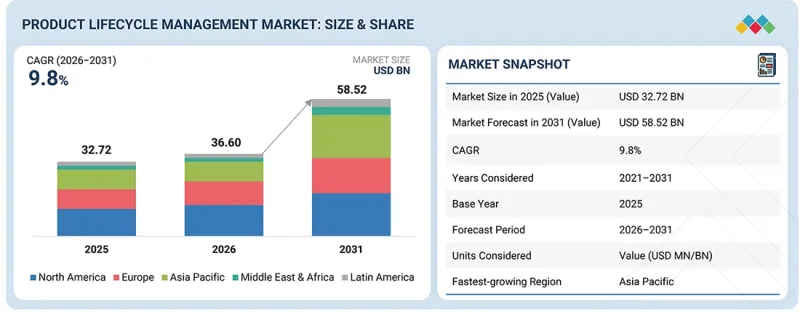
產品生命週期管理 (PLM) 市場預計將從 2026 年的 366 億美元成長到 2031 年的 585.2 億美元,複合年成長率為 9.8%。
PLM市場的主要驅動力是雲端和SaaS平台的日益普及,因為企業希望降低基礎設施開銷並縮短價值實現時間。隨著軟體定義產品變得日益複雜,對連接需求、設計和檢驗等跨學科領域的系統工程和數位線程實踐的需求也日益成長。整合生成式人工智慧、基於模型的工程和數位雙胞胎技術能夠實現更早的檢驗、配置管理和預測性決策,從而提高產品品質並縮短開發週期。
| 調查範圍 | |
|---|---|
| 調查期 | 2021-2031 |
| 基準年 | 2025 |
| 預測期 | 2026-2031 |
| 計算單位 | 金額(10億美元) |
| 部分 | 依產品/服務、軟體、產品類型、部署類型、組織規模、產業、地區 |
| 目標區域 | 北美洲、歐洲、亞太地區、中東和非洲、拉丁美洲 |
此外,日益嚴格的監管和永續發展合規要求促使企業將可追溯性和生命週期視覺化直接整合到其工程工作流程中。然而,市場面臨著許多限制因素,例如缺乏能夠配置和客製化複雜部署環境的熟練PLM管理員和系統工程師,這可能導致延誤和效率降低。將資料遷移和整合到傳統CAD、ERP和檔案式的設計系統中也構成了一項挑戰,因為企業正在考慮將專有工程資料和智慧財產權整合到雲端對應平臺的成本。
“按企業規模分類,預計中小企業在預測期內將呈現最高的成長率。”
經濟實惠的訂閱式雲端平台降低了產品生命週期管理 (PLM) 的成本和複雜性,使之不再局限於大型製造商,從而促進了中小企業 (SME) 對 PLM 的採用。這些企業受益於預先配置的基於 SaaS 的 PLM,無需專門的 IT 人員來管理基礎設施、升級或客製化。 2025 年 9 月,PTC 發布了 Arena AI Assistant,互動式AI 工具,可直接整合到 Arena PLM 和品管系統介面中,幫助資源有限的團隊在無需 PLM 專業知識的情況下簡化設計變更指令和合規性相關的工作流程。 2025 年 12 月,PTC 又發布了 Arena AI Engine,根據該公司的新聞稿,該引擎可自動執行文件審查和比較,幫助小規模團隊更有效率地管理複雜的文件和修訂。新興供應商的商機在於提供透明的按用戶訂閱定價、快速自助部署以及針對常見產品類型客製化的現成模板。這將減輕先前阻礙中小型製造商採用 PLM 的實施負擔。在PLM市場的中小企業(SME)領域,能夠提供快速實施、最大限度減少IT相關負擔和清晰升級路徑的供應商將具有優勢。
“按軟體類型分類,預計產品數據管理(PDM)細分市場在預測期內將佔據最大的市場佔有率。”
產品資料管理 (PDM) 是產品生命週期管理 (PLM) 市場的基礎層,它為 CAD 檔案、材料清單(BOM) 和版本歷史記錄提供了一個集中式儲存庫。幾乎所有其他 PLM 功能都建立在此基礎上。進入該領域的供應商可以透過提供 AI 驅動的文件搜尋、確定性版本控制以及 CAD、ERP 和供應商系統之間的無縫互通性來脫穎而出。客戶越來越期望 PDM 不僅能作為記錄系統,還能作為智慧層自動提取相關的產品資訊。 PTC 在 2025 年 3 月的漢諾威工業博覽會上發布了“Windchill AI”預覽版,其中展示了“文檔庫 AI 代理”,該代理可以幫助工程師直接從存儲在 Windchill 中的文檔中提取產品信息,從而展現 PDM 如何朝著 AI 驅動的信息搜尋方向發展。 2025年12月,PTC宣布將其雲端原生CAD和PDM平台「Onshape Government」與AWS GovCloud上的「Arena PLM」整合。此舉打造了一個統一的系統,用於管理工程、品質和供應鏈營運中的產品數據,取代了以往分散的、檔案式的工具。對於新供應商而言,機會在於提供從檔案式的舊有系統平滑遷移的路徑,同時建立輕量級的PDM模組,並具備強大的CAD互通性和AI輔助搜尋功能。供應商可以透過瞄準材料清單(BOM)複雜的行業來站穩腳跟,並在核心數據骨幹網路搭建完成後,將業務擴展到相鄰的PLM模組。
“預計在預測期內,北美將引領產品生命週期管理(PLM)市場的發展。”
北美預計將成為產品生命週期管理 (PLM) 市場的主要驅動力,這主要得益於航太、國防和汽車原始設備製造商 (OEM) 的集中分佈、雲原生和人工智慧輔助 PLM 平台的日益普及以及國內製造能力回流的加速。對於供應商和解決方案供應商,這帶來了巨大的機遇,可以建立可擴展、高度安全的平台,將工程、合規和生產資料跨地域連接起來。該地區受監管行業的集中以及生成式人工智慧和數位線程技術的加速融合,正促使企業從孤立的、檔案式的設計工具轉向協作式、基於模型的產品開發。 PLM 供應商、工業 OEM 和雲端超大規模資料中心業者之間的策略合作將進一步加強生態系統,並確保工程資料在全球供應鏈中的無縫整合。同時,亞太地區也正經歷快速發展,中國、印度和東南亞的製造能力不斷擴張,這得益於「印度製造」等政府計畫以及中國在智慧製造領域樹立領導地位的努力。透過滿足關鍵的企業需求,例如減少重新設計、縮短上市時間以及確保符合監管規定,供應商可以在這個以快速技術採用和持續創新為特徵的市場中獲得巨大的價值。
本報告包含對提供產品生命週期管理 (PLM) 產品的主要公司的研究。報告介紹了產品生命週期管理市場主要供應商的概況。主要市場參與企業包括 PTC(美國)、達梭系統(法國)、西門子(德國)、SAP(德國)、歐特克(美國)、甲骨文(美國)、Aras(美國)、Infor(美國)和 Propel(美國)。
調查範圍
本研究報告根據產品/服務、軟體類型、部署方式、企業規模、產品類型、產業垂直領域和地區對產品生命週期管理 (PLM) 市場進行細分。產品/服務細分包括軟體和服務,其中服務進一步細分為託管服務和專業服務。軟體細分包括產品資料管理 (PDM)、製造流程管理、數位雙胞胎數位線程執行緒解決方案、產品創新管理、品質和合規性管理、工程生命週期管理、服務生命週期管理 (SLM) 以及其他 PLM 軟體。部署方式細分為本機部署 PLM 和雲端 PLM。企業規模細分為大型企業和中小企業。產品類型細分涵蓋遊戲、機械產品、電子電氣產品和複雜工程系統。產業細分涵蓋汽車和交通運輸、工業設備和機械、航太和國防、電子和半導體、醫療保健和醫療設備、能源和公共產業、零售和消費品、建築、工程和施工 (AEC)、IT 和電信以及其他行業。本報告的區域分類包括北美、歐洲、亞太、中東和非洲以及拉丁美洲。報告涵蓋了影響產品生命週期管理市場成長的關鍵因素的詳細資訊,例如促進因素、阻礙因素、挑戰和機會。該報告對主要行業參與企業進行了深入分析,詳細介紹了他們的業務概況、解決方案、服務、關鍵戰略、合約、夥伴關係、協議、新產品和服務發布、併購以及與產品生命週期管理市場相關的最新發展。此外,該報告還對產品生命週期管理市場生態系統中新興的新創企業進行了競爭分析。
購買本報告的理由
本報告為市場領導和新參與企業提供產品生命週期管理市場及其細分市場最準確的收入預測。這有助於相關人員了解競爭格局,更好地定位自身業務,並獲得更深入的洞察,從而製定合適的打入市場策略。報告還提供有關市場趨勢、關鍵市場促進因素、限制因素、挑戰和機會的資訊。
本報告深入分析了以下幾點:
本報告深入分析了關鍵促進因素(為提高成本效益和擴充性,擴大採用基於雲端和 SaaS 的 PLM 解決方案;軟體定義產品的複雜性不斷增加,推動了系統工程的採用;將生成式 AI數位雙胞胎技術整合到產品開發中;以及日益嚴格的監管和傳統阻礙因素系統整合的複雜性;以及全球供應商網路中的網路安全和智慧財產權保護問題)、機會(工程和製造領域對數位線程一致性的需求不斷成長;需要 ALM 和 PLM 融合的軟體定義產品的興起;以及 AI 驅動的生成式設計和配置管理)和挑戰(與傳統 PDM 和檔案式的設計系統的複雜性;由於缺乏開放標準而導致的設計管理
● 產品開發/創新:深入了解產品生命週期管理市場的未來技術趨勢、研發活動以及新產品/服務的推出。
● 市場發展:盈利市場的全面資訊-本報告分析了各地區的產品生命週期管理市場。
● 市場多元化:有關產品生命週期管理市場的新產品和服務、未開發的市場、近期趨勢和投資的全面資訊。
競爭格局分析:本報告對PTC(美國)、達梭系統(法國)、西門子(德國)、SAP(德國)、歐特克(美國)、甲骨文(美國)、Aras(美國)、Infor(美國)和Propel(美國)等主要廠商的市場佔有率、成長策略和服務產品進行了詳細評估。此外,本報告還幫助相關人員了解產品生命週期管理市場的趨勢,並提供關鍵市場促進因素、限制、挑戰和機會的資訊。
目錄
第1章:引言
第2章執行摘要
第3章重要考察
第4章 市場概覽
- 市場動態
- 促進因素
- 抑制因子
- 機會
- 任務
- 未滿足的需求和未開發的領域
- 相互關聯的市場與跨產業機遇
- 新的經營模式和生態系統的變化
- 參與企業一級/二級/三級市場的策略性舉措。
第5章 產業趨勢
- 波特五力分析
- 總體經濟指標
- 供應鏈分析
- 生態系分析
- 價格分析
- 2026-2027 年主要會議和活動
- 影響客戶業務的趨勢/顛覆性因素
- 投資和資金籌措場景
- 案例研究分析
- 2025年美國關稅的影響-產品生命週期管理市場
第6章:透過採用技術、專利、數位技術和人工智慧實現策略顛覆
- 技術分析
- 技術/產品藍圖
- 專利分析
- 人工智慧/生成式人工智慧對產品生命週期管理市場的影響
第7章 監理情勢
- 監理情勢
- 監管機構、政府機構和其他組織
- 區域產業標準
第8章:顧客趨勢與購買行為
- 決策流程
- 買方相關人員和採購評估標準
- 實施障礙和內部挑戰
- 各個終端用戶產業尚未滿足的需求
- 市場盈利
第9章:產品生命週期管理市場(依產品/服務分類)
- 軟體
- 服務
第10章:產品生命週期管理市場(依軟體分類)
- 產品資料管理
- 製造流程管理(MPM)
- 數位雙胞胎與數位線程執行緒解決方案
- 產品創新管理(PIM)
- 品質與合規管理
- 工程生命週期管理(ELM)
- 服務生命週期管理(SLM)
- 其他
第11章:產品生命週期管理市場(依產品類型分類)
- 機械產品
- 電子電氣產品
- 複雜工程產品
- 機電一體化產品
- 軟體定義產品
第12章:產品生命週期管理市場(依部署類型分類)
- 雲
- 現場
第13章:產品生命週期管理市場(依組織規模分類)
- 大公司
- 小型企業
第14章:產品生命週期管理市場(依產業分類)
- 汽車和交通運輸
- 工業設備和機械
- 航太/國防
- 電子和半導體
- 醫療保健和醫療設備
- 能源與公共產業
- 零售和消費品
- 建築、工程和施工 (AEC)
- 資訊科技/通訊
- 其他
第15章:產品生命週期管理市場(依地區分類)
- 北美洲
- 美國
- 加拿大
- 歐洲
- 英國
- 德國
- 法國
- 義大利
- 其他
- 亞太地區
- 中國
- 印度
- 日本
- 澳洲和紐西蘭
- 韓國
- 其他
- 中東和非洲
- 海灣合作理事會國家
- 南非
- 其他
- 拉丁美洲
- 巴西
- 墨西哥
- 其他
第16章 競爭格局
- 主要公司的策略/優勢
- 2021-2025年收入分析
- 企業估值矩陣:主要公司,2025 年
- 公司估值矩陣:新創企業/中小企業,2025 年
- 企業估值和財務指標
- 競爭格局
第17章:公司簡介
- 大公司
- SIEMENS
- DASSAULT SYSTEMES
- PTC
- SAP
- ORACLE
- AUTODESK
- IBM
- INFOR
- HCL TECH
- ATOS
- ARAS
- 其他公司
- OPENBOM
- LECTRA
- BAMBOO ROSE
- ALETIQ
- NORA IPLM
- BILD
- AEGIS SOFTWARE
- VISIATIV
- 3YOURMIND
- TECHNIA
- RAZORLEAF
- TRACE ONE
- PROPEL
- KINGDEE
第18章:調查方法
第19章附錄
The product lifecycle management market is anticipated to rise from USD 36.60 billion in 2026 to USD 58.52 billion by 2031, featuring a CAGR of 9.8%. The product lifecycle management (PLM) market drivers are centered on the rising adoption of cloud and SaaS-based PLM platforms, where organizations aim to reduce infrastructure overhead and accelerate time-to-value. The growing complexity of software-defined products accelerates demand for systems engineering and digital thread practices that connect requirements, design, and validation across disciplines. Integrating generative AI, model-based engineering, and digital twin technologies enables earlier validation, configuration management, and predictive decision-making, improving product quality and shortening development cycles.
| Scope of the Report | |
|---|---|
| Years Considered for the Study | 2021-2031 |
| Base Year | 2025 |
| Forecast Period | 2026-2031 |
| Units Considered | Value (USD Billion) |
| Segments | Offering, Deployment Type, Product Type, Software Type, Vertical, Region |
| Regions covered | North America, Europe, Asia Pacific, Middle East & Africa, Latin America |
Additionally, tightening regulatory and sustainability compliance requirements pushes enterprises to embed traceability and lifecycle visibility directly into engineering workflows. On the other hand, the market faces restraints such as a shortage of skilled PLM administrators and systems engineers capable of configuring and customizing complex deployments, which can delay implementations and reduce effectiveness. Data migration and integration complexity with legacy CAD, ERP, and file-based design systems further challenge adoption, as enterprises weigh the cost of connecting proprietary engineering data and intellectual property to cloud-enabled platforms.
"By organization size, the SMEs segment is expected to exhibit the fastest growth rate during the forecast period"
Small and medium-sized enterprises (SMEs) are increasingly adopting product lifecycle management as affordable, subscription-based cloud platforms lower the cost and complexity that once limited PLM to large manufacturers. These organizations benefit from pre-configured, SaaS-delivered PLM that eliminates the need for dedicated IT staff to manage infrastructure, upgrades, or customization. In September 2025, PTC announced the release of its Arena AI Assistant, a conversational AI tool embedded directly in the Arena PLM and quality management system interface, helping resource-constrained teams navigate engineering change orders and compliance workflows without specialized PLM expertise. In December 2025, PTC followed with the launch of Arena AI Engine, which automates document review and comparison to help smaller teams manage complex documentation and revisions more efficiently, according to the press release of the company. For emerging vendors, the opportunity is in providing transparent, per-seat subscription pricing, rapid self-service onboarding, and pre-built templates tailored to common product categories, reducing the implementation burden that has historically deterred smaller manufacturers. Vendors who deliver fast deployment, minimal IT overhead, and clear upgrade paths will win in the SME segment of the PLM market.
"By software type, the product data management (PDM) segment is expected to hold the largest market share during the forecast period"
Product data management forms the foundational layer of the product lifecycle management market, providing the centralized repository for CAD files, bills of materials, and revision history that nearly every other PLM capability builds upon. Vendors entering this segment can differentiate by delivering AI-assisted document retrieval, deterministic version control, and seamless interoperability across CAD, ERP, and supplier systems. Customers increasingly expect PDM to serve not only as a system of record but as an intelligent layer that surfaces relevant product information automatically. PTC's March 2025 preview of Windchill AI at Hannover Messe, featuring a Document Vault AI agent that helps engineers extract product information directly from documents stored in Windchill, demonstrates how PDM is moving closer to AI-assisted retrieval. In December 2025, PTC announced the connection of its Onshape Government cloud-native CAD and PDM platform with Arena PLM on AWS GovCloud, replacing fragmented, file-based tools with a unified system for managing product data across engineering, quality, and supply chain operations. For new vendors, opportunities lie in building lightweight PDM modules with strong CAD interoperability and AI-assisted search, while offering low-friction migration paths from file-based and legacy systems. Providers can establish strong footholds by targeting industries with complex bills of materials and expanding into adjacent PLM modules once the core data backbone is in place.
"North America is estimated to lead the product lifecycle management market during the forecast period"
North America is expected to lead the product lifecycle management (PLM) market, driven by the concentration of aerospace, defense, and automotive OEMs, rising adoption of cloud-native and AI-assisted PLM platforms, and accelerating reshoring of domestic manufacturing capacity. For vendors and solution providers, this presents significant opportunities to deliver scalable, high-security platforms that connect engineering, compliance, and production data across distributed sites. The region's strong concentration of regulated industries and accelerated integration of generative AI and digital thread technologies push enterprises toward connected, model-based product development over siloed, file-based design tools. Strategic collaborations between PLM providers, industrial OEMs, and cloud hyperscalers further strengthen the ecosystem, ensuring seamless engineering data integration across global supply chains. Asia Pacific, meanwhile, is advancing rapidly as manufacturing capacity expands across China, India, and Southeast Asia, supported by government programs such as Make in India and China's push for smart manufacturing leadership. By addressing key enterprise requirements such as reducing engineering rework, accelerating time-to-market, and ensuring regulatory compliance, vendors can capture substantial value in a market defined by rapid technological adoption and continuous innovation.
Breakdown of Primaries
In-depth interviews were conducted with chief executive officers (CEOs), engineering and technology directors, systems integrators, and executives from various key organizations operating in the product lifecycle management market.
● By Company: Tier I - 34%, Tier II - 43%, and Tier III - 23%
● By Designation: C-Level Executives - 50%, Directors - 30%, and others - 20%
● By Region: North America - 25%, Europe - 30%, Asia Pacific - 30%, Middle East & Africa - 5%, and Latin America - 5%
The report includes a study of key players offering product lifecycle management products. It profiles major vendors in the product lifecycle management market. The major market players include PTC (US), Dassault Systemes (France), Siemens (Germany), SAP (Germany), Autodesk (US), Oracle (US), Aras (US), Infor (US), and Propel (US).
Research Coverage
This research report categorizes the product lifecycle management market, which has been segmented based on offering, software type, deployment type, organization size, product type, vertical, and region. The offering segment comprises software and services, with services further split into managed services and professional services. The software segment comprises product data management (PDM), manufacturing process management, digital twin & digital thread solutions, product innovation management, quality & compliance management, engineering lifecycle management, service lifecycle management (SLM), and other PLM software. The deployment type segment is split into on-premises PLM and cloud-based PLM. The organization size segment is bifurcated into large enterprises and SMEs. The product type segment covers gaming, mechanical products, electronic & electrical products, and complex engineered systems. The vertical segment covers automotive & transportation, industrial equipment & machinery, aerospace & defense, electronics & semiconductor, healthcare & medical devices, energy & utilities, retail & consumer goods, architecture, engineering & construction (AEC), IT & telecom, and other verticals, and the regional segment include North America, Europe, Asia Pacific, the Middle East & Africa, and Latin America. The report's scope covers detailed information regarding the major factors, such as drivers, restraints, challenges, and opportunities, influencing the growth of the product lifecycle management market. A thorough analysis of the key industry players was done to provide insights into their business overview, solutions, and services; key strategies; contracts, partnerships, agreements, new product & service launches, and mergers and acquisitions; and recent developments associated with the product lifecycle management market. This report also covers the competitive analysis of upcoming startups in the product lifecycle management market ecosystem.
Reason to buy this Report
The report would provide market leaders and new entrants with information on the closest approximations of the revenue numbers for the overall product lifecycle management market and its subsegments. It would help stakeholders understand the competitive landscape and gain more insights to better position their businesses and plan suitable go-to-market strategies. It also helps stakeholders understand the market's pulse and provides them with information on key market drivers, restraints, challenges, and opportunities.
The report provides insights on the following pointers:
● Analysis of key drivers (Rising adoption of cloud and SaaS-based PLM solutions for cost efficiency and scalability, Growing complexity of software-defined products driving systems engineering adoption, Integration of generative AI and digital twin technologies into product development, Tightening regulatory and sustainability compliance requirements), restraints (Shortage of skilled PLM administrators and systems engineers, Data migration and integration complexity with legacy CAD and ERP systems, Cybersecurity and intellectual property protection concerns across global supplier networks), opportunities (Rising demand for digital thread connectivity across engineering and manufacturing, Emergence of software-defined products requiring ALM-PLM convergence, AI-driven generative design and configuration management), and challenges (Complex integration with legacy PDM and file-based design systems, Lack of open standards leading to vendor lock-in, Rising cost and complexity of customizing enterprise PLM deployments).
● Product Development/Innovation: Detailed insights on upcoming technologies, research & development activities, and new product & service launches in the product lifecycle management market.
● Market Development: Comprehensive information about lucrative markets - the report analyses the product lifecycle management market across varied regions.
● Market Diversification: Exhaustive information about new products & services, untapped geographies, recent developments, and investments in the product lifecycle management market.
Competitive Assessment: In-depth assessment of market shares, growth strategies and service offerings of leading players such as PTC (US), Dassault Systemes (France), Siemens (Germany), SAP (Germany), Autodesk (US), Oracle (US), Aras (US), Infor (US), and Propel (US). The report also helps stakeholders understand the product lifecycle management market's pulse and provides information on key market drivers, restraints, challenges, and opportunities.
TABLE OF CONTENTS
1 INTRODUCTION
- 1.1 STUDY OBJECTIVES
- 1.2 MARKET DEFINITION
- 1.3 MARKET SCOPE
- 1.3.1 MARKET SEGMENTATION AND REGIONAL SCOPE
- 1.3.2 INCLUSIONS AND EXCLUSIONS
- 1.3.3 YEARS CONSIDERED
- 1.3.4 CURRENCY CONSIDERED
- 1.4 LIMITATIONS
- 1.5 STAKEHOLDERS
- 1.6 SUMMARY OF CHANGES
2 EXECUTIVE SUMMARY
- 2.1 MARKET HIGHLIGHTS AND KEY INSIGHTS
- 2.2 KEY MARKET PARTICIPANTS: MAPPING OF STRATEGIC DEVELOPMENTS
- 2.3 DISRUPTIVE TRENDS IN PRODUCT LIFECYCLE MANAGEMENT MARKET
- 2.4 HIGH-GROWTH SEGMENTS
- 2.5 REGIONAL SNAPSHOT: MARKET SIZE, GROWTH RATE, AND FORECAST
3 PREMIUM INSIGHTS
- 3.1 ATTRACTIVE OPPORTUNITIES FOR PLAYERS IN PRODUCT LIFECYCLE MANAGEMENT MARKET
- 3.2 PRODUCT LIFECYCLE MANAGMENT MARKET, BY OFFERING
- 3.3 PRODUCT LIFECYCLE MANAGEMENT MARKET, BY PRODUCT TYPE
- 3.4 PRODUCT LIFECYCLE MANAGEMENT MARKET, BY VERTICAL
- 3.5 PRODUCT LIFECYCLE MANAGEMENT MARKET, BY REGION
4 MARKET OVERVIEW
- 4.1 INTRODUCTION
- 4.2 MARKET DYNAMICS
- 4.2.1 DRIVERS
- 4.2.1.1 AI-assisted product engineering becoming a core purchasing criterion for PLM platforms
- 4.2.1.2 Software-defined products increasing demand for integrated PLM and ALM environments
- 4.2.1.3 Digital thread initiatives driving enterprise-wide PLM modernization
- 4.2.1.4 Increasing product complexity, accelerating adoption of model-based engineering approaches
- 4.2.2 RESTRAINTS
- 4.2.2.1 Legacy engineering environments creating barriers to enterprise PLM transformation
- 4.2.2.2 Product data quality and governance challenges limiting digital thread initiatives
- 4.2.2.3 Complex integration requirements across engineering and operational systems
- 4.2.3 OPPORTUNITIES
- 4.2.3.1 AI-powered engineering copilots creating a new growth avenue for PLM vendors
- 4.2.3.2 Sustainability and product compliance management expanding PLM spending
- 4.2.3.3 Industrial digital twin adoption expanding PLM's role beyond engineering
- 4.2.4 CHALLENGES
- 4.2.4.1 Scaling digital thread initiatives from pilot projects to enterprise-wide deployment
- 4.2.4.2 Managing software, electronics, and mechanical development within a unified lifecycle framework
- 4.2.1 DRIVERS
- 4.3 UNMET NEEDS AND WHITE SPACES
- 4.3.1 UNMET NEEDS IN PRODUCT LIFECYCLE MANAGEMENT MARKET
- 4.3.2 WHITE SPACE OPPORTUNITIES
- 4.4 INTERCONNECTED MARKETS AND CROSS-SECTOR OPPORTUNITIES
- 4.4.1 INTERCONNECTED MARKETS
- 4.4.2 CROSS-SECTOR OPPORTUNITIES
- 4.5 EMERGING BUSINESS MODELS AND ECOSYSTEM SHIFTS
- 4.5.1 EMERGING BUSINESS MODELS
- 4.5.1.1 Managed Service Business Models
- 4.5.2 ECOSYSTEM SHIFTS
- 4.5.1 EMERGING BUSINESS MODELS
- 4.6 STRATEGIC MOVES BY TIER-1/2/3 PLAYERS
- 4.6.1 KEY MOVES AND STRATEGIC FOCUS
5 INDUSTRY TRENDS
- 5.1 PORTER'S FIVE FORCES ANALYSIS
- 5.1.1 THREAT OF NEW ENTRANTS
- 5.1.2 THREAT OF SUBSTITUTES
- 5.1.3 BARGAINING POWER OF SUPPLIERS
- 5.1.4 BARGAINING POWER OF BUYERS
- 5.1.5 INTENSITY OF COMPETITIVE RIVALRY
- 5.2 MACROECONOMIC INDICATORS
- 5.2.1 INTRODUCTION
- 5.2.2 GDP TRENDS & FORECASTS
- 5.2.3 TRENDS IN GLOBAL APPLICATION LIFECYCLE MANAGEMENT MARKET
- 5.2.4 TRENDS IN GLOBAL INDUSTRIAL IOT MARKET
- 5.3 SUPPLY CHAIN ANALYSIS
- 5.4 ECOSYSTEM ANALYSIS
- 5.5 PRICING ANALYSIS
- 5.5.1 AVERAGE SELLING PRICE TRENDS OF VENDORS, BY REGION,2025
- 5.5.1.1 North America
- 5.5.1.2 Europe
- 5.5.1.3 Asia Pacific
- 5.5.1.4 Middle East & Africa
- 5.5.1.5 Latin America
- 5.5.2 PRICING LANDSCAPE FOR PRODUCT LIFECYCLE MANAGEMENT MARKET, 2025
- 5.5.3 INDICATIVE PRICING TRENDS, BY KEY VENDOR,2025
- 5.5.1 AVERAGE SELLING PRICE TRENDS OF VENDORS, BY REGION,2025
- 5.6 KEY CONFERENCES AND EVENTS, 2026-2027
- 5.7 TRENDS/DISRUPTIONS IMPACTING CUSTOMER BUSINESS
- 5.8 INVESTMENT AND FUNDING SCENARIO
- 5.9 CASE STUDY ANALYSIS
- 5.9.1 PTC AND AUTOMOBILI LAMBORGHINI ENABLE CONNECTED PRODUCT LIFECYCLE FOR SOFTWARE-DEFINED VEHICLES
- 5.9.2 PTC AND ELECTROLUX PROFESSIONAL REDUCE DESIGN COMPLEXITY WITH WINDCHILL PLM
- 5.9.3 SIEMENS AND BSH STANDARDIZE PROCESS PLANNING ACROSS GLOBAL PLANTS
- 5.9.4 DASSAULT SYSTEMES AND 3CON IMPROVE AUTOMOTIVE EQUIPMENT DEVELOPMENT WITH 3DEXPERIENCE
- 5.9.5 ARAS AND MICROSOFT HARDWARE TEAM STREAMLINE PRODUCT DELIVERY USING AGILE PLM PLATFORM
- 5.10 IMPACT OF 2025 US TARIFF - PRODUCT LIFECYCLE MANAGEMENT MARKET
- 5.10.1 INTRODUCTION
- 5.10.2 KEY TARIFF RATES
- 5.10.3 PRICE IMPACT ANALYSIS
- 5.10.4 IMPACT ON COUNTRY/REGION
- 5.10.4.1 North America
- 5.10.4.2 Europe
- 5.10.4.3 Asia Pacific
- 5.10.5 IMPACT ON VERTICALS
- 5.10.5.1 Automotive & Transportation
- 5.10.5.2 Aerospace & Defense
- 5.10.5.3 Electronics & Semiconductor
- 5.10.5.4 Healthcare & Medical Devices
6 STRATEGIC DISRUPTION THROUGH TECHNOLOGY, PATENTS, DIGITAL, AND AI ADOPTION
- 6.1 TECHNOLOGY ANALYSIS
- 6.1.1 KEY EMERGING TECHNOLOGIES
- 6.1.1.1 Digital Thread & Model-Based Systems Engineering (MBSE)
- 6.1.1.2 AI-driven Generative Design & Intelligent Engineering Automation
- 6.1.1.3 Cloud-Native & SaaS PLM Platforms
- 6.1.2 COMPLEMENTARY TECHNOLOGIES
- 6.1.2.1 Digital Twin Technology
- 6.1.2.2 Industrial IoT & Connected Product Intelligence
- 6.1.2.3 Additive Manufacturing Integration
- 6.1.3 ADJACENT TECHNOLOGIES
- 6.1.3.1 Augmented Reality & Extended Reality (AR/XR)
- 6.1.3.2 Blockchain
- 6.1.3.3 Advanced Simulation & CAE Platforms
- 6.1.1 KEY EMERGING TECHNOLOGIES
- 6.2 TECHNOLOGY/PRODUCT ROADMAP
- 6.2.1 SHORT-TERM (2026-2028) | AI-ASSISTED ENGINEERING & CLOUD PLM MIGRATION
- 6.2.1.1 Focus Areas
- 6.2.1.1.1 Technology Development
- 6.2.1.1.2 Product Innovations
- 6.2.1.1.3 Market Adoption
- 6.2.1.1 Focus Areas
- 6.2.2 MID-TERM (2028-2031) | DIGITAL THREAD MATURITY & MODEL-BASED ENTERPRISE
- 6.2.2.1 Focus Areas
- 6.2.2.1.1 Technology Development
- 6.2.2.1.2 Product Innovations
- 6.2.2.1.3 Market Adoption
- 6.2.2.1 Focus Areas
- 6.2.3 LONG-TERM (2031-2035+) | AUTONOMOUS PRODUCT INTELLIGENCE & PLATFORM-CENTRIC PLM ECOSYSTEMS
- 6.2.3.1 Focus Areas
- 6.2.3.1.1 Technology Development
- 6.2.3.1.2 Product Innovations
- 6.2.3.1.3 Market Adoption
- 6.2.3.1 Focus Areas
- 6.2.1 SHORT-TERM (2026-2028) | AI-ASSISTED ENGINEERING & CLOUD PLM MIGRATION
- 6.3 PATENT ANALYSIS
- 6.4 IMPACT OF AI/GENERATIVE AI ON PRODUCT LIFECYCLE MANAGEMENT MARKET
- 6.4.1 TOP USE CASES AND MARKET POTENTIAL
- 6.4.2 BEST PRACTICES IN PRODUCT LIFECYCLE MANAGEMENT
- 6.4.3 CASE STUDY OF AI IMPLEMENTATION IN THE PRODUCT LIFECYCLE MANAGEMENT MARKET
- 6.4.3.1 Dassault Systemes and Volkswagen Group: Implementing Cloud-Native PLM & Virtual Twin Experiences for Global Vehicle Development
- 6.4.4 INTERCONNECTED ADJACENCY ECOSYSTEM AND IMPACT ON MARKET PLAYERS
- 6.4.5 CLIENT READINESS TO ADOPT GENERATIVE AI IN PRODUCT LIFECYCLE MANAGEMENT MARKET
7 REGULATORY LANDSCAPE
- 7.1 REGULATORY LANDSCAPE
- 7.1.1 REGULATORY BODIES, GOVERNMENT AGENCIES, AND OTHER ORGANIZATIONS
- 7.1.2 INDUSTRY STANDARDS, BY REGION
8 CUSTOMER LANDSCAPE AND BUYER BEHAVIOR
- 8.1 DECISION-MAKING PROCESS
- 8.2 BUYER STAKEHOLDERS AND BUYING EVALUATION CRITERIA
- 8.2.1 KEY STAKEHOLDERS IN BUYING PROCESS
- 8.2.2 BUYING CRITERIA
- 8.3 ADOPTION BARRIERS AND INTERNAL CHALLENGES
- 8.4 UNMET NEEDS IN VARIOUS END-USER INDUSTRIES
- 8.5 MARKET PROFITABILITY
- 8.5.1 REVENUE POTENTIAL
- 8.5.2 COST DYNAMICS
- 8.5.3 MARGIN OPPORTUNITIES IN KEY APPLICATIONS
9 PRODUCT LIFECYCLE MANAGEMENT MARKET, BY OFFERING
- 9.1 INTRODUCTION
- 9.1.1 OFFERING: PRODUCT LIFECYCLE MANAGEMENT MARKET DRIVERS
- 9.2 SOFTWARE
- 9.2.1 INCREAS IN ADOPTION OF DIGITAL THREAD AND SOFTWARE-DEFINED PRODUCTS TO DRIVE DOMINANCE OF PLM SOFTWARE
- 9.3 SERVICES
- 9.3.1 RISING PLM INTEGRATION COMPLEXITY IS DRIVING DEMAND FOR SERVICES
- 9.3.2 PROFESSIONAL SERVICES
- 9.3.2.1 Growth in digital thread and enterprise integration requirements to increase need for professional services
- 9.3.2.2 Implementation & Integration
- 9.3.2.3 Support and maintenance
- 9.3.2.4 Consultant and Advisory
10 PRODUCT LIFECYCLE MANAGEMENT MARKET, BY SOFTWARE
- 10.1 INTRODUCTION
- 10.1.1 SOFTWARE: PRODUCT LIFECYCLE MANAGEMENT MARKET DRIVERS
- 10.2 PRODUCT DATA MANAGEMENT
- 10.2.1 INCREASING PRODUCT COMPLEXITY AND ENGINEERING COLLABORATION REQUIREMENTS TO DRIVE ADOPTION OF PRODUCT DATA MANAGEMENT
- 10.3 MANUFACTURING PROCESS MANAGEMENT (MPM)
- 10.3.1 INCREASING PRODUCT COMPLEXITY AND ENGINEERING COLLABORATION REQUIREMENTS TO DRIVE ADOPTION OF PRODUCT DATA MANAGEMENT
- 10.4 DIGITAL TWIN & DIGITAL THREAD SOLUTIONS
- 10.4.1 INCREASING ADOPTION OF DIGITAL THREAD STRATEGIES AND VIRTUAL PRODUCT VALIDATION IS DRIVING THE GROWTH OF DIGITAL TWIN & DIGITAL THREAD SOLUTIONS
- 10.5 PRODUCT INNOVATION MANAGEMENT (PIM)
- 10.5.1 INCREASING NEED TO IMPROVE NEW PRODUCT SUCCESS AND INNOVATION PIPELINE VISIBILITY TO DRIVE PRODUCT INNOVATION MANAGEMENT ADOPTION
- 10.6 QUALITY AND COMPLIANCE MANAGEMENT
- 10.6.1 INCREASING REGULATORY REQUIREMENTS AND FOCUS ON PRODUCT QUALITY TO FUEL ADOPTION OF QUALITY AND COMPLIANCE MANAGEMENT SOLUTIONS
- 10.7 ENGINEERING LIFECYCLE MANAGEMENT (ELM)
- 10.7.1 GROWING ADOPTION OF SOFTWARE-DEFINED PRODUCTS AND MULTIDISCIPLINARY ENGINEERING TO DRIVE DEMAND FOR ENGINEERING LIFECYCLE MANAGEMENT
- 10.8 SERVICE LIFECYCLE MANAGEMENT (SLM)
- 10.8.1 INCREASING FOCUS ON AFTERMARKET REVENUE AND ASSET UPTIME TO DRIVE ADOPTION OF SERVICE LIFECYCLE MANAGEMENT
- 10.9 OTHER PLM SOFTWARE
11 PRODUCT LIFECYCLE MANAGEMENT MARKET, BY PRODUCT TYPE
- 11.1 INTRODUCTION
- 11.1.1 PRODUCT LIFECYCLE MANAGEMENT MARKET: PRODUCT TYPE DRIVERS
- 11.2 MECHANICAL PRODUCTS
- 11.2.1 INDUSTRIAL EQUIPMENT MODERNIZATION AND DESIGN REUSE TO DRIVE PLM ADOPTION FOR MECHANICAL PRODUCTS
- 11.3 ELECTRONIC & ELECTRICAL PRODUCTS
- 11.3.1 INCREASING ELECTRONIC COMPONENT OBSOLESCENCE AND SUPPLY CHAIN VOLATILITY ARE DRIVING PLM ADOPTION FOR ELECTRONIC & ELECTRICAL PRODUCTS
- 11.4 COMPLEX ENGINEERED PRODUCTS
- 11.4.1 RISING DEFENSE SPENDING AND LONG-CYCLE AEROSPACE PROGRAMS TO DRIVE PLM ADOPTION FOR COMPLEX ENGINEERED PRODUCTS
- 11.5 MECHATRONIC PRODUCTS
- 11.5.1 RISING INDUSTRIAL ROBOT DEPLOYMENT TO DRIVE PLM ADOPTION FOR MECHATRONIC PRODUCTS
- 11.6 SOFTWARE-DEFINED PRODUCTS
- 11.6.1 RISE IN SOFTWARE COMPLEXITY AND SDV SYSTEM OPTIMIZATION TO DRIVE PLM ADOPTION FOR SOFTWARE-DEFINED PRODUCTS
12 PRODUCT LIFECYCLE MANAGEMENT MARKET, BY DEPLOYMENT TYPE
- 12.1 INTRODUCTION
- 12.1.1 DEPLOYMENT TYPE: PRODUCT LIFECYCLE MANAGEMENT MARKET DRIVERS
- 12.2 CLOUD
- 12.2.1 GROWING NEED FOR GLOBAL ENGINEERING COLLABORATION AND FASTER PLM MODERNIZATION TO ACCELERATE CLOUD PLM ADOPTION
- 12.3 ON-PREMISES
- 12.3.1 STRINGENT DATA SOVEREIGNTY AND INTELLECTUAL PROPERTY PROTECTION REQUIREMENTS TO SUSTAIN DEMAND FOR ON-PREMISE PLM DEPLOYMENTS
13 PRODUCT LIFECYCLE MANAGEMENT MARKET, ORGANIZATION SIZE
- 13.1 INTRODUCTION
- 13.1.1 ORGANIZATION SIZE: PRODUCT LIFECYCLE MANAGEMENT MARKET DRIVERS
- 13.2 LARGE ENTERPRISES
- 13.2.1 MANAGING GLOBAL PRODUCT DEVELOPMENT COMPLEXITY TO DRIVE PLM ADOPTION AMONG LARGE ENTERPRISES
- 13.3 SMES
- 13.3.1 CLOUD-BASED PLM ACCESSIBILITY TO ACCELERATE ADOPTION AMONG SMES
14 PRODUCT LIFECYCLE MANAGEMENT MARKET, BY VERTICAL
- 14.1 INTRODUCTION
- 14.1.1 VERTICAL: PRODUCT LIFECYCLE MANAGEMENT MARKET DRIVERS
- 14.2 AUTOMOTIVE & TRANSPORTATION
- 14.2.1 VEHICLE ELECTRIFICATION AND SOFTWARE INTEGRATION TO DRIVE PLM ADOPTION IN AUTOMOTIVE & TRANSPORTATION INDUSTRY
- 14.3 INDUSTRIAL EQUIPMENT & MACHINERY
- 14.3.1 RISING AUTOMATION AND EQUIPMENT CUSTOMIZATION TO DRIVE PLM ADOPTION IN INDUSTRIAL EQUIPMENT & MACHINERY
- 14.4 AEROSPACE & DEFENSE
- 14.4.1 RISING DEFENSE MODERNIZATION AND COMPLEX AIRCRAFT PROGRAMS TO DRIVE PLM ADOPTION IN AEROSPACE & DEFENSE
- 14.5 ELECTRONICS & SEMICONDUCTOR
- 14.5.1 COMPONENT TRACEABILITY AND SEMICONDUCTOR SUPPLY CHAIN COMPLEXITY TO DRIVE PLM ADOPTION IN ELECTRONICS & SEMICONDUCTOR
- 14.6 HEALTHCARE & MEDICAL DEVICES
- 14.6.1 INCREASING REGULATORY SCRUTINY AND CONNECTED MEDICAL DEVICE INNOVATION TO DRIVE PLM ADOPTION IN HEALTHCARE & MEDICAL DEVICES
- 14.7 ENERGY & UTILITIES
- 14.7.1 ENERGY TRANSITION AND GRID MODERNIZATION TO DRIVE PLM ADOPTION IN ENERGY & UTILITIES
- 14.8 RETAIL & CONSUMER GOODS
- 14.8.1 FASTER PRODUCT LAUNCHES AND SUSTAINABILITY-DRIVEN PRODUCT DEVELOPMENT TO DRIVE PLM ADOPTION IN RETAIL & CONSUMER GOODS
- 14.9 ARCHITECTURE, ENGINEERING, AND CONSTRUCTION (AEC)
- 14.9.1 DIGITAL DESIGN COLLABORATION AND BIM-LED PROJECT DELIVERY TO DRIVE PLM ADOPTION IN AEC
- 14.10 IT & TELECOM
- 14.10.1 EXPANSION OF 5G INFRASTRUCTURE AND CONNECTED DEVICE ECOSYSTEMS TO DRIVE PLM ADOPTION IN IT & TELECOM
- 14.11 OTHER VERTICALS
15 PRODUCT LIFECYCLE MANAGEMENT MARKET, BY REGION
- 15.1 INTRODUCTION
- 15.2 NORTH AMERICA
- 15.2.1 US
- 15.2.1.1 Expansion of Digital Engineering and Software-defined Product Development is Accelerating PLM Adoption in the US
- 15.2.2 CANADA
- 15.2.2.1 Manufacturing Modernization and Industry 4.0 Adoption are Driving PLM Growth in Canada
- 15.2.1 US
- 15.3 EUROPE
- 15.3.1 UK
- 15.3.1.1 Sustainability-driven Manufacturing and Advanced Engineering Capabilities are Accelerating PLM Adoption in the UK
- 15.3.2 GERMANY
- 15.3.2.1 Automotive Electrification and Industry 4.0 Leadership are Accelerating PLM Adoption in Germany
- 15.3.3 FRANCE
- 15.3.3.1 Aerospace Modernization and Sustainable Manufacturing are Driving PLM Adoption in France
- 15.3.4 ITALY
- 15.3.4.1 Industrial Machinery Modernization and Smart Manufacturing Adoption are Driving PLM Growth in Italy
- 15.3.5 REST OF EUROPE
- 15.3.1 UK
- 15.4 ASIA PACIFIC
- 15.4.1 CHINA
- 15.4.1.1 EV Expansion and Semiconductor Localization are Accelerating PLM Adoption in China
- 15.4.2 INDIA
- 15.4.2.1 Electronics Localization and Aerospace Engineering Expansion are Driving PLM Adoption in India
- 15.4.3 JAPAN
- 15.4.3.1 Robotics Innovation and Precision Engineering are Driving PLM Adoption in Japan
- 15.4.4 AUSTRALIA & NEW ZEALAND
- 15.4.4.1 Mining Equipment Innovation and Defense Modernization are Supporting PLM Adoption in ANZ
- 15.4.5 SOUTH KOREA
- 15.4.5.1 Semiconductor Leadership and Smart Electronics Development are Accelerating PLM Adoption in South Korea
- 15.4.6 REST OF ASIA PACIFIC
- 15.4.1 CHINA
- 15.5 MIDDLE EAST & AFRICA
- 15.5.1 GCC COUNTRIES
- 15.5.1.1 Saudi Arabia
- 15.5.1.1.1 Defense Localization and Vision 2030 Industrial Expansion are Accelerating PLM Adoption in Saudi Arabia
- 15.5.1.2 UAE
- 15.5.1.2.1 Aerospace Expansion and Smart City Development are Driving PLM Adoption in the UAE
- 15.5.1.3 Other GCC Countries
- 15.5.1.1 Saudi Arabia
- 15.5.2 SOUTH AFRICA
- 15.5.2.1 Automotive Production and Mining Equipment Digitalization are Driving PLM Adoption in South Africa
- 15.5.3 REST OF MIDDLE EAST & AFRICA
- 15.5.1 GCC COUNTRIES
- 15.6 LATIN AMERICA
- 15.6.1 BRAZIL
- 15.6.1.1 Aerospace Engineering and Industrial Digitalization are Driving PLM Adoption in Brazil
- 15.6.2 MEXICO
- 15.6.2.1 Nearshoring-Led Industrial Expansion is Accelerating PLM Adoption in Mexico
- 15.6.3 REST OF LATIN AMERICA
- 15.6.1 BRAZIL
16 COMPETITIVE LANDSCAPE
- 16.1 INTRODUCTION
- 16.2 KEY PLAYERS' STRATEGIES/RIGHT TO WIN
- 16.3 REVENUE ANALYSIS, 2021-2025
- 16.4 COMPANY EVALUATION MATRIX: KEY PLAYERS, 2025
- 16.4.1 STARS
- 16.4.2 EMERGING LEADERS
- 16.4.3 PERVASIVE PLAYERS
- 16.4.4 PARTICIPANTS
- 16.4.5 COMPANY FOOTPRINT: KEY PLAYERS, 2025
- 16.4.5.1 Company footprint
- 16.4.5.2 Region footprint
- 16.4.5.3 Solution Type footprint
- 16.4.5.4 Deployment Type footprint
- 16.4.5.5 Vertical footprint
- 16.5 COMPANY EVALUATION MATRIX: STARTUPS/SMES, 2025
- 16.5.1 PROGRESSIVE COMPANIES
- 16.5.2 RESPONSIVE COMPANIES
- 16.5.3 DYNAMIC COMPANIES
- 16.5.4 STARTING BLOCKS
- 16.5.5 COMPETITIVE BENCHMARKING: STARTUP/SMES, 2025
- 16.5.5.1 Detailed list of key startups/SMEs
- 16.5.5.2 Competitive benchmarking of key startups/SMEs
- 16.6 COMPANY VALUATION AND FINANCIAL METRICS
- 16.6.1 COMPANY VALUATION OF KEY VENDORS
- 16.6.2 FINANCIAL METRICS OF KEY VENDORS
- 16.7 COMPETITIVE SCENARIO
- 16.7.1 PRODUCT LAUNCHES/ENHANCEMENTS
- 16.7.2 DEALS
17 COMPANY PROFILES
- 17.1 INTRODUCTION
- 17.2 MAJOR PLAYERS
- 17.2.1 SIEMENS
- 17.2.1.1 Business overview
- 17.2.1.2 Products/Solutions/Services offered
- 17.2.1.3 Recent developments
- 17.2.1.3.1 Product/service launches and enhancements
- 17.2.1.3.2 Deals
- 17.2.1.4 MnM view
- 17.2.1.4.1 Right to win
- 17.2.1.4.2 Strategic choices
- 17.2.1.4.3 Weaknesses and competitive threats
- 17.2.2 DASSAULT SYSTEMES
- 17.2.2.1 Business overview
- 17.2.2.2 Products/Solutions/Services offered
- 17.2.2.3 Recent developments
- 17.2.2.3.1 Product/service launches and enhancements
- 17.2.2.3.2 Deals
- 17.2.2.4 MnM view
- 17.2.2.4.1 Right to win
- 17.2.2.4.2 Strategic choices
- 17.2.2.4.3 Weaknesses and competitive threats
- 17.2.3 PTC
- 17.2.3.1 Business overview
- 17.2.3.2 Products/Solutions/Services offered
- 17.2.3.3 Recent developments
- 17.2.3.3.1 Product/Service launches and enhancements
- 17.2.3.3.2 Deals
- 17.2.3.4 MnM view
- 17.2.3.4.1 Right to win
- 17.2.3.4.2 Strategic choices
- 17.2.3.4.3 Weaknesses and competitive threats
- 17.2.4 SAP
- 17.2.4.1 Business overview
- 17.2.4.2 Products/Solutions/Services offered
- 17.2.4.3 Recent developments
- 17.2.4.3.1 Product/Service launches and enhancements
- 17.2.4.3.2 Deals
- 17.2.4.4 MnM view
- 17.2.4.4.1 Right to win
- 17.2.4.4.2 Strategic choices
- 17.2.4.4.3 Weaknesses and competitive threats
- 17.2.5 ORACLE
- 17.2.5.1 Business overview
- 17.2.5.2 Products/Solutions/Services offered
- 17.2.5.3 Recent developments
- 17.2.5.3.1 Product/Service launches and enhancements
- 17.2.5.3.2 Deals
- 17.2.5.4 MnM view
- 17.2.5.4.1 Right to win
- 17.2.5.4.2 Strategic choices
- 17.2.5.4.3 Weaknesses and competitive threats
- 17.2.6 AUTODESK
- 17.2.6.1 Business overview
- 17.2.6.2 Products/Solutions/Services offered
- 17.2.6.3 Recent developments
- 17.2.6.3.1 Product/service launches and enhancements
- 17.2.6.3.2 Deals
- 17.2.6.4 MnM view
- 17.2.6.4.1 Right to win
- 17.2.6.4.2 Strategic choices
- 17.2.6.4.3 Weaknesses and competitive threats
- 17.2.7 IBM
- 17.2.7.1 Business overview
- 17.2.7.2 Products/Solutions/Services offered
- 17.2.7.3 Recent developments
- 17.2.7.3.1 Product/Service launches and enhancements
- 17.2.7.3.2 Deals
- 17.2.8 INFOR
- 17.2.8.1 Business overview
- 17.2.8.2 Products/Solutions/Services offered
- 17.2.8.3 Recent developments
- 17.2.8.3.1 Product/Service launches and enhancements
- 17.2.8.3.2 Deals
- 17.2.9 HCL TECH
- 17.2.9.1 Business overview
- 17.2.9.2 Products/Solutions/Services offered
- 17.2.9.3 Recent developments
- 17.2.9.3.1 Product/service launches and enhancements
- 17.2.9.3.2 Deals
- 17.2.10 ATOS
- 17.2.10.1 Business overview
- 17.2.10.2 Products/Solutions/Services offered
- 17.2.10.3 Recent developments
- 17.2.10.3.1 Product/service launches and enhancements
- 17.2.11 ARAS
- 17.2.11.1 Business overview
- 17.2.11.2 Products/Solutions/Services offered
- 17.2.11.3 Recent developments
- 17.2.11.3.1 Product/Service launches and enhancements
- 17.2.11.3.2 Deals
- 17.2.1 SIEMENS
- 17.3 OTHER PLAYERS
- 17.3.1 OPENBOM
- 17.3.2 LECTRA
- 17.3.3 BAMBOO ROSE
- 17.3.4 ALETIQ
- 17.3.5 NORA IPLM
- 17.3.6 BILD
- 17.3.7 AEGIS SOFTWARE
- 17.3.8 VISIATIV
- 17.3.9 3YOURMIND
- 17.3.10 TECHNIA
- 17.3.11 RAZORLEAF
- 17.3.12 TRACE ONE
- 17.3.13 PROPEL
- 17.3.14 KINGDEE
18 RESEARCH METHODOLOGY
- 18.1 RESEARCH APPROACH
- 18.1.1 SECONDARY DATA
- 18.1.1.1 Key data from secondary sources
- 18.1.1.2 Breakup of primary profiles
- 18.1.1.3 Key industry insights
- 18.1.1 SECONDARY DATA
- 18.2 DATA TRIANGULATION
- 18.3 MARKET SIZE ESTIMATION
- 18.4 MARKET FORECAST
- 18.5 RESEARCH ASSUMPTIONS
- 18.6 RESEARCH LIMITATIONS
19 APPENDIX
- 19.1 DISCUSSION GUIDE
- 19.2 KNOWLEDGESTORE: MARKETSANDMARKETS' SUBSCRIPTION PORTAL
- 19.3 CUSTOMIZATION OPTIONS
- 19.4 RELATED REPORTS
- 19.5 AUTHOR DETAILS
List of Tables
- TABLE 1 INCLUSIONS AND EXCLUSIONS
- TABLE 2 USD EXCHANGE RATES, 2020-2025
- TABLE 3 IMPACT OF PORTER'S FIVE FORCES ON PRODUCT LIFECYCLE MANAGEMENT (PLM) MARKET
- TABLE 4 GDP PERCENTAGE CHANGE, BY KEY COUNTRY, 2021-2029
- TABLE 5 AVERAGE SELLING PRICE TREND OF VENDORS, BY REGION, 2025 (USD THOUSAND PER MONTH)
- TABLE 6 PRICING LANDSCAPE FOR PRODUCT LIFECYCLE MANAGEMENT, 2025
- TABLE 7 PRODUCT LIFECYCLE MANAGEMENT MARKET: INDICATIVE PRICING ANALYSIS, BY KEY VENDOR, 2025
- TABLE 8 PRODUCT LIFECYCLE MANAGEMENT MARKET: LIST OF KEY CONFERENCES AND EVENTS, 2026-2027
- TABLE 9 US ADJUSTED RECIPROCAL TARIFF RATES
- TABLE 10 LIST OF GRANTED PATENTS IN THE PRODUCT LIFECYCLE MANAGEMENT MARKET, 2024-2025
- TABLE 11 TOP USE CASES AND MARKET POTENTIAL
- TABLE 12 BEST PRACTICES: COMPANIES IMPLEMENTING USE CASES
- TABLE 13 INTERCONNECTED ADJACENT ECOSYSTEMS AND IMPLICATIONS FOR MARKET PLAYERS
- TABLE 14 NORTH AMERICA: REGULATORY BODIES, GOVERNMENT AGENCIES, AND OTHER ORGANIZATIONS
- TABLE 15 EUROPE: REGULATORY BODIES, GOVERNMENT AGENCIES, AND OTHER ORGANIZATIONS
- TABLE 16 ASIA PACIFIC: REGULATORY BODIES, GOVERNMENT AGENCIES, AND OTHER ORGANIZATIONS
- TABLE 17 OTHERS: REGULATORY BODIES, GOVERNMENT AGENCIES, AND OTHER ORGANIZATIONS
- TABLE 18 NORTH AMERICA
- TABLE 19 EUROPE
- TABLE 20 ASIA PACIFIC
- TABLE 21 MIDDLE EAST & SOUTH AFRICA
- TABLE 22 LATIN AMERICA
- TABLE 23 INFLUENCE OF STAKEHOLDERS ON BUYING PROCESS FOR THE TOP THREE VERTICALS
- TABLE 24 KEY BUYING CRITERIA FOR TOP THREE VERTICALS
- TABLE 25 PRODUCT LIFECYCLE MANAGEMENT MARKET: UNMET NEEDS IN KEY END-USER INDUSTRIES
- TABLE 26 PRODUCT LIFECYCLE MANAGEMENT MARKET, BY OFFERING, 2021-2025 (USD MILLION)
- TABLE 27 PRODUCT LIFECYCLE MANAGEMENT MARKET, BY OFFERING, 2026-2031 (USD MILLION)
- TABLE 28 PRODUCT LIFECYCLE MANAGEMENT SOFTWARE MARKET, BY REGION, 2021-2025 (USD MILLION)
- TABLE 29 PRODUCT LIFECYCLE MANAGEMENT SOFTWARE MARKET, BY REGION, 2026-2031 (USD MILLION)
- TABLE 30 PRODUCT LIFECYCLE MANAGEMENT MARKET, BY SERVICE, 2021-2025 (USD MILLION)
- TABLE 31 PRODUCT LIFECYCLE MANAGEMENT MARKET, BY SERVICE, 2026-2031 (USD MILLION)
- TABLE 32 PRODUCT LIFECYCLE MANAGEMENT SERVICES MARKET, BY REGION, 2021-2025 (USD MILLION)
- TABLE 33 PRODUCT LIFECYCLE MANAGEMENT SERVICES MARKET, BY REGION, 2026-2031 (USD MILLION)
- TABLE 34 PROFESSIONAL SERVICES : PRODUCT LIFECYCLE MANAGEMENT MARKET, BY REGION, 2021-2025 (USD MILLION)
- TABLE 35 PROFESSIONAL SERVICES : PRODUCT LIFECYCLE MANAGEMENT MARKET, BY REGION, 2026-2031 (USD MILLION)
- TABLE 36 IMPLEMENTATION & INTEGRATION SERVICES : PRODUCT LIFECYCLE MANAGEMENT MARKET, BY REGION, 2021-2025 (USD MILLION)
- TABLE 37 IMPLEMENTATION & INTEGRATION SERVICES : PRODUCT LIFECYCLE MANAGEMENT MARKET, BY REGION, 2026-2031 (USD MILLION)
- TABLE 38 SUPPORT & MAINTENANCE SERVICES : PRODUCT LIFECYCLE MANAGEMENT MARKET, BY REGION, 2021-2025 (USD MILLION)
- TABLE 39 SUPPORT & MAINTENANCE SERVICES : PRODUCT LIFECYCLE MANAGEMENT MARKET, BY REGION, 2026-2031 (USD MILLION)
- TABLE 40 CONSULTING AND ADVISORY SERVICES :PRODUCT LIFECYCLE MANAGEMENT MARKET, BY REGION, 2021-2025 (USD MILLION)
- TABLE 41 CONSULTING AND ADVISORY SERVICES :PRODUCT LIFECYCLE MANAGEMENT MARKET, BY REGION, 2026-2031 (USD MILLION)
- TABLE 42 PRODUCT LIFECYCLE MANAGEMENT MARKET, BY SOFTWARE , 2021-2025 (USD MILLION)
- TABLE 43 PRODUCT LIFECYCLE MANAGEMENT MARKET, BY SOFTWARE TYPE, 2026-2031 (USD MILLION)
- TABLE 44 PRODUCT DATA MANAGEMENT: PRODUCT LIFECYCLE MANAGEMENT MARKET, BY REGION, 2021-2025 (USD MILLION)
- TABLE 45 PRODUCT DATA MANAGEMENT: PRODUCT LIFECYCLE MANAGEMENT MARKET, BY REGION, 2026-2031 (USD MILLION)
- TABLE 46 MANUFACTURING PROCESS MANAGEMENT: PRODUCT LIFECYCLE MANAGEMENT MARKET, BY REGION, 2021-2025 (USD MILLION)
- TABLE 47 MANUFACTURING PROCESS MANAGEMENT : PRODUCT LIFECYCLE MANAGEMENT MARKET, BY REGION, 2026-2031 (USD MILLION)
- TABLE 48 DIGITAL TWIN & DIGITAL THREAD SOLUTIONS : PRODUCT LIFECYCLE MANAGEMENT MARKET, BY REGION, 2021-2025 (USD MILLION)
- TABLE 49 DIGITAL TWIN & DIGITAL THREAD SOLUTIONS:PRODUCT LIFECYCLE MANAGEMENT MARKET, BY REGION, 2026-2031 (USD MILLION)
- TABLE 50 PRODUCT INNOVATION MANAGEMENT :PRODUCT LIFECYCLE MANAGEMENT MARKET, BY REGION, 2021-2025 (USD MILLION)
- TABLE 51 PRODUCT INNOVATION MANAGEMENT:PRODUCT LIFECYCLE MANAGEMENT MARKET, BY REGION, 2026-2031 (USD MILLION)
- TABLE 52 QUALITY AND COMPLIANCE MANAGEMENT:PRODUCT LIFECYCLE MANAGEMENT MARKET, BY REGION, 2021-2025 (USD MILLION)
- TABLE 53 QUALITY AND COMPLIANCE MANAGEMENT:PRODUCT LIFECYCLE MANAGEMENT MARKET, BY REGION, 2026-2031 (USD MILLION)
- TABLE 54 ENGINEERING LIFECYCLE MANAGEMENT:PRODUCT LIFECYCLE MANAGEMENT MARKET, BY REGION, 2021-2025 (USD MILLION)
- TABLE 55 ENGINEERING LIFECYCLE MANAGEMENT :PRODUCT LIFECYCLE MANAGEMENT MARKET, BY REGION, 2026-2031 (USD MILLION)
- TABLE 56 SERVICE LIFECYCLE MANAGEMENT :PRODUCT LIFECYCLE MANAGEMENT MARKET, BY REGION, 2021-2025 (USD MILLION)
- TABLE 57 SERVICE LIFECYCLE MANAGEMENT:PRODUCT LIFECYCLE MANAGEMENT MARKET, BY REGION, 2026-2031 (USD MILLION)
- TABLE 58 OTHER PRODUCT LIFECYCLE MANAGEMENT SOFTWARE :PRODUCT LIFECYCLE MANAGEMENT MARKET, BY REGION, 2021-2025 (USD MILLION)
- TABLE 59 OTHER PRODUCT LIFECYCLE MANAGEMENT SOFTWARE:PRODUCT LIFECYCLE MANAGEMENT MARKET, BY REGION, 2026-2031 (USD MILLION)
- TABLE 60 PRODUCT LIFECYCLE MANAGEMENT MARKET, BY PRODUCT TYPE, 2021-2025 (USD MILLION)
- TABLE 61 PRODUCT LIFECYCLE MANAGEMENT MARKET, BY PRODUCT TYPE, 2026-2031 (USD MILLION)
- TABLE 62 MECHANICAL PRODUCT: PRODUCT LIFECYCLE MANAGEMENT MARKET, BY REGION, 2021-2025 (USD MILLION)
- TABLE 63 MECHANICAL PRODUCT: PRODUCT LIFECYCLE MANAGEMENT MARKET, BY REGION, 2026-2031 (USD MILLION)
- TABLE 64 ELECTRONIC & ELECTRICAL PRODUCT S: PRODUCT LIFECYCLE MANAGEMENT MARKET, BY REGION, 2021-2025 (USD MILLION)
- TABLE 65 ELECTRONIC & ELECTRICAL PRODUCTS: PRODUCT LIFECYCLE MANAGEMENT MARKET, BY REGION, 2026-2031 (USD MILLION)
- TABLE 66 COMPLEX ENGINEERED PRODUCTS: PRODUCT LIFECYCLE MANAGEMENT MARKET, BY REGION, 2021-2025 (USD MILLION)
- TABLE 67 COMPLEX ENGINEERED PRODUCTS: PRODUCT LIFECYCLE MANAGEMENT MARKET, BY REGION, 2026-2031 (USD MILLION)
- TABLE 68 MECHATRONIC PRODUCTS PRODUCT LIFECYCLE MANAGEMENT MARKET, BY REGION, 2021-2025 (USD MILLION)
- TABLE 69 MECHATRONIC PRODUCTS: PRODUCT LIFECYCLE MANAGEMENT MARKET, BY REGION, 2026-2031 (USD MILLION)
- TABLE 70 SOFTWARE-DEFINED PRODUCTS: PRODUCT LIFECYCLE MANAGEMENT MARKET, BY REGION, 2021-2025 (USD MILLION)
- TABLE 71 SOFTWARE-DEFINED PRODUCTS: PRODUCT LIFECYCLE MANAGEMENT MARKET, BY REGION, 2026-2031 (USD MILLION)
- TABLE 72 PRODUCT LIFECYCLE MANAGEMENT MARKET, BY DEPLOYMENT TYPE, 2021-2025 (USD MILLION)
- TABLE 73 PRODUCT LIFECYCLE MANAGEMENT MARKET, BY DEPLOYMENT TYPE, 2026-2031 (USD MILLION)
- TABLE 74 CLOUD: PRODUCT LIFECYCLE MANAGEMENT MARKET, BY REGION, 2021-2025 (USD MILLION)
- TABLE 75 CLOUD: PRODUCT LIFECYCLE MANAGEMENT MARKET, BY REGION, 2026-2031 (USD MILLION)
- TABLE 76 ON-PREMISES: PRODUCT LIFECYCLE MANAGEMENT MARKET, BY REGION, 2021-2025 (USD MILLION)
- TABLE 77 ON-PREMISE: PRODUCT LIFECYCLE MANAGEMENT MARKET, BY REGION, 2026-2031 (USD MILLION)
- TABLE 78 PRODUCT LIFECYCLE MANAGEMENT MARKET, BY ORGANIZATION SIZE, 2021-2025 (USD MILLION)
- TABLE 79 PRODUCT LIFECYCLE MANAGEMENT MARKET, BY ORGANIZATION SIZE, 2026-2031 (USD MILLION)
- TABLE 80 LARGE ENTERPRISES: PRODUCT LIFECYCLE MANAGEMENT MARKET , BY REGION, 2021-2025 (USD MILLION)
- TABLE 81 LARGE ENTERPRISES: PRODUCT LIFECYCLE MANAGEMENT MARKET , BY REGION, 2026-2031 (USD MILLION)
- TABLE 82 SMES: PRODUCT LIFECYCLE MANAGEMENT MARKET , BY REGION, 2021-2025 (USD MILLION)
- TABLE 83 SMES: PRODUCT LIFECYCLE MANAGEMENT MARKET , BY REGION, 2026-2031 (USD MILLION)
- TABLE 84 PRODUCT LIFECYCLE MANAGEMENT MARKET, BY VERTICAL, 2021-2025 (USD MILLION)
- TABLE 85 PRODUCT LIFECYCLE MANAGEMENT MARKET, BY VERTICAL, 2026-2031 (USD MILLION)
- TABLE 86 PRODUCT LIFECYCLE MANAGEMENT MARKET IN AUTOMOTIVE & TRANSPORTATION, BY REGION, 2021-2025 (USD MILLION)
- TABLE 87 PRODUCT LIFECYCLE MANAGEMENT MARKET IN AUTOMOTIVE & TRANSPORTATION, BY REGION, 2026-2031 (USD MILLION)
- TABLE 88 PRODUCT LIFECYCLE MANAGEMENT MARKET IN INDUSTRIAL EQUIPMENT & MACHINERY, BY REGION, 2021-2025 (USD MILLION)
- TABLE 89 PRODUCT LIFECYCLE MANAGEMENT MARKET IN INDUSTRIAL EQUIPMENT & MACHINERY, BY REGION, 2026-2031 (USD MILLION)
- TABLE 90 PRODUCT LIFECYCLE MANAGEMENT MARKET IN AEROSPACE & DEFENSE, BY REGION, 2021-2025 (USD MILLION)
- TABLE 91 PRODUCT LIFECYCLE MANAGEMENT MARKET IN AEROSPACE & DEFENSE, BY REGION, 2026-2031 (USD MILLION)
- TABLE 92 PRODUCT LIFECYCLE MANAGEMENT MARKET IN ELECTRONICS & SEMICONDUCTORS, BY REGION, 2021-2025 (USD MILLION)
- TABLE 93 PRODUCT LIFECYCLE MANAGEMENT MARKET IN ELECTRONICS & SEMICONDUCTORS, BY REGION, 2026-2031 (USD MILLION)
- TABLE 94 PRODUCT LIFECYCLE MANAGEMENT MARKET IN HEALTHCARE & MEDICAL DEVICES, BY REGION, 2021-2025 (USD MILLION)
- TABLE 95 PRODUCT LIFECYCLE MANAGEMENT MARKET IN HEALTHCARE & MEDICAL DEVICES, BY REGION, 2026-2031 (USD MILLION)
- TABLE 96 PRODUCT LIFECYCLE MANAGEMENT MARKET IN ENERGY & UTILITIES, BY REGION, 2021-2025 (USD MILLION)
- TABLE 97 PRODUCT LIFECYCLE MANAGEMENT MARKET IN ENERGY & UTILITIES, BY REGION, 2026-2031 (USD MILLION)
- TABLE 98 PRODUCT LIFECYCLE MANAGEMENT MARKET IN RETAIL & CONSUMER GOODS, BY REGION, 2021-2025 (USD MILLION)
- TABLE 99 PRODUCT LIFECYCLE MANAGEMENT MARKET IN RETAIL & CONSUMER GOODS, BY REGION, 2026-2031 (USD MILLION)
- TABLE 100 PRODUCT LIFECYCLE MANAGEMENT MARKET IN ARCHITECTURE, ENGINEERING, AND CONSTRUCTION (AEC), BY REGION, 2021-2025 (USD MILLION)
- TABLE 101 PRODUCT LIFECYCLE MANAGEMENT MARKET IN ARCHITECTURE, ENGINEERING, AND CONSTRUCTION (AEC), BY REGION, 2026-2031 (USD MILLION)
- TABLE 102 PRODUCT LIFECYCLE MANAGEMENT MARKET IN IT & TELECOM, BY REGION, 2021-2025 (USD MILLION)
- TABLE 103 PRODUCT LIFECYCLE MANAGEMENT MARKET IN IT & TELECOM, BY REGION, 2026-2031 (USD MILLION)
- TABLE 104 PRODUCT LIFECYCLE MANAGEMENT MARKET IN OTHER VERTICALS, BY REGION, 2021-2025 (USD MILLION)
- TABLE 105 PRODUCT LIFECYCLE MANAGEMENT MARKET IN OTHER VERTICALS, BY REGION, 2026-2031 (USD MILLION)
- TABLE 106 PRODUCT LIFECYCLE MANAGEMENT MARKET, BY REGION, 2021-2025 (USD MILLION)
- TABLE 107 PRODUCT LIFECYCLE MANAGEMENT MARKET, BY REGION, 2026-2031 (USD MILLION)
- TABLE 108 NORTH AMERICA: PRODUCT LIFECYCLE MANAGEMENT MARKET, BY OFFERING, 2021-2025 (USD MILLION)
- TABLE 109 NORTH AMERICA: PRODUCT LIFECYCLE MANAGEMENT MARKET, BY OFFERING, 2026-2031 (USD MILLION)
- TABLE 110 NORTH AMERICA: PRODUCT LIFECYCLE MANAGEMENT MARKET, BY SOFTWARE TYPE, 2021-2025 (USD MILLION)
- TABLE 111 NORTH AMERICA: PRODUCT LIFECYCLE MANAGEMENT MARKET, BY SOFTWARE , 2026-2031 (USD MILLION)
- TABLE 112 NORTH AMERICA: PRODUCT LIFECYCLE MANAGEMENT MARKET, BY SERVICE, 2021-2025 (USD MILLION)
- TABLE 113 NORTH AMERICA: PRODUCT LIFECYCLE MANAGEMENT MARKET, BY SERVICE, 2026-2031 (USD MILLION)
- TABLE 114 NORTH AMERICA: PRODUCT LIFECYCLE MANAGEMENT MARKET, BY PROFESSIONAL SERVICE, 2021-2025 (USD MILLION)
- TABLE 115 NORTH AMERICA: PRODUCT LIFECYCLE MANAGEMENT MARKET, BY PROFESSIONAL SERVICE, 2026-2031 (USD MILLION)
- TABLE 116 NORTH AMERICA: PRODUCT LIFECYCLE MANAGEMENT MARKET, BY ORGANIZATION SIZE, 2021-2025 (USD MILLION)
- TABLE 117 NORTH AMERICA: PRODUCT LIFECYCLE MANAGEMENT MARKET, BY ORGANIZATION SIZE, 2026-2031 (USD MILLION)
- TABLE 118 NORTH AMERICA: PRODUCT LIFECYCLE MANAGEMENT MARKET, BY PRODUCT TYPE, 2021-2025 (USD MILLION)
- TABLE 119 NORTH AMERICA: PRODUCT LIFECYCLE MANAGEMENT MARKET, BY PRODUCT TYPE, 2026-2031 (USD MILLION)
- TABLE 120 NORTH AMERICA: PRODUCT LIFECYCLE MANAGEMENT MARKET, BY DEPLOYMENT TYPE, 2021-2025 (USD MILLION)
- TABLE 121 NORTH AMERICA: PRODUCT LIFECYCLE MANAGEMENT MARKET, BY DEPLOYMENT TYPE, 2026-2031 (USD MILLION)
- TABLE 122 NORTH AMERICA: PRODUCT LIFECYCLE MANAGEMENT MARKET, BY VERTICAL, 2021-2025 (USD MILLION)
- TABLE 123 NORTH AMERICA: PRODUCT LIFECYCLE MANAGEMENT MARKET, BY VERTICAL, 2026-2031 (USD MILLION)
- TABLE 124 NORTH AMERICA: PRODUCT LIFECYCLE MANAGEMENT MARKET, BY COUNTRY, 2021-2025 (USD MILLION)
- TABLE 125 NORTH AMERICA: PRODUCT LIFECYCLE MANAGEMENT MAR KET, BY COUNTRY, 2026-2031 (USD MILLION)
- TABLE 126 US: PRODUCT LIFECYCLE MANAGEMENT MARKET, BY DEPLOYMENT TYPE, 2021-2025 (USD MILLION)
- TABLE 127 US: PRODUCT LIFECYCLE MANAGEMENT MARKET, BY DEPLOYMENT TYPE, 2026-2031 (USD MILLION)
- TABLE 128 CANADA: PRODUCT LIFECYCLE MANAGEMENT MARKET, BY DEPLOYMENT TYPE, 2021-2025 (USD MILLION)
- TABLE 129 CANADA: PRODUCT LIFECYCLE MANAGEMENT MARKET, BY DEPLOYMENT TYPE, 2026-2031 (USD MILLION)
- TABLE 130 EUROPE: PRODUCT LIFECYCLE MANAGEMENT MARKET, BY OFFERING, 2021-2025 (USD MILLION)
- TABLE 131 EUROPE: PRODUCT LIFECYCLE MANAGEMENT MARKET, BY OFFERING, 2026-2031 (USD MILLION)
- TABLE 132 EUROPE: PRODUCT LIFECYCLE MANAGEMENT MARKET, BY SOFTWARE TYPE, 2021-2025 (USD MILLION)
- TABLE 133 EUROPE: PRODUCT LIFECYCLE MANAGEMENT MARKET, BY SOFTWARE TYPE, 2026-2031 (USD MILLION)
- TABLE 134 EUROPE: PRODUCT LIFECYCLE MANAGEMENT MARKET, BY SERVICE, 2021-2025 (USD MILLION)
- TABLE 135 EUROPE: PRODUCT LIFECYCLE MANAGEMENT MARKET, BY SERVICE, 2026-2031 (USD MILLION)
- TABLE 136 EUROPE: PRODUCT LIFECYCLE MANAGEMENT MARKET, BY PROFESSIONAL SERVICE, 2021-2025 (USD MILLION)
- TABLE 137 EUROPE: PRODUCT LIFECYCLE MANAGEMENT MARKET, BY PROFESSIONAL SERVICE, 2026-2031 (USD MILLION)
- TABLE 138 EUROPE: PRODUCT LIFECYCLE MANAGEMENT MARKET, BY ORGANIZATION SIZE, 2021-2025 (USD MILLION)
- TABLE 139 EUROPE: PRODUCT LIFECYCLE MANAGEMENT MARKET, BY ORGANIZATION SIZE, 2026-2031 (USD MILLION)
- TABLE 140 EUROPE: PRODUCT LIFECYCLE MANAGEMENT MARKET, BY PRODUCT TYPE, 2021-2025 (USD MILLION)
- TABLE 141 EUROPE: PRODUCT LIFECYCLE MANAGEMENT MARKET, BY PRODUCT TYPE, 2026-2031 (USD MILLION)
- TABLE 142 EUROPE: PRODUCT LIFECYCLE MANAGEMENT MARKET, BY DEPLOYMENT TYPE, 2021-2025 (USD MILLION)
- TABLE 143 EUROPE: PRODUCT LIFECYCLE MANAGEMENT MARKET, BY DEPLOYMENT TYPE, 2026-2031 (USD MILLION)
- TABLE 144 EUROPE: PRODUCT LIFECYCLE MANAGEMENT MARKET, BY VERTICAL, 2021-2025 (USD MILLION)
- TABLE 145 EUROPE: PRODUCT LIFECYCLE MANAGEMENT MARKET, BY VERTICAL, 2026-2031 (USD MILLION)
- TABLE 146 EUROPE: PRODUCT LIFECYCLE MANAGEMENT MARKET, BY COUNTRY, 2021-2025 (USD MILLION)
- TABLE 147 EUROPE: PRODUCT LIFECYCLE MANAGEMENT MARKET, BY COUNTRY, 2026-2031 (USD MILLION)
- TABLE 148 UK: PRODUCT LIFECYCLE MANAGEMENT MARKET, BY DEPLOYMENT TYPE, 2021-2025 (USD MILLION)
- TABLE 149 UK: PRODUCT LIFECYCLE MANAGEMENT MARKET, BY DEPLOYMENT TYPE, 2026-2031 (USD MILLION)
- TABLE 150 GERMANY: PRODUCT LIFECYCLE MANAGEMENT MARKET, BY DEPLOYMENT TYPE, 2021-2025 (USD MILLION)
- TABLE 151 GERMANY: PRODUCT LIFECYCLE MANAGEMENT MARKET, BY DEPLOYMENT MODE, 2026-2031 (USD MILLION)
- TABLE 152 FRANCE: PRODUCT LIFECYCLE MANAGEMENT MARKET, BY DEPLOYMENT TYPE, 2021-2025 (USD MILLION)
- TABLE 153 FRANCE: PRODUCT LIFECYCLE MANAGEMENT MARKET, BY DEPLOYMENT TYPE, 2026-2031 (USD MILLION)
- TABLE 154 ITALY: PRODUCT LIFECYCLE MANAGEMENT MARKET, BY DEPLOYMENT TYPE, 2021-2025 (USD MILLION)
- TABLE 155 ITALY: PRODUCT LIFECYCLE MANAGEMENT MARKET, BY DEPLOYMENT TYPE, 2026-2031 (USD MILLION)
- TABLE 156 REST OF EUROPE: PRODUCT LIFECYCLE MANAGEMENT MARKET, BY DEPLOYMENT TYPE, 2021-2025 (USD MILLION)
- TABLE 157 REST OF EUROPE: PRODUCT LIFECYCLE MANAGEMENT MARKET, BY DEPLOYMENT TYPE, 2026-2031 (USD MILLION)
- TABLE 158 ASIA PACIFIC: PRODUCT LIFECYCLE MANAGEMENT MARKET, BY OFFERING, 2021-2025 (USD MILLION)
- TABLE 159 ASIA PACIFIC: PRODUCT LIFECYCLE MANAGEMENT MARKET, BY OFFERING, 2026-2031 (USD MILLION)
- TABLE 160 ASIA PACIFIC: PRODUCT LIFECYCLE MANAGEMENT MARKET, BY SOFTWARE TYPE, 2021-2025 (USD MILLION)
- TABLE 161 ASIA PACIFIC: PRODUCT LIFECYCLE MANAGEMENT MARKET, BY SOFTWARE TYPE, 2026-2031 (USD MILLION)
- TABLE 162 ASIA PACIFIC: PRODUCT LIFECYCLE MANAGEMENT MARKET, BY SERVICE, 2021-2025 (USD MILLION)
- TABLE 163 ASIA PACIFIC: PRODUCT LIFECYCLE MANAGEMENT MARKET, BY SERVICE, 2026-2031 (USD MILLION)
- TABLE 164 ASIA PACIFIC: PRODUCT LIFECYCLE MANAGEMENT MARKET, BY PROFESSIONAL SERVICE, 2021-2025 (USD MILLION)
- TABLE 165 ASIA PACIFIC: PRODUCT LIFECYCLE MANAGEMENT MARKET, BY PROFESSIONAL SERVICE, 2026-2031 (USD MILLION)
- TABLE 166 ASIA PACIFIC: PRODUCT LIFECYCLE MANAGEMENT MARKET, BY ORGANIZATION SIZE, 2021-2025 (USD MILLION)
- TABLE 167 ASIA PACIFIC: PRODUCT LIFECYCLE MANAGEMENT MARKET, BY ORGANIZATION SIZE, 2026-2031 (USD MILLION)
- TABLE 168 ASIA PACIFIC: PRODUCT LIFECYCLE MANAGEMENT MARKET, BY PRODUCT TYPE, 2021-2025 (USD MILLION)
- TABLE 169 ASIA PACIFIC: PRODUCT LIFECYCLE MANAGEMENT MARKET, BY PRODUCT TYPE, 2026-2031 (USD MILLION)
- TABLE 170 ASIA PACIFIC: PRODUCT LIFECYCLE MANAGEMENT MARKET, BY DEPLOYMENT TYPE, 2021-2025 (USD MILLION)
- TABLE 171 ASIA PACIFIC: PRODUCT LIFECYCLE MANAGEMENT MARKET, BY DEPLOYMENT TYPE, 2026-2031 (USD MILLION)
- TABLE 172 ASIA PACIFIC: PRODUCT LIFECYCLE MANAGEMENT MARKET, BY VERTICAL, 2021-2025 (USD MILLION)
- TABLE 173 ASIA PACIFIC: PRODUCT LIFECYCLE MANAGEMENT MARKET, BY VERTICAL, 2026-2031 (USD MILLION)
- TABLE 174 ASIA PACIFIC: PRODUCT LIFECYCLE MANAGEMENT MARKET, BY COUNTRY, 2021-2025 (USD MILLION)
- TABLE 175 ASIA PACIFIC: PRODUCT LIFECYCLE MANAGEMENT MARKET, BY COUNTRY, 2026-2031 (USD MILLION)
- TABLE 176 CHINA: PRODUCT LIFECYCLE MANAGEMENT MARKET, BY DEPLOYMENT TYPE, 2021-2025 (USD MILLION)
- TABLE 177 CHINA: PRODUCT LIFECYCLE MANAGEMENT MARKET, BY DEPLOYMENT TYPE, 2026-2031 (USD MILLION)
- TABLE 178 INDIA: PRODUCT LIFECYCLE MANAGEMENT MARKET, BY DEPLOYMENT TYPE, 2021-2025 (USD MILLION)
- TABLE 179 INDIA: PRODUCT LIFECYCLE MANAGEMENT MARKET, BY DEPLOYMENT TYPE, 2026-2031 (USD MILLION)
- TABLE 180 JAPAN: PRODUCT LIFECYCLE MANAGEMENT MARKET, BY DEPLOYMENT TYPE, 2021-2025 (USD MILLION)
- TABLE 181 JAPAN: PRODUCT LIFECYCLE MANAGEMENT MARKET, BY DEPLOYMENT TYPE, 2026-2031 (USD MILLION)
- TABLE 182 ANZ: PRODUCT LIFECYCLE MANAGEMENT MARKET, BY DEPLOYMENT TYPE, 2021-2025 (USD MILLION)
- TABLE 183 ANZ: PRODUCT LIFECYCLE MANAGEMENT MARKET, BY DEPLOYMENT TYPE, 2026-2031 (USD MILLION)
- TABLE 184 SOUTH KOREA: PRODUCT LIFECYCLE MANAGEMENT MARKET, BY DEPLOYMENT TYPE, 2021-2025 (USD MILLION)
- TABLE 185 SOUTH KOREA: PRODUCT LIFECYCLE MANAGEMENT MARKET, BY DEPLOYMENT TYPE, 2026-2031 (USD MILLION)
- TABLE 186 REST OF APAC: PRODUCT LIFECYCLE MANAGEMENT MARKET, BY DEPLOYMENT TYPE, 2021-2025 (USD MILLION)
- TABLE 187 REST OF APAC: PRODUCT LIFECYCLE MANAGEMENT MARKET, BY DEPLOYMENT TYPE, 2026-2031 (USD MILLION)
- TABLE 188 MIDDLE EAST AND AFRICA: PRODUCT LIFECYCLE MANAGEMENT MARKET, BY OFFERING, 2021-2025 (USD MILLION)
- TABLE 189 MIDDLE EAST AND AFRICA: PRODUCT LIFECYCLE MANAGEMENT MARKET, BY OFFERING, 2026-2031 (USD MILLION)
- TABLE 190 MIDDLE EAST AND AFRICA: PRODUCT LIFECYCLE MANAGEMENT MARKET, BY SOFTWARE TYPE, 2021-2025 (USD MILLION)
- TABLE 191 MIDDLE EAST AND AFRICA: PRODUCT LIFECYCLE MANAGEMENT MARKET, BY SOFTWARE TYPE, 2026-2031 (USD MILLION)
- TABLE 192 MIDDLE EAST AND AFRICA: PRODUCT LIFECYCLE MANAGEMENT MARKET, BY SERVICE, 2021-2025 (USD MILLION)
- TABLE 193 MIDDLE EAST AND AFRICA: PRODUCT LIFECYCLE MANAGEMENT MARKET, BY SERVICE, 2026-2031 (USD MILLION)
- TABLE 194 MIDDLE EAST AND AFRICA: PRODUCT LIFECYCLE MANAGEMENT MARKET, BY PROFESSIONAL SERVICE, 2021-2025 (USD MILLION)
- TABLE 195 MIDDLE EAST AND AFRICA: PRODUCT LIFECYCLE MANAGEMENT MARKET, BY PROFESSIONAL SERVICE, 2026-2031 (USD MILLION)
- TABLE 196 MIDDLE EAST AND AFRICA: PRODUCT LIFECYCLE MANAGEMENT MARKET, BY ORGANIZATION SIZE, 2021-2025 (USD MILLION)
- TABLE 197 MIDDLE EAST AND AFRICA: PRODUCT LIFECYCLE MANAGEMENT MARKET, BY ORGANIZATION SIZE, 2026-2031 (USD MILLION)
- TABLE 198 MIDDLE EAST AND AFRICA: PRODUCT LIFECYCLE MANAGEMENT MARKET, BY PRODUCT TYPE, 2021-2025 (USD MILLION)
- TABLE 199 MIDDLE EAST AND AFRICA: PRODUCT LIFECYCLE MANAGEMENT MARKET, BY PRODUCT TYPE, 2026-2031 (USD MILLION)
- TABLE 200 MIDDLE EAST AND AFRICA: PRODUCT LIFECYCLE MANAGEMENT MARKET, BY DEPLOYMENT TYPE, 2021-2025 (USD MILLION)
- TABLE 201 MIDDLE EAST AND AFRICA: PRODUCT LIFECYCLE MANAGEMENT MARKET, BY DEPLOYMENT TYPE, 2026-2031 (USD MILLION)
- TABLE 202 MIDDLE EAST AND AFRICA: PRODUCT LIFECYCLE MANAGEMENT MARKET, BY VERTICAL, 2021-2025 (USD MILLION)
- TABLE 203 MIDDLE EAST AND AFRICA: PRODUCT LIFECYCLE MANAGEMENT MARKET, BY VERTICAL, 2026-2031 (USD MILLION)
- TABLE 204 MIDDLE EAST AND AFRICA: PRODUCT LIFECYCLE MANAGEMENT MARKET, BY COUNTRY, 2021-2025 (USD MILLION)
- TABLE 205 MIDDLE EAST AND AFRICA: PRODUCT LIFECYCLE MANAGEMENT MARKET, BY COUNTRY, 2026-2031 (USD MILLION)
- TABLE 206 GCC COUNTRIES: PRODUCT LIFECYCLE MANAGEMENT MARKET, BY COUNTRY, 2021-2025 (USD MILLION)
- TABLE 207 GCC COUNTRIES: PRODUCT LIFECYCLE MANAGEMENT MARKET, BY COUNTRY, 2026-2031 (USD MILLION)
- TABLE 208 GCC: PRODUCT LIFECYCLE MANAGEMENT MARKET, BY DEPLOYMENT TYPE, 2021-2025 (USD MILLION)
- TABLE 209 GCC: PRODUCT LIFECYCLE MANAGEMENT MARKET, BY DEPLOYMENT TYPE, 2026-2031 (USD MILLION)
- TABLE 210 SAUDI ARABIA: PRODUCT LIFECYCLE MANAGEMENT MARKET, BY DEPLOYMENT TYPE, 2021-2025 (USD MILLION)
- TABLE 211 SAUDI ARABIA: PRODUCT LIFECYCLE MANAGEMENT MARKET, BY DEPLOYMENT TYPE, 2026-2031 (USD MILLION)
- TABLE 212 UAE: PRODUCT LIFECYCLE MANAGEMENT MARKET, BY DEPLOYMENT TYPE, 2021-2025 (USD MILLION)
- TABLE 213 UAE: PRODUCT LIFECYCLE MANAGEMENT MARKET, BY DEPLOYMENT TYPE, 2026-2031 (USD MILLION)
- TABLE 214 OTHER GCC COUNTRIES: PRODUCT LIFECYCLE MANAGEMENT MARKET, BY DEPLOYMENT TYPE, 2021-2025 (USD MILLION)
- TABLE 215 OTHER GCC COUNTRIES: PRODUCT LIFECYCLE MANAGEMENT MARKET, BY DEPLOYMENT TYPE, 2026-2031 (USD MILLION)
- TABLE 216 SOUTH AFRICA: PRODUCT LIFECYCLE MANAGEMENT MARKET, BY DEPLOYMENT TYPE, 2021-2025 (USD MILLION)
- TABLE 217 SOUTH AFRICA: PRODUCT LIFECYCLE MANAGEMENT MARKET, BY DEPLOYMENT TYPE, 2026-2031 (USD MILLION)
- TABLE 218 REST OF MIDDLE EAST & AFRICA: PRODUCT LIFECYCLE MANAGEMENT MARKET, BY DEPLOYMENT TYPE, 2021-2025 (USD MILLION)
- TABLE 219 REST OF MIDDLE EAST & AFRICA: PRODUCT LIFECYCLE MANAGEMENT MARKET, BY DEPLOYMENT TYPE, 2026-2031 (USD MILLION)
- TABLE 220 LATIN AMERICA: PRODUCT LIFECYCLE MANAGEMENT MARKET, BY OFFERING, 2021-2025 (USD MILLION)
- TABLE 221 LATIN AMERICA: PRODUCT LIFECYCLE MANAGEMENT MARKET, BY OFFERING, 2026-2031 (USD MILLION)
- TABLE 222 LATIN AMERICA: PRODUCT LIFECYCLE MANAGEMENT MARKET, BY SOFTWARE TYPE, 2021-2025 (USD MILLION)
- TABLE 223 LATIN AMERICA: PRODUCT LIFECYCLE MANAGEMENT MARKET, BY SOFTWARE TYPE, 2026-2031 (USD MILLION)
- TABLE 224 LATIN AMERICA: PRODUCT LIFECYCLE MANAGEMENT MARKET, BY SERVICE, 2021-2025 (USD MILLION)
- TABLE 225 LATIN AMERICA: PRODUCT LIFECYCLE MANAGEMENT MARKET, BY SERVICE, 2026-2031 (USD MILLION)
- TABLE 226 LATIN AMERICA: PRODUCT LIFECYCLE MANAGEMENT MARKET, BY PROFESSIONAL SERVICE, 2021-2025 (USD MILLION)
- TABLE 227 LATIN AMERICA: PRODUCT LIFECYCLE MANAGEMENT MARKET, BY PROFESSIONAL SERVICE, 2026-2031 (USD MILLION)
- TABLE 228 LATIN AMERICA: PRODUCT LIFECYCLE MANAGEMENT MARKET, BY ORGANIZATION SIZE, 2021-2025 (USD MILLION)
- TABLE 229 LATIN AMERICA: PRODUCT LIFECYCLE MANAGEMENT MARKET, BY ORGANIZATION SIZE, 2026-2031 (USD MILLION)
- TABLE 230 LATIN AMERICA: PRODUCT LIFECYCLE MANAGEMENT MARKET, BY PRODUCT TYPE, 2021-2025 (USD MILLION)
- TABLE 231 LATIN AMERICA: PRODUCT LIFECYCLE MANAGEMENT MARKET, BY PRODUCT TYPE, 2026-2031 (USD MILLION)
- TABLE 232 LATIN AMERICA: PRODUCT LIFECYCLE MANAGEMENT MARKET, BY DEPLOYMENT TYPE, 2021-2025 (USD MILLION)
- TABLE 233 LATIN AMERICA: PRODUCT LIFECYCLE MANAGEMENT MARKET, BY DEPLOYMENT TYPE, 2026-2031 (USD MILLION)
- TABLE 234 LATIN AMERICA: PRODUCT LIFECYCLE MANAGEMENT MARKET, BY VERTICAL, 2021-2025 (USD MILLION)
- TABLE 235 LATIN AMERICA: PRODUCT LIFECYCLE MANAGEMENT MARKET, BY VERTICAL, 2026-2031 (USD MILLION)
- TABLE 236 LATIN AMERICA: PRODUCT LIFECYCLE MANAGEMENT MARKET, BY COUNTRY, 2021-2025 (USD MILLION)
- TABLE 237 LATIN AMERICA: PRODUCT LIFECYCLE MANAGEMENT MARKET, BY ORGANIZATION SIZE, 2026-2031 (USD MILLION)
- TABLE 238 BRAZIL: PRODUCT LIFECYCLE MANAGEMENT MARKET, BY DEPLOYMENT TYPE, 2021-2025 (USD MILLION)
- TABLE 239 BRAZIL: PRODUCT LIFECYCLE MANAGEMENT MARKET, BY DEPLOYMENT TYPE, 2026-2031 (USD MILLION)
- TABLE 240 MEXICO: PRODUCT LIFECYCLE MANAGEMENT MARKET, BY DEPLOYMENT TYPE, 2021-2025 (USD MILLION)
- TABLE 241 MEXICO: PRODUCT LIFECYCLE MANAGEMENT MARKET, BY DEPLOYMENT TYPE, 2026-2031 (USD MILLION)
- TABLE 242 REST OF LATIN AMERICA: PRODUCT LIFECYCLE MANAGEMENT MARKET, BY DEPLOYMENT TYPE, 2021-2025 (USD MILLION)
- TABLE 243 REST OF LATIN AMERICA: PRODUCT LIFECYCLE MANAGEMENT MARKET, BY DEPLOYMENT TYPE, 2026-2031 (USD MILLION)
- TABLE 244 OVERVIEW OF STRATEGIES ADOPTED BY KEY VENDORS
- TABLE 245 PRODUCT LIFECYCLE MANAGEMENT MARKET: DEGREE OF COMPARISON
- TABLE 246 PRODUCT LIFECYCLE MANAGEMENT MARKET: REGION FOOTPRINT
- TABLE 247 PRODUCT LIFECYCLE MANAGEMENT MARKET: SERVICE FOOTPRINT
- TABLE 248 PRODUCT LIFECYCLE MANAGEMENT MARKET: DEPLOYMENT TYPE FOOTPRINT
- TABLE 249 PRODUCT LIFECYCLE MANAGEMENT MARKET: VERTICAL FOOTPRINT
- TABLE 250 PRODUCT LIFECYCLE MANAGEMENT MARKET: LIST OF KEY STARTUPS/SMES
- TABLE 251 PRODUCT LIFECYCLE MANAGEMENT MARKET: COMPETITIVE BENCHMARKING OF KEY STARTUPS/SMES, 2026
- TABLE 252 PRODUCT LIFECYCLE MANAGEMENT MARKET: PRODUCT LAUNCHES/ENHANCEMENTS, JUNE 2026- MAY 2024
- TABLE 253 PRODUCT LIFECYCLE MANAGEMENT MARKET: DEALS, APRIL 2024-MAY 2026
- TABLE 254 SIEMENS: COMPANY OVERVIEW
- TABLE 255 SIEMENS: PRODUCTS/SOLUTIONS/SERVICES OFFERED
- TABLE 256 SIEMENS: PRODUCT/SERVICE LAUNCHES AND ENHANCEMENTS
- TABLE 257 SIEMENS: DEALS
- TABLE 258 DASSAULT SYSTEMES : COMPANY OVERVIEW
- TABLE 259 DASSAULT SYSTEMES: PRODUCTS/SOLUTIONS/SERVICES OFFERED
- TABLE 260 DASSAULT SYSTEMES: PRODUCT/SERVICE LAUNCHES AND ENHANCEMENTS
- TABLE 261 DASSAULT SYSTEMES : DEALS
- TABLE 262 PTC: COMPANY OVERVIEW
- TABLE 263 PTC: PRODUCTS/SOLUTIONS/SERVICES OFFERED
- TABLE 264 PTC: PRODUCT/SERVICE LAUNCHES AND ENHANCEMENTS
- TABLE 265 PTC: DEALS
- TABLE 266 SAP: COMPANY OVERVIEW
- TABLE 267 SAP: PRODUCTS/SOLUTIONS/SERVICES OFFERED
- TABLE 268 SAP: PRODUCT/SERVICE LAUNCHES AND ENHANCEMENTS
- TABLE 269 SAP: DEALS
- TABLE 270 ORACLE: COMPANY OVERVIEW
- TABLE 271 ORACLE: PRODUCTS/SOLUTIONS/SERVICES OFFERED
- TABLE 272 ORACLE: PRODUCT/SERVICE LAUNCHES AND ENHANCEMENTS
- TABLE 273 ORACLE: DEALS
- TABLE 274 AUTODESK: COMPANY OVERVIEW
- TABLE 275 AUTODESK: PRODUCTS/SOLUTIONS/SERVICES OFFERED
- TABLE 276 AUTODESK: PRODUCT/SERVICE LAUNCHES AND ENHANCEMENTS
- TABLE 277 AUTODESK: DEALS
- TABLE 278 IBM: COMPANY OVERVIEW
- TABLE 279 IBM: PRODUCTS/SOLUTIONS/SERVICES OFFERED
- TABLE 280 IBM: PRODUCT/SERVICE LAUNCHES AND ENHANCEMENTS
- TABLE 281 IBM: DEALS
- TABLE 282 INFOR: COMPANY OVERVIEW
- TABLE 283 INFOR: PRODUCTS/SOLUTIONS/SERVICES OFFERED
- TABLE 284 INFOR: PRODUCT/SERVICE LAUNCHES AND ENHANCEMENTS
- TABLE 285 INFOR: DEALS
- TABLE 286 HCL TECH: COMPANY OVERVIEW
- TABLE 287 HCL TECH: PRODUCTS/SOLUTIONS/SERVICES OFFERED
- TABLE 288 HCL TECH: PRODUCT/SERVICE LAUNCHES AND ENHANCEMENTS
- TABLE 289 HCL TECH: DEALS
- TABLE 290 ATOS: COMPANY OVERVIEW
- TABLE 291 ATOS: PRODUCTS/SOLUTIONS/SERVICES OFFERED
- TABLE 292 ATOS: PRODUCT/SERVICE LAUNCHES AND ENHANCEMENTS
- TABLE 293 ARAS: COMPANY OVERVIEW
- TABLE 294 ARAS: PRODUCTS/SOLUTIONS/SERVICES OFFERED
- TABLE 295 ARAS: PRODUCT/SERVICE LAUNCHES AND ENHANCEMENTS
- TABLE 296 ARAS: DEALS
- TABLE 297 FACTOR ANALYSIS
List of Figures
- FIGURE 1 PRODUCT LIFECYCLE MANAGEMENT MARKET SEGMENTATION AND REGIONAL SCOPE
- FIGURE 2 MARKET SCENARIO
- FIGURE 3 GLOBAL PRODUCT LIFECYCLE MANAGEMENT MARKET, 2021-2031 (USD MILLION)
- FIGURE 4 MAJOR STRATEGIES ADOPTED BY KEY PLAYERS IN PRODUCT LIFECYCLE MANAGEMENT MARKET (2023-2026)
- FIGURE 5 DISRUPTIONS INFLUENCING GROWTH OF PRODUCT LIFECYCLE MANAGEMENT MARKET
- FIGURE 6 HIGH-GROWTH SEGMENTS IN PRODUCT LIFECYCLE MANAGEMENT MARKET, 2026-2031
- FIGURE 7 ASIA PACIFIC TO REGISTER HIGHEST CAGR IN PRODUCT LIFECYCLE MANAGEMENT MARKET DURING FORECAST PERIOD
- FIGURE 8 ACCELERATING PLM ADOPTION ACROSS HIGH-GROWTH MANUFACTURING ECONOMIES
- FIGURE 9 SOFTWARE SEGMENT TO ACCOUNT FOR LARGEST MARKET SHARE
- FIGURE 10 MECHANICAL PRODUCTS TO ACCOUNT FOR LARGEST MARKET SHARE
- FIGURE 11 AUTOMOTIVE AND TRANSPORTATION TO HOLD LARGEST MARKET SHARE
- FIGURE 12 NORTH AMERICA TO EMERGE AS MOST SIGNIFICANT MARKET IN NEXT FIVE YEARS
- FIGURE 13 PRODUCT LIFECYCLE MANAGEMENT MARKET: DRIVERS, RESTRAINTS, OPPORTUNITIES, AND CHALLENGES
- FIGURE 14 PRODUCT LIFECYCLE MANAGEMENT (PLM) MARKET: PORTER'S FIVE FORCES ANALYSIS
- FIGURE 15 PRODUCT LIFECYCLE MANAGEMENT MARKET: VALUE CHAIN ANALYSIS
- FIGURE 16 PRODUCT LIFECYCLE MANAGEMENT MARKET: ECOSYSTEM ANALYSIS
- FIGURE 17 AVERAGE SELLING PRICE TREND OF VENDORS, BY REGION, 2025 (USD THOUSAND)
- FIGURE 18 TRENDS/DISRUPTIONS IMPACTING CUSTOMER BUSINESS
- FIGURE 19 PRODUCT LIFECYCLE MANAGEMENT MARKET: INVESTMENT AND FUNDING SCENARIO
- FIGURE 20 PATENTS APPLIED AND GRANTED, 2015-2026
- FIGURE 21 PRODUCT LIFECYCLE MANAGEMENT MARKET: DECISION-MAKING FACTOR
- FIGURE 22 INFLUENCE OF STAKEHOLDERS ON BUYING PROCESS FOR TOP THREE VERTICALS
- FIGURE 23 KEY BUYING CRITERIA FOR TOP THREE VERTICALS
- FIGURE 24 ADOPTION BARRIERS AND INTERNAL CHALLENGES
- FIGURE 25 SOFTWARE SEGMENT TO GROW AT HIGHEST CAGR DURING FORECAST PERIOD
- FIGURE 26 DIGITAL TWIN & DIGITAL THREAD SOLUTIONS SEGMENT GROW AT HIGHEST CAGR
- FIGURE 27 SOFTWARE DEFINED PRODUCTS TO GROW AT HIGHEST RATE DURING FORECAST PERIOD
- FIGURE 28 CLOUD TO GROW AT HIGHEST CAGR DURING FORECAST PERIOD
- FIGURE 29 SMES TO GROW AT HIGHEST CAGR DURING FORECAST PERIOD
- FIGURE 30 ELECTRONICS AND SEMICONDUCTORS TO WITNESS MOST GROWTH DURING FORECAST PERIOD
- FIGURE 31 NORTH AMERICA TO LEAD MARKET DURING FORECAST PERIOD
- FIGURE 32 NORTH AMERICA: PRODUCT LIFECYCLE MANAGEMENT MARKET SNAPSHOT
- FIGURE 33 ASIA PACIFIC: PRODUCT LIFECYCLE MANAGEMENT MARKET SNAPSHOT
- FIGURE 34 PRODUCT LIFECYCLE MANAGEMENT MARKET: REVENUE ANALYSIS OF KEY VENDORS, 2021-2025 (USD MILLION)
- FIGURE 35 PRODUCT LIFECYCLE MANAGEMENT MARKET: MARKET SHARE ANALYSIS, 2025
- FIGURE 36 PRODUCT LIFECYCLE MANAGEMENT MARKET: PRODUCT COMPARISON
- FIGURE 37 PRODUCT LIFECYCLE MANAGEMENT MARKET: COMPANY EVALUATION MATRIX, KEY PLAYERS, 2025
- FIGURE 38 PRODUCT LIFECYCLE MANAGEMENT MARKET: COMPANY FOOTPRINT
- FIGURE 39 PRODUCT LIFECYCLE MANAGEMENT MARKET: COMPANY EVALUATION MATRIX (STARTUPS/SMES), 2025
- FIGURE 40 COMPANY VALUATION OF KEY VENDORS, 2026 (USD BILLION)
- FIGURE 41 EV/EBITDA ANALYSIS OF KEY VENDORS, 2026
- FIGURE 42 YEAR-TO-DATE (YTD) PRICE TOTAL RETURN, AND 5-YEAR STOCK BETA OF KEY VENDORS
- FIGURE 43 SIEMENS: COMPANY SNAPSHOT
- FIGURE 44 DASSAULT SYSTEMES: COMPANY SNAPSHOT
- FIGURE 45 PTC: COMPANY OVERVIEW
- FIGURE 46 SAP: COMPANY SNAPSHOT
- FIGURE 47 ORACLE: COMPANY SNAPSHOT
- FIGURE 48 AUTODESK: COMPANY SNAPSHOT
- FIGURE 49 IBM: COMPANY OVERVIEW
- FIGURE 50 HCL TECH: COMPANY OVERVIEW
- FIGURE 51 PRODUCT LIFECYCLE MANAGEMENT MARKET: RESEARCH DESIGN
- FIGURE 52 BREAKUP OF PRIMARY INTERVIEWS, BY COMPANY TYPE, DESIGNATION, AND REGION
- FIGURE 53 KEY INSIGHTS FROM INDUSTRIAL EXPERTS
- FIGURE 54 DATA TRIANGULATION
- FIGURE 55 PRODUCT LIFECYCLE MANAGEMENT MARKET: TOP-DOWN AND BOTTOM-UP APPROACHES
- FIGURE 56 MARKET SIZE ESTIMATION METHODOLOGY: SUPPLY-SIDE ANALYSIS
- FIGURE 57 BOTTOM-UP APPROACH (SUPPLY SIDE): COLLECTIVE REVENUE OF PRODUCT LIFECYCLE MANAGEMENT VENDORS
- FIGURE 58 ILLUSTRATION OF VENDOR REVENUE ESTIMATION (SUPPLY SIDE)
- FIGURE 59 APPROACH 2 (DEMAND SIDE): REVENUE GENERATED FROM OFFERINGS
- FIGURE 60 APPROACH 2 (DEMAND SIDE): PRODUCT LIFECYCLE MANAGEMENT MARKET
- FIGURE 61 RESEARCH LIMITATIONS

 電氣和電子產業PLM市場規模、佔有率和成長分析:按組件、部署類型、企業規模、應用、最終用戶和地區分類-2026-2033年產業預測
 全球產品生命週期管理 (PLM) 軟體市場規模、佔有率、趨勢和成長分析報告(2026-2034 年)
 產品生命週期管理(PLM)軟體:市場佔有率分析、產業趨勢與統計及成長預測(2026-2031)
 產品生命週期管理 (PLM) 軟體市場 – 全球市場預測 2026–2032基於雲端的產品生命週期管理 (PLM) 市場:2026-2032 年全球市場預測(按組件、功能、定價模式、部署類型、產業和企業規模分類)
 2034年氣候友善產品開發市場預測-按產品類型、類別、開發方法、應用、最終用戶和地區分類的全球分析
 2026年全球產品開發市場報告2026年全球零售及保險類投資產品重要資訊文件(PRIIPs KIDs)製作市場報告
 產品生命週期管理 (PLM) 市場:按組件類型、部署模式、企業規模、行業和地區分類:行業趨勢和全球市場預測(至 2035 年)
 產品生命週期管理 (PLM) 市場規模、佔有率和趨勢分析報告:按組件、部署模式、最終用途、地區和細分市場預測 (2026–2033)