


 |
市場調查報告書
商品編碼
2122643
勞動力分析:市場佔有率分析、行業趨勢和統計數據、成長預測(2026-2031 年)Workforce Analytics - Market Share Analysis, Industry Trends & Statistics, Growth Forecasts (2026 - 2031) |
||||||

※ 本網頁內容可能與最新版本有所差異。詳細情況請與我們聯繫。
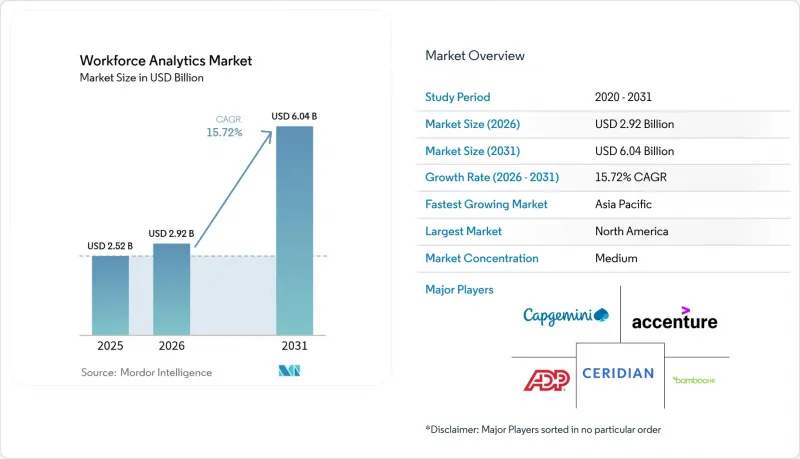
根據 Mordor Intelligence 估計,勞動力分析市場在 2026 年的價值為 29.2 億美元,高於 2025 年的 25.2 億美元,預計到 2031 年將達到 60.4 億美元。
預計 2026 年至 2031 年的複合年成長率為 15.72%。
本報告按組件(解決方案、服務)、部署類型(雲端、本地部署)、組織規模(大型企業、中小企業)、最終用戶行業(銀行、金融服務和保險、製造業、IT和電信、醫療保健、零售、政府、能源和公共產業等)以及地區進行細分。市場預測以價值(美元)表示。
全球勞動力分析市場趨勢與洞察
人工智慧驅動的預測分析正在改變人力資源管理決策。
企業採用機器學習模型,使人力資源部門能夠預測人才短缺、最佳化人才配置並提高員工留任率。強生公司的人工智慧技能推理框架透過建立分類系統和被動評估,提高了學習內容的一致性和招募的準確性。製造業尤其迫切需要這種技術。 42%的工廠計劃在五年內擴大人工智慧/機器學習的應用,50%的工廠計劃明年將人工智慧應用於品管。管理者的角色也正在發生變化,70%的管理者認為人才轉型對績效至關重要。這些因素共同刺激了企業對勞動分析市場的需求。
雲端HCM整合加速了資料分發和分析技術的應用。
諸如Oracle Fusion HCM Analytics和SAP SuccessFactors Workforce Analytics等雲端HCM套件,能夠提供關於員工組成、薪酬和技能的即時指標,使人力資源經理能夠將人才能力與業務目標相匹配。 「One Model」等整合平台能夠標準化來自多個HCM資料來源的數據,並利用預測性洞察來豐富數據,從而提高離職率和薪酬差距。市政機構的採用凸顯了這些解決方案的規模。例如,洛杉磯市已為5萬名員工部署了Workday系統,並利用人工智慧技術篩選篩檢和標記技能。因此,雲端運算的普及正在加速整個勞動力分析市場的應用案例成長。
資料隱私和監管合規的複雜性限制了市場成長。
將於2024年8月生效的歐盟人工智慧法案將許多人力資源人工智慧應用列為「高風險」應用,要求進行風險評估並提高透明度。隨著企業整合大規模語言模型,GDPR的義務也日趨嚴格,強制要求採用可解釋人工智慧和「隱私設計」工作流程。在北美,42%的人力資源負責人擔心加州消費者隱私法案(CCPA)和各州特定的人工智慧法律所帶來的合規性問題。這些相互重疊的監管要求正在拖慢決策週期,並推高勞動力分析市場的總體擁有成本(TCO)。
細分市場分析
到2025年,解決方案將佔勞動分析市場的64.92%,反映出市場對包含預測演算法的綜合平台有著廣泛的需求。隨著企業努力彌合技能差距,人才招募和發展最佳化解決方案正展現出強勁的發展勢頭。亨廷頓英格斯工業公司(Huntington Ingalls Industries)報告稱,在實施人工智慧原生工具後,招聘速度提高了25%,員工留存率提高了30%。績效和敬業度分析也不斷擴展,例如,埃爾卡米諾健康中心(El Camino Health)將註冊護理師(RN)的離職率降低了7個百分點,並實現了每年84萬美元的成本節約。雖然服務業的規模較小,但隨著企業獲得實施支援、託管服務和培訓支持,其複合年成長率(CAGR)仍高達16.74%。專業服務有助於進行複雜的資料遷移,而託管服務則使人力資源團隊能夠專注於策略制定。採用Visier的Vee等生成式人工智慧助手,能夠大幅提升企業在競爭中的競爭力,並促進解決方案的持續成長。
人們對培訓和支援的需求日益成長。 31%的製造商表示,他們需要技能提升才能實施其分析舉措。因此,提供結合學習模組和變革管理模組服務的供應商正在擴大其在勞動力分析市場的佔有率。
預計到2025年,雲端平台將佔據58.62%的市場佔有率,年複合成長率(CAGR)為15.86%,主要得益於企業對更低前期成本和無縫升級的需求。 「單一模型」透過將Workday和SAP SuccessFactors中的資料抽像到一個可用於分析的框架中,展現了其價值。洛杉磯等大規模公共部門客戶正在透過該雲端平台管理數萬名員工,充分證明了其規模和安全性。
在資料主權至關重要的產業,尤其是在金融、保險和證券(BFSI)以及國防領域,本地部署解決方案仍然至關重要。混合部署正逐漸成為一種折衷方案,它允許將敏感資料儲存在本地,同時在雲端進行分析處理。供應商正在增強加密和存取控制模型,SAP 和 Oracle 都增加了基於角色的控制和合規性認證功能。因此,勞動力分析市場正堅定地向雲端轉型,但並未完全放棄本地部署模式。
區域分析
預計到2025年,北美將佔據勞動力分析市場25.45%的佔有率,這主要得益於美國證券交易委員會(SEC)的資訊揭露要求,該要求強制要求提供更細緻的勞動力指標。洛杉磯市利用Workday的AI功能實現了5萬名員工的招募和薪資核算自動化,顯著縮短了處理時間,展現了高度的成熟度。加拿大正在利用其公共部門的數位轉型,而墨西哥則透過近岸外包將分析技術整合到其製造業的人力資源項目中。
預計亞太地區將維持最高的成長率,到2031年複合年成長率將達到16.05%。在印度塔塔鋼鐵公司位於卡林加納加爾的工廠,透過130名員工進行分析技能培訓,營運成功率從60%提升至90%,每年節省成本400萬美元。中國正積極投資將自動化與員工技能提升結合,而日本和韓國則利用分析技術來應對勞動力老化問題。澳洲和紐西蘭正在利用分析技術來提高人才保留率,因為在主要大都會圈,只有41%的醫護人員工作超過兩年。
在歐洲,受GDPR和人工智慧立法的推動,分析技術正穩步成長,這些立法要求演算法高度透明並接受人工監督。德國、英國和法國正在大規模採用分析技術,法國的新創公司受益於Visier和Le Lab RH之間的合作。雖然荷蘭的跨國公司對分析技術的應用十分廣泛,但由於分析人才供應有限,南歐的發展相對落後。中東和非洲蘊藏早期發展機會。阿拉伯聯合大公國和沙烏地阿拉伯已將分析技術納入其「2030願景」計劃,南非也啟動了一個專注於技能映射的公共部門試點計畫。
其他好處:
- Excel格式的市場預測(ME)表
- 3個月的分析師支持
目錄
第1章:引言
- 研究假設和市場定義
- 調查範圍
第2章:調查方法
第3章執行摘要
第4章 市場狀況
- 市場概覽
- 市場促進因素
- 在混合職場環境下,對數據驅動型人才決策的需求日益成長。
- 由於基於雲端的HCM套件,人力資源數據激增
- 將人工智慧/機器學習引入預測性勞動力分析
- 在經濟不確定性中最佳化人事費用
- 向以技能為基礎的市場轉型,這需要進行能力映射。
- ESG 和多元化報告要求正在加速分析技術的應用。
- 市場限制因素
- 資料隱私和合規性日益複雜(GDPR、CCPA、人工智慧相關法律)
- 實施成本高且變更管理負擔沉重。
- 人工智慧分析中的演算法偏見與倫理問題
- 零工/彈性工作生態系中資料分散的孤島
- 供應鏈分析
- 監理情勢
- 技術展望
- 波特五力模型
- 對影響市場的宏觀經濟因素進行評估
第5章 市場規模與成長預測
- 依組件類型
- 解決方案
- 最佳化人才招募和發展
- 薪資核算和員工管理
- 績效與敬業度分析
- 離職率和留任率分析
- 風險與合規分析
- 服務
- 專業服務
- 託管服務
- 培訓和支援服務
- 解決方案
- 依部署類型
- 雲
- 現場
- 按組織規模
- 大公司
- 中小企業
- 按最終用戶行業分類
- 銀行、金融服務和保險(BFSI)
- 製造業
- 資訊科技/通訊
- 醫療保健和生命科學
- 零售與電子商務
- 政府/公共部門
- 能源公用事業
- 運輸/物流
- 其他行業
- 按地區
- 北美洲
- 美國
- 加拿大
- 墨西哥
- 南美洲
- 巴西
- 阿根廷
- 其他南美國家
- 歐洲
- 德國
- 英國
- 法國
- 荷蘭
- 其他歐洲國家
- 亞太地區
- 中國
- 日本
- 印度
- 韓國
- 澳洲和紐西蘭
- 其他亞太國家
- 中東和非洲
- 中東
- 阿拉伯聯合大公國
- 沙烏地阿拉伯
- 土耳其
- 其他中東國家
- 非洲
- 南非
- 奈及利亞
- 其他非洲國家
- 中東
- 北美洲
第6章 競爭情勢
- 市場集中度
- 策略趨勢
- 市佔率分析
- 公司簡介
- Accenture plc
- ADP, Inc.
- BambooHR LLC
- Capgemini SE
- Ceridian HCM Holding Inc.
- ChartHop, Inc.
- Cisco Systems, Inc.
- CultureAmp Pty Ltd
- Darwinbox Digital Solutions Pvt. Ltd.
- Eightfold AI, Inc.
- Gusto, Inc.
- IBM Corporation
- Infor, Inc.
- Kronos-UKG, Inc.
- Lattice, Inc.
- Microsoft Corp.(Viva Insights)
- Namely, Inc.
- Oracle Corporation
- Peoplestreme Pty Ltd(Ascender)
- SAP SE
- Skillsoft Corp.(SumTotal Systems)
- Tableau Software LLC
- Visier, Inc.
- Workday, Inc.
- Zoho Corporation(Zoho People Analytics)
第7章 市場機會與未來展望
According to Mordor Intelligence, the workforce analytics market size in 2026 is estimated at USD 2.92 billion, growing from 2025 value of USD 2.52 billion with 2031 projections showing USD 6.04 billion, growing at 15.72% CAGR over 2026-2031.
This report is Segmented by Component (Solutions, Services), Deployment Type (Cloud, On-Premises), Organization Size (Large Enterprises, Smes), End-User Industry (BFSI, Manufacturing, IT and Telecom, Healthcare, Retail, Government, Energy and Utilities and More), and by Geography. The Market Forecasts are Provided in Terms of Value (USD)
Global Workforce Analytics Market Trends and Insights
AI-Powered Predictive Analytics Transforms Workforce Decision-Making
Enterprise adoption of machine-learning models allows HR teams to predict talent gaps, refine allocation, and lift retention. Johnson & Johnson's AI skills-inference framework, which builds taxonomies and passive assessments, improved learning alignment and hiring accuracy. Manufacturing illustrates urgency: 42% of plants plan to raise AI/ML use within five years, with 50% deploying quality-control AI in the coming year. Managers shift roles as 70% view workforce transformation as critical to performance. These factors collectively stimulate enterprise demand across the workforce analytics market.
Cloud HCM Integration Drives Data Proliferation and Analytics Adoption
Cloud HCM suites such as Oracle Fusion HCM Analytics and SAP SuccessFactors Workforce Analytics offer real-time metrics on composition, compensation, and skills, empowering HR leaders to match capabilities to business goal. Integration platforms like One Model standardize data from multiple HCM sources and enrich it with predictive insights on attrition and pay equity. Municipal deployments highlight scale: the City of Los Angeles runs Workday for 50,000 staff, with AI guiding resume screening and skill tagging. Cloud ubiquity therefore accelerates use-case volume across the workforce analytics market.
Data Privacy and Regulatory Compliance Complexity Constrains Market Growth
The EU AI Act, effective August 2024, designates many HR-AI applications high-risk, demanding risk assessments and transparency. GDPR obligations deepen as firms integrate large language models, mandating explainable AI and privacy-by-design workflows. In North America, CCPA and state AI laws leave 42% of HR managers uncertain about compliance. These overlapping mandates slow decision cycles and elevate total cost of ownership for the workforce analytics market.
Other drivers and restraints analyzed in the detailed report include:
- Skills-Based Talent Marketplace Evolution Requires Advanced Capability Mapping
- Economic Uncertainty Accelerates Workforce Cost Optimization Strategies
- High Implementation Costs and Change Management Complexity Limit Adoption
For complete list of drivers and restraints, kindly check the Table Of Contents.
Segment Analysis
Solutions represented 64.92% of the workforce analytics market in 2025, reflecting pervasive demand for comprehensive platforms that embed predictive algorithms. Talent acquisition and development optimization solutions enjoy strong momentum as enterprises fill skills gaps; Huntington Ingalls Industries recorded 25% faster hiring and 30% higher retention by deploying AI-native tools. Performance and engagement analytics also expand as El Camino Health reduced RN turnover by 7 points, saving USD 840,000 annually. Services, although smaller, post 16.74% CAGR as firms secure implementation, managed-service, and training support. Professional services guide complex data migrations, while managed services allow HR teams to focus on strategy. The introduction of generative AI assistants such as Visier's "Vee" sharpens competitive differentiation and sustains solution growth.
Training and support fetch mounting interest: 31% of manufacturers cite upskilling needs to realize analytics initiatives. Providers that bundle learning and change-management modules thereby capture incremental share within the workforce analytics market.
Cloud platforms held 58.62% share in 2025 and will grow at 15.86% CAGR as organizations chase lower upfront costs and seamless upgrades. One Model proves value by abstracting data from Workday and SAP SuccessFactors into analytics-ready frameworks. Large public-sector clients such as Los Angeles showcase scale and security when managing tens of thousands of employees on cloud stacks.
On-premises retains relevance where data sovereignty dictates, especially in BFSI and defense. Hybrid deployment emerges as a compromise, storing sensitive data locally while running analytics compute in the cloud. Vendors strengthen encryption and permission models: SAP and Oracle both add role-based controls and compliance attestations. The workforce analytics market therefore skewers decisively toward cloud without abandoning localized models.
Complete Report Scope:
- By Component Type
- Solutions
- Talent Acquisition and Development Optimization
- Payroll and Workforce Monitoring
- Performance and Engagement Analytics
- Turnover and Retention Analytics
- Risk and Compliance Analytics
- Services
- Professional Services
- Managed Services
- Training and Support Services
- Solutions
- By Deployment Type
- Cloud
- On-premises
- By Organization Size
- Large Enterprises
- Small and Medium-sized Enterprises (SMEs)
- By End-user Industry
- Banking, Financial Services and Insurance (BFSI)
- Manufacturing
- IT and Telecom
- Healthcare and Life Sciences
- Retail and e-Commerce
- Government and Public Sector
- Energy and Utilities
- Transportation and Logistics
- Other Industries
- By Geography
- North America
- United States
- Canada
- Mexico
- South America
- Brazil
- Argentina
- Rest of South America
- Europe
- Germany
- United Kingdom
- France
- Netherlands
- Rest of Europe
- Asia_Pacific
- China
- Japan
- India
- South Korea
- Australia and New Zealand
- Rest of Asia-Pacific
- Middle East and Africa
- Middle East
- United Arab Emirates
- Saudi Arabia
- Turkey
- Rest of Middle East
- Africa
- South Africa
- Nigeria
- Rest of Africa
- Middle East
- North America
Geography Analysis
North America held 25.45% of the workforce analytics market in 2025, supported by SEC disclosure mandates that push granular workforce metrics. The City of Los Angeles demonstrates advanced maturity by automating hiring and payroll for 50,000 staff through Workday's AI features, lowering processing times materially. Canada capitalizes on public-sector digitization, while Mexico rides near-shoring to embed analytics in manufacturing HR programs.
Asia-Pacific shows the fastest 16.05% CAGR through 2031. India's Tata Steel Kalinganagar plant saved USD 4 million annually by training 130 staff in analytics and boosting strike rates from 60% to 90%. China invests aggressively to align automation and worker reskilling, while Japan and South Korea blend analytics with aging-workforce strategies. Australia and New Zealand apply analytics to retain healthcare professionals, where only 41% stay more than two years in non-metro areas.
Europe grows steadily on the back of GDPR and the AI Act, which both demand transparent algorithms and human oversight. Germany, the United Kingdom, and France implement at scale, with French start-ups benefiting from Visier and Le Lab RH collaboration. The Netherlands sees robust adoption among multinationals, whereas Southern Europe lags because of limited analytics talent supply. Middle East and Africa constitute early-stage opportunities: UAE and Saudi Arabia weave analytics into Vision 2030 programs, and South Africa begins public-sector pilots focused on skills mapping.
- Accenture plc
- ADP, Inc.
- BambooHR LLC
- Capgemini SE
- Ceridian HCM Holding Inc.
- ChartHop, Inc.
- Cisco Systems, Inc.
- CultureAmp Pty Ltd
- Darwinbox Digital Solutions Pvt. Ltd.
- Eightfold AI, Inc.
- Gusto, Inc.
- IBM Corporation
- Infor, Inc.
- Kronos-UKG, Inc.
- Lattice, Inc.
- Microsoft Corp. (Viva Insights)
- Namely, Inc.
- Oracle Corporation
- Peoplestreme Pty Ltd (Ascender)
- SAP SE
- Skillsoft Corp. (SumTotal Systems)
- Tableau Software LLC
- Visier, Inc.
- Workday, Inc.
- Zoho Corporation (Zoho People Analytics)
Additional Benefits:
- The market estimate (ME) sheet in Excel format
- 3 months of analyst support
TABLE OF CONTENTS
1 INTRODUCTION
- 1.1 Study Assumptions and Market Definition
- 1.2 Scope of the Study
2 RESEARCH METHODOLOGY
3 EXECUTIVE SUMMARY
4 MARKET LANDSCAPE
- 4.1 Market Overview
- 4.2 Market Drivers
- 4.2.1 Growing need for data-driven talent decisions in hybrid workplaces
- 4.2.2 Proliferation of HR data from cloud HCM suites
- 4.2.3 Adoption of AI/ML for predictive people analytics
- 4.2.4 Workforce cost-optimization amid economic uncertainty
- 4.2.5 Shift to skills-based talent marketplaces requiring capability mapping
- 4.2.6 ESG and diversity-reporting mandates accelerating analytics roll-outs
- 4.3 Market Restraints
- 4.3.1 Data-privacy and compliance complexity (GDPR, CCPA, AI Acts)
- 4.3.2 High implementation cost and change-management burden
- 4.3.3 Algorithmic-bias and ethics concerns in AI-driven analytics
- 4.3.4 Fragmented data silos in gig/flexible-work ecosystems
- 4.4 Supply-Chain Analysis
- 4.5 Regulatory Landscape
- 4.6 Technological Outlook
- 4.7 Porter's Five Forces
- 4.7.1 Threat of New Entrants
- 4.7.2 Bargaining Power of Buyers
- 4.7.3 Bargaining Power of Suppliers
- 4.7.4 Threat of Substitutes
- 4.7.5 Competitive Rivalry
- 4.8 Assesment of Macroeconomic Factors on the Market
5 MARKET SIZE AND GROWTH FORECASTS (VALUE)
- 5.1 By Component Type
- 5.1.1 Solutions
- 5.1.1.1 Talent Acquisition and Development Optimization
- 5.1.1.2 Payroll and Workforce Monitoring
- 5.1.1.3 Performance and Engagement Analytics
- 5.1.1.4 Turnover and Retention Analytics
- 5.1.1.5 Risk and Compliance Analytics
- 5.1.2 Services
- 5.1.2.1 Professional Services
- 5.1.2.2 Managed Services
- 5.1.2.3 Training and Support Services
- 5.1.1 Solutions
- 5.2 By Deployment Type
- 5.2.1 Cloud
- 5.2.2 On-premises
- 5.3 By Organization Size
- 5.3.1 Large Enterprises
- 5.3.2 Small and Medium-sized Enterprises (SMEs)
- 5.4 By End-user Industry
- 5.4.1 Banking, Financial Services and Insurance (BFSI)
- 5.4.2 Manufacturing
- 5.4.3 IT and Telecom
- 5.4.4 Healthcare and Life Sciences
- 5.4.5 Retail and e-Commerce
- 5.4.6 Government and Public Sector
- 5.4.7 Energy and Utilities
- 5.4.8 Transportation and Logistics
- 5.4.9 Other Industries
- 5.5 By Geography
- 5.5.1 North America
- 5.5.1.1 United States
- 5.5.1.2 Canada
- 5.5.1.3 Mexico
- 5.5.2 South America
- 5.5.2.1 Brazil
- 5.5.2.2 Argentina
- 5.5.2.3 Rest of South America
- 5.5.3 Europe
- 5.5.3.1 Germany
- 5.5.3.2 United Kingdom
- 5.5.3.3 France
- 5.5.3.4 Netherlands
- 5.5.3.5 Rest of Europe
- 5.5.4 Asia_Pacific
- 5.5.4.1 China
- 5.5.4.2 Japan
- 5.5.4.3 India
- 5.5.4.4 South Korea
- 5.5.4.5 Australia and New Zealand
- 5.5.4.6 Rest of Asia-Pacific
- 5.5.5 Middle East and Africa
- 5.5.5.1 Middle East
- 5.5.5.1.1 United Arab Emirates
- 5.5.5.1.2 Saudi Arabia
- 5.5.5.1.3 Turkey
- 5.5.5.1.4 Rest of Middle East
- 5.5.5.2 Africa
- 5.5.5.2.1 South Africa
- 5.5.5.2.2 Nigeria
- 5.5.5.2.3 Rest of Africa
- 5.5.5.1 Middle East
- 5.5.1 North America
6 COMPETITIVE LANDSCAPE
- 6.1 Market Concentration
- 6.2 Strategic Moves
- 6.3 Market Share Analysis
- 6.4 Company Profiles (includes Global-level Overview, Market-level Overview, Core Segments, Financials as available, Strategic Information, Market Rank/Share for key companies, Products and Services, Recent Developments)
- 6.4.1 Accenture plc
- 6.4.2 ADP, Inc.
- 6.4.3 BambooHR LLC
- 6.4.4 Capgemini SE
- 6.4.5 Ceridian HCM Holding Inc.
- 6.4.6 ChartHop, Inc.
- 6.4.7 Cisco Systems, Inc.
- 6.4.8 CultureAmp Pty Ltd
- 6.4.9 Darwinbox Digital Solutions Pvt. Ltd.
- 6.4.10 Eightfold AI, Inc.
- 6.4.11 Gusto, Inc.
- 6.4.12 IBM Corporation
- 6.4.13 Infor, Inc.
- 6.4.14 Kronos-UKG, Inc.
- 6.4.15 Lattice, Inc.
- 6.4.16 Microsoft Corp. (Viva Insights)
- 6.4.17 Namely, Inc.
- 6.4.18 Oracle Corporation
- 6.4.19 Peoplestreme Pty Ltd (Ascender)
- 6.4.20 SAP SE
- 6.4.21 Skillsoft Corp. (SumTotal Systems)
- 6.4.22 Tableau Software LLC
- 6.4.23 Visier, Inc.
- 6.4.24 Workday, Inc.
- 6.4.25 Zoho Corporation (Zoho People Analytics)
7 MARKET OPPORTUNITIES AND FUTURE OUTLOOK
- 7.1 White-space and Unmet-need Assessment

 勞動力分析市場:按組件、組織規模、工作方式、應用、部署類型和產業分類-2026-2032年全球市場預測
 勞動力技能提昇技術市場預測至2034年-按組件、部署模式、技術、組織規模、應用、最終用戶和地區分類的全球分析教育產業勞動力分析市場預測(至 2034 年)—按組件、部署形式、分析類型、應用、最終用戶和地區分類的全球分析
 2026-2030年全球人力資源分析市場
 2026年全球勞動力分析市場報告
 2026-2030年全球人力資源發展分析市場
 全球勞動力管理市場:市場規模、佔有率、成長率、產業分析、依類型、應用和地區劃分的分析及預測(2026-2034年)
 勞動力分析市場 - 全球產業規模、佔有率、趨勢、機會和預測(按組件類型、部署類型、組織規模、最終用戶產業、地區和競爭格局分類,2021-2031 年)
 勞動力分析市場報告:2031 年趨勢、預測與競爭分析
 勞動力分析市場規模、佔有率和成長分析:按類型、部署模型、組織規模、產業和地區 - 產業預測,2024-2031 年