


 |
市場調查報告書
商品編碼
2122503
磁感測器:市場佔有率分析、產業趨勢與統計、成長預測(2026-2031)Magnetic Sensors - Market Share Analysis, Industry Trends & Statistics, Growth Forecasts (2026 - 2031) |
||||||

※ 本網頁內容可能與最新版本有所差異。詳細情況請與我們聯繫。
據 Mordor Intelligence 稱,磁感測器市場預計到 2026 年價值 54.2 億美元,高於 2025 年的 50.6 億美元,預計到 2031 年將達到 76.2 億美元。
預計從 2026 年到 2031 年,其複合年成長率將達到 7.06%。
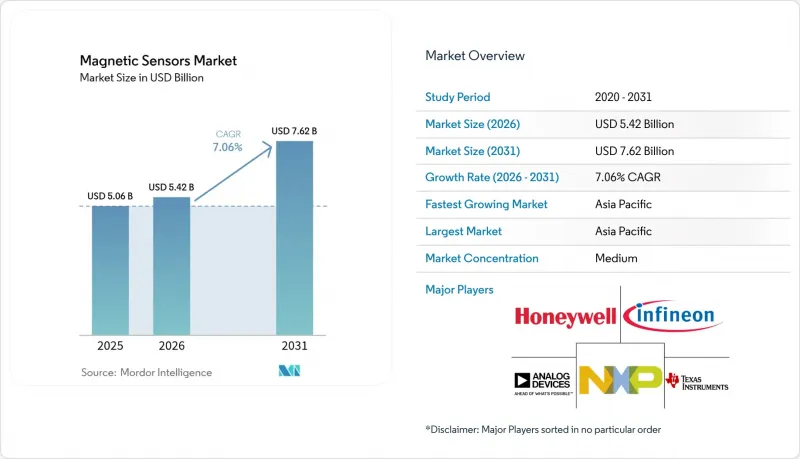
本報告依技術(霍爾效應、AMR、GMR、TMR 及其他技術)、應用(汽車、家用電子電器等)、終端用戶產業(汽車OEM廠商及一級供應商、家用電子電器OEM廠商等)、輸出訊號(數位、類比)及地區進行細分。市場預測以美元計價。
全球磁感測器市場趨勢與洞察
關於電動車驅動系統電氣化的法規
歐盟和加州的電動車 (EV) 法規正在推動感測器應用的日益普及,從轉子位置和溫度追蹤到電池管理子系統,感測器的應用範圍不斷擴大。大陸集團的 e-Motor 轉子溫度感測器將測量誤差限制在 3 度C以內,使設計人員能夠在保持性能的同時減少稀土元素磁體的使用 (assemblymag.com)。如此高的精度既符合法規要求,也有助於整個電動車平台的成本控制。
智慧型手機和穿戴式裝置中三軸磁感測技術的普及
行動電話廠商正在整合3D磁感測器,以實現擴增實境(AR)疊加和精準的室內導航。小型TMR晶片滿足角度精度和功耗要求,推動了跨產業需求。 TDK的Nivio™ xMR組件能夠以比實驗室SQUID更小的尺寸測量生物磁場,這顯示其在醫療設備領域具有應用潛力。
商品化霍爾效應積體電路價格下降
霍爾效應裝置正面臨來自中國低成本晶圓廠日益激烈的競爭。自2024年以來釹的價格下跌了42%,進一步削弱了高階供應商先前在材料成本方面的優勢,加劇了它們的競爭壓力。因此,供應商正將研發重點放在差異化的TMR和GMR產品線上,並整合訊號處理模組,以維持其定價權。
細分市場分析
TMR感測器正以8.46%的複合年成長率快速成長,在主要技術中成長最快。霍爾效應解決方案憑藉其成熟的製造技術和極具吸引力的價格,預計到2025年仍將佔據磁感測器市場47.35%的佔有率。然而,汽車安全系統和工業4.0機器人現在要求在-40 度C至+150 度C的溫度範圍內,角度精度小於1度,而這正是TMR感測器的優勢所在。 Allegro MicroSystems公司推出的「XtremeSense™」產品,其靈敏度比同類霍爾效應產品高10倍,但功耗降低了50%。
對於希望提高靈敏度但又不想承擔TMR相關成本的客戶而言,GMR是一種折衷選擇;而AMR則在需要簡單訊號鏈的線性工業編碼器領域佔有一席之地。磁通門和SQUID元件則應用於高階實驗室設備、國防設備和醫療設備。鑑於此技術格局,霍爾效應技術預計將在注重成本的產品線中繼續保持其主導地位,但TMR很可能在磁感測器市場創造大部分價值。
到2025年,汽車產業將佔據磁感測器市場55.32%的佔有率。在電動動力傳動系統(HDD)和固態硬碟(SSD)的量子級TMR磁頭正幫助超大規模資料中心業者資料中心以9.28%的複合年成長率(CAGR)提升Terabyte級儲存密度。營運商還在配電單元中引入霍爾效應電流感測器,以最佳化機架級能源利用,從而實現脫碳目標。隨著工廠組裝日益數位化,工業自動化行業的銷售額穩步成長,而醫療行業則在TDK生物磁技術的創新支持下,透過非侵入式成像和植入監測,迎來了新的成長機會。
區域分析
預計到2025年,亞太地區將以41.68%的市佔率引領磁感測器市場,並持續以9.07%的複合年成長率成長,這主要得益於中國半導體製造廠和日本精密感測器技術的發展。中國對稀土元素的出口限制既是挑戰也是機會。國內晶圓廠可以確保磁鐵的穩定供應,而出口導向汽車製造商則在尋求替代來源。日本的TMR(三磁體磁阻)藍圖正利用其深度測量技術推動感測器小型化,這為汽車和醫療產業都做出了貢獻。韓國主要儲存設備製造商正在推動對高密度TMR磁頭的需求,而印度不斷擴大的汽車生產也正在拓展該地區的基本客群。
儘管面臨原料供應挑戰,北美仍然是至關重要的市場。 Allegro Microsystems公司累計, 2024會計年度銷售額達10.5億美元,其中電動車產品線成長38%。各州政府對稀土元素加工的激勵措施正在支持諸如Noveon Magnetics公司位於德克薩斯的工廠等項目,但預計未來幾年北美的稀土產量仍將落後於亞洲。汽車製造商高度依賴本地感測器設計中心來滿足美國國家公路交通安全管理局(NHTSA)的軟體更新要求。
其他好處:
- Excel格式的市場預測(ME)表
- 3個月的分析師支持
目錄
第1章:引言
- 研究假設和市場定義
- 調查範圍
第2章:調查方法
第3章執行摘要
第4章 市場狀況
- 市場概覽
- 市場促進因素
- 關於電動車動力系統電氣化的法規
- 智慧型手機和穿戴式裝置中三軸磁感測器的普及
- 汽車產業對ADAS和電動馬達的需求不斷成長
- 向工業4.0時代的工廠自動化轉型
- 車載直流快速充電中的電流監測
- 在資料中心的硬碟/固態硬碟磁頭中採用量子級TMR技術
- 市場限制因素
- 商品化霍爾效應積體電路價格下降
- 稀土元素磁鐵供應鏈的集中化
- 高速電氣化平台中的電磁干擾合規成本
- 圍繞xMR感測器專利的智慧財產權訴訟風險
- 價值供應鏈分析
- 監理情勢
- 技術展望
- 波特五力模型
第5章 市場規模與成長預測
- 透過技術
- 霍爾效應
- 異性磁電阻(AMR)
- 巨磁電阻(GMR)
- 隧道磁阻(TMR)
- 其他技術
- 透過使用
- 車
- 家用電子產品
- 工業自動化
- 醫療保健和醫療設備
- 航太/國防
- 資料中心和伺服器存儲
- 其他用途
- 按最終用途行業分類
- 汽車原始設備製造商和一級供應商
- 家用電子電器OEM製造商
- 工業設備製造商
- 能源公用事業
- 醫療設備OEM製造商
- 航太和國防領域的主要公司
- 透過輸出訊號
- 數位式(IC/SPI、SENT、PSI5)
- 類比(線性電壓/電流)
- 按地區
- 北美洲
- 美國
- 加拿大
- 墨西哥
- 南美洲
- 巴西
- 阿根廷
- 其他南美國家
- 歐洲
- 英國
- 德國
- 法國
- 義大利
- 西班牙
- 俄羅斯
- 其他歐洲國家
- 亞太地區
- 中國
- 日本
- 印度
- 韓國
- ASEAN-5
- 澳洲和紐西蘭
- 其他亞太國家
- 中東和非洲
- 土耳其
- 以色列
- 沙烏地阿拉伯
- UAE
- 南非
- 奈及利亞
- 其他中東和非洲國家
- 北美洲
第6章 競爭情勢
- 市場集中度
- 策略趨勢
- 市佔率分析
- 公司簡介
- Infineon Technologies AG
- Allegro MicroSystems LLC
- NXP Semiconductors NV
- TDK Corporation
- Honeywell International Inc.
- Analog Devices Inc.
- STMicroelectronics NV
- Murata Manufacturing Co. Ltd
- TE Connectivity Ltd
- Texas Instruments Inc.
- NVE Corporation
- Crocus Technology Inc.
- Omron Corporation
- Asahi Kasei Microdevices(AKM)
- Diodes Incorporated
- Melexis NV
- ams-OSRAM AG
- Sensitec GmbH
- TT Electronics plc
- Robert Bosch GmbH
- Lake Shore Cryotronics Inc.
第7章 市場機會與未來展望
According to Mordor Intelligence, magnetic sensor market size in 2026 is estimated at USD 5.42 billion, growing from 2025 value of USD 5.06 billion with 2031 projections showing USD 7.62 billion, growing at 7.06% CAGR over 2026-2031.
This report is Segmented by Technology (Hall-Effect, AMR, GMR, TMR, Other Technologies), Application (Automotive, Consumer Electronics, and More), End-Use Industry (Automotive OEMs and Tier-1s, Consumer Electronics OEMs, and More), Output Signal (Digital, Analog), and by Geography. The Market Forecasts are Provided in Terms of Value (USD).
Global Magnetic Sensors Market Trends and Insights
EV drivetrain electrification mandates
Electric-vehicle regulations in the European Union and California spur wider sensor deployment, stretching from rotor position and temperature tracking to battery-management subsystems. Continental's e-Motor Rotor Temperature Sensor trims measurement tolerance to 3 °C, allowing designers to cut rare-earth magnet content while protecting performance assemblymag.com. Such precision supports both compliance targets and cost-containment strategies across EV platforms.
Proliferation of 3-axis magnetic sensing in smartphones and wearables
Handset vendors embed 3-D magnetic sensors to deliver augmented-reality overlays and accurate indoor navigation. Miniature TMR dies meet the angular-accuracy and power requirements, stimulating cross-industry demand spillovers. TDK's Nivio(TM) xMR component measures biomagnetic fields in a footprint smaller than laboratory-grade SQUIDs, hinting at medical-device spill-over potential.
Price erosion in commoditised Hall-effect ICs
Hall-effect devices face rising competition from low-cost Chinese fabs. The 42% fall in neodymium prices since 2024 compounds pressure by eroding the material-cost moat once held by premium suppliers. Vendors therefore channel R&D into differentiated TMR and GMR lines or integrate signal-processing blocks to sustain pricing power.
Other drivers and restraints analyzed in the detailed report include:
- Growing ADAS and e-motor position needs in automotive
- Factory automation shift to Industry 4.0
- Supply-chain concentration in rare-earth magnetics
For complete list of drivers and restraints, kindly check the Table Of Contents.
Segment Analysis
TMR sensors are expanding at 8.46% CAGR, the fastest pace among major technologies. Hall-effect solutions still hold 47.35% of the magnetic sensor market share in 2025 due to mature tooling and attractive pricing. Yet automotive safety systems and Industry 4.0 robots now specify sub-degree angular accuracy across -40 °C to +150 °C ranges, a window where TMR excels. Allegro MicroSystems markets XtremeSense(TM) implementations with 10 X sensitivity and 50% lower current draw than Hall-effect peers.
GMR represents a middle path for customers demanding enhanced sensitivity without the cost premium of TMR, while AMR retains a niche in linear industrial encoders requiring simple signal chains. Fluxgate and SQUID devices serve high-end laboratory, defense, and medical equipment. The technology mix suggests Hall-effect incumbency in cost-sensitive lines will persist, but TMR will absorb most incremental value creation within the magnetic sensor market.
Automotive accounted for 55.32% of the magnetic sensor market size in 2025. The proliferation of electric powertrains and ADAS keeps that base stable, yet the standout growth story is data centers. Quantum-grade TMR heads for HDDs and SSDs help hyperscalers raise terabyte density at a 9.28% CAGR. Operators also deploy Hall-based current sensors in power-distribution units to optimize rack-level energy use amid decarbonization targets. Industrial automation contributes steady volume as factories digitize assembly lines, while healthcare opens nascent upside through non-invasive imaging and implant monitoring supported by TDK's biomagnetic innovations.
Complete Report Scope:
- By Technology
- Hall-Effect
- Anisotropic Magnetoresistance (AMR)
- Giant Magnetoresistance (GMR)
- Tunnel Magnetoresistance (TMR)
- Other Technologies
- By Application
- Automotive
- Consumer Electronics
- Industrial Automation
- Healthcare and Medical Devices
- Aerospace and Defense
- Data-Center and Server Storage
- Other Applications
- By End-Use Industry
- Automotive OEMs and Tier-1s
- Consumer Electronics OEMs
- Industrial Equipment Manufacturers
- Energy and Utilities
- Healthcare OEMs
- Aerospace and Defense Primes
- By Output Signal
- Digital (IC/SPI, SENT, PSI5)
- Analog (Linear Voltage/Current)
- By Geography
- North America
- United States
- Canada
- Mexico
- South America
- Brazil
- Argentina
- Rest of South America
- Europe
- United Kingdom
- Germany
- France
- Italy
- Spain
- Russia
- Rest of Europe
- Asia Pacific
- China
- Japan
- India
- South Korea
- ASEAN-5
- Australia and New Zealand
- Rest of Asia Pacific
- Middle East and Africa
- Turkey
- Israel
- Saudi Arabia
- UAE
- South Africa
- Nigeria
- Rest of Middle East and Africa
- North America
Geography Analysis
Asia-Pacific led the magnetic sensor market with 41.68% share in 2025 and is heading toward a 9.07% CAGR, powered by China's semiconductor fabs and Japan's precision sensor know-how. Chinese export curbs on rare-earths create both threat and windfall: domestic fabs gain a captive magnet supply, while export-oriented carmakers scramble for alternate sourcing. Japan's TMR roadmap leverages metrology depth to push sensor miniaturization that feeds both auto and medical verticals. South Korea's storage-device majors lift demand for high-density TMR heads, and India's expanding vehicle output widens the regional customer base.
North America remains pivotal despite material-supply pain points. Allegro MicroSystems booked USD 1.05 billion sales in fiscal 2024, up 38% in e-mobility-linked lines. State incentives for domestic rare-earth processing underpin projects such as Noveon Magnetics' Texas plant, though volumes will lag Asia for several years. Automakers rely heavily on local sensor design centers to meet National Highway Traffic Safety Administration software-update requirements.
- Infineon Technologies AG
- Allegro MicroSystems LLC
- NXP Semiconductors NV
- TDK Corporation
- Honeywell International Inc.
- Analog Devices Inc.
- STMicroelectronics NV
- Murata Manufacturing Co. Ltd
- TE Connectivity Ltd
- Texas Instruments Inc.
- NVE Corporation
- Crocus Technology Inc.
- Omron Corporation
- Asahi Kasei Microdevices (AKM)
- Diodes Incorporated
- Melexis NV
- ams-OSRAM AG
- Sensitec GmbH
- TT Electronics plc
- Robert Bosch GmbH
- Lake Shore Cryotronics Inc.
Additional Benefits:
- The market estimate (ME) sheet in Excel format
- 3 months of analyst support
TABLE OF CONTENTS
1 INTRODUCTION
- 1.1 Study Assumptions and Market Definition
- 1.2 Scope of the Study
2 RESEARCH METHODOLOGY
3 EXECUTIVE SUMMARY
4 MARKET LANDSCAPE
- 4.1 Market Overview
- 4.2 Market Drivers
- 4.2.1 EV drivetrain electrification mandates
- 4.2.2 Proliferation of 3-axis magnetic sensing in smartphones and wearables
- 4.2.3 Growing ADAS and e-motor position needs in automotive
- 4.2.4 Factory automation shift to Industry 4.0
- 4.2.5 On-board DC-fast-charging current monitoring
- 4.2.6 Quantum-grade TMR adoption in data-center HDD/SSD heads
- 4.3 Market Restraints
- 4.3.1 Price erosion in commoditised Hall-effect ICs
- 4.3.2 Supply-chain concentration in rare-earth magnetics
- 4.3.3 EMI compliance costs for high-speed electrification platforms
- 4.3.4 IP litigation risk around xMR sensor patents
- 4.4 Value / Supply-Chain Analysis
- 4.5 Regulatory Landscape
- 4.6 Technological Outlook
- 4.7 Porter's Five Forces
- 4.7.1 Threat of New Entrants
- 4.7.2 Bargaining Power of Buyers
- 4.7.3 Bargaining Power of Suppliers
- 4.7.4 Threat of Substitutes
- 4.7.5 Intensity of Competitive Rivalry
5 MARKET SIZE AND GROWTH FORECASTS (VALUE)
- 5.1 By Technology
- 5.1.1 Hall-Effect
- 5.1.2 Anisotropic Magnetoresistance (AMR)
- 5.1.3 Giant Magnetoresistance (GMR)
- 5.1.4 Tunnel Magnetoresistance (TMR)
- 5.1.5 Other Technologies
- 5.2 By Application
- 5.2.1 Automotive
- 5.2.2 Consumer Electronics
- 5.2.3 Industrial Automation
- 5.2.4 Healthcare and Medical Devices
- 5.2.5 Aerospace and Defense
- 5.2.6 Data-Center and Server Storage
- 5.2.7 Other Applications
- 5.3 By End-Use Industry
- 5.3.1 Automotive OEMs and Tier-1s
- 5.3.2 Consumer Electronics OEMs
- 5.3.3 Industrial Equipment Manufacturers
- 5.3.4 Energy and Utilities
- 5.3.5 Healthcare OEMs
- 5.3.6 Aerospace and Defense Primes
- 5.4 By Output Signal
- 5.4.1 Digital (IC/SPI, SENT, PSI5)
- 5.4.2 Analog (Linear Voltage/Current)
- 5.5 By Geography
- 5.5.1 North America
- 5.5.1.1 United States
- 5.5.1.2 Canada
- 5.5.1.3 Mexico
- 5.5.2 South America
- 5.5.2.1 Brazil
- 5.5.2.2 Argentina
- 5.5.2.3 Rest of South America
- 5.5.3 Europe
- 5.5.3.1 United Kingdom
- 5.5.3.2 Germany
- 5.5.3.3 France
- 5.5.3.4 Italy
- 5.5.3.5 Spain
- 5.5.3.6 Russia
- 5.5.3.7 Rest of Europe
- 5.5.4 Asia Pacific
- 5.5.4.1 China
- 5.5.4.2 Japan
- 5.5.4.3 India
- 5.5.4.4 South Korea
- 5.5.4.5 ASEAN-5
- 5.5.4.6 Australia and New Zealand
- 5.5.4.7 Rest of Asia Pacific
- 5.5.5 Middle East and Africa
- 5.5.5.1 Turkey
- 5.5.5.2 Israel
- 5.5.5.3 Saudi Arabia
- 5.5.5.4 UAE
- 5.5.5.5 South Africa
- 5.5.5.6 Nigeria
- 5.5.5.7 Rest of Middle East and Africa
- 5.5.1 North America
6 COMPETITIVE LANDSCAPE
- 6.1 Market Concentration
- 6.2 Strategic Moves
- 6.3 Market Share Analysis
- 6.4 Company Profiles (includes Global level Overview, Market level overview, Core Segments, Financials as available, Strategic Information, Market Rank/Share for key companies, Products and Services, and Recent Developments)
- 6.4.1 Infineon Technologies AG
- 6.4.2 Allegro MicroSystems LLC
- 6.4.3 NXP Semiconductors NV
- 6.4.4 TDK Corporation
- 6.4.5 Honeywell International Inc.
- 6.4.6 Analog Devices Inc.
- 6.4.7 STMicroelectronics NV
- 6.4.8 Murata Manufacturing Co. Ltd
- 6.4.9 TE Connectivity Ltd
- 6.4.10 Texas Instruments Inc.
- 6.4.11 NVE Corporation
- 6.4.12 Crocus Technology Inc.
- 6.4.13 Omron Corporation
- 6.4.14 Asahi Kasei Microdevices (AKM)
- 6.4.15 Diodes Incorporated
- 6.4.16 Melexis NV
- 6.4.17 ams-OSRAM AG
- 6.4.18 Sensitec GmbH
- 6.4.19 TT Electronics plc
- 6.4.20 Robert Bosch GmbH
- 6.4.21 Lake Shore Cryotronics Inc.
7 MARKET OPPORTUNITIES AND FUTURE OUTLOOK
- 7.1 White-space and Unmet-Need Assessment

 汽車磁感測器市場:按類型、磁密度、應用、產業垂直領域、國家和地區分類-產業分析、市場規模、市場佔有率和預測(2026-2033 年)
 2026年全球電磁感測器市場報告
 奈米磁性元件:市場佔有率分析、產業趨勢與統計、成長預測(2026-2031)
 磁場感測器市場:按類型、組件、感測器類別、應用和最終用戶產業分類-2026-2032年全球市場預測磁性感測器市場:2026-2032年全球市場預測(依感測器類型、偵測功能、封裝、輸出、軸類型、磁場範圍和應用分類)
 嵌入式磁感測器市場-全球產業規模、佔有率、趨勢、機會、預測:按類型、磁密度、應用、產業垂直領域、地區和競爭格局分類,2021-2031年
 磁場感測器市場預測至2034年—按類型、測量範圍、應用、最終用戶和地區分類的全球分析
 磁感測器市場報告:按技術、應用、最終用途和地區分類(2026-2034 年)
 全球磁感測器市場(2026-2036 年)旋轉磁編碼器市場報告:趨勢、預測和競爭分析(至2035年)