


 |
市場調查報告書
商品編碼
2115202
奈米磁性元件:市場佔有率分析、產業趨勢與統計、成長預測(2026-2031)Nano-Magnetic Devices - Market Share Analysis, Industry Trends & Statistics, Growth Forecasts (2026 - 2031) |
||||||

※ 本網頁內容可能與最新版本有所差異。詳細情況請與我們聯繫。
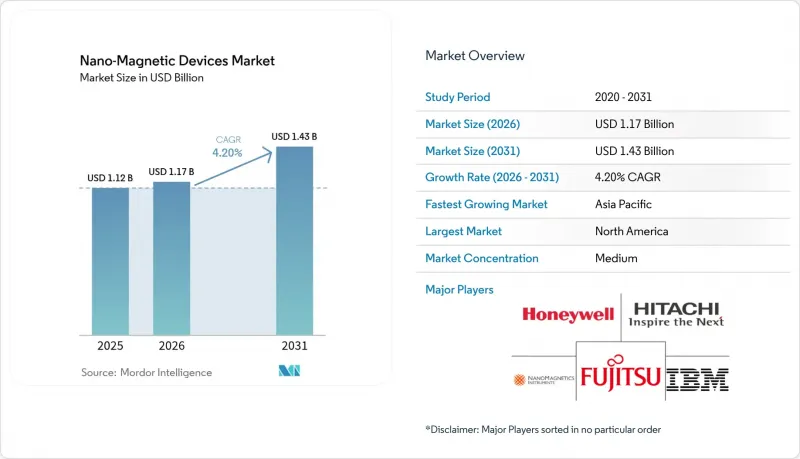
根據 Mordor Intelligence 預測,奈米磁性元件市場規模將從 2025 年的 11.2 億美元成長到 2026 年的 11.7 億美元,到 2031 年將達到 14.3 億美元,2026 年至 2031 年的複合年成長率為 4.20%。
本報告按類型(感測器、資料儲存設備、成像設備、執行器和邏輯裝置、其他)、技術(磁阻式、自旋傳輸力矩 (STT) 式、電壓調節器異向性(VCMA) 式、其他)、終端用戶產業(IT 和電信(資料中心)、能源和公共產業、其他)以及地區進行細分。市場預測以美元 (USD) 為單位。
全球奈米磁性元件市場趨勢及洞察
汽車產業OTA韌體更新的MRAM認證
汽車OEM廠商目前正在認證可承受無限次寫入循環的MRAM,以解決軟體定義汽車中快閃損耗的問題。台積電的嵌入式MRAM使微控制器能夠處理頻繁的空中下載(OTA)補丁而不會造成資料損壞。 TDK發布了TAS8240,這是一款符合ASIL D安全標準的冗餘TMR角度感測器,可在高達150 度C的溫度下工作,進一步推動了市場發展。隨著電動車產量預計將成長27%,電池和動力總成模組對磁感的需求也不斷成長。強大的記憶體耐久性和高精度感測的結合,正在鞏固奈米磁性裝置市場作為未來汽車電子產品核心技術的地位。
升級改造用於GMR/TMR感測器IC生產的300mm晶圓廠
東亞晶圓代工廠已確認,在300mm晶圓上,自旋軌道扭力(SOT)型磁隧道接面(MTJ)的良率達99.6%。此元件實現了2ns時680µA的開關電流和超過119%的TMR比。良率的提升將降低單位成本,使製造商能夠在單一晶片上整合多軸感測器。東北大學針對1nm級MTJ所製定的指導原則是,在150 度C環境下,維持10年以上的資料保存時間的同時,速度低於10ns。極紫外光刻技術目前已達到5nm解析度,進一步推動了裝置的微型化。具有成本競爭力的高密度感測器正在消費電子和工業自動化領域中得到更廣泛的應用,加速了奈米磁性裝置市場的成長。
對鈷、鎵等重要礦產的出口實施限制。
由於中國佔全球整體鎵供應量的98%,出口禁令可能導致美國GDP減少34億美元,鎵價飆漲150%以上。由於砷化鎵和氮化鎵裝置通常與射頻模組中的磁性感測器結合使用,供不應求將對整個奈米磁性元件市場產生影響。美國國防部的雷達現代化計畫依賴氮化鎵,進一步加劇了戰略風險。儘管回收和人工智慧驅動的磁鐵設計正在緩解風險,但短期內價格波動預計仍將持續。
細分市場分析
到2025年,感測器(主要由汽車、工業和行動產品驅動)將佔據奈米磁性裝置市場41.05%的佔有率。同時,數據儲存設備預計將以6.01%的複合年成長率成長,推動奈米磁性裝置儲存市場規模從2026年的2.4億美元成長到2031年的3.3億美元。磁阻隨機存取記憶體(MRAM)的非揮發性和抗輻射性正推動其在太空探勘和電動車領域的應用。成像設備憑藉著能夠捕捉生物磁訊號的超靈敏xMR組件,正蓬勃發展,並創造新的收入來源。
MRAM的無限壽命超越了快閃記憶體,消除了乘用車OTA升級的瓶頸。突破性的3D磁記錄技術實現了10 Tbit/in²的容量,維持了硬碟(HDD)的重要性。新興的自旋邏輯整合了儲存和算術功能,預示著記憶體內處理的新範式。
霍爾效應感測器憑藉著低成本和成熟的供應鏈,預計到2025年將佔感測器銷售額的41.08%。 TMR感測器的複合年成長率(CAGR)為5.61%,隨著300mm晶圓廠產能的提升,價格差異正在縮小。冗餘角度感測器「TAS8240」符合ISO 26262 ASIL D標準,顯示其已準備好應用於汽車領域。
GMRは、感度と手頃な価格のバランスを取りながら、中級市場のニッチセグメントを占めています。磁歪式センサは、EMI耐性が不可欠な航太セグメントの油圧制御において優れた性能を発揮します。TMRベース數位羅盤は、校正後に方位角誤差を4.18°から0.46°に大幅に低減し、ドローンのナビゲーション精度を向上させます。オフセット補正機能を備えた新しい3軸シリコン,ホールセンサは、感度を198V/(A,T)まで向上させ、ホールセンサファミリーにもなお革新の余地があることを示しています。
區域分析
到2025年,北美將佔據奈米磁性元件市場31.25%的佔有率。這主要得益於國防和航太計畫對抗輻射MRAM的需求。大學與產業界的緊密合作正在推動神經形態PIN電子晶片原型的發展,並充分利用了《晶片創新與應用法案》(CHIPS Act)的資金支持。在北美的航太供應鏈中,記憶體的耐久性優先於成本,從而支撐了較高的價格。
由於日本、韓國和中國300毫米晶圓廠產能的提升,亞太地區預計將實現4.83%的複合年成長率。中國向釹鐵硼奈米複合磁體的轉型正在增強國內渦輪機製造商的實力,並產生全球連鎖反應。日本和韓國將3D雷射雷達和磁融合感測器引入自主移動機器人(AMR)正在推動智慧工廠的擴張。
歐洲已撥款158億歐元用於「晶片聯合計畫」(Chips Joint Undertaking),在天體離子神經形態運算領域佔據獨特地位。德國汽車產業生態系統需要符合ASIL D標準的TMR感測器,而法國和比利時的研究機構則在主導。南美洲和中東等新興地區正利用跨國OEM廠商的技術轉讓,部署用於電網穩定和工業自動化的奈米磁性裝置。
其他福利
- Excel格式的市場預測(ME)表
- 3個月的分析師支持
目錄
第1章:引言
- 研究假設和市場定義
- 調查範圍
第2章:調查方法
第3章執行摘要
第4章 市場狀況
- 市場概覽
- 市場促進因素
- 用於歐盟和美國車輛OTA韌體更新的MRAM的汽車認證。
- 東亞地區300毫米晶圓廠升級改造,用於生產GMR/TMR感測器IC
- 北美和歐洲深空任務對抗輻射自旋電子記憶體的需求
- 中國風力發電機向釹鐵硼奈米複合磁體的過渡
- 透過《晶片與科學法案》和《歐盟晶片法案》為自旋電子學研究和開發提供資金
- 日本和韓國在自主移動機器人(AMR)中引入了3D雷射雷達和磁融合感測器
- 市場限制因素
- 對鈷、鎵等重要礦產的出口實施限制。
- 奈米磁鐵製造中10nm或更小圖形化的良率下降。
- 新一代硬碟的面密度極限(3 Tb/平方英吋或更低)
- 缺乏關於TMR感測器可靠性的IEC/JEDEC標準
- 工業生態系分析
- 技術展望
- 波特五力分析
第5章 市場規模與成長預測
- 按類型
- 感應器
- 磁場感測器
- 霍爾效應感測器
- GMR感測器
- TMR感測器
- 磁致伸縮感測器
- 資料儲存設備
- MRAM
- Spintronics 硬碟讀寫頭
- 磁帶儲存頭
- 影像設備
- 磁粒子成像系統
- 奈米磁共振線圈
- 執行器邏輯裝置
- 自旋電子邏輯/電晶體
- 微型馬達執行器
- 其他奈米磁性成分
- 天線和射頻設備
- 感應器
- 透過技術
- 磁阻
- 自旋傳輸力矩(STT)
- 電壓調節器異向性(VCMA)
- 超順磁性奈米粒子
- 按最終用途行業分類
- 家用電器
- 資訊科技與電信(資料中心)
- 汽車和運輸業
- 航太/國防
- 醫療保健和醫療設備
- 能源與公共產業(風力發電、電力轉換設備)
- 工業自動化機器人
- 其他(研究和教育)
- 按地區
- 北美洲
- 美國
- 加拿大
- 墨西哥
- 歐洲
- 德國
- 英國
- 法國
- 北歐的
- 其他歐洲國家
- 南美洲
- 巴西
- 其他南美國家
- 亞太地區
- 中國
- 日本
- 印度
- 東南亞
- 其他亞太國家
- 中東和非洲
- 中東
- 波灣合作理事會(GCC)成員國
- 土耳其
- 其他中東國家
- 非洲
- 南非
- 其他非洲地區
- 中東
- 北美洲
第6章 競爭情勢
- 市場集中度
- 策略趨勢
- 市佔率分析
- 公司簡介
- IBM Corporation
- Intel Corporation
- Everspin Technologies Inc.
- Honeywell International Inc.
- NVE Corporation
- Avalanche Technology Inc.
- Fujitsu Limited
- Siemens AG
- Infineon Technologies AG
- TDK Corporation
- Hitachi Metals Ltd.
- Samsung Electronics Co., Ltd.
- Western Digital Technologies Inc.
- Seagate Technology PLC
- Crocus Nano Electronics
- Spin Transfer Technologies
- Analog Devices Inc.
- NXP Semiconductors NV
- Micron Technology Inc.
- Bosch Sensortec GmbH
- Renesas Electronics Corporation
- STMicroelectronics NV
第7章 市場機會與未來展望
According to Mordor Intelligence, the nano-magnetic devices market size is expected to grow from USD 1.12 billion in 2025 to USD 1.17 billion in 2026 and is forecast to reach USD 1.43 billion by 2031 at 4.20% CAGR over 2026-2031.
This report is Segmented by Type (Sensors, Data Storage Devices, Imaging Devices, Actuators and Logic Devices, and More), Technology (Magneto-Resistive, Spin-Transfer Torque (STT), Voltage-Controlled Magnetic Anisotropy (VCMA), and More), End-Use Vertical (IT and Telecom (Data Centers), Energy and Utilities, and More), and Geography. The Market Forecasts are Provided in Terms of Value (USD).
Global Nano-Magnetic Devices Market Trends and Insights
Automotive Qualification of MRAM for OTA Firmware Updates
Automotive OEMs now certify MRAM that endures unlimited write cycles, eliminating the wear-out concerns of flash memory in software-defined vehicles. TSMC's embedded MRAM enables microcontrollers that manage frequent over-the-air patches without data corruption. TDK reinforced momentum by unveiling the TAS8240 redundant TMR angle sensor that complies with ASIL D safety norms while operating up to 150 °C. Electric-vehicle production is projected to rise 27%, intensifying demand for magnetic sensing in battery and drivetrain modules. Together, robust memory endurance and high-precision sensing cement the nano-magnetic devices market as a core enabler for future automotive electronics.
300 mm Fab Upgrades for GMR/TMR Sensor IC Production
East-Asian foundries have validated 99.6% yield for spin-orbit-torque MTJs on 300 mm wafers, with switching currents of 680 µA at 2 ns and TMR ratios above 119%. These yields drive down unit costs and let manufacturers integrate multi-axis sensors on a single die. Tohoku University guidelines on single-nanometer MTJs secure data retention beyond 10 years at 150 °C while retaining sub-10 ns speed. EUV lithography now reaches 5 nm resolution, guiding further miniaturization. Cost-competitive high-density sensors broaden adoption in consumer electronics and industrial automation, accelerating the nano-magnetic devices market.
Critical Mineral Export Controls on Cobalt and Gallium
China supplies 98% of global gallium, so potential export bans could shave USD 3.4 billion from U.S. GDP and lift gallium prices more than 150%. Gallium arsenide and gallium nitride devices often co-package with magnetic sensors in RF modules, so shortages reverberate through the nano-magnetic devices market. The Pentagon's radar modernization that relies on GaN further heightens strategic exposure. Recycling initiatives and AI-guided magnet design aim to mitigate risk, but near-term volatility persists.
Other drivers and restraints analyzed in the detailed report include:
- Radiation-Hard Spintronic Memory Demand for Deep-Space Missions
- Shift to NdFeB Nano-Composite Magnets in Chinese Wind Turbines
- Sub-10 nm Patterning Yield Losses in Nano-Magnet Fabrication
For complete list of drivers and restraints, kindly check the Table Of Contents.
Segment Analysis
Sensors dominated 41.05% of the nano-magnetic devices market in 2025, anchored in automotive, industrial, and mobile products. Data storage devices, however, clock a 6.01% CAGR, propelling the nano-magnetic devices market size for storage from USD 0.24 billion in 2026 to USD 0.33 billion by 2031. MRAM's non-volatility and radiation tolerance underpin adoption in space probes and electric vehicles. Imaging devices gain traction thanks to ultra-sensitive xMR components that capture biomagnetic signals, creating new revenue pools.
MRAM's unlimited endurance outperforms flash, removing OTA bottlenecks in passenger vehicles. Breakthrough 3-D magnetic recording promises 10 Tbit/in2 capacities, sustaining HDD relevance. Emerging spin-logic integrates memory and compute, foreshadowing in-memory processing paradigms.
Hall-effect sensors held 41.08% of sensor revenue in 2025 due to low cost and mature supply chains. TMR sensors expand at 5.61% CAGR, narrowing the price gap as 300 mm fabs ramp volume. The TAS8240 redundant angle sensor meets ISO 26262 ASIL D, signaling automotive readiness.
GMR occupies mid-tier niches, balancing sensitivity with affordability. Magnetostrictive sensors excel in aerospace hydraulic controls where EMI immunity is vital. TMR-based digital compasses slash azimuth errors from 4.18° to 0.46° after calibration, improving drone navigation. A new 3-axis silicon Hall sensor with offset cancellation lifts sensitivity to 198 V A-1 T-1, showing the Hall family can still innovate.
Complete Report Scope:
- By Type
- Sensors
- Magnetic Field Sensors
- Hall-Effect Sensors
- GMR Sensors
- TMR Sensors
- Magnetostrictive Sensors
- Data Storage Devices
- MRAM
- Spintronic HDD Read Heads
- Tape Storage Heads
- Imaging Devices
- Magnetic Particle Imaging Systems
- Nano-MRI Coils
- Actuators and Logic Devices
- Spintronic Logic/Transistors
- Micromotors and Actuators
- Other Nano-Magnetic Components
- Antenna and RF Devices
- Sensors
- By Technology
- Magnetoresistive
- Spin-Transfer Torque (STT)
- Voltage-Controlled Magnetic Anisotropy (VCMA)
- Superparamagnetic Nanoparticles
- By End-use Vertical
- Consumer Electronics
- IT and Telecom (Data Centers)
- Automotive and Transportation
- Aerospace and Defense
- Healthcare and Medical Devices
- Energy and Utilities (Wind, Power Converters)
- Industrial Automation and Robotics
- Others (Research and Education)
- By Geography
- North America
- United States
- Canada
- Mexico
- Europe
- Germany
- United Kingdom
- France
- Nordics
- Rest of Europe
- South America
- Brazil
- Rest of South America
- Asia-Pacific
- China
- Japan
- India
- South-East Asia
- Rest of Asia-Pacific
- Middle East and Africa
- Middle East
- Gulf Cooperation Council Countries
- Turkey
- Rest of Middle East
- Africa
- South Africa
- Rest of Africa
- Middle East
- North America
Geography Analysis
North America captured 31.25% of the nano-magnetic devices market in 2025, propelled by defense and space programs requiring radiation-tolerant MRAM. Robust university-industry collaborations harness CHIPS Act funding to prototype neuromorphic spintronic chips. The region's aerospace supply chain values memory endurance over cost, supporting premium pricing.
Asia-Pacific is projected to post a 4.83% CAGR, benefitting from 300 mm fab ramps in Japan, Korea, and China. China's shift to NdFeB nano-composite magnets strengthens domestic turbine makers and sparks global trickle-down effects. Deployment of 3-D LiDAR-magnetic fusion sensors in Japanese and Korean AMRs underpins smart-factory expansion.
Europe allocates EUR 15.8 billion for Chips Joint Undertaking projects, carving a niche in skyrmionic neuromorphic computing. Germany's automotive ecosystem demands ASIL D-compliant TMR sensors, while French and Belgian institutes spearhead High-NA EUV lithography. Emerging regions in South America and the Middle East embrace nano-magnetic devices for grid stability and industrial automation, leveraging technology transfer from multinational OEMs.
- IBM Corporation
- Intel Corporation
- Everspin Technologies Inc.
- Honeywell International Inc.
- NVE Corporation
- Avalanche Technology Inc.
- Fujitsu Limited
- Siemens AG
- Infineon Technologies AG
- TDK Corporation
- Hitachi Metals Ltd.
- Samsung Electronics Co., Ltd.
- Western Digital Technologies Inc.
- Seagate Technology PLC
- Crocus Nano Electronics
- Spin Transfer Technologies
- Analog Devices Inc.
- NXP Semiconductors N.V.
- Micron Technology Inc.
- Bosch Sensortec GmbH
- Renesas Electronics Corporation
- STMicroelectronics N.V.
Additional Benefits:
- The market estimate (ME) sheet in Excel format
- 3 months of analyst support
TABLE OF CONTENTS
1 INTRODUCTION
- 1.1 Study Assumptions and Market Definition
- 1.2 Scope of the Study
2 RESEARCH METHODOLOGY
3 EXECUTIVE SUMMARY
4 MARKET LANDSCAPE
- 4.1 Market Overview
- 4.2 Market Drivers
- 4.2.1 Automotive Qualification of MRAM for OTA Firmware Updates in EU and United States Vehicles
- 4.2.2 300 mm Fab Upgrades for GMR/TMR Sensor IC Production in East Asia
- 4.2.3 Radiation-Hard Spintronic Memory Demand for Deep-Space Missions in North America and Europe
- 4.2.4 Shift to NdFeB Nano-Composite Magnets in Chinese Wind Turbines
- 4.2.5 CHIPS and Science Act + EU Chips Act Funding Allocated to Spintronics R&D
- 4.2.6 Deployment of 3-D Lidar-Magnetic Fusion Sensors in Japanese and Korean AMRs
- 4.3 Market Restraints
- 4.3.1 Critical Mineral Export Controls on Cobalt and Gallium
- 4.3.2 Sub-10 nm Patterning Yield Losses in Nano-Magnet Fabrication
- 4.3.3 Areal Density Limits (Less than 3 Tb/sq. inch) for Next-Gen HDDs
- 4.3.4 Lack of IEC/JEDEC Standards for TMR-Sensor Reliability
- 4.4 Industry Ecosystem Analysis
- 4.5 Technological Outlook
- 4.6 Porter's Five Forces Analysis
- 4.6.1 Threat of New Entrants
- 4.6.2 Bargaining Power of Buyers/Consumers
- 4.6.3 Bargaining Power of Suppliers
- 4.6.4 Threat of Substitute Products
- 4.6.5 Intensity of Competitive Rivalry
5 Market Size and Growth Forecasts
- 5.1 By Type
- 5.1.1 Sensors
- 5.1.1.1 Magnetic Field Sensors
- 5.1.1.2 Hall-Effect Sensors
- 5.1.1.3 GMR Sensors
- 5.1.1.4 TMR Sensors
- 5.1.1.5 Magnetostrictive Sensors
- 5.1.2 Data Storage Devices
- 5.1.2.1 MRAM
- 5.1.2.2 Spintronic HDD Read Heads
- 5.1.2.3 Tape Storage Heads
- 5.1.3 Imaging Devices
- 5.1.3.1 Magnetic Particle Imaging Systems
- 5.1.3.2 Nano-MRI Coils
- 5.1.4 Actuators and Logic Devices
- 5.1.4.1 Spintronic Logic/Transistors
- 5.1.4.2 Micromotors and Actuators
- 5.1.5 Other Nano-Magnetic Components
- 5.1.5.1 Antenna and RF Devices
- 5.1.1 Sensors
- 5.2 By Technology
- 5.2.1 Magnetoresistive
- 5.2.2 Spin-Transfer Torque (STT)
- 5.2.3 Voltage-Controlled Magnetic Anisotropy (VCMA)
- 5.2.4 Superparamagnetic Nanoparticles
- 5.3 By End-use Vertical
- 5.3.1 Consumer Electronics
- 5.3.2 IT and Telecom (Data Centers)
- 5.3.3 Automotive and Transportation
- 5.3.4 Aerospace and Defense
- 5.3.5 Healthcare and Medical Devices
- 5.3.6 Energy and Utilities (Wind, Power Converters)
- 5.3.7 Industrial Automation and Robotics
- 5.3.8 Others (Research and Education)
- 5.4 By Geography
- 5.4.1 North America
- 5.4.1.1 United States
- 5.4.1.2 Canada
- 5.4.1.3 Mexico
- 5.4.2 Europe
- 5.4.2.1 Germany
- 5.4.2.2 United Kingdom
- 5.4.2.3 France
- 5.4.2.4 Nordics
- 5.4.2.5 Rest of Europe
- 5.4.3 South America
- 5.4.3.1 Brazil
- 5.4.3.2 Rest of South America
- 5.4.4 Asia-Pacific
- 5.4.4.1 China
- 5.4.4.2 Japan
- 5.4.4.3 India
- 5.4.4.4 South-East Asia
- 5.4.4.5 Rest of Asia-Pacific
- 5.4.5 Middle East and Africa
- 5.4.5.1 Middle East
- 5.4.5.1.1 Gulf Cooperation Council Countries
- 5.4.5.1.2 Turkey
- 5.4.5.1.3 Rest of Middle East
- 5.4.5.2 Africa
- 5.4.5.2.1 South Africa
- 5.4.5.2.2 Rest of Africa
- 5.4.5.1 Middle East
- 5.4.1 North America
6 COMPETITIVE LANDSCAPE
- 6.1 Market Concentration
- 6.2 Strategic Moves
- 6.3 Market Share Analysis
- 6.4 Company Profiles {(includes Global level Overview, Market level overview, Core Segments, Financials as available, Strategic Information, Market Rank/Share for key companies, Products and Services, and Recent Developments)}
- 6.4.1 IBM Corporation
- 6.4.2 Intel Corporation
- 6.4.3 Everspin Technologies Inc.
- 6.4.4 Honeywell International Inc.
- 6.4.5 NVE Corporation
- 6.4.6 Avalanche Technology Inc.
- 6.4.7 Fujitsu Limited
- 6.4.8 Siemens AG
- 6.4.9 Infineon Technologies AG
- 6.4.10 TDK Corporation
- 6.4.11 Hitachi Metals Ltd.
- 6.4.12 Samsung Electronics Co., Ltd.
- 6.4.13 Western Digital Technologies Inc.
- 6.4.14 Seagate Technology PLC
- 6.4.15 Crocus Nano Electronics
- 6.4.16 Spin Transfer Technologies
- 6.4.17 Analog Devices Inc.
- 6.4.18 NXP Semiconductors N.V.
- 6.4.19 Micron Technology Inc.
- 6.4.20 Bosch Sensortec GmbH
- 6.4.21 Renesas Electronics Corporation
- 6.4.22 STMicroelectronics N.V.
7 MARKET OPPORTUNITIES AND FUTURE OUTLOOK
- 7.1 White-Space and Unmet-Need Assessment

 汽車磁感測器市場:按類型、磁密度、應用、產業垂直領域、國家和地區分類-產業分析、市場規模、市場佔有率和預測(2026-2033 年)
 2026年全球電磁感測器市場報告
 磁感測器:市場佔有率分析、產業趨勢與統計、成長預測(2026-2031)
 磁場感測器市場:按類型、組件、感測器類別、應用和最終用戶產業分類-2026-2032年全球市場預測磁性感測器市場:2026-2032年全球市場預測(依感測器類型、偵測功能、封裝、輸出、軸類型、磁場範圍和應用分類)
 嵌入式磁感測器市場-全球產業規模、佔有率、趨勢、機會、預測:按類型、磁密度、應用、產業垂直領域、地區和競爭格局分類,2021-2031年
 磁場感測器市場預測至2034年—按類型、測量範圍、應用、最終用戶和地區分類的全球分析
 磁感測器市場報告:按技術、應用、最終用途和地區分類(2026-2034 年)
 全球磁感測器市場(2026-2036 年)旋轉磁編碼器市場報告:趨勢、預測和競爭分析(至2035年)