


 |
市場調查報告書
商品編碼
2122492
定向纖維板(OSB):市場佔有率分析、產業趨勢與統計數據、成長預測(2026-2031)Oriented Strand Board (OSB) - Market Share Analysis, Industry Trends & Statistics, Growth Forecasts (2026 - 2031) |
||||||

※ 本網頁內容可能與最新版本有所差異。詳細情況請與我們聯繫。
根據 Mordor Intelligence 預測, 定向纖維板市場規模將從 2025 年的 4,077 萬立方米和 2026 年的 4,225 萬立方米成長到 2031 年的 5,050 萬立方米,2026 年至 2031 年的複合年成長率為 3.63%。
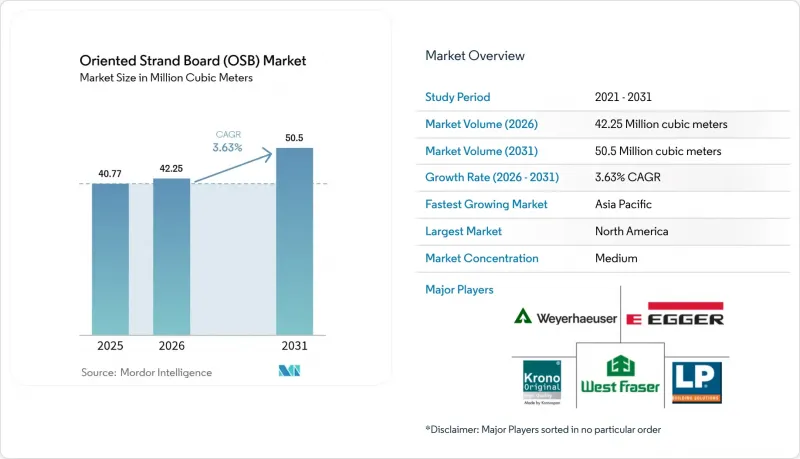
本報告按等級(OSB/1、OSB/2、OSB/3、OSB/4)、最終用戶應用(建築、家具、包裝)和地區(亞太、北美、歐洲、南美、中東和非洲)進行細分。市場預測以體積(立方米)為單位。
全球定向纖維板(OSB)市場趨勢與洞察
比膠合板更經濟實惠的替代品
定向塑合板(OSB)的價格優勢一直優於合板。這項價格優勢正推動著單戶住宅和小規模商業項目在規格方面的穩定變化。美國東南部和加拿大草原地區的建築商擴大採用OSB作為屋頂底層材料和牆體加固材料。 OSB均勻的纖維排列方向使其具有可靠的抗剪強度。此外,OSB的預先切割包裝減少了現場浪費,從而顯著降低了人事費用,尤其是在最低工資較高的地區。膠合板在需要卓越邊緣密封的外部應用中仍然佔據著一定的市場佔有率,這限制了OSB在結構覆層市場中的實際佔有率。然而,隨著單板木材供應量的減少以及膠合板廠面臨木材價格上漲的困境,預計OSB在中期內仍將保持成長勢頭。
全球建設活動的擴張
2025年,整體建築產出呈現溫和成長。然而,住宅和基礎設施等高度依賴定向纖維板(OSB)的領域表現更為強勁。由於印度住宅政策指定在住宅中使用複合板,住宅建設激增。同時,越南的高速公路擴建工程穩步推進,印尼也啟動了新的基礎設施建設項目,這兩個項目都大量使用了臨時模板。在這種情況下,建築公司顯然更傾向於使用再生OSB板材而非傳統膠合板。中國房地產市場的低迷降低了OSB的年度需求,但其影響在一定程度上得到了緩解。這主要是因為來自北美和歐洲的OSB出口轉向了印度和東協市場。因此,OSB市場的趨勢不再由單一國家主導,而是與新興亞洲國家的建設活動日益緊密地連結在一起。
加強對甲醛和揮發性有機化合物的監管
加州空氣資源委員會 (CARB) 第二階段法規正迫使定向塑合板 (OSB) 製造商過渡到超低揮發性樹脂。由於大型零售商要求所有產品都必須符合相關法規,即使板材目前不受該法規約束,這項轉變也在加速進行。從酚醛樹脂轉向 MDI 樹脂導致樹脂成本上升,這對小規模製造商來說是一個難以承受的負擔。歐盟的 E1 標準上限將於 2025 年 1 月起強制執行,這迫使許多土耳其和俄羅斯出口商要麼維修其工廠,要麼退出市場,導致海外供應減少。此外,日本嚴格的室內空氣品質標準進一步限制了未密封 OSB 的使用。雖然擁有自有樹脂工廠的大型製造商可以輕鬆適應這些變化,但監管政策的轉變正在加速產業結構調整,並在短期內阻礙 OSB 市場的成長。
細分市場分析
預計到2025年,OSB/3將佔定向纖維板市場成長。 OSB/3憑藉其承重和防潮認證,滿足了北美和歐洲大部分的覆層需求。這項特性使得企業無需為乾燥和高濕度環境分別管理庫存。同時,專為高濕度環境下的結構應用而設計的OSB/4雖然市場佔有率較小,但正處於成長期,這主要得益於沿海地區(易受颶風和颱風侵襲)的建築規範要求。目前市佔率較大的OSB/1和OSB/2成長停滯。這表明,隨著建築商轉向性能更高的板材,這些等級的板材可能會被逐步淘汰。
儘管成本不斷上漲,但OSB/3和OSB/4中MDI樹脂的廣泛應用不僅確保了其獲得LEED和BREEAM認證,也推高了平均售價。相較之下,沒有樹脂生產設施的小規模工廠則傾向於使用OSB/1和OSB/2。這一趨勢凸顯了定向纖維板市場的兩極化,其中等級主導與是否符合環保法規密切相關。
區域分析
北美擁有眾多鋸木廠和高度整合的木材供應鏈,預計到2025年將佔全球產量的60.12%。然而,其成長速度低於全球平均。這種放緩歸因於美國房屋抵押貸款利率上升,抑制了獨棟住宅的建造許可,以及加拿大木材價格上漲。因此,北美定向纖維板(OSB)市場規模保持穩定,但憑藉其地理優勢,利潤率依然很高。
亞太地區市佔率龐大,預計到2031年將維持6.28%的年增率。印度的成長動能主要得益於總理住房計畫(Pradhan Mantri Awas Yojana),該計畫顯著提升了定向塑合板(OSB)的消費量。同時,越南和印尼都在高速公路和新城建設方面進行大規模基礎設施投資,重點是模板密集型施工方法。在中國,儘管房地產市場正在經歷調整,但西部省份的基礎設施項目支撐著基本需求。然而,南亞和東南亞高度依賴進口,導致碼頭建設成本溢價顯著。這種情況為考慮在待開發區中擴大產能的當地投資者提供了盈利的機會。
在歐洲,木結構建築市場佔有率保持穩定,並呈現穩定成長的態勢。 「近零能耗建築」的概念推動了木造建築的蓬勃發展。然而,嚴格的樹脂法規和紙漿供應緊張等挑戰正在擠壓利潤空間。南美洲也處於成長軌道,儘管市佔率不高。巴西尤其利用其桉樹種植園,將定向塑合板(OSB)轉化為盈利的出口產品。中東和非洲的市場佔有率雖然不高,但對進口的依賴程度越來越高,尤其是在雄心勃勃的大型專案中,對大規模模板的需求尤其迫切。高昂的運輸成本仍然是一大挑戰,但強勁且永續的石油收入預示著長期建設項目將擁有充足的項目儲備。
其他好處
- Excel格式的市場預測(ME)表
- 3個月的分析師支持
目錄
第1章:引言
- 研究假設和市場定義
- 調查範圍
第2章:調查方法
第3章執行摘要
第4章 市場狀況
- 市場概覽
- 市場促進因素
- 比膠合板更經濟實惠的替代品
- 全球建設活動的擴張
- 永續性驅動了對複合板的需求。
- 模組化和預製住宅熱潮
- 木材排碳權獎勵
- 市場限制因素
- 加強對甲醛和揮發性有機化合物的監管
- 木纖維價格波動
- 由於CLT的引入,結構應用市場佔有率受到侵蝕。
- 價值鏈分析
- 波特五力模型
第5章 市場規模與成長預測
- 按年級
- OSB/1
- OSB/2
- OSB/3
- OSB/4
- 透過最終用戶應用程式
- 建造
- 地板和屋頂
- 牆
- 門
- 柱和梁(模板)
- 樓梯
- 其他建築
- 家具
- 住宅
- 商業的
- 包裝
- 飲食
- 產業
- 製藥
- 化妝品
- 其他包裝
- 建造
- 按地區
- 亞太地區
- 中國
- 印度
- 日本
- 韓國
- 馬來西亞
- 泰國
- 印尼
- 越南
- 其他亞太國家
- 北美洲
- 美國
- 加拿大
- 墨西哥
- 歐洲
- 德國
- 英國
- 法國
- 義大利
- 西班牙
- 北歐國家
- 土耳其
- 俄羅斯
- 其他歐洲國家
- 南美洲
- 巴西
- 阿根廷
- 哥倫比亞
- 其他南美國家
- 中東和非洲
- 沙烏地阿拉伯
- 卡達
- 阿拉伯聯合大公國
- 奈及利亞
- 埃及
- 南非
- 其他中東和非洲國家
- 亞太地區
第6章 競爭情勢
- 市場集中度
- 策略趨勢
- 市佔率(%)/排名分析
- 公司簡介
- Arbec Forest Products Inc.
- Besgrade Plywood Sdn. Bhd.
- Coillte
- EGGER
- JM Huber Corporation
- Koch IP Holdings, LLC
- Koyuncuoglu Group of Companies
- Kronoplus Limited
- Louisiana-Pacific Corporation
- RoyOMartin
- Sonae Arauco
- STRANDPLYOSB
- Swiss Krono Group
- Tolko Industries Ltd.
- West Fraser
- Weyerhaeuser Company
- Yalong Wood
第7章 市場機會與未來展望
According to Mordor Intelligence, the oriented strand board market size is projected to expand from 40.77 million cubic meters in 2025 and 42.25 million cubic meters in 2026 to 50.50 million cubic meters by 2031, registering a CAGR of 3.63% between 2026 to 2031.
This report is Segmented by Grade (OSB/1, OSB/2, OSB/3, and OSB/4), End-User Application (Construction, Furniture, and Packaging), and Geography (Asia-Pacific, North America, Europe, South America, and Middle-East and Africa). The Market Forecasts are Provided in Terms of Volume (Cubic Meters).
Global Oriented Strand Board (OSB) Market Trends and Insights
Cost-Effective Substitution for Plywood
OSB enjoys a consistent price discount compared to plywood. This price advantage is driving a steady shift in specifications for single-family homes and light-commercial projects. Builders in the U.S. Southeast and Canadian Prairies are increasingly opting for OSB in roof decking and wall bracing. OSB's uniform strand orientation provides reliable shear resistance. Additionally, OSB's pre-cut trim packages reduce on-site scrap, translating to significant labor savings, especially in areas where minimum wages are high. While plywood still holds a niche for exterior uses demanding superior edge sealing, this limits OSB's practical share of the structural sheathing demand. However, with veneer-quality logs becoming scarcer and plywood mills grappling with rising raw-wood costs, the momentum favoring OSB is expected to continue in the medium term.
Expansion of Global Construction Activity
In 2025, overall construction output saw a modest growth. However, segments like residential and infrastructure, which have a heavy reliance on Oriented Strand Board (OSB), showcased stronger performance. Thanks to India's housing initiatives, which rolled out engineered wood-specified dwellings, residential construction surged. Meanwhile, as Vietnam expanded its expressways and Indonesia embarked on its new capital project, both undertakings leaned heavily on temporary formwork. Contractors, in these instances, showed a clear preference for reusable OSB panels over traditional plywood. Although China's property market slump led to a dip in annual OSB demand, the impact was somewhat mitigated. This was largely due to the redirection of North American and European OSB exports towards India and ASEAN markets. Thus, the trajectory of the OSB market is increasingly tied to the construction activities in emerging Asia, rather than being dominated by any single nation.
Formaldehyde and VOC Regulations Tightening
California's CARB Phase 2 limits are steering OSB mills towards ultra-low-emitting resins. This shift comes despite current rules exempting panels, as major retailers demand consistent compliance across all products. Transitioning from phenol-formaldehyde to MDI increases resin costs, a squeeze that smaller mills find hard to absorb. The EU's E1 ceiling, mandated since January 2025, has compelled numerous Turkish and Russian exporters to either retrofit or exit, leading to a reduction in external supply. Japan's stringent indoor-air standards further curtail the use of unsealed OSB. While major producers with their own resin plants navigate these changes with ease, the evolving regulations are hastening consolidation and, in the short term, stunting the growth of the Oriented Strand Board market.
Other drivers and restraints analyzed in the detailed report include:
- Sustainability-Driven Demand for Engineered Wood
- Modular and Prefab Housing Boom
- Wood-Fiber Price Volatility
For complete list of drivers and restraints, kindly check the Table Of Contents.
Segment Analysis
OSB/3 held 46.89% of 2025 volume and is forecast to lead the Oriented Strand Board market at a 4.61% CAGR through 2031. With a load-bearing, moisture-resistant certification, OSB/3 caters to a significant portion of North American and European sheathing demands. This capability negates the need for separate dry- and humid-grade inventories. While OSB/4, tailored for high-moisture structural applications, captures a smaller market share, it is witnessing growth driven by code requirements in coastal regions prone to hurricanes and typhoons. OSB/1 and OSB/2, holding a notable market share, are lagging behind, indicating a potential phase-out as builders gravitate towards higher-performing grades.
Even with a cost increase, the rising use of MDI resins in OSB/3 and OSB/4 not only secures LEED and BREEAM credits but also boosts average selling prices. In contrast, smaller mills without resin integration are leaning towards OSB/1 and OSB/2. This trend underscores a two-tier dynamic in the Oriented Strand Board market, where grade leadership increasingly aligns with environmental compliance.
Complete Report Scope:
- By Grade
- OSB/1
- OSB/2
- OSB/3
- OSB/4
- By End-user Application
- Construction
- Floor and Roof
- Wall
- Door
- Column and Beam (Shuttering)
- Staircase
- Other Constructions
- Furniture
- Residential
- Commercial
- Packaging
- Food and Beverage
- Industrial
- Pharmaceutical
- Cosmetics
- Other Packaging
- Construction
- By Geography
- Asia-Pacific
- China
- India
- Japan
- South Korea
- Malaysia
- Thailand
- Indonesia
- Vietnam
- Rest of Asia-Pacific
- North America
- United States
- Canada
- Mexico
- Europe
- Germany
- United Kingdom
- France
- Italy
- Spain
- NORDIC Countries
- Turkey
- Russia
- Rest of Europe
- South America
- Brazil
- Argentina
- Colombia
- Rest of South America
- Middle-East and Africa
- Saudi Arabia
- Qatar
- United Arab Emirates
- Nigeria
- Egypt
- South Africa
- Rest of Middle-East and Africa
- Asia-Pacific
Geography Analysis
North America controlled 60.12% of the 2025 volume, buoyed by the operations of numerous mills and a robustly integrated timber supply chain. However, its growth trails behind global averages. This sluggish growth is attributed to rising mortgage rates in the U.S., which dampen single-family permits, and increasing stumpage fees in Canada. Consequently, while the market size for Oriented Strand Board (OSB) in North America stabilizes, it continues to enjoy high margins, thanks to its geographical advantages.
Asia-Pacific, holding a significant market share, is on a growth trajectory with a 6.28% growth rate through 2031. The momentum in India can be largely credited to the Pradhan Mantri Awas Yojana, which has significantly boosted OSB consumption. Meanwhile, both Vietnam and Indonesia are channeling substantial infrastructure investments into expressways and new cities, emphasizing formwork-heavy constructions. Even amidst a property correction in China, infrastructure projects in the western provinces are sustaining a baseline demand. However, with South and Southeast Asia's reliance on imports, there's a notable landed-cost premium. This scenario presents a lucrative opportunity for local investors considering green-field capacities.
Europe, with a steady market share, is witnessing consistent growth. The push for near-zero-energy buildings is driving a surge in timber-frame constructions. Yet, challenges loom with stringent resin regulations and a tight pulpwood supply, both of which are pressuring profit margins. South America, capturing a modest market share, is on a growth path. Brazil, in particular, is capitalizing on its plantation eucalyptus, turning it into a lucrative export for OSB. In the Middle East and Africa, holding a modest share, there's a heavy reliance on imports, especially for large-scale formwork in ambitious giga-projects. While high freight costs pose challenges, the buoyancy from sustained oil revenues promises a robust pipeline for long-term construction endeavors.
- Arbec Forest Products Inc.
- Besgrade Plywood Sdn. Bhd.
- Coillte
- EGGER
- J.M. Huber Corporation
- Koch IP Holdings, LLC
- Koyuncuoglu Group of Companies
- Kronoplus Limited
- Louisiana-Pacific Corporation
- RoyOMartin
- Sonae Arauco
- STRANDPLYOSB
- Swiss Krono Group
- Tolko Industries Ltd.
- West Fraser
- Weyerhaeuser Company
- Yalong Wood
Additional Benefits:
- The market estimate (ME) sheet in Excel format
- 3 months of analyst support
TABLE OF CONTENTS
1 Introduction
- 1.1 Study Assumptions and Market Definition
- 1.2 Scope of the Study
2 Research Methodology
3 Executive Summary
4 Market Landscape
- 4.1 Market Overview
- 4.2 Market Drivers
- 4.2.1 Cost-effective substitution for plywood
- 4.2.2 Expansion of global construction activity
- 4.2.3 Sustainability-driven demand for engineered wood
- 4.2.4 Modular and prefab housing boom
- 4.2.5 Carbon-credit incentives for wood-based materials
- 4.3 Market Restraints
- 4.3.1 Formaldehyde and VOC regulations tightening
- 4.3.2 Wood-fibre price volatility
- 4.3.3 CLT adoption stealing structural share
- 4.4 Value Chain Analysis
- 4.5 Porter's Five Forces
- 4.5.1 Bargaining Power of Suppliers
- 4.5.2 Bargaining Power of Buyers
- 4.5.3 Threat of New Entrants
- 4.5.4 Threat of Substitutes
- 4.5.5 Degree of Competition
5 Market Size and Growth Forecasts (Volume)
- 5.1 By Grade
- 5.1.1 OSB/1
- 5.1.2 OSB/2
- 5.1.3 OSB/3
- 5.1.4 OSB/4
- 5.2 By End-user Application
- 5.2.1 Construction
- 5.2.1.1 Floor and Roof
- 5.2.1.2 Wall
- 5.2.1.3 Door
- 5.2.1.4 Column and Beam (Shuttering)
- 5.2.1.5 Staircase
- 5.2.1.6 Other Constructions
- 5.2.2 Furniture
- 5.2.2.1 Residential
- 5.2.2.2 Commercial
- 5.2.3 Packaging
- 5.2.3.1 Food and Beverage
- 5.2.3.2 Industrial
- 5.2.3.3 Pharmaceutical
- 5.2.3.4 Cosmetics
- 5.2.3.5 Other Packaging
- 5.2.1 Construction
- 5.3 By Geography
- 5.3.1 Asia-Pacific
- 5.3.1.1 China
- 5.3.1.2 India
- 5.3.1.3 Japan
- 5.3.1.4 South Korea
- 5.3.1.5 Malaysia
- 5.3.1.6 Thailand
- 5.3.1.7 Indonesia
- 5.3.1.8 Vietnam
- 5.3.1.9 Rest of Asia-Pacific
- 5.3.2 North America
- 5.3.2.1 United States
- 5.3.2.2 Canada
- 5.3.2.3 Mexico
- 5.3.3 Europe
- 5.3.3.1 Germany
- 5.3.3.2 United Kingdom
- 5.3.3.3 France
- 5.3.3.4 Italy
- 5.3.3.5 Spain
- 5.3.3.6 NORDIC Countries
- 5.3.3.7 Turkey
- 5.3.3.8 Russia
- 5.3.3.9 Rest of Europe
- 5.3.4 South America
- 5.3.4.1 Brazil
- 5.3.4.2 Argentina
- 5.3.4.3 Colombia
- 5.3.4.4 Rest of South America
- 5.3.5 Middle-East and Africa
- 5.3.5.1 Saudi Arabia
- 5.3.5.2 Qatar
- 5.3.5.3 United Arab Emirates
- 5.3.5.4 Nigeria
- 5.3.5.5 Egypt
- 5.3.5.6 South Africa
- 5.3.5.7 Rest of Middle-East and Africa
- 5.3.1 Asia-Pacific
6 Competitive Landscape
- 6.1 Market Concentration
- 6.2 Strategic Moves
- 6.3 Market Share (%) / Ranking Analysis
- 6.4 Company Profiles (includes Global-level overview, Market-level overview, Core Segments, Financials, Strategic Information, Products and Services, Recent Developments)
- 6.4.1 Arbec Forest Products Inc.
- 6.4.2 Besgrade Plywood Sdn. Bhd.
- 6.4.3 Coillte
- 6.4.4 EGGER
- 6.4.5 J.M. Huber Corporation
- 6.4.6 Koch IP Holdings, LLC
- 6.4.7 Koyuncuoglu Group of Companies
- 6.4.8 Kronoplus Limited
- 6.4.9 Louisiana-Pacific Corporation
- 6.4.10 RoyOMartin
- 6.4.11 Sonae Arauco
- 6.4.12 STRANDPLYOSB
- 6.4.13 Swiss Krono Group
- 6.4.14 Tolko Industries Ltd.
- 6.4.15 West Fraser
- 6.4.16 Weyerhaeuser Company
- 6.4.17 Yalong Wood
7 Market Opportunities and Future Outlook
- 7.1 White-space and Unmet-need Assessment

 定向纖維板(OSB)基材市場規模、佔有率和成長分析:按產品類型、厚度、應用、分銷管道和地區分類-2026-2033年產業預測
 定向塑合板(OSB)市場 - 全球市場預測(2026-2032年)
 定向纖維板(OSB)市場規模、佔有率、趨勢和預測:按等級、應用、最終用戶和地區分類,2026-2034年
 定向塑合板(OSB)市場規模、佔有率和成長分析:按等級、應用、最終用戶、材料特性、分銷管道和地區分類-2026-2033年產業預測
 全球定向塑合板市場規模、佔有率、趨勢和成長分析報告(2026-2034年)日本定向纖維板(OSB)市場規模、佔有率、趨勢和預測:按等級、應用、最終用戶和地區分類,2026-2034年
 2026年全球定向塑合板市場報告
 定向纖維板市場-全球產業規模、佔有率、趨勢、機會、預測:按等級、應用、最終用戶、地區和競爭格局分類,2021-2031年
 歐洲定向纖維板(OSB):市場佔有率分析、產業趨勢與統計、成長預測(2026-2031)
 OSB護牆板:全球市場佔有率和排名、總收入和需求預測(2025-2031年)