


 |
市場調查報告書
商品編碼
2122479
北美蒸發冷卻市場:市場佔有率分析、產業趨勢與統計及成長預測(2026-2031 年)North America Evaporative Cooling - Market Share Analysis, Industry Trends & Statistics, Growth Forecasts (2026 - 2031) |
||||||

※ 本網頁內容可能與最新版本有所差異。詳細情況請與我們聯繫。
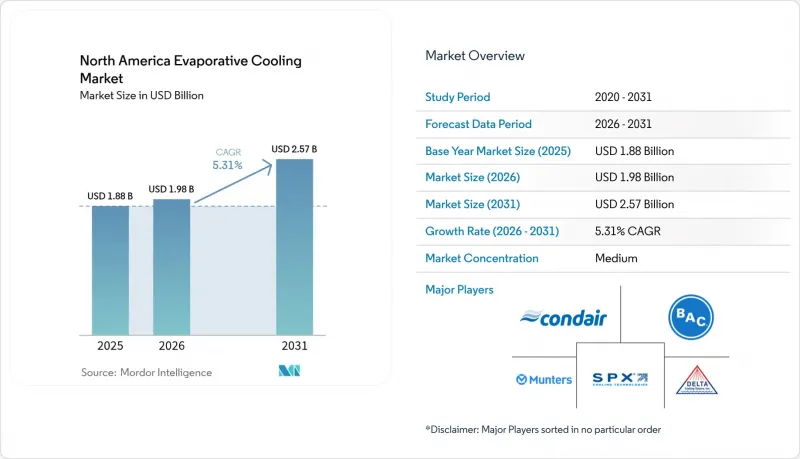
據 Mordor Intelligence 稱,2025 年北美蒸發冷卻市場價值為 18.8 億美元,預計到 2031 年將從 2026 年的 19.8 億美元成長至 25.7 億美元,預測期(2026-2031 年)複合年成長率為 5.31%。
本報告按冷卻方式(直接冷卻、間接冷卻、兩級冷卻)、應用領域(住宅、商業、工業等)、組件(設備、墊片、介質等)、銷售管道(直銷、暖通空調承包商/整合商、分銷商/批發商、線上零售/電子商務)和地區進行細分。市場預測以美元(USD)為單位。
北美蒸發冷卻市場趨勢與洞察
資料中心向低PUE冷卻過渡
超大規模營運商正在部署絕熱預冷模組,可將冷凝器入口溫度降低高達 40°F,從而在 300 MW 的園區內為 IT 負載提供高達 14 MW 的電力保障。封閉回路型零水設計以及美國國家可再生能源實驗室 (NREL) 的地熱能儲存示範項目,凸顯了專注於零用水和低電力消耗架構的生態系統的重要性。巴爾的摩空氣冷卻公司 (Baltimore Aircoil) 授權的浸入式蒸發冷卻水塔進一步展示了液側和氣側解決方案的融合。隨著人工智慧工作負載的增加,機架密度不斷提高,間接冷卻和直接冷卻階段無需壓縮機驅動的增壓即可實現更窄的頻寬,這使得蒸發冷卻成為數位基礎設施擴展的核心。
工業和商業領域的能源效率法規
加州第24號法規目前規定,對於製冷量超過8000 MBH的蒸發式冷凝器,其最低性能標準為350 Btuh/W,並要求使用與濕球溫度相符的變速風扇。聯邦冷媒法規正在逐步淘汰全球暖化潛勢(GWP)超過750的冷媒,這加速了可使用蒸發式散熱裝置供能的天然冷媒系統的普及。加拿大自然資源部遵循美國基準值,從而實現了設備標準的跨境協調。這些政策共同製定了有利於絕熱式或混合式冷卻塔的最低性能標準,與直接膨脹式冷卻器相比,這些冷卻水塔可達到高達75%的節能效果。
氣候對濕度的依賴性
當相對濕度超過 60% 時,蒸發冷卻的效率會急劇下降,迫使美國東南部各州依賴結合乾燥劑和蒸發冷卻的混合系統。在墨西卡利進行的模擬表明,這些系統僅在季節性低濕度時期實用,在濕度高峰期則需要備用除濕裝置。雖然引入間接露點冷卻階段擴大了性能範圍,但其複雜性的增加正在縮小北美蒸發冷卻市場主導地位所依據的資本投資 (Capex) 差距。
細分市場分析
2025年,直接蒸發冷卻裝置在北美市場仍佔據63.20%的佔有率,這反映了其在乾旱西部地區設施中數十年的應用。間接式冷卻水塔佔23.70%的佔有率,在食品加工和製藥等禁止空氣與水直接接觸的行業中備受青睞。兩級間接-直接式冷卻設計實現了最高的複合年成長率,達到5.69%,這主要得益於資料中心和高產熱行業的維修項目,這些項目需要在不增加用水量的情況下提供低於露點溫度的冷卻水。
穿孔露點熱交換器提高了間接冷卻的效率,允許在低於0.5的送風比下保持低壓損,從而縮小了性能差距。隨著這些材料的成熟,兩級平台在設計和建造規範方面正超越單級平台,預計到2031年,兩級平台在北美蒸發冷卻市場的佔有率將進一步成長。目前,供應商正在整合無化學水處理技術和抗菌薄膜,這不僅延長了冷卻墊的使用壽命,也緩解了大規模園區營運商面臨的人手不足問題。
到2025年,工業廠房將佔銷售額的36.60%,這主要得益於食品、化學和一般製造業對穩健運作和能源效率的優先需求。資料中心雖然規模較小,但隨著人工智慧的普及,機架熱密度超過了空調機組的承載能力,其複合年成長率也達到了5.34%。受控環境農業、溫室和封閉式農業系統正以8.74%的複合年成長率成長,這得益於大麻合法化和垂直農業的蓬勃發展。這使得蒸發冷卻解決方案成為一種低能耗、濕度可控的壓縮機盤管替代方案。
商業建築領域,零售商店和辦公室的維修符合永續發展認證標準,佔了24.30%的市場佔有率;而住宅的應用成長較為緩慢,年複合成長率僅為5.12%,且主要集中在乾旱氣候地區。預計到2031年,農業領域在北美蒸發冷卻市場的佔有率將超過10.5%,因為生產者需要低碳、低耗水的暖通空調系統,以在不使用昂貴的乾燥劑轉輪的情況下保護作物蒸騰作用。
其他好處:
- Excel格式的市場預測(ME)表
- 3個月的分析師支持
目錄
第1章:引言
- 研究假設和市場定義
- 調查範圍
第2章:調查方法
第3章執行摘要
第4章 市場狀況
- 市場概覽
- 市場促進因素
- 資料中心向低PUE冷卻過渡
- 工業和商業領域的強制性能源效率
- CAP-ex 的優點及其與壓縮機式空調的比較
- 可再生能源微電網和蒸發式混合系統的引入
- 大麻和受控環境農業的需求
- 使用生物基/水凝膠墊延長保養週期
- 市場限制因素
- 對氣候和濕度的依賴性
- 加強缺水法規
- 野火煙霧對遵守室內空氣品質 (IAQ) 法規帶來挑戰。
- 計量控制和衛生管理技術純熟勞工短缺
- 產業價值鏈分析
- 監理情勢
- 技術展望
- 波特五力分析
- 對宏觀經濟影響的評估
- 投資分析
第5章 市場規模與成長預測
- 透過冷卻法
- 直接的
- 間接
- 兩階段類型(間接/直接)
- 透過使用
- 住宅
- 商業設施(零售、辦公室、飯店)
- 工業(食品飲料、化工、製造業)
- 封閉式水產養殖及溫室
- 其他
- 按組件
- 設備(冷卻器和冷卻塔)
- 平板電腦和媒體
- 供水系統
- 控制與自動化
- 服務與維護
- 按銷售管道
- 直銷(從製造商到最終用戶)
- 暖通空調承包商/整合商
- 分銷和批發
- 線上零售/電子商務
- 國家
- 美國
- 加拿大
- 墨西哥
第6章 競爭情勢
- 市場集中度
- 策略趨勢
- 市佔率分析
- 公司簡介
- Condair Group AG
- Baltimore Aircoil Company, Inc.
- Munters Group AB
- SPX Cooling Technologies, Inc.
- Delta Cooling Towers Private Limited
- Phoenix Manufacturing, Inc.
- Colt Group Holdings Limited
- Bonaire Pty Ltd
- Cambridge Engineering, Inc.
- Portacool, LLC
- EVAPCO, Inc.
- Seeley International Pty Ltd
- Symphony Limited
- Honeywell International India Private Limited
- Champion Cooler Corp.
- Mastercool, USA, Inc.
- Excel Air Systems
- Air2O Cooling Limited
- The Chemours Company
- Hydro Cool Inc.(Anderson, SC)
第7章 市場機會與未來展望
According to Mordor Intelligence, the North America evaporative cooling market size was valued at USD 1.88 billion in 2025 and estimated to grow from USD 1.98 billion in 2026 to reach USD 2.57 billion by 2031, at a CAGR of 5.31% during the forecast period (2026-2031).
This report is Segmented by Cooling Method (Direct, Indirect, and Two-Stage), Application (Residential, Commercial, Industrial, and More), Component (Equipment, Pads and Media, and More), Sales Channel (Direct, HVAC Contractors/Integrators, Distribution and Wholesale, and Online Retail/E-Commerce), and Geography. The Market Forecasts are Provided in Terms of Value (USD).
North America Evaporative Cooling Market Trends and Insights
Data-center shift to low-PUE cooling
Hyperscale operators are deploying adiabatic precooling modules that shave condenser inlet temperatures by up to 40 °F, freeing as much as 14 MW for IT loads in a 300 MW campus. Microsoft's closed-loop zero-water designs and NREL's underground thermal energy storage trials highlight an ecosystem focused on water-neutral, power-lean architectures. Immersion-ready evaporative towers licensed by Baltimore Aircoil further illustrate convergence between liquid and air side solutions. As AI workloads heighten rack densities, indirect-direct stages deliver tighter thermal bands without compressor lift, placing evaporative cooling at the core of digital-infrastructure expansion.
Industrial and commercial energy-efficiency mandates
Title 24 in California now stipulates 350 Btuh/W minimums for evaporative-cooled condensers above 8,000 MBH and requires wet-bulb responsive variable-speed fans. Federal refrigerant rules that phase out GWP> 750 options accelerate the adoption of natural refrigerant systems feedable by evaporative rejectors. Natural Resources Canada mirrors U.S. thresholds, enabling cross-border equipment harmonization. Together, these policies lock in minimum performance levels that favor adiabatic or hybrid towers capable of 75% energy savings versus direct expansion chillers.
Climate humidity dependency
Evaporative effectiveness declines sharply when relative humidity climbs above 60%, leaving southeastern states reliant on hybrid desiccant-evaporative pairs. Simulations for Mexicali confirm viability only during seasonal low-humidity windows, necessitating backup dehumidification in peak months. Although dew-point indirect stages extend performance envelopes, added complexity narrows the Cap-ex gap that defines the North America evaporative cooling market advantage.
Other drivers and restraints analyzed in the detailed report include:
- CAP-ex advantage vs. compressor-based HVAC
- Renewable-microgrid + evaporative hybrid roll-outs
- Water-scarcity regulations
For complete list of drivers and restraints, kindly check the Table Of Contents.
Segment Analysis
Direct units retained a 63.20% foothold in the North America evaporative cooling market in 2025, reflecting decades of installation across arid western facilities. Indirect towers held 23.70%, favored in food processing and pharmaceuticals that prohibit direct air-water contact. Two-stage indirect-direct designs recorded the fastest 5.69% CAGR, propelled by data-center and high-heat industrial retrofits that need sub-dewpoint delivery without excessive water draw.
Performance gaps are narrowing as perforated dew-point heat exchangers raise indirect effectiveness, enabling supply-air ratios below 0.5 while maintaining low pressure drops. As these materials mature, two-stage platforms are eclipsing single-stage gear in design-build specifications, a trend expected to lift their slice of the North America evaporative cooling market size by 2031. Vendors now integrate chemical-free water treatment and antimicrobial films, extending pad life and alleviating the labor bottleneck facing large campus operators.
Industrial plants generated 36.60% of 2025 revenue, driven by food, chemical, and general-manufacturing loads that prioritize robust operation and energy savings. Data centers, although smaller, are growing at a 5.34% CAGR as AI accelerates rack heat densities beyond what air-conditioned CRAC units can manage. Controlled-environment agriculture, greenhouses, and confinement farming chart a 8.74% CAGR, benefiting from the legalization of cannabis and vertical-farm momentum that positions evaporative solutions as low-energy, humidity-tunable alternatives to compressor coils.
Commercial buildings capture a 24.30% share through retail and office retrofits tied to sustainability certifications, while residential adoption advances at a modest 5.12% CAGR, largely confined to dry-climate locales. Agricultural uptake is expected to raise its chunk of the North America evaporative cooling market share beyond 10.5% by 2031 as growers seek low-carbon, low-water HVAC that protects crop transpiration profiles without costly desiccant wheels.
Complete Report Scope:
- By Cooling Method
- Direct
- Indirect
- Two-Stage (Indirect-Direct)
- By Application
- Residential
- Commercial (Retail, Offices, Hospitality)
- Industrial (Food and Beverage, Chemical, Manufacturing)
- Confinement Farming and Greenhouses
- Others
- By Component
- Equipment (Coolers and Towers)
- Pads and Media
- Water Distribution Systems
- Controls and Automation
- Services and Maintenance
- By Sales Channel
- Direct (Manufacturer to End-User)
- HVAC Contractors / Integrators
- Distribution and Wholesale
- Online Retail / E-Commerce
- By Country
- United States
- Canada
- Mexico
List of Companies Covered in this Report:
- Condair Group AG
- Baltimore Aircoil Company, Inc.
- Munters Group AB
- SPX Cooling Technologies, Inc.
- Delta Cooling Towers Private Limited
- Phoenix Manufacturing, Inc.
- Colt Group Holdings Limited
- Bonaire Pty Ltd
- Cambridge Engineering, Inc.
- Portacool, LLC
- EVAPCO, Inc.
- Seeley International Pty Ltd
- Symphony Limited
- Honeywell International India Private Limited
- Champion Cooler Corp.
- Mastercool, U.S.A., Inc.
- Excel Air Systems
- Air2O Cooling Limited
- The Chemours Company
- Hydro Cool Inc. (Anderson, SC)
Additional Benefits:
- The market estimate (ME) sheet in Excel format
- 3 months of analyst support
TABLE OF CONTENTS
1 INTRODUCTION
- 1.1 Study Assumptions and Market Definition
- 1.2 Scope of the Study
2 RESEARCH METHODOLOGY
3 EXECUTIVE SUMMARY
4 MARKET LANDSCAPE
- 4.1 Market Overview
- 4.2 Market Drivers
- 4.2.1 Data-center shift to low-PUE cooling
- 4.2.2 Industrial and commercial energy-efficiency mandates
- 4.2.3 CAP-ex advantage vs. compressor-based HVAC
- 4.2.4 Renewable-microgrid + evaporative hybrid roll-outs
- 4.2.5 Cannabis and controlled-environment agriculture demand
- 4.2.6 Bio-based/hydrogel pads extending maintenance cycles
- 4.3 Market Restraints
- 4.3.1 Climate humidity dependency
- 4.3.2 Escalating water-scarcity regulations
- 4.3.3 Wildfire-smoke IAQ compliance hurdles
- 4.3.4 Skilled-labor shortages for scale-control and hygiene
- 4.4 Industry Value Chain Analysis
- 4.5 Regulatory Landscape
- 4.6 Technological Outlook
- 4.7 Porter's Five Forces Analysis
- 4.7.1 Bargaining Power of Buyers
- 4.7.2 Bargaining Power of Suppliers
- 4.7.3 Threat of New Entrants
- 4.7.4 Threat of Substitutes
- 4.7.5 Intensity of Competitive Rivalry
- 4.8 Assessment of Macro-economic Impact
- 4.9 Investment Analysis
5 MARKET SIZE AND GROWTH FORECASTS (VALUE)
- 5.1 By Cooling Method
- 5.1.1 Direct
- 5.1.2 Indirect
- 5.1.3 Two-Stage (Indirect-Direct)
- 5.2 By Application
- 5.2.1 Residential
- 5.2.2 Commercial (Retail, Offices, Hospitality)
- 5.2.3 Industrial (Food and Beverage, Chemical, Manufacturing)
- 5.2.4 Confinement Farming and Greenhouses
- 5.2.5 Others
- 5.3 By Component
- 5.3.1 Equipment (Coolers and Towers)
- 5.3.2 Pads and Media
- 5.3.3 Water Distribution Systems
- 5.3.4 Controls and Automation
- 5.3.5 Services and Maintenance
- 5.4 By Sales Channel
- 5.4.1 Direct (Manufacturer to End-User)
- 5.4.2 HVAC Contractors / Integrators
- 5.4.3 Distribution and Wholesale
- 5.4.4 Online Retail / E-Commerce
- 5.5 By Country
- 5.5.1 United States
- 5.5.2 Canada
- 5.5.3 Mexico
6 COMPETITIVE LANDSCAPE
- 6.1 Market Concentration
- 6.2 Strategic Moves
- 6.3 Market Share Analysis
- 6.4 Company Profiles (includes Global level Overview, Market level overview, Core Segments, Financials as available, Strategic Information, Market Rank/Share for key companies, Products and Services, and Recent Developments)
- 6.4.1 Condair Group AG
- 6.4.2 Baltimore Aircoil Company, Inc.
- 6.4.3 Munters Group AB
- 6.4.4 SPX Cooling Technologies, Inc.
- 6.4.5 Delta Cooling Towers Private Limited
- 6.4.6 Phoenix Manufacturing, Inc.
- 6.4.7 Colt Group Holdings Limited
- 6.4.8 Bonaire Pty Ltd
- 6.4.9 Cambridge Engineering, Inc.
- 6.4.10 Portacool, LLC
- 6.4.11 EVAPCO, Inc.
- 6.4.12 Seeley International Pty Ltd
- 6.4.13 Symphony Limited
- 6.4.14 Honeywell International India Private Limited
- 6.4.15 Champion Cooler Corp.
- 6.4.16 Mastercool, U.S.A., Inc.
- 6.4.17 Excel Air Systems
- 6.4.18 Air2O Cooling Limited
- 6.4.19 The Chemours Company
- 6.4.20 Hydro Cool Inc. (Anderson, SC)
7 MARKET OPPORTUNITIES AND FUTURE OUTLOOK
- 7.1 White-space and unmet-need assessment

 2026-2030年全球蒸發冷卻市場
 蒸發冷卻:市場佔有率分析、產業趨勢與統計、成長預測(2026-2031)
 蒸發冷卻市場:按冷卻方式、應用程式、銷售管道和地區分類
 蒸發冷卻市場規模、佔有率、趨勢和預測:按冷卻方式、銷售管道、應用和地區分類,2026-2034年
 蒸發冷卻市場:按產品類型、最終用戶、分銷管道和應用分類的全球市場預測,2026-2032年高壓霧化加濕系統市場依產品類型、最終用途產業、應用及通路分類,全球預測(2026-2032)
 2026年全球蒸發冷卻市場報告
 蒸發冷卻市場規模、佔有率和成長分析(按冷卻類型、最終用途、容量範圍、部署類型和地區分類)-2026-2033年產業預測
 被動輻射冷卻膜:全球市場佔有率和排名、總收入和需求預測(2025-2031 年)
 蒸發冷卻市場 - 全球產業規模、佔有率、趨勢、機會和預測,按冷卻類型、應用、配銷通路、地區和競爭進行細分,2020-2030 年預測