


 |
市場調查報告書
商品編碼
2121367
蒸發冷卻:市場佔有率分析、產業趨勢與統計、成長預測(2026-2031)Evaporative Cooling - Market Share Analysis, Industry Trends & Statistics, Growth Forecasts (2026 - 2031) |
||||||

※ 本網頁內容可能與最新版本有所差異。詳細情況請與我們聯繫。
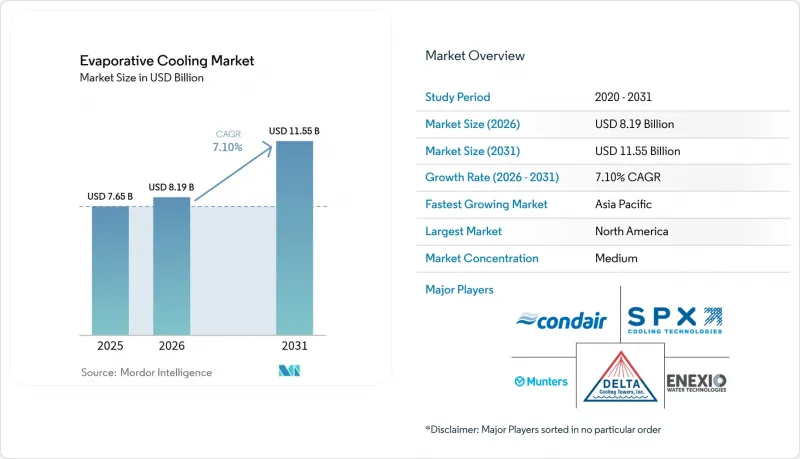
根據 Mordor Intelligence 預測,蒸發冷卻市場將從 2025 年的 76.5 億美元成長到 2026 年的 81.9 億美元,然後在 2031 年達到 115.5 億美元,2026 年至 2031 年的複合年成長率為 7.10%。
本報告按冷卻方式(直接蒸發冷卻、間接蒸發冷卻等)、應用領域(住宅、商業設施等)、冷卻能力(CFM)(低於5000 CFM、高於5000 CFM)、組件(冷卻墊、風扇/鼓風機等)和地區進行細分。市場預測以美元計價。
全球蒸發冷卻市場趨勢及洞察
其具成本效益正推動其在工業領域的應用。
在美國乾旱地區的製造工廠中,與機械冷凍系統相比,該系統的運作成本降低了60-80%。隨著電費上漲,這項投資可在兩年內收回成本。通常情況下,在濕球溫度低於78°F(26°C)的條件下,該系統只需冷水系統十分之一的電力即可將溫度降低15-20°F(8-11°C)。德克薩斯州和亞利桑那州的家禽養殖場報告稱,該系統使熱壓力死亡率降低了25%,冷卻成本降低了70%。
資料中心正在採用蒸發冷卻技術來最佳化PUE(電源使用效率)。
超大規模業者透過採用間接式兩級設計,將PUE值降低至1.06,顯著優於傳統的平均水準1.4-1.6。歐盟能源效率指令要求,到2025年,IT負載超過500千瓦的設施必須進行餘熱回收,而蒸發冷卻技術被視為實現該指令合規性的有效途徑。微軟位於亞利桑那州的園區已證明,即使在沙漠氣候下,透過在最終隔熱空調系統之前預冷進氣,也能實現全年運作。
對氣候的依賴限制了地理擴張
由於環境濕度超過 60% 時效率會降至 50% 以下,因此在熱帶地區獨立部署受到限制。美國東南部地區的設施報告稱,其性能存在季節性波動,因此需要引入混合式 HVAC 系統,這會使初始投資增加 30% 至 40%。雖然製造商正在透過兩級和乾燥劑輔助型系統來解決這個問題,但高昂的成本仍然是中小商業用戶採用該系統的一大障礙。
細分市場分析
至2025年,由於安裝成本較低(3,000至8,000美元),直接蒸發冷卻設計將佔銷售額的66.20%。同時,兩級蒸發冷卻解決方案預計將以7.72%的複合年成長率成長,因為它們即使在環境濕度高達75%的情況下也能保持舒適的氣流。預計到2031年,兩級蒸發冷卻裝置的市場規模將加倍,因為在混合濕潤氣候條件下,資料中心和學校在不犧牲舒適度的前提下,優先考慮效率。製造商透過提供模組化升級方案來規避風險,這些方案可以將現有的直接蒸發冷卻裝置升級為兩級配置,從而推遲重大資本投資,直到濕度要求發生變化。
在大型零售商店和物流中心安裝的屋頂機組中,間接蒸發冷卻模組的需求量很大。空側節熱器透過將冷卻後的室外空氣導入不與空調空間接觸的聚合物熱交換器,確保了免費冷卻時間,同時保護了室內空氣品質。為了解決退伍軍人菌問題,系統整合商正在生產可整合到現有管道中的承包套件,這些套件結合了紫外線燈和抗菌塗層。因此,蒸發冷卻市場正不斷融合傳統冷卻墊和新興技術,例如聚合物薄膜和高表面積熱管。
到2025年,住宅安裝將佔銷售額的71.05%,這主要得益於美國陽光地帶和澳洲的廣泛應用。由於能耗低,住宅可以透過屋頂太陽能發電來抵消部分電力需求,而電力公司提供的500至2000美元的獎勵進一步降低了實際成本。然而,超大規模雲端營運商正在增加大部分新增容量,預計該細分市場將以9.05%的複合年成長率成長。隨著越來越多的地區強制要求報告電源使用效率(PUE)和廢熱再利用,資料中心蒸發冷卻的市場佔有率預計將大幅成長。
在商業設施中,屋頂式蒸發預冷器的引入可以減少壓縮機的運作時間,並避免高達每千瓦時0.35美元的高峰時段電費。在養雞場和溫室中,蒸發冷卻墊被用於動物福利和作物保護,研究表明,在熱浪期間,蒸發冷卻墊可降低25%的死亡率,並提高15%的產量。這種跨產業的廣泛應用使得蒸發冷卻產業受住宅建設市場波動的影響較小。
區域分析
預計到2025年,北美將佔全球銷售額的38.20%,其中美國西南部是該市場的中心。在該地區,由於白天濕球溫度較高,蒸發冷卻是最經濟的選擇。加州第24號能源法規規定,降低壓縮機容量可獲得合規積分,這實際上是在津貼蒸發冷卻市場。內華達州和亞利桑那州的電力公司推出的獎勵計劃,為每戶住宅每次安裝提供高達2000美元的補貼,即使在高房屋抵押貸款貸款利率的情況下也能支撐市場需求。然而,持續的乾旱導致相關政策處於不穩定狀態。在2022-2023年的缺水期間,一些電力公司暫時停止了補貼,這表明需要採用水循環系統設計並尋找替代水源。
亞太地區預計將以8.10%的複合年成長率成為成長最快的地區,其蒸發冷卻市場規模預計到2031年將翻倍。光是沙烏地阿拉伯的NEOM計畫就蘊藏20億美元的終身商機,因為建築規範要求80%的規劃住宅必須配備隔熱型暖通空調系統。澳洲已推出加速折舊方案,印度綠建築委員會(IGBC)也已開始在其評估標準中對蒸發預冷點進行認證。快速的都市化和電力儲備緊張使得低能耗暖通空調系統至關重要,迫使各邦政府考慮建造水資源再利用平台和處理後的污水回收系統。
在歐洲,節能技術的普及速度各不相同。在北半球氣候區,愛爾蘭和北歐國家的資料中心正在部署間接蒸發節熱器,利用室外冷空氣實現全年80%的自然冷卻。南歐由於濕度較高,普及速度較慢,但西班牙一家物流園區已部署了一套兩級系統,即使在相對濕度高達60%的環境下,也能保證供水溫度低於75°F(約24°C)。在中東,儘管水資源有限,但高效冷卻墊和耐微鹹水材料的使用正在穩步推進。南美洲仍在發展中,但前景可期,尤其是巴西,在汽車噴漆房中使用隔熱冷卻器,可降低70%的能耗。
其他好處:
- Excel格式的市場預測(ME)表
- 3個月的分析師支持
目錄
第1章:引言
- 研究假設和市場定義
- 調查範圍
第2章:調查方法
第3章執行摘要
第4章 市場狀況
- 市場概覽
- 市場促進因素
- 對經濟高效的冷卻解決方案的需求
- 資料中心實施以提高能源效率
- 乾旱地區的建築熱潮
- 環境法規推薦使用低全球暖化潛勢冷媒
- 與離網太陽能混合空調系統整合
- 透過水資源再利用墊減少用水量
- 市場限制因素
- 對外部氣候條件的依賴
- 水資源緊張地區的高用水量
- 與退伍軍人菌和微生物相關的健康問題
- 智慧建築中感測器互通性的問題
- 產業價值鏈分析
- 監理情勢
- 技術展望
- 波特五力分析
- 蒸發冷卻的區域分析
- 替代冷卻技術的比較分析
第5章 市場規模與成長預測
- 透過冷卻法
- 直接蒸發冷卻
- 間接蒸發冷卻
- 兩級蒸發冷卻
- 透過使用
- 住宅
- 商業設施
- 工業設施
- 封閉式畜牧設施
- 資料中心
- 依冷氣量(CFM)
- 5,000 CFM 或更少
- 5,001~15,000 CFM
- 超過 15,000 CFM
- 按組件
- 冷卻墊
- 風扇鼓風機
- 水泵
- 控制系統和感測器
- 其他
- 按地區
- 北美洲
- 美國
- 加拿大
- 南美洲
- 巴西
- 阿根廷
- 其他南美國家
- 歐洲
- 德國
- 英國
- 法國
- 西班牙
- 義大利
- 其他歐洲國家
- 亞太地區
- 中國
- 印度
- 日本
- 韓國
- 其他亞太國家
- 中東和非洲
- 中東
- 沙烏地阿拉伯
- 阿拉伯聯合大公國
- 土耳其
- 其他中東國家
- 非洲
- 南非
- 奈及利亞
- 其他非洲國家
- 中東
- 北美洲
第6章 競爭情勢
- 市場集中度
- 策略趨勢
- 市佔率分析
- 公司簡介
- Baltimore Aircoil Company Inc.
- SPX Cooling Technologies Inc.
- Delta Cooling Towers Inc.
- Condair Group AG
- Munters Group AB
- Seeley International Pty Ltd
- Symphony Limited
- Portacool LLC
- Phoenix Manufacturing Inc.
- Honeywell International Inc.(Honeywell Comfort)
- Colt Group Limited
- Cambridge Air Solutions Inc.
- Frigiking-Nortek Global HVAC LLC
- Bonaire-Climate Technologies Pty Ltd
- Hessaire Products Inc.
- Airgroup Australia Pty Ltd(Coolair)
- Oasis Coolers LLC
- Swiss Evaporative Systems AG
- Celsius Design Limited
- CFW Evapcool(CFW Industries Ltd.)
- ENEXIO Water Technologies GmbH
- Temperzone Ltd.
- SPIG SpA
第7章 市場機會與未來展望
According to Mordor Intelligence, the evaporative cooling market size is expected to grow from USD 7.65 billion in 2025 to USD 8.19 billion in 2026 and is forecast to reach USD 11.55 billion by 2031 at 7.10% CAGR over 2026-2031.
This report is Segmented by Cooling Principle (Direct Evaporative Cooling, Indirect Evaporative Cooling, and More), Application (Residential Buildings, Commercial Buildings, and More), Cooling Capacity - CFM ( Less Than or Equal To 5, 000 CFM, and More), Component (Cooling Pads, Fans and Blowers, and More), and Geography. The Market Forecasts are Provided in Terms of Value (USD).
Global Evaporative Cooling Market Trends and Insights
Cost-Effectiveness Drives Industrial Adoption
Manufacturing plants in dry U.S. states report operating expenses that are 60-80% lower than those of mechanical refrigeration, with capital recovery inside two years as electricity tariffs climb. Typical wet-bulb conditions below 78 °F enable 15-20 °F air temperature reductions using one-tenth the power of chilled-water systems. Texas and Arizona poultry farms cite 25% lower heat-stress mortality alongside 70% savings on cooling bills.
Data Centers Embrace Evaporative Cooling for PUE Optimization
Hyperscale operators use indirect and two-stage designs to achieve PUE as low as 1.06, far outperforming traditional averages of 1.4-1.6. The EU Energy Efficiency Directive obliges facilities above 500 kW IT load to recover waste heat by 2025, positioning evaporative technology as a compliance enabler. Microsoft's Arizona campus proves all-year viability even in desert climates by pre-cooling intake air before final adiabatic conditioning.
Climate Dependence Limits Geographic Expansion
Efficiency drops below 50% when ambient humidity rises beyond 60%, limiting standalone adoption in tropical belts. Southeastern U.S. facilities report seasonal performance swings that necessitate hybrid HVAC, boosting upfront spending by 30-40%. Manufacturers respond with two-stage and desiccant-assisted variants, yet cost premiums still deter small commercial buyers.
Other drivers and restraints analyzed in the detailed report include:
- Construction Boom in Arid Regions Fuels Demand
- Environmental Regulations Accelerate Low-GWP Adoption
- Water Scarcity Challenges Adoption in Arid Markets
For complete list of drivers and restraints, kindly check the Table Of Contents.
Segment Analysis
Direct evaporative designs retained 66.20% of revenue in 2025 because of low installed cost between USD 3,000 and USD 8,000. Yet two-stage solutions are forecast to deliver a 7.72% CAGR as they sustain comfortable supply air at ambient humidity up to 75%. The evaporative cooling market size for two-stage units is projected to double by 2031 as data centers and schools in mixed-humid climates prioritize efficiency without sacrificing comfort. Manufacturers hedge risk by offering modular upgrades that convert installed direct units into two-stage configurations, deferring large capital outlays until humidity demands change.
Demand for indirect evaporative modules grows inside packaged rooftop units that serve big-box retail and logistics centers. Air-side economizers route cool outdoor air through polymer heat exchangers that never contact conditioned space, protecting indoor air quality while capturing free cooling hours. Integrators bundle ultraviolet lamps and antimicrobial coatings to address Legionella fears, assembling turnkey kits that slot into existing ductwork. As a result, the evaporative cooling market continues to blend traditional pads with emerging polymer membranes and high-surface-area heat pipes.
Residential installations hold 71.05% of 2025 revenue, a legacy of widespread adoption across U.S. Sunbelt states and Australia. Low energy draw lets homeowners offset power needs with rooftop solar, and utility incentives of USD 500-2,000 cut net cost further. Still, hyperscale cloud operators will add the most new capacity, with the segment advancing at a 9.05% CAGR. The evaporative cooling market share for data centers is expected to rise sharply as more jurisdictions require PUE reporting and waste-heat reuse.
Commercial properties deploy roof-mounted evaporative pre-coolers to trim compressor runtime and dodge peak-demand tariffs that can reach USD 0.35 per kWh. Poultry houses and greenhouses integrate pads for animal welfare and crop protection, noting 25% mortality reductions and 15% yield gains during extreme heat. Such cross-sector versatility shields the evaporative cooling industry from cyclical swings in residential construction.
Complete Report Scope:
- By Cooling Principle
- Direct Evaporative Cooling
- Indirect Evaporative Cooling
- Two-stage Evaporative Cooling
- By Application
- Residential Buildings
- Commercial Buildings
- Industrial Facilities
- Confinement Farming
- Data Centers
- By Cooling Capacity - CFM
- less than or equal to 5,000 CFM
- 5,001-15,000 CFM
- above 15,000 CFM
- By Component
- Cooling Pads
- Fans and Blowers
- Water Pumps
- Control Systems and Sensors
- Other Components
- By Geography
- North America
- United States
- Canada
- South America
- Brazil
- Argentina
- Rest of South America
- Europe
- Germany
- United Kingdom
- France
- Spain
- Italy
- Rest of Europe
- Asia-Pacific
- China
- India
- Japan
- South Korea
- Rest of Asia-Pacific
- Middle East and Africa
- Middle East
- Saudi Arabia
- United Arab Emirates
- Turkey
- Rest of Middle East
- Africa
- South Africa
- Nigeria
- Rest of Africa
- Middle East
- North America
Geography Analysis
North America held 38.20% of global revenue in 2025, anchored by the United States Southwest where daytime wet-bulb temperatures make evaporative cooling the most economical choice. Title 24 energy codes in California assign compliance credits that reduce compressor capacity, effectively subsidizing the evaporative cooling market. Incentive programs from Nevada and Arizona utilities reimburse up to USD 2,000 per residential install, sustaining demand amid high mortgage rates. Yet prolonged drought keeps policy fluid. During 2022-2023 shortages some utilities paused rebates, signaling a need for recirculating designs and alternative water sources.
Asia-Pacific is forecast to be the fastest-growing cluster at an 8.10% CAGR, and its evaporative cooling market size is projected to double by 2031. Saudi Arabia's NEOM alone represents a USD 2 billion lifetime opportunity as codes demand adiabatic conditioning for 80% of planned homes. Australia offers accelerated depreciation, while India's green-building council now recognizes evaporative pre-cooling points under its IGBC rating. Rapid urbanization and tight power reserves make low-energy HVAC essential, pushing state governments to explore water-recycling pads and treated wastewater loops.
Europe shows mixed momentum. Northern climates deploy indirect evaporative economizers in data centers across Ireland and the Nordics, leveraging cool ambient air for free cooling 80% of the year. Southern Europe is slower due to higher humidity, but Spain's logistics parks integrate two-stage systems that guarantee supply temperatures under 75 °F even at 60% relative humidity. The Middle East, despite water scarcity, moves ahead with high-efficiency pads and brackish-water tolerant materials. South America remains nascent but promising, led by Brazil where automotive paint booths adopt adiabatic coolers to save 70% on energy.
- Baltimore Aircoil Company Inc.
- SPX Cooling Technologies Inc.
- Delta Cooling Towers Inc.
- Condair Group AG
- Munters Group AB
- Seeley International Pty Ltd
- Symphony Limited
- Portacool LLC
- Phoenix Manufacturing Inc.
- Honeywell International Inc. (Honeywell Comfort)
- Colt Group Limited
- Cambridge Air Solutions Inc.
- Frigiking - Nortek Global HVAC LLC
- Bonaire - Climate Technologies Pty Ltd
- Hessaire Products Inc.
- Airgroup Australia Pty Ltd (Coolair)
- Oasis Coolers LLC
- Swiss Evaporative Systems AG
- Celsius Design Limited
- CFW Evapcool (CFW Industries Ltd.)
- ENEXIO Water Technologies GmbH
- Temperzone Ltd.
- SPIG S.p.A.
Additional Benefits:
- The market estimate (ME) sheet in Excel format
- 3 months of analyst support
TABLE OF CONTENTS
1 INTRODUCTION
- 1.1 Study Assumptions and Market Definition
- 1.2 Scope of the Study
2 RESEARCH METHODOLOGY
3 EXECUTIVE SUMMARY
4 MARKET LANDSCAPE
- 4.1 Market Overview
- 4.2 Market Drivers
- 4.2.1 Demand for cost-effective cooling solutions
- 4.2.2 Data-center adoption for energy efficiency
- 4.2.3 Booming construction in arid regions
- 4.2.4 Environmental regulations favoring low-GWP cooling
- 4.2.5 Integration with off-grid solar-hybrid HVAC
- 4.2.6 Water-recapture pads cutting consumptive use
- 4.3 Market Restraints
- 4.3.1 Dependence on external climate conditions
- 4.3.2 High water footprint in water-stressed zones
- 4.3.3 Legionella and microbial health concerns
- 4.3.4 Sensor interoperability issues in smart buildings
- 4.4 Industry Value Chain Analysis
- 4.5 Regulatory Landscape
- 4.6 Technological Outlook
- 4.7 Porter's Five Forces Analysis
- 4.7.1 Threat of New Entrants
- 4.7.2 Bargaining Power of Suppliers
- 4.7.3 Bargaining Power of Buyers
- 4.7.4 Threat of Substitutes
- 4.7.5 Competitive Rivalry
- 4.8 Evaporative-Cooling Hotspot Analysis
- 4.9 Comparative Analysis of Alternative/Substitute Cooling Technologies
5 MARKET SIZE AND GROWTH FORECASTS (VALUE)
- 5.1 By Cooling Principle
- 5.1.1 Direct Evaporative Cooling
- 5.1.2 Indirect Evaporative Cooling
- 5.1.3 Two-stage Evaporative Cooling
- 5.2 By Application
- 5.2.1 Residential Buildings
- 5.2.2 Commercial Buildings
- 5.2.3 Industrial Facilities
- 5.2.4 Confinement Farming
- 5.2.5 Data Centers
- 5.3 By Cooling Capacity - CFM
- 5.3.1 less than or equal to 5,000 CFM
- 5.3.2 5,001-15,000 CFM
- 5.3.3 above 15,000 CFM
- 5.4 By Component
- 5.4.1 Cooling Pads
- 5.4.2 Fans and Blowers
- 5.4.3 Water Pumps
- 5.4.4 Control Systems and Sensors
- 5.4.5 Other Components
- 5.5 By Geography
- 5.5.1 North America
- 5.5.1.1 United States
- 5.5.1.2 Canada
- 5.5.2 South America
- 5.5.2.1 Brazil
- 5.5.2.2 Argentina
- 5.5.2.3 Rest of South America
- 5.5.3 Europe
- 5.5.3.1 Germany
- 5.5.3.2 United Kingdom
- 5.5.3.3 France
- 5.5.3.4 Spain
- 5.5.3.5 Italy
- 5.5.3.6 Rest of Europe
- 5.5.4 Asia-Pacific
- 5.5.4.1 China
- 5.5.4.2 India
- 5.5.4.3 Japan
- 5.5.4.4 South Korea
- 5.5.4.5 Rest of Asia-Pacific
- 5.5.5 Middle East and Africa
- 5.5.5.1 Middle East
- 5.5.5.1.1 Saudi Arabia
- 5.5.5.1.2 United Arab Emirates
- 5.5.5.1.3 Turkey
- 5.5.5.1.4 Rest of Middle East
- 5.5.5.2 Africa
- 5.5.5.2.1 South Africa
- 5.5.5.2.2 Nigeria
- 5.5.5.2.3 Rest of Africa
- 5.5.5.1 Middle East
- 5.5.1 North America
6 COMPETITIVE LANDSCAPE
- 6.1 Market Concentration
- 6.2 Strategic Moves
- 6.3 Market Share Analysis
- 6.4 Company Profiles (includes Global level Overview, Market level overview, Core Segments, Financials as available, Strategic Information, Market Rank/Share, Products and Services, Recent Developments)
- 6.4.1 Baltimore Aircoil Company Inc.
- 6.4.2 SPX Cooling Technologies Inc.
- 6.4.3 Delta Cooling Towers Inc.
- 6.4.4 Condair Group AG
- 6.4.5 Munters Group AB
- 6.4.6 Seeley International Pty Ltd
- 6.4.7 Symphony Limited
- 6.4.8 Portacool LLC
- 6.4.9 Phoenix Manufacturing Inc.
- 6.4.10 Honeywell International Inc. (Honeywell Comfort)
- 6.4.11 Colt Group Limited
- 6.4.12 Cambridge Air Solutions Inc.
- 6.4.13 Frigiking - Nortek Global HVAC LLC
- 6.4.14 Bonaire - Climate Technologies Pty Ltd
- 6.4.15 Hessaire Products Inc.
- 6.4.16 Airgroup Australia Pty Ltd (Coolair)
- 6.4.17 Oasis Coolers LLC
- 6.4.18 Swiss Evaporative Systems AG
- 6.4.19 Celsius Design Limited
- 6.4.20 CFW Evapcool (CFW Industries Ltd.)
- 6.4.21 ENEXIO Water Technologies GmbH
- 6.4.22 Temperzone Ltd.
- 6.4.23 SPIG S.p.A.
7 MARKET OPPORTUNITIES AND FUTURE OUTLOOK
- 7.1 White-space and Unmet-need Assessment

 2026-2030年全球蒸發冷卻市場
 北美蒸發冷卻市場:市場佔有率分析、產業趨勢與統計及成長預測(2026-2031 年)
 蒸發冷卻市場:按冷卻方式、應用程式、銷售管道和地區分類
 蒸發冷卻市場規模、佔有率、趨勢和預測:按冷卻方式、銷售管道、應用和地區分類,2026-2034年
 蒸發冷卻市場:按產品類型、最終用戶、分銷管道和應用分類的全球市場預測,2026-2032年高壓霧化加濕系統市場依產品類型、最終用途產業、應用及通路分類,全球預測(2026-2032)
 2026年全球蒸發冷卻市場報告
 蒸發冷卻市場規模、佔有率和成長分析(按冷卻類型、最終用途、容量範圍、部署類型和地區分類)-2026-2033年產業預測
 被動輻射冷卻膜:全球市場佔有率和排名、總收入和需求預測(2025-2031 年)
 蒸發冷卻市場 - 全球產業規模、佔有率、趨勢、機會和預測,按冷卻類型、應用、配銷通路、地區和競爭進行細分,2020-2030 年預測