


 |
市場調查報告書
商品編碼
2122475
熱塑性複合材料:市場佔有率分析、產業趨勢與統計、成長預測(2026-2031)Thermoplastic Composites - Market Share Analysis, Industry Trends & Statistics, Growth Forecasts (2026 - 2031) |
||||||

※ 本網頁內容可能與最新版本有所差異。詳細情況請與我們聯繫。
據 Mordor Intelligence 稱,熱塑性複合材料市場預計將從 2025 年的 492 萬噸成長到 2026 年的 517 萬噸,到 2031 年達到 664 萬噸,預計 2026 年至 2031 年的複合年成長率為 5.14%。
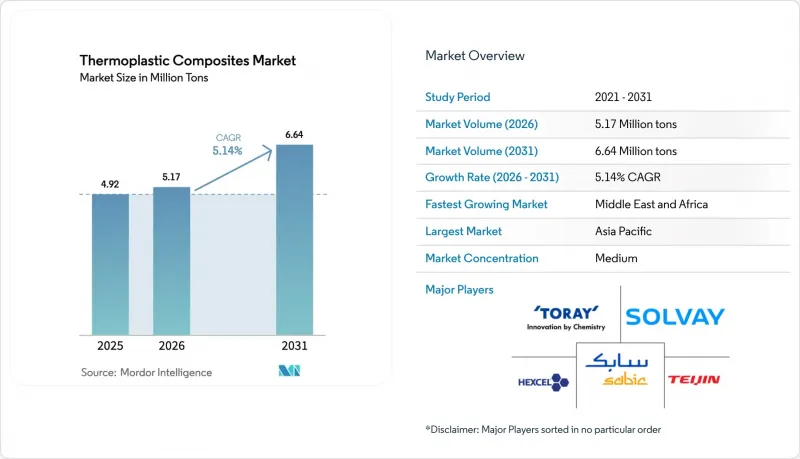
本報告按樹脂類型(聚丙烯、聚醯胺及其他)、纖維類型(玻璃纖維、碳纖維及其他纖維類型)、產品類型(短纖維、長絲纖維及其他)、終端用戶產業(汽車、航太與國防及其他)以及地區(亞太、北美、歐洲、南美、中東和非洲)進行細分。市場預測以噸為單位。
全球熱塑性複合材料市場趨勢與洞察
歐洲和美國迅速訂定法規,以減輕汽車重量。
根據2025年中期生效的歐盟7排放標準以及美國環保署(EPA)2027-2032年的溫室氣體排放標準,汽車製造商必須將車輛整備質量降低8%至12%,以確保其車隊的平均排放量符合限值。熱塑性複合材料不僅比鋼材減重30%至40%,而且其不到60秒的成型週期使其能夠輕鬆整合到生產線中。 BMWiX的頂棚面板就證明了這種材料的結構可行性,同時實現了每輛車15公斤的減重。從經濟角度來看,採用複合材料勢在必行,因為二氧化碳排放基準值將導致每克超過95歐元的罰款。
原始設備製造商在電動車領域尋求可回收複合材料解決方案的努力
歐盟電池法規,包括回收率要求和數位護照標準,正在推動採用可重熔基體製造的閉合迴路機殼的發展。梅賽德斯-賓士回收並再利用短纖維聚醯胺電池外殼,在不影響衝擊強度的前提下,實現了22%的回收率。中國提出的「可拆卸設計」法規正在加速這項轉型,而美國化學工業協會(ACC)的目標是到2030年將複合複合材料廢料的回收率提高到30%。
原料和成型製程高成本
2024年至2025年間,己內醯胺供應緊張導致聚醯胺樹脂價格在每噸2,800美元至3,400美元之間波動。聚醚醚酮(PEEK)價格依然昂貴,每公斤60至80美元,限制了其在航空航太和植入領域以外的應用。碳纖維價格相對較高,每公斤15至25美元,遠低於玻璃纖維。自動化膠帶層壓單元的高昂成本(超過500萬美元)限制了中小企業進入該領域,而環氧樹脂材料在低產量航太領域仍保持著一定的市場佔有率,價格為每公斤4至6美元。
細分市場分析
預計到2025年,聚醯胺熱塑性複合材料市場將佔總產量的38.89%,這主要得益於高速射出成型線的普及,這些生產線能夠滿足汽車產業對生產週期的要求。雖然吸濕性會使剛度降低15-20%,但其衝擊韌性的提升使其在保險桿橫樑等應用領域保持了需求。聚醚醚酮(PEEK)雖然目前僅佔總產量的一小部分,但由於其在需要180 度C高溫作業的飛機支架中的應用以及其在脊柱支架中的不透射線滲透性,其複合年成長率(CAGR)仍高達6.08%。聚丙烯繼續用於非結構性覆蓋材料,以滿足成本和再生材料含量的要求,而聚苯乙烯磺酸鈉(PPS)和聚乙烯亞胺(PEI)則在引擎室阻燃材料領域佔據了一席之地。
隨著電氣化進程的推進,對耐化學腐蝕基體材料的需求日益成長。電池托盤供應商正在測試採用回收材料製成的聚醯胺,以滿足報廢車輛(ELV)25%的回收率標準。同時,美國FDA對PEEK脊椎融合器的510(k)批准提振了醫院的需求,儘管外科醫生更傾向於選擇手感熟悉的鈦合金材料。在預測期內,隨著防火、防菸和毒性測試技術的日趨成熟,聚醯亞胺共混物和低煙、無鹵PEEK材料有望在汽車內裝領域佔據更大的市場佔有率。
玻璃纖維預計到2025年將佔供應量的87.27%,其彈性模量為72吉帕,價格為每公斤1.50至2美元,足以滿足電池托盤和座椅靠背等零件的性能要求。碳纖維的前景也十分樂觀,其複合年成長率預計為5.81%,這得益於諸如梅賽德斯-奔馳EQS車頂拱架等項目,該項目使車輛減重8公斤,重心降低12毫米。玄武岩和芳香聚醯胺總合佔比不到3%,原因是供應鏈規模不足。
隨著碰撞安全標準的日益嚴格,如果碳纖維成本降至每公斤12美元以下,預計其在B柱加強件中的應用將逐步增加。預計隨著中國兩條運作碳纖維的新生產線於2027年投產,這一目標將得以實現。天然纖維混合材料在歐盟廂型車車門內裝的隔音性能測試中表現良好,但吸濕性問題仍然存在。
區域分析
預計到2025年,亞太地區將佔48.76%的市場佔有率,這主要得益於中國2,610萬輛的汽車產量以及Delta電子產業叢集的蓬勃發展。北京的新能源汽車(NEV)計畫已延長至2030年,該計畫強制要求使用可回收的輕量化零件,從而促進了短纖維和長纖維原料的進口。在日本,政府計劃投入3,000億日圓補貼,到2030年建成1,000座加氫站,將推動對IV型氫氣瓶的需求。在韓國,採用多材料中框使智慧型手機的組裝流程縮短了40%。在印度,與生產連結獎勵計畫正在降低複合材料電池的資本成本;而在越南和泰國,供應鏈多元化正在擴大包覆成型產品的產能。
北美和歐洲佔據了大部分消費市場。美國的燃油經濟性標準(CAFE)迫使底特律的汽車製造商透過採用複合材料車身面板和座椅,將每款車型的重量減輕100-150公斤。波音777X的地板梁實現了成本降低和製造週期縮短,而歐洲的報廢車輛(ELV)法規規定,到2030年,再生塑膠的使用比例必須達到25%或以上。英國一項耗資1,800萬英鎊的機翼蒙皮計畫旨在將ATI工廠的人事費用降低50%。
預計到2031年,中東和非洲的成長率將達到5.72%,成為成長最快的地區。沙烏地阿美在NEOM新城鋪設的200公里氫氣管道重量減輕了60%,並提高了抗脆性。在Masdar城,能夠承受50 度C溫度波動的熱塑性外牆材料正被列為建築規範。南非Nampak公司的複合材料生產線正準備生產出口歐洲的車輛,而在奈及利亞,用於輸送酸性氣體的複合材料管道正在接受評估,以滿足在地採購法規。南美洲的發展相對落後,但在巴西的農業機械領域,低柴油消耗的輕型收割機正獲得市場認可。
其他好處
- Excel格式的市場預測(ME)表
- 3個月的分析師支持
目錄
第1章:引言
- 研究假設和市場定義
- 調查範圍
第2章:調查方法
第3章執行摘要
第4章 市場狀況
- 市場概覽
- 市場促進因素
- 歐洲和美國迅速訂定法規,以減輕汽車重量。
- 原始設備製造商在電動車領域尋求可回收複合材料解決方案的努力
- 亞太地區液化天然氣和氫氣儲存大型企劃的管道
- 智慧電子產品機殼中熱塑性樹脂包覆成型技術的應用
- 軍方對耐損傷和雷達滲透性結構的需求
- 市場限制因素
- 原料和成型製程高成本
- 意識水平低和缺乏標準化
- 來自熱固性複合材料的競爭壓力
- 價值鏈分析
- 波特五力模型
第5章 市場規模與成長預測
- 依樹脂類型
- 聚丙烯(PP)
- 聚醯胺(PA)
- 聚醚醚酮(PEEK)
- 其他樹脂類型
- 依纖維類型
- 玻璃纖維
- 碳纖維
- 其他纖維類型
- 依產品類型
- 短纖維熱塑性樹脂(SFT)
- 長纖維熱塑性樹脂(LFT)
- 連續纖維熱塑性樹脂(CFT)
- 玻璃纖維氈熱塑性樹脂(GMT)
- 按最終用戶行業分類
- 車
- 航太/國防
- 電氣和電子設備
- 建造
- 醫療保健
- 其他終端用戶產業
- 按地區
- 亞太地區
- 中國
- 日本
- 印度
- 韓國
- ASEAN
- 其他亞太國家
- 北美洲
- 美國
- 加拿大
- 墨西哥
- 歐洲
- 德國
- 英國
- 法國
- 義大利
- 西班牙
- 其他歐洲國家
- 南美洲
- 巴西
- 阿根廷
- 其他南美國家
- 中東和非洲
- 沙烏地阿拉伯
- 阿拉伯聯合大公國
- 南非
- 奈及利亞
- 其他中東和非洲國家
- 亞太地區
第6章 競爭情勢
- 市場集中度
- 策略趨勢
- 市佔率和排名分析
- 公司簡介
- Arkema
- Avient Corporation
- Alsiano A/S
- BASF
- Celanese Corporation
- Daicel Corporation
- dsm-firmenich
- DuPont
- Hexcel Corporation
- LANXESS
- LyondellBasell Industries Holdings BV
- Mitsubishi Chemical Group Corporation
- Owens Corning
- RTP Company
- SABIC
- SGL Carbon
- Solvay
- TechnoCompound GmbH
- TEIJIN LIMITED
- TORAY INDUSTRIES, INC.
- Victrex plc
第7章 市場機會與未來展望
According to Mordor Intelligence, the thermoplastic composites market size is expected to increase from 4.92 Million tons in 2025 to 5.17 Million tons in 2026 and reach 6.64 Million tons by 2031, growing at a CAGR of 5.14% over 2026-2031.
This report is Segmented by Resin Type (Polypropylene, Polyamide, and More), Fiber Type (Glass Fiber, Carbon Fiber, Other Fiber Types), Product Type (Short-Fiber, Long-Fiber, and More), End-User Industry (Automotive, Aerospace and Defense, and More), and Geography (Asia-Pacific, North America, Europe, South America, Middle East and Africa). Market Forecasts are Provided in Terms of Volume (Tons).
Global Thermoplastic Composites Market Trends and Insights
Rapid Vehicle Lightweighting Mandates in Europe and the United States
Euro 7 rules effective mid-2025 and the U.S. EPA's 2027-2032 greenhouse-gas standards oblige automakers to remove 8%-12% of curb weight to stay inside fleet-average limits. Thermoplastic composites deliver 30%-40% savings versus steel yet cycle in under 60 seconds, enabling line-side integration. BMW's iX roof panel shows structural feasibility while trimming 15 kg per vehicle. Penalties above EUR 95 per excess gram of CO2 make adoption financially unavoidable.
OEM Push for Recyclable Composite Solutions in E-Mobility
EU Battery Regulation thresholds on recycled content and digital passports promote closed-loop enclosures built from remeltable matrices. Mercedes-Benz recovers short-fiber polyamide housings for reuse, achieving 22% recycled content with no impact-strength loss. China's draft design-for-disassembly rules amplify the shift, and the American Chemistry Council targets 30% composite scrap circularity by 2030.
High Cost of Raw Materials and Forming Processes
Polyamide resins fluctuated between USD 2,800 and USD 3,400/ton in 2024-2025 as caprolactam supply tightened, and PEEK still commands USD 60-80/kg, curbing penetration outside aviation and implants. Carbon fiber at USD 15-25/kg remains a premium over glass. Automated tape-laying cells exceed USD 5 million, limiting SME entry, whereas epoxy systems price in at USD 4-6/kg and keep share in low-volume aerospace runs.
Other drivers and restraints analyzed in the detailed report include:
- Asia-Pacific LNG and Hydrogen Storage Megaproject Pipeline
- Thermoplastic Over-Molding Adoption in Smart-Electronics Housings
- Limited Awareness and Standardization
For complete list of drivers and restraints, kindly check the Table Of Contents.
Segment Analysis
The thermoplastic composites market size for polyamide reached 38.89% of total volume in 2025, owing to high-speed injection lines that meet automotive cycle-time targets. Moisture absorption cuts stiffness 15%-20% but boosts impact toughness, sustaining bumper-beam appeal. PEEK, although just a fraction of tonnage, is on a 6.08% CAGR path as aircraft brackets need 180 °C service and spine cages demand radiolucency. Polypropylene retains non-structural covers where cost and recycled-content mandates align, while PPS and PEI satisfy under-hood flame-retardant niches.
Heightened electrification keeps demand for chemical-resistant matrices; battery-tray suppliers are trialing recycled-content polyamide to meet 25% ELV thresholds. Meanwhile, the U.S. FDA's 510(k) clearance of PEEK spinal cages spurs hospital demand even as surgeons weigh titanium familiarity. Over the forecast horizon, polyimide blends and low-smoke zero-halogen PAEK grades could carve out cabin-interior volume once fire-smoke-toxicity testing matures.
Glass fiber supplied 87.27% of 2025 volume, offering 72 GPa modulus for USD 1.50-2.00/kg - adequate for battery trays and seat backs. Carbon fiber's 5.81% CAGR outlook is underpinned by programs like Mercedes-Benz EQS roof bows that trim 8 kg and lower center of gravity 12 mm. Basalt and aramid remain below 3% combined because supply chains lack scale.
Crash-standards tightening will gradually expand carbon into B-pillar reinforcements once cost drops below USD 12/kg, expected as two new 25 kt lines in China come online in 2027. Natural-fiber hybrids are testing well for door-trim acoustics in EU vans, though moisture uptake challenges persist.
Complete Report Scope:
- By Resin Type
- Polypropylene (PP)
- Polyamide (PA)
- Polyether-ether-ketone (PEEK)
- Other Resin Types
- By Fiber Type
- Glass Fiber
- Carbon Fiber
- Other Fiber Types
- By Product Type
- Short-Fiber Thermoplastic (SFT)
- Long-Fiber Thermoplastic (LFT)
- Continuous-Fiber Thermoplastic (CFT)
- Glass-Mat Thermoplastic (GMT)
- By End-User Industry
- Automotive
- Aerospace and Defense
- Electrical and Electronics
- Construction
- Medical
- Other End-Users
- By Geography
- Asia-Pacific
- China
- Japan
- India
- South Korea
- ASEAN
- Rest of Asia-Pacific
- North America
- United States
- Canada
- Mexico
- Europe
- Germany
- United Kingdom
- France
- Italy
- Spain
- Rest of Europe
- South America
- Brazil
- Argentina
- Rest of South America
- Middle East and Africa
- Saudi Arabia
- United Arab Emirates
- South Africa
- Nigeria
- Rest of Middle East and Africa
- Asia-Pacific
Geography Analysis
Asia-Pacific held 48.76% share in 2025, powered by China's 26.1 million vehicle output and electronics clusters along the Pearl River Delta. Beijing's NEV plan, extended to 2030, requires recyclable lightweight components, fueling short- and long-fiber feedstock imports. Japan's JPY 300 billion subsidy backs 1,000 hydrogen stations by 2030, pulling Type IV cylinder demand. South Korea's multi-material mid-frame adoption reduced smartphone assembly steps 40%. India's production-linked incentive cuts capital costs for composite cells, while Vietnam and Thailand expand over-molding capacity as supply chains diversify.
North America and Europe account for significant consumption volume. U.S. CAFE rules force Detroit to drop 100-150 kg per model using composite closures and seating. Boeing's 777X floor beams showcase cost and cycle reductions, and Euro ELV mandates place 25% recycled-plastic thresholds by 2030. The U.K.'s GBP 18 million wing-skin project targets 50% labor cuts at ATI facilities.
The Middle East and Africa lead by growth rate at 5.72% through 2031. Saudi Aramco's 200-km hydrogen pipeline at NEOM highlights 60% weight savings and embrittlement resistance. Masdar City specs thermoplastic facades that survive 50 °C swings. South Africa's Nampak compounding line readies for export vehicles bound for Europe, while Nigeria assesses sour-gas composite pipe to meet local content rules. South America trails, though Brazilian agri-equipment gains from lightweight harvesters that consume less diesel.
- Arkema
- Avient Corporation
- Alsiano A/S
- BASF
- Celanese Corporation
- Daicel Corporation
- dsm-firmenich
- DuPont
- Hexcel Corporation
- LANXESS
- LyondellBasell Industries Holdings B.V.
- Mitsubishi Chemical Group Corporation
- Owens Corning
- RTP Company
- SABIC
- SGL Carbon
- Solvay
- TechnoCompound GmbH
- TEIJIN LIMITED
- TORAY INDUSTRIES, INC.
- Victrex plc
Additional Benefits:
- The market estimate (ME) sheet in Excel format
- 3 months of analyst support
TABLE OF CONTENTS
1 Introduction
- 1.1 Study Assumptions and Market Definition
- 1.2 Scope of the Study
2 Research Methodology
3 Executive Summary
4 Market Landscape
- 4.1 Market Overview
- 4.2 Market Drivers
- 4.2.1 Rapid Vehicle-Light-Weighting Mandates in Europe and the United States
- 4.2.2 OEM Push for Recyclable Composite Solutions in E-Mobility
- 4.2.3 Asia-Pacific LNG and Hydrogen-Storage Megaproject Pipeline
- 4.2.4 Thermoplastic Over-Moulding Adoption in Smart-Electronics Housings
- 4.2.5 Military Demand for Damage-Tolerant, Radar-Transparent Structures
- 4.3 Market Restraints
- 4.3.1 High Cost of Raw Materials and Forming Processes
- 4.3.2 Limited Awareness and Standardization
- 4.3.3 Competitive Pressure from Thermoset Composites
- 4.4 Value Chain Analysis
- 4.5 Porter's Five Forces
- 4.5.1 Bargaining Power of Suppliers
- 4.5.2 Bargaining Power of Buyers
- 4.5.3 Threat of New Entrants
- 4.5.4 Threat of Substitutes
- 4.5.5 Competitive Rivalry
5 Market Size and Growth Forecasts (Volume)
- 5.1 By Resin Type
- 5.1.1 Polypropylene (PP)
- 5.1.2 Polyamide (PA)
- 5.1.3 Polyether-ether-ketone (PEEK)
- 5.1.4 Other Resin Types
- 5.2 By Fiber Type
- 5.2.1 Glass Fiber
- 5.2.2 Carbon Fiber
- 5.2.3 Other Fiber Types
- 5.3 By Product Type
- 5.3.1 Short-Fiber Thermoplastic (SFT)
- 5.3.2 Long-Fiber Thermoplastic (LFT)
- 5.3.3 Continuous-Fiber Thermoplastic (CFT)
- 5.3.4 Glass-Mat Thermoplastic (GMT)
- 5.4 By End-User Industry
- 5.4.1 Automotive
- 5.4.2 Aerospace and Defense
- 5.4.3 Electrical and Electronics
- 5.4.4 Construction
- 5.4.5 Medical
- 5.4.6 Other End-Users
- 5.5 By Geography
- 5.5.1 Asia-Pacific
- 5.5.1.1 China
- 5.5.1.2 Japan
- 5.5.1.3 India
- 5.5.1.4 South Korea
- 5.5.1.5 ASEAN
- 5.5.1.6 Rest of Asia-Pacific
- 5.5.2 North America
- 5.5.2.1 United States
- 5.5.2.2 Canada
- 5.5.2.3 Mexico
- 5.5.3 Europe
- 5.5.3.1 Germany
- 5.5.3.2 United Kingdom
- 5.5.3.3 France
- 5.5.3.4 Italy
- 5.5.3.5 Spain
- 5.5.3.6 Rest of Europe
- 5.5.4 South America
- 5.5.4.1 Brazil
- 5.5.4.2 Argentina
- 5.5.4.3 Rest of South America
- 5.5.5 Middle East and Africa
- 5.5.5.1 Saudi Arabia
- 5.5.5.2 United Arab Emirates
- 5.5.5.3 South Africa
- 5.5.5.4 Nigeria
- 5.5.5.5 Rest of Middle East and Africa
- 5.5.1 Asia-Pacific
6 Competitive Landscape
- 6.1 Market Concentration
- 6.2 Strategic Moves
- 6.3 Market Share(%)/Ranking Analysis
- 6.4 Company Profiles (includes Global level Overview, Market level overview, Core Segments, Financials as available, Strategic Information, Market Rank/Share for key companies, Products and Services, and Recent Developments)
- 6.4.1 Arkema
- 6.4.2 Avient Corporation
- 6.4.3 Alsiano A/S
- 6.4.4 BASF
- 6.4.5 Celanese Corporation
- 6.4.6 Daicel Corporation
- 6.4.7 dsm-firmenich
- 6.4.8 DuPont
- 6.4.9 Hexcel Corporation
- 6.4.10 LANXESS
- 6.4.11 LyondellBasell Industries Holdings B.V.
- 6.4.12 Mitsubishi Chemical Group Corporation
- 6.4.13 Owens Corning
- 6.4.14 RTP Company
- 6.4.15 SABIC
- 6.4.16 SGL Carbon
- 6.4.17 Solvay
- 6.4.18 TechnoCompound GmbH
- 6.4.19 TEIJIN LIMITED
- 6.4.20 TORAY INDUSTRIES, INC.
- 6.4.21 Victrex plc
7 Market Opportunities and Future Outlook
- 7.1 White-Space and Unmet-Need Assessment
- 7.2 Wide Application Scope in the Healthcare Sector

 熱塑性複合材料市場預測至2034年-按樹脂類型、纖維類型、產品形式、製造流程、最終用途產業和地區分類的全球分析
 熱塑性複合材料市場:依產品形式、纖維類型、樹脂類型、製造流程、終端應用產業及銷售管道分類-2026-2032年全球市場預測
 熱固性模塑膠:市場佔有率分析、產業趨勢與統計、成長預測(2026-2031)
 熱塑性複合材料市場報告:按纖維類型、產品類型、樹脂類型、終端應用產業和地區分類(2026-2034 年)
 熱塑性複合材料市場規模、佔有率、成長及全球產業分析:按類型、應用和地區分類,並提供2026-2034年的洞察和預測
 2026年全球熱塑性複合材料市場報告工業用聚四氟乙烯複合材料市場(依複合材料類型、加工方法、形態、應用和最終用途產業分類)-2026-2032年全球預測氧化鋯陶瓷連續纖維市場:依纖維類型、等級、銷售管道、應用和最終用途產業分類-全球預測,2026-2032年熱可塑性橡膠化合物市場按產品類型、形態、應用和分銷管道分類-2026-2032年全球預測
 熱固性模塑材料市場規模、佔有率及成長分析(依樹脂類型、成型類型、最終用途產業及地區分類)-2026-2033年產業預測