


 |
市場調查報告書
商品編碼
2122463
氟聚合物塗料:市場佔有率分析、產業趨勢與統計、成長預測(2026-2031)Fluoropolymer Coatings - Market Share Analysis, Industry Trends & Statistics, Growth Forecasts (2026 - 2031) |
||||||

※ 本網頁內容可能與最新版本有所差異。詳細情況請與我們聯繫。
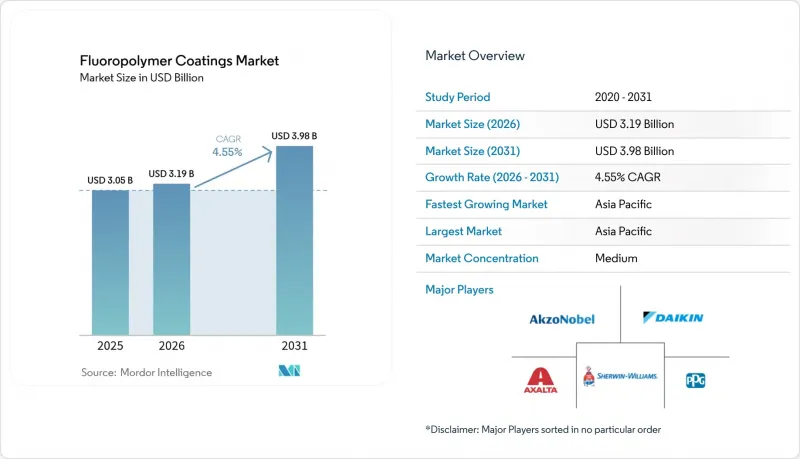
據 Mordor Intelligence 稱,2025 年氟聚合物塗料市值為 30.5 億美元,預計到 2031 年將達到 39.8 億美元,而 2026 年為 31.9 億美元,預測期(2026-2031 年)的複合年成長率為 4.55%。
本報告按樹脂類型(聚四氟乙烯(PTFE)、聚二氟亞乙烯(PVDF)、其他)、塗層技術(液體、粉末)、基材(金屬、塑膠、複合材料、其他)、應用(工業、建築、汽車、食品加工、炊具、其他)和地區(亞太地區、北美、歐洲、其他)對產業進行分類。
全球氟聚合物塗料市場趨勢及洞察
離岸風力發電塔架對防腐蝕塗層的需求不斷成長。
隨著離岸風力發電設施的快速成長,對性能的要求也日益提高,傳統環氧樹脂系統已無法滿足這些要求。目前,含氟聚合物配方採用有機-無機雜化材料,能夠抵抗海水、鹽霧和冰的侵蝕,而冰的侵蝕會導致渦輪機輸出功率下降高達30%。這種塗層的預期使用壽命可達10至12年,使部署在深海域的下一代浮體式的維護週期延長一倍。原型溶膠-凝膠系統對金屬具有極強的附著力,並能減少表面下腐蝕,進而降低業者為25年使用壽命所承擔的停機成本。
電動車動力傳動系統部件中低摩擦塗層的快速應用
與內燃機相比,電動傳動系統在更高的轉速、溫度和電壓下運行,導致摩擦應力增加。氟聚合物塗層可降低表面能,最大限度地減少電弧放電,並保護800V電驅動橋內的銅導體,從而將傳動系統的整體效率提高3%至5%。主要汽車製造商正在指定在軸承和花鍵齒輪上使用聚四氟乙烯(PTFE)改質塗層,以縮小潤滑系統尺寸,延長零件壽命並提高續航里程。預計這些解決方案在中檔電動車車型中的標準化應用將在本十年後半期加速對塗層的需求。
由於中國的出口配額,螢石衍生的氫氟酸的供應和價格出現波動。
中國控制著全球一半以上的螢石礦產資源,並正在收緊出口配額以維持高附加價值產品的生產,這使得海外氫氟酸生產商處境艱難。預計現貨價格將在2024年再次飆升,大型氟聚合物生產商已紛紛簽訂多年合約並囤積庫存。中小塗料生產商則面臨利潤率下降、交貨訂單風險增加等問題,這促使它們透過併購來提升議價能力和供應鏈韌性。
細分市場分析
由於其工作溫度為 260 度C且化學惰性,PTFE 適用於半導體蝕刻設備、食品輸送機和化學反應器等惡劣環境中的應用,因此,即使到 2025 年,它在氟聚合物塗料市場仍保持著 43.35% 的市場佔有率。
聚偏氟乙烯(PVDF)以5.12%的複合年成長率領先市場,廣泛應用於鋰離子電池正極黏合劑、隔膜以及對介電強度和溶劑相容性要求極高的半導體潔淨室設備。北美和歐洲產能的擴展確保了區域供應的穩定性,而本地化生產則最大限度地減少了碳排放和關稅,進一步鞏固了PVDF的成長動能。
液態配方佔氟聚合物塗料市場的62.10%。水性產品能夠在不影響漆膜品質的前提下顯著降低揮發性有機化合物(VOC)的含量,幫助製造商滿足加州和歐盟嚴格的排放法規。
粉末塗料預計到2031年將以5.28%的複合年成長率成長,因為它們能將揮發性有機化合物(VOC)排放量降至接近零,並允許回收過噴塗料。 CARC認證的粉末面漆和其他產品的開發,確保了軍用設備的耐化學腐蝕性,同時縮短了施工時間,從而將粉末塗料的應用範圍擴展到航太、海事和重型機械領域,而這些領域此前一直由液體塗料系統主導。
區域分析
到2025年,亞太地區將佔43.40%的氟聚合物塗料市場。這主要得益於中國龐大的氟化工基地和可再生能源的大規模擴張。印度將緊隨其後,透過激勵措施促進電子和光伏(PV)製造業的發展,從而持續創造對工廠設備防腐蝕塗料的需求。日本和韓國將繼續保持其在半導體領域的主導地位,推動該地區尖端技術的發展,並穩定高階塗料的消費。
北美正受益於製造業回流,加速了國內PVDF和PTFE的生產,從而保護了電池和航太領域的關鍵企業免受供應衝擊。聯邦政府的激勵措施進一步提振了需求,刺激了需要ETFE襯裡工廠周邊設備的氫能計畫。
在歐洲,人們力求在高環保標準和工業需求之間取得平衡。德國和英國的離岸風力發電製造商正在指定使用長壽命的含氟聚合物塗層,以最大限度地減少北海地區昂貴的維護工作。即將訂定的 PFAS 法規迫使化合物製造商探索閉合迴路回收和低排放生產方式,以確保業務永續營運。
其他好處
- Excel格式的市場預測(ME)表
- 3個月的分析師支持
目錄
第1章:引言
- 研究假設和市場定義
- 調查範圍
第2章:調查方法
第3章執行摘要
第4章 市場狀況
- 市場概覽
- 市場促進因素
- 離岸風力發電塔架對防腐蝕塗層的需求不斷成長。
- 電動車動力傳動系統部件中低摩擦塗層的快速應用
- 智慧炊具中耐熱不沾塗層的發展
- 北美和歐洲PVDF內襯鋰離子電池超級工廠的擴張
- 氫氣管道計畫的激增推動了對 ETFE 和 FEP 塗料的需求。
- 市場限制因素
- 由於中國的出口配額,螢石衍生的氫氟酸的供應和價格出現波動。
- 由於工業用途的低成本防護塗料的出現,競爭加劇。
- 嚴格的環境政策和法規
- 價值鏈分析
- 波特五力模型
第5章 市場規模與成長預測
- 依樹脂類型
- 聚四氟乙烯(PTFE)
- 聚二氟亞乙烯(PVDF)
- 氟化乙烯丙烯(FEP)
- 乙烯四氟乙烯(ETFE)
- 全氟烷氧基烷烴(PFAs)
- 聚偏氟乙烯(PVF)
- 其他樹脂類型
- 透過塗層技術
- 液體
- 粉末
- 按基礎材料
- 金屬
- 塑膠
- 複合材料及其他
- 透過使用
- 產業
- 建築/施工
- 車
- 食品加工
- 航空航太
- 電
- 炊具
- 其他用途
- 按地區
- 亞太地區
- 中國
- 印度
- 日本
- 韓國
- 其他亞太國家
- 北美洲
- 美國
- 加拿大
- 墨西哥
- 歐洲
- 德國
- 英國
- 義大利
- 法國
- 其他歐洲國家
- 南美洲
- 巴西
- 阿根廷
- 其他南美國家
- 中東和非洲
- 沙烏地阿拉伯
- 南非
- 其他中東和非洲國家
- 亞太地區
第6章 競爭情勢
- 市場集中度
- 策略性措施(併購、合資、擴大生產能力)
- 市佔率分析
- 公司簡介
- AkzoNobel NV
- Arkema SA
- Axalta Coating Systems LLC
- Beckers Group
- Berger Paints India Ltd.
- Daikin Industries, Ltd.
- Dongyue Group Co., Ltd.
- Endura Coatings
- Hempel A/S
- Jiangsu Chenguang Fluoropolymer Co., Ltd.
- Jotun
- NIC Industries Inc.
- PPG Industries, Inc.
- Praxair Surface Technologies, Inc.
- Precision Coating Company, LLC(Integer Holdings Corporation)
- Solvay SA
- The Chemours Company
- The Sherwin-Williams Company
- Tnemec Company Inc.
- Walter Wurdack Inc.
- Whitford Corporation
第7章 市場機會與未來展望
According to Mordor Intelligence, the fluoropolymer coatings market size was valued at USD 3.05 billion in 2025 and estimated to grow from USD 3.19 billion in 2026 to reach USD 3.98 billion by 2031, at a CAGR of 4.55% during the forecast period (2026-2031).
This report Segments the Industry by Resin Type (Polytetrafluoroethylene (PTFE), Polyvinylidene Fluoride (PVDF), and More), Coating Technology (Liquid and Powder), Substrate (Metal, Plastic, and Composite and Others), Application (Industrial, Building and Construction, Automotive, Food Processing, Cookware, and More), and Geography (Asia-Pacific, North America, Europe, and More).
Global Fluoropolymer Coatings Market Trends and Insights
Increased Demand for Anti-corrosive Coatings in Offshore Wind Turbine Towers
Surging offshore wind installations are elevating performance requirements beyond conventional epoxy systems. Fluoropolymer formulations now integrate organic-inorganic hybrids that resist seawater, salt spray, and ice accumulation that can cut turbine output by 30%. Coating lifetimes are projected to stretch to 10 - 12 years, doubling the maintenance window for next-generation floating platforms deployed in deeper waters. Prototype sol-gel systems deliver strong metal adhesion, reducing under-film corrosion and cutting downtime expenses for operators who target 25-year service lives.
Fast-growing Adoption of Low-Friction Coatings in Electric-Vehicle Powertrains
Electrified drivetrains operate at higher rpm, temperature, and voltage than internal-combustion engines, amplifying tribological stress. Fluoropolymer layers reduce surface energy, minimize arcing, and protect copper conductors in 800 V e-axles, raising overall drivetrain efficiency by 3-5%. Leading OEMs specify PTFE-modified coatings on bearings and spline gears to enable downsized lubrication systems, extending part life and boosting range. Standardization of these solutions across mid-segment EV models will accelerate coating volumes by the latter half of the decade.
Volatile Supply and Pricing of Fluorspar-derived HF Acid
China controls well over half of mined fluorspar and tightens export quotas to retain value-added production, squeezing external producers of HF acid. Spot prices rose sharply again in 2024, prompting larger fluoropolymer makers to lock multi-year contracts and build stockpiles. Smaller coaters face margin erosion, shortened order books, and greater exposure to delivery disruptions, encouraging mergers aimed at negotiating power and supply-chain resilience.
Other drivers and restraints analyzed in the detailed report include:
- Growth of High-temperature Non-stick Coatings in Smart Cookware
- Expansion of PVDF-lined Lithium-ion Battery Gigafactories
- Strict Environmental Policies and Regulations
For complete list of drivers and restraints, kindly check the Table Of Contents.
Segment Analysis
PTFE maintained 43.35% of fluoropolymer coatings market share in 2025 because its 260 °C service temperature and chemical inertness serve harsh duties in semiconductor etching tools, food-grade conveyors, and chemical reactors.
PVDF, posting the fastest 5.12% CAGR, is leveraged in lithium-ion cathode binders, separator films, and semiconductor clean-room hardware where its dielectric strength and solvent compatibility are critical. Capacity expansions in North America and Europe lock in regional security of supply, while localized production minimizes carbon footprints and tariffs, further entrenching PVDF's trajectory.
Liquid formulations held 62.10% of fluoropolymer coatings market size. Waterborne variants that slash VOCs without compromising film integrity are helping manufacturers comply with stringent emission rules in California and the EU.
Powder coatings deliver near-zero VOCs and over-spray recyclability, propelling a 5.28% CAGR through 2031. Developments such as CARC-qualified powder topcoats offer chemical-agent resistance for military assets while cutting application time, broadening powder use into aerospace, maritime, and heavy equipment segments formerly dominated by liquid systems.
Complete Report Scope:
- By Resin Type
- Polytetrafluoroethylene (PTFE)
- Polyvinylidene Fluoride (PVDF)
- Fluorinated Ethylene Propylene (FEP)
- Ethylene Tetrafluoroethylene (ETFE)
- Perfluoroalkoxy Alkanes (PFA)
- Polyvinyl Fluoride (PVF)
- Other Resin Types
- By Coating Technology
- Liquid
- Powder
- By Substrate
- Metal
- Plastic
- Composite and Others
- By Application
- Industrial
- Building and Construction
- Automotive
- Food Processing
- Aviation and Aerospace
- Electrical
- Cookware
- Other Applications
- By Geography
- Asia-Pacific
- China
- India
- Japan
- South Korea
- Rest of Asia-Pacific
- North America
- United States
- Canada
- Mexico
- Europe
- Germany
- United Kingdom
- Italy
- France
- Rest of Europe
- South America
- Brazil
- Argentina
- Rest of South America
- Middle East and Africa
- Saudi Arabia
- South Africa
- Rest of Middle East and Africa
- Asia-Pacific
Geography Analysis
Asia Pacific accounted for 43.40% of fluoropolymer coatings market share in 2025, driven by China's extensive fluorochemicals base and massive renewable-energy build-out. India follows with incentives that stimulate electronics and PV manufacturing, creating sustained coating demand for anti-corrosive plant equipment. Japan and South Korea maintain leadership in semiconductors, pushing the region's technology frontier and thereby steadying premium coating consumption.
North America benefits from reshoring that promotes domestic PVDF and PTFE production, insulating battery and aerospace primes from supply shocks. Federal incentives catalyze hydrogen projects that call for ETFE-lined balance-of-plant hardware, further bolstering demand.
Europe balances high environmental standards with industrial necessity. Offshore-wind tower builders in Germany and the United Kingdom specify long-life fluoropolymer layers to minimize expensive North Sea maintenance campaigns. Nevertheless, the looming PFAS restriction forces formulators to examine closed-loop recycling and lower-emission manufacturing to secure long-term viability.
- AkzoNobel N.V.
- Arkema SA
- Axalta Coating Systems LLC
- Beckers Group
- Berger Paints India Ltd.
- Daikin Industries, Ltd.
- Dongyue Group Co., Ltd.
- Endura Coatings
- Hempel A/S
- Jiangsu Chenguang Fluoropolymer Co., Ltd.
- Jotun
- NIC Industries Inc.
- PPG Industries, Inc.
- Praxair Surface Technologies, Inc.
- Precision Coating Company, LLC (Integer Holdings Corporation)
- Solvay SA
- The Chemours Company
- The Sherwin-Williams Company
- Tnemec Company Inc.
- Walter Wurdack Inc.
- Whitford Corporation
Additional Benefits:
- The market estimate (ME) sheet in Excel format
- 3 months of analyst support
TABLE OF CONTENTS
1 Introduction
- 1.1 Study Assumptions and Market Definition
- 1.2 Scope of the Study
2 Research Methodology
3 Executive Summary
4 Market Landscape
- 4.1 Market Overview
- 4.2 Market Drivers
- 4.2.1 Increased Demand for Anti-corrosive Coatings in Offshore Wind Turbine Towers
- 4.2.2 Fast-growing Adoption of Low-Friction Coatings in Electric Vehicle Powertrain Components
- 4.2.3 Growth of High-temperature Non-stick Coatings in Smart Cookware
- 4.2.4 Expansion of PVDF-lined Lithium-ion Battery Gigafactories in the North America and Europe
- 4.2.5 Surge in Hydrogen Pipeline Projects Driving ETFE and FEP Coatings
- 4.3 Market Restraints
- 4.3.1 Volatile Supply and Pricing of Fluorspar-derived HF Acid Due to Chinese Export Quotas
- 4.3.2 Competition from Low-priced Protective Coatings Available in the Industry
- 4.3.3 Strict Environmental Policies and Regulations
- 4.4 Value Chain Analysis
- 4.5 Porter's Five Forces
- 4.5.1 Bargaining Power of Suppliers
- 4.5.2 Bargaining Power of Consumers
- 4.5.3 Threat of New Entrants
- 4.5.4 Threat of Substitute Products and Services
- 4.5.5 Degree of Competition
5 Market Size and Growth Forecasts (Value)
- 5.1 By Resin Type
- 5.1.1 Polytetrafluoroethylene (PTFE)
- 5.1.2 Polyvinylidene Fluoride (PVDF)
- 5.1.3 Fluorinated Ethylene Propylene (FEP)
- 5.1.4 Ethylene Tetrafluoroethylene (ETFE)
- 5.1.5 Perfluoroalkoxy Alkanes (PFA)
- 5.1.6 Polyvinyl Fluoride (PVF)
- 5.1.7 Other Resin Types
- 5.2 By Coating Technology
- 5.2.1 Liquid
- 5.2.2 Powder
- 5.3 By Substrate
- 5.3.1 Metal
- 5.3.2 Plastic
- 5.3.3 Composite and Others
- 5.4 By Application
- 5.4.1 Industrial
- 5.4.2 Building and Construction
- 5.4.3 Automotive
- 5.4.4 Food Processing
- 5.4.5 Aviation and Aerospace
- 5.4.6 Electrical
- 5.4.7 Cookware
- 5.4.8 Other Applications
- 5.5 By Geography
- 5.5.1 Asia-Pacific
- 5.5.1.1 China
- 5.5.1.2 India
- 5.5.1.3 Japan
- 5.5.1.4 South Korea
- 5.5.1.5 Rest of Asia-Pacific
- 5.5.2 North America
- 5.5.2.1 United States
- 5.5.2.2 Canada
- 5.5.2.3 Mexico
- 5.5.3 Europe
- 5.5.3.1 Germany
- 5.5.3.2 United Kingdom
- 5.5.3.3 Italy
- 5.5.3.4 France
- 5.5.3.5 Rest of Europe
- 5.5.4 South America
- 5.5.4.1 Brazil
- 5.5.4.2 Argentina
- 5.5.4.3 Rest of South America
- 5.5.5 Middle East and Africa
- 5.5.5.1 Saudi Arabia
- 5.5.5.2 South Africa
- 5.5.5.3 Rest of Middle East and Africa
- 5.5.1 Asia-Pacific
6 Competitive Landscape
- 6.1 Market Concentration
- 6.2 Strategic Moves (Merger and Acquisition, JV, Capacity Expansions)
- 6.3 Market Share Analysis
- 6.4 Company Profiles {(includes Global level Overview, Market level overview, Core Segments, Financials as available, Strategic Information, Market Rank/Share for key companies, Products and Services, and Recent Developments)}
- 6.4.1 AkzoNobel N.V.
- 6.4.2 Arkema SA
- 6.4.3 Axalta Coating Systems LLC
- 6.4.4 Beckers Group
- 6.4.5 Berger Paints India Ltd.
- 6.4.6 Daikin Industries, Ltd.
- 6.4.7 Dongyue Group Co., Ltd.
- 6.4.8 Endura Coatings
- 6.4.9 Hempel A/S
- 6.4.10 Jiangsu Chenguang Fluoropolymer Co., Ltd.
- 6.4.11 Jotun
- 6.4.12 NIC Industries Inc.
- 6.4.13 PPG Industries, Inc.
- 6.4.14 Praxair Surface Technologies, Inc.
- 6.4.15 Precision Coating Company, LLC (Integer Holdings Corporation)
- 6.4.16 Solvay SA
- 6.4.17 The Chemours Company
- 6.4.18 The Sherwin-Williams Company
- 6.4.19 Tnemec Company Inc.
- 6.4.20 Walter Wurdack Inc.
- 6.4.21 Whitford Corporation
7 Market Opportunities and Future Outlook
- 7.1 White-space and Unmet-need Assessment
- 7.2 Sustainable and Eco-Friendly Coatings

 聚偏氟乙烯(PVDF)氟聚合物塗料市場:全球市場預測,2026-2032年
 FEVE氟聚合物塗料:市場佔有率分析、產業趨勢與統計、成長預測(2026-2031年)FEVE氟聚合物塗料市場-2026-2032年全球市場預測
 FEVE氟聚合物塗料市場規模、佔有率和成長分析:按技術類型、應用方法、基材、最終用途產業和地區分類-2026-2033年產業預測
 2026年全球氟聚合物塗料市場報告氟聚合物塗料市場:按類型、形態、基材和應用分類-2026-2032年全球市場預測防腐蝕氟聚合物塗料市場:2026-2032年全球預測(依樹脂類型、形態、應用及銷售管道)
 FEVE氟聚合物塗料市場-2025-2030年預測
 美國氟聚合物塗料市場規模、佔有率、趨勢分析報告:按產品、最終用途、國家和細分市場預測,2025-2033 年
 氟聚合物塗料市場規模、佔有率、成長分析(按樹脂類型、應用和地區分類)- 產業預測,2025-2032 年