


 |
市場調查報告書
商品編碼
2114053
FEVE氟聚合物塗料:市場佔有率分析、產業趨勢與統計、成長預測(2026-2031年)FEVE Fluoropolymer Coatings - Market Share Analysis, Industry Trends & Statistics, Growth Forecasts (2026 - 2031) |
||||||

※ 本網頁內容可能與最新版本有所差異。詳細情況請與我們聯繫。
根據 Mordor Intelligence 預測,FEVE 氟聚合物塗料市場將從 2025 年的 2.0045 億美元成長到 2026 年的 2.1124 億美元,然後在 2031 年達到 2.7446 億美元,2026 年至 2031 年的複合年成長率為 5.38%。
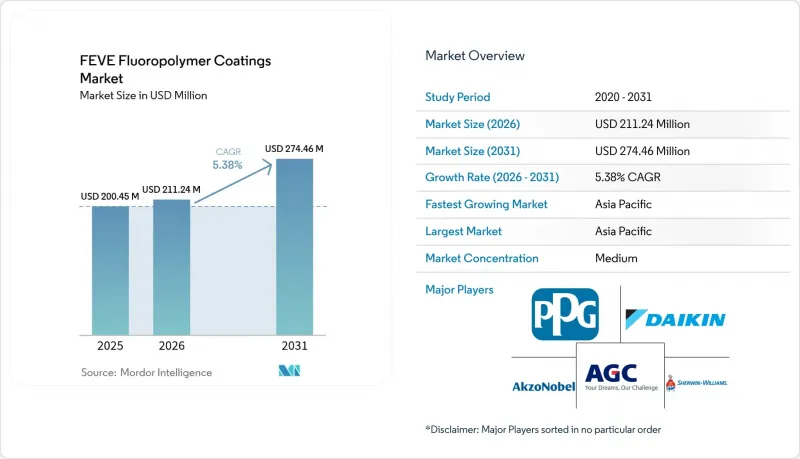
本報告按最終用戶行業(工業、建築施工、汽車、船舶、航空航太及其他最終用戶行業)和地區(亞太地區、北美、歐洲、南美以及中東和非洲)進行細分。市場預測以美元計價。
全球FEVE氟聚合物塗料市場趨勢及洞察
全球建築熱潮推動對長壽命外牆的需求。
高層建築開發商選擇FEVE帷幕牆塗料,是因為其年膜侵蝕率低於0.1微米,約為聚氨酯塗料的一半,從而最大限度地減少了成本高昂的鷹架搭建週期。據日本塗料製造商協會稱,考慮到重新塗裝成本的降低,30年的總成本相當於高成本橡膠塗料的37%。中國、海灣國家和東南亞是需要符合美國建築製造商協會(AAMA)2605標準的高層建築專案的主要來源地。 「阿布達比法拉利世界」和「阿拉伯塔」等案例研究表明,即使在紫外線引起的溫度波動超過50 度C的情況下,FEVE也能保護鋁板。隨著抗震標準允許使用輕質外牆板,對FEVE粉末的需求正在不斷成長,因為這種粉末可以在低溫下固化而不會導致面板變形。
FEVE粉末在可再生能源設備的應用
塗覆FEVE塗層的太陽能組件背板在戶外暴露一年後仍能維持95%以上的初始輸出功率,比未塗覆的對照組高出10個百分點。 FEVE粉末塗料是一種單層塗層,可在200 度C以下固化,可回收利用過噴塗物,並能抵抗海上環境中的鹽霧腐蝕,因此被應用於風力發電機塔架。石墨烯增強的FEVE/聚氨酯混合材料可實現高達99%的前緣抗侵蝕性能,從而滿足歐洲和中國兆瓦級葉片的生產目標。該樹脂不含VOC的特性備受價值鏈重視,尤其是在美國和歐盟溶劑法規日益嚴格的背景下。
與聚氨酯基系統相比的價格差異
FEVE的標價是聚氨酯的2到4倍,這阻礙了其在預算緊張地區的普及。根據ChemQuest的研究數據,由於裝修商推遲項目,導致預算緊張,並提高了初始成本門檻,2023年建築塗料出貨量下降了4.6%。聚矽氧烷面漆的價格是聚氨酯的1.5倍,目前正佔據中價位市場,尤其是在那些企業只有5到15年短期規劃的地區。 FEVE供應商正透過生命週期計算工具和培訓,強調其在未來幾十年內可降低15%到30%的總成本。
細分市場分析
到2025年,建築施工領域將佔據FEVE氟聚合物塗料市場47.38%的佔有率,這反映出該領域較早採用了30年保固的單層外牆塗料方案。預計2026年至2031年,該領域FEVE氟聚合物塗料市場將以6.59%的複合年成長率成長。帷幕牆業主對FEVE塗料的超長使用壽命讚賞有加,這使其重塗週期延長了兩到三倍,從而降低了支架成本,並減少了對人口密集城區租戶的影響。日本橋樑標準的修訂指定FEVE為唯一認可的面漆,進一步鞏固了公共工程領域對FEVE塗料的需求。
在工業設備領域,FEVE的需求正在穩定成長。與價格低30-40%的聚矽氧烷基塗料相比,石油和天然氣公司正在考慮FEVE塗料較長的重塗週期。汽車應用仍然是一個小眾市場,主要集中在需要抗紫外線和抗刮擦性能的特殊車輛和鋁製裝飾件。在船舶和航空航太產業,由於替代品有限,買家正在採用FEVE塗料進行防污和線束保護。在亞洲和北美不斷成長的維修市場中,低氣味的水性FEVE塗料被用於避免居住者疏散。由於粉末塗料的固化溫度低於200 度C且噴塗過量可回收,因此在工廠噴塗的屋頂板和鋁擠壓件領域,粉末塗料的市場佔有率正在不斷擴大。將FEVE與陶瓷混合的混合塗料也開始應用於橋樑拱肋,以滿足對顏色穩定性和阻隔性能的要求。儘管價格敏感性在拉丁美洲的市政項目中仍然普遍存在,但生命週期成本計算表明,成本降低 15-30% 是可能的,採購標準也逐漸改變。
區域分析
亞太地區是FEVE氟聚合物塗料市場的主要驅動力,預計到2025年將佔據51.05%的市場佔有率,並以6.42%的複合年成長率成長。這主要得益於中國的都市化、日本的橋樑標準以及韓國的海洋結構建設。中國的捲材塗裝商提供符合HG/T 4104-2019標準的水性塗料,可保持30年光澤,同時避免因VOC排放法規而受到處罰。日本國土交通省已將公共橋樑面漆限定為FEVE塗料,從而確保了其高價位。韓國造船廠已指定LNG裝運船隻上層建築採用長效塗料,從而減少了乾船塢維修的頻率。
北美約佔市佔率的24.85%。美國州公路和運輸官員協會(AASHTO)規定的橋樑75年設計壽命標準正在推動新建和維修項目向FEVE(氟化物增強型防火塗料)過渡,密西西比河上的I-74大橋就是一個典型的例子。在這座橋上,剪切機司的「Fluorokem」塗料保護了3,400英尺長的鋼結構。美國環保署(EPA)的氣溶膠法規正在加強對揮發性有機化合物(VOC)的監管,並透過全氟烷基和多氟烷基物質(PFAS)的報告要求進一步強化合規工作。加拿大的一項生命週期研究建議採用低VOC解決方案來降低交通堵塞等社會成本。在墨西哥,煉油廠和特種車輛項目正在逐步採用FEVE,因為更長的使用壽命可以抵消資本投資。
歐洲佔全球市場佔有率的17.80%,但面臨最嚴格的監管挑戰。提案的50 ppm總氟濃度上限將使價值鏈更加複雜。在德國和北歐國家,FEVE粉末塗料用於符合QUALIOAT 3級標準的離岸風力發電渦輪機的塗層。在南歐,儘管公共預算緊張,FEVE塗料仍然被指定用於機場和零售商店的外牆。在俄羅斯,由於貿易制裁的影響,與北極管道相關的商業機會仍然有限。
其他好處:
- Excel格式的市場預測(ME)表
- 3個月的分析師支持
目錄
第1章:引言
- 研究假設和市場定義
- 調查範圍
第2章:調查方法
第3章執行摘要
第4章 市場狀況
- 市場概覽
- 市場促進因素
- 全球建築熱潮推動對長壽命外牆的需求。
- 工業基礎設施腐蝕預防計劃
- 法規轉向低VOC、高耐久性塗料
- FEVE粉末在可再生能源硬體(太陽能和風能)的應用
- 政府關於公共橋樑和水箱使用壽命的規定。
- 市場限制因素
- 聚氨酯和丙烯酸體系的價格差異
- 加強美國和歐盟對 PFAS 相關事項的監管
- 熟練噴灑人員及專用噴灑設備短缺
- 價值鏈分析
- 波特五力模型
第5章 市場規模與成長預測
- 按最終用戶行業分類
- 產業
- 建築/施工
- 車
- 海上
- 航空航太太空產業
- 其他終端用戶產業
- 按地區
- 亞太地區
- 中國
- 印度
- 日本
- 韓國
- 東南亞國協
- 其他亞太國家
- 北美洲
- 美國
- 加拿大
- 墨西哥
- 歐洲
- 德國
- 英國
- 法國
- 義大利
- 西班牙
- 俄羅斯
- 北歐國家
- 其他歐洲國家
- 南美洲
- 巴西
- 阿根廷
- 哥倫比亞
- 其他南美國家
- 中東和非洲
- 沙烏地阿拉伯
- 南非
- 中東和非洲其他地區
- 亞太地區
第6章 競爭情勢
- 市場集中度
- 策略趨勢
- 市佔率/排名分析
- 公司簡介
- A&I Coatings
- AGC Inc.
- Akzo Nobel NV
- Axalta Coating Systems Ltd.
- DAIKIN INDUSTRIES, Ltd.
- IFS Coatings
- Innocoat Systems
- Kansai Paint Co., Ltd.
- KCC CORPORATION
- PPG Industries Inc.
- The Sherwin-Williams Company
- Tnemec
第7章 市場機會與未來展望
According to Mordor Intelligence, the FEVE fluoropolymer coatings market size is expected to grow from USD 200.45 million in 2025 to USD 211.24 million in 2026 and is forecast to reach USD 274.46 million by 2031 at 5.38% CAGR over 2026-2031.
This report is Segmented by End-User Industry (Industrial, Building and Construction, Automotive, Marine, Aviation and Aerospace, and Other End-User Industries) and Geography (Asia-Pacific, North America, Europe, South America, and Middle East and Africa). The Market Forecasts are Provided in Terms of Value (USD).
Global FEVE Fluoropolymer Coatings Market Trends and Insights
Long-Life Facade Demand in Global Construction Boom
Skyscraper developers select FEVE curtain-wall coatings because the annual film erosion rate stays below 0.1 µm, roughly half that of polyurethane, which limits expensive scaffold cycles. The Japan Paint Manufacturers Association values the total 30-year costs at 37% of those for chlorinated rubber systems when repainting savings are factored in. China, the Gulf states, and Southeast Asia supply the largest pipelines of high-rise projects needing American Architectural Manufacturers Association 2605 compliance. Case studies such as Ferrari World Abu Dhabi and Burj al Arab show FEVE protecting aluminum panels under UV swings exceeding 50°C. Lighter cladding panels permitted by seismic codes intensify the need for low-temperature cures that FEVE powders deliver without panel distortion.
Renewable-Energy Hardware Adoption of FEVE Powders
Photovoltaic module backsheets coated with FEVE sustain more than 95% of initial power after one year of outdoor exposure, outperforming uncoated controls by 10 percentage points. Wind-turbine towers utilize single-coat FEVE powder finishes that cure at temperatures below 200 °C, recycle overspray, and resist salt-spray corrosion in offshore environments. Hybrid FEVE/polyurethane blends reinforced with graphene achieve up to 99% leading-edge erosion resistance, supporting megawatt-scale blade production targets in Europe and China. Supply chains value the resin's zero-VOC profile as the U.S. and EU ratchet solvent regulations.
Premium Price Versus Polyurethane Systems
FEVE lists at two to four times the price of polyurethane, discouraging adoption in budget-constrained regions. ChemQuest survey data show 2023 architectural volumes dipped 4.6% as remodelers delayed projects, squeezing budgets and elevating first-cost hurdles. Polysiloxane topcoats, priced at 1.5 times the cost of polyurethane, now capture mid-range demand, especially where operators calculate only five- to 15-year horizons. FEVE vendors respond with lifecycle calculators and training to spotlight 15-30% total cost savings over decades.
Other drivers and restraints analyzed in the detailed report include:
- Industrial Infrastructure Corrosion-Control Programs
- Regulatory Pivot to Low-VOC/High-Durability Coatings
- Rising PFAS-Related Regulatory Scrutiny
For complete list of drivers and restraints, kindly check the Table Of Contents.
Segment Analysis
Building and Construction commanded 47.38% of the FEVE Fluoropolymer Coatings market share in 2025, reflecting the segment's early embrace of 30-year, single-coat facade programs. The FEVE Fluoropolymer Coatings market size for this segment is projected to expand at a 6.59% CAGR from 2026 to 2031. Curtain-wall owners credit service life extensions that defer two to three repaint cycles, cutting scaffold expenses and tenant disruption in dense urban cores. Japan's updated bridge standards, which name FEVE as the sole approved topcoat, embed demand across public works.
Industrial equipment follows at a measured pace. Operators in oil and gas weigh FEVE's longer intervals against polysiloxane options that cost 30-40% less. Automotive applications remain niche, covering specialty vehicles and aluminum trim that require UV and chip resistance. Marine and aviation buyers pursue FEVE for antifouling and wire-bundle protection where acceptable alternatives are scarce. Growing retrofit markets in Asia and North America lean on low-odor, waterborne FEVE grades to avoid occupant evacuation. Powder variants win share in factory-coated roof panels and aluminum extrusions because they cure below 200 °C and recycle overspray. Hybrid FEVE-ceramic blends emerge in bridge arch ribs needing color stability and barrier strength. Demand remains price-sensitive in Latin American municipal projects, yet lifecycle calculators reveal 15-30% cost savings that gradually shift procurement criteria.
Complete Report Scope:
- By End-user Industry
- Industrial
- Building & Construction
- Automotive
- Marine
- Aviation & Aerospace
- Other End-user Industries
- By Geography
- Asia-Pacific
- China
- India
- Japan
- South Korea
- ASEAN Countries
- Rest of APAC
- North America
- United States
- Canada
- Mexico
- Europe
- Germany
- United Kingdom
- France
- Italy
- Spain
- Russia
- NORDIC Countries
- Rest of Europe
- South America
- Brazil
- Argentina
- Colombia
- Rest of South America
- Middle-East and Africa
- Saudi Arabia
- South Africa
- Rest of Middle-East and Africa
- Asia-Pacific
Geography Analysis
The Asia-Pacific governs the FEVE Fluoropolymer Coatings market with a 51.05% share in 2025 and a forecasted 6.42% CAGR, driven by Chinese urbanization, Japanese bridge standards, and South Korean offshore fabrication. Chinese coil coaters offer waterborne grades that meet HG/T 4104-2019 to bypass VOC penalties while preserving a 30-year gloss. Japan's Ministry of Land, Infrastructure, Transport, and Tourism restricts topcoats on public bridges to FEVE, securing premium prices. South Korean yards specify long-life finishes for LNG carrier topsides, reducing dry-dock frequency.
North America accounts for approximately 24.85% of the market. AASHTO's 75-year bridge design life shifts new construction and rehabilitation to FEVE, illustrated by the I-74 Mississippi River Bridge, where Sherwin-Williams Fluorokem shields 3,400 ft of steel. The EPA's aerosol rule tightens VOC controls yet raises compliance efforts through PFAS reporting. Canadian lifecycle studies promote low-VOC solutions that reduce social costs, such as traffic congestion. Mexico sees a selective uptake in refinery and specialty vehicle projects, where long service life offsets capital expenditures.
Europe accounts for 17.80% of the value but faces the steepest regulatory tests. The proposed 50 ppm total-fluorine cap will complicate supply chains. Germany and the Nordics lean on FEVE powder grades for offshore wind towers under QUALICOAT Class 3 standards. Southern Europe's public budgets lag, though airport and retail facades still specify FEVE. Russia's Arctic pipeline opportunities remain limited amid trade sanctions.
- A&I Coatings
- AGC Inc.
- Akzo Nobel N.V.
- Axalta Coating Systems Ltd.
- DAIKIN INDUSTRIES, Ltd.
- IFS Coatings
- Innocoat Systems
- Kansai Paint Co., Ltd.
- KCC CORPORATION
- PPG Industries Inc.
- The Sherwin-Williams Company
- Tnemec
Additional Benefits:
- The market estimate (ME) sheet in Excel format
- 3 months of analyst support
TABLE OF CONTENTS
1 Introduction
- 1.1 Study Assumptions & Market Definition
- 1.2 Scope of the Study
2 Research Methodology
3 Executive Summary
4 Market Landscape
- 4.1 Market Overview
- 4.2 Market Drivers
- 4.2.1 Long-life facade demand in global construction boom
- 4.2.2 Industrial infrastructure corrosion-control programs
- 4.2.3 Regulatory pivot to low-VOC/high-durability coatings
- 4.2.4 Renewable-energy hardware (solar/wind) adopA-tion of FEVE powders
- 4.2.5 Government service-life mandates for public bridges & tanks
- 4.3 Market Restraints
- 4.3.1 Premium price versus polyurethane & acrylic systems
- 4.3.2 Rising PFAS-related regulatory scrutiny in United States/European Union
- 4.3.3 Shortage of trained applicators & specialized spray equipment
- 4.4 Value Chain Analysis
- 4.5 Porter's Five Forces
- 4.5.1 Bargaining Power of Suppliers
- 4.5.2 Bargaining Power of Buyers
- 4.5.3 Threat of New Entrants
- 4.5.4 Threat of Substitutes
- 4.5.5 Degree of Competition
5 Market Size & Growth Forecasts (Value)
- 5.1 By End-user Industry
- 5.1.1 Industrial
- 5.1.2 Building & Construction
- 5.1.3 Automotive
- 5.1.4 Marine
- 5.1.5 Aviation & Aerospace
- 5.1.6 Other End-user Industries
- 5.2 By Geography
- 5.2.1 Asia-Pacific
- 5.2.1.1 China
- 5.2.1.2 India
- 5.2.1.3 Japan
- 5.2.1.4 South Korea
- 5.2.1.5 ASEAN Countries
- 5.2.1.6 Rest of APAC
- 5.2.2 North America
- 5.2.2.1 United States
- 5.2.2.2 Canada
- 5.2.2.3 Mexico
- 5.2.3 Europe
- 5.2.3.1 Germany
- 5.2.3.2 United Kingdom
- 5.2.3.3 France
- 5.2.3.4 Italy
- 5.2.3.5 Spain
- 5.2.3.6 Russia
- 5.2.3.7 NORDIC Countries
- 5.2.3.8 Rest of Europe
- 5.2.4 South America
- 5.2.4.1 Brazil
- 5.2.4.2 Argentina
- 5.2.4.3 Colombia
- 5.2.4.4 Rest of South America
- 5.2.5 Middle-East and Africa
- 5.2.5.1 Saudi Arabia
- 5.2.5.2 South Africa
- 5.2.5.3 Rest of Middle-East and Africa
- 5.2.1 Asia-Pacific
6 Competitive Landscape
- 6.1 Market Concentration
- 6.2 Strategic Moves
- 6.3 Market Share/ Ranking Analysis
- 6.4 Company Profiles (includes Global level Overview, Market level overview, Core Segments, Financials as available, Strategic Information, Market Rank/Share for key companies, Products & Services, and Recent Developments)
- 6.4.1 A&I Coatings
- 6.4.2 AGC Inc.
- 6.4.3 Akzo Nobel N.V.
- 6.4.4 Axalta Coating Systems Ltd.
- 6.4.5 DAIKIN INDUSTRIES, Ltd.
- 6.4.6 IFS Coatings
- 6.4.7 Innocoat Systems
- 6.4.8 Kansai Paint Co., Ltd.
- 6.4.9 KCC CORPORATION
- 6.4.10 PPG Industries Inc.
- 6.4.11 The Sherwin-Williams Company
- 6.4.12 Tnemec
7 Market Opportunities & Future Outlook
- 7.1 White-space & Unmet-need Assessment

 聚偏氟乙烯(PVDF)氟聚合物塗料市場:全球市場預測,2026-2032年
 氟聚合物塗料:市場佔有率分析、產業趨勢與統計、成長預測(2026-2031)FEVE氟聚合物塗料市場-2026-2032年全球市場預測
 FEVE氟聚合物塗料市場規模、佔有率和成長分析:按技術類型、應用方法、基材、最終用途產業和地區分類-2026-2033年產業預測
 2026年全球氟聚合物塗料市場報告氟聚合物塗料市場:按類型、形態、基材和應用分類-2026-2032年全球市場預測防腐蝕氟聚合物塗料市場:2026-2032年全球預測(依樹脂類型、形態、應用及銷售管道)
 FEVE氟聚合物塗料市場-2025-2030年預測
 美國氟聚合物塗料市場規模、佔有率、趨勢分析報告:按產品、最終用途、國家和細分市場預測,2025-2033 年
 氟聚合物塗料市場規模、佔有率、成長分析(按樹脂類型、應用和地區分類)- 產業預測,2025-2032 年