


 |
市場調查報告書
商品編碼
2122449
中重型商用車:市場佔有率分析、行業趨勢和統計數據以及成長預測(2026-2031 年)Medium And Heavy Duty Commercial Vehicles - Market Share Analysis, Industry Trends & Statistics, Growth Forecasts (2026 - 2031) |
||||||

※ 本網頁內容可能與最新版本有所差異。詳細情況請與我們聯繫。
根據 Mordor Intelligence 預測,中型和重型商用車市場規模預計將從 2025 年的 3433.8 億美元成長到 2026 年的 3551.6 億美元,並將從 2026 年到 2031 年以 3.43% 的複合年成長率,到 2031 年達到 4203.90 億美元。
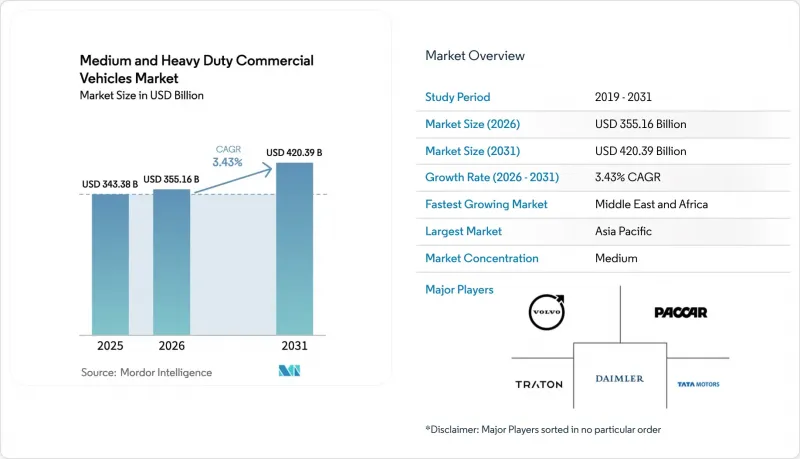
本報告按負載容量(3.5-7.5噸、7.5-16噸、16噸以上)、動力系統(內燃機、純電動、其他)、車輛類型(剛性卡車、牽引車、自卸車、特殊車輛)、最終用戶(物流、建築/採礦、農業、公共產業)和地區進行細分。市場預測以價值(美元)和數量(輛)表示。
全球中重型商用車市場趨勢及洞察。
車輛更新換代受歐VII和EPA 2027排放氣體法規驅動
在不久的將來,更嚴格的歐VII排放標準將大幅降低氮氧化物排放基準值。這些標準還將在真實的都市區駕駛環境中引入走走停停測試,並首次對煞車和輪胎產生的顆粒物排放設定限制。同時,美國環保署(EPA)的第三階段溫室氣體排放法規旨在未來十年大幅降低排放強度。然而,僅僅對柴油車進行漸進式改進並不能實現這一目標。包括加州在內的幾個州強制要求在未來十年內銷售的7-8級車輛中,相當一部分必須是零排放車輛。此舉威脅到新柴油牽引車的二手價值。為了應對這項挑戰,製造商正將研發重點放在電池電動車和燃料電池平台。他們也正在努力改進再生煞車系統和電池健康診斷技術,以滿足耐久性標準。在截止日期前購買符合標準的卡車的車隊營運商預計將獲得更高的二手價值以及與ESG指標掛鉤的更優惠的融資方案。
新興國家基礎建設發展的獎勵策略
印度的「國家基礎設施管道」計畫在2020年代中期獲得大量投資,主要集中在公路和港口建設方面。這項計劃導致各貨運走廊對重型卡車的需求大幅增加。同時,印尼和越南也在高速公路計畫上投入大量資源。這些投資帶動了混凝土攪拌車和自動卸貨卡車的銷售量激增,推動了兩國的建築業蓬勃發展。在中東,沙烏地阿拉伯正大力投資其“2030願景”,尤其注重開發NEOM物流走廊。同時,阿拉伯聯合大公國正雄心勃勃地擴建哈利法港,以期在未來幾年內處理更多貨櫃,預計這將為牽引車帶來穩定的需求。
零排放卡車的初始成本很高
即使到了2025年,8級純電動牽引車的價格仍將遠高於柴油車。燃料電池車型的價格則會更高。儘管美國《通貨膨脹抑制法案》的稅額扣抵抵免和德國的KsNI補貼有助於縮小價格差距,但並未完全消除差距。對於缺乏經濟實惠資金籌措方案的小規模車隊營運商,尤其是在長途運輸領域,較長的投資回收期是一項挑戰。雖然租賃和電池即服務(BaaS)等方案提供了一些緩解措施,但它們的可行性取決於殘值預測,而二手市場的趨勢仍然不明朗。業者面臨艱難的抉擇:既要考慮高昂的初始投資,又要權衡排放區日益嚴格的法規對柴油車轉售價值的威脅。
細分市場分析
到2025年,總重超過16噸的車輛將佔中重型商用車市場佔有率的61.27%,這反映出它們在城際貨運和礦業運輸領域的主導地位。預計到2031年,總重在3.5噸至7.5噸之間的車輛將以3.45%的複合年成長率成長。這項成長主要由電子商務企業推動,這些企業優先考慮人口密集城市地區的旅遊需求,並受益於單次充電即可完成配送週期。
由於所有超過3.5噸的車輛都統一適用嚴格的排放氣體法規,中型車的合規優勢正在喪失,純電動車或燃料電池車的替代品正在所有重量級別加速推進。現代汽車的燃料電池牽引車「XCIENT」在瑞士和加州的營運里程已超過1000萬公里(預計到2025年),證明了其在長途運輸中的實用性,而電池重量仍然是長途運輸的一大障礙。在中型和重型商用車市場,汽車製造商正在聯合設計充電站和路線規劃軟體,並根據不同的負載容量等級進行客製化,從而使投資決策與城市規劃政策保持一致。
儘管內燃機汽車在2025年仍將佔汽車銷量的87.71%,但預計到2031年,純電動卡車的年複合成長率將達到3.55%,成為該細分市場中成長最快的車型。到2026年,戴姆勒的eCascadia、沃爾沃的VNR Electric和比亞迪的8TT總合車型的總產量將超過每年5萬輛,這將是中重型商用車市場規模最大的協同產能擴張。
插電式混合動力車佔據著一個過渡性的利基市場,但由於系統複雜且與最佳化後的柴油車相比燃油節省有限,其市場佔有率仍低於3%。燃料電池卡車在已建成氫能走廊的地區正在鞏固其市場地位,但大規模應用取決於綠色氫氣價格降至每公斤4美元以下。液化天然氣(LNG)和壓縮天然氣(CNG)等替代燃料在充電基礎設施有限的農業和林業領域可作為臨時解決方案。中國的雙軌制正在加速純電動車(BEV)的普及,國內汽車製造商計劃在2024年至2025年間推出15款新車型。
區域分析
預計到2025年,亞太地區將佔全球銷售量的43.16%。這主要得益於中國鼓勵新能源汽車生產的政策以及印度的大規模基礎建設。在中國,隨著主要製造商推出多款電動卡車以滿足監管要求,商用新能源汽車的銷售量顯著成長。在印度,物流主導的經濟成長支撐了卡車需求,但由於充電基礎設施不足以及小規模企業面臨資金籌措難題,電動車的普及率仍然有限。同時,在日本和韓國,對燃料電池卡車的巨額補貼推動了先進車型的引進,加速了該地區的電氣化進程。
預計到2025年,北美和歐洲的卡車銷售將佔據相當大的佔有率,而推動其成長的法律規範也促成了這一趨勢。在美國,針對大多數卡車銷售的措施推動了這項轉型;而在歐洲,更嚴格的排放氣體標準限制了柴油平台的生存空間。在歐洲主要市場,用於市政和小包裹遞送路線的中型卡車尤其明顯地採用了電池電動卡車。
中東和非洲地區預計將在2031年以3.51%的複合年成長率推動經濟成長,這主要得益於海灣國家的多元化計畫以及採礦業的電氣化試點計畫。沙烏地阿拉伯投資5000億美元的NEOM新城計畫以及阿拉伯聯合大公國的港口擴建工程,都提振了對牽引車的需求;與此同時,南非的礦業公司正在將運輸卡車改造為氫動力動力傳動系統,以降低柴油燃料成本。土耳其憑藉其低廉的人事費用和有利的物流條件,正崛起成為中型卡車出口歐洲的中心。在拉丁美洲,由於巴西和阿根廷的農產品出口,卡車數量正在增加,但外匯波動抑制了對電氣化領域的投資。
其他好處
- Excel格式的市場預測(ME)表
- 3個月的分析師支持
目錄
第1章:引言
- 研究假設和市場定義
- 調查範圍
第2章:調查方法
第3章執行摘要
第4章 市場狀況
- 市場概覽
- 市場促進因素
- 車輛更新換代受歐VII和EPA 2027排放氣體法規驅動
- 新興國家基礎建設發展的獎勵策略
- 電子商務物流的擴張
- 採礦業正在推廣使用電池驅動的電動運輸卡車。
- 利用遠端資訊處理技術,透過基於里程的保險降低總擁有成本 (TCO)。
- 二次電池租賃模式
- 市場限制因素
- 零排放卡車的初始成本很高
- 電力電子和電池供應鏈瓶頸
- 車輛段級電網容量限制
- 混合動力和電動車傳動系統熟練技術人員短缺。
- 價值供應鏈分析
- 監理情勢
- 技術展望
- 波特五力模型
第5章 市場規模與成長預測
- 按負載容量
- 3.5至7.5噸
- 7.5至16噸
- 超過16噸
- 透過推進方法
- 內燃機(柴油/汽油)
- 電池電動車
- 插電式混合動力電動車
- 燃料電池電動車
- 替代燃料(壓縮天然氣、液化天然氣、生質燃料、液化石油氣)
- 按車輛類型
- 剛性軌道
- 聯結車
- 自動卸貨卡車
- 特種和商用卡車
- 按最終用戶行業分類
- 物流/運輸
- 建築和採礦
- 農業和林業
- 公共產業及地方政府服務
- 按地區
- 北美洲
- 美國
- 加拿大
- 其他北美國家
- 南美洲
- 巴西
- 阿根廷
- 其他南美國家
- 歐洲
- 德國
- 英國
- 法國
- 義大利
- 西班牙
- 其他歐洲國家
- 亞太地區
- 中國
- 印度
- 日本
- 韓國
- 其他亞太國家
- 中東和非洲
- 阿拉伯聯合大公國
- 沙烏地阿拉伯
- 南非
- 土耳其
- 其他中東和非洲國家
- 北美洲
第6章 競爭情勢
- 市場集中度
- 策略趨勢
- 市佔率分析
- 公司簡介
- Daimler Truck AG
- Volvo Group
- Traton SE(MAN, Scania, Navistar)
- PACCAR Inc.
- Tata Motors Ltd.
- Hyundai Motor Co.
- CNHTC(Sinotruk)
- Dongfeng Motor Corp.
- FAW Group
- Renault Trucks
- Isuzu Motors Ltd.
- Hino Motors
- Ashok Leyland
- Iveco Group
- Kamaz PJSC
- Shacman(Shaanxi Auto)
- UD Trucks
- BYD Auto
- Nikola Corp.
第7章 市場機會與未來展望
According to Mordor Intelligence, the medium and heavy duty commercial vehicles market size is expected to grow from USD 343.38 billion in 2025 to USD 355.16 billion in 2026 and is forecast to reach USD 420.39 billion by 2031 at a 3.43% CAGR over 2026-2031.
This report is Segmented by Tonnage (3. 5 To 7. 5 T, 7. 5 To 16 T, and Above 16 T), Propulsion Type (ICE, Battery Electric, and More), Vehicle Type (Rigid, Tractor-Trailer, Tipper, and Specialized), End-User (Logistics, Construction & Mining, Agriculture, and Utilities), and Geography. Market Forecasts are in Value (USD) and Volume (Units).
Global Medium And Heavy Duty Commercial Vehicles Market Trends and Insights
Fleet Renewal Driven by Euro-VII & EPA 2027 Emission Rules
In the near future, stricter Euro-VII limits will significantly reduce nitrogen-oxide thresholds. These limits will also introduce real-world urban stop-and-go testing and, for the first time, impose caps on brake and tire particle emissions. Meanwhile, the U.S. EPA's Phase 3 greenhouse-gas rule aims for a substantial reduction in intensity over the next decade. However, achieving this target is impossible through mere incremental improvements in diesel. In California, along with several other states, there is a mandate for a significant portion of Class 7-8 sales to be zero-emission within the next decade. This move jeopardizes the resale value of new diesel tractors . In response, manufacturers are channeling R&D into battery-electric and fuel-cell platforms. They're also bolstering regenerative braking and battery-health diagnostics to adhere to durability standards. Fleets that purchase compliant trucks ahead of the deadline stand to gain from enhanced resale values and better financing terms linked to ESG metrics .
Infrastructure Stimulus in Emerging Economies
India's National Infrastructure Pipeline is set to invest a substantial amount by mid-decade, primarily focusing on upgrading roads and ports. This initiative has significantly boosted the demand for rigid trucks across various freight corridors. Meanwhile, both Indonesia and Vietnam have allocated significant resources for highway projects. These investments are driving a surge in the purchases of concrete mixers and dump trucks, fueling a construction boom in both nations. In the Middle East, Saudi Arabia is channeling considerable funding into its Vision 2030, specifically targeting the development of NEOM logistics corridors. Simultaneously, the United Arab Emirates is ambitiously scaling Khalifa Port's capacity to handle a much larger volume of containers in the coming years, ensuring a steady intake of tractor-trailers.
High Upfront Cost of Zero-Emission Trucks
In 2025, battery-electric Class 8 tractors remain significantly more expensive than their diesel counterparts. Additionally, fuel-cell variants come with an even higher cost. While incentives like the U.S. Inflation Reduction Act's credit and Germany's KsNI subsidy help reduce the price disparity, they do not fully bridge the gap. For smaller fleets without access to affordable capital, the extended payback periods pose a challenge, particularly in long-haul segments. Although leasing models and battery-as-a-service options provide some relief, their feasibility depends on residual-value forecasts, which are still unproven in secondary markets. Operators face a difficult decision, balancing the higher upfront investment against the increasing restrictions in emission zones, which threaten the resale value of diesel assets.
Other drivers and restraints analyzed in the detailed report include:
- E-Commerce Logistics Expansion
- Mining Sector Push for Battery-Electric Haul Trucks
- Supply-Chain Bottlenecks for Power Electronics & Batteries
For complete list of drivers and restraints, kindly check the Table Of Contents.
Segment Analysis
Vehicles above 16 tonnes captured 61.27% of the medium and heavy-duty commercial vehicles market share in 2025, reflecting their dominance in intercity freight and mining haulage. The 3.5-7.5 tonne band is growing at a 3.45% CAGR to 2031, fueled by e-commerce operators that prioritize maneuverability in dense city cores and can profit from single-charge delivery cycles.
Rigid emission standards apply uniformly across weights above 3.5 tonnes, nullifying any compliance advantage of mid-duty categories and nudging fleets toward battery-electric or fuel-cell upgrades in every bracket. Hyundai's XCIENT fuel-cell tractor exceeded 10 million km in Swiss and California service by 2025, proving viability for long-haul payloads where battery weight remains a hurdle. The medium and heavy-duty commercial vehicles market now sees OEMs co-designing charging hubs and route planning software specific to tonnage class, aligning investment decisions with urban zoning policies.
Internal-combustion engines commanded 87.71% of 2025 volume, yet battery-electric trucks expand at a 3.55% CAGR to 2031, the fastest rate in the segment. Combined output of Daimler eCascadia, Volvo VNR Electric, and BYD 8TT exceeds half a lakh vehicles annually by 2026, marking the largest coordinated capacity build-out in the medium and heavy-duty commercial vehicles market context.
Plug-in hybrids occupy a transition niche but remain under 3% share due to complexity and marginal fuel savings over optimized diesel models. Fuel-cell trucks secure footholds in regions with hydrogen corridors, but large-scale uptake hinges on sub-USD 4/kg green hydrogen pricing. Alternative fuels such as LNG and CNG act as interim solutions across agriculture and forestry where charging infrastructure is sparse. China's dual-credit system accelerates BEV penetration, with domestic OEMs launching 15 new models across 2024-2025.
Complete Report Scope:
- By Tonnage
- 3.5 to 7.5 t
- 7.5 to 16 t
- Above 16 t
- By Propulsion Type
- Internal-Combustion Engine (Diesel & Gasoline)
- Battery Electric
- Plug-in Hybrid Electric
- Fuel-cell Electric
- Alternative Fuels (CNG, LNG, Bio-fuel, LPG)
- By Vehicle Type
- Rigid Truck
- Tractor-Trailer
- Tipper / Dump Truck
- Specialized & Vocational Trucks
- By End-user Industry
- Logistics & Transportation
- Construction & Mining
- Agriculture & Forestry
- Utilities & Municipal Services
- By Geography
- North America
- United States
- Canada
- Rest of North America
- South America
- Brazil
- Argentina
- Rest of South America
- Europe
- Germany
- United Kingdom
- France
- Italy
- Spain
- Rest of Europe
- Asia Pacific
- China
- India
- Japan
- South Korea
- Rest of Asia Pacific
- Middle East and Africa
- United Arab Emirates
- Saudi Arabia
- South Africa
- Turkey
- Rest of Middle East and Africa
- North America
Geography Analysis
Asia-Pacific delivered 43.16% of global revenue in 2025, driven by China's policies encouraging new-energy-vehicle production and India's large-scale infrastructure initiatives. Chinese commercial NEV sales saw significant growth as major manufacturers introduced multiple electric truck models to comply with regulatory requirements. While India's logistics-driven economic growth sustained truck demand, the adoption of electric vehicles remained minimal due to inadequate charging infrastructure and financing challenges for smaller operators. Meanwhile, Japan and South Korea's substantial subsidies for fuel-cell trucks supported the rollout of advanced models, boosting the region's electrification efforts.
North America and Europe collectively accounted for a significant share of the 2025 revenue, with their growth shaped by regulatory frameworks mandating early electrification. In the United States, policies targeting a substantial portion of truck sales drove the transition, while in Europe, stricter emissions standards limited the viability of diesel platforms. Key European markets registered notable adoption of battery-electric trucks, particularly in medium-duty models serving municipal and parcel delivery routes.
The Middle East and Africa lead growth at 3.51% CAGR through 2031, buoyed by Gulf diversification projects and mining electrification pilots. Saudi Arabia's USD 500 billion NEOM investment and UAE port expansion underpin tractor-trailer demand, while South African mines retrofit haul trucks with hydrogen powertrains to cut diesel expense. Turkey emerges as an export base for medium-duty trucks into Europe, exploiting lower labor costs and favorable logistics. Latin America's truck fleet expands with agricultural exports from Brazil and Argentina, though currency volatility tempers electrification investment.
- Daimler Truck AG
- Volvo Group
- Traton SE (MAN, Scania, Navistar)
- PACCAR Inc.
- Tata Motors Ltd.
- Hyundai Motor Co.
- CNHTC (Sinotruk)
- Dongfeng Motor Corp.
- FAW Group
- Renault Trucks
- Isuzu Motors Ltd.
- Hino Motors
- Ashok Leyland
- Iveco Group
- Kamaz PJSC
- Shacman (Shaanxi Auto)
- UD Trucks
- BYD Auto
- Nikola Corp.
Additional Benefits:
- The market estimate (ME) sheet in Excel format
- 3 months of analyst support
TABLE OF CONTENTS
1 Introduction
- 1.1 Study Assumptions & Market Definition
- 1.2 Scope of the Study
2 Research Methodology
3 Executive Summary
4 Market Landscape
- 4.1 Market Overview
- 4.2 Market Drivers
- 4.2.1 Fleet Renewal Driven by Euro-VII & EPA 2027 Emission Rules
- 4.2.2 Infrastructure Stimulus in Emerging Economies
- 4.2.3 E-Commerce Logistics Expansion
- 4.2.4 Mining Sector'S Push for Battery-Electric Haul Trucks
- 4.2.5 Telematics-Enabled Usage-Based Insurance Lowers TCO
- 4.2.6 Secondary-Use Battery Leasing Models
- 4.3 Market Restraints
- 4.3.1 High Upfront Cost of Zero-Emission Trucks
- 4.3.2 Supply-Chain Bottlenecks for Power-Electronics & Batteries
- 4.3.3 Depot-Level Grid-Capacity Limitations
- 4.3.4 Skilled-Technician Shortage for HV-EV Drivetrains
- 4.4 Value / Supply-Chain Analysis
- 4.5 Regulatory Landscape
- 4.6 Technological Outlook
- 4.7 Porter's Five Forces
- 4.7.1 Bargaining Power of Suppliers
- 4.7.2 Bargaining Power of Buyers
- 4.7.3 Threat of New Entrants
- 4.7.4 Threat of Substitutes
- 4.7.5 Competitive Rivalry
5 Market Size & Growth Forecasts (Value (USD) and Volume (Units))
- 5.1 By Tonnage
- 5.1.1 3.5 to 7.5 t
- 5.1.2 7.5 to 16 t
- 5.1.3 Above 16 t
- 5.2 By Propulsion Type
- 5.2.1 Internal-Combustion Engine (Diesel & Gasoline)
- 5.2.2 Battery Electric
- 5.2.3 Plug-in Hybrid Electric
- 5.2.4 Fuel-cell Electric
- 5.2.5 Alternative Fuels (CNG, LNG, Bio-fuel, LPG)
- 5.3 By Vehicle Type
- 5.3.1 Rigid Truck
- 5.3.2 Tractor-Trailer
- 5.3.3 Tipper / Dump Truck
- 5.3.4 Specialized & Vocational Trucks
- 5.4 By End-user Industry
- 5.4.1 Logistics & Transportation
- 5.4.2 Construction & Mining
- 5.4.3 Agriculture & Forestry
- 5.4.4 Utilities & Municipal Services
- 5.5 By Geography
- 5.5.1 North America
- 5.5.1.1 United States
- 5.5.1.2 Canada
- 5.5.1.3 Rest of North America
- 5.5.2 South America
- 5.5.2.1 Brazil
- 5.5.2.2 Argentina
- 5.5.2.3 Rest of South America
- 5.5.3 Europe
- 5.5.3.1 Germany
- 5.5.3.2 United Kingdom
- 5.5.3.3 France
- 5.5.3.4 Italy
- 5.5.3.5 Spain
- 5.5.3.6 Rest of Europe
- 5.5.4 Asia Pacific
- 5.5.4.1 China
- 5.5.4.2 India
- 5.5.4.3 Japan
- 5.5.4.4 South Korea
- 5.5.4.5 Rest of Asia Pacific
- 5.5.5 Middle East and Africa
- 5.5.5.1 United Arab Emirates
- 5.5.5.2 Saudi Arabia
- 5.5.5.3 South Africa
- 5.5.5.4 Turkey
- 5.5.5.5 Rest of Middle East and Africa
- 5.5.1 North America
6 Competitive Landscape
- 6.1 Market Concentration
- 6.2 Strategic Moves
- 6.3 Market Share Analysis
- 6.4 Company Profiles (includes Global Level Overview, Market Level Overview, Core Segments, Financials as Available, Strategic Information, Market Rank/Share for Key Companies, Products and Services, SWOT Analysis, and Recent Developments)
- 6.4.1 Daimler Truck AG
- 6.4.2 Volvo Group
- 6.4.3 Traton SE (MAN, Scania, Navistar)
- 6.4.4 PACCAR Inc.
- 6.4.5 Tata Motors Ltd.
- 6.4.6 Hyundai Motor Co.
- 6.4.7 CNHTC (Sinotruk)
- 6.4.8 Dongfeng Motor Corp.
- 6.4.9 FAW Group
- 6.4.10 Renault Trucks
- 6.4.11 Isuzu Motors Ltd.
- 6.4.12 Hino Motors
- 6.4.13 Ashok Leyland
- 6.4.14 Iveco Group
- 6.4.15 Kamaz PJSC
- 6.4.16 Shacman (Shaanxi Auto)
- 6.4.17 UD Trucks
- 6.4.18 BYD Auto
- 6.4.19 Nikola Corp.
7 Market Opportunities & Future Outlook
- 7.1 White-space & Unmet-need Assessment

 2026年全球重型商用車輪胎壓力監測(TPM)市場報告
 8級卡車市場分析及預測(至2035年):按類型、產品、服務、技術、組件、應用、材質、過程及最終用戶
 到 2026 年,全球輕型商用車和中/重型卡車市場將迎來成長機會。
 中重型商用車中冷器市場-全球產業規模、佔有率、趨勢、機會與預測:按類型、引擎類型、設計類型、地區和競爭格局分類,2021-2031年重型商用車市場規模、佔有率、成長和全球產業分析:按類型、應用和地區分類的洞察,以及 2026-2034 年的預測。
 7級卡車市場:依動力系統和地區分類中型商用車市場規模、佔有率、成長和全球行業分析:按類型、應用和地區的洞察,2026-2034年的預測全球7級卡車市場規模、佔有率、趨勢和成長分析報告(2026-2034年)全球8級卡車市場規模、佔有率、趨勢和成長分析報告(2026-2034年)中重型商用車排氣系統市場-全球產業規模、佔有率、趨勢、機會及預測(依燃料類型、後處理類型、零件類型、地區及競爭格局分類,2021-2031年)