


 |
市場調查報告書
商品編碼
2122448
二手卡車:市場佔有率分析、行業趨勢和統計數據、成長預測(2026-2031)Used Truck - Market Share Analysis, Industry Trends & Statistics, Growth Forecasts (2026 - 2031) |
||||||

※ 本網頁內容可能與最新版本有所差異。詳細情況請與我們聯繫。
根據 Mordor Intelligence 預測,二手卡車市場規模預計將從 2025 年的 527.3 億美元成長到 2026 年的 553.8 億美元,到 2031 年達到 707.4 億美元,2026 年至 2031 年的複合年預計成長率為 5.02%。
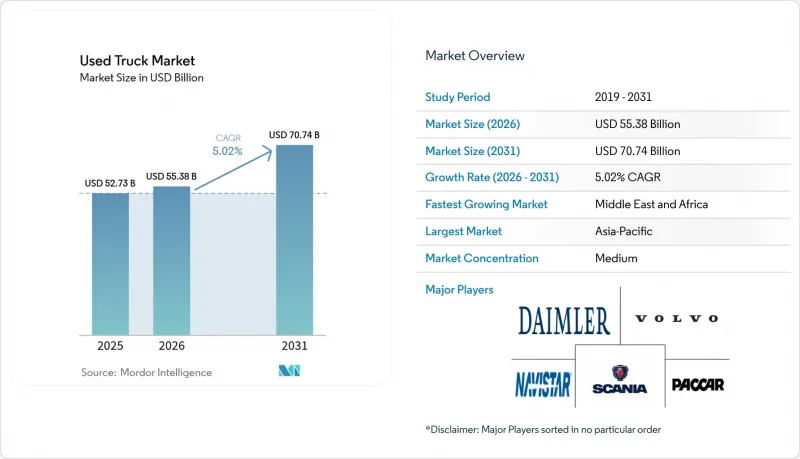
本報告按車輛類型(輕型卡車、中型卡車、其他)、燃料類型(柴油、汽油、其他)、車型年份(3年以下、4-7年、其他)、車輛級別(3級、其他)、最終用途行業(建築基礎設施、其他)、銷售管道(獨立經銷商、其他)和地區進行分類。市場預測以價值(美元)和銷售(輛)為單位呈現。
全球二手卡車市場趨勢與洞察
印度和東協的主導設施建設熱潮正在推動大型二手卡車的貿易。
國家基礎設施計畫撥款超過1.4兆美元用於交通運輸和物流項目,導致重型卡車新車註冊量增加,這些新車隨後流入二手車市場。高速公路網和港口擴建等大型專案縮短了車輛的擁有週期,因為承包商傾向於在專案完成後盡可能減少資產負債。因此,許多處於使用壽命中期的卡車狀況良好地進入二手車市場,吸引了那些無法購買新車的中小型建築公司。印度的2024年報廢政策免除了車齡超過15年的報廢卡車的註冊費,從而將老舊車輛從市場上淘汰,並支撐了使用壽命在4-7年之間的卡車的單價。印尼和越南類似的公共產業計畫也產生了類似的連鎖反應,確保了符合法規的最新型重型自動卸貨卡車和牽引車的穩定供應。
北美電子商務最後一公里配送的擴張刺激了對二手輕型卡車的需求。
小包裹遞送量的激增促使微型配送中心興起,這些中心利用3-5級廂型車提供當日送達服務。隨著美國環保署的清潔卡車計畫於2024年最終確定,以及氮氧化物排放僅限於2027年生效,車隊正在加速淘汰柴油車輛。這種替代趨勢增加了低里程車輛的供應,即使是個人企業主也能負擔得起。同時,美國幾個主要大都會圈的零排放檢測區促使早期採用者轉售第一代電動貨車,在不犧牲都市區配送所需續航里程的前提下,豐富了二手市場的燃料結構。由於輕型卡車的初始投資要求相對較低,且投資回報潛力巨大,其市場消化能力仍然強勁。
歐盟日益嚴格的歐VII第三階段氮氧化物排放法規將限制老舊柴油車進口到歐盟。
從2027年起,歐VII排放標準將禁止許多不符合歐VI標準的卡車進入低排放氣體區,從而有效抑制對老舊柴油車的需求。在德國和英國,對於不符合市政清潔空氣區排放氣體標準的大型車輛,將處以罰款,這進一步阻礙了潛在買家。進口商正將目光轉向東歐和北非,以處理這些車輛。此舉縮小了歐盟內部的買家群體,並推高了符合歐VI排放氣體標準的車輛價格。
細分市場分析
預計到2025年,重型卡車將佔二手卡車市場佔有率的43.57%,凸顯其在長途貨運和基礎設施運輸領域的穩固地位。對於優先考慮載重能力、耐用性和完善服務網路的車隊營運商而言,重型卡車仍然是首選。然而,日益嚴格的排放氣體法規和不斷變化的運輸模式正迫使營運商重新評估其車隊組成,從而催生了對更適合都市區路線的輕型車輛的需求。製造商正透過擴大認證二手車專案(包括承包維護服務包)來應對這一需求,以增強買家對二手重型卡車的信心。在此背景下,即使買家轉向購買較小型號的卡車,保養良好的重型卡車的殘值仍然堅挺。
預計到2031年,3-5級輕型卡車的複合年成長率將達到7.69%,是所有重量級別中成長最快的。這一成長反映了「最後一公里」電子商務的興起、市政空氣品質改善的舉措以及個體企業主融資門檻的降低。車隊營運商正在升級其第一代電動貨車,並將較新的柴油和純電動輕型卡車大量投放二手市場,為注重預算的買家提供多種動力系統選擇。輕型卡車非常適合當日送達路線,因為都市區配送合約通常規定了較小的轉彎半徑和較低的車輛總重。數位競標網站透過發布遠端資訊處理數據和偵測報告,擴大了這些車輛的取得管道,從而縮短了實質審查時間。
2025年,柴油引擎在二手卡車市場仍佔據93.36%的佔有率。這得益於完善的燃料供應基礎設施以及在高扭矩運作循環中久經考驗的可靠性。營運商重視柴油動力系統完善的零件生態系統和可預測的保養週期。即使零排放法規日益嚴格,許多運輸公司也選擇升級到更新、更清潔的柴油車型來規避合規風險,而不是徹底更換動力系統。認證二手車分銷管道透過提供延長的引擎保固和用於里程驗證的先進遠端資訊處理功能,進一步推動了這一趨勢。因此,無論是在經銷商展廳還是線上平台上,柴油車仍然是定價的標竿。
預計到2031年,混合動力汽車和純電動卡車的複合年成長率將達到22.55%,在所有燃料類型中成長最快。早期採用者,也就是那些檢驗並引進第一代電動卡車的用戶,如今正將這些卡車投放到二手市場,為渴望嘗試零排放技術的小規模車隊營運商創造了新的庫存來源。政府的獎勵,例如報廢補貼和清潔交通退稅,進一步推動了經濟向電氣化方向發展。買家正在權衡電動車較低的營運成本與電池狀況的不確定性,而原廠提供的電池保固的轉移則是關鍵的差異化因素。未來,隨著充電網路的建設和診斷標準的標準化,二手電動卡車的評估模式有望趨於標準化。
區域分析
到2025年,亞太地區將佔全球貿易量的47.92%,鞏固其作為二手卡車市場中心的地位。印度和東南亞的大型企劃持續推動重型卡車在原車主和二手車主之間的快速流通。中國電氣化進程的推進使車隊營運商能夠在柴油車隊生命週期的早期階段就將其出售,從而豐富了全部區域的出口管道。新加坡和曼谷的數位競標中心正在簡化跨境交易,並縮小區域間的價格差異。這些因素共同鞏固了亞太地區作為全球最大需求中心和日益成熟的供應中心的地位。
在北美,隨著電子商務網路日益密集,以及運輸公司在環保署(EPA)更嚴格的法規訂定前更新車隊,市場活動依然活躍。雖然供不應求提高了新車的供應量,但許多小規模車隊仍然選擇購買二手車以節省成本。各州對低排放氣體卡車的獎勵,刺激了消費者對最新柴油車型和新興電動車的需求。中西部和東南部的競標行現在提供直播服務,吸引了遠超過本地市場的買家。該地區成熟的金融基礎設施進一步加快了交易速度。
預計中東和非洲將迎來最快成長,到2031年複合年成長率將達到7.41%。海灣國家的物流措施強調多模態走廊,推動了對符合歐V和歐VI排放標準的大型牽引車的需求。線上競標將區域買家與歐洲和北美的剩餘庫存聯繫起來,縮小了先前存在的供應缺口。在非洲,大量價格具有競爭力的卡車湧入,正在加強支持採礦業和農業的貿易路線。這些趨勢共同推動該地區從邊緣地帶躍升為重要的成長前沿。
其他好處
- Excel格式的市場預測(ME)表
- 3個月的分析師支持
目錄
第1章:引言
- 研究假設和市場定義
- 調查範圍
第2章:調查方法
第3章執行摘要
第4章 市場狀況
- 市場概覽
- 市場促進因素
- 印度和東協的主導設施建設熱潮正在推動大型二手卡車的貿易。
- 北美電子商務最後一公里配送的擴張刺激了對二手輕型卡車的需求。
- 透過歐洲的OEM認證二手車項目,提高可靠性和殘值。
- 透過數位化批發競標擴大買家群體(尤其是在中東地區)
- 中國的汽車電氣化目標將加速柴油車的淘汰。
- 巴西透過對二手商用車提供稅收優惠來支持自僱者
- 市場限制因素
- 歐盟日益嚴格的歐VII第三階段氮氧化物排放法規將限制老舊柴油車進口到歐盟。
- 來自中國的低成本新卡車正在給非洲二手車價格溢價帶來壓力。
- 東協農村地區老舊大型資產的資金籌措選擇有限。
- 半導體短缺問題的緩解將縮短新車交貨時間,並緩解二手車短缺問題。
- 價值供應鏈分析
- 監管和技術展望
- 排放氣體法規過渡時程
- 利用遠端資訊處理技術的數位版權管理和檢查技術
- 波特五力分析
第5章 市場規模與成長預測
- 按車輛類型
- 小型卡車(3-5級)
- 中型卡車(6-7級)
- 大型卡車(8級以上,15噸以上)
- 燃料類型
- 柴油引擎
- 汽油
- 天然氣和液化石油氣
- 混合動力汽車和純電動車
- 按車型年份分類
- 3年或以下
- 4-7年
- 8-12歲
- 超過12年
- 按車輛類別
- 三年級
- 四年級
- 五年級
- 六年級
- 七年級
- 八年級
- 按最終用途行業分類
- 建設基礎設施
- 物流與電子商務配送
- 採礦和採石
- 農業和林業
- 地方政府/公共產業
- 其他終端用戶產業
- 按銷售管道
- 獨立經銷商
- 特許經銷商
- 原廠認證二手車
- 線上P2P競標
- 按地區
- 北美洲
- 美國
- 加拿大
- 其他北美國家
- 南美洲
- 巴西
- 阿根廷
- 智利
- 其他南美國家
- 歐洲
- 德國
- 英國
- 法國
- 義大利
- 西班牙
- 俄羅斯
- 其他歐洲國家
- 亞太地區
- 中國
- 印度
- 日本
- 韓國
- 其他亞太國家
- 中東和非洲
- 阿拉伯聯合大公國
- 沙烏地阿拉伯
- 卡達
- 南非
- 其他中東和非洲國家
- 北美洲
第6章 競爭情勢
- 市場集中度
- 策略趨勢
- 市佔率分析
- 公司簡介
- Daimler AG(SelecTrucks)
- PACCAR Inc.
- Volvo Group
- Scania AB
- MAN Truck and Bus SE
- Navistar International Corp.
- Tata Motors
- Ashok Leyland
- Isuzu Motors
- Hino Motors
- Mitsubishi Fuso Truck and Bus Corp.
- Eicher Motors(VECV)
- Iveco Group NV
- Ford Otosan
- Sinotruk(CNHTC)
- FAW Jiefang
- Dongfeng Commercial Vehicles
- UD Trucks
- Penske Used Trucks
- Enterprise Truck Rental
- Ryder Used Vehicle Sales
- AmeriQuest Used Trucks
- Copart Inc.
- Ritchie Bros. Auctioneers
- Mascus
- TruckPlanet(IronPlanet)
- AutoNation USA
- OLX Autos Commercial
第7章 市場機會與未來展望
According to Mordor Intelligence, the used truck market size is expected to increase from USD 52.73 billion in 2025 to USD 55.38 billion in 2026 and reach USD 70.74 billion by 2031, growing at a CAGR of 5.02% over 2026-2031.
This report is Segmented by Vehicle Type (Light Trucks, Medium-Duty Trucks, and More), Fuel Type (Diesel, Gasoline, and More), Age Bracket (Up To 3 Years, 4-7 Years, and More), Vehicle Class (Class 3 and More), End-Use Industry (Construction and Infrastructure and More), Sales Channel (Independent Dealer and More), and Geography. The Market Forecasts are Provided in Terms of Value (USD) and Volume (Units).
Global Used Truck Market Trends and Insights
Infrastructure-Led Construction Booms in India and ASEAN Stimulating Heavy Used-Truck Turnover
The National Infrastructure Pipeline earmarks more than USD 1.4 trillion to transport and logistics projects, which is raising heavy-duty registrations that later flow into the used truck market. Large projects such as highway corridors and port expansions shorten ownership cycles because contractors prefer asset-light balance sheets once projects end. Resulting mid-life trucks enter secondary channels in good condition, attracting small builders that cannot finance new equipment. India's 2024 scrappage policy, offering registration-fee waivers for retiring trucks aged over 15 years, removes aged assets and supports unit values in the 4-to-7-year window. Comparable public works agendas in Indonesia and Vietnam have similar knock-on effects, ensuring a stable pipeline of compliant, late-model heavy dumpers and tractors.
E-commerce Last-Mile Expansion in North America Triggering Demand for Used Light-Duty Trucks
Rapid parcel growth led carriers to open micro-hubs that rely on Class 3-5 box trucks for same-day delivery. Compliance deadlines under the U.S. Environmental Protection Agency's Clean Truck Plan, finalized in 2024, encourage fleets to retire diesel models before 2027 NOx ceilings take hold. Turnover raises the supply of low-mileage units that owner-operators can afford. In parallel, zero-emission pilot zones in several U.S. metros spur early adopters to remarket first-generation electric vans, broadening fuel mix in the secondary channel without sacrificing range for urban drops. Light-truck absorption remains robust because these vehicles require modest capital and deliver quick payback.
Tightening Euro-VII/Phase-3 NOx Rules Discouraging Older Diesel Imports in EU
Starting in 2027, the Euro VII framework will prohibit many pre-Euro VI trucks from accessing low-emission corridors, effectively dampening the demand for older diesel vehicles. In Germany and the UK, municipal clean-air zones are penalizing heavy vehicles that don't meet compliance standards, further dissuading potential buyers. Importers are shifting their focus to Eastern Europe and North Africa for liquidating these vehicles. This shift is narrowing the pool of buyers within the EU and driving up prices for compliant Euro VI vehicles.
Other drivers and restraints analyzed in the detailed report include:
- OEM Certified Pre-Owned Programs in Europe Enhancing Trust and Residual Values
- Digital Wholesale Auctions Broadening Buyer Pool, Especially in Middle East
- Low-Cost New Chinese Trucks Compressing Used Price Premiums in Africa
For complete list of drivers and restraints, kindly check the Table Of Contents.
Segment Analysis
Heavy-duty trucks captured 43.57% of the used-truck market share in 2025, underscoring their entrenched role in long-haul freight and infrastructure hauling. They remain the preferred choice for fleets that prioritize payload capacity, durability, and an extensive service network. Yet tightening emission rules and shifting delivery patterns are prompting operators to reassess fleet composition, opening space for lighter formats that better suit urban corridors. Manufacturers are responding by broadening certified pre-owned programs that include turnkey maintenance bundles, raising buyer confidence in previously owned heavy rigs. Against this backdrop, residual values for well-maintained heavy-duty units stay resilient even as buyers diversify into smaller classes.
Light trucks in the Class 3-5 band are projected to expand at a 7.69% CAGR through 2031, the fastest pace among all weight classes. This surge reflects last-mile e-commerce growth, municipal clean-air initiatives, and lower capital hurdles for independent owner-operators. Fleets cycling out of first-generation electric vans are releasing late-model diesel and battery-electric light trucks into secondary channels, offering budget-minded buyers multiple propulsion choices. Urban delivery contracts often specify tight turning radii and low curb weights, making light trucks the logical selection for same-day routes. Digital auction houses expand access to these assets by publishing telematics data and inspection reports, thereby shortening due diligence cycles.
Diesel engines retained 93.36% of the used truck market share in 2025, supported by ubiquitous fueling infrastructure and proven reliability in high-torque duty cycles. Operators value the established parts ecosystem and the predictable maintenance intervals associated with diesel powertrains. Even as zero-emission mandates tighten, many carriers hedge compliance risk by refreshing to newer, cleaner diesel models rather than switching to propulsion entirely. Certified pre-owned channels reinforce this trend by bundling extended engine warranties and advanced telematics for mileage verification. Consequently, diesel continues to anchor price discovery across dealer lots and digital platforms alike.
Hybrid and battery-electric trucks are scaling at a 22.55% CAGR through 2031, the swiftest rate across the fuel type spectrum. Early adopters who trialed first-wave electric rigs now release them into resale pools, creating an emerging inventory stream for smaller fleets eager to test zero-tailpipe technology. Government incentives, such as scrappage credits or clean-transport rebates, further tilt economics in favor of electrified options. Buyers weigh the lower operating costs of electricity against the uncertainty of battery health, making OEM-issued battery-warranty transfers a critical differentiator. Over time, improved charging networks and standardized diagnostics are expected to normalize valuation models for used electric trucks.
Complete Report Scope:
- By Vehicle Type
- Light Trucks (Class 3-5)
- Medium-Duty Trucks (Class 6-7)
- Heavy-Duty Trucks (Class 8 and Over 15 t)
- By Fuel Type
- Diesel
- Gasoline
- Natural Gas and LPG
- Hybrid and Battery-Electric
- By Age Bracket
- Up to 3 Years
- 4 to 7 Years
- 8 to 12 Years
- Above 12 Years
- By Vehicle Class
- Class 3
- Class 4
- Class 5
- Class 6
- Class 7
- Class 8
- By End-use Industry
- Construction and Infrastructure
- Logistics and E-commerce Delivery
- Mining and Quarrying
- Agriculture and Forestry
- Municipal and Utilities
- Others
- By Sales Channel
- Independent Dealer
- Franchised Dealer
- OEM-Backed Certified Pre-Owned
- Online Peer-to-Peer and Auction
- By Geography
- North America
- United States
- Canada
- Rest of North America
- South America
- Brazil
- Argentina
- Chile
- Rest of South America
- Europe
- Germany
- United Kingdom
- France
- Italy
- Spain
- Russia
- Rest of Europe
- Asia-Pacific
- China
- India
- Japan
- South Korea
- Rest of Asia-Pacific
- Middle East and Africa
- United Arab Emirates
- Saudi Arabia
- Qatar
- South Africa
- Rest of Middle East and Africa
- North America
Geography Analysis
Asia-Pacific accounted for 47.92% of global volume in 2025, cementing its position as the nucleus of the used truck market. Infrastructure megaprojects in India and Southeast Asia keep heavy-duty units circulating swiftly between primary and secondary owners. China's electrification trajectory is prompting fleets to sell diesel stock earlier in the lifecycle, enriching export pipelines across the region. Digital auction hubs in Singapore and Bangkok simplify cross-border trade, tightening regional price spreads. Collectively, these factors reinforce Asia-Pacific's standing as both the largest demand center and an increasingly sophisticated supply hub.
North America sustains steady activity as e-commerce networks grow denser and carriers pre-empt stricter EPA rules by refreshing assets. The easing of semiconductor bottlenecks improves new-truck availability, but many smaller fleets still gravitate toward used alternatives to conserve capital. State-level incentives for low-emission trucks create a selective appetite for late-model diesel and emerging electric units. Auction facilities across the Midwest and Southeast now livestream events, attracting buyers well beyond local markets. The region's mature financing infrastructure further lubricates transaction velocity.
The Middle East and Africa region is poised for the fastest expansion, with a 7.41% CAGR through 2031. Gulf logistics visions emphasize multimodal freight corridors, driving appetite for heavy tractors that meet Euro V and Euro VI benchmarks. Online auctions connect regional buyers with surplus inventory in Europe and North America, compressing historical supply gaps. In Africa, the influx of competitively priced trucks strengthens trade routes that serve mining and agriculture. These dynamics collectively elevate the region from a peripheral participant to a focal growth frontier.
- Daimler AG (SelecTrucks)
- PACCAR Inc.
- Volvo Group
- Scania AB
- MAN Truck and Bus SE
- Navistar International Corp.
- Tata Motors
- Ashok Leyland
- Isuzu Motors
- Hino Motors
- Mitsubishi Fuso Truck and Bus Corp.
- Eicher Motors (VECV)
- Iveco Group N.V.
- Ford Otosan
- Sinotruk (CNHTC)
- FAW Jiefang
- Dongfeng Commercial Vehicles
- UD Trucks
- Penske Used Trucks
- Enterprise Truck Rental
- Ryder Used Vehicle Sales
- AmeriQuest Used Trucks
- Copart Inc.
- Ritchie Bros. Auctioneers
- Mascus
- TruckPlanet (IronPlanet)
- AutoNation USA
- OLX Autos Commercial
Additional Benefits:
- The market estimate (ME) sheet in Excel format
- 3 months of analyst support
TABLE OF CONTENTS
1 Introduction
- 1.1 Study Assumptions and Market Definition
- 1.2 Scope of the Study
2 Research Methodology
3 Executive Summary
4 Market Landscape
- 4.1 Market Overview
- 4.2 Market Drivers
- 4.2.1 Infrastructure-Led Construction Booms in India and ASEAN Stimulating Heavy Used-Truck Turnover
- 4.2.2 E-commerce Last-Mile Expansion in North America Triggering Demand for Used Light-Duty Trucks
- 4.2.3 OEM Certified Pre-Owned Programs in Europe Enhancing Trust and Residual Values
- 4.2.4 Digital Wholesale Auctions Broadening Buyer Pool, Especially in Middle East
- 4.2.5 Fleet Electrification Targets in China Pushing Diesel Fleet Liquidation
- 4.2.6 Tax Incentives on Used Commercial Vehicles in Brazil Supporting Owner-Operators
- 4.3 Market Restraints
- 4.3.1 Tightening Euro-VII/Phase-3 NOx Rules Discouraging Older Diesel Imports in EU
- 4.3.2 Low-Cost New Chinese Trucks Compressing Used Price Premiums in Africa
- 4.3.3 Limited Financing Options for Aged Heavy-Duty Assets in ASEAN Rural Regions
- 4.3.4 Chip Shortages Easing New-Truck Lead Times, Reducing Used-Vehicle Scarcity
- 4.4 Value / Supply-Chain Analysis
- 4.5 Regulatory or Technological Outlook
- 4.5.1 Emission-Norm Transition Timelines
- 4.5.2 Digital Title and Telematics-Enabled Inspection Technologies
- 4.6 Porter's Five Forces Analysis
- 4.6.1 Threat of New Entrants
- 4.6.2 Bargaining Power of Buyers
- 4.6.3 Bargaining Power of Suppliers
- 4.6.4 Threat of Substitutes
- 4.6.5 Intensity of Competitive Rivalry
5 Market Size and Growth Forecasts (Value (USD) and Volume (Units))
- 5.1 By Vehicle Type
- 5.1.1 Light Trucks (Class 3-5)
- 5.1.2 Medium-Duty Trucks (Class 6-7)
- 5.1.3 Heavy-Duty Trucks (Class 8 and Over 15 t)
- 5.2 By Fuel Type
- 5.2.1 Diesel
- 5.2.2 Gasoline
- 5.2.3 Natural Gas and LPG
- 5.2.4 Hybrid and Battery-Electric
- 5.3 By Age Bracket
- 5.3.1 Up to 3 Years
- 5.3.2 4 to 7 Years
- 5.3.3 8 to 12 Years
- 5.3.4 Above 12 Years
- 5.4 By Vehicle Class
- 5.4.1 Class 3
- 5.4.2 Class 4
- 5.4.3 Class 5
- 5.4.4 Class 6
- 5.4.5 Class 7
- 5.4.6 Class 8
- 5.5 By End-use Industry
- 5.5.1 Construction and Infrastructure
- 5.5.2 Logistics and E-commerce Delivery
- 5.5.3 Mining and Quarrying
- 5.5.4 Agriculture and Forestry
- 5.5.5 Municipal and Utilities
- 5.5.6 Others
- 5.6 By Sales Channel
- 5.6.1 Independent Dealer
- 5.6.2 Franchised Dealer
- 5.6.3 OEM-Backed Certified Pre-Owned
- 5.6.4 Online Peer-to-Peer and Auction
- 5.7 By Geography
- 5.7.1 North America
- 5.7.1.1 United States
- 5.7.1.2 Canada
- 5.7.1.3 Rest of North America
- 5.7.2 South America
- 5.7.2.1 Brazil
- 5.7.2.2 Argentina
- 5.7.2.3 Chile
- 5.7.2.4 Rest of South America
- 5.7.3 Europe
- 5.7.3.1 Germany
- 5.7.3.2 United Kingdom
- 5.7.3.3 France
- 5.7.3.4 Italy
- 5.7.3.5 Spain
- 5.7.3.6 Russia
- 5.7.3.7 Rest of Europe
- 5.7.4 Asia-Pacific
- 5.7.4.1 China
- 5.7.4.2 India
- 5.7.4.3 Japan
- 5.7.4.4 South Korea
- 5.7.4.5 Rest of Asia-Pacific
- 5.7.5 Middle East and Africa
- 5.7.5.1 United Arab Emirates
- 5.7.5.2 Saudi Arabia
- 5.7.5.3 Qatar
- 5.7.5.4 South Africa
- 5.7.5.5 Rest of Middle East and Africa
- 5.7.1 North America
6 Competitive Landscape
- 6.1 Market Concentration
- 6.2 Strategic Moves
- 6.3 Market Share Analysis
- 6.4 Company Profiles (Includes Global Level Overview, Market Level Overview, Core Segments, Financials as Available, Strategic Information, Market Rank/Share for Key Companies, Products and Services, SWOT Analysis, and Recent Developments)
- 6.4.1 Daimler AG (SelecTrucks)
- 6.4.2 PACCAR Inc.
- 6.4.3 Volvo Group
- 6.4.4 Scania AB
- 6.4.5 MAN Truck and Bus SE
- 6.4.6 Navistar International Corp.
- 6.4.7 Tata Motors
- 6.4.8 Ashok Leyland
- 6.4.9 Isuzu Motors
- 6.4.10 Hino Motors
- 6.4.11 Mitsubishi Fuso Truck and Bus Corp.
- 6.4.12 Eicher Motors (VECV)
- 6.4.13 Iveco Group N.V.
- 6.4.14 Ford Otosan
- 6.4.15 Sinotruk (CNHTC)
- 6.4.16 FAW Jiefang
- 6.4.17 Dongfeng Commercial Vehicles
- 6.4.18 UD Trucks
- 6.4.19 Penske Used Trucks
- 6.4.20 Enterprise Truck Rental
- 6.4.21 Ryder Used Vehicle Sales
- 6.4.22 AmeriQuest Used Trucks
- 6.4.23 Copart Inc.
- 6.4.24 Ritchie Bros. Auctioneers
- 6.4.25 Mascus
- 6.4.26 TruckPlanet (IronPlanet)
- 6.4.27 AutoNation USA
- 6.4.28 OLX Autos Commercial
7 Market Opportunities and Future Outlook
- 7.1 Digital Inspection-as-a-Service for Cross-Border Buyers
- 7.2 Subscription and Pay-per-mile Financing Models for SMEs
- 7.3 Electrified Truck After-market and Second-life Batteries


