


 |
市場調查報告書
商品編碼
2122439
東協商用車市場:市場佔有率分析、產業趨勢與統計及成長預測(2026-2031)ASEAN Commercial Vehicles - Market Share Analysis, Industry Trends & Statistics, Growth Forecasts (2026 - 2031) |
||||||

※ 本網頁內容可能與最新版本有所差異。詳細情況請與我們聯繫。
據 Mordor Intelligence 稱,2025 年東協商用車市場價值 471.3 億美元,預計到 2031 年將達到 663.3 億美元,而 2026 年為 498.9 億美元,預測期(2026-2031 年)複合年成長率為 5.86%。
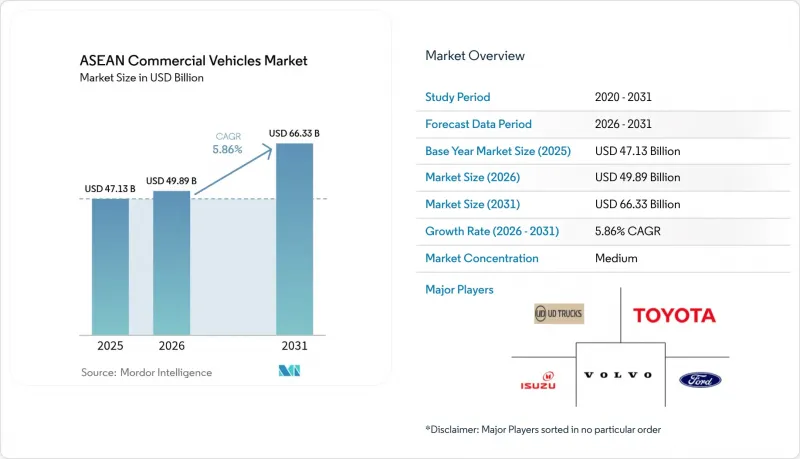
本報告按車輛類型(輕型商用車、中型商用車、其他)、動力系統(內燃機、純電動、其他)、應用領域(物流和電商配送、其他)、車身類型(廂型車、其他)以及國家/地區進行分類。市場預測以貨幣價值(美元)和銷售(輛)兩種形式呈現。
東協商用車市場趨勢與洞察
電子商務和最後一公里物流的快速發展
線上零售的爆炸性成長徹底改變了配送方式,車隊營運商更傾向於使用能夠在擁擠的城市區域順暢穿梭的緊湊型貨車、皮卡和摩托車貨運車輛。 2024年,泰國全國宅配網路的服務中心數量加倍,凸顯了業者縮短配送時限的迫切性。配備模組化貨廂的特製電動輕型卡車正迅速發展,尤其是在柴油車因通行限制而處於劣勢的地區。叫車平台與本地組裝製造商的合作催生了售價低於1000美元的換電摩托車,從而縮短了等待時間並延長了車輛使用壽命。此外,社群電商平台處理生鮮食品數量的不斷成長也推動了對溫控微型配送車輛的需求。這些變化共同促成了輕型商用車採購量的增加,並為能夠最佳化多點配送路線的遠端資訊處理供應商創造了新的商機。
大型基礎建設項目的規劃方案
泰國、印尼、馬來西亞和越南已累計超過43兆美元用於道路和橋樑建設,預計到2035年將佔亞太地區交通基礎設施預算的63%。高速公路維修和採石場擴建工程正迅速提振對自動卸貨卡車、混凝土攪拌車和重型礦用運輸車的訂單。以林查班港和巴生港為中心的物流走廊的形成也推動了對貨櫃牽引車的需求。專案核准創造了穩定的需求基礎,但由於土地徵用和資金限制導致的延誤造成了季度性的需求波動,迫使整車製造商採用模組化車身方案和靈活的輪班安排。由於車隊所有者傾向於優先考慮車輛運作而非初始購置成本,因此提供動力傳動系統耐久性解決方案和現場維護服務的供應商也從中受益。
更嚴格的標準,相當於歐VI排放標準
泰國於2024年1月開始實施歐5柴油排放標準,並計畫最遲於2030年達到歐盟6標準,柬埔寨和菲律賓也採取了類似措施。雖然環境效益顯而易見,但此標準提升將使引擎和廢氣後後處理系統的成本增加15%至20%,從而擠壓小規模組裝製造商的利潤空間。各成員國柴油燃料含硫量的差異也增加了標定工作的複雜性,並延長了型式認證週期。採用選擇性催化還原(SCR)技術的整車製造商預計將迎來銷售成長,但小規模製造商則面臨著因資本投資需求超過其財務能力而被擠出市場的風險。
細分市場分析
到2025年,輕型商用車將佔據東協商用車市場55.70%的佔有率,這主要得益於小包裹遞送業務的蓬勃發展以及地方政府針對重型柴油車的監管政策。預計到2031年,該細分市場的年均成長率將達到6.65%,超過東協整體商用車市場的成長速度。中國新晉參與企業正在推出價格比傳統車型低20%的純電動皮卡,而日本老牌廠商則透過輕混動力升級來應對挑戰。曼谷和胡志明市周邊都市區群的快速發展,也帶動了市場對配備貨架和遠端資訊處理系統的廂型車的需求。
中型車輛細分市場主要服務於建築物流和廢棄物管理等細分市場,依靠更優異的扭力特性和自動變速箱來應對交通堵塞。雖然大型牽引車在東協內部的貨運路線上仍然至關重要,但隨著鐵路運輸在當地路線上的發展,其成長速度正在放緩。因此,專注於輕量化複合材料和改進空氣動力學的底盤製造商在那些優先考慮燃油效率並要求快速投資回報的車隊中獲得了競爭優勢。
到2025年,內燃機車將佔東協商用車市場規模的93.85%,但隨著政策獎勵對車隊經濟性的影響,其佔有率正在下降。電池式電動車(BEV)車型雖然起步較晚,但預計到2031年在東協商用車市場的佔有率將加倍,年複合成長率(CAGR)將達到10.12%。泰國的「EV3.5」計畫透過免除消費稅降低了整車製造商(OEM)的採購成本,從而加速了車型線的擴張。印尼雄心勃勃地計劃在2030年實現60萬輛電動車的保有量,這推動了與國內鎳含量豐富的電池供應相關的供應商融資方案的實施。
插電式混合動力車憑藉著關稅優惠政策,作為一種低碳且續航里程更長的解決方案,正在發揮橋樑作用。燃料電池汽車原型車主要出現在馬來西亞和新加坡之間的長途跨境運輸試點計畫中,利用與港口當局合作開發的短途氫燃料運輸走廊。對於繼續使用內燃機汽車的用戶而言,符合歐VI排放標準的硬體以及與合成柴油燃料的兼容性是其賣點,消費者會權衡未來的轉售價值與短期初始投資。
其他好處
- Excel格式的市場預測(ME)表
- 3個月的分析師支持
目錄
第1章:引言
- 研究假設和市場定義
- 調查範圍
第2章:調查方法
第3章執行摘要
第4章 市場狀況
- 市場概覽
- 市場促進因素
- 電子商務和最後一公里物流的快速發展
- 大型基礎建設項目的規劃方案
- 東協區域內貿易成長
- 中國電動車和商用車製造商的本地化
- 冷鏈需求激增
- 碳權與綠色車隊強制命令
- 市場限制因素
- 更嚴格的標準,相當於歐VI排放標準
- 電動車/商用車充電障礙及總擁有成本
- 先進動力傳動系統售後市場的細分
- 收緊中小企業的貸款,以支持車輛更換。
- 價值供應鏈分析
- 監理情勢
- 技術展望
- 波特五力模型
第5章 市場規模與成長預測
- 按車輛類型
- 輕型商用車
- 中型商用車
- 大型商用車輛
- 透過推進方法
- 內燃機
- 電池電動車
- 插電式混合動力電動車
- 燃料電池電動車
- 透過使用
- 物流與電子商務配送
- 建築和採礦
- 農業和林業
- 公共運輸(公車、長途汽車)
- 公共產業及地方政府服務
- 按車輛配置
- 剛性貨車
- 聯結車
- 巴士和長途汽車
- 翻斗車傾卸
- 冷藏車
- 國家
- 印尼
- 泰國
- 越南
- 馬來西亞
- 菲律賓
- 新加坡
- 其他東南亞國協
第6章 競爭情勢
- 市場集中度
- 策略趨勢
- 市佔率分析
- 公司簡介
- Isuzu Motors
- AB Volvo
- Toyota Motor Corporation
- Ford Motor Company
- UD Trucks
- Iveco Group
- Tata Motors
- BYD Auto
- Chery Commercial Vehicles
- Foton Motor
- Dongfeng Trucks
- MAN Truck & Bus
- Daimler Truck(Mitsubishi Fuso & Mercedes-Benz Trucks)
- Hyundai Motor Company
- Ashok Leyland
- Suzuki Motor
第7章 市場機會與未來展望
According to Mordor Intelligence, the ASEAN commercial vehicles market size was valued at USD 47.13 billion in 2025 and estimated to grow from USD 49.89 billion in 2026 to reach USD 66.33 billion by 2031, at a CAGR of 5.86% during the forecast period (2026-2031).
This report is Segmented by Vehicle Type (Light Commercial Vehicles, Medium-Duty Commercial Vehicles, and More), Propulsion (Internal Combustion Engine, Battery Electric Vehicle, and More), Application (Logistics and E-Commerce Delivery, and More), Body Configuration (Rigid Truck and Van, and More) and by Country. The Market Forecasts are Provided in Terms of Value (USD) and Volume (Units).
ASEAN Commercial Vehicles Market Trends and Insights
E-commerce Boom and Last-Mile Logistics
Explosive online retail growth has redrawn shipment profiles, pushing fleet operators to favour compact vans, pickups, and two-wheeler cargo carriers that can slip through congested urban cores. Courier networks doubled service points across Thailand during 2024, underscoring operators' urgency to narrow fulfilment windows. Purpose-built electric light trucks featuring modular cargo bays are gaining traction, especially where access restrictions penalise diesel vehicles. Partnerships between ride-hailing platforms and local assemblers have yielded sub-USD 1,000 battery-swappable motorbikes that cut idle time and extend asset life. Demand also tilts toward temperature-controlled micro-delivery units as social-commerce platforms heighten fresh-food throughput. Collectively, these shifts amplify procurement of light commercial platforms and open opportunities for telematics suppliers that can optimise multi-drop routing.
Infrastructure Mega-Projects Pipeline
Across Thailand, Indonesia, Malaysia, and Vietnam, more than USD 43 trillion in road and bridge spending is earmarked through 2035, equal to 63% of Asia-Pacific transport allocations. Highway upgrades and quarry expansions lift immediate orders for tipper trucks, concrete mixers, and heavy-duty mining haulers. Port-centric logistics corridors spawning around Laem Chabang and Klang also boost container tractors. While project approvals create a steady baseline, delays tied to land acquisition or fiscal constraints introduce quarterly demand swings that compel OEMs to pursue modular body programmes and flexible shift patterns. Suppliers of drivetrain durability solutions and on-site maintenance services benefit as fleet owners prioritise uptime over outright acquisition cost.
Stricter Euro VI-Equivalent Standards
Thailand enforced Euro 5 diesel specifications in January 2024 and signalled Euro VI compliance no later than 2030, moves mirrored by Cambodia and the Philippines. While environmental gains are clear, the upgrades inflate engine and exhaust-after-treatment costs by 15-20%, squeezing margins for low-volume assemblers. Disparities in diesel sulphur content across member states complicate calibration work, lengthening homologation cycles. OEMs with selective catalytic reduction portfolios stand to gain volume, but smaller players risk exit as capital-expenditure demands outstrip balance-sheet capacity.
Other drivers and restraints analyzed in the detailed report include:
- Intra-ASEAN Trade Growth
- Localization by Chinese EV-CV OEMs
- Cold-Chain Demand Surge
- EV-CV Charging & TCO Barrier
For complete list of drivers and restraints, kindly check the Table Of Contents.
Segment Analysis
Light commercial vehicles held 55.70% of ASEAN commercial vehicles market share in 2025, buoyed by parcel-delivery momentum and municipal restrictions on heavy diesels. Segment revenue is projected to compound at 6.65% annually through 2031, outpacing the broader ASEAN commercial vehicles market. Chinese challengers introduce battery-electric pickups that undercut traditional offerings by 20%, while Japanese incumbents counter with mild-hybrid upgrades. Urban consolidation centres proliferate around Bangkok and Ho Chi Minh City, catalysing demand for panel vans equipped with factory-fitted shelving and telematics bundles.
The medium-duty cohort serves construction logistics and waste-management niches, relying on improved torque curves and automated transmissions to navigate congestion. Heavy-duty tractors remain vital for intra-ASEAN freight corridors, yet their growth moderates as rail pipelines gain traction on mainland routes. Consequently, chassis makers exploring lightweight composites and aerodynamics enhancements secure competitive advantage in fuel-efficiency-obsessed fleets seeking quick returns on capital.
Internal-combustion engines represent 93.85% of the ASEAN commercial vehicles market size in 2025, but their share erodes as policy incentives tilt fleet economics. Battery-electric models, starting from a low base, are expected to post a 10.12% CAGR to 2031, doubling their contribution within the ASEAN commercial vehicles market. Thailand's EV3.5 scheme grants excise waivers that reduce OEM landed costs, accelerating model-line additions. Indonesia's aspirational target of 600,000 electric vehicles by 2030 stimulates vendor finance packages tied to nickel-rich domestic battery supply.
Plug-in hybrids occupy a bridging role where duty concessions favour low-carbon yet range-extending solutions. Fuel-cell prototypes surface mainly in cross-border haulage pilots between Malaysia and Singapore, leveraging short hydrogen corridors co-developed with port authorities. For ICE holdouts, Euro VI hardware and synthetic-diesel compatibility become selling points as customers weigh future resale value against near-term capital outlay.
Complete Report Scope:
- By Vehicle Type
- Light Commercial Vehicles
- Medium-Duty Commercial Vehicles
- Heavy-Duty Commercial Vehicles
- By Propulsion
- Internal Combustion Engine
- Battery Electric Vehicle
- Plug-in Hybrid Electric Vehicle
- Fuel Cell Electric Vehicle
- By Application / End-Use
- Logistics and E-commerce Delivery
- Construction and Mining
- Agriculture and Forestry
- Public Transportation (Bus & Coach)
- Utilities and Municipal Services
- By Body Configuration (NEW)
- Rigid Truck and Van
- Tractor-Trailer
- Bus and Coach
- Tipper and Dump
- Refrigerated
- By Country
- Indonesia
- Thailand
- Vietnam
- Malaysia
- Philippines
- Singapore
- Rest of the ASEAN Countries
List of Companies Covered in this Report:
- Isuzu Motors
- AB Volvo
- Toyota Motor Corporation
- Ford Motor Company
- UD Trucks
- Iveco Group
- Tata Motors
- BYD Auto
- Chery Commercial Vehicles
- Foton Motor
- Dongfeng Trucks
- MAN Truck & Bus
- Daimler Truck (Mitsubishi Fuso & Mercedes-Benz Trucks)
- Hyundai Motor Company
- Ashok Leyland
- Suzuki Motor
Additional Benefits:
- The market estimate (ME) sheet in Excel format
- 3 months of analyst support
TABLE OF CONTENTS
1 Introduction
- 1.1 Study Assumptions & Market Definition
- 1.2 Scope of the Study
2 Research Methodology
3 Executive Summary
4 Market Landscape
- 4.1 Market Overview
- 4.2 Market Drivers
- 4.2.1 E-Commerce Boom and Last-Mile Logistics
- 4.2.2 Infrastructure Mega-Projects Pipeline
- 4.2.3 Intra-ASEAN Trade Growth
- 4.2.4 Localization by Chinese EV-CV OEMs
- 4.2.5 Cold-Chain Demand Surge
- 4.2.6 Carbon-Credit and Green-Fleet Mandates
- 4.3 Market Restraints
- 4.3.1 Stricter Euro VI-Equivalent Standards
- 4.3.2 EV-CV Charging and TCO Barrier
- 4.3.3 Fragmented Advanced-Powertrain After-Sales
- 4.3.4 SME Credit Tightening for Fleet Renewal
- 4.4 Value / Supply-Chain Analysis
- 4.5 Regulatory Landscape
- 4.6 Technological Outlook
- 4.7 Porter's Five Forces
- 4.7.1 Bargaining Power of Suppliers
- 4.7.2 Bargaining Power of Buyers
- 4.7.3 Threat of New Entrants
- 4.7.4 Threat of Substitute Products
- 4.7.5 Intensity of Competitive Rivalry
5 Market Size & Growth Forecasts (Value (USD), Volume (Units))
- 5.1 By Vehicle Type
- 5.1.1 Light Commercial Vehicles
- 5.1.2 Medium-Duty Commercial Vehicles
- 5.1.3 Heavy-Duty Commercial Vehicles
- 5.2 By Propulsion
- 5.2.1 Internal Combustion Engine
- 5.2.2 Battery Electric Vehicle
- 5.2.3 Plug-in Hybrid Electric Vehicle
- 5.2.4 Fuel Cell Electric Vehicle
- 5.3 By Application / End-Use
- 5.3.1 Logistics and E-commerce Delivery
- 5.3.2 Construction and Mining
- 5.3.3 Agriculture and Forestry
- 5.3.4 Public Transportation (Bus & Coach)
- 5.3.5 Utilities and Municipal Services
- 5.4 By Body Configuration (NEW)
- 5.4.1 Rigid Truck and Van
- 5.4.2 Tractor-Trailer
- 5.4.3 Bus and Coach
- 5.4.4 Tipper and Dump
- 5.4.5 Refrigerated
- 5.5 By Country
- 5.5.1 Indonesia
- 5.5.2 Thailand
- 5.5.3 Vietnam
- 5.5.4 Malaysia
- 5.5.5 Philippines
- 5.5.6 Singapore
- 5.5.7 Rest of the ASEAN Countries
6 Competitive Landscape
- 6.1 Market Concentration
- 6.2 Strategic Moves
- 6.3 Market Share Analysis
- 6.4 Company Profiles (includes Global Level Overview, Market Level Overview, Core Segments, Financials as Available, Strategic Information, Market Rank/Share for Key Companies, Products and Services, SWOT Analysis, and Recent Developments)
- 6.4.1 Isuzu Motors
- 6.4.2 AB Volvo
- 6.4.3 Toyota Motor Corporation
- 6.4.4 Ford Motor Company
- 6.4.5 UD Trucks
- 6.4.6 Iveco Group
- 6.4.7 Tata Motors
- 6.4.8 BYD Auto
- 6.4.9 Chery Commercial Vehicles
- 6.4.10 Foton Motor
- 6.4.11 Dongfeng Trucks
- 6.4.12 MAN Truck & Bus
- 6.4.13 Daimler Truck (Mitsubishi Fuso & Mercedes-Benz Trucks)
- 6.4.14 Hyundai Motor Company
- 6.4.15 Ashok Leyland
- 6.4.16 Suzuki Motor
7 Market Opportunities & Future Outlook

 全球商用車市場規模、佔有率、趨勢和成長分析報告(2026-2034)
 商用車市場分析及預測(至2035年):車輛類型、產品、服務、技術、零件、應用、材料類型、最終用戶及功能
 2026年全球街頭藝術自行車之旅市場報告
 商用車:市場佔有率分析、產業趨勢與統計、成長預測(2026-2031)
 商用車市場規模、佔有率、趨勢和預測:按車輛類型、動力系統、應用和地區分類,2026-2034 年2026年全球商用車市場報告
 商用車市場:依產品、最終用途及地區分類
 商用車市場:2026-2032年全球市場預測(依車輛類型、燃料類型、變速箱類型、負載容量、動力傳動系統、應用和銷售管道)商用車市場規模、佔有率、成長及全球產業分析:按類型、應用和地區分類的洞察,2026-2034 年預測
 商用車市場規模、佔有率和成長分析:按產品類型、動力系統、最終用途和地區分類-2026-2033年產業預測