


 |
市場調查報告書
商品編碼
2122428
聚氨酯泡沫塗料:市場佔有率分析、產業趨勢與統計、成長預測(2026-2031)Spray Polyurethane Foam - Market Share Analysis, Industry Trends & Statistics, Growth Forecasts (2026 - 2031) |
||||||

※ 本網頁內容可能與最新版本有所差異。詳細情況請與我們聯繫。
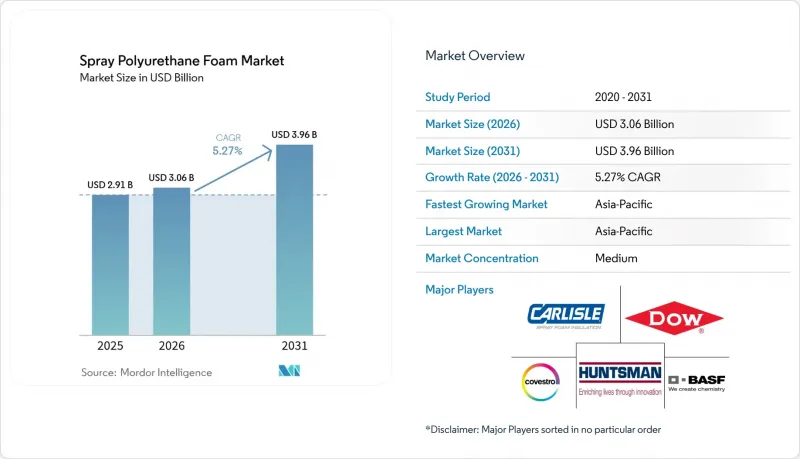
據 Mordor Intelligence 稱,聚氨酯泡沫塗料市場預計到 2026 年價值 30.6 億美元,高於 2025 年的 29.1 億美元,預計到 2031 年將達到 39.6 億美元。
預計 2026 年至 2031 年的複合年成長率為 5.27%。
本報告按產品類型(雙組分高壓噴塗泡沫、雙組分低壓噴塗泡沫、其他)、應用(絕緣、防水、石棉控制、密封劑、其他應用)、最終用途行業(住宅、商業建築、工業/基礎設施、其他)和地區(亞太地區、北美、歐洲、南美、中東和非洲)進行分類。
全球聚氨酯泡沫塗料市場趨勢及洞察
嚴格的建築能源標準和維修義務
2024 年國際節能標準 (IECC) 指定閉孔噴塗泡棉為建議的密封層解決方案,要求建築師指定更高的 R 值和防潮措施。加州 2023 年標準和佛羅裡達州 2026 年規範修訂均簡化了維修核准流程,降低了拆除成本,並加速了市場需求,尤其是在低坡度商業屋頂方面。這些法規變更擴大了維修範圍,推廣了混合保溫結構,並鼓勵承包商進一步培訓和投資適用於雙組分系統的設備。
人們越來越關注溫室氣體排放
企業的淨零排放目標與建築物業主的成本目標一致,美國環保署的「能源之星」計畫也強調,噴塗泡沫可減少高達10%的暖氣和冷氣能耗。 《建築產品安裝》雜誌報告稱,自2020年以來,噴塗泡沫的使用已使二氧化碳排放量減少了55%,同時顯著提高了產量,這表明該技術正在促進經濟成長並實現減排脫鉤。約翰·曼維爾等製造商在提高節能產品產量的同時,實現了兩位數的絕對排放量下降,這證實了永續性和盈利可以兼得。
玻璃纖維與纖維素之間的競爭
注重成本的住宅建築商,在長期穩定的承包商網路和較低的設備要求支援下,仍傾向於選擇玻璃纖維隔熱材料。根據家庭創新研究實驗室(Home Innovation Research Labs)的數據,隨著多用戶住宅市場的成長和材料成本的下降,噴塗泡棉保溫材料的市場佔有率已從11%下降至8%,凸顯了消費者對價格的敏感度。玻璃纖維製造商正透過高密度產品縮小性能差距,而纖維素保溫材料則透過強調再生材料的品牌宣傳來吸引環保意識強的消費者。因此,噴塗泡沫保溫材料供應商需要進一步闡明其在整個生命週期中節能方面的價值提案,以克服其較高的初始成本。
細分市場分析
此細分市場主要集中於雙組分高壓噴塗系統,預計2025年將佔據聚氨酯泡沫塗料市場37.02%的佔有率。這主要得益於其穩定的現場混合性能、卓越的隔熱性能(R值)以及符合商業建築規範。BASF在湛江上推出的全新異氰酸酯和TPU產品線正在加強當地供應鏈,並進一步鞏固該細分市場在亞太地區的領先地位。由於基礎設施項目需要具備抗振動和應對溫度波動的柔軟性,因此半硬質噴塗泡沫正以6.84%的複合年成長率快速成長。單組分噴塗罐方便小規模專案使用,而低壓噴塗套件則適用於對發熱量要求較高的敏感基材。
整合品牌的推廣清晰地展現了一種競爭策略。 Holcim 的「Enverge®」品牌整合了「Gaco™」和「SES™」產品系列,為承包商提供屋頂、牆壁和特殊泡棉材質的單一規格管道。產品多元化創造了交叉銷售機會,例如,針對太陽能屋頂和橋面的創新半硬質泡沫技術,以及採用可膨脹材料的系統以滿足消防安全法規要求。擁有豐富產品目錄和區域技術中心的供應商,在規格選擇方面始終處於最佳競爭優勢地位。
區域分析
預計到2025年,亞太地區將佔據聚氨酯泡沫塗料市場47.66%的佔有率,年複合成長率達7.21%,主要受快速都市化、工廠擴張和能源法規實施的推動。在中國,房地產市場成長放緩促使政府調整城市更新獎勵策略,增加了對現有建築保溫維修的投資。同時,預計到2030年,印度暖通空調(HVAC)產業規模將達到300億美元,年複合成長率達15.8%,這將推動建築圍護結構維修的需求。在日本和韓國,地震多發地區正在實施嚴格的建築圍護結構要求,這使得噴塗泡沫等輕質高黏性隔熱材料更受青睞。在東協,水產品和疫苗冷鏈儲存能力的提升正在推動全部區域的需求成長。BASF在亞太地區總額達195億美元的多年投資計劃,充分體現了供應商對該地區市場吸收能力的信心。
北美市場依然成熟穩定,聯邦政府逐步淘汰氫氟碳化合物(HFCs)的措施帶來了統一的監管合規性和較低的規範複雜性。加拿大寒冷的氣候持續推動著閣樓厚層噴塗泡沫的使用,而墨西哥則憑藉近岸外包的勢頭和汽車製造業的成長,正在崛起成為全球第四大聚氨酯消費國。承包商的整合使得全美各地的建築商能夠實現建築圍護結構解決方案在美國和加拿大的標準化,而TopBuild不斷擴張的網路進一步加速了這一趨勢。
在歐洲,儘管宏觀經濟低迷,但淨零排放指令和維修熱潮刺激了需求。雖然有關二異氰酸酯的培訓法規造成了一些摩擦,但最終將有利於資金雄厚且擁有完善的EHS(環境、安全和衛生)項目的製造商。科思創的「DreamResource」計畫引進了含有20%二氧化碳的硬質發泡材作為原料,展現了歐洲在循環化學品領域的領導地位。列日大學正在開發一種不含異氰酸酯、含有70-90%生物基成分的發泡材,凸顯了該地區產學合作的重要性。在南美洲、中東和非洲,能源效率法規正逐步收緊。在巴西、沙烏地阿拉伯和阿拉伯聯合大公國,一些先行企業正在商業大型企劃中採用噴塗泡沫,預示著未來需求將持續成長。
其他好處
- Excel格式的市場預測(ME)表
- 3個月的分析師支持
目錄
第1章:引言
- 研究假設和市場定義
- 調查範圍
第2章:調查方法
第3章執行摘要
第4章 市場狀況
- 市場概覽
- 市場促進因素
- 嚴格的建築能源標準和維修義務
- 人們越來越關注溫室氣體排放
- 冷鍊和冷藏物流的發展
- 透過與 ESG 掛鉤的綠色債券為 SPF(特殊用途設施)的維修資金籌措。
- 太陽能屋頂對高吸力泡沫材料的需求
- 市場限制因素
- 玻璃纖維與纖維素之間的競爭
- 二異氰酸酯的法規和限制
- HFO發泡供應波動
- 價值鏈分析
- 波特五力模型
第5章 市場規模與成長預測
- 依產品類型
- 雙組分高壓噴塗泡沫
- 雙組分低壓噴塗泡沫
- 單組分泡沫(OCF)
- 半硬質噴塗泡沫
- 透過使用
- 絕緣
- 防水的
- 石棉控制
- 密封劑
- 其他用途(混凝土提升、空隙填充等)
- 按最終用途行業分類
- 住宅
- 商業建築
- 工業和基礎設施
- 農業/特殊用途
- 按地區
- 亞太地區
- 中國
- 日本
- 印度
- 韓國
- ASEAN
- 其他亞太國家
- 北美洲
- 美國
- 加拿大
- 墨西哥
- 歐洲
- 德國
- 英國
- 法國
- 義大利
- 西班牙
- 俄羅斯
- 北歐國家
- 其他歐洲國家
- 南美洲
- 巴西
- 阿根廷
- 其他南美國家
- 中東和非洲
- 沙烏地阿拉伯
- 南非
- 其他中東和非洲國家
- 亞太地區
第6章 競爭情勢
- 市場集中度
- 策略趨勢
- 市佔率和排名分析
- 公司簡介
- BASF
- Accella Polyurethane Systems
- Carlisle Spray Foam Insulation
- Covestro AG
- Dow
- FOAM-LOK(Firestone)
- GACO
- Huntsman Corporation LLC
- ISOTHANE LTD
- Johns Manville
- NCFI Polyurethanes
- Rhino Linings
- SOPREMA Canada.
- SWD Urethane
第7章 市場機會與未來展望
According to Mordor Intelligence, spray polyurethane foam market size in 2026 is estimated at USD 3.06 billion, growing from 2025 value of USD 2.91 billion with 2031 projections showing USD 3.96 billion, growing at 5.27% CAGR over 2026-2031.
This report is Segmented by Product Type (Two-Component High-Pressure Spray Foam, Two-Component Low-Pressure Spray Foam, and More), Application (Insulation, Waterproofing, Asbestos Encapsulation, Sealant, Other Application), End-Use Industry (Residential Buildings, Commercial Buildings, Industrial and More), and Geography (Asia-Pacific, North America, Europe, South America, Middle East and Africa).
Global Spray Polyurethane Foam Market Trends and Insights
Strict Building-Energy Codes and Retrofit Mandates
The 2024 International Energy Conservation Code elevates closed-cell spray foam as a preferred air-barrier solution, compelling architects to specify higher R-values and moisture control measures. California's 2023 standards and Florida's 2026 code update both streamline retrofit approvals, lowering removal costs and accelerating demand, particularly for low-slope commercial roofs These rule changes widen the retrofit addressable base, encourage hybrid insulation assemblies, and push contractors toward more training and equipment investment that favors two-component systems.
Rising Concerns Over GHG Emissions
Corporate net-zero goals merge with building-owner cost targets, highlighting spray foam's ability to cut heating-and-cooling energy by up to 10% according to the EPA's Energy Star program. Installed Building Products reported a 55% CO2 reduction from spray foam use since 2020 while materially increasing output, showing the technology's decoupling of growth from emissions. Manufacturers such as Johns Manville logged double-digit drops in absolute emissions even as energy-saving product volumes rose, underscoring alignment between sustainability and profitability.
Competition from Fiberglass and Cellulose
Cost-focused residential builders still default to fiberglass batts, supported by long-standing installer networks and low equipment requirements. Home Innovation Research Labs data showed an 11% to 8% pullback in spray foam share amid multifamily growth and material cost saving, highlighting price sensitivity. Fiberglass makers are narrowing performance gaps with higher-density offerings, while cellulose leverages recycled content branding to appeal to eco-minded consumers. Spray foam suppliers must therefore sharpen value messaging around lifecycle energy savings to overcome higher upfront spend.
Other drivers and restraints analyzed in the detailed report include:
- Growth in Cold-Chain and Refrigerated Logistics
- ESG-Linked Green-Bond Financing for SPF Upgrades
- Regulations and Restrictions on Di-Isocyanates
For complete list of drivers and restraints, kindly check the Table Of Contents.
Segment Analysis
The segment anchored by two-component high-pressure systems held a 37.02% spray polyurethane foam market share in 2025, reflecting consistent on-site mixing, superior R-values, and code acceptance in commercial construction. BASF's new isocyanate and TPU lines in Zhanjiang strengthen local supply chains, reinforcing the segment's dominance in Asia-Pacific. Semi-rigid spray foam is expanding at a 6.84% CAGR as infrastructure projects need flexibility for vibration and temperature swings. One-component cans address small-project convenience, while low-pressure kits cover sensitive substrates where reduced exothermic heat is critical.
A push for integrated brands illustrates competitive strategy: Holcim's Enverge(R) label merges Gaco(TM) and SES(TM) portfolios, giving installers a single specification path for roof, wall, and specialty foams. Product diversification frames cross-selling opportunities, with semi-rigid innovations aimed at solar-ready roofs and bridge decks, and intumescent-infused systems targeting fire-resistance regulations. Suppliers that maintain broad catalogs and regional technical centers remain best positioned to seize specification wins.
Complete Report Scope:
- By Product Type
- Two-Component High-Pressure Spray Foam
- Two-Component Low-Pressure Spray Foam
- One-Component Foam (OCF)
- Semi-Rigid Spray Foam
- By Application
- Insulation
- Waterproofing
- Asbestos Encapsulation
- Sealant
- Other Application (Concrete Lifting / Void Filling, etc.)
- By End-use Industry
- Residential Buildings
- Commercial Buildings
- Industrial and Infrastructure
- Agriculture and Specialty
- By Geography
- Asia-Pacific
- China
- Japan
- India
- South Korea
- ASEAN Countries
- Rest of Asia-Pacific
- North America
- United States
- Canada
- Mexico
- Europe
- Germany
- United Kingdom
- France
- Italy
- Spain
- Russia
- NORDIC Countries
- Rest of Europe
- South America
- Brazil
- Argentina
- Rest of South America
- Middle East and Africa
- Saudi Arabia
- South Africa
- Rest of Middle East and Africa
- Asia-Pacific
Geography Analysis
Asia-Pacific captured 47.66% of spray polyurethane foam market share in 2025 and is forecast to climb at 7.21% CAGR, driven by rapid urbanization, factory expansions, and energy-code adoption. China's real-estate slowdown redirects stimulus toward urban renewal, boosting retrofit insulation spend, while India's HVAC sector is set to hit USD 30 billion by 2030 on a 15.8% CAGR pathway, raising demand for building envelope upgrades. Japan and South Korea enforce stringent envelope requirements in seismic zones, favoring lightweight, high-adhesion insulation such as spray foam. ASEAN nations expand cold-chain capacity for seafood and vaccine storage, pulling regional demand upward. BASF's multi-year USD 19.5 billion Asia-Pacific investment plan exemplifies supplier confidence in the region's absorption capacity.
North America remains a mature but stable arena where federal HFC phase-outs harmonize compliance and keep specification complexity low. Canada's cold climates sustain thick-layer attic spray foam usage, while Mexico emerges as the world's fourth-largest polyurethane consumer on near-shoring momentum and automotive manufacturing growth. Consolidation among contractors enables national builders to standardize envelope solutions across the US and Canada, reinforced by TopBuild's network expansion.
Europe's net-zero directives and renovation wave stimulate demand despite tepid macro-economics. Di-isocyanate training rules introduce friction but ultimately favor well-capitalized manufacturers with robust EHS programs. Covestro's DreamResource project introduces rigid foam containing 20% CO2 as feedstock, demonstrating European leadership in circular chemistry. University of Liege advances isocyanate-free foams with 70-90% biobased content, underscoring regional academic-industry collaboration. In South America and the Middle East and Africa, energy-efficiency codes are tightening gradually; early movers in Brazil, Saudi Arabia, and the UAE adopt spray foam in commercial megaprojects, signaling future volume uplift.
- BASF
- Accella Polyurethane Systems
- Carlisle Spray Foam Insulation
- Covestro AG
- Dow
- FOAM-LOK (Firestone)
- GACO
- Huntsman Corporation LLC
- ISOTHANE LTD
- Johns Manville
- NCFI Polyurethanes
- Rhino Linings
- SOPREMA Canada.
- SWD Urethane
Additional Benefits:
- The market estimate (ME) sheet in Excel format
- 3 months of analyst support
TABLE OF CONTENTS
1 Introduction
- 1.1 Study Assumptions and Market Definition
- 1.2 Scope of the Study
2 Research Methodology
3 Executive Summary
4 Market Landscape
- 4.1 Market Overview
- 4.2 Market Drivers
- 4.2.1 Strict Building-Energy Codes and Retrofit Mandates
- 4.2.2 Rising Concerns over GHG Emissions
- 4.2.3 Growth in Cold-Chain and Refrigerated Logistics
- 4.2.4 ESG-linked green bond financing for SPF upgrades
- 4.2.5 High-lift Foam Demand for Solar-Ready Roofs
- 4.3 Market Restraints
- 4.3.1 Competition from Fiberglass and Cellulose
- 4.3.2 Regulations and Restrictions on Di-isocyanates
- 4.3.3 HFO Blowing-agent Supply Volatility
- 4.4 Value Chain Analysis
- 4.5 Porter's Five Forces
- 4.5.1 Bargaining Power of Suppliers
- 4.5.2 Bargaining Power of Buyers
- 4.5.3 Threat of New Entrants
- 4.5.4 Threat of Substitutes
- 4.5.5 Competitive Rivalry
5 Market Size and Growth Forecasts (Value)
- 5.1 By Product Type
- 5.1.1 Two-Component High-Pressure Spray Foam
- 5.1.2 Two-Component Low-Pressure Spray Foam
- 5.1.3 One-Component Foam (OCF)
- 5.1.4 Semi-Rigid Spray Foam
- 5.2 By Application
- 5.2.1 Insulation
- 5.2.2 Waterproofing
- 5.2.3 Asbestos Encapsulation
- 5.2.4 Sealant
- 5.2.5 Other Application (Concrete Lifting / Void Filling, etc.)
- 5.3 By End-use Industry
- 5.3.1 Residential Buildings
- 5.3.2 Commercial Buildings
- 5.3.3 Industrial and Infrastructure
- 5.3.4 Agriculture and Specialty
- 5.4 By Geography
- 5.4.1 Asia-Pacific
- 5.4.1.1 China
- 5.4.1.2 Japan
- 5.4.1.3 India
- 5.4.1.4 South Korea
- 5.4.1.5 ASEAN Countries
- 5.4.1.6 Rest of Asia-Pacific
- 5.4.2 North America
- 5.4.2.1 United States
- 5.4.2.2 Canada
- 5.4.2.3 Mexico
- 5.4.3 Europe
- 5.4.3.1 Germany
- 5.4.3.2 United Kingdom
- 5.4.3.3 France
- 5.4.3.4 Italy
- 5.4.3.5 Spain
- 5.4.3.6 Russia
- 5.4.3.7 NORDIC Countries
- 5.4.3.8 Rest of Europe
- 5.4.4 South America
- 5.4.4.1 Brazil
- 5.4.4.2 Argentina
- 5.4.4.3 Rest of South America
- 5.4.5 Middle East and Africa
- 5.4.5.1 Saudi Arabia
- 5.4.5.2 South Africa
- 5.4.5.3 Rest of Middle East and Africa
- 5.4.1 Asia-Pacific
6 Competitive Landscape
- 6.1 Market Concentration
- 6.2 Strategic Moves
- 6.3 Market Share(%)/Ranking Analysis
- 6.4 Company Profiles (includes Global level Overview, Market level overview, Core Segments, Financials as available, Strategic Information, Market Rank/Share for key companies, Products and Services, and Recent Developments)
- 6.4.1 BASF
- 6.4.2 Accella Polyurethane Systems
- 6.4.3 Carlisle Spray Foam Insulation
- 6.4.4 Covestro AG
- 6.4.5 Dow
- 6.4.6 FOAM-LOK (Firestone)
- 6.4.7 GACO
- 6.4.8 Huntsman Corporation LLC
- 6.4.9 ISOTHANE LTD
- 6.4.10 Johns Manville
- 6.4.11 NCFI Polyurethanes
- 6.4.12 Rhino Linings
- 6.4.13 SOPREMA Canada.
- 6.4.14 SWD Urethane
7 Market Opportunities and Future Outlook
- 7.1 White-space and Unmet-Need Assessment

 全球SPF和OCF泡沫市場(2026年)
 聚氨酯泡棉:市場佔有率分析、產業趨勢與統計、成長預測(2026-2031)
 聚氨酯泡棉市場:按類型、原料、密度、結構、應用和分銷管道分類-2026-2032年全球市場預測
 導電軟性聚氨酯市場規模、佔有率和成長分析:按導電填料類型、產品形式、功能、應用、最終用途產業、分銷通路和地區分類-2026-2033年產業預測
 2026-2030年全球聚氨酯泡沫塗料市場
 聚氨酯泡棉市場分析:按結構、產品類型、密度、終端用途產業和地區分類(2026-2034 年)
 彩色聚氨酯泡棉市場:按類型、應用和地區分類單組分聚氨酯泡棉:市場佔有率分析、行業趨勢和統計數據、成長預測(2026-2031)
 聚氨酯泡棉市場規模、佔有率、成長及全球產業分析:按類型、應用和地區分類的洞察,2026-2034年
 聚氨酯泡棉市場規模、佔有率和成長分析:按產品類型、密度、應用、最終用途產業、地區和產業預測分類,2026-2033年