


 |
市場調查報告書
商品編碼
2116591
聚氨酯泡棉:市場佔有率分析、產業趨勢與統計、成長預測(2026-2031)Polyurethane Foam - Market Share Analysis, Industry Trends & Statistics, Growth Forecasts (2026 - 2031) |
||||||

※ 本網頁內容可能與最新版本有所差異。詳細情況請與我們聯繫。
據 Mordor Intelligence 稱,聚氨酯泡棉市場預計在 2026 年達到 1588 萬噸,預計在預測期(2026-2031 年)內將以 4.31% 的複合年成長率成長,到 2031 年達到 1961 萬噸。
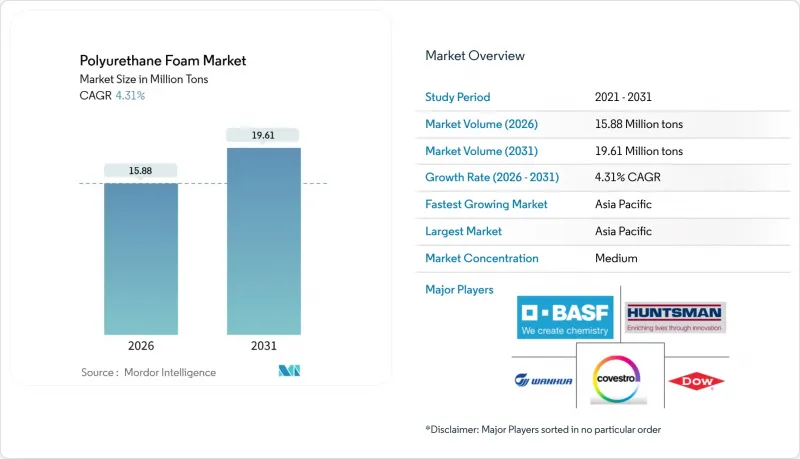
本報告按類型(軟質泡沫、硬質泡沫及其他)、終端用途行業(建築施工、床上用品及家具、鞋類、汽車、電子、包裝及其他終端用途行業)和地區(亞太地區、北美地區、歐洲地區、南美地區以及中東和非洲地區)進行細分。市場預測以噸為單位。
全球聚氨酯泡棉市場趨勢與洞察
節能建築隔熱材料的需求
世界各國政府都在收緊保溫性能要求,這使得聚氨酯泡棉市場的基準複合年成長率提高了1.2個百分點。 2024年,歐盟修訂了《建築能源性能指令》,強製成員國對公共建築進行年度維修。此舉促使規範制定者優先考慮噴塗式聚氨酯泡棉,因為它可以在一次施工中同時實現保溫和氣密性。在美國,18個州採納了2024年國際節能標準(IECC),將寒冷氣候下牆體的保溫性能標準從R-13提高到R-20。這項變更使得連續硬質發泡保溫板成為符合標準的首選材料。在中國,GB 50189-2024提高了暖氣能耗的上限。此舉促使北方省份的開發商從發泡聚苯乙烯轉向閉孔聚氨酯板。此外,噴塗式泡棉在維修工程中也佔據了越來越大的市場佔有率。其優點在於無需拆除覆材即可進行安裝,從而縮短了安裝時間。預計這些政策將在未來幾年內顯著提升市場需求,尤其是在現有建築中,由於節能效果顯著,有望獲得可觀的投資回報。
旨在減輕車輛重量並提高舒適性的應用。
汽車監管機構強制要求提高燃油效率並延長電動車續航里程,這推動聚氨酯泡棉市場成長了0.9個百分點。為了達到美國企業平均燃油經濟性(CAFE)標準(該標準旨在到2027年實現平均車輛油耗達到每加侖58英里),汽車製造商正從傳統的襯墊材料轉向低密度、軟性聚氨酯。這項轉變可以在不影響人體工學舒適性的前提下減輕座椅重量。美國汽車工程師協會(SAE)的研究表明,針對車門面板和頂棚最佳化的發泡體配方可以降低高速行駛時的車廂噪音,從而提升電動車靜謐車廂內的駕駛舒適度。在中國,新能源汽車銷售蓬勃發展,當地供應商正合作開發填充電池模組縫隙的硬質泡棉。這些泡沫在抑制熱失控傳播方面比氣凝膠更有效。聚氨酯兼具輕量化和安全性優勢,其在汽車材料清單中的作用日益增強,在高階和大眾市場細分領域,其單車使用量都在不斷成長。
加強對異氰酸酯的健康和環境法規
對二異氰酸酯暴露監管力度的加強,使聚氨酯泡棉市場的成長率下降了0.6個百分點。根據美國環保署 (EPA) 2024 年的《重要新用途規則》(SNUR),噴塗泡沫施工團隊必須穿戴提供的呼吸防護設備並進行即時監測。這項強制性規定增加了每個團隊的年度遵循成本,阻礙了預算有限的維修項目採用噴塗泡沫。同時,歐盟 REACH 法規的修訂提高了 TDI 的職業暴露限值。這項變更要求加工商投資建造閉迴路混合系統。 2025 年,加州 65 號提案進行了修訂,將 MDI 納入其中。新增的 MDI 要求零售商在含有 0.1% 或以上 MDI 的產品上貼上警告標籤。因此,儘管成本更高,家具製造商仍擴大轉向水性發泡配方。雖然非異氰酸酯聚氨酯化學技術正在取得進展,但預計其商業性化應用至少還需要五年時間,主要原因是目前成本和性能的差異。
細分市場分析
到2025年,軟質泡棉將佔聚氨酯泡棉市場佔有率的56.44%,主要成長動力來自家具、寢具和汽車座椅等應用領域。然而,通用型泡棉塊正面臨低成本進口產品的利潤壓力,北美和歐洲的加工商正轉向高回彈和黏彈性產品線,這些產品線可提供30%的溢價。其他類型的泡沫(噴塗泡沫、整體表皮泡沫和記憶泡沫)預計將以6.49%的複合年成長率成長,幾乎是整體市場成長的兩倍。噴塗泡沫具有能夠密封不規則空腔的優勢,在美國,由於公共產業補貼計劃,噴塗泡沫在住宅翻新中的應用日益廣泛。隨著電動車內裝對觸感品質的日益重視,整體表皮泡棉在方向盤和扶手領域的應用也越來越受歡迎。記憶泡棉的應用範圍正在從豪華床墊擴展到運動鞋和醫用坐墊等領域。
高成長的細分市場正透過提供其他材料難以企及的性能特性,不斷擴大其在聚氨酯泡棉產業的市場佔有率。在美國,噴塗泡沫市場受益於《通膨控制法案》中針對提高氣密性的補貼計畫而蓬勃發展。汽車製造商利用一體式表皮技術,最大限度地減少電動車車廂內的振動傳遞,同時消除引擎噪音。這項措施源自於美國汽車工程師協會(SAE)的研究,該研究強調了其降噪效果。記憶海綿先前僅限於床上用品,如今也憑藉耐吉推出的雙密度中底(可根據行走週期進行調整)在跑鞋市場嶄露頭角。這些來自不同行業的成功案例表明,特種聚氨酯泡棉有望在未來的創新投資和利潤率中佔據重要佔有率。
區域分析
預計亞太地區將在2025年佔據全球消費49.58%的佔有率,並以6.36%的年均成長率持續成長至2031年,成為所有地區中成長最快的地區。 2024年,中國修訂了GB 50189標準,提高了暖氣區域牆體保溫性能的R值。這一變化推動了商業和住宅項目中從發泡聚苯乙烯向硬質聚氨酯的轉變。預計印度的家具市場將在2025年實現顯著成長。同時,Sheila Foam公司擴大了產能,旨在滿足二線城市對記憶海綿床墊日益成長的需求。儘管市場已趨於成熟,日本和韓國仍在電子和電動車電池領域持續推動創新。一個值得注意的例子是,LG能源解決方案公司為其E-GMP平台獲得了相變增強聚氨酯的認證,凸顯了該地區的技術優勢。在東南亞,尤其是在越南和印度尼西亞,政府為減少收穫後食物浪費而獎勵正在推動對低溫運輸倉庫的投資。
預計到2025年,北美將佔據顯著的市場佔有率,其中美國聚氨酯泡棉市場將保持穩定成長。噴塗泡沫維修和電動車電池機殼是推動這一成長的主要因素。美國《通膨控制法案》中包含的住宅能源補貼計畫是促進這一成長的重要因素,該計畫在2025年推動了噴塗泡沫的應用。住宅利用這項補貼計畫降低了建築成本。同時,加拿大2025年《國家建築標準法案》鼓勵建築商採用硬質發泡隔熱材料,強制要求在所有氣候區使用連續隔熱材料。 2025年,墨西哥憑藉其強大的汽車生產基地,正見證著美國汽車製造商(OEM)增加聚氨酯含量的趨勢。此舉符合墨西哥推動近岸電動車組裝並確保符合當地採購要求的策略。
在歐洲,聚氨酯泡棉產業正處於穩定成長的軌道上。儘管面臨嚴格的異氰酸酯法規,該地區仍在積極努力實現維修目標。 《建築能源性能指令》規定了公共建築的年度維修率。該指令鼓勵使用高效噴塗泡沫,儘管不斷上漲的人工合規成本帶來了挑戰。南美洲和中東及非洲(MEA)地區也呈現強勁成長勢頭,這些地區佔據了全球需求的很大一部分。在巴西,市政當局為獲得LEED認證的建築提供房產稅退稅,促進了聚氨酯隔熱材料的應用。在沙烏地阿拉伯,對冷庫的大規模投資推動了對硬質板材的需求。同時,在南非,計劃於2025年擴建的太陽能發電設施正在促進使用聚氨酯保溫材料運輸生鮮食品。
其他好處:
- Excel格式的市場預測(ME)表
- 3個月的分析師支持
目錄
第1章:引言
- 研究假設和市場定義
- 調查範圍
第2章:調查方法
第3章執行摘要
第4章 市場狀況
- 市場概覽
- 市場促進因素
- 節能建築隔熱材料的需求
- 旨在減輕車輛重量並提高舒適性的應用。
- 家具和床墊的產量正在激增。
- 擴大低溫運輸和冷藏能力
- 用於電動汽車電池溫度控管的發泡體
- 市場限制因素
- 加強對異氰酸酯的健康和環境法規
- MDI/TDI原物料價格波動
- 在高階包裝材料領域,菌絲體/藻類衍生的生物泡沫被用作聚氨酯的替代品。
- 價值鏈分析
- 波特五力模型
第5章 市場規模與成長預測
- 按類型
- 軟性發泡體
- 硬質發泡體
- 其他類型(噴塗泡沫、整體皮膚泡沫、記憶泡沫)
- 按最終用途行業分類
- 建築/施工
- 床上用品和家具
- 鞋類
- 車
- 電子設備
- 包裝
- 其他終端使用者產業(醫療設備、紡織服裝、航太)
- 按地區
- 亞太地區
- 中國
- 印度
- 日本
- 韓國
- 其他亞太國家
- 北美洲
- 美國
- 加拿大
- 墨西哥
- 歐洲
- 德國
- 英國
- 法國
- 義大利
- 其他歐洲國家
- 南美洲
- 巴西
- 阿根廷
- 其他南美國家
- 中東和非洲
- 沙烏地阿拉伯
- 南非
- 其他中東和非洲國家
- 亞太地區
第6章 競爭情勢
- 市場集中度
- 策略趨勢
- 市佔率和排名分析
- 公司簡介
- Arkema
- BASF SE
- Carpenter Co.
- Covestro AG
- Dow
- Eurofoam Srl
- Foam Partner Group
- Foamcraft Inc.
- FXI
- Huntsman International LLC
- INOAC Corporation
- Rogers Corporation
- Saint-Gobain
- Sekisui Chemical Co., Ltd.
- Sheela Foam Ltd.
- UFP Technologies Inc.
第7章 市場機會與未來展望
According to Mordor Intelligence, the polyurethane foam market size is estimated at 15.88 million tons in 2026, and is expected to reach 19.61 million tons by 2031, at a CAGR of 4.31% during the forecast period (2026-2031).
This report is Segmented by Type (Flexible Foam, Rigid Foam, and Other Types), End-Use Industry (Building and Construction, Bedding and Furniture, Footwear, Automotive, Electronics, Packaging, and Other End-Use Industries), and Geography (Asia-Pacific, North America, Europe, South America, and Middle-East and Africa). Market Forecasts are Provided in Terms of Volume (Tons).
Global Polyurethane Foam Market Trends and Insights
Energy-Efficient Building Insulation Demand
Governments are tightening thermal-performance requirements, adding 1.2 percentage points to the baseline CAGR in the polyurethane foam market. In 2024, the European Union revised its Energy Performance of Buildings Directive, mandating member states to annually renovate public buildings. This move is guiding specifiers to favor spray polyurethane foam, which offers insulation and achieves air-sealing in a single application. In the United States, eighteen states adopted the 2024 International Energy Conservation Code, raising prescriptive wall insulation from R-13 to R-20 in colder climate zones, a change that places continuous rigid foam sheathing at the forefront of compliance. China's GB 50189-2024 has raised heating-energy limits. This move has pushed developers in northern provinces to shift from expanded polystyrene to closed-cell polyurethane panels. Additionally, spray foam is capturing a larger share in retrofit projects. Its advantage lies in the ability to apply it without removing exterior cladding, reducing installation time. These combined policies ensure a clear demand trajectory over the coming years, especially for existing buildings where energy savings offer appealing payback periods.
Automotive Lightweighting and Comfort Applications
Automotive regulators are mandating higher fuel economy and extended EV range, contributing 0.9 percentage points to to the polyurethane foam market growth. In response to the U.S. Corporate Average Fuel Economy standard aiming for a fleet average of 58 miles per gallon equivalent by 2027, automakers are shifting from traditional padding to low-density flexible polyurethane. This change reduces seat weight without compromising ergonomics. An SAE study found that optimized foam formulations in door panels and headliners can reduce cabin noise at highway speeds, boosting passenger comfort in the quiet cabins of electric vehicles. In China, where new-energy-vehicle sales have grown significantly, local suppliers are collaborating on rigid foams for battery-module gap-filling. These foams are more effective than aerogels at inhibiting thermal-runaway propagation. With benefits in both mass reduction and safety, polyurethane's role in vehicle bills of materials is expanding, leading to increased content per vehicle in both premium and mass-market segments.
Stricter Isocyanate Health and Environmental Rules
Widening regulatory scrutiny on diisocyanate exposure is trimming 0.6 percentage points from polyurethane foam market growth. Under the 2024 Significant New Use Rule by the U.S. Environmental Protection Agency, spray-foam teams must don supplied-air respirators and utilize real-time monitoring. This mandate escalates annual compliance expenses for each team, hindering adoption in budget-conscious retrofits. Meanwhile, Europe's REACH update has tightened the occupational exposure limit for TDI. This change mandates converters to invest in closed-loop mixing systems. In 2025, California's Proposition 65 was updated to include MDI. This addition requires retailers to label products with warnings if they contain more than 0.1% MDI. As a result, furniture manufacturers are increasingly leaning towards water-blown formulations, albeit at a cost premium. While there's progress in non-isocyanate polyurethane chemistries, their widespread commercial adoption is still projected to be at least five years away, primarily due to existing cost and performance disparities.
Other drivers and restraints analyzed in the detailed report include:
- Furniture and Mattress Production Upsurge
- Cold-Chain and Refrigeration Capacity Expansion
- Volatility in MDI/TDI Feedstock Prices
For complete list of drivers and restraints, kindly check the Table Of Contents.
Segment Analysis
Flexible foam retained 56.44% of the polyurethane foam market share in 2025, anchored by furniture, bedding, and automotive seating applications. However, commodity blocks face margin squeeze from low-cost imports, persuading North American and European converters to shift toward high-resilience and viscoelastic lines that command 30% price premiums. Other formats-spray, integral-skin, and memory foams-are projected to grow at 6.49% CAGR, nearly double the broader market. Spray foam benefits from its ability to air-seal irregular cavities, driving residential retrofit adoption under utility rebate programs in the United States. Integral-skin foams in steering wheels and armrests are gaining favor as EV interiors prioritize tactile quality, while memory foams are migrating from premium mattresses to athletic footwear and medical cushions.
High-growth niches are gaining market share within the polyurethane foam industry by offering performance attributes that alternative materials struggle to match. The U.S. spray-foam segment expanded, spurred by the Inflation Reduction Act's rebate for air-sealing enhancements. Automotive OEMs harnessed integral-skin technology to minimize vibration transmission in EV cabins, now devoid of engine noise. This shift was bolstered by an SAE study highlighting noise reduction. Memory foams, previously limited to sleep products, gained a foothold in running shoes, thanks to Nike's introduction of a dual-density midsole that adapts to the gait cycle. These successes across diverse industries indicate that specialty polyurethane foams are poised to secure a significant portion of future innovation investments and profit margins.
Complete Report Scope:
- By Type
- Flexible Foam
- Rigid Foam
- Other Types (Spray Foam, Integral Skin Foam, Memory Foam)
- By End-Use Industry
- Building and Construction
- Bedding and Furniture
- Footwear
- Automotive
- Electronics
- Packaging
- Other End-Use Industries (Medical Devices, Textiles and Apparel, Aerospace)
- By Geography
- Asia-Pacific
- China
- India
- Japan
- South Korea
- Rest of Asia-Pacific
- North America
- United States
- Canada
- Mexico
- Europe
- Germany
- United Kingdom
- France
- Italy
- Rest of Europe
- South America
- Brazil
- Argentina
- Rest of South America
- Middle-East and Africa
- Saudi Arabia
- South Africa
- Rest of Middle-East and Africa
- Asia-Pacific
Geography Analysis
Asia-Pacific dominated global consumption with a 49.58% share in 2025 and is on course to grow 6.36% annually to 2031, the highest regional pace. In 2024, China upgraded its GB 50189 standard, boosting wall insulation R-values in heating zones. This change prompted a shift from expanded polystyrene to rigid polyurethane in both commercial and residential projects. India's organized furniture market experienced significant growth in 2025. This uptick coincided with Sheela Foam's capacity expansion, aimed at meeting the rising demand for memory-foam mattresses in tier-2 cities. Japan and South Korea, despite their market maturity, are capitalizing on innovations in electronics and EV batteries. A notable instance is LG Energy Solution's qualification of phase-change-enhanced polyurethane for the E-GMP platform, underscoring the region's technological advancements. In Southeast Asia, investments in cold-chain warehousing, especially in Vietnam and Indonesia, are bolstered by government incentives targeting a reduction in post-harvest food loss.
North America accounted for a significant market share in 2025 and registered steady growth in the US polyurethane foam market. Spray-foam retrofits and EV battery enclosures largely drove the momentum. A significant contributor to this growth was the U.S. Inflation Reduction Act's Home Energy Rebates, which spurred an increase in spray-foam installations in 2025. Homeowners capitalized on these rebates to mitigate installation expenses. Meanwhile, Canada's National Building Code 2025 is steering builders towards rigid foam sheathing by mandating continuous insulation across all climate zones. In 2025, Mexico, with a strong vehicle production base, is witnessing a trend where U.S. OEMs are integrating higher polyurethane content. This move aligns with their strategy to near-shore EV assembly, ensuring compliance with regional-content requirements.
Europe is navigating a steady growth trajectory in the polyurethane foam industry. The region grapples with stringent isocyanate regulations while aggressively pursuing retrofit targets. The Energy Performance of Buildings Directive mandates an annual renovation rate for public buildings. This directive leans towards high-efficiency spray foam, even with the challenge of elevated labor compliance costs. South America and the Middle East and Africa (MEA), collectively representing a notable portion of global demand, are experiencing robust growth. In Brazil, municipalities are incentivizing LEED-certified buildings with property-tax rebates, leading to a heightened adoption of polyurethane insulation. In Saudi Arabia, a substantial investment in cold storage is driving demand for rigid panels. Concurrently, in South Africa, the addition of new solar capacity in 2025 is spurring the use of polyurethane-insulated transport for exporting perishables.
- Arkema
- BASF SE
- Carpenter Co.
- Covestro AG
- Dow
- Eurofoam S.r.l.
- Foam Partner Group
- Foamcraft Inc.
- FXI
- Huntsman International LLC
- INOAC Corporation
- Rogers Corporation
- Saint-Gobain
- Sekisui Chemical Co., Ltd.
- Sheela Foam Ltd.
- UFP Technologies Inc.
Additional Benefits:
- The market estimate (ME) sheet in Excel format
- 3 months of analyst support
TABLE OF CONTENTS
1 Introduction
- 1.1 Study Assumptions and Market Definition
- 1.2 Scope of the Study
2 Research Methodology
3 Executive Summary
4 Market Landscape
- 4.1 Market Overview
- 4.2 Market Drivers
- 4.2.1 Energy-efficient building insulation demand
- 4.2.2 Automotive lightweighting and comfort applications
- 4.2.3 Furniture and mattress production upsurge
- 4.2.4 Cold-chain and refrigeration capacity expansion
- 4.2.5 EV battery thermal-management foams
- 4.3 Market Restraints
- 4.3.1 Stricter isocyanate health and environmental rules
- 4.3.2 Volatility in MDI/TDI feed-stock prices
- 4.3.3 Mycelium/algae bio-foams replacing PU in premium packaging
- 4.4 Value Chain Analysis
- 4.5 Porter's Five Forces
- 4.5.1 Threat of New Entrants
- 4.5.2 Bargaining Power of Buyers
- 4.5.3 Bargaining Power of Suppliers
- 4.5.4 Threat of Substitutes
- 4.5.5 Intensity of Competitive Rivalry
5 Market Size and Growth Forecasts (Volume)
- 5.1 By Type
- 5.1.1 Flexible Foam
- 5.1.2 Rigid Foam
- 5.1.3 Other Types (Spray Foam, Integral Skin Foam, Memory Foam)
- 5.2 By End-Use Industry
- 5.2.1 Building and Construction
- 5.2.2 Bedding and Furniture
- 5.2.3 Footwear
- 5.2.4 Automotive
- 5.2.5 Electronics
- 5.2.6 Packaging
- 5.2.7 Other End-Use Industries (Medical Devices, Textiles and Apparel, Aerospace)
- 5.3 By Geography
- 5.3.1 Asia-Pacific
- 5.3.1.1 China
- 5.3.1.2 India
- 5.3.1.3 Japan
- 5.3.1.4 South Korea
- 5.3.1.5 Rest of Asia-Pacific
- 5.3.2 North America
- 5.3.2.1 United States
- 5.3.2.2 Canada
- 5.3.2.3 Mexico
- 5.3.3 Europe
- 5.3.3.1 Germany
- 5.3.3.2 United Kingdom
- 5.3.3.3 France
- 5.3.3.4 Italy
- 5.3.3.5 Rest of Europe
- 5.3.4 South America
- 5.3.4.1 Brazil
- 5.3.4.2 Argentina
- 5.3.4.3 Rest of South America
- 5.3.5 Middle-East and Africa
- 5.3.5.1 Saudi Arabia
- 5.3.5.2 South Africa
- 5.3.5.3 Rest of Middle-East and Africa
- 5.3.1 Asia-Pacific
6 Competitive Landscape
- 6.1 Market Concentration
- 6.2 Strategic Moves
- 6.3 Market Share(%)/Ranking Analysis
- 6.4 Company Profiles {(includes Global level Overview, Market level overview, Core Segments, Financials as available, Strategic Information, Market Rank/Share for key companies, Products and Services, and Recent Developments)}
- 6.4.1 Arkema
- 6.4.2 BASF SE
- 6.4.3 Carpenter Co.
- 6.4.4 Covestro AG
- 6.4.5 Dow
- 6.4.6 Eurofoam S.r.l.
- 6.4.7 Foam Partner Group
- 6.4.8 Foamcraft Inc.
- 6.4.9 FXI
- 6.4.10 Huntsman International LLC
- 6.4.11 INOAC Corporation
- 6.4.12 Rogers Corporation
- 6.4.13 Saint-Gobain
- 6.4.14 Sekisui Chemical Co., Ltd.
- 6.4.15 Sheela Foam Ltd.
- 6.4.16 UFP Technologies Inc.
7 Market Opportunities and Future Outlook
- 7.1 White-space and Unmet-Need Assessment
- 7.2 Increasing the Production of Bio-Based Polyols

 聚氨酯泡棉市場:按類型、原料、密度、結構、應用和分銷管道分類-2026-2032年全球市場預測
 導電軟性聚氨酯市場規模、佔有率和成長分析:按導電填料類型、產品形式、功能、應用、最終用途產業、分銷通路和地區分類-2026-2033年產業預測
 2026-2030年全球聚氨酯泡沫塗料市場
 聚氨酯泡棉市場分析:按結構、產品類型、密度、終端用途產業和地區分類(2026-2034 年)
 彩色聚氨酯泡棉市場:按類型、應用和地區分類
 單組分聚氨酯泡棉:市場佔有率分析、行業趨勢和統計數據、成長預測(2026-2031)
 聚氨酯泡棉市場規模、佔有率、成長及全球產業分析:按類型、應用和地區分類的洞察,2026-2034年
 聚氨酯泡棉市場規模、佔有率和成長分析:按產品類型、密度、應用、最終用途產業、地區和產業預測分類,2026-2033年依軟管結構、工作壓力範圍、內徑範圍和最終用途產業分類的聚氨酯增強軟管市場-全球預測,2026-2032年鋼絲增強聚氨酯軟管市場:依結構、壓力等級、材料類型、應用及通路分類,全球預測(2026-2032年)