


 |
市場調查報告書
商品編碼
2122393
石油和天然氣管道:市場佔有率分析、行業趨勢和統計數據、成長預測(2026-2031 年)Oil And Gas Pipeline - Market Share Analysis, Industry Trends & Statistics, Growth Forecasts (2026 - 2031) |
||||||

※ 本網頁內容可能與最新版本有所差異。詳細情況請與我們聯繫。
根據 Mordor Intelligence 估計,石油和天然氣管道市場在 2026 年的價值將達到 1,087.3 億美元,高於 2025 年的 1,036.3 億美元,預計到 2031 年將達到 1,381.7 億美元。
預計從 2026 年到 2031 年,其複合年成長率將達到 4.92%。
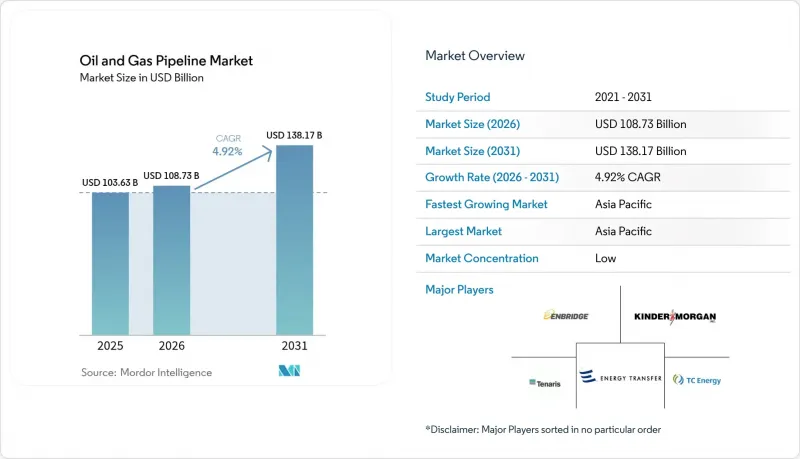
本報告按活動類型(資本支出、營運支出)、功能(集油管、輸油管、供油管)、安裝地點(陸上、海上)和地區(北美、歐洲、亞太、南美、中東和非洲)進行細分。市場規模和預測均以美元計價。
全球油氣管道市場趨勢與洞察
二疊紀盆地聯產氣開採能力的擴張將穩定瓦哈樞紐的價格差異。
自2024年初以來,金德摩根公司的二疊紀高速公路天然氣管道和能源傳輸公司的勇士天然氣管道系統新增了41億立方英尺/日的天然氣開採能力。這使得瓦哈樞紐天然氣田的基準價差從每百萬英熱單位-2.50美元降至-0.75美元,並使該地區的天然氣燃燒量減少了35%。淨收益的提高提升了鑽井的獲利能力,促使生產商簽署了15至20年的獨家契約,從而支持了對天然氣收集和壓縮設施的進一步投資。德克薩斯州監管機構已批准一項新的32億美元的州內管道項目,透過縮短環境審查週期和降低資金籌措風險,加快了這項基礎設施的建設。
深海FPSO的回接管道正在加速海底設備訂單的積壓。
埃克森美孚位於圭亞那的斯塔布羅克區塊,到2030年需要8艘FPSO(浮動生產儲卸油船),並透過一條450公里長的輸油管線連接。同時,巴西石油公司(Petrobras)簽署了一份價值28億美元的契約,為巴西的梅羅油田和布濟奧斯油田採購軟性海底管道。這種軟性管道由德希尼布FMC公司率先採用熱塑性複合材料製造,可承受15,000磅/平方英吋的壓力,同時也能降低25%的安裝成本。由於需求旺盛,巴西和特立尼達的造船廠透過大量採購和在地採購,實現了15%的成本節約。
受環境、社會及公司治理(ESG)因素驅動,石油基礎建設領域的資本外流不斷擴大。
管理130兆美元資產的全球資產管理公司已採用排除標準,限制管道專案的融資,導致與脫碳轉型不符的專案借貸成本上升200-300個基點。歐洲銀行目前正尋求在2050年實現淨零排放的路徑,這實際上排除了設計壽命為40年的新建原油管線專案。營運商正在調整策略,例如TC Energy將其70億美元投資計畫的30%分配給氫能和碳捕獲資產,而私人資本則專注於回報潛力更高的現代化改造項目。
細分市場分析
在2025年的油氣管道市場中,資本支出(CAPEX)佔市場佔有率的73.65%。這主要得益於數十億美元的項目,例如Energy Transfer公司投資60億美元的「Warrior System」管道和TC Energy公司投資45億美元的「Southeast Gateway」管道。約60%的資本支出用於管道材料和壓縮設備,其中氫兼容型X70和X80鋼種的投入顯著提升了這一比例,這些鋼種的價格比傳統合金高出25%。剩餘的40%用於施工服務,但由於合格焊工長期短缺,平均工期延長了四個月,導致開發商需要增加緊急資金。工程承包商正在利用模組化管段製造和自動化焊接設備等技術來緩解這些延誤,這些技術可以將直線段的每週鋪設速度提高12%。在確定子細分領域的優先順序時,具有雙重用途潛力的管道(例如未來可輸送天然氣和氫氣的管道)正日益受到重視,這使得管道所有者能夠保護其資產免受「擱淺資本」的風險。
儘管預計到2025年營運成本將佔收入的26.35%,但這種情況正在迅速變化。人工智慧驅動的檢測技術將檢測頻率從每三年延長至每五年,降低了30%的成本。具備超音波裂紋檢測功能的線上檢測工具能夠識別傳統磁法檢測方法無法檢測到的微小裂紋,從而提高資產可靠性。目前,退役市場仍屬於小眾市場,但隨著北美老舊資產陸續達到使用壽命終點,預計2028年後此趨勢將加速發展,為專業翻新創造更多機會。
預計2025年,在經合組織各國住宅及商業領域強勁需求的推動下,發行網路將佔銷售額的58.25%。智慧電錶和自動壓力控制系統正在減少洩漏並加強監管合規性。在都市區,隨著暖氣系統電氣化程度的提高、燃氣備用系統的建立以及氫氣引入準備工作的開展,配發行網中油氣管道的市場規模預計將穩步擴大。
儘管規模較小,但運輸系統的發展速度更快,預計到2031年複合年成長率將達到6.38%。由於需要高性能壓縮機和厚壁管道,像Mountain Valley和Coast Gaslink這樣的州際管道每英里造價約為800萬美元。監管機構對能源安全項目的優先考慮減少了核准過程中的阻力,聯邦能源監管委員會(FERC)的政策變化也有利於那些能夠緩解區域價格波動的項目。與傳統型鑽井緊密相關的天然氣收集網路,每口水平井需要增加2.5英里的管道,這構成了頁岩盆地中游領域資本支出(CAPEX)的基礎。
區域分析
預計到2025年,亞太地區將佔全球銷售額的34.35%,並有望維持最高成長率,到2031年複合成長率(CAGR)將達到6.46%。印度幹線管道的快速發展預計將偏遠天然氣田與都市區中心連接起來,加速工業氣體的利用,並促進煤炭發電的替代。中國的「西伯利亞力量」計畫以及與中亞的合作正在推動供應來源多元化,降低對液化天然氣(LNG)的依賴;同時,東南亞新興經濟體正在探索官民合作關係(PPP)模式,為跨境管道建設資金籌措。
隨著頁岩氣產量的擴張和運輸能力的提升,北美繼續發揮至關重要的作用,人工智慧驅動的升級改造也提高了管網的運轉率。預計隨著墨西哥灣沿岸的出口樞紐為LNG接收站爭取更多供應管道,北美油氣管道市場將持續擴張。在歐洲,重點是維修天然氣管網以適應氫能,並利用歐盟再生能源津貼加速轉型,同時降低來自俄羅斯的供應風險。在中東和非洲,連接富氣盆地和沿海需求中心的新開發項目前景廣闊,但地緣政治風險和資金籌措限制了短期發展勢頭。南美洲的機會集中在巴西鹽層下下層和阿根廷瓦卡穆埃爾塔地區的天然氣運輸,目前正在透過區域合作框架來推進監管和收費系統的標準化。
其他好處:
- Excel格式的市場預測(ME)表
- 3個月的分析師支持
目錄
第1章:引言
- 市場分析與定義的前提條件
- 分析範圍
第2章 分析方法
第3章執行摘要
第4章 市場狀況
- 市場概覽
- 市場促進因素
- 二疊紀盆地聯產氣輸送能力的提升穩定了瓦哈基地。
- 圭亞那和巴西深海FPSO的回接管道專案增加了與海底相關的累積訂單。
- TMX 引進後,美國和加拿大之間的原油出口路線開始從價格差異中獲利。
- 透過維修管道以適應氫氣,將可以獲得 IRA 和 REPowerEU 的資助。
- 人工智慧驅動的完整性分析可顯著降低營運成本並最大限度地減少意外停機時間。
- 聯邦能源監管委員會 (FERC) 對小直徑天然氣支線的快速核准程序降低了天然氣管道網路擴建帶來的風險。
- 市場限制因素
- 受 ESG(環境、社會和治理)因素的影響,長期輸油管的資本外流正在增加。
- 勒索軟體和OT網路威脅的增加導致保險費上漲。
- 大直徑鋼材價格上漲,提高了專案的內部收益率門檻。
- 可再生能源併網速度加快,正在蠶食對精煉產品的需求。
- 供應鏈分析
- 監理情勢
- 技術展望
- 管道設置容量分析
- 即將進行的重大項目
- 波特五力分析
第5章:預測市場規模與成長率
- 按活動
- CAPEX
- 管道材料和設備
- 管道製造和建設
- OPEX
- 檢查
- MRO(維修、修理和大修)
- 退休
- CAPEX
- 按功能
- 集油管
- 運輸管道
- 供應管道
- 按安裝位置
- 陸上
- 離岸
- 按最終用戶類別
- 上游工程(探勘與生產)
- 中游過程
- 下游工藝,石油化工
- 按地區
- 北美洲
- 美國
- 加拿大
- 墨西哥
- 歐洲
- 德國
- 法國
- 英國
- 西班牙
- 北歐國家
- 土耳其
- 俄羅斯
- 其他歐洲國家
- 亞太地區
- 印度
- 中國
- 韓國
- 日本
- 馬來西亞
- 泰國
- 印尼
- 越南
- 其他亞太國家
- 南美洲
- 巴西
- 阿根廷
- 哥倫比亞
- 其他南美國家
- 中東和非洲
- 沙烏地阿拉伯
- 阿拉伯聯合大公國
- 南非
- 埃及
- 其他中東和非洲國家
- 北美洲
第6章 競爭情勢
- 市場集中度
- 策略趨勢(併購、聯盟、購電協議)
- 市場佔有率分析(主要公司的市場排名和佔有率)
- 公司簡介
- Tenaris SA
- Nippon Steel Corporation
- TMK Group
- United States Steel Corporation
- ChelPipe Group
- OMK Steel Ltd
- Shengli Oil & Gas Pipe Holdings Ltd
- Jindal SAW Ltd
- EVRAZ North America
- Vallourec SA
- Welspun Corp
- ArcelorMittal SA
- TechnipFMC plc
- Saipem SpA
- Subsea 7 SA
- Enbridge Inc.
- Kinder Morgan Inc.
- Energy Transfer LP
- Pembina Pipeline Corp.
- TC Energy Corp.
- Gazprom PJSC
第7章 市場機會與未來展望
According to Mordor Intelligence, oil and gas pipeline market size in 2026 is estimated at USD 108.73 billion, growing from 2025 value of USD 103.63 billion with 2031 projections showing USD 138.17 billion, growing at 4.92% CAGR over 2026-2031.
This report is Segmented by Activity (CAPEX and OPEX), Function (Gathering Lines, Transmission Lines, and Distribution Lines), Location of Deployment (Onshore and Offshore), and Geography (North America, Europe, Asia-Pacific, South America, and Middle East, and Africa). The Market Sizes and Forecasts are Provided in Terms of Value (USD).
Global Oil And Gas Pipeline Market Trends and Insights
Permian Associated-Gas Takeaway Expansions Stabilize Waha Hub Pricing
Kinder Morgan's Permian Highway and Energy Transfer's Warrior systems have added 4.1 Bcf/d of takeaway since early 2024, narrowing Waha basis differentials from -USD 2.50/MMBtu to -USD 0.75/MMBtu and cutting regional flaring by 35%. Improved netbacks reinforce drilling economics, prompting producers to execute 15- to 20-year acreage dedications that underpin additional gathering and compression investments. Texas regulators are supporting the buildout by green-lighting USD 3.2 billion in new intrastate pipeline projects, shrinking environmental review cycles, and lowering financing risk.
Deepwater FPSO Tie-Back Pipelines Accelerate Subsea Order Books
ExxonMobil's Stabroek Block in Guyana requires eight FPSOs connected by 450 km of flowlines by 2030, while Petrobras has awarded USD 2.8 billion for flexible subsea pipes in Brazil's Mero and Buzios fields. Flexible thermoplastic composite pipe pioneered by TechnipFMC withstands 15,000 psi yet slices installation cost by 25%. Concentrated demand is driving fabrication yards in Brazil and Trinidad to achieve 15% cost efficiencies through bulk procurement and local content mandates.
Growing ESG-Led Capital Flight from Oil Infrastructure
Global asset managers controlling USD 130 trillion have adopted exclusion criteria that have curtailed pipeline financing, driving borrowing costs up by 200-300 bp for projects lacking transition alignment. European banks now demand credible net-zero pathways by 2050, effectively sidelining greenfield crude lines with 40-year design lives. Operators are pivoting; TC Energy channels 30% of its USD 7 billion program into hydrogen-ready and carbon-capture assets, while private capital targets higher-return modernization plays.
Other drivers and restraints analyzed in the detailed report include:
- US-Canada Crude Export Corridors Monetize Price Differentials
- Hydrogen-Ready Pipeline Retrofits Unlock Subsidy Pools
- Heightened Cybersecurity Threats Drive Insurance Costs
For complete list of drivers and restraints, kindly check the Table Of Contents.
Segment Analysis
Capital expenditure captured 73.65% of the oil and gas pipeline market share in 2025, supported by multi-billion-dollar projects such as Energy Transfer's USD 6 billion Warrior system and TC Energy's USD 4.5 billion Southeast Gateway line. Roughly 60% of CAPEX outlays are allocated to pipe materials and compression equipment, a share inflated by hydrogen-compatible X70 and X80 grades that command 25% price premiums over legacy alloys. Construction services account for the remaining 40%, yet chronic shortages of certified welders have stretched average build schedules by four months, thereby elevating contingency costs for developers. Engineering contractors mitigate these delays through modular spool fabrication and automated welding rigs, techniques that can lift weekly lay rates by 12% on linear spreads. Sub-segment prioritization increasingly favors lines with dual-service potential, such as natural gas today and hydrogen tomorrow, helping owners future-proof their assets against stranded-capital risk.
OPEX accounts for 26.35% of 2025 revenue but is evolving rapidly; AI-enabled inspections reduce survey frequency from triennial to quinquennial cycles, resulting in a 30% cost reduction. Inline inspection tools with ultrasonic crack detection identify micro-fissures that are invisible to older magnetic methods, thereby raising asset reliability. Decommissioning remains a niche market today but is expected to accelerate after 2028 as North American legacy assets approach the end of their life, unlocking specialized remediation opportunities.
Distribution networks contributed 58.25% revenue in 2025, underpinned by dense residential and commercial demand in OECD nations. Smart meters and automated pressure controls are lowering leak incidents and enhancing regulatory compliance. The oil and gas pipeline market size for distribution lines is projected to rise steadily as urban centers electrify their heating systems with gas-fired backup and adopt hydrogen readiness.
Transmission systems, although smaller, are growing at a faster rate, with a 6.38% CAGR projected to 2031. Interstate lines, such as Mountain Valley and Coastal GasLink, cost roughly USD 8 million per mile due to high-spec compressors and thicker walls. Regulatory priority for energy-security projects reduces approval friction, and updated FERC policies reward ventures that cut regional price volatility. Gathering networks, closely tied to unconventional drilling, add 2.5 miles of pipe per horizontal well, anchoring midstream CAPEX in shale basins.
Complete Report Scope:
- By Activity
- CAPEX
- Pipeline Materials & Equipment
- Pipeline Fabrication & Construction
- OPEX
- Inspection
- MRO
- Decommissioning
- CAPEX
- By Function
- Gathering Lines
- Transmission Lines
- Distribution Lines
- By Location of Deployment
- Onshore
- Offshore
- By End-user Sector
- Upstream (E&P)
- Midstream Operators
- Downstream & Petrochemicals
- By Geography
- North America
- United States
- Canada
- Mexico
- Europe
- Germany
- France
- United Kingdom
- Spain
- NORDIC Countries
- Turkey
- Russia
- Rest of Europe
- Asia-Pacific
- India
- China
- South Korea
- Japan
- Malaysia
- Thailand
- Indonesia
- Vietnam
- Rest of Asia-Pacific
- South America
- Brazil
- Argentina
- Colombia
- Rest of South America
- Middle East and Africa
- Saudi Arabia
- United Arab Emirates
- South Africa
- Egypt
- Rest of Middle East and Africa
- North America
Geography Analysis
Asia-Pacific dominated 2025 revenue at 34.35% and posts the fastest 6.46% CAGR through 2031. India's trunkline blitz will connect remote gasfields to urban hubs, fostering industrial gas use and displacing coal in power generation. China's Power of Siberia and Central Asia integrations deepen supply diversity and reduce LNG dependence, while emerging Southeast Asian economies court public-private partnerships to fund cross-border pipes.
North America remains pivotal as shale output pushes incremental takeaway builds and AI-enabled upgrades improve network uptime. The oil and gas pipeline market size for North America is projected to keep expanding as Gulf Coast export hubs secure additional feedgas pipes for LNG terminals. Europe's focus is on retrofitting gas grids for hydrogen, channeling REPowerEU grants to accelerate conversions and lower Russian supply risk. The Middle East and Africa offer greenfield prospects linking gas-rich basins to coastal demand centers, but geopolitical risk and financing gaps restrain near-term momentum. South America's opportunities center around Brazil's presalt and Argentina's Vaca Muerta gas evacuation, where regional cooperation frameworks aim to standardize regulatory and tariff regimes.
- Tenaris S.A.
- Nippon Steel Corporation
- TMK Group
- United States Steel Corporation
- ChelPipe Group
- OMK Steel Ltd
- Shengli Oil & Gas Pipe Holdings Ltd
- Jindal SAW Ltd
- EVRAZ North America
- Vallourec S.A.
- Welspun Corp
- ArcelorMittal S.A.
- TechnipFMC plc
- Saipem S.p.A.
- Subsea 7 S.A.
- Enbridge Inc.
- Kinder Morgan Inc.
- Energy Transfer LP
- Pembina Pipeline Corp.
- TC Energy Corp.
- Gazprom PJSC
Additional Benefits:
- The market estimate (ME) sheet in Excel format
- 3 months of analyst support
TABLE OF CONTENTS
1 Introduction
- 1.1 Study Assumptions & Market Definition
- 1.2 Scope of the Study
2 Research Methodology
3 Executive Summary
4 Market Landscape
- 4.1 Market Overview
- 4.2 Market Drivers
- 4.2.1 Permian associated-gas takeaway expansions stabilise Waha basis
- 4.2.2 Deep-water FPSO tie-back pipelines in Guyana & Brazil accelerate subsea order books
- 4.2.3 US-Canada crude export corridors monetise price-differentials post-TMX
- 4.2.4 Hydrogen-ready pipeline retrofits unlock IRA & REPowerEU subsidy pools
- 4.2.5 AI-enabled integrity analytics slash OPEX and shrink unplanned downtime
- 4.2.6 FERC fast-track for small-diameter gas laterals de-risks gathering build-outs
- 4.3 Market Restraints
- 4.3.1 Growing ESG-led capital flight from long-lived oil trunklines
- 4.3.2 Heightened ransomware & OT-cyber threats drive insurance costs
- 4.3.3 Rising large-diameter steel prices widen project IRR hurdle rates
- 4.3.4 Accelerating renewables-to-grid penetration cannibalises refined-product demand
- 4.4 Supply-Chain Analysis
- 4.5 Regulatory Landscape
- 4.6 Technological Outlook
- 4.7 Installed Pipeline Capacity Analysis
- 4.8 Key Upcoming Projects
- 4.9 Porter's Five Forces
- 4.9.1 Bargaining Power of Suppliers
- 4.9.2 Bargaining Power of Consumers
- 4.9.3 Threat of New Entrants
- 4.9.4 Threat of Substitutes
- 4.9.5 Intensity of Competitive Rivalry
5 Market Size & Growth Forecasts
- 5.1 By Activity
- 5.1.1 CAPEX
- 5.1.1.1 Pipeline Materials & Equipment
- 5.1.1.2 Pipeline Fabrication & Construction
- 5.1.2 OPEX
- 5.1.2.1 Inspection
- 5.1.2.2 MRO
- 5.1.2.3 Decommissioning
- 5.1.1 CAPEX
- 5.2 By Function
- 5.2.1 Gathering Lines
- 5.2.2 Transmission Lines
- 5.2.3 Distribution Lines
- 5.3 By Location of Deployment
- 5.3.1 Onshore
- 5.3.2 Offshore
- 5.4 By End-user Sector
- 5.4.1 Upstream (E&P)
- 5.4.2 Midstream Operators
- 5.4.3 Downstream & Petrochemicals
- 5.5 By Geography
- 5.5.1 North America
- 5.5.1.1 United States
- 5.5.1.2 Canada
- 5.5.1.3 Mexico
- 5.5.2 Europe
- 5.5.2.1 Germany
- 5.5.2.2 France
- 5.5.2.3 United Kingdom
- 5.5.2.4 Spain
- 5.5.2.5 NORDIC Countries
- 5.5.2.6 Turkey
- 5.5.2.7 Russia
- 5.5.2.8 Rest of Europe
- 5.5.3 Asia-Pacific
- 5.5.3.1 India
- 5.5.3.2 China
- 5.5.3.3 South Korea
- 5.5.3.4 Japan
- 5.5.3.5 Malaysia
- 5.5.3.6 Thailand
- 5.5.3.7 Indonesia
- 5.5.3.8 Vietnam
- 5.5.3.9 Rest of Asia-Pacific
- 5.5.4 South America
- 5.5.4.1 Brazil
- 5.5.4.2 Argentina
- 5.5.4.3 Colombia
- 5.5.4.4 Rest of South America
- 5.5.5 Middle East and Africa
- 5.5.5.1 Saudi Arabia
- 5.5.5.2 United Arab Emirates
- 5.5.5.3 South Africa
- 5.5.5.4 Egypt
- 5.5.5.5 Rest of Middle East and Africa
- 5.5.1 North America
6 Competitive Landscape
- 6.1 Market Concentration
- 6.2 Strategic Moves (M&A, Partnerships, PPAs)
- 6.3 Market Share Analysis (Market Rank/Share for key companies)
- 6.4 Company Profiles (includes Global level Overview, Market level overview, Core Segments, Financials as available, Strategic Information, Products & Services, and Recent Developments)
- 6.4.1 Tenaris S.A.
- 6.4.2 Nippon Steel Corporation
- 6.4.3 TMK Group
- 6.4.4 United States Steel Corporation
- 6.4.5 ChelPipe Group
- 6.4.6 OMK Steel Ltd
- 6.4.7 Shengli Oil & Gas Pipe Holdings Ltd
- 6.4.8 Jindal SAW Ltd
- 6.4.9 EVRAZ North America
- 6.4.10 Vallourec S.A.
- 6.4.11 Welspun Corp
- 6.4.12 ArcelorMittal S.A.
- 6.4.13 TechnipFMC plc
- 6.4.14 Saipem S.p.A.
- 6.4.15 Subsea 7 S.A.
- 6.4.16 Enbridge Inc.
- 6.4.17 Kinder Morgan Inc.
- 6.4.18 Energy Transfer LP
- 6.4.19 Pembina Pipeline Corp.
- 6.4.20 TC Energy Corp.
- 6.4.21 Gazprom PJSC
7 Market Opportunities & Future Outlook
- 7.1 White-space & Unmet-Need Assessment

 馬來西亞油氣管道:市場佔有率分析、產業趨勢與統計及成長預測(2026-2031 年)
 石油和天然氣管道市場-2026-2032年全球市場預測
 2026-2030年全球油氣管道市場
 半導體人才儲備發展市場預測至2034年:全球人才來源、技能領域、交付方式、相關人員與區域分析燃氣排水管市場:依材料、應用、最終用戶、壓力等級、安裝方式和通路分類,全球預測,2026-2032年
 石油和天然氣管道市場-全球產業規模、佔有率、趨勢、機會及預測(按類型、應用、材料、地區和競爭格局分類,2021-2031年)石油管線修復樹脂市場(按樹脂類型、形態、應用、最終用途和銷售管道分類),全球預測(2026-2032)
 全球石油、天然氣管線產業預測(~2030年)- 生產能力和設備投資預測,運作中、計劃中的全開發平台(管線)詳細內容
 石油和天然氣管道市場分析及預測至 2033 年:按類型、產品、服務、技術、組件、應用、材料類型、製程、最終用戶東南亞石油和天然氣管道-市場佔有率分析、產業趨勢和成長預測(2025-2030 年)