


 |
市場調查報告書
商品編碼
2116725
馬來西亞油氣管道:市場佔有率分析、產業趨勢與統計及成長預測(2026-2031 年)Malaysia Oil And Gas Pipeline - Market Share Analysis, Industry Trends & Statistics, Growth Forecasts (2026 - 2031) |
||||||

※ 本網頁內容可能與最新版本有所差異。詳細情況請與我們聯繫。
據 Mordor Intelligence 稱,馬來西亞油氣管道市場在 2025 年的價值為 2.319 億美元,預計到 2031 年將達到 2.6425 億美元,而 2026 年為 2.37 億美元,預測期(2026-2031 年成長率為 2.2%。
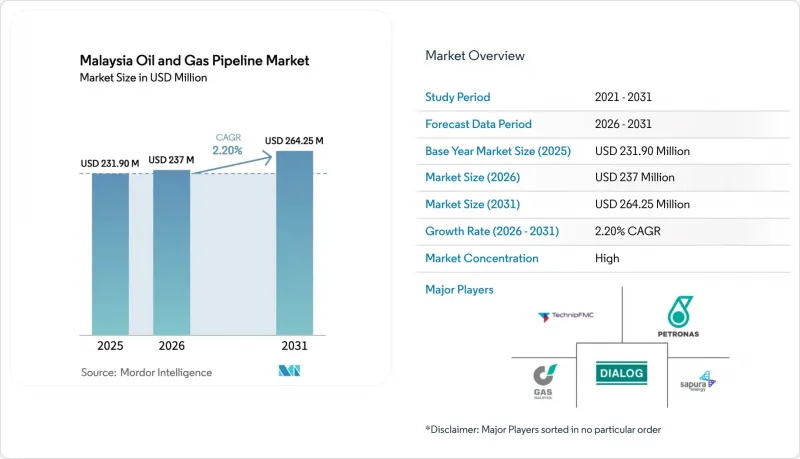
本報告按活動類型(資本支出、營運支出)、功能(收集管線、輸送管線、分配管線)、部署地點(陸上、海上)和最終用戶細分市場(上游產業(能源生產)、中游企業、下游產業/石化)進行細分。市場規模和預測均以美元計價。
馬來西亞油氣管道市場趨勢與洞察
電力生產和石化產業的擴張導致天然氣需求增加
到2027年下半年,馬來西亞國家石油公司(PETRONAS)位於西必丹的第三座浮體式液化天然氣(LNG)設施將每年新增200萬噸的天然氣供給能力,這將加速天然氣消費,並推動陸上天然氣管道的擴建。位於柔佛州、耗資53億美元的邊佳蘭能源綜合體預計每日可處理15萬桶冷凝油,需要在2028年前建造專用的成品油和冷凝油。馬來西亞國家石油公司與沙巴電力公司簽訂的1600萬標準立方英尺/日(MMscfd)的天然氣供應合約、在馬來西亞半島簽署的多份購電協議(PPA),以及從傑隆平台通過一條80公里長的管道進行的初始天然氣供應,都將共同增加輸送至馬來西亞半島管網的天然氣流量。 Enquest公司對Serigi氣田的升級改造將透過現有管線增加7,000萬標準立方英尺/日(MMscfd)的輸送能力,凸顯了棕地回接的經濟效益。所有這些項目都提升了運輸和發行系統的處理能力,推動了馬來西亞油氣管道市場的持續投資。
PETRONAS RAPID 的下游整合正在創造基礎設施協同效應。
RAPID綜合大樓擁有日處理能力達30萬桶的煉油廠和一體化石化廠,依托連接邊佳蘭與國內需求中心以及新加坡煉油廠樞紐的多產品平臺走廊。 RAPID實現了燃料、原料和成品油管道的共享,從而降低了單位運輸成本,並提高了管道資產的利用率。分階段的產能提升使管網擴張與產量成長計畫保持一致,並平衡了資本支出。該綜合體還促進了柔佛州第三方終端的建設,這將需要連接支線,從而產生對管道製造和安裝的二次需求。從長遠來看,RAPID的幹線運輸量將吸引區域現貨運輸量,鞏固馬來西亞作為東南亞運輸樞紐的地位,並擴大馬來西亞的油氣管道市場。
冗長的財政核准週期制約了專案進度。
環境評估涉及多個機構的審查,耗時可能長達24個月;而各州和聯邦政府的不同要求,又可能使幹線管道的核准流程延長18至30個月。在人口稠密地區徵地面臨重重障礙,不僅增加了補償成本,還可能引發法律糾紛,導致工程無限期停滯。 2025年4月布特拉高地爆炸事件發生後,安全規程加強,並新增了技術審查和文件編制流程。這些累積的延誤增加了資金籌措維修成本,降低了專案的淨現值,從而打擊了馬來西亞油氣管道產業開發商的積極性。
細分市場分析
預計到2025年,馬來西亞油氣管道市場的資本支出(CAPEX)將佔市場佔有率的63.55%,複合年成長率(CAGR)為4.07%,幾乎是整體市場成長率的兩倍。高價值項目,例如耗資10億馬幣的蘭卡威海底管線升級改造項目以及新建設計畫,佔據了大部分累積訂單。隨著馬來西亞國家石油公司(PETRONAS)加快材料採購以應對成本上漲,高強度管線、自動化焊接系統和腐蝕抑制劑的供應商正在獲得持續的合約。在地採購法規規定,製造必須在馬來西亞的造船廠進行,這將對就業和輔助服務產生連鎖反應。
營運支出 (OPEX) 構成了一筆穩定的退休金,這得益於對半島天然氣公司 (PGU) 2,551 公里管網的健康管理。大部分支出用於管道檢查、陰極防蝕系統升級以及洩漏檢測感測器的安裝。儘管管道退役仍處於早期階段,但隨著營運商計劃重新利用已退役的管道,退役工作正在加速推進,從而確保了營運支出的長期重要性。數位孿生和機器學習分析在製定維護計劃、減少意外停機時間和延長資產使用壽命方面發揮越來越重要的作用。這一趨勢正在緩解馬來西亞油氣管道市場的波動性。
2025年,在PGU公司30億標準立方英尺/日(MMscfd)的輸送能力支持下,運輸網路將佔馬來西亞油氣管道市場規模的52.20%。沙巴-砂拉越天然氣管道對東馬仍然至關重要,但部分管段需要考慮運作或維修以適應氫氣輸送。來自傑蘭油田等新油田的連接將提供額外的供應,維持處理能力,並為管道環線的擴建提供基礎。
此發行道以4.85%的複合年成長率成長,滿足了柔佛州和雪蘭莪州不斷成長的工業需求。馬來西亞天然氣公司(Gas Malaysia)五年預算中將撥出12億至14億馬幣用於建設800公里發行,為中小企業和大規模石化產品買家提供「最後一公里」連接。天然氣收集系統與上游鑽井速度保持同步,確保馬來西亞油氣管道市場均衡成長,尤其是在邊際叢集,這些區塊的衛星系統由多個油井組成,並向共用的處理中心供氣。
其他好處
- Excel格式的市場預測(ME)表
- 3個月的分析師支持
目錄
第1章:引言
- 研究假設和市場定義
- 調查範圍
第2章:調查方法
第3章執行摘要
第4章 市場狀況
- 市場概覽
- 市場促進因素
- 電力和石化項目導致天然氣需求增加
- 下游部門與PETRONAS RAPID整合的綜效
- 連接到邊際近海油田的回接工程正在推高對海底管線。
- 國家氫能發展藍圖,其中包括現有管道的改造利用
- 老舊陸上管線更新計畫(2025-2030 年)
- 將退役設備重新用於碳捕獲與封存 (CCS) 的機會
- 市場限制因素
- 新建幹線輸油管的財務審核週期越來越長。
- 受監管的天然氣運輸率較低
- 加強新建石油管線的環境、社會和治理(ESG)監管
- 深海焊接技術純熟勞工短缺
- 供應鏈分析
- 監理情勢
- 技術展望
- 管道輸送能力分析
- 即將進行的重大項目
- 波特五力模型
- PESTLE分析
第5章 市場規模與成長預測
- 按活動
- CAPEX
- 管道材料和設備
- 管道製造和建設
- OPEX
- 檢查
- MRO
- 退休
- CAPEX
- 按功能
- 整合線
- 運輸線路
- 配送線
- 按部署位置
- 陸上
- 離岸
- 按最終用戶細分
- 上游部門(EnP)
- 中游營運商
- 下游產業及石化產品
第6章 競爭情勢
- 市場集中度
- 策略趨勢(併購、聯盟、購電協議)
- 市場佔有率分析(主要公司的市場排名和佔有率)
- 公司簡介
- Petroliam Nasional Berhad(PETRONAS)
- PETRONAS Gas Berhad
- Sapura Energy Berhad
- Dialog Group Berhad
- Gas Malaysia Berhad
- JFE Engineering Corporation
- Stats Group
- Cortez Subsea Limited
- PBJV Group Sdn Bhd
- Yokogawa Kontrol(Malaysia)Sdn Bhd
- EcoPrasinos Engineering Sdn Bhd
- Punj Lloyd Limited
- Saipem SpA
- TechnipFMC plc
- McDermott International
- Worley Ltd.
- Malaysia Marine & Heavy Engineering
- Muhibbah Engineering(M)Bhd
- Asiaflex Products Sdn Bhd
- MMC Oil & Gas Engineering
第7章 市場機會與未來展望
According to Mordor Intelligence, the Malaysia oil and gas pipeline market size was valued at USD 231.90 million in 2025 and estimated to grow from USD 237 million in 2026 to reach USD 264.25 million by 2031, at a CAGR of 2.2% during the forecast period (2026-2031).
This report is Segmented by Activity (CAPEX and OPEX), Function (Gathering Lines, Transmission Lines, and Distribution Lines), Location of Deployment (Onshore and Offshore), and End-User Sector (Upstream, Midstream Operators, and Downstream and Petrochemicals). The Market Sizes and Forecasts are Provided in Terms of Value (USD).
Malaysia Oil And Gas Pipeline Market Trends and Insights
Rising Gas Demand from Power Generation and Petrochemical Expansion
Gas consumption accelerates as PETRONAS's third floating LNG unit at Sipitang adds 2 mtpa by H2 2027, driving new feed-gas lines to shore. The USD 5.3 billion Pengerang Energy Complex in Johor will process 150,000 barrels per day of condensate, necessitating dedicated product and condensate pipelines by 2028. PETRONAS's 16 MMscfd supply contract with Sabah Electricity, multiple Peninsular power PPAs, and first gas from the Jerun platform via an 80 km line collectively lift gas flows to Peninsula networks. EnQuest's Seligi upgrade adds 70 MMscfd through existing corridors, underscoring the economic benefits of brownfield tie-backs. Each of these projects heightens throughput on both transmission and distribution systems, reinforcing sustained investment in the Malaysia oil and gas pipeline market.
PETRONAS RAPID Downstream Integration Creating Infrastructure Synergies
The RAPID complex's 300,000 b/d refinery and integrated petrochemical trains rely on multi-product pipeline corridors that connect Pengerang with national demand centers and Singapore's refining hub. RAPID enables shared line usage for fuels, feedstocks, and byproducts, thereby lowering unit transport costs and increasing pipeline asset utilization. Phased capacity additions align network expansions with product ramp-up schedules, smoothing CAPEX outflows. The complex also stimulates third-party terminal builds in Johor that require link-in spurs, creating secondary demand for pipe fabrication and installation. Over the long term, RAPID's anchor volumes attract regional spot volumes, reinforcing Malaysia's role as Southeast Asia's transit interface and expanding the Malaysia oil and gas pipeline market.
Prolonged Fiscal Approval Cycles Constraining Project Timelines
Multiple agency reviews can extend environmental studies to 24 months and increase trunkline approvals by an additional 18-30 months when state and federal requirements diverge. Land acquisition hurdles in populated corridors increase compensation costs and lead to legal disputes that can halt work indefinitely. The April 2025 Putra Heights explosion triggered stricter safety protocols, adding fresh layers of technical vetting and documentation. These cumulative delays elevate financing carry costs and erode the net present value of projects, dampening developer appetite in the Malaysia oil and gas pipeline industry.
Other drivers and restraints analyzed in the detailed report include:
- Offshore Marginal Field Development Driving Subsea Pipeline Expansion
- National Hydrogen Roadmap Enabling Pipeline Repurposing Opportunities
- Low Regulated Gas Transmission Tariffs Pressuring Operator Margins
For complete list of drivers and restraints, kindly check the Table Of Contents.
Segment Analysis
CAPEX spending accounted for 63.55% of the Malaysian oil and gas pipeline market share in 2025 and is projected to grow at a 4.07% CAGR, nearly twice the overall rate. Large-ticket items, such as the RM1 billion Langkawi submarine replacement and the 1,130 km newbuild program through 2026, dominate order books. Suppliers of high-strength line pipe, automated welding systems, and corrosion inhibitors secure recurring contracts as PETRONAS front-loads material procurement to hedge cost escalation. Local content rules direct fabrication to Malaysian yards, creating multiplier effects on jobs and ancillary services.
OPEX forms a stable annuity stream anchored to the integrity management of the 2,551 km Peninsula Gas Utilisation (PGU) grid. Inline inspection runs, cathodic-protection upgrades, and leak-detection sensor installs account for the bulk of the spend. Decommissioning, although nascent, is gaining traction as operators plan for the reuse of retired lines, ensuring long-term OPEX relevance. Digital twins and machine-learning analytics are increasingly shaping maintenance schedules, reducing unplanned outages and extending asset life -a trend that mitigates volatility in the Malaysian oil and gas pipeline market.
Transmission networks accounted for 52.20% of the Malaysia oil and gas pipeline market size in 2025, anchored by the PGU's 3,000 MMscfd capacity. The Sabah-Sarawak Gas Pipeline remains pivotal for East Malaysia, although select segments require reactivation or hydrogen retrofit studies. New field tie-backs, such as Jerun, inject incremental volumes that sustain throughput and justify loop expansions.
Distribution pipelines, growing at a 4.85% CAGR, respond to expanding industrial loads in Johor and Selangor. Gas Malaysia's RM 1.2-1.4 billion five-year budget funds 800 km of distribution lines, unlocking last-mile connectivity to SMEs and large petrochemical off-takers. Gathering systems follow the upstream drilling pace, especially across marginal clusters where multi-well satellite systems feed shared processing hubs, ensuring balanced growth across the Malaysian oil and gas pipeline market.
Complete Report Scope:
- By Activity
- CAPEX
- Pipeline Materials and Equipment
- Pipeline Fabrication and Construction
- OPEX
- Inspection
- MRO
- Decommissioning
- CAPEX
- By Function
- Gathering Lines
- Transmission Lines
- Distribution Lines
- By Location of Deployment
- Onshore
- Offshore
- By End-user Sector
- Upstream (EnP)
- Midstream Operators
- Downstream and Petrochemicals
List of Companies Covered in this Report:
- Petroliam Nasional Berhad (PETRONAS)
- PETRONAS Gas Berhad
- Sapura Energy Berhad
- Dialog Group Berhad
- Gas Malaysia Berhad
- JFE Engineering Corporation
- Stats Group
- Cortez Subsea Limited
- PBJV Group Sdn Bhd
- Yokogawa Kontrol (Malaysia) Sdn Bhd
- EcoPrasinos Engineering Sdn Bhd
- Punj Lloyd Limited
- Saipem S.p.A.
- TechnipFMC plc
- McDermott International
- Worley Ltd.
- Malaysia Marine & Heavy Engineering
- Muhibbah Engineering (M) Bhd
- Asiaflex Products Sdn Bhd
- MMC Oil & Gas Engineering
Additional Benefits:
- The market estimate (ME) sheet in Excel format
- 3 months of analyst support
TABLE OF CONTENTS
1 Introduction
- 1.1 Study Assumptions & Market Definition
- 1.2 Scope of the Study
2 Research Methodology
3 Executive Summary
4 Market Landscape
- 4.1 Market Overview
- 4.2 Market Drivers
- 4.2.1 Rising gas demand from power & petrochemical projects
- 4.2.2 PETRONAS RAPID downstream integration synergies
- 4.2.3 Offshore marginal-field tie-backs boosting subsea lines
- 4.2.4 National hydrogen roadmap repurposing existing pipes
- 4.2.5 Aging on-shore pipe replacement programs (2025-30)
- 4.2.6 Decommissioning-to-CCS re-use opportunities
- 4.3 Market Restraints
- 4.3.1 Prolonged fiscal approval cycles for new trunklines
- 4.3.2 Low regulated gas-transmission tariffs
- 4.3.3 Heightened ESG scrutiny on new oil pipelines
- 4.3.4 Skilled-labour shortages for deep-water welding
- 4.4 Supply-Chain Analysis
- 4.5 Regulatory Landscape
- 4.6 Technological Outlook
- 4.7 Installed Pipeline Capacity Analysis
- 4.8 Key Upcoming Projects
- 4.9 Porter's Five Forces
- 4.9.1 Bargaining Power of Suppliers
- 4.9.2 Bargaining Power of Buyers
- 4.9.3 Threat of New Entrants
- 4.9.4 Threat of Substitutes
- 4.9.5 Competitive Rivalry
- 4.10 PESTLE Analysis
5 Market Size & Growth Forecasts
- 5.1 By Activity
- 5.1.1 CAPEX
- 5.1.1.1 Pipeline Materials and Equipment
- 5.1.1.2 Pipeline Fabrication and Construction
- 5.1.2 OPEX
- 5.1.2.1 Inspection
- 5.1.2.2 MRO
- 5.1.2.3 Decommissioning
- 5.1.1 CAPEX
- 5.2 By Function
- 5.2.1 Gathering Lines
- 5.2.2 Transmission Lines
- 5.2.3 Distribution Lines
- 5.3 By Location of Deployment
- 5.3.1 Onshore
- 5.3.2 Offshore
- 5.4 By End-user Sector
- 5.4.1 Upstream (EnP)
- 5.4.2 Midstream Operators
- 5.4.3 Downstream and Petrochemicals
6 Competitive Landscape
- 6.1 Market Concentration
- 6.2 Strategic Moves (M&A, Partnerships, PPAs)
- 6.3 Market Share Analysis (Market Rank/Share for key companies)
- 6.4 Company Profiles (includes Global level Overview, Market level overview, Core Segments, Financials as available, Strategic Information, Products & Services, and Recent Developments)
- 6.4.1 Petroliam Nasional Berhad (PETRONAS)
- 6.4.2 PETRONAS Gas Berhad
- 6.4.3 Sapura Energy Berhad
- 6.4.4 Dialog Group Berhad
- 6.4.5 Gas Malaysia Berhad
- 6.4.6 JFE Engineering Corporation
- 6.4.7 Stats Group
- 6.4.8 Cortez Subsea Limited
- 6.4.9 PBJV Group Sdn Bhd
- 6.4.10 Yokogawa Kontrol (Malaysia) Sdn Bhd
- 6.4.11 EcoPrasinos Engineering Sdn Bhd
- 6.4.12 Punj Lloyd Limited
- 6.4.13 Saipem S.p.A.
- 6.4.14 TechnipFMC plc
- 6.4.15 McDermott International
- 6.4.16 Worley Ltd.
- 6.4.17 Malaysia Marine & Heavy Engineering
- 6.4.18 Muhibbah Engineering (M) Bhd
- 6.4.19 Asiaflex Products Sdn Bhd
- 6.4.20 MMC Oil & Gas Engineering
7 Market Opportunities & Future Outlook
- 7.1 White-space & Unmet-Need Assessment

 石油和天然氣管道:市場佔有率分析、行業趨勢和統計數據、成長預測(2026-2031 年)
 石油和天然氣管道市場-2026-2032年全球市場預測
 2026-2030年全球油氣管道市場
 半導體人才儲備發展市場預測至2034年:全球人才來源、技能領域、交付方式、相關人員與區域分析燃氣排水管市場:依材料、應用、最終用戶、壓力等級、安裝方式和通路分類,全球預測,2026-2032年
 石油和天然氣管道市場-全球產業規模、佔有率、趨勢、機會及預測(按類型、應用、材料、地區和競爭格局分類,2021-2031年)石油管線修復樹脂市場(按樹脂類型、形態、應用、最終用途和銷售管道分類),全球預測(2026-2032)
 全球石油、天然氣管線產業預測(~2030年)- 生產能力和設備投資預測,運作中、計劃中的全開發平台(管線)詳細內容
 石油和天然氣管道市場分析及預測至 2033 年:按類型、產品、服務、技術、組件、應用、材料類型、製程、最終用戶東南亞石油和天然氣管道-市場佔有率分析、產業趨勢和成長預測(2025-2030 年)