


 |
市場調查報告書
商品編碼
2122390
抽水蓄能水力發電(PHS):市場佔有率分析、產業趨勢與統計、成長預測(2026-2031 年)Pumped Hydro Storage (PHS) - Market Share Analysis, Industry Trends & Statistics, Growth Forecasts (2026 - 2031) |
||||||

※ 本網頁內容可能與最新版本有所差異。詳細情況請與我們聯繫。
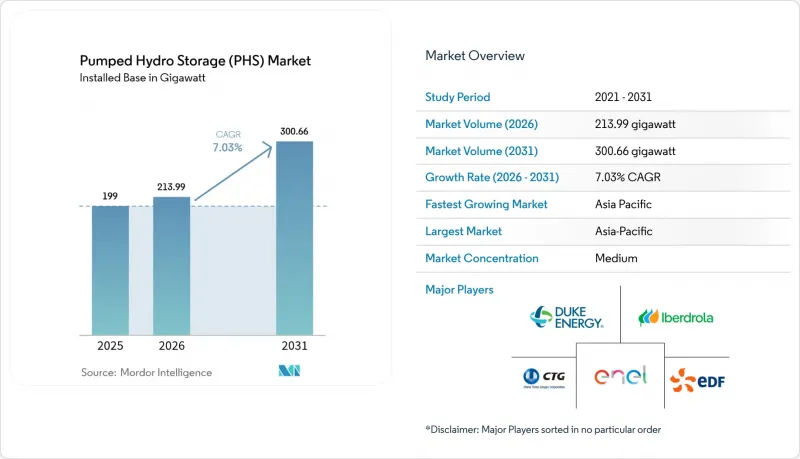
據 Mordor Intelligence 稱,2025 年抽水蓄能水力發電 (PHS) 市場規模為 199 吉瓦,預計到 2031 年將從 2026 年的 213.99 吉瓦成長至 300.66 吉瓦,預測期(2026-2031 年)的複合年成長率為 7.03%。
本報告按類型(開放回路型、封閉回路型)、額定輸出(小於 200 MW、200-1,000 MW、大於 1,000 MW)、儲層配置(地表到地表、地表到地下)、應用(可再生能源穩定、電網支援服務、套利/尖峰用電調節)和地區(北美、歐洲、亞太地區分類、北美、歐洲和非洲)。
全球抽水蓄能水力發電市場趨勢與洞察
強制推行電網級可再生能源併網將加速其普及應用。
清潔能源的強制性目標正促使電力公司和國家負責人擴大抽水蓄能水力發電市場,中國承諾到2030年實現120吉瓦的裝置容量就是一個政策主導擴張的典型例子。 「抽水蓄能+」模式將可再生能源群與鄰近的倉儲設施連接起來,以緩解棄風棄光並降低電網擴建成本。在歐洲,類似的措施正在透過「通用利益項目(PCI)」清單進行,該清單包含12個儲能項目,並簡化了核准程序。西班牙7億歐元的補貼計畫進一步支持了這些舉措,透過提供明確的回報預測來降低投資者的風險。
運作老舊的水力發電基礎設施將釋放潛在的發電能力。
透過加裝可逆式抽水機對現有水壩進行現代化改造,可以在不引發待開發區案常見的土地利用爭議的情況下,使老舊資產重煥生機。美國能源局斥資4.3億美元升級全國水力發電設施的舉措,清楚展現了其潛在效益的規模。安大略省發電公司斥資10億美元對八座電廠進行維修,預計透過安裝高效機組,將新增1617兆瓦的裝置容量;而墨西哥九座電廠的維修,預計將使年發電量增加1754吉瓦時,並延長其運作壽命50年。
長期環境影響評估限制了開發進度。
針對地質、生物多樣性和文化遺產的調查可能需要5到10年時間,導致成本超支和授權核准困難。雖然封閉系統可以減輕對水生環境的影響,但水文地質風險仍需要逐一評估,紐約州米內維爾的申請就證明了這一點。
細分市場分析
預計到2025年,封閉回路型水力發電廠將佔抽水蓄能水力發電市場的53.40%,年複合成長率達7.56%。這主要歸功於閉迴路式水力發電廠與河流隔離,減少了對水生環境的影響,以及其簡化的核准流程。聯邦能源監管委員會(FERC)目前專門針對此類計畫提供為期兩年的快速核准程序,進一步增強了其推廣優勢。雖然開放回路型水力發電廠仍然佔據相當大的佔有率,但生態系統監測正變得日益嚴格,尤其是在流量控制和魚類洄游是關鍵關注點的地區。
封閉回路型系統透過利用廢棄礦場和採石場等新型場地,拓展了抽水蓄能水力發電市場的地理覆蓋範圍。生命週期分析表明,低泥沙淤積風險和簡單的排水流程使營運商能夠維持數十年的高往返效率。同時,供應商正在改進適用於專用水庫並能快速切換運轉模式的變速水泵水輪機,這對於調節可再生能源的供需至關重要。
2025年,裝置容量在200-1000兆瓦之間的抽水蓄能電站將佔抽水蓄能市場規模的45.20%,因為它們能夠使資本投資與電網容量限制相符。區域營運商,例如阿達尼綠色能源公司在北方邦的1250兆瓦項目,展示瞭如何透過協調運作與電網升級來避免因電網擁塞而導致的發電量限制。
隨著分散式架構的興起,預計到2031年,200兆瓦以下的電站將以8.06%的複合年成長率成長。由於其環境影響較小,更容易獲得地方政府的批准,而模組化土木工程降低了施工風險,從而提高了投資者的興趣。另一方面,1000兆瓦以上的項目雖然具有大規模的發展潛力,但前置作業時間更長,且面臨更嚴格的公眾審查。中國3.6吉瓦的豐寧電站計畫就是一個例證,該計畫需要大量的生態補償。
區域分析
預計到2025年,亞太地區將佔抽水蓄能水力發電市場的48.40%,其中中國已安裝50.94吉瓦的抽水蓄能電站,並有超過300座在建電站項目正在積極推進中,預計年複合成長率將達到8.85%。北京的規劃體係正在將儲能技術與可再生能源基礎設施結合,以最大限度地減少發電限制,並降低加強輸電網的成本。同時,印度103吉瓦的技術潛力仍未充分開發,但在推出優惠的電價指導方針後,印度已做好全面建設的準備。
歐洲抽水蓄能水力發電市場正獲得歐盟5,840億歐元電網現代化藍圖的強力政策支持,該路線圖將儲能列為關鍵資產類別。歐洲投資銀行(EIB)等機構貸款方已向伊維爾多羅拉公司(Iberdorola)提供1.08億歐元的優惠貸款,用於在2025年維修和提升伊比利亞半島的設施發電量、提高水庫效率並增強尖峰時段供給能力。阿爾卑斯山國家繼續利用其天然的海拔差異優勢,而英國的「上限和下限」機制已使格倫馬克洛克(Glenmaclock)和科伊爾格拉斯(Coir Grass)計畫做好最終投資決策的準備。
在《通膨抑制法案》的推動下,北美正處於復甦階段。該法案為抽水蓄能水力發電市場提供30%的投資稅額扣抵(ITC),與電池儲能的優惠力道相當。一項總裝置容量達39.5吉瓦的項目計劃在亞利桑那州、奧勒岡州和阿巴拉契亞山脈地區建設,其中三個項目已獲得聯邦能源監管委員會(FERC)的批准。加拿大則專注於現代化改造,安大略省發電公司斥資10億美元的專案表明,維修老舊渦輪機無需新的土木工程即可立即提高發電能力。
其他好處:
- Excel格式的市場預測(ME)表
- 3個月的分析師支持
目錄
第1章:引言
- 市場分析與定義的前提條件
- 分析範圍
第2章 分析方法
第3章執行摘要
第4章 市場狀況
- 市場概覽
- 市場促進因素
- 可再生能源
- 利用可逆式發電裝置對老舊水力發電廠維修
- 美國《通貨膨脹控制法》下的長期儲存激勵措施
- 歐盟戰略性儲能資產快速許可程序
- 透過與浮體式太陽能發電相結合,24 小時內的現金流 (CF) 將得到改善。
- 在環境影響較小的封閉回路型工程中利用廢棄礦山和採石場
- 市場限制因素
- 環境影響評估所需時間越來越長。
- 與鋰離子電池的其他技術相比,初始資本支出(CAPEX)較高。
- 都市區缺乏適合建造雙水庫的地形。
- 併網費用的不確定性影響儲能套利利潤
- 供應鏈分析
- 抽水蓄能能源儲存系統系統的成本分析
- 監理情勢
- 技術展望
- 波特五力分析
第5章:預測市場規模與成長率
- 按類型
- 開放回路型型
- 封閉回路型型
- 按額定輸出功率(兆瓦)
- 小於200兆瓦
- 200~1,000 MW
- 1000兆瓦或以上
- 按儲層組成
- 地球表面之間
- 地表與地下之間
- 透過使用
- 可再生能源的穩定
- 系統支援服務
- 套利交易/尖峰用電調節
- 按地區
- 北美洲
- 美國
- 加拿大
- 墨西哥
- 歐洲
- 德國
- 英國
- 法國
- 義大利
- 西班牙
- 其他歐洲國家
- 亞太地區
- 中國
- 印度
- 日本
- 韓國
- 東南亞國協
- 其他亞太國家
- 南美洲
- 阿根廷
- 其他南美國家
- 中東和非洲
- 伊朗
- 摩洛哥
- 南非
- 其他中東和非洲國家
- 北美洲
第6章 競爭情勢
- 市場集中度
- 策略趨勢(併購、聯盟、購電協議)
- 市場佔有率分析(主要公司的市場排名和佔有率)
- 公司簡介
- Operators
- Duke Energy Corporation
- E.ON SE
- Enel SpA
- Electricite de France SA(EDF)
- Iberdrola SA
- China Three Gorges Corporation
- Pacific Gas & Electric Company
- Xcel Energy Inc.
- AGL Energy Ltd
- Statkraft AS
- Technology Providers
- General Electric Company
- Siemens AG
- Andritz AG
- Mitsubishi Heavy Industries Ltd
- Voith GmbH & Co. KGaA
- Ansaldo Energia SpA
- Toshiba Energy Systems & Solutions
- Hitachi Energy Ltd
- Kossler GmbH
- Hyosung Heavy Industries Co., Ltd
- Operators
第7章 市場機會與未來展望
According to Mordor Intelligence, the pumped hydro storage market size was valued at 199 gigawatt in 2025 and estimated to grow from 213.99 gigawatt in 2026 to reach 300.66 gigawatt by 2031, at a CAGR of 7.03% during the forecast period (2026-2031).
This report is Segmented by Type (Open-Loop and Closed-Loop), Power Rating (Below 200 MW, 200-1, 000 MW, and Above 1, 000 MW), Reservoir Configuration (Surface-To-Surface and Surface-To-Underground), Application (Renewable Firming, Ancillary Grid Services, and Arbitrage and Peak Shaving), and Geography (North America, Europe, Asia-Pacific, South America, and Middle East and Africa).
Global Pumped Hydro Storage (PHS) Market Trends and Insights
Grid-scale renewable integration mandates drive deployment acceleration
Mandatory clean-energy targets are pushing utilities and state planners to expand the pumped hydro storage market, with China's pledge for 120 GW by 2030 exemplifying the policy-led build-out. The "PSH-plus" model links renewable clusters with adjacent storage, trimming curtailment, and easing grid expansion costs. Europe mirrors this through its Projects of Common Interest list, which features 12 storage schemes that enjoy streamlined permitting.Spain's EUR 700 million subsidy window further underlines national follow-through, providing clear revenue visibility that de-risks investor returns.
Repowering ageing hydro infrastructure unlocks latent capacity
Modernizing existing dams by adding reversible pump-turbines breathes new life into legacy assets without the land-use controversies of greenfield builds. The US Department of Energy's USD 430 million initiative to upgrade the domestic fleet demonstrates the scale of latent gains. Ontario Power Generation's USD 1 billion rehabilitation of eight stations adds 1,617 MW via higher-efficiency units, while Mexico's nine-plant refurbishments will raise annual output by 1,754 GWh and extend operational lives by five decades.
Lengthy environmental impact assessments constrain development timelines
Studies covering geology, biodiversity, and cultural heritage can take 5-10 years, adding cost overruns and permitting fatigue. Closed-loop schemes mitigate aquatic impacts, yet hydro-geological risks still demand case-specific reviews, as the Mineville filing in New York shows.
Other drivers and restraints analyzed in the detailed report include:
- Inflation Reduction Act incentives catalyze US market revival
- EU fast-track licensing streamlines strategic asset development
- High upfront CAPEX versus lithium-ion alternatives
For complete list of drivers and restraints, kindly check the Table Of Contents.
Segment Analysis
Closed-loop plants accounted for 53.40% of the pumped hydro storage market share in 2025 and are pacing at a 7.56% CAGR, largely because decoupling from rivers curtails aquatic disruption and speeds approvals. The Federal Energy Regulatory Commission now offers an accelerated two-year license solely for such projects, reinforcing their deployment advantage. Open-loop facilities retain a sizeable base but confront intensifying ecosystem scrutiny, especially where flow regulation or fish passage is contentious.
Closed-loop schemes also unlock new topographies, including disused mine pits and quarries, broadening the pumped hydro storage market's geographic reach. Lifecycle analyses show lower sedimentation risk and simpler de-watering processes, helping operators maintain high round-trip efficiencies for decades. In parallel, suppliers are refining variable-speed pump-turbines that fit purpose-built reservoirs and allow rapid mode changes, crucial for renewables balancing.
Plants between 200 MW and 1,000 MW delivered 45.20% of the pumped hydro storage market size in 2025 because they harmonize capital outlay with grid uptake limits. Regional operators such as Adani Green's 1,250 MW Uttar Pradesh project demonstrate how synchronized commissioning with transmission upgrades protects against congestion curtailment.
As distributed architectures emerge, installations below 200 MW record an 8.06% CAGR through 2031. Their lighter environmental footprint garners quicker local authority consent, and modular civil works lower schedule risk, fueling investor interest. Conversely, projects over 1,000 MW, while offering bulk inertia, confront longer lead times and heightened public scrutiny-witnessed by China's 3.6 GW Fengning build that demanded substantial ecological offsets.
Complete Report Scope:
- By Type
- Open-loop
- Closed-loop
- By Power Rating (MW)
- Below 200 MW
- 200 to 1,000 MW
- Above 1,000 MW
- By Reservoir Configuration
- Surface-to-Surface
- Surface-to-Underground
- By Application
- Renewable Firming
- Ancillary Grid Services
- Arbitrage & Peak Shaving
- By Geography
- North America
- United States
- Canada
- Mexico
- Europe
- Germany
- United Kingdom
- France
- Italy
- Spain
- Rest of Europe
- Asia Pacific
- China
- India
- Japan
- South Korea
- ASEAN Countries
- Rest of Asia Pacific
- South America
- Argentina
- Rest of South America
- Middle East and Africa
- Iran
- Morocco
- South Africa
- Rest of Middle East and Africa
- North America
Geography Analysis
Asia-Pacific held 48.40% of the pumped hydro storage market in 2025 and is posting a 8.85% CAGR owing to China's 50.94 GW installed base and an aggressive >300-plant pipeline. Beijing's planning regime integrates storage with renewable bases, minimizing curtailment and shaving grid reinforcement costs, while India's 103 GW technical potential remains largely untapped but is now primed for build-out after the release of supportive tariff guidelines.
Europe's pumped hydro storage market enjoys policy heft via the EU's €584 billion grid-modernization roadmap, which earmarks storage as a priority asset class. Institutional lenders like the European Investment Bank channel concessional loans-€108 million to Iberdrola in 2025-to refurbish and uprate Iberian plants, improving reservoir efficiency and adding peak capacity. Alpine nations continue to exploit natural elevation advantages, while the UK's cap-and-floor mechanism has readied Glenmuckloch and Coire Glas for final investment decisions.
North America is rebounding under the Inflation Reduction Act, which gives the pumped hydro storage market direct parity with batteries under a 30% ITC. A 39.5 GW pipeline traverses Arizona, Oregon, and the Appalachians, with three schemes already through the FERC gate. Canada focuses on modernization; Ontario Power Generation's USD 1 billion program illustrates how refurbishing ageing turbines can yield immediate incremental megawatts without new civil works.
- Operators
- Technology Providers
Additional Benefits:
- The market estimate (ME) sheet in Excel format
- 3 months of analyst support
TABLE OF CONTENTS
1 Introduction
- 1.1 Study Assumptions & Market Definition
- 1.2 Scope of the Study
2 Research Methodology
3 Executive Summary
4 Market Landscape
- 4.1 Market Overview
- 4.2 Market Drivers
- 4.2.1 Grid-scale renewable integration mandates
- 4.2.2 Repowering of ageing hydro dams with reversible units
- 4.2.3 Long-duration storage incentives in Inflation Reduction Act (USA)
- 4.2.4 Fast-track licensing in EU for strategic energy-storage assets
- 4.2.5 Co-location with floating solar to raise round-the-clock CF
- 4.2.6 Use of disused mines & quarries for low-impact closed-loop projects
- 4.3 Market Restraints
- 4.3.1 Lengthy environmental impact assessments
- 4.3.2 High upfront CAPEX vs. lithium-ion alternatives
- 4.3.3 Scarcity of suitable dual-reservoir topographies in urban centres
- 4.3.4 Grid tariff uncertainty for storage arbitrage revenues
- 4.4 Supply-Chain Analysis
- 4.5 Cost Analysis of Pumped-Hydro Energy-Storage Systems
- 4.6 Regulatory Landscape
- 4.7 Technological Outlook
- 4.8 Porter's Five Forces
- 4.8.1 Bargaining Power of Suppliers
- 4.8.2 Bargaining Power of Buyers
- 4.8.3 Threat of New Entrants
- 4.8.4 Threat of Substitutes
- 4.8.5 Intensity of Rivalry
5 Market Size & Growth Forecasts
- 5.1 By Type
- 5.1.1 Open-loop
- 5.1.2 Closed-loop
- 5.2 By Power Rating (MW)
- 5.2.1 Below 200 MW
- 5.2.2 200 to 1,000 MW
- 5.2.3 Above 1,000 MW
- 5.3 By Reservoir Configuration
- 5.3.1 Surface-to-Surface
- 5.3.2 Surface-to-Underground
- 5.4 By Application
- 5.4.1 Renewable Firming
- 5.4.2 Ancillary Grid Services
- 5.4.3 Arbitrage & Peak Shaving
- 5.5 By Geography
- 5.5.1 North America
- 5.5.1.1 United States
- 5.5.1.2 Canada
- 5.5.1.3 Mexico
- 5.5.2 Europe
- 5.5.2.1 Germany
- 5.5.2.2 United Kingdom
- 5.5.2.3 France
- 5.5.2.4 Italy
- 5.5.2.5 Spain
- 5.5.2.6 Rest of Europe
- 5.5.3 Asia Pacific
- 5.5.3.1 China
- 5.5.3.2 India
- 5.5.3.3 Japan
- 5.5.3.4 South Korea
- 5.5.3.5 ASEAN Countries
- 5.5.3.6 Rest of Asia Pacific
- 5.5.4 South America
- 5.5.4.1 Argentina
- 5.5.4.2 Rest of South America
- 5.5.5 Middle East and Africa
- 5.5.5.1 Iran
- 5.5.5.2 Morocco
- 5.5.5.3 South Africa
- 5.5.5.4 Rest of Middle East and Africa
- 5.5.1 North America
6 Competitive Landscape
- 6.1 Market Concentration
- 6.2 Strategic Moves (M&A, Partnerships, PPAs)
- 6.3 Market Share Analysis (Market Rank/Share for key companies)
- 6.4 Company Profiles (includes Global level Overview, Market level overview, Core Segments, Financials as available, Strategic Information, Products & Services, and Recent Developments)
- 6.4.1 Operators
- 6.4.1.1 Duke Energy Corporation
- 6.4.1.2 E.ON SE
- 6.4.1.3 Enel SpA
- 6.4.1.4 Electricite de France SA (EDF)
- 6.4.1.5 Iberdrola SA
- 6.4.1.6 China Three Gorges Corporation
- 6.4.1.7 Pacific Gas & Electric Company
- 6.4.1.8 Xcel Energy Inc.
- 6.4.1.9 AGL Energy Ltd
- 6.4.1.10 Statkraft AS
- 6.4.2 Technology Providers
- 6.4.2.1 General Electric Company
- 6.4.2.2 Siemens AG
- 6.4.2.3 Andritz AG
- 6.4.2.4 Mitsubishi Heavy Industries Ltd
- 6.4.2.5 Voith GmbH & Co. KGaA
- 6.4.2.6 Ansaldo Energia SpA
- 6.4.2.7 Toshiba Energy Systems & Solutions
- 6.4.2.8 Hitachi Energy Ltd
- 6.4.2.9 Kossler GmbH
- 6.4.2.10 Hyosung Heavy Industries Co., Ltd
- 6.4.1 Operators
7 Market Opportunities & Future Outlook
- 7.1 White-space & Unmet-Need Assessment

 抽水蓄能水力發電市場預測至 2034 年-按類型、電廠配置、水庫配置、水泵水輪機配置、容量、儲存週期、應用、最終用戶和地區進行全球分析。
 抽水蓄能水力發電市場-2026-2032年全球市場預測
 2026年全球抽水蓄能市場報告
 抽水蓄能水力發電市場:按類型和地區分類
 抽水蓄能市場-全球產業規模、佔有率、趨勢、機會及預測(依系統、應用、區域及競爭格局分類,2021-2031年)大型能源儲存系統市場(按儲能技術、容量範圍、持續時間、所有權類型、配置、應用和最終用戶分類)-2026年至2032年全球預測
 抽水蓄能水電市場規模、佔有率及成長分析(按類型、儲能容量、抽水蓄能機組容量、計劃類型、最終用戶及地區分類)-2026-2033年產業預測
 亞太地區抽水蓄能:市場佔有率分析、產業趨勢與成長預測(2025-2030 年)北美抽水蓄能能源:市場佔有率分析、產業趨勢與成長預測(2025-2030)南美洲抽水蓄能儲能:市場佔有率分析、產業趨勢與成長預測(2025-2030)