


 |
市場調查報告書
商品編碼
2122387
空氣壓縮機:市佔率分析、產業趨勢及統計、成長預測(2026-2031)Air Compressor - Market Share Analysis, Industry Trends & Statistics, Growth Forecasts (2026 - 2031) |
||||||

※ 本網頁內容可能與最新版本有所差異。詳細情況請與我們聯繫。
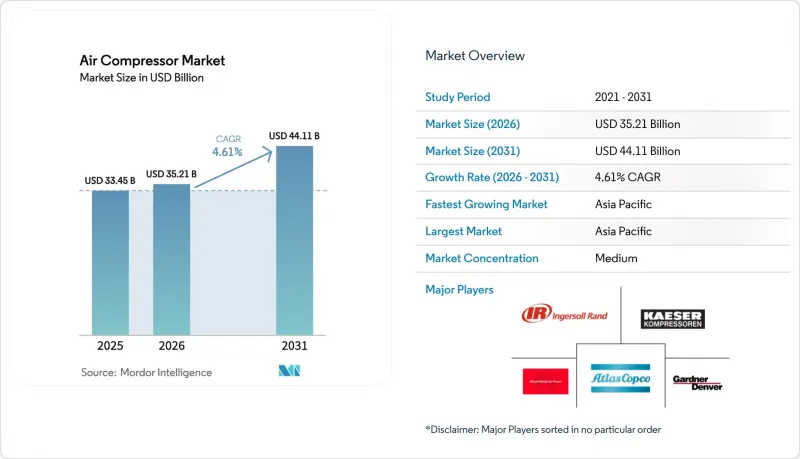
根據 Mordor Intelligence 預測,空氣壓縮機市場規模預計將在 2025 年達到 334.5 億美元,2026 年達到 352.1 億美元,到 2031 年達到 441.1 億美元,2026 年至 2031 年的複合年成長率為 4.61%。
本報告依運行原理(固定式、攜帶式、動態式)、技術(注油式、無油式)、便攜性(固定式、可攜式)、冷卻方式(空冷式、水冷式)、額定輸出功率(101-300 kW、500 kW 及以上、其他)、最終用戶業(製造業、石油及其他地區發電業、石油及其他地區進行北美地區天然氣(製造業、石油及其他地區)。
全球空氣壓縮機市場趨勢及洞察
電氣化導致對無油壓縮機的需求增加
製藥、半導體和食品包裝行業對 ISO 8573-1 純度標準的日益嚴格,正推動著從油潤滑設計向無油設計的轉變,這不僅降低了潤滑油的處置成本,也符合企業在整個生命週期內減少碳排放的承諾。注重成本的維修優先考慮提升過濾性能,導致無油技術的普及率呈現兩極化。零級空氣對於電池式電動車和氫燃料電池車的生產線至關重要,推動無油市場的複合年成長率超過了整體市場 4.61% 的成長率。原始設備製造商 (OEM) 正透過提供無油硬體和能源管理軟體的打包服務來加強客戶維繫。
液化天然氣和氫能基礎設施的資本支出(CAPEX)激增。
預計到2030年,全球將建成超過230吉瓦的電解槽產能,而每吉瓦的產能都需要大規模的氫氣壓縮設備用於儲存、管道輸送和氨合成。液化天然氣出口終端也同樣需要訂購兆瓦級的離心式壓縮機系統。Honeywell以18.1億美元收購空氣產品公司的液化天然氣設施業務,進一步強化了其一體化壓縮和液化業務策略。高壓氫氣專用材料是一個盈利的細分市場,但專案啟動需要時間。
變速無油系統的初始成本較高
由於變頻無油壓縮機的初始投資成本高出25%至50%,印度、東南亞和拉丁美洲的中小企業難以採用這些設備。雖然大型用戶可以透過降低生命週期成本來抵消初始成本,但資金籌措困難和租賃基礎設施不完善阻礙了其普及。儘管零件價格往往會隨著規模的擴大而下降,但預計在預測期內不會出現向大眾市場的過渡。
細分市場分析
在液化天然氣 (LNG)、氫氣和碳捕獲、利用與封存 (CCUS) 專案中,由於對高處理能力和無油運行的重視,動態壓縮機預計將進一步擴大其在空氣壓縮機市場的佔有率。儘管到 2025 年,容積式壓縮機仍將主導空氣壓縮機市場,但預計到 2031 年,離心式和軸流式壓縮機的複合年成長率將達到 5.3%。往復式壓縮機對於壓力超過 300 巴的應用仍然至關重要,尤其是在氫氣加註領域。結合旋轉螺桿和離心級的混合結構清晰地展現了技術的持續融合。
這些變化在區域層面也顯而易見。沿岸地區的液化天然氣出口終端正在訂購多級離心式壓縮機組,而中國氫能一體化運營商則更傾向於在中壓電電解槽的輔助設備應用中使用無油螺桿式壓縮機。北美壓縮天然氣加氣站和歐洲工業氣體領域對往復式壓縮機的需求仍然強勁。原始設備製造商(OEM)正在擴展模組化平台,利用通用零件庫存,可將壓力範圍從5巴擴展到350巴,旨在降低生命週期成本。
無油空氣淨化裝置以5.2%的複合年成長率成長,在監管和責任壓力日益增加的背景下,正向製藥、食品飲料和半導體產業擴張。同時,由於初始投資成本較低且易於維護,油浸式泛光系統仍是工業領域空氣供應的主要來源。
水噴射螺桿壓縮機和磁浮軸承等技術進步降低了壓縮機在其整個生命週期中的摩擦,並將容量擴展至500千瓦以上。在台灣和韓國的半導體潔淨室中,目前已指定使用無油空氣軸承離心式壓縮機;而在歐洲的飲料填充廠,水封螺桿壓縮機正在維修,以省去下游過濾工序。預計這兩種技術將在採礦和建設產業繼續並存,在這些行業中,使用後置過濾器仍然可以容忍油霧的存在。
區域分析
預計到2025年,亞太地區將佔據全球空氣壓縮機市場43.7%的佔有率,並在2031年之前保持5.0%的複合年成長率,這主要得益於中國氫能基礎設施的快速擴張和印度基礎設施的蓬勃發展。中國正在將其電解槽年產能提升至165吉瓦,對離心式和螺桿式壓縮機產生了巨大的需求。同時,在印度,高速公路和地鐵的建設推動了可攜式壓縮機租賃的需求。在日本和韓國,超潔淨、無油壓縮機正被廣泛應用於半導體和燃料電池汽車領域,該地區也因此需要為磁軸承和碳化矽變頻驅動裝置支付更高的成本。
在北美,製造業回流、墨西哥灣沿岸LNG接收站的建設以及超大規模資料中心的興起,正推動固定式設備安裝量激增,預計到2025年,固定式設備將佔銷售額的四分之一左右。美國中西部地區的碳捕集與利用(CCUS)計畫正受惠於45Q稅額扣抵,從而帶動多級二氧化碳壓縮機訂單的成長。在加拿大,氫能策略的資金支持正推動亞伯達油砂業務轉型為低碳氫化合物,這需要高壓往復式壓縮機。墨西哥的近岸外包需求正推動中型固定式壓縮機和柴油可攜式壓縮機的採購,以加快工廠建設。
歐洲約佔20%的市場佔有率,其中德國、法國和北歐國家在綠色氫能和碳捕獲、利用與封存(CCUS)試點計畫方面主導地位。歐盟的ISO 50001採購法規正在加速變頻驅動器(VSD)的普及應用。東歐是電動車電池生產中心,無油技術規範正被納入超級工廠的設計中。該地區也正在率先引入與區域供熱迴路相連的水冷壓縮機,從而提高專案的投資回報率。
預計到2025年,南美洲、中東和非洲將佔全球支出的約10%。巴西的鹽層下礦藏和阿根廷的鋰礦正在推動對大型可攜式壓縮機的需求,而卡達和阿拉伯聯合大公國液化天然氣出口的擴張則催生了對大型離心式壓縮機組的需求。在非洲,由於電網不穩定,柴油可攜式壓縮機仍然在礦山和建築工地廣泛使用。這些地區人工智慧驅動的維護技術普及緩慢,主要受工業物聯網(IIoT)滲透率有限的影響。
其他好處:
- Excel格式的市場預測(ME)表
- 3個月的分析師支持
目錄
第1章:引言
- 市場分析與定義的前提條件
- 分析範圍
第2章 分析方法
第3章執行摘要
第4章 市場狀況
- 市場概覽
- 市場促進因素
- 電氣化導致對無油壓縮機的需求增加
- 液化天然氣和氫能基礎設施領域的資本投資激增。
- 新冠疫情後,北美和歐洲的製造業正回流本國。
- 工業設備能源效率強制規定
- 人工智慧驅動的預測性維護模組的快速普及
- 新推出的碳捕獲壓縮撬裝設備
- 市場限制因素
- 變速系統和無油系統的初始成本很高。
- 原料價格波動(鐵、鋼、稀土元素磁鐵)
- 新興國家電網的不穩定性推高了對柴油發電機租賃的需求。
- 原始設備製造商 (OEM) 面臨先進轉子幾何設計方面熟練人才短缺的問題。
- 供應鏈分析
- 監理情勢
- 技術展望
- 波特五力分析
第5章:預測市場規模與成長率
- 運行原理
- 正位移
- 往復式
- 旋轉螺桿
- 轉葉
- 動態的
- 離心式
- 軸
- 正位移
- 透過技術
- 注油法
- 無油
- 可移植性
- 固定式
- 可攜式的
- 透過冷卻法
- 空冷式
- 水冷
- 額定功率
- 100千瓦或以下
- 101~300 kW
- 301~500 kW
- 超過500千瓦
- 按最終用戶行業分類
- 製造業
- 石油和天然氣
- 發電
- 化工/石油化工
- 採礦和建設業
- 食品/飲料
- 醫療保健
- 其他
- 按地區
- 北美洲
- 美國
- 加拿大
- 墨西哥
- 歐洲
- 德國
- 英國
- 法國
- 義大利
- 北歐國家
- 俄羅斯
- 其他歐洲國家
- 亞太地區
- 中國
- 印度
- 日本
- 韓國
- 東南亞國協
- 其他亞太國家
- 南美洲
- 巴西
- 阿根廷
- 其他南美國家
- 中東和非洲
- 沙烏地阿拉伯
- 阿拉伯聯合大公國
- 南非
- 埃及
- 其他中東和非洲國家
- 北美洲
第6章 競爭情勢
- 市場集中度
- 策略趨勢(併購、聯盟、購電協議)
- 市場佔有率分析(主要公司的市場排名和佔有率)
- 公司簡介
- Atlas Copco AB
- Ingersoll Rand Inc.
- Hitachi Global Air Power(Sullair)
- Gardner Denver Industries
- Siemens Energy Compressor Business
- Kaeser Kompressoren SE
- Elgi Equipments Ltd
- Kobe Steel(Kobelco Compressors)
- Mitsubishi Heavy Industries Compressor Corp.
- Doosan Portable Power
- Kaishan Compressor Co. Ltd
- BOGE Kompressoren
- Aerzen Maschinenfabrik GmbH
- Quincy Compressor
- Chicago Pneumatic
- Bauer Kompressoren GmbH
- Hanwha Power Systems
- Danfoss Turbocor Compressors
- Sulzer Ltd
- General Electric(GE Aero-Derivatives)
第7章 市場機會與未來展望
According to Mordor Intelligence, the air compressor market size is projected to be USD 33.45 billion in 2025, USD 35.21 billion in 2026, and reach USD 44.11 billion by 2031, growing at a CAGR of 4.61% from 2026 to 2031.
This report is Segmented by Operating Principle (Positive Displacement and Dynamic), Technology (Oil-Flooded and Oil-Free), Portability (Stationary and Portable), Cooling Method (Air-Cooled and Water-Cooled), Power Rating (101-300 KW, Above 500 KW, and More), End-User Industry (Manufacturing, Oil and Gas, Power Generation, Healthcare, and More), and Geography (North America, Europe, Asia-Pacific, and More).
Global Air Compressor Market Trends and Insights
Electrification-driven demand for oil-free compressors
Tightening ISO 8573-1 purity rules in pharmaceuticals, semiconductors, and food packaging shift specifications from oil-flooded to oil-free designs, curbing lubricant disposal costs and aligning with lifecycle-carbon pledges. Cost-sensitive retrofits rely on upgraded filtration, creating a dual-speed adoption path. Battery-electric and hydrogen vehicle lines mandate Class Zero air, propelling oil-free growth above the overall 4.61% market CAGR. OEMs bundle oil-free hardware with energy-management software, strengthening service lock-in.
Surging CAPEX in LNG & hydrogen infrastructure
Global announcements exceed 230 GW of committed electrolyzer capacity by 2030, each gigawatt requiring sizable hydrogen compression for storage, pipeline, and ammonia synthesis. LNG export terminals likewise order multi-megawatt centrifugal trains. Honeywell's USD 1.81 billion purchase of Air Products' LNG equipment business reinforces an integrated compression-plus-liquefaction play. Specialized materials for high-pressure hydrogen create a profitable niche despite longer project gestation.
High Initial Cost of Variable-Speed & Oil-Free Systems
Variable-speed and oil-free compressors carry capital premiums of 25-50%, discouraging SME buyers in India, Southeast Asia, and Latin America. Although lifecycle savings offset cost for large users, financing gaps and weak leasing ecosystems slow diffusion. Component prices are easing with scale, yet mass-market transition remains beyond the forecast horizon.
Other drivers and restraints analyzed in the detailed report include:
- Post-COVID Re-Shoring of Manufacturing in North America & Europe
- Mandatory Energy-Efficiency Regulations for Industrial Equipment
- Volatility in Raw-Material Prices (Steel, Rare-Earth Magnets)
For complete list of drivers and restraints, kindly check the Table Of Contents.
Segment Analysis
Dynamic compressors are set to capture greater air compressor market share as LNG, hydrogen, and CCUS projects prefer their high throughput and oil-free profiles. Positive-displacement designs still dominated the air compressor market size in 2025, but centrifugal and axial units posted a 5.3% CAGR through 2031. Reciprocating machines remain vital for pressures above 300 bar, especially in hydrogen refueling. Hybrid architectures blending rotary screw and centrifugal stages illustrate the ongoing convergence.
The shift manifests geographically: Gulf LNG export terminals order multi-stage centrifugal trains, while Chinese hydrogen integrators favor oil-free screws for mid-pressure electrolyzer balance-of-plant. Reciprocating demand endures in North American CNG stations and European industrial gases. OEMs expand modular platforms that let customers scale from 5 bar to 350 bar with shared parts inventories, lowering lifecycle cost.
Oil-free units, growing at a 5.2% CAGR, make inroads into pharmaceuticals, food and beverage, and semiconductors as regulatory and liability pressures tighten. Oil-flooded equipment still delivers the bulk of air across the general industry thanks to favorable capex and easy maintenance.
Advances such as water-injected screws and magnetic bearings cut lifecycle friction and expand capacity beyond 500 kW. Semiconductor cleanrooms in Taiwan and Korea now specify oil-free centrifugal machines with air bearings, while European beverage bottlers retrofit with water-sealed screws to eliminate downstream filtration. The coexistence of both technologies will persist as mining and construction continue accepting oil mist with post-filters.
Complete Report Scope:
- By Operating Principle
- Positive Displacement
- Reciprocating
- Rotary Screw
- Rotary Vane
- Dynamic
- Centrifugal
- Axial
- Positive Displacement
- By Technology
- Oil-Flooded
- Oil-Free
- By Portability
- Stationary
- Portable
- By Cooling Method
- Air-Cooled
- Water-Cooled
- By Power Rating
- Up to 100 kW
- 101 to 300 kW
- 301 to 500 kW
- Above 500 kW
- By End-User Industry
- Manufacturing
- Oil and Gas
- Power Generation
- Chemicals and Petrochemicals
- Mining and Construction
- Food and Beverage
- Healthcare
- Others
- By Geography
- North America
- United States
- Canada
- Mexico
- Europe
- Germany
- United Kingdom
- France
- Italy
- NORDIC Countries
- Russia
- Rest of Europe
- Asia Pacific
- China
- India
- Japan
- South Korea
- ASEAN Countries
- Rest of Asia Pacific
- South America
- Brazil
- Argentina
- Rest of South America
- Middle East and Africa
- Saudi Arabia
- United Arab Emirates
- South Africa
- Egypt
- Rest of Middle East and Africa
- North America
Geography Analysis
Asia-Pacific anchored 43.7% of the air compressor market in 2025 and is forecast to log a 5.0% CAGR through 2031 on China's hydrogen build-out and India's infrastructure blitz. China scales electrolyzer output toward 165 GW per year, embedding vast centrifugal and screw demand, while India's highways and metro rail drive portable rentals. Japan and South Korea emphasize ultra-clean oil-free compressors for chips and fuel-cell vehicles, paying a premium for magnetic bearings and silicon-carbide VSD drives.
North America controlled about one-quarter of 2025 revenue as re-shoring, LNG terminals on the Gulf Coast, and hyperscale data centers multiply stationary installations. Section 45Q tax credits stimulate CCUS projects in the U.S. Midwest, pulling orders for multi-stage CO2 compression. Canada leverages hydrogen strategy funding to retrofit Alberta oil-sands operations with low-carbon hydrogen, requiring high-pressure reciprocating units. Mexico's nearshoring inflows spur mid-size stationary purchases and diesel portables for rapid plant construction.
Europe held a roughly 20% share, led by Germany, France, and the Nordics, pushing green-hydrogen and CCUS pilots. EU ISO 50001 procurement rules accelerate VSD adoption. Eastern Europe attracts EV battery production, embedding oil-free specifications into gigafactory designs. The region also pioneers water-cooled compressors linked to district-heating loops, improving project ROI.
South America, plus the Middle East and Africa, made up about 10% of the 2025 spend. Brazil's pre-salt fields and Argentina's lithium mines underpin heavy-duty portable demand, while Qatar and UAE LNG export expansions specify large centrifugal trains. Africa's grid unreliability sustains diesel portables for mining and construction. Weak IIoT coverage delays AI-based maintenance adoption in these regions.
- Atlas Copco AB
- Ingersoll Rand Inc.
- Hitachi Global Air Power (Sullair)
- Gardner Denver Industries
- Siemens Energy Compressor Business
- Kaeser Kompressoren SE
- Elgi Equipments Ltd
- Kobe Steel (Kobelco Compressors)
- Mitsubishi Heavy Industries Compressor Corp.
- Doosan Portable Power
- Kaishan Compressor Co. Ltd
- BOGE Kompressoren
- Aerzen Maschinenfabrik GmbH
- Quincy Compressor
- Chicago Pneumatic
- Bauer Kompressoren GmbH
- Hanwha Power Systems
- Danfoss Turbocor Compressors
- Sulzer Ltd
- General Electric (GE Aero-Derivatives)
Additional Benefits:
- The market estimate (ME) sheet in Excel format
- 3 months of analyst support
TABLE OF CONTENTS
1 Introduction
- 1.1 Study Assumptions & Market Definition
- 1.2 Scope of the Study
2 Research Methodology
3 Executive Summary
4 Market Landscape
- 4.1 Market Overview
- 4.2 Market Drivers
- 4.2.1 Electrification-driven demand for oil-free compressors
- 4.2.2 Surging CAPEX in LNG & hydrogen infrastructure
- 4.2.3 Post-COVID re-shoring of manufacturing in North America & Europe
- 4.2.4 Mandatory energy-efficiency regulations for industrial equipment
- 4.2.5 Rapid adoption of AI-enabled predictive maintenance modules
- 4.2.6 Emerging carbon-capture compression skids
- 4.3 Market Restraints
- 4.3.1 High initial cost of variable-speed & oil-free systems
- 4.3.2 Volatility in raw-material prices (steel, rare-earth magnets)
- 4.3.3 Grid-power unreliability in emerging economies boosting diesel rentals
- 4.3.4 OEM talent crunch for advanced rotor-profile design
- 4.4 Supply-Chain Analysis
- 4.5 Regulatory Landscape
- 4.6 Technological Outlook
- 4.7 Porter's Five Forces
- 4.7.1 Bargaining Power of Suppliers
- 4.7.2 Bargaining Power of Consumers
- 4.7.3 Threat of New Entrants
- 4.7.4 Threat of Substitutes
- 4.7.5 Intensity of Competitive Rivalry
5 Market Size & Growth Forecasts
- 5.1 By Operating Principle
- 5.1.1 Positive Displacement
- 5.1.1.1 Reciprocating
- 5.1.1.2 Rotary Screw
- 5.1.1.3 Rotary Vane
- 5.1.2 Dynamic
- 5.1.2.1 Centrifugal
- 5.1.2.2 Axial
- 5.1.1 Positive Displacement
- 5.2 By Technology
- 5.2.1 Oil-Flooded
- 5.2.2 Oil-Free
- 5.3 By Portability
- 5.3.1 Stationary
- 5.3.2 Portable
- 5.4 By Cooling Method
- 5.4.1 Air-Cooled
- 5.4.2 Water-Cooled
- 5.5 By Power Rating
- 5.5.1 Up to 100 kW
- 5.5.2 101 to 300 kW
- 5.5.3 301 to 500 kW
- 5.5.4 Above 500 kW
- 5.6 By End-User Industry
- 5.6.1 Manufacturing
- 5.6.2 Oil and Gas
- 5.6.3 Power Generation
- 5.6.4 Chemicals and Petrochemicals
- 5.6.5 Mining and Construction
- 5.6.6 Food and Beverage
- 5.6.7 Healthcare
- 5.6.8 Others
- 5.7 By Geography
- 5.7.1 North America
- 5.7.1.1 United States
- 5.7.1.2 Canada
- 5.7.1.3 Mexico
- 5.7.2 Europe
- 5.7.2.1 Germany
- 5.7.2.2 United Kingdom
- 5.7.2.3 France
- 5.7.2.4 Italy
- 5.7.2.5 NORDIC Countries
- 5.7.2.6 Russia
- 5.7.2.7 Rest of Europe
- 5.7.3 Asia Pacific
- 5.7.3.1 China
- 5.7.3.2 India
- 5.7.3.3 Japan
- 5.7.3.4 South Korea
- 5.7.3.5 ASEAN Countries
- 5.7.3.6 Rest of Asia Pacific
- 5.7.4 South America
- 5.7.4.1 Brazil
- 5.7.4.2 Argentina
- 5.7.4.3 Rest of South America
- 5.7.5 Middle East and Africa
- 5.7.5.1 Saudi Arabia
- 5.7.5.2 United Arab Emirates
- 5.7.5.3 South Africa
- 5.7.5.4 Egypt
- 5.7.5.5 Rest of Middle East and Africa
- 5.7.1 North America
6 Competitive Landscape
- 6.1 Market Concentration
- 6.2 Strategic Moves (M&A, Partnerships, PPAs)
- 6.3 Market Share Analysis (Market Rank/Share for key companies)
- 6.4 Company Profiles (includes Global level Overview, Market level overview, Core Segments, Financials as available, Strategic Information, Products & Services, and Recent Developments)
- 6.4.1 Atlas Copco AB
- 6.4.2 Ingersoll Rand Inc.
- 6.4.3 Hitachi Global Air Power (Sullair)
- 6.4.4 Gardner Denver Industries
- 6.4.5 Siemens Energy Compressor Business
- 6.4.6 Kaeser Kompressoren SE
- 6.4.7 Elgi Equipments Ltd
- 6.4.8 Kobe Steel (Kobelco Compressors)
- 6.4.9 Mitsubishi Heavy Industries Compressor Corp.
- 6.4.10 Doosan Portable Power
- 6.4.11 Kaishan Compressor Co. Ltd
- 6.4.12 BOGE Kompressoren
- 6.4.13 Aerzen Maschinenfabrik GmbH
- 6.4.14 Quincy Compressor
- 6.4.15 Chicago Pneumatic
- 6.4.16 Bauer Kompressoren GmbH
- 6.4.17 Hanwha Power Systems
- 6.4.18 Danfoss Turbocor Compressors
- 6.4.19 Sulzer Ltd
- 6.4.20 General Electric (GE Aero-Derivatives)
7 Market Opportunities & Future Outlook
- 7.1 White-space & Unmet-Need Assessment

 三區熱衝擊試驗機市場:按類型、應用、冷卻介質、腔室配置、國家及地區分類-全球產業分析、市場規模、市場佔有率及2026-2033年預測
 空氣壓縮機市場規模、佔有率、成長、全球產業分析、區域趨勢及2026年至2034年預測
 空氣壓縮機控制器市場:全球市場預測,2026-2032年空氣壓縮機市場:2026-2032年全球市場預測(依產品類型、類別、輸出功率、密封方式、最大壓力、運轉模式和應用分類)
 空氣壓縮機市場規模、佔有率、趨勢和預測:按類型、技術、潤滑方式、額定功率、最終用戶和地區分類,2026-2034年
 固定式電動壓縮機市場-全球產業規模、佔有率、趨勢、機會和預測:按產品類型、功率等級、最終用途產業、地區和競爭格局分類,2021-2031年
 旋轉式空氣壓縮機市場規模、佔有率和趨勢分析報告:按潤滑方式、類型、應用、地區和細分市場預測(2026-2033 年)空氣噴射器市場:全球市場按產品類型、級數、真空度、材質、最終用途產業和應用進行預測 - 2026-2032 年空氣和氣體壓縮機市場:2026-2032年全球市場預測(按產品類型、技術、潤滑方式、排氣壓力、驅動方式、額定輸出功率、終端用戶產業和分銷管道分類)全球空氣壓縮機市場規模、佔有率、趨勢和成長分析報告(2026-2034年)