


 |
市場調查報告書
商品編碼
2122381
離子交換樹脂:市場佔有率分析、產業趨勢與統計、成長預測(2026-2031)Ion Exchange Resin - Market Share Analysis, Industry Trends & Statistics, Growth Forecasts (2026 - 2031) |
||||||

※ 本網頁內容可能與最新版本有所差異。詳細情況請與我們聯繫。
據 Mordor Intelligence 稱,2025 年離子交換樹脂市場價值為 24 億美元,預計在預測期(2026-2031 年)內將以 4.70% 的複合年成長率成長,從 2026 年的 24.8 億美元成長到 2031 年的 31.2 億美元。
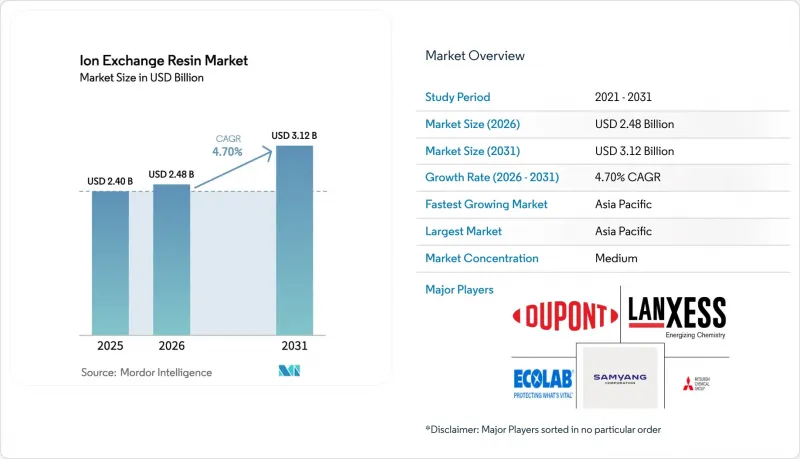
本報告按類型(通用樹脂、特殊樹脂)、應用功能(軟化/海水淡化、超純水生產等)、終端用戶產業(水處理、電力、食品飲料、製藥等)和地區(亞太、北美、歐洲、南美、中東和非洲)進行細分。市場預測以美元計價。
全球離子交換樹脂市場趨勢及洞察
亞太地區對半導體級超純水的需求
製造尺寸小於3奈米的邏輯晶片需要總有機碳(TOC)含量低於1 ppb、電阻率不低於18.2 MΩ*cm的水,而只有核級混合床樹脂才能滿足這些規格要求。 2026年4月,三菱化學宣布將「Diaion」的產能提高15%,目標晶圓代工廠是目前正在擴大2奈米製程產能的台灣和韓國的代工廠。 SEMI標準要求在微影術設備前使用離子交換拋光機作為最後一道屏障,以取代獨立的膜循環系統。在中國,預計2025年將安裝超過200套超純水系統,但每套系統每吉瓦晶圓廠產能消耗10-15立方公尺的混合床樹脂,一旦颱風導致苯乙烯在東亞地區運輸延誤,就會造成供應鏈風險。
由於北美地區對 PFAS 和重金屬排放的限制,對螯合樹脂的需求正在擴大。
2024年4月,美國環保署(EPA)制定了全氟辛酸(PFOA)最高濃度為4 ppt、全氟辛烷磺酸(PFOS)最高濃度為10 ppt的標準,並強制要求在2029年前達到標準。 II型強鹼性陰離子樹脂成為同時去除傳統全氟烷基物質(PFAS)和短鏈PFAS的最佳可用可用技術。儘管廢舊樹脂的處置問題尚未解決,密西根州、新澤西州和加州的公共產業仍在2025年簽署了超過3億美元的顆粒床系統維修合約。同時,《清潔水法》的修正案提高了鉛、鎘和鉻的基準值,加速了亞氨基二乙酸和氨基膦酸功能樹脂的應用。目前,特種級樹脂的售價比通用型軟水珠高出40%至60%。
苯乙烯和丙烯酸單體的價格波動很大。
苯乙烯-二乙烯基苯共聚物佔全球產量的80%以上,但在亞洲,2024年至2025年間苯乙烯價格高達每噸1150至1450美元,導致成品樹脂成本上漲6%至8%。用於製藥和食品行業的丙烯酸樹脂也面臨類似的價格波動,此前歐洲丙烯酸價格在2025年上半年同比上漲了22%。印度和中國依賴現貨市場原料的小規模生產商的利潤率被壓縮至7%至9%,迫使他們進行產業重組,甚至出現工廠停產的情況。
細分市場分析
通用樹脂(主要用於鍋爐給水軟化系統,價格在每公升 8 至 12 美元之間)在 2025 年佔總銷售額的 74.35%。同時,特種樹脂預計將以每年 5.33% 的速度成長,比通用樹脂高出 63 個基點。 Sunresin 和 LANXESS 於 2024 年至 2025 年間推出的鋰選擇性樹脂,其鎂鋰選擇性超過 100:1,可直接從阿根廷和智利的鹽水中提取。符合 NSF/ANSI 61 標準的食品級產品每公升成本增加 3 至 5 美元,但可防止飲料生產線因異味而導致的召回事件。
具有永久孔隙率的大孔微珠因其能承受滲透壓衝擊並延長使用壽命,目前在醣類脫色和抗生素純化等應用領域佔據主導地位。隨著以法規遵從性為導向的化學技術不斷發展,預計到2031年,通用產品的市佔率將會下降。
區域分析
預計到2025年,亞太地區將佔全球銷售額的34.59%,並在半導體製造廠和鋰鹵水項目的推動下,到2031年將維持5.54%的複合年成長率。在中國,2025年將安裝超過200套超純水系統,每套系統採用混合床樹脂,處理能力為每吉瓦10-15立方公尺。在印度,製藥業的快速成長以及「M類水質標準」的修訂正在推動混合床樹脂的更新換代;而越南和馬來西亞等東協市場則迎來了電子業待開發區投資的激增。關鍵原料苯乙烯的價格波動(2024年至2025年間價格波動幅度達26%)正對非垂直整合型製造商的利潤率構成壓力。
在北美,美國環保署 (EPA) 的 PFAS 法規要求到 2029 年,美國 6% 至 10% 的公共供水系統中的陰離子交換系統必須維修。在加拿大,離子交換技術被用於淨化油砂計畫產生的廢水,但亞伯達資本投資的減少限制了額外的需求。在美墨加協定 (USMCA) 沿線,由於電子塗裝生產線對超純水的需求不斷成長,近岸外包業務湧入墨西哥,擴大了離子交換樹脂的市場。
在歐洲,由於掩埋法規導致生命週期成本上升,成長有所滯後,但該地區仍保持著技術優勢。歐盟到2030年實現40吉瓦電解槽產能的氫能目標,意味著對PFSA膜的累計需求量將達到600萬至800萬平方米,而AEM的先導計畫可能會部分蠶食這一需求。在南美洲,需求集中在巴西和阿根廷,兩國的糖精煉和採礦計畫正在推動食品級和螯合樹脂的應用。在中東和非洲,海水淡化技術的進步以及沙烏地阿拉伯、阿拉伯聯合大公國和卡達強制推行的「零液體排放」政策正在推動需求成長。
其他好處:
- Excel格式的市場預測(ME)表
- 3個月的分析師支持
目錄
第1章:引言
- 市場分析與定義的前提條件
- 分析範圍
第2章 分析方法
第3章執行摘要
第4章 市場狀況
- 市場概覽
- 市場促進因素
- 亞太地區半導體產業對超純水的需求
- 在北美,PFAS 和重金屬排放標準正在推動對螯合樹脂的需求。
- 中東的海水淡化和零排放大型企劃正在加速混合床技術的應用。
- 歐洲對氫氣和電解槽的獎勵正在推動對 PFSA 離子交換膜的需求。
- 南美洲糖脫色產業的蓬勃發展正在推動對食品級樹脂的需求。
- 市場限制因素
- 苯乙烯和丙烯酸單體的價格波動
- 生物基吸附劑正在削弱樹脂的經濟可行性。
- 歐盟關於廢棄舊塑膠的掩埋和焚燒法規
- 價值鏈分析
- 波特五力分析
第5章:預測市場規模與成長率
- 按類型
- 通用樹脂
- 特殊樹脂
- 按功能
- 軟化/海水淡化
- 超純水的生產
- 重金屬去除,PFAS 對策
- 催化劑/分離(非水相)
- 糖漂白、食品和飲料精煉
- 貴金屬回收及濕式冶金
- 按最終用途行業分類
- 水處理
- 電力
- 食品/飲料
- 製藥
- 化學處理
- 採礦和冶金
- 其他終端用戶產業
- 按地區
- 亞太地區
- 中國
- 印度
- 日本
- 韓國
- 東南亞國協
- 其他亞太國家
- 北美洲
- 美國
- 加拿大
- 墨西哥
- 歐洲
- 德國
- 英國
- 義大利
- 法國
- 其他歐洲國家
- 南美洲
- 巴西
- 阿根廷
- 其他南美國家
- 中東和非洲
- 沙烏地阿拉伯
- 南非
- 其他中東和非洲國家
- 亞太地區
第6章 競爭情勢
- 市場集中度
- 策略趨勢
- 市佔率和排名分析
- 公司簡介
- Anhui Sanxing Resin Co., Ltd.
- Bio-Rad Laboratories, Inc.
- DOSHION POLYSCIENCE PVT. LTD.
- DuPont
- Ecolab
- Eichrom Technologies, LLC
- IEI
- Jacobi Carbons Group
- LANXESS
- Mitsubishi Chemical Group Corporation
- Polymex
- Pure Resin Co., Ltd.
- ResinTech, Inc.
- Samyang Corporation
- Sunresin New Materials Co., Ltd.
- Suqing Group
- Suzhou Bojie Resin Technology Co., Ltd.
- Thermax Limited
- Xylem
第7章 市場機會與未來展望
According to Mordor Intelligence, the ion exchange resin market size was valued at USD 2.40 billion in 2025 and is estimated to grow from USD 2.48 billion in 2026 to reach USD 3.12 billion by 2031, at a CAGR of 4.70% during the forecast period (2026-2031).
This report is Segmented by Type (Commodity Resins and Specialty Resins), Application Function (Softening and Demineralization, Ultrapure Water Production, and More), End-Use Industry (Water Treatment, Power, Food and Beverage, Pharmaceutical, and More), and Geography (Asia-Pacific, North America, Europe, South America, and Middle East and Africa). The Market Forecasts are Provided in Terms of Value (USD).
Global Ion Exchange Resin Market Trends and Insights
Semiconductor-Grade Ultrapure Water Demand in Asia-Pacific
Fabricating sub-3 nm logic chips requires water with total organic carbon below 1 ppb and resistivity above 18.2 MΩ*cm, a specification met only by nuclear-grade mixed-bed resins. Mitsubishi Chemical disclosed a 15% Diaion capacity expansion in April 2026, aimed at Taiwanese and South Korean foundries now ramping 2 nm production. SEMI standards mandate ion-exchange polishers as the final barrier before photolithography tools, displacing stand-alone membrane loops. China installed more than 200 ultrapure-water systems in 2025, each consuming 10-15 m3 of mixed-bed resin per gigawatt of fab capacity, creating supply-chain risk whenever typhoons delay styrene shipments across East Asia.
PFAS and Heavy-Metal Discharge Limits Boosting Chelating Resins in North America
The U.S. EPA finalized maximum contaminant levels of 4 ppt for PFOA and 10 ppt for PFOS in April 2024, with compliance required by 2029. Type II strong-base anion resins emerged as the best available technology for simultaneous removal of legacy and short-chain PFAS. Utilities in Michigan, New Jersey, and California awarded contracts exceeding USD 300 million in 2025 to retrofit granular-bed systems, even though spent-resin disposal remains unresolved. Parallel Clean Water Act updates tightened lead, cadmium, and chromium limits, accelerating uptake of iminodiacetic- and aminophosphonic-functional resins. Specialty grades now sell at 40-60% price premiums over commodity softening beads.
Volatile Styrene and Acrylic Monomer Prices
Styrene-divinylbenzene copolymers constitute more than 80% of global output, yet styrene traded between USD 1,150 and USD 1,450 t-1 in Asia during 2024-2025, lifting finished-resin costs 6-8%. Acrylic resins used in pharma and food lines face similar volatility after European acrylic-acid prices rose 22% year-on-year in H1 2025. Smaller producers in India and China, reliant on spot feedstock, saw margins compress to 7-9%, forcing consolidation and occasional plant shutdowns.
Other drivers and restraints analyzed in the detailed report include:
- Desalination and ZLD Megaprojects in the Middle East Raising Mixed-Bed Uptake
- Hydrogen-Electrolyzer Incentives Lifting PFSA Membranes in Europe
- European Union Landfill and Incineration Restrictions on Spent Resins
For complete list of drivers and restraints, kindly check the Table Of Contents.
Segment Analysis
Commodity resins delivered 74.35% of 2025 revenue, anchored by boiler-feed softening systems priced at USD 8-12 L-1. However, specialty resins are projected to grow 5.33% annually, eclipsing commodity expansion by 63 bps. Lithium-selective resins launched by Sunresin and LANXESS in 2024-2025 provide Mg:Li selectivity above 100:1, enabling direct extraction from Argentine and Chilean brines. Food-grade variants that meet NSF/ANSI 61 carry USD 3-5 L-1 additional cost yet prevent off-flavor recalls in beverage lines.
Macroporous beads with permanent porosity now dominate sugar-decolorization and antibiotic purification because they resist osmotic shock, extending service life. Continued migration toward compliance-driven chemistries will narrow commodity revenue share by 2031.
Complete Report Scope:
- By Type
- Commodity Resins
- Specialty Resins
- By Application Function
- Softening and Demineralization
- Ultrapure Water Production
- Heavy-Metal Removal and PFAS Mitigation
- Catalysis and Separation (Non-Water)
- Sugar Decolorization and Food and Beverage Purification
- Precious-Metal Recovery and Hydrometallurgy
- By End-use Industry
- Water Treatment
- Power
- Food and Beverage
- Pharmaceutical
- Chemical Processing
- Mining and Metallurgy
- Other End-User Industries
- By Geography
- Asia-Pacific
- China
- India
- Japan
- South Korea
- ASEAN Countries
- Rest of Asia-Pacific
- North America
- United States
- Canada
- Mexico
- Europe
- Germany
- United Kingdom
- Italy
- France
- Rest of Europe
- South America
- Brazil
- Argentina
- Rest of South America
- Middle East and Africa
- Saudi Arabia
- South Africa
- Rest of Middle East and Africa
- Asia-Pacific
Geography Analysis
Asia-Pacific held 34.59% of 2025 revenue and should log a 5.54% CAGR through 2031, paced by semiconductor fabs and lithium-brine projects. China added more than 200 ultrapure-water systems in 2025, each deploying 10-15 m3 of mixed-bed resin per gigawatt of capacity. India's pharmaceutical boom and revised Schedule M water codes are catalyzing mixed-bed upgrades, while ASEAN markets such as Vietnam and Malaysia are attracting greenfield electronics investments. Volatile styrene feedstock-26% price swing peak-to-trough in 2024-2025-compresses margins for producers without vertical integration.
In North America, EPA PFAS rules mean 6-10% of U.S. public water systems will require anion-exchange retrofits by 2029. Canada's oil-sands projects rely on ion exchange to polish produced water, but capex cuts in Alberta curb incremental demand. Mexico's near-shoring inflow is pushing electronics-coating lines that require ultrapure water, expanding the ion exchange resin market across the USMCA corridor.
Europe trails in growth as landfill restrictions raise lifecycle costs, yet the bloc retains a technology edge. EU hydrogen targets of 40 GW electrolyzer capacity by 2030 imply cumulative PFSA membrane demand of 6-8 million m2, though AEM pilots could partially cannibalize PFSA volumes. South America concentrates in Brazil and Argentina, where sugar refining and mining projects drive food-grade and chelating resin adoption. The Middle East and Africa drive demand as desalination and zero-liquid-discharge mandates rolled out across Saudi Arabia, the UAE, and Qatar.
- Anhui Sanxing Resin Co., Ltd.
- Bio-Rad Laboratories, Inc.
- DOSHION POLYSCIENCE PVT. LTD.
- DuPont
- Ecolab
- Eichrom Technologies, LLC
- IEI
- Jacobi Carbons Group
- LANXESS
- Mitsubishi Chemical Group Corporation
- Polymex
- Pure Resin Co., Ltd.
- ResinTech, Inc.
- Samyang Corporation
- Sunresin New Materials Co., Ltd.
- Suqing Group
- Suzhou Bojie Resin Technology Co., Ltd.
- Thermax Limited
- Xylem
Additional Benefits:
- The market estimate (ME) sheet in Excel format
- 3 months of analyst support
TABLE OF CONTENTS
1 Introduction
- 1.1 Study Assumptions and Market Definition
- 1.2 Scope of the Study
2 Research Methodology
3 Executive Summary
4 Market Landscape
- 4.1 Market Overview
- 4.2 Market Drivers
- 4.2.1 Semiconductor-Grade Ultrapure Water Demand in Asia-Pacific
- 4.2.2 PFAS and Heavy-Metal Discharge Limits Boosting Chelating Resins in North America
- 4.2.3 Desalination and ZLD Megaprojects in the Middle East Raising Mixed-Bed Uptake
- 4.2.4 Hydrogen-Electrolyzer Incentives Lifting PFSA Ion-Exchange Membranes in Europe
- 4.2.5 Sugar-Decolorization Boom Driving Food-Grade Resins in South America
- 4.3 Market Restraints
- 4.3.1 Volatile Styrene and Acrylic Monomer Prices
- 4.3.2 Bio-Based Adsorbents Undercutting Resin Economics
- 4.3.3 European Union Landfill and Incineration Restrictions on Spent Resins
- 4.4 Value Chain Analysis
- 4.5 Porter's Five Forces
- 4.5.1 Bargaining Power of Suppliers
- 4.5.2 Bargaining Power of Buyers
- 4.5.3 Threat of New Entrants
- 4.5.4 Threat of Substitutes
- 4.5.5 Industry Rivalry
5 Market Size and Growth Forecasts (Value)
- 5.1 By Type
- 5.1.1 Commodity Resins
- 5.1.2 Specialty Resins
- 5.2 By Application Function
- 5.2.1 Softening and Demineralization
- 5.2.2 Ultrapure Water Production
- 5.2.3 Heavy-Metal Removal and PFAS Mitigation
- 5.2.4 Catalysis and Separation (Non-Water)
- 5.2.5 Sugar Decolorization and Food and Beverage Purification
- 5.2.6 Precious-Metal Recovery and Hydrometallurgy
- 5.3 By End-use Industry
- 5.3.1 Water Treatment
- 5.3.2 Power
- 5.3.3 Food and Beverage
- 5.3.4 Pharmaceutical
- 5.3.5 Chemical Processing
- 5.3.6 Mining and Metallurgy
- 5.3.7 Other End-User Industries
- 5.4 By Geography
- 5.4.1 Asia-Pacific
- 5.4.1.1 China
- 5.4.1.2 India
- 5.4.1.3 Japan
- 5.4.1.4 South Korea
- 5.4.1.5 ASEAN Countries
- 5.4.1.6 Rest of Asia-Pacific
- 5.4.2 North America
- 5.4.2.1 United States
- 5.4.2.2 Canada
- 5.4.2.3 Mexico
- 5.4.3 Europe
- 5.4.3.1 Germany
- 5.4.3.2 United Kingdom
- 5.4.3.3 Italy
- 5.4.3.4 France
- 5.4.3.5 Rest of Europe
- 5.4.4 South America
- 5.4.4.1 Brazil
- 5.4.4.2 Argentina
- 5.4.4.3 Rest of South America
- 5.4.5 Middle East and Africa
- 5.4.5.1 Saudi Arabia
- 5.4.5.2 South Africa
- 5.4.5.3 Rest of Middle East and Africa
- 5.4.1 Asia-Pacific
6 Competitive Landscape
- 6.1 Market Concentration
- 6.2 Strategic Moves
- 6.3 Market Share/Ranking Analysis
- 6.4 Company Profiles (includes Global-level Overview, Market-level Overview, Core Segments, Financials as available, Strategic Information, Market Rank/Share, Products and Services, and Recent Developments)
- 6.4.1 Anhui Sanxing Resin Co., Ltd.
- 6.4.2 Bio-Rad Laboratories, Inc.
- 6.4.3 DOSHION POLYSCIENCE PVT. LTD.
- 6.4.4 DuPont
- 6.4.5 Ecolab
- 6.4.6 Eichrom Technologies, LLC
- 6.4.7 IEI
- 6.4.8 Jacobi Carbons Group
- 6.4.9 LANXESS
- 6.4.10 Mitsubishi Chemical Group Corporation
- 6.4.11 Polymex
- 6.4.12 Pure Resin Co., Ltd.
- 6.4.13 ResinTech, Inc.
- 6.4.14 Samyang Corporation
- 6.4.15 Sunresin New Materials Co., Ltd.
- 6.4.16 Suqing Group
- 6.4.17 Suzhou Bojie Resin Technology Co., Ltd.
- 6.4.18 Thermax Limited
- 6.4.19 Xylem
7 Market Opportunities and Future Outlook
- 7.1 White-space and Unmet-Need Assessment
- 7.2 Growing Demand for Fuel Cells

 陰離子樹脂市場:全球市場預測,2026-2032年離子交換樹脂市場-2026-2032年全球市場預測
 離子交換樹脂市場規模、佔有率、趨勢和預測:按類型、應用和地區分類,2026-2034年
 離子交換材料:技術與全球市場
 離子交換樹脂市場規模、佔有率和趨勢分析報告:按產品、應用、地區和細分市場預測(2026-2033 年)碳電池和石墨電池用軟毛氈市場:按電池類型、產品類型、製造流程、應用和最終用途產業分類-全球預測,2026-2032年
 離子交換樹脂市場-2025-2030年預測
 離子交換樹脂:全球市場佔有率和排名、總收入和需求預測(2025-2031年)
 全球離子交換樹脂市場:產能、需求、平均價格及產業展望(至2034年)
 陽離子和陰離子交換樹脂市場報告:趨勢、預測和競爭分析(至 2031 年)