


 |
市場調查報告書
商品編碼
2158068
離子交換樹脂市場:按類型、應用、終端用戶產業和地區分類-全球預測至2031年lon Exchange Resins Market by Type (Cationic Resins, Anionic Resins), Application (Water, Non-Water), End-Use Industry (Power, Chemicals & Petrochemicals, Pharmaceuticals, Food & Beverage, Electrical & Electronics), and Region - Global Forecast to 2031 |
||||||


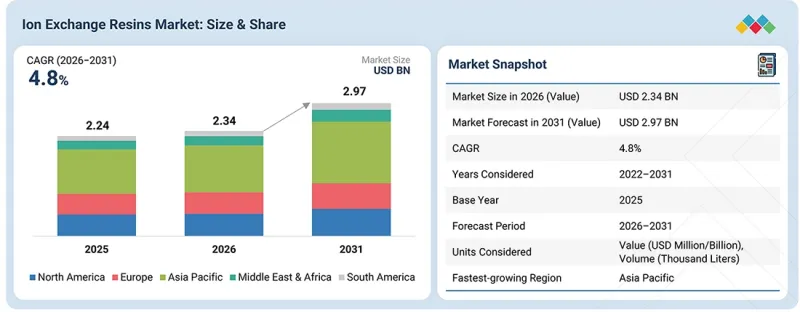
預計離子交換樹脂市場將從 2026 年的 23.4 億美元成長到 2031 年的 29.7 億美元,複合年成長率為 4.8%。
市政和工業領域對水處理和淨化需求的不斷成長推動了這一成長。日益嚴重的水資源短缺和不斷增加的污水排放量正在推動各行業的水資源再利用。離子交換技術透過軟化水、海水淡化和去除溶解物質來支持這些努力。發電和半導體製造等應用需要近乎絕對純淨的水,因此需要使用專用的離子交換樹脂來保護設備並確保製程穩定運作。此外,日益嚴格的環境和廢水法規迫使企業改善其水資源管理實踐,同時水質監測也越來越嚴格。
| 調查範圍 | |
|---|---|
| 調查期 | 2022-2031 |
| 基準年 | 2025 |
| 預測期 | 2026-2031 |
| 計算單位 | 金額(百萬/十億美元) 數量(千公升) |
| 部分 | 類型、應用、最終用途產業和地區 |
| 目標區域 | 北美洲、歐洲、亞太地區、南美洲、中東和非洲 |
同時,製造商們正在研發新型離子交換樹脂,這些樹脂具有更高的吸附容量、更好的選擇性、更高的效率以及在特定應用中更優異的性能。這些進步正在推動其在更廣泛的行業中得到應用,進一步加速市場成長。
“預計電氣和電子行業將成為以金額為準成長最快的終端用戶行業。”
受多種因素驅動,電氣和電子產業預計將成為離子交換樹脂市場中成長最快的終端用戶產業。該行業是成長最快的行業之一,高度依賴高純度原料和製程來確保電子元件的可靠性和性能。離子交換樹脂能夠有效去除帶電金屬離子和有機污染物等雜質,這些雜質會損害電子設備的性能。例如,在半導體和電路基板的製造過程中,離子交換樹脂能夠達到良好的導電性和半導體性能所需的純度等級。透過確保電子材料不含污染物,離子交換樹脂可以提高電子產品的可靠性和使用壽命。隨著對先進電子設備需求的不斷成長,離子交換樹脂在確保製造過程的品質和效率方面發揮著至關重要的作用。
“到 2026 年,供水應用預計將在水處理應用領域中佔據最大的以金額為準佔有率。”
供水產業在離子交換樹脂市場中扮演著至關重要的角色,它透過公共供水系統提供清潔、安全、優質的水。在水處理廠中,離子交換樹脂主要用於軟化和去離子水。軟化水可以去除導致水硬度的鈣離子和鎂離子,並用鈉離子取代。這可以防止水垢積聚,延長管道和設備的使用壽命。相較之下,去離子水則使用陽離子交換樹脂和陰離子交換樹脂的組合,去除幾乎所有離子雜質,從而生產出適用於關鍵應用的超純水。
“在預測期內,陽離子交換樹脂預計將成為離子交換樹脂市場的主導類型。”
陽離子交換樹脂是最常見的離子交換樹脂類型,廣泛應用於水處理、水質淨化和化學加工領域。它們通過去除鈣、鎂、鐵、錳等帶正電荷的離子,在水軟化、海水淡化和水質淨化方面表現出極高的效率。強酸性陽離子交換樹脂特別適用於去除硬度和生產高純度水,而弱酸性陽離子交換樹脂則用於需要選擇性去除離子的場合。其在水處理、發電、製藥、食品飲料和化學等眾多領域的成功應用,支撐了其穩定的市場需求。隨著工業化進程的推進和水質標準的日益嚴格,對處理水和高純度水的需求不斷成長,陽離子交換樹脂的應用也進一步擴大。其多功能性和卓越的性能鞏固了其在市場上的主導地位。
“在預測期內,北美有望成為離子交換樹脂市場第二大地區。”
北美在全球離子交換樹脂市場佔有重要地位。該地區市場已趨於成熟,預計電力、化工、製藥以及電氣和電子等終端用戶產業將保持溫和成長。杜邦(美國)、藝康(美國)和博來生物(美國)是北美領先的離子交換樹脂生產商,服務全球客戶。該市場的特點是存在多家產品系列豐富、競爭激烈的大型企業。因此,小規模的企業面臨高昂的資本成本,限制了其研發和市場推廣機會。北美領導者正透過夥伴關係、簽訂合約、進行協作、開發新產品和新技術、擴大產能以及新建工廠等策略來擴大市場佔有率,以滿足日益成長的離子交換樹脂需求。
我們進行了廣泛的初步訪談,以確定和檢驗從二手研究中得出的幾個細分市場和子細分市場的市場規模。
第一次面試的具體內容如下:
- 按部門分類:一級:40%,二級:25%,三級:35%
- 按職位分類:首席級別主管:35%,總監:30%,其他:35%
- 按地區分類:北美:25%,歐洲:45%,亞太地區:20%,南美:5%,中東和非洲:5%
調查範圍
本市場研究報告涵蓋離子交換樹脂市場的各個細分領域,旨在按類型、應用、終端用戶產業和地區估算市場規模和成長潛力。該研究還包含對市場主要參與者的詳細競爭分析,包括公司簡介、產品類型和營業內容的關鍵觀察結果、近期趨勢以及為提升其在離子交換樹脂市場地位而採取的主要成長策略。
購買本報告的主要好處
本報告旨在為市場領導者和新參與企業提供最準確的離子交換樹脂市場及其細分市場和子細分市場的銷售數據,從而助力其發展。報告也將幫助相關人員了解競爭格局,取得提升自身業務地位的洞察,並制定合適的打入市場策略。此外,本報告還將提供有關關鍵市場促進因素和挑戰的信息,幫助相關人員了解市場趨勢。
本報告深入分析了以下幾點:
- 對關鍵促進因素(亞太地區城市人口不斷成長、新興經濟體對核能發電的需求不斷成長以及嚴格的水處理法規)、阻礙因素(原料價格波動和逆滲透膜技術的競爭)、機遇(新興經濟體工業化的推進以及水資源再利用和循環利用日益重要)和挑戰(離子交換樹脂應用的開發以及發展中缺乏嚴格的法規的分析。
- 產品開發/創新:深入了解離子交換樹脂市場的未來技術、研發活動以及產品/服務發布。
- 市場發展:我們透過分析各地區的離子交換樹脂市場,提供有關盈利市場的全面資訊。
- 市場多元化:全面介紹離子交換樹脂市場的新產品和服務、未開發的地區、近期趨勢和投資情況。
- 競爭分析:對主要公司的市場佔有率、成長策略和服務產品進行詳細評估。
目錄
第1章:引言
第2章執行摘要
第3章重要考察
- 離子交換樹脂市場對企業而言極具吸引力的機會
- 離子交換樹脂市場:依類型
- 離子交換樹脂市場:依應用領域分類
- 離子交換樹脂市場:依終端用戶產業分類
- 離子交換樹脂市場:依主要國家分類
第4章 市場概覽
- 市場動態
- 促進因素
- 抑制因子
- 機會
- 任務
- 波特五力分析
- 替代品的威脅
- 供應商的議價能力
- 新進入者的威脅
- 買方的議價能力
- 競爭公司之間的競爭強度
- 主要相關人員和採購標準
- 採購過程中的關鍵相關人員
- 採購標準
- 價值鏈分析
- 原料
- 製造商
- 分配
- 最終用戶
- 宏觀經濟展望
- 全球GDP趨勢
- 發電統計數據
- 生態系分析
- 案例研究分析
- 希臘石油公司使用杜邦公司的Amberlite樹脂
- 澳洲利頓市庫吉化學公司(COOGEE CHEMICALS)的氯鹼鹽水淨化
- 使用 PUROLITE 離子交換樹脂降低飲用水成本並進行硬度處理。
- 監理情勢
- 監管機構、政府機構和其他組織
- 技術分析
- 主要技術
- 互補技術
- 鄰近技術
- 影響客戶業務的趨勢/顛覆性因素
- 貿易分析
- 進口方案(HS編碼391400)
- 出口方案(HS編碼391400)
- 2026-2027 年主要會議和活動
- 價格分析
- 各地區平均售價趨勢
- 按產品類型分類的平均售價趨勢
- 投資和資金籌措方案
- 專利分析
- 專利的法律狀況
- 管轄權分析
- 人工智慧/生成式人工智慧的影響
- 影響總結
第5章:離子交換樹脂市場:依類型分類
- 陽離子交換樹脂
- 陰離子交換樹脂
- 其他類型
第6章:離子交換樹脂市場:依應用領域分類
- 水
- 除了水以外
第7章:離子交換樹脂市場:依終端用戶產業分類
- 電力
- 化工/石油化工
- 食品/飲料
- 電氣和電子
- 製藥
- 金屬和採礦
- 其他終端用戶產業
第8章:離子交換樹脂市場:依地區分類
- 北美洲
- 美國
- 加拿大
- 墨西哥
- 歐洲
- 德國
- 法國
- 義大利
- 英國
- 西班牙
- 俄羅斯
- 荷蘭
- 其他歐洲國家
- 亞太地區
- 中國
- 印度
- 日本
- 韓國
- 泰國
- 印尼
- 台灣
- 亞太其他地區
- 中東和非洲
- GCC
- 土耳其
- 南非
- 其他中東和非洲地區
- 南美洲
- 巴西
- 阿根廷
- 南美洲其他地區
第9章 競爭情勢
- 主要參與企業的策略/優勢,2023-2026 年
- 2023-2025年收入分析
- 市佔率分析(2025 年)
- DUPONT
- LANXESS
- ECOLAB
- MITSUBISHI CHEMICAL GROUP CORPORATION
- SAMYANG CORPORATION
- 企業估值和財務指標
- 品牌和產品對比
- 企業估值矩陣:主要公司,2025 年
- 星星
- 新興領導者
- 業務範圍廣泛的公司
- 參與企業
- 企業企業發展:主要公司,2025 年
- 公司估值矩陣:新創企業/中小企業,2025 年
- 先進公司
- 應對力的公司
- 充滿活力的公司
- 起始點
- 競爭標竿分析:新創企業/中小企業,2025 年
- 競爭格局
- 新產品發布
- 交易
- 業務拓展
第10章:公司簡介
- 大公司
- DUPONT
- LANXESS
- ECOLAB(PUROLITE)
- MITSUBISHI CHEMICAL GROUP CORPORATION
- SAMYANG CORPORATION
- ION EXCHANGE INDIA(IEI)
- JACOBI RESINS
- THERMAX LIMITED
- OVIVO
- SUNRESIN NEW MATERIALS CO., LTD.
- 其他主要公司
- RESINTECH, INC.
- EVOQUA WATER TECHNOLOGIES LLC
- ALDEX CHEMICAL COMPANY, LTD.
- GFS CHEMICALS, INC.
- SUQING GROUP
- APPLEXION
- ANHUI SANXING RESIN TECHNOLOGY CO., LTD.
- RESINDION SRL
- KOVALUS SEPARATION SOLUTIONS
- ACURO ORGANICS LIMITED
- WESTERN CARBON &CHEMICALS
- DOSHION POLYSCIENCE PVT. LTD.
- AQUAFILSEP
- GRAVER TECHNOLOGIES
- HYDROFLUX
第11章:調查方法
第12章附錄
The ion exchange resins market is projected to grow from USD 2.34 billion in 2026 to USD 2.97 billion by 2031, at a CAGR of 4.8%. Growth is driven by rising demand for water treatment and purification across municipal and industrial sectors. Worsening water scarcity and increasing volumes of wastewater are prompting industries to adopt water reuse practices. Ion exchange technologies support these efforts through water softening, demineralization, and the removal of dissolved substances. Applications such as power generation and semiconductor manufacturing require water of near-absolute purity, and specialized ion exchange resins are used to protect equipment and ensure stable process operations. Stricter environmental and wastewater regulations are also compelling companies to improve their water management practices, while scrutiny of water supply quality continues to intensify.
| Scope of the Report | |
|---|---|
| Years Considered for the Study | 2022-2031 |
| Base Year | 2025 |
| Forecast Period | 2026-2031 |
| Units Considered | Value (USD Million/Billion) Volume (Thousand Liters) |
| Segments | Type, Application, End-use Industry, and Region |
| Regions covered | North America, Europe, Asia Pacific, South America, and Middle East & Africa |
At the same time, manufacturers are developing new ion exchange resins that offer higher capacity, greater selectivity, improved efficiency, and better performance in specific applications. These advancements are encouraging adoption across a wider range of industries, further accelerating market growth.
"The electrical & electronics end-use industry is projected to be the fastest-growing end-use industry in terms of value."
The electrical & electronics industry is projected to be the fastest-growing end-use industry in the ion exchange resins market, driven by several factors. It is among the fastest-growing industries and depends heavily on high-purity raw materials and processes to ensure the reliability and performance of electronic components. Ion exchange resins effectively remove impurities, such as charged metal ions and organic contaminants, that could compromise electronic devices. In semiconductor and circuit board manufacturing, for example, ion exchange resins deliver the purity levels required for good conductivity and semiconductor performance. By ensuring that electronic materials are free of contaminants, they enhance the reliability and service life of electronic products. With growing demand for advanced electronic devices, ion exchange resins play a vital role in ensuring quality and efficiency in the manufacturing process.
"The municipal water application is expected to account for the largest share of the water application segment in 2026 in terms of value."
The municipal water segment plays a crucial role in the ion exchange resins market by ensuring that clean, safe, and high-quality water is delivered through public water systems. In water treatment facilities, ion exchange resins are primarily used for water softening and deionization. Water softening removes the calcium and magnesium ions that cause water hardness and replaces them with sodium ions. This prevents scale buildup and extends the service life of plumbing and appliances. Deionization, by contrast, removes virtually all ionic impurities by using cation and anion exchange resins in combination, producing ultrapure water suitable for critical applications.
"Cationic resins are expected to dominate the ion exchange resins market, by type, during the forecast period."
Cationic resins are the most common type of ion exchange resins and are widely used in water treatment, purification, and chemical processing. They remove positively charged ions such as calcium, magnesium, iron, and manganese, making them highly effective for water softening, demineralization, and purification. Strong acid cationic resins are used specifically to remove hardness and produce high-purity water, while weak acid cationic resins are used where selective ion removal is required. Their proven use across the water treatment, power generation, pharmaceuticals, food & beverage, and chemical industries sustains steady demand. Rising demand for treated and high-purity water, coupled with growing industrialization and stricter water quality requirements, further supports the adoption of cationic resins. Their versatility and proven performance continue to secure their dominant market position.
"North America is expected to be the second-largest region in the ion exchange resins market during the forecast period."
North America holds a significant position in the global ion exchange resins market. The regional market is mature; hence, moderate growth is expected across end-use industries such as power, chemical, pharmaceuticals, and electrical & electronics. DuPont (US), Ecolab (US), and Bio-Rad Laboratories (US) are the major players in North America and serve customers globally. The market is characterized by the presence of several large, highly competitive players with extensive product portfolios. As a result, smaller players have limited scope for R&D and marketing due to the high capital costs involved. Major players in North America adopt strategies such as partnerships, agreements, and collaborations; new product and technology developments; capacity expansions; and new plant establishments to increase their market share and meet the growing demand for ion exchange resins.
Extensive primary interviews were conducted to determine and verify the market sizes of several segments and subsegments derived through secondary research.
The breakdown of the primary interviews is as follows:
- By Department: Tier 1: 40%, Tier 2: 25%, and Tier 3: 35%
- By Designation: C-level Executives: 35%, Directors: 30%, and Others: 35%
- By Region: North America: 25%, Europe: 45%, Asia Pacific: 20%, South America: 5%, and Middle East & Africa: 5%
DuPont (US), LANXESS (Germany), Mitsubishi Chemical Group Corporation (Japan), Samyang Corporation (South Korea), Ecolab (US), JACOBI RESINS (Sweden), Ovivo (Canada), IEI (India), Thermax Limited (India), and Sunresin New Materials Co., Ltd. (China) are among the key players in the ion exchange resins market. The study includes an in-depth competitive analysis of these key players, along with their company profiles, recent developments, and key market strategies.
Research Coverage
The market study covers the ion exchange resins market across various segments. It aims to estimate the market size and growth potential by type, application, end-use industry, and region. The study also includes an in-depth competitive analysis of key players in the market, their company profiles, key observations on their products and business offerings, recent developments, and key growth strategies adopted to improve their position in the ion exchange resins market.
Key Benefits of Buying the Report
The report is expected to help market leaders and new entrants by providing the most accurate available revenue figures for the overall ion exchange resins market and its segments and subsegments. It will also help stakeholders understand the competitive landscape of the market, gain insights to improve their businesses' positions, and plan suitable go-to-market strategies. In addition, the report helps stakeholders understand the pulse of the market by providing information on key market drivers, restraints, challenges, and opportunities.
The report provides insights into the following:
- Analysis of key drivers (growing urban population in the Asia Pacific region, increasing demand for nuclear power in emerging economies, and stringent water treatment regulations), restraints (volatility in raw material prices and increasing competition from reverse osmosis membrane technology), opportunities (growing industrialization in emerging economies and the increasing importance of water recycling and reuse), and challenges (finding new applications for ion exchange resins and the lack of strict regulations in developing regions)
- Product Development/Innovation: Detailed insights into upcoming technologies, research & development activities, and product and service launches in the ion exchange resins market
- Market Development: Comprehensive information about lucrative markets through an analysis of the ion exchange resins market across various regions
- Market Diversification: Exhaustive information about new products & services, untapped geographies, recent developments, and investments in the ion exchange resins market
- Competitive Assessment: In-depth assessment of market share, growth strategies, and service offerings of leading players such as DuPont (US), LANXESS (Germany), Mitsubishi Chemical Group Corporation (Japan), Samyang Corporation (South Korea), Ecolab (US), JACOBI RESINS (Sweden), Ovivo (Canada), IEI (India), Thermax Limited (India), and Sunresin New Materials Co., Ltd. (China), among others, in the ion exchange resins market
TABLE OF CONTENTS
1 INTRODUCTION
- 1.1 STUDY OBJECTIVES
- 1.2 MARKET DEFINITION
- 1.3 STUDY SCOPE
- 1.3.1 MARKETS COVERED
- 1.3.2 INCLUSIONS AND EXCLUSIONS
- 1.3.3 YEARS CONSIDERED
- 1.4 CURRENCY CONSIDERED
- 1.5 UNITS CONSIDERED
- 1.6 STAKEHOLDERS
- 1.7 SUMMARY OF CHANGES
2 EXECUTIVE SUMMARY
- 2.1 KEY INSIGHTS AND MARKET HIGHLIGHTS
- 2.2 KEY MARKET PARTICIPANTS: MAPPING OF STRATEGIC DEVELOPMENTS
- 2.3 DISRUPTIVE TRENDS IN ION EXCHANGE RESINS MARKET
- 2.4 HIGH GROWTH SEGMENTS
- 2.5 REGIONAL SNAPSHOT: MARKET SIZE, GROWTH RATE, AND FORECAST
3 PREMIUM INSIGHTS
- 3.1 ATTRACTIVE OPPORTUNITIES FOR PLAYERS IN ION EXCHANGE RESINS MARKET
- 3.2 ION EXCHANGE RESINS MARKET, BY TYPE
- 3.3 ION EXCHANGE RESINS MARKET, BY APPLICATION
- 3.4 ION EXCHANGE RESINS MARKET, BY END-USE INDUSTRY
- 3.5 ION EXCHANGE RESINS MARKET, BY KEY COUNTRIES
4 MARKET OVERVIEW
- 4.1 INTRODUCTION
- 4.2 MARKET DYNAMICS
- 4.2.1 DRIVERS
- 4.2.1.1 Growing urban population in Asia Pacific
- 4.2.1.2 Increasing demand for nuclear power in emerging economies
- 4.2.1.3 Stringent water treatment regulations in US and Europe
- 4.2.2 RESTRAINTS
- 4.2.2.1 Volatility in raw material prices
- 4.2.2.2 Increasing competition from reverse osmosis membrane and other emerging technologies
- 4.2.3 OPPORTUNITIES
- 4.2.3.1 Expansion of PFAS-selective resin applications
- 4.2.3.2 Increasing adoption of water recycling and re-use
- 4.2.4 CHALLENGES
- 4.2.4.1 Resin fouling and performance degradation
- 4.2.4.2 Complex mixed-contaminant streams
- 4.2.1 DRIVERS
- 4.3 PORTER'S FIVE FORCES ANALYSIS
- 4.3.1 THREAT OF SUBSTITUTES
- 4.3.2 BARGAINING POWER OF SUPPLIERS
- 4.3.3 THREAT OF NEW ENTRANTS
- 4.3.4 BARGAINING POWER OF BUYERS
- 4.3.5 INTENSITY OF COMPETITIVE RIVALRY
- 4.4 KEY STAKEHOLDERS AND BUYING CRITERIA
- 4.4.1 KEY STAKEHOLDERS IN BUYING PROCESS
- 4.4.2 BUYING CRITERIA
- 4.5 VALUE CHAIN ANALYSIS
- 4.5.1 RAW MATERIAL
- 4.5.2 MANUFACTURER
- 4.5.3 DISTRIBUTION
- 4.5.4 END USER
- 4.6 MACROECONOMIC OUTLOOK
- 4.6.1 GLOBAL GDP TRENDS
- 4.6.2 POWER GENERATION STATISTICS
- 4.7 ECOSYSTEM ANALYSIS
- 4.8 CASE STUDY ANALYSIS
- 4.8.1 HELLENIC PETROLEUM SA'S USE OF DUPONT AMBERLITE RESINS
- 4.8.2 CHLOR-ALKALI BRINE PURIFICATION AT COOGEE CHEMICALS IN LYTTON, AUSTRALIA
- 4.8.3 REDUCING COSTS AND TREATING HARDNESS IN DRINKING WATER WITH PUROLITE'S ION EXCHANGE RESINS
- 4.9 REGULATORY LANDSCAPE
- 4.9.1 REGULATORY BODIES, GOVERNMENT AGENCIES, AND OTHER ORGANIZATIONS
- 4.10 TECHNOLOGY ANALYSIS
- 4.10.1 KEY TECHNOLOGIES
- 4.10.1.1 Mixed bed resin
- 4.10.1.2 Chelating ion exchange resin
- 4.10.1.3 Monodisperse resin
- 4.10.2 COMPLEMENTARY TECHNOLOGIES
- 4.10.2.1 Macroreticular technology
- 4.10.2.2 Integration of ion exchange resin with solvent extraction technology
- 4.10.3 ADJACENT TECHNOLOGIES
- 4.10.3.1 Sustainable regeneration process
- 4.10.3.2 Resin-in-Pulp
- 4.10.3.3 Adsorption technologies
- 4.10.1 KEY TECHNOLOGIES
- 4.11 TRENDS/DISRUPTIONS IMPACTING CUSTOMER BUSINESS
- 4.12 TRADE ANALYSIS
- 4.12.1 IMPORT SCENARIO (HS CODE 391400)
- 4.12.2 EXPORT SCENARIO (HS CODE 391400)
- 4.13 KEY CONFERENCES AND EVENTS, 2026-2027
- 4.14 PRICING ANALYSIS
- 4.14.1 AVERAGE SELLING PRICE TREND, BY REGION
- 4.14.2 AVERAGE SELLING PRICE TREND, BY TYPE
- 4.15 INVESTMENT AND FUNDING SCENARIO
- 4.16 PATENT ANALYSIS
- 4.16.1 LEGAL STATUS OF PATENTS
- 4.16.2 JURISDICTION ANALYSIS
- 4.17 IMPACT OF AI/GENERATIVE AI
- 4.17.1 INTRODUCTION
- 4.17.2 OVERVIEW OF IMPACT
- 4.17.2.1 Role of GenAI in transforming chemicals industry
- 4.17.2.2 Role of AI in optimizing drug discovery and ion exchange resins
- 4.17.2.3 Impact of AI on ion exchange resin management in water treatment
5 ION EXCHANGE RESINS MARKET, BY TYPE
- 5.1 INTRODUCTION
- 5.2 CATIONIC RESINS
- 5.2.1 EXTENSIVE UTILIZATION OF CATIONIC RESINS IN WATER TREATMENT APPLICATIONS TO DRIVE GROWTH
- 5.3 ANIONIC RESINS
- 5.3.1 EFFECTIVENESS IN REMOVING NEGATIVELY CHARGED IONS FROM SOLUTIONS TO DRIVE GROWTH
- 5.4 OTHER TYPES
6 ION EXCHANGE RESINS MARKET, BY APPLICATION
- 6.1 INTRODUCTION
- 6.2 WATER
- 6.2.1 GROWTH IN VARIOUS END-USE INDUSTRIES TO DRIVE MARKET
- 6.2.2 MUNICIPAL
- 6.2.3 INDUSTRIAL
- 6.2.4 OTHERS
- 6.3 NON-WATER
- 6.3.1 PHARMACEUTICALS AND CHEMICALS & PETROCHEMICALS INDUSTRIES TO DRIVE GROWTH
7 ION EXCHANGE RESINS MARKET, BY END-USE INDUSTRY
- 7.1 INTRODUCTION
- 7.2 POWER
- 7.2.1 WATER TREATMENT & PURIFICATION APPLICATION TO DRIVE GROWTH
- 7.3 CHEMICALS & PETROCHEMICALS
- 7.3.1 WIDE USE IN WATER TREATMENT, PURIFICATION, AND SEPARATION TO DRIVE GROWTH
- 7.4 FOOD & BEVERAGE
- 7.4.1 HIGH-QUALITY WATER REQUIREMENT TO DRIVE GROWTH
- 7.5 ELECTRICAL & ELECTRONICS
- 7.5.1 DEMAND FOR HIGH-PERFORMANCE ELECTRONIC COMPONENTS TO DRIVE GROWTH
- 7.6 PHARMACEUTICALS
- 7.6.1 ABILITY OF ION EXCHANGE RESINS TO FORM DRUG-RESIN COMPLEXES TO DRIVE GROWTH
- 7.7 METAL & MINING
- 7.7.1 NEED FOR WASTEWATER TREATMENT TO DRIVE GROWTH
- 7.8 OTHER END-USE INDUSTRIES
- 7.8.1 WATER TREATMENT
- 7.8.2 AGRICULTURE
- 7.8.3 TEXTILES
- 7.8.4 PAPER
- 7.8.5 OIL & GAS
8 ION EXCHANGE RESINS MARKET, BY REGION
- 8.1 INTRODUCTION
- 8.2 NORTH AMERICA
- 8.2.1 US
- 8.2.1.1 PFAS remediation and high-purity water requirements to drive the market
- 8.2.2 CANADA
- 8.2.2.1 Municipal water infrastructure upgrades to drive the market
- 8.2.3 MEXICO
- 8.2.3.1 Desalination and industrial water treatment to drive the market
- 8.2.1 US
- 8.3 EUROPE
- 8.3.1 GERMANY
- 8.3.1.1 Chemical industry, ultrapure water, industrial demineralization to drive market
- 8.3.2 FRANCE
- 8.3.2.1 Nuclear power water treatment and radioactive resin management to drive market
- 8.3.3 ITALY
- 8.3.3.1 Spent nuclear resin treatment and industrial water purification to drive market
- 8.3.4 UK
- 8.3.4.1 Nuclear wastewater treatment and PFAS removal requirements to drive market
- 8.3.5 SPAIN
- 8.3.5.1 Surge in demand for desalinated water to drive growth
- 8.3.6 RUSSIA
- 8.3.6.1 Presence of large power industry to drive growth
- 8.3.7 NETHERLANDS
- 8.3.7.1 Increasing demand for pure water across various end-use industries to drive growth
- 8.3.8 REST OF EUROPE
- 8.3.1 GERMANY
- 8.4 ASIA PACIFIC
- 8.4.1 CHINA
- 8.4.1.1 Rising demand for nuclear energy to drive growth
- 8.4.2 INDIA
- 8.4.2.1 Consistently increasing manufacturing output to drive growth
- 8.4.3 JAPAN
- 8.4.3.1 Ultra-high-purity water requirements in semiconductor manufacturing to drive market
- 8.4.4 SOUTH KOREA
- 8.4.4.1 Increase in domestic wastewater and industrial wastewater to drive growth
- 8.4.5 THAILAND
- 8.4.5.1 Industrial process-water purification and boiler-water treatment to drive the market
- 8.4.6 INDONESIA
- 8.4.6.1 Large infrastructure budget to drive growth
- 8.4.7 TAIWAN
- 8.4.7.1 Growth of semiconductors industry to drive growth
- 8.4.8 REST OF ASIA PACIFIC
- 8.4.1 CHINA
- 8.5 MIDDLE EAST & AFRICA
- 8.5.1 GCC
- 8.5.1.1 Saudi Arabia
- 8.5.1.1.1 Increasing energy consumption to drive growth
- 8.5.1.2 UAE
- 8.5.1.2.1 Increasing desalination of seawater to drive growth
- 8.5.1.3 Rest of GCC
- 8.5.1.1 Saudi Arabia
- 8.5.2 TURKIYE
- 8.5.2.1 Growing electricity demand to drive growth
- 8.5.3 SOUTH AFRICA
- 8.5.3.1 Abundant natural resources, R&D capabilities, and established manufacturing base to drive growth
- 8.5.4 REST OF MIDDLE EAST & AFRICA
- 8.5.1 GCC
- 8.6 SOUTH AMERICA
- 8.6.1 BRAZIL
- 8.6.1.1 Sugar-ethanol purification and resource recovery to drive growth
- 8.6.2 ARGENTINA
- 8.6.2.1 Sustainable economic development to drive market
- 8.6.3 REST OF SOUTH AMERICA
- 8.6.1 BRAZIL
9 COMPETITIVE LANDSCAPE
- 9.1 INTRODUCTION
- 9.2 KEY PLAYER COMPETITIVE STRATEGIES/RIGHT TO WIN, 2023-2026
- 9.3 REVENUE ANALYSIS, 2023-2025
- 9.4 MARKET SHARE ANALYSIS, 2025
- 9.4.1 DUPONT
- 9.4.2 LANXESS
- 9.4.3 ECOLAB
- 9.4.4 MITSUBISHI CHEMICAL GROUP CORPORATION
- 9.4.5 SAMYANG CORPORATION
- 9.5 COMPANY VALUATION AND FINANCIAL METRICS
- 9.6 BRAND/PRODUCT COMPARISON
- 9.7 COMPANY EVALUATION MATRIX: KEY PLAYERS, 2025
- 9.7.1 STARS
- 9.7.2 EMERGING LEADERS
- 9.7.3 PERVASIVE PLAYERS
- 9.7.4 PARTICIPANTS
- 9.7.5 COMPANY FOOTPRINT: KEY PLAYERS, 2025
- 9.7.5.1 Company footprint
- 9.7.5.2 Region footprint
- 9.7.5.3 Type footprint
- 9.7.5.4 Application footprint
- 9.7.5.5 End-use industry footprint
- 9.8 COMPANY EVALUATION MATRIX: START-UPS/SMES, 2025
- 9.8.1 PROGRESSIVE COMPANIES
- 9.8.2 RESPONSIVE COMPANIES
- 9.8.3 DYNAMIC COMPANIES
- 9.8.4 STARTING BLOCKS
- 9.8.5 COMPETITIVE BENCHMARKING: START-UPS/SMES, 2025
- 9.8.5.1 List of start-ups/SMEs
- 9.8.5.2 Competitive benchmarking of start-ups/SMEs
- 9.9 COMPETITIVE SCENARIO
- 9.9.1 PRODUCT LAUNCHES
- 9.9.2 DEALS
- 9.9.3 EXPANSIONS
10 COMPANY PROFILES
- 10.1 KEY PLAYERS
- 10.1.1 DUPONT
- 10.1.1.1 Business overview
- 10.1.1.2 Products offered
- 10.1.1.3 Recent developments
- 10.1.1.3.1 Product launches
- 10.1.1.4 MnM view
- 10.1.1.4.1 Right to win
- 10.1.1.4.2 Strategic choices
- 10.1.1.4.3 Weaknesses and competitive threats
- 10.1.2 LANXESS
- 10.1.2.1 Business overview
- 10.1.2.2 Products offered
- 10.1.2.3 Recent developments
- 10.1.2.3.1 Product launches
- 10.1.2.3.2 Expansions
- 10.1.2.4 MnM view
- 10.1.2.4.1 Right to win
- 10.1.2.4.2 Strategic choices
- 10.1.2.4.3 Weaknesses and competitive threats
- 10.1.3 ECOLAB (PUROLITE)
- 10.1.3.1 Business overview
- 10.1.3.2 Products offered
- 10.1.3.3 Recent developments
- 10.1.3.3.1 Product launches
- 10.1.3.3.2 Deals
- 10.1.3.3.3 Expansions
- 10.1.3.4 MnM view
- 10.1.3.4.1 Right to win
- 10.1.3.4.2 Strategic choices
- 10.1.3.4.3 Weaknesses and competitive threats
- 10.1.4 MITSUBISHI CHEMICAL GROUP CORPORATION
- 10.1.4.1 Business overview
- 10.1.4.2 Products offered
- 10.1.4.3 Recent developments
- 10.1.4.3.1 Expansions
- 10.1.4.4 MnM view
- 10.1.4.4.1 Right to win
- 10.1.4.4.2 Strategic choices
- 10.1.4.4.3 Weaknesses and competitive threats
- 10.1.5 SAMYANG CORPORATION
- 10.1.5.1 Business overview
- 10.1.5.2 Products offered
- 10.1.5.3 MnM view
- 10.1.5.3.1 Right to win
- 10.1.5.3.2 Strategic choices
- 10.1.5.3.3 Weaknesses and competitive threats
- 10.1.6 ION EXCHANGE INDIA (IEI)
- 10.1.6.1 Business overview
- 10.1.6.2 Products offered
- 10.1.6.3 MnM view
- 10.1.6.3.1 Right to win
- 10.1.6.3.2 Strategic choices
- 10.1.6.3.3 Weaknesses and competitive threats
- 10.1.7 JACOBI RESINS
- 10.1.7.1 Business overview
- 10.1.7.2 Products offered
- 10.1.7.3 MnM view
- 10.1.8 THERMAX LIMITED
- 10.1.8.1 Business overview
- 10.1.8.2 Products offered
- 10.1.8.3 Recent developments
- 10.1.8.3.1 Deals
- 10.1.8.3.2 Expansions
- 10.1.8.4 MnM view
- 10.1.9 OVIVO
- 10.1.9.1 Business overview
- 10.1.9.2 Products offered
- 10.1.9.3 MnM view
- 10.1.10 SUNRESIN NEW MATERIALS CO., LTD.
- 10.1.10.1 Business overview
- 10.1.10.2 Products offered
- 10.1.10.3 MnM view
- 10.1.1 DUPONT
- 10.2 OTHER PLAYERS
- 10.2.1 RESINTECH, INC.
- 10.2.2 EVOQUA WATER TECHNOLOGIES LLC
- 10.2.3 ALDEX CHEMICAL COMPANY, LTD.
- 10.2.4 GFS CHEMICALS, INC.
- 10.2.5 SUQING GROUP
- 10.2.6 APPLEXION
- 10.2.7 ANHUI SANXING RESIN TECHNOLOGY CO., LTD.
- 10.2.8 RESINDION S.R.L.
- 10.2.9 KOVALUS SEPARATION SOLUTIONS
- 10.2.10 ACURO ORGANICS LIMITED
- 10.2.11 WESTERN CARBON & CHEMICALS
- 10.2.12 DOSHION POLYSCIENCE PVT. LTD.
- 10.2.13 AQUAFILSEP
- 10.2.14 GRAVER TECHNOLOGIES
- 10.2.15 HYDROFLUX
11 RESEARCH METHODOLOGY
- 11.1 RESEARCH DATA
- 11.1.1 SECONDARY DATA
- 11.1.1.1 Key secondary sources
- 11.1.1.2 Key data from secondary sources
- 11.1.2 PRIMARY DATA
- 11.1.2.1 Key data from primary sources
- 11.1.2.2 Key industry insights
- 11.1.2.3 Breakdown of interviews with experts
- 11.1.1 SECONDARY DATA
- 11.2 MARKET SIZE ESTIMATION
- 11.2.1 BOTTOM-UP APPROACH
- 11.2.2 TOP-DOWN APPROACH
- 11.3 DATA TRIANGULATION
- 11.4 FACTOR ANALYSIS
- 11.5 GROWTH FORECAST
- 11.5.1 SUPPLY SIDE
- 11.5.2 DEMAND SIDE
- 11.6 RESEARCH ASSUMPTIONS
- 11.7 RESEARCH LIMITATIONS
- 11.8 RISK ASSESSMENT
12 APPENDIX
- 12.1 DISCUSSION GUIDE
- 12.2 KNOWLEDGESTORE: MARKETSANDMARKETS' SUBSCRIPTION PORTAL
- 12.3 CUSTOMIZATION OPTIONS
- 12.4 RELATED REPORTS
- 12.5 AUTHOR DETAILS
List of Tables
- TABLE 1 ION EXCHANGE RESINS MARKET: INCLUSIONS AND EXCLUSIONS
- TABLE 2 IMPACT OF PORTER'S FIVE FORCES ON ION EXCHANGE RESINS MARKET
- TABLE 3 INFLUENCE OF STAKEHOLDERS ON BUYING PROCESS, BY END-USE INDUSTRY (%)
- TABLE 4 KEY BUYING CRITERIA, BY TOP 3 END-USE INDUSTRIES
- TABLE 5 PROJECTED REAL GDP GROWTH (ANNUAL PERCENT CHANGE) OF KEY COUNTRIES, 2021-2030
- TABLE 6 POWER GENERATED IN KEY COUNTRIES, 2023-2025, TERAWATT HOUR (TWH)
- TABLE 7 ROLE OF COMPANIES IN ION EXCHANGE RESINS MARKET ECOSYSTEM
- TABLE 8 ASIA PACIFIC: LIST OF REGULATORY BODIES, GOVERNMENT AGENCIES, AND OTHER ORGANIZATIONS
- TABLE 9 EUROPE: LIST OF REGULATORY BODIES, GOVERNMENT AGENCIES, AND OTHER ORGANIZATIONS
- TABLE 10 NORTH AMERICA: LIST OF REGULATORY BODIES, GOVERNMENT AGENCIES, AND OTHER ORGANIZATIONS
- TABLE 11 MIDDLE EAST & AFRICA: LIST OF REGULATORY BODIES, GOVERNMENT AGENCIES, AND OTHER ORGANIZATIONS
- TABLE 12 SOUTH AMERICA: LIST OF REGULATORY BODIES, GOVERNMENT AGENCIES, AND OTHER ORGANIZATIONS
- TABLE 13 IMPORT SCENARIO FOR HS CODE 391400-COMPLIANT PRODUCTS, BY COUNTRY, 2021-2025 (USD MILLION)
- TABLE 14 EXPORT SCENARIO FOR HS CODE 391400-COMPLIANT PRODUCTS, BY COUNTRY, 2021-2025 (USD MILLION)
- TABLE 15 ION EXCHANGE RESINS MARKET: KEY CONFERENCES AND EVENTS, 2026-2027
- TABLE 16 ION EXCHANGE RESINS MARKET, BY TYPE, 2022-2025 (THOUSAND LITERS)
- TABLE 17 ION EXCHANGE RESINS MARKET, BY TYPE, 2026-2031 (THOUSAND LITERS)
- TABLE 18 ION EXCHANGE RESINS MARKET, BY TYPE, 2022-2025 (USD MILLION)
- TABLE 19 ION EXCHANGE RESINS MARKET, BY TYPE, 2026-2031 (USD MILLION)
- TABLE 20 ION EXCHANGE RESINS MARKET, BY APPLICATION, 2022-2025 (THOUSAND LITERS)
- TABLE 21 ION EXCHANGE RESINS MARKET, BY APPLICATION, 2026-2031 (THOUSAND LITERS)
- TABLE 22 ION EXCHANGE RESINS MARKET, BY APPLICATION, 2022-2025 (USD MILLION)
- TABLE 23 ION EXCHANGE RESINS MARKET, BY APPLICATION, 2026-2031 (USD MILLION)
- TABLE 24 ION EXCHANGE RESINS MARKET, BY END-USE INDUSTRY, 2022-2025 (THOUSAND LITERS)
- TABLE 25 ION EXCHANGE RESINS MARKET, BY END-USE INDUSTRY, 2026-2031 (THOUSAND LITERS)
- TABLE 26 ION EXCHANGE RESINS MARKET, BY END-USE INDUSTRY, 2022-2025 (USD MILLION)
- TABLE 27 ION EXCHANGE RESINS MARKET, BY END-USE INDUSTRY, 2026-2031 (USD MILLION)
- TABLE 28 ION EXCHANGE RESINS MARKET, BY REGION, 2022-2025 (THOUSAND LITERS)
- TABLE 29 ION EXCHANGE RESINS MARKET, BY REGION, 2026-2031 (THOUSAND LITERS)
- TABLE 30 ION EXCHANGE RESINS MARKET, BY REGION, 2022-2025 (USD MILLION)
- TABLE 31 ION EXCHANGE RESINS MARKET, BY REGION, 2026-2031 (USD MILLION)
- TABLE 32 NORTH AMERICA: ION EXCHANGE RESINS MARKET, BY COUNTRY, 2022-2025 (THOUSAND LITERS)
- TABLE 33 NORTH AMERICA: ION EXCHANGE RESINS MARKET, BY COUNTRY, 2026-2031 (THOUSAND LITERS)
- TABLE 34 NORTH AMERICA: ION EXCHANGE RESINS MARKET, BY COUNTRY, 2022-2025 (USD MILLION)
- TABLE 35 NORTH AMERICA: ION EXCHANGE RESINS MARKET, BY COUNTRY, 2026-2031 (USD MILLION)
- TABLE 36 NORTH AMERICA: ION EXCHANGE RESINS MARKET, BY TYPE, 2022-2025 (THOUSAND LITERS)
- TABLE 37 NORTH AMERICA: ION EXCHANGE RESINS MARKET, BY TYPE, 2026-2031 (THOUSAND LITERS)
- TABLE 38 NORTH AMERICA: ION EXCHANGE RESINS MARKET, BY TYPE, 2022-2025 (USD MILLION)
- TABLE 39 NORTH AMERICA: ION EXCHANGE RESINS MARKET, BY TYPE, 2026-2031 (USD MILLION)
- TABLE 40 NORTH AMERICA: ION EXCHANGE RESINS MARKET, BY APPLICATION, 2022-2025 (THOUSAND LITERS)
- TABLE 41 NORTH AMERICA: ION EXCHANGE RESINS MARKET, BY APPLICATION, 2026-2031 (THOUSAND LITERS)
- TABLE 42 NORTH AMERICA: ION EXCHANGE RESINS MARKET, BY APPLICATION, 2022-2025 (USD MILLION)
- TABLE 43 NORTH AMERICA: ION EXCHANGE RESINS MARKET, BY APPLICATION, 2026-2031 (USD MILLION)
- TABLE 44 NORTH AMERICA: ION EXCHANGE RESINS MARKET, BY END-USE INDUSTRY, 2022-2025 (THOUSAND LITERS)
- TABLE 45 NORTH AMERICA: ION EXCHANGE RESINS MARKET, BY END-USE INDUSTRY, 2026-2031 (THOUSAND LITERS)
- TABLE 46 NORTH AMERICA: ION EXCHANGE RESINS MARKET, BY END-USE INDUSTRY, 2022-2025 (USD MILLION)
- TABLE 47 NORTH AMERICA: ION EXCHANGE RESINS MARKET, BY END-USE INDUSTRY, 2026-2031 (USD MILLION)
- TABLE 48 US: ION EXCHANGE RESINS MARKET, BY END-USE INDUSTRY, 2022-2025 (THOUSAND LITERS)
- TABLE 49 US: ION EXCHANGE RESINS MARKET, BY END-USE INDUSTRY, 2026-2031 (THOUSAND LITERS)
- TABLE 50 US: ION EXCHANGE RESINS MARKET, BY END-USE INDUSTRY, 2022-2025 (USD MILLION)
- TABLE 51 US: ION EXCHANGE RESINS MARKET, BY END-USE INDUSTRY, 2026-2031 (USD MILLION)
- TABLE 52 CANADA: ION EXCHANGE RESINS MARKET, BY END-USE INDUSTRY, 2022-2025 (THOUSAND LITERS)
- TABLE 53 CANADA: ION EXCHANGE RESINS MARKET, BY END-USE INDUSTRY, 2026-2031 (THOUSAND LITERS)
- TABLE 54 CANADA: ION EXCHANGE RESINS MARKET, BY END-USE INDUSTRY, 2022-2025 (USD MILLION)
- TABLE 55 CANADA: ION EXCHANGE RESINS MARKET, BY END-USE INDUSTRY, 2026-2031 (USD MILLION)
- TABLE 56 MEXICO: ION EXCHANGE RESINS MARKET, BY END-USE INDUSTRY, 2022-2025 (THOUSAND LITERS)
- TABLE 57 MEXICO: ION EXCHANGE RESINS MARKET, BY END-USE INDUSTRY, 2026-2031 (THOUSAND LITERS)
- TABLE 58 MEXICO: ION EXCHANGE RESINS MARKET, BY END-USE INDUSTRY, 2022-2025 (USD MILLION)
- TABLE 59 MEXICO: ION EXCHANGE RESINS MARKET, BY END-USE INDUSTRY, 2026-2031 (USD MILLION)
- TABLE 60 EUROPE: ION EXCHANGE RESINS MARKET, BY COUNTRY, 2022-2025 (THOUSAND LITERS)
- TABLE 61 EUROPE: ION EXCHANGE RESINS MARKET, BY COUNTRY, 2026-2031 (THOUSAND LITERS)
- TABLE 62 EUROPE: ION EXCHANGE RESINS MARKET, BY COUNTRY, 2022-2025 (USD MILLION)
- TABLE 63 EUROPE: ION EXCHANGE RESINS MARKET, BY COUNTRY, 2026-2031 (USD MILLION)
- TABLE 64 EUROPE: ION EXCHANGE RESINS MARKET, BY TYPE, 2022-2025 (THOUSAND LITERS)
- TABLE 65 EUROPE: ION EXCHANGE RESINS MARKET, BY TYPE, 2026-2031 (THOUSAND LITERS)
- TABLE 66 EUROPE: ION EXCHANGE RESINS MARKET, BY TYPE, 2022-2025 (USD MILLION)
- TABLE 67 EUROPE: ION EXCHANGE RESINS MARKET, BY TYPE, 2026-2031 (USD MILLION)
- TABLE 68 EUROPE: ION EXCHANGE RESINS MARKET, BY APPLICATION, 2022-2025 (THOUSAND LITERS)
- TABLE 69 EUROPE: ION EXCHANGE RESINS MARKET, BY APPLICATION, 2026-2031 (THOUSAND LITERS)
- TABLE 70 EUROPE: ION EXCHANGE RESINS MARKET, BY APPLICATION, 2022-2025 (USD MILLION)
- TABLE 71 EUROPE: ION EXCHANGE RESINS MARKET, BY APPLICATION, 2026-2031 (USD MILLION)
- TABLE 72 EUROPE: ION EXCHANGE RESINS MARKET, BY END-USE INDUSTRY, 2022-2025 (THOUSAND LITERS)
- TABLE 73 EUROPE: ION EXCHANGE RESINS MARKET, BY END-USE INDUSTRY, 2026-2031 (THOUSAND LITERS)
- TABLE 74 EUROPE: ION EXCHANGE RESINS MARKET, BY END-USE INDUSTRY, 2022-2025 (USD MILLION)
- TABLE 75 EUROPE: ION EXCHANGE RESINS MARKET, BY END-USE INDUSTRY, 2026-2031 (USD MILLION)
- TABLE 76 GERMANY: ION EXCHANGE RESINS MARKET, BY END-USE INDUSTRY, 2022-2025 (THOUSAND LITERS)
- TABLE 77 GERMANY: ION EXCHANGE RESINS MARKET, BY END-USE INDUSTRY, 2026-2031 (THOUSAND LITERS)
- TABLE 78 GERMANY: ION EXCHANGE RESINS MARKET, BY END-USE INDUSTRY, 2022-2025 (USD MILLION)
- TABLE 79 GERMANY: ION EXCHANGE RESINS MARKET, BY END-USE INDUSTRY, 2026-2031 (USD MILLION)
- TABLE 80 FRANCE: ION EXCHANGE RESINS MARKET, BY END-USE INDUSTRY, 2022-2025 (THOUSAND LITERS)
- TABLE 81 FRANCE: ION EXCHANGE RESINS MARKET, BY END-USE INDUSTRY, 2026-2031 (THOUSAND LITERS)
- TABLE 82 FRANCE: ION EXCHANGE RESINS MARKET, BY END-USE INDUSTRY, 2022-2025 (USD MILLION)
- TABLE 83 FRANCE: ION EXCHANGE RESINS MARKET, BY END-USE INDUSTRY, 2026-2031 (USD MILLION)
- TABLE 84 ITALY: ION EXCHANGE RESINS MARKET, BY END-USE INDUSTRY, 2022-2025 (THOUSAND LITERS)
- TABLE 85 ITALY: ION EXCHANGE RESINS MARKET, BY END-USE INDUSTRY, 2026-2031 (THOUSAND LITERS)
- TABLE 86 ITALY: ION EXCHANGE RESINS MARKET, BY END-USE INDUSTRY, 2022-2025 (USD MILLION)
- TABLE 87 ITALY: ION EXCHANGE RESINS MARKET, BY END-USE INDUSTRY, 2026-2031 (USD MILLION)
- TABLE 88 UK: ION EXCHANGE RESINS MARKET, BY END-USE INDUSTRY, 2022-2025 (THOUSAND LITERS)
- TABLE 89 UK: ION EXCHANGE RESINS MARKET, BY END-USE INDUSTRY, 2026-2031 (THOUSAND LITERS)
- TABLE 90 UK: ION EXCHANGE RESINS MARKET, BY END-USE INDUSTRY, 2022-2025 (USD MILLION)
- TABLE 91 UK: ION EXCHANGE RESINS MARKET, BY END-USE INDUSTRY, 2026-2031 (USD MILLION)
- TABLE 92 SPAIN: ION EXCHANGE RESINS MARKET, BY END-USE INDUSTRY, 2022-2025 (THOUSAND LITERS)
- TABLE 93 SPAIN: ION EXCHANGE RESINS MARKET, BY END-USE INDUSTRY, 2026-2031 (THOUSAND LITERS)
- TABLE 94 SPAIN: ION EXCHANGE RESINS MARKET, BY END-USE INDUSTRY, 2022-2025 (USD MILLION)
- TABLE 95 SPAIN: ION EXCHANGE RESINS MARKET, BY END-USE INDUSTRY, 2026-2031 (USD MILLION)
- TABLE 96 RUSSIA: ION EXCHANGE RESINS MARKET, BY END-USE INDUSTRY, 2022-2025 (THOUSAND LITERS)
- TABLE 97 RUSSIA: ION EXCHANGE RESINS MARKET, BY END-USE INDUSTRY, 2026-2031 (THOUSAND LITERS)
- TABLE 98 RUSSIA: ION EXCHANGE RESINS MARKET, BY END-USE INDUSTRY, 2022-2025 (USD MILLION)
- TABLE 99 RUSSIA: ION EXCHANGE RESINS MARKET, BY END-USE INDUSTRY, 2026-2031 (USD MILLION)
- TABLE 100 NETHERLANDS: ION EXCHANGE RESINS MARKET, BY END-USE INDUSTRY, 2022-2025 (THOUSAND LITERS)
- TABLE 101 NETHERLANDS: ION EXCHANGE RESINS MARKET, BY END-USE INDUSTRY, 2026-2031 (THOUSAND LITERS)
- TABLE 102 NETHERLANDS: ION EXCHANGE RESINS MARKET, BY END-USE INDUSTRY, 2022-2025 (USD MILLION)
- TABLE 103 NETHERLANDS: ION EXCHANGE RESINS MARKET, BY END-USE INDUSTRY, 2026-2031 (USD MILLION)
- TABLE 104 REST OF EUROPE: ION EXCHANGE RESINS MARKET, BY END-USE INDUSTRY, 2022-2025 (THOUSAND LITERS)
- TABLE 105 REST OF EUROPE: ION EXCHANGE RESINS MARKET, BY END-USE INDUSTRY, 2026-2031 (THOUSAND LITERS)
- TABLE 106 REST OF EUROPE: ION EXCHANGE RESINS MARKET, BY END-USE INDUSTRY, 2022-2025 (USD MILLION)
- TABLE 107 REST OF EUROPE: ION EXCHANGE RESINS MARKET, BY END-USE INDUSTRY, 2026-2031 (USD MILLION)
- TABLE 108 ASIA PACIFIC: ION EXCHANGE RESINS MARKET, BY COUNTRY, 2022-2025 (THOUSAND LITERS)
- TABLE 109 ASIA PACIFIC: ION EXCHANGE RESINS MARKET, BY COUNTRY, 2026-2031 (THOUSAND LITERS)
- TABLE 110 ASIA PACIFIC: ION EXCHANGE RESINS MARKET, BY COUNTRY, 2022-2025 (USD MILLION)
- TABLE 111 ASIA PACIFIC: ION EXCHANGE RESINS MARKET, BY COUNTRY, 2026-2031 (USD MILLION)
- TABLE 112 ASIA PACIFIC: ION EXCHANGE RESINS MARKET, BY TYPE, 2022-2025 (THOUSAND LITERS)
- TABLE 113 ASIA PACIFIC: ION EXCHANGE RESINS MARKET, BY TYPE, 2026-2031 (THOUSAND LITERS)
- TABLE 114 ASIA PACIFIC: ION EXCHANGE RESINS MARKET, BY TYPE, 2022-2025 (USD MILLION)
- TABLE 115 ASIA PACIFIC: ION EXCHANGE RESINS MARKET, BY TYPE, 2026-2031 (USD MILLION)
- TABLE 116 ASIA PACIFIC: ION EXCHANGE RESINS MARKET, BY APPLICATION, 2022-2025 (THOUSAND LITERS)
- TABLE 117 ASIA PACIFIC: ION EXCHANGE RESINS MARKET, BY APPLICATION, 2026-2031 (THOUSAND LITERS)
- TABLE 118 ASIA PACIFIC: ION EXCHANGE RESINS MARKET, BY APPLICATION, 2022-2025 (USD MILLION)
- TABLE 119 ASIA PACIFIC: ION EXCHANGE RESINS MARKET, BY APPLICATION, 2026-2031 (USD MILLION)
- TABLE 120 ASIA PACIFIC: ION EXCHANGE RESINS MARKET, BY END-USE INDUSTRY, 2022-2025 (THOUSAND LITERS)
- TABLE 121 ASIA PACIFIC: ION EXCHANGE RESINS MARKET, BY END-USE INDUSTRY, 2026-2031 (THOUSAND LITERS)
- TABLE 122 ASIA PACIFIC: ION EXCHANGE RESINS MARKET, BY END-USE INDUSTRY, 2022-2025 (USD MILLION)
- TABLE 123 ASIA PACIFIC: ION EXCHANGE RESINS MARKET, BY END-USE INDUSTRY, 2026-2031 (USD MILLION)
- TABLE 124 CHINA: ION EXCHANGE RESINS MARKET, BY END-USE INDUSTRY, 2022-2025 (THOUSAND LITERS)
- TABLE 125 CHINA: ION EXCHANGE RESINS MARKET, BY END-USE INDUSTRY, 2026-2031 (THOUSAND LITERS)
- TABLE 126 CHINA: ION EXCHANGE RESINS MARKET, BY END-USE INDUSTRY, 2022-2025 (USD MILLION)
- TABLE 127 CHINA: ION EXCHANGE RESINS MARKET, BY END-USE INDUSTRY, 2026-2031 (USD MILLION)
- TABLE 128 INDIA: ION EXCHANGE RESINS MARKET, BY END-USE INDUSTRY, 2022-2025 (THOUSAND LITERS)
- TABLE 129 INDIA: ION EXCHANGE RESINS MARKET, BY END-USE INDUSTRY, 2026-2031 (THOUSAND LITERS)
- TABLE 130 INDIA: ION EXCHANGE RESINS MARKET, BY END-USE INDUSTRY, 2022-2025 (USD MILLION)
- TABLE 131 INDIA: ION EXCHANGE RESINS MARKET, BY END-USE INDUSTRY, 2026-2031 (USD MILLION)
- TABLE 132 JAPAN: ION EXCHANGE RESINS MARKET, BY END-USE INDUSTRY, 2022-2025 (THOUSAND LITERS)
- TABLE 133 JAPAN: ION EXCHANGE RESINS MARKET, BY END-USE INDUSTRY, 2026-2031 (THOUSAND LITERS)
- TABLE 134 JAPAN: ION EXCHANGE RESINS MARKET, BY END-USE INDUSTRY, 2022-2025 (USD MILLION)
- TABLE 135 JAPAN: ION EXCHANGE RESINS MARKET, BY END-USE INDUSTRY, 2026-2031 (USD MILLION)
- TABLE 136 SOUTH KOREA: ION EXCHANGE RESINS MARKET, BY END-USE INDUSTRY, 2022-2025 (THOUSAND LITERS)
- TABLE 137 SOUTH KOREA: ION EXCHANGE RESINS MARKET, BY END-USE INDUSTRY, 2026-2031 (THOUSAND LITERS)
- TABLE 138 SOUTH KOREA: ION EXCHANGE RESINS MARKET, BY END-USE INDUSTRY, 2022-2025 (USD MILLION)
- TABLE 139 SOUTH KOREA: ION EXCHANGE RESINS MARKET, BY END-USE INDUSTRY, 2026-2031 (USD MILLION)
- TABLE 140 THAILAND: ION EXCHANGE RESINS MARKET, BY END-USE INDUSTRY, 2022-2025 (THOUSAND LITERS)
- TABLE 141 THAILAND: ION EXCHANGE RESINS MARKET, BY END-USE INDUSTRY, 2026-2031 (THOUSAND LITERS)
- TABLE 142 THAILAND: ION EXCHANGE RESINS MARKET, BY END-USE INDUSTRY, 2022-2025 (USD MILLION)
- TABLE 143 THAILAND: ION EXCHANGE RESINS MARKET, BY END-USE INDUSTRY, 2026-2031 (USD MILLION)
- TABLE 144 INDONESIA: ION EXCHANGE RESINS MARKET, BY END-USE INDUSTRY, 2022-2025 (THOUSAND LITERS)
- TABLE 145 INDONESIA: ION EXCHANGE RESINS MARKET, BY END-USE INDUSTRY, 2026-2031 (THOUSAND LITERS)
- TABLE 146 INDONESIA: ION EXCHANGE RESINS MARKET, BY END-USE INDUSTRY, 2022-2025 (USD MILLION)
- TABLE 147 INDONESIA: ION EXCHANGE RESINS MARKET, BY END-USE INDUSTRY, 2026-2031 (USD MILLION)
- TABLE 148 TAIWAN: ION EXCHANGE RESINS MARKET, BY END-USE INDUSTRY, 2022-2025 (THOUSAND LITERS)
- TABLE 149 TAIWAN: ION EXCHANGE RESINS MARKET, BY END-USE INDUSTRY, 2026-2031 (THOUSAND LITERS)
- TABLE 150 TAIWAN: ION EXCHANGE RESINS MARKET, BY END-USE INDUSTRY, 2022-2025 (USD MILLION)
- TABLE 151 TAIWAN: ION EXCHANGE RESINS MARKET, BY END-USE INDUSTRY, 2026-2031 (USD MILLION)
- TABLE 152 REST OF ASIA PACIFIC: ION EXCHANGE RESINS MARKET, BY END-USE INDUSTRY, 2022-2025 (THOUSAND LITERS)
- TABLE 153 REST OF ASIA PACIFIC: ION EXCHANGE RESINS MARKET, BY END-USE INDUSTRY, 2026-2031 (THOUSAND LITERS)
- TABLE 154 REST OF ASIA PACIFIC: ION EXCHANGE RESINS MARKET, BY END-USE INDUSTRY, 2022-2025 (USD MILLION)
- TABLE 155 REST OF ASIA PACIFIC: ION EXCHANGE RESINS MARKET, BY END-USE INDUSTRY, 2026-2031 (USD MILLION)
- TABLE 156 MIDDLE EAST & AFRICA: ION EXCHANGE RESINS MARKET, BY COUNTRY, 2022-2025 (THOUSAND LITERS)
- TABLE 157 MIDDLE EAST & AFRICA: ION EXCHANGE RESINS MARKET, BY COUNTRY, 2026-2031 (THOUSAND LITERS)
- TABLE 158 MIDDLE EAST & AFRICA: ION EXCHANGE RESINS MARKET, BY COUNTRY, 2022-2025 (USD MILLION)
- TABLE 159 MIDDLE EAST & AFRICA: ION EXCHANGE RESINS MARKET, BY COUNTRY, 2026-2031 (USD MILLION)
- TABLE 160 MIDDLE EAST & AFRICA: ION EXCHANGE RESINS MARKET, BY TYPE, 2022-2025 (THOUSAND LITERS)
- TABLE 161 MIDDLE EAST & AFRICA: ION EXCHANGE RESINS MARKET, BY TYPE, 2026-2031 (THOUSAND LITERS)
- TABLE 162 MIDDLE EAST & AFRICA: ION EXCHANGE RESINS MARKET, BY TYPE, 2022-2025 (USD MILLION)
- TABLE 163 MIDDLE EAST & AFRICA: ION EXCHANGE RESINS MARKET, BY TYPE, 2026-2031 (USD MILLION)
- TABLE 164 MIDDLE EAST & AFRICA: ION EXCHANGE RESINS MARKET, BY APPLICATION, 2022-2025 (THOUSAND LITERS)
- TABLE 165 MIDDLE EAST & AFRICA: ION EXCHANGE RESINS MARKET, BY APPLICATION, 2026-2031 (THOUSAND LITERS)
- TABLE 166 MIDDLE EAST & AFRICA: ION EXCHANGE RESINS MARKET, BY APPLICATION, 2022-2025 (USD MILLION)
- TABLE 167 MIDDLE EAST & AFRICA: ION EXCHANGE RESINS MARKET, BY APPLICATION, 2026-2031 (USD MILLION)
- TABLE 168 MIDDLE EAST & AFRICA: ION EXCHANGE RESINS MARKET, BY END-USE INDUSTRY, 2022-2025 (THOUSAND LITERS)
- TABLE 169 MIDDLE EAST & AFRICA: ION EXCHANGE RESINS MARKET, BY END-USE INDUSTRY, 2026-2031 (THOUSAND LITERS)
- TABLE 170 MIDDLE EAST & AFRICA: ION EXCHANGE RESINS MARKET, BY END-USE INDUSTRY, 2022-2025 (USD MILLION)
- TABLE 171 MIDDLE EAST & AFRICA: ION EXCHANGE RESINS MARKET, BY END-USE INDUSTRY, 2026-2031 (USD MILLION)
- TABLE 172 SAUDI ARABIA: ION EXCHANGE RESINS MARKET, BY END-USE INDUSTRY, 2022-2025 (THOUSAND LITERS)
- TABLE 173 SAUDI ARABIA: ION EXCHANGE RESINS MARKET, BY END-USE INDUSTRY, 2026-2031 (THOUSAND LITERS)
- TABLE 174 SAUDI ARABIA: ION EXCHANGE RESINS MARKET, BY END-USE INDUSTRY, 2022-2025 (USD MILLION)
- TABLE 175 SAUDI ARABIA: ION EXCHANGE RESINS MARKET, BY END-USE INDUSTRY, 2026-2031 (USD MILLION)
- TABLE 176 UAE: ION EXCHANGE RESINS MARKET, BY END-USE INDUSTRY, 2022-2025 (THOUSAND LITERS)
- TABLE 177 UAE: ION EXCHANGE RESINS MARKET, BY END-USE INDUSTRY, 2026-2031 (THOUSAND LITERS)
- TABLE 178 UAE: ION EXCHANGE RESINS MARKET, BY END-USE INDUSTRY, 2022-2025 (USD MILLION)
- TABLE 179 UAE: ION EXCHANGE RESINS MARKET, BY END-USE INDUSTRY, 2026-2031 (USD MILLION)
- TABLE 180 REST OF GCC: ION EXCHANGE RESINS MARKET, BY END-USE INDUSTRY, 2022-2025 (THOUSAND LITERS)
- TABLE 181 REST OF GCC: ION EXCHANGE RESINS MARKET, BY END-USE INDUSTRY, 2026-2031 (THOUSAND LITERS)
- TABLE 182 REST OF GCC: ION EXCHANGE RESINS MARKET, BY END-USE INDUSTRY, 2022-2025 (USD MILLION)
- TABLE 183 REST OF GCC: ION EXCHANGE RESINS MARKET, BY END-USE INDUSTRY, 2026-2031 (USD MILLION)
- TABLE 184 TURKIYE: ION EXCHANGE RESINS MARKET, BY END-USE INDUSTRY, 2022-2025 (THOUSAND LITERS)
- TABLE 185 TURKIYE: ION EXCHANGE RESINS MARKET, BY END-USE INDUSTRY, 2026-2031 (THOUSAND LITERS)
- TABLE 186 TURKIYE: ION EXCHANGE RESINS MARKET, BY END-USE INDUSTRY, 2022-2025 (USD MILLION)
- TABLE 187 TURKIYE: ION EXCHANGE RESINS MARKET, BY END-USE INDUSTRY, 2026-2031 (USD MILLION)
- TABLE 188 SOUTH AFRICA: ION EXCHANGE RESINS MARKET, BY END-USE INDUSTRY, 2022-2025 (THOUSAND LITERS)
- TABLE 189 SOUTH AFRICA: ION EXCHANGE RESINS MARKET, BY END-USE INDUSTRY, 2026-2031 (THOUSAND LITERS)
- TABLE 190 SOUTH AFRICA: ION EXCHANGE RESINS MARKET, BY END-USE INDUSTRY, 2022-2025 (USD MILLION)
- TABLE 191 SOUTH AFRICA: ION EXCHANGE RESINS MARKET, BY END-USE INDUSTRY, 2026-2031 (USD MILLION)
- TABLE 192 REST OF MIDDLE EAST & AFRICA: ION EXCHANGE RESINS MARKET, BY END-USE INDUSTRY, 2022-2025 (THOUSAND LITERS)
- TABLE 193 REST OF MIDDLE EAST & AFRICA: ION EXCHANGE RESINS MARKET, BY END-USE INDUSTRY, 2026-2031 (THOUSAND LITERS)
- TABLE 194 REST OF MIDDLE EAST & AFRICA: ION EXCHANGE RESINS MARKET, BY END-USE INDUSTRY, 2022-2025 (USD MILLION)
- TABLE 195 REST OF MIDDLE EAST & AFRICA: ION EXCHANGE RESINS MARKET, BY END-USE INDUSTRY, 2026-2031 (USD MILLION)
- TABLE 196 SOUTH AMERICA: ION EXCHANGE RESINS MARKET, BY COUNTRY, 2022-2025 (THOUSAND LITERS)
- TABLE 197 SOUTH AMERICA: ION EXCHANGE RESINS MARKET, BY COUNTRY, 2026-2031 (THOUSAND LITERS)
- TABLE 198 SOUTH AMERICA: ION EXCHANGE RESINS MARKET, BY COUNTRY, 2022-2025 (USD MILLION)
- TABLE 199 SOUTH AMERICA: ION EXCHANGE RESINS MARKET, BY COUNTRY, 2026-2031 (USD MILLION)
- TABLE 200 SOUTH AMERICA: ION EXCHANGE RESINS MARKET, BY TYPE, 2022-2025 (THOUSAND LITERS)
- TABLE 201 SOUTH AMERICA: ION EXCHANGE RESINS MARKET, BY TYPE, 2026-2031 (THOUSAND LITERS)
- TABLE 202 SOUTH AMERICA: ION EXCHANGE RESINS MARKET, BY TYPE, 2022-2025 (USD MILLION)
- TABLE 203 SOUTH AMERICA: ION EXCHANGE RESINS MARKET, BY TYPE, 2026-2031 (USD MILLION)
- TABLE 204 SOUTH AMERICA: ION EXCHANGE RESINS MARKET, BY APPLICATION, 2022-2025 (THOUSAND LITERS)
- TABLE 205 SOUTH AMERICA: ION EXCHANGE RESINS MARKET, BY APPLICATION, 2026-2031 (THOUSAND LITERS)
- TABLE 206 SOUTH AMERICA: ION EXCHANGE RESINS MARKET, BY APPLICATION, 2022-2025 (USD MILLION)
- TABLE 207 SOUTH AMERICA: ION EXCHANGE RESINS MARKET, BY APPLICATION, 2026-2031 (USD MILLION)
- TABLE 208 SOUTH AMERICA: ION EXCHANGE RESINS MARKET, BY END-USE INDUSTRY, 2022-2025 (THOUSAND LITERS)
- TABLE 209 SOUTH AMERICA: ION EXCHANGE RESINS MARKET, BY END-USE INDUSTRY, 2026-2031 (THOUSAND LITERS)
- TABLE 210 SOUTH AMERICA: ION EXCHANGE RESINS MARKET, BY END-USE INDUSTRY, 2022-2025 (USD MILLION)
- TABLE 211 SOUTH AMERICA: ION EXCHANGE RESINS MARKET, BY END-USE INDUSTRY, 2026-2031 (USD MILLION)
- TABLE 212 BRAZIL: ION EXCHANGE RESINS MARKET, BY END-USE INDUSTRY, 2022-2025 (THOUSAND LITERS)
- TABLE 213 BRAZIL: ION EXCHANGE RESINS MARKET, BY END-USE INDUSTRY, 2026-2031 (THOUSAND LITERS)
- TABLE 214 BRAZIL: ION EXCHANGE RESINS MARKET, BY END-USE INDUSTRY, 2022-2025 (USD MILLION)
- TABLE 215 BRAZIL: ION EXCHANGE RESINS MARKET, BY END-USE INDUSTRY, 2026-2031 (USD MILLION)
- TABLE 216 ARGENTINA: ION EXCHANGE RESINS MARKET, BY END-USE INDUSTRY, 2022-2025 (THOUSAND LITERS)
- TABLE 217 ARGENTINA: ION EXCHANGE RESINS MARKET, BY END-USE INDUSTRY, 2026-2031 (THOUSAND LITERS)
- TABLE 218 ARGENTINA: ION EXCHANGE RESINS MARKET, BY END-USE INDUSTRY, 2022-2025 (USD MILLION)
- TABLE 219 ARGENTINA: ION EXCHANGE RESINS MARKET, BY END-USE INDUSTRY, 2026-2031 (USD MILLION)
- TABLE 220 REST OF SOUTH AMERICA: ION EXCHANGE RESINS MARKET, BY END-USE INDUSTRY, 2022-2025 (THOUSAND LITERS)
- TABLE 221 REST OF SOUTH AMERICA: ION EXCHANGE RESINS MARKET, BY END-USE INDUSTRY, 2026-2031 (THOUSAND LITERS)
- TABLE 222 REST OF SOUTH AMERICA: ION EXCHANGE RESINS MARKET, BY END-USE INDUSTRY, 2022-2025 (USD MILLION)
- TABLE 223 REST OF SOUTH AMERICA: ION EXCHANGE RESINS MARKET, BY END-USE INDUSTRY, 2026-2031 (USD MILLION)
- TABLE 224 KEY PLAYER STRATEGIES/RIGHT TO WIN, 2023-2026
- TABLE 225 ION EXCHANGE RESINS MARKET: DEGREE OF COMPETITION
- TABLE 226 REGION FOOTPRINT
- TABLE 227 TYPE FOOTPRINT
- TABLE 228 APPLICATION FOOTPRINT
- TABLE 229 END-USE INDUSTRY FOOTPRINT
- TABLE 230 LIST OF START-UPS/SMES
- TABLE 231 COMPETITIVE BENCHMARKING OF STARTUPS/SMES
- TABLE 232 ION EXCHANGE RESINS MARKET: PRODUCT LAUNCHES, JANUARY 2023-SEPTEMBER 2026
- TABLE 233 ION EXCHANGE RESINS MARKET: DEALS, JANUARY 2023-SEPTEMBER 2026
- TABLE 234 ION EXCHANGE RESINS MARKET: EXPANSIONS, JANUARY 2023-SEPTEMBER 2026
- TABLE 235 DUPONT: COMPANY OVERVIEW
- TABLE 236 DUPONT: PRODUCTS OFFERED
- TABLE 237 DUPONT: PRODUCT LAUNCHES, JANUARY 2023-SEPTEMBER 2026
- TABLE 238 LANXESS: COMPANY OVERVIEW
- TABLE 239 LANXESS: PRODUCTS OFFERED
- TABLE 240 LANXESS: PRODUCT LAUNCHES, JANUARY 2023-SEPTEMBER 2026
- TABLE 241 LANXESS: EXPANSIONS, JANUARY 2023-SEPTEMBER 2026
- TABLE 242 ECOLAB: COMPANY OVERVIEW
- TABLE 243 ECOLAB: PRODUCTS OFFERED
- TABLE 244 ECOLAB: PRODUCT LAUNCHES, JANUARY 2023-SEPTEMBER 2026
- TABLE 245 ECOLAB: DEALS, JANUARY 2023-SEPTEMBER 2026
- TABLE 246 ECOLAB: EXPANSIONS, JANUARY 2023-SEPTEMBER 2026
- TABLE 247 MITSUBISHI CHEMICAL GROUP CORPORATION: COMPANY OVERVIEW
- TABLE 248 MITSUBISHI CHEMICAL GROUP CORPORATION: PRODUCTS OFFERED
- TABLE 249 MITSUBISHI CHEMICAL GROUP CORPORATION: EXPANSIONS, JANUARY 2023-SEPTEMBER 2026
- TABLE 250 SAMYANG CORPORATION: COMPANY OVERVIEW
- TABLE 251 SAMYANG CORPORATION: PRODUCTS OFFERED
- TABLE 252 IEI: COMPANY OVERVIEW
- TABLE 253 IEI: PRODUCTS OFFERED
- TABLE 254 JACOBI RESINS: COMPANY OVERVIEW
- TABLE 255 JACOBI RESINS: PRODUCTS OFFERED
- TABLE 256 THERMAX LIMITED: COMPANY OVERVIEW
- TABLE 257 THERMAX LIMITED: PRODUCTS OFFERED
- TABLE 258 THERMAX LIMITED: DEALS, JANUARY 2023-SEPTEMBER 2026
- TABLE 259 THERMAX LIMITED: EXPANSIONS, JANUARY 2023-SEPTEMBER 2026
- TABLE 260 OVIVO: COMPANY OVERVIEW
- TABLE 261 OVIVO: PRODUCTS OFFERED
- TABLE 262 SUNRESIN NEW MATERIALS CO., LTD.: COMPANY OVERVIEW
- TABLE 263 SUNRESIN NEW MATERIALS CO., LTD.: PRODUCTS OFFERED
- TABLE 264 RESINTECH, INC.: COMPANY OVERVIEW
- TABLE 265 EVOQUA WATER TECHNOLOGIES LLC: COMPANY OVERVIEW
- TABLE 266 ALDEX CHEMICAL COMPANY, LTD.: COMPANY OVERVIEW
- TABLE 267 GFS CHEMICALS, INC.: COMPANY OVERVIEW
- TABLE 268 SUQING GROUP: COMPANY OVERVIEW
- TABLE 269 APPLEXION: COMPANY OVERVIEW
- TABLE 270 ANHUI SANXING RESIN TECHNOLOGY CO., LTD.: COMPANY OVERVIEW
- TABLE 271 RESINDION S.R.L.: COMPANY OVERVIEW
- TABLE 272 KOVALUS SEPARATION SOLUTIONS: COMPANY OVERVIEW
- TABLE 273 ACURO ORGANICS LIMITED: COMPANY OVERVIEW
- TABLE 274 WESTERN CARBON & CHEMICALS: COMPANY OVERVIEW
- TABLE 275 DOSHION POLYSCIENCE PVT. LTD.: COMPANY OVERVIEW
- TABLE 276 AQUAFILSEP: COMPANY OVERVIEW
- TABLE 277 GRAVER TECHNOLOGIES: COMPANY OVERVIEW
- TABLE 278 HYDROFLUX: COMPANY OVERVIEW
- TABLE 279 INTERVIEWS WITH EXPERTS: DEMAND AND SUPPLY SIDES
List of Figures
- FIGURE 1 ION EXCHANGE RESINS MARKET SEGMENTATION
- FIGURE 2 KEY INSIGHTS AND MARKET HIGHLIGHTS
- FIGURE 3 ION EXCHANGE RESINS MARKET, 2026-2031
- FIGURE 4 MAJOR STRATEGIES ADOPTED BY KEY PLAYERS IN ION EXCHANGE RESINS MARKET, 2023-2026
- FIGURE 5 DISRUPTIONS INFLUENCING GROWTH OF ION EXCHANGE RESINS MARKET
- FIGURE 6 HIGH-GROWTH SEGMENTS IN ION EXCHANGE RESINS MARKET, 2026-2031
- FIGURE 7 ASIA PACIFIC TO REGISTER HIGHEST CAGR IN ION EXCHANGE RESINS MARKET DURING FORECAST PERIOD
- FIGURE 8 ASIA PACIFIC TO REGISTER HIGHEST CAGR DURING FORECAST PERIOD
- FIGURE 9 CATIONIC RESINS TO BE LARGEST TYPE SEGMENT DURING FORECAST PERIOD
- FIGURE 10 WATER SEGMENT TO ACCOUNT FOR LARGER MARKET SHARE THAN NON-WATER SEGMENT DURING FORECAST PERIOD
- FIGURE 11 ELECTRICAL & ELECTRONICS SEGMENT TO WITNESS HIGHEST CAGR DURING FORECAST PERIOD
- FIGURE 12 INDIA TO REGISTER HIGHEST CAGR DURING FORECAST PERIOD
- FIGURE 13 DRIVERS, RESTRAINTS, OPPORTUNITIES, AND CHALLENGES IN ION EXCHANGE RESINS MARKET
- FIGURE 14 ION EXCHANGE RESINS MARKET: PORTER'S FIVE FORCES ANALYSIS
- FIGURE 15 INFLUENCE OF STAKEHOLDERS ON BUYING PROCESS, BY TOP 3 END-USE INDUSTRIES
- FIGURE 16 KEY BUYING CRITERIA, BY TOP 3 END-USE INDUSTRIES
- FIGURE 17 ION EXCHANGE RESINS MARKET VALUE CHAIN
- FIGURE 18 ION EXCHANGE RESINS MARKET ECOSYSTEM
- FIGURE 19 TRENDS/DISRUPTIONS IMPACTING CUSTOMER BUSINESS
- FIGURE 20 IMPORT SCENARIO FOR HS CODE 391400-COMPLIANT PRODUCTS, BY COUNTRY, 2021-2025
- FIGURE 21 EXPORT SCENARIO FOR HS CODE 391400-COMPLIANT PRODUCTS, BY COUNTRY, 2021-2025
- FIGURE 22 AVERAGE SELLING PRICE TREND, BY REGION, 2023-2025 (USD/LITER)
- FIGURE 23 AVERAGE SELLING PRICE TREND, BY TYPE, 2023-2025 (USD/LITER)
- FIGURE 24 INVESTMENT AND FUNDING SCENARIO, 2021-2025
- FIGURE 25 PATENTS APPLIED AND GRANTED, 2016-2025
- FIGURE 26 PATENT ANALYSIS, BY LEGAL STATUS
- FIGURE 27 TOP JURISDICTION, BY DOCUMENT
- FIGURE 28 CATIONIC RESINS TO ACCOUNT FOR LARGEST MARKET SHARE DURING FORECAST PERIOD
- FIGURE 29 WATER APPLICATION TO ACCOUNT FOR LARGER MARKET SHARE DURING FORECAST PERIOD
- FIGURE 30 POWER TO BE LARGEST END-USE INDUSTRY DURING FORECAST PERIOD
- FIGURE 31 INDIA TO REGISTER HIGHEST GROWTH RATE DURING FORECAST PERIOD
- FIGURE 32 NORTH AMERICA: ION EXCHANGE RESINS MARKET SNAPSHOT
- FIGURE 33 EUROPE: ION EXCHANGE RESINS MARKET SNAPSHOT
- FIGURE 34 ASIA PACIFIC: ION EXCHANGE RESINS MARKET SNAPSHOT
- FIGURE 35 REVENUE ANALYSIS OF TOP LISTED/PUBLIC PLAYERS, 2023-2025
- FIGURE 36 MARKET SHARE ANALYSIS OF KEY PLAYERS, 2025
- FIGURE 37 COMPANY VALUATION (USD BILLION)
- FIGURE 38 FINANCIAL METRICS (EV/EBITDA)
- FIGURE 39 BRAND/PRODUCT COMPARISON
- FIGURE 40 COMPANY EVALUATION MATRIX (KEY PLAYERS), 2025
- FIGURE 41 COMPANY FOOTPRINT
- FIGURE 42 COMPANY EVALUATION MATRIX (START-UPS/SMES), 2025
- FIGURE 43 DUPONT: COMPANY SNAPSHOT
- FIGURE 44 LANXESS: COMPANY SNAPSHOT
- FIGURE 45 ECOLAB: COMPANY SNAPSHOT
- FIGURE 46 MITSUBISHI CHEMICAL GROUP CORPORATION: COMPANY SNAPSHOT
- FIGURE 47 SAMYANG CORPORATION: COMPANY SNAPSHOT
- FIGURE 48 IEI: COMPANY SNAPSHOT
- FIGURE 49 THERMAX LIMITED: COMPANY SNAPSHOT
- FIGURE 50 SUNRESIN NEW MATERIALS CO., LTD.: COMPANY SNAPSHOT
- FIGURE 51 ION EXCHANGE RESINS MARKET: RESEARCH DESIGN
- FIGURE 52 MARKET SIZE ESTIMATION APPROACH: DEMAND SIDE
- FIGURE 53 MARKET SIZE ESTIMATION: BOTTOM-UP APPROACH
- FIGURE 54 MARKET SIZE ESTIMATION: TOP-DOWN APPROACH
- FIGURE 55 ION EXCHANGE RESINS MARKET: DATA TRIANGULATION

 半導體用離子交換樹脂市場:2026-2032年全球市場預測石墨烯離子交換材料市場:全球市場預測,2026-2032年
 離子交換樹脂:市場佔有率分析、產業趨勢與統計、成長預測(2026-2031)
 離子交換樹脂市場規模、佔有率、趨勢和預測:按類型、應用和地區分類,2026-2034年
 離子交換材料:技術與全球市場
 離子交換樹脂市場規模、佔有率和趨勢分析報告:按產品、應用、地區和細分市場預測(2026-2033 年)
 離子交換樹脂市場-2025-2030年預測
 離子交換樹脂:全球市場佔有率和排名、總收入和需求預測(2025-2031年)
 陽離子和陰離子交換樹脂市場報告:趨勢、預測和競爭分析(至 2031 年)
 全球半導體離子交換樹脂市場 -市場佔有率和排名、總收入、需求預測(2025-2031)