


 |
市場調查報告書
商品編碼
2122374
聚乙烯醇:市佔率分析、產業趨勢與統計、成長預測(2026-2031)Polyvinyl Alcohol - Market Share Analysis, Industry Trends & Statistics, Growth Forecasts (2026 - 2031) |
||||||

※ 本網頁內容可能與最新版本有所差異。詳細情況請與我們聯繫。
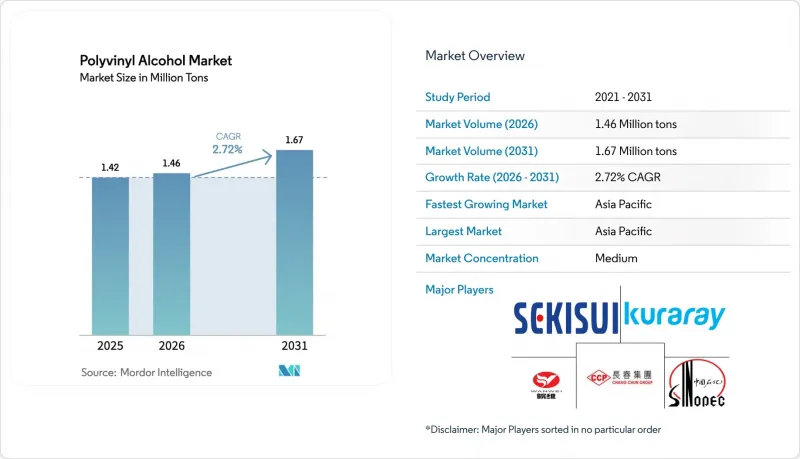
根據 Mordor Intelligence 預測,聚乙烯醇市場規模將從 2025 年的 142 萬噸和 2026 年的 146 萬噸成長到 2031 年的 167 萬噸,2026 年至 2031 年的年複合成長率(CAGR)為 2.72%。
本報告按等級(部分水解、完全水解、其他)、形態(粉末、顆粒、其他)、應用(聚合助劑、聚乙烯丁醛、其他)、終端用戶行業(食品包裝、造紙、其他)和地區(亞太地區、北美地區、其他)進行細分。市場預測以噸為單位。
全球聚乙烯醇市場趨勢與洞察
食品包裝產業需求不斷成長
便捷的單份包裝徹底改變了消費者的購買選擇。 2025年,洗碗機洗滌塊包裝、咖啡膠囊和醬料包佔終端用途出貨量的33.67%。美國食品藥物管理局(FDA)於2024年修訂了食品接觸規程,加快了含抗菌奈米顆粒的聚乙烯醇(PVA)薄膜的核准速度,導致2025年FDA收到的申請數量增加了22%。日本厚生勞動省將核准時間縮短了一半,促進了午餐盒內襯和泡麵包裝薄膜在日本國內的應用。德國和荷蘭的食品零售商報告稱,消費者願意為可溶於水槽的包裝支付12%至15%的溢價,證實了該類產品對價格具有彈性。
建築密封劑和砂漿使用量的增加
部分水解聚乙烯醇(PVA)可改善磁磚黏合劑和自流平材料的流變性能和抗裂性能。中國將於2024年實施的公共基礎設施低揮發性有機化合物(VOC)排放法規預計將在2025年將建築級PVA的需求增加9%。在印度的低收入住宅建設促進計畫中,PVA纖維被用於降低鋼筋成本。同時,中東的大型企劃指定使用PVA改質密封劑,該密封劑能夠承受50度C至15度C的晝夜溫差變化。
醋酸乙烯單體(VAM)價格波動較大,對利潤率帶來了壓力。
預計到2025年,VAM現貨價格波動幅度將達18%,這將使非一體化生產商的毛利率下降12%至15%,並迫使其暫時停產。同時,中國一體化企業預計將享有每噸180美元的成本優勢,進而推動出口成長23%。
細分市場分析
到2025年,部分水解產品佔總銷售量的37.51%,並預計到2031年將成長3.01%,這主要得益於紡織品製造商對其冷熱水溶解性能的偏好。完全水解產品可用於清潔劑膠囊的支撐膜,其中KURARAY CO. LTD.的「POVAL 205」(水解率達98.5%)預計在2025年成為行業標竿。針對特殊應用的創新產品包括用於高速噴墨塗層的超低發泡型產品和用於可重複使用保溫包裝的熱敏凝膠。這些先進等級的產品提高了整體平均售價,並穩定了利潤率。
製造商正在調整黏度、分子量和官能基。三菱化學計畫於2025年推出表面張力為28達因/公分的聚乙烯醇(PVA),以實現無缺陷的光學薄膜塗層。積水化學的熱可逆凝膠在60°C以上溫度下會液化,然後重新固化,這使其在資料中心作為熱緩衝材料有了新的應用。這些發展有助於維持客戶忠誠度,並為聚乙烯醇市場向高附加價值細分市場轉型奠定基礎。
2025年,粉末產品市佔率將維持在54.36%,這主要得益於黏合劑和纖維領域對現場溶解的需求。同時,隨著對膠囊和農藥袋的需求不斷成長,預計到2031年,水溶性薄膜的複合年成長率將達到3.41%。日本VAM & Poval公司2025年生產的三層薄膜在冷水中的溶解速度提高了30%,從而縮短了清潔劑工廠的生產週期。顆粒狀產品用於無需產生粉塵的建築工地,而纖維則用於增強混凝土和瀝青路面。KURARAY CO. LTD.公司的「Kuraron」纖維取代了鋼材用於日本磁浮列車隧道噴射混凝土,使隧道重量減輕了40%。
薄膜製造商會調整塑化劑的混合比例,以平衡拉伸強度和溶解度。滾筒乾燥法生產的片狀產品適用於造紙廠的自動化秤重。因此,在聚乙烯醇市場,物理形態的選擇會影響其適用範圍和定價。
區域分析
預計到2025年,亞太地區將引領市場,佔全球銷售量的47.72%,複合年成長率(CAGR)預計為2.92%。中國85萬噸的綜合產能相比乙烯基生產路線,每噸可節省180美元的成本,使其能夠進行更具競爭力的商品定價。在印度,由於住宅建築和紡織品上漿劑的應用,預計2025年需求將激增。日本出口了用於光學薄膜的高黏度等級產品。在東南亞,隨著跨國公司將生產在地化,對清潔劑凝珠的需求正在成長。
在北美,簡化的FDA核准程序加快了薄膜產品的核准速度,而寶潔公司產品包裝的普及也提振了市場需求。在加拿大,研究人員測試了聚乙烯醇(PVA)種子披衣,該包衣可將鹽鹼土壤中的種子發芽率提高10%。在墨西哥,受近岸外包帶來的建築需求推動,PVA改性砂漿市場實現了溫和成長。
在歐洲,可生物分解薄膜在2025年廢棄物管理法規中被列為優先發展領域,這推動了從日本進口量的成長。在南美洲、中東和非洲,由於基礎建設和農業領域的一系列檢查,需求仍然強勁。不同地區正在湧現新的細分市場,例如巴西石油公司對含聚乙烯醇(PVA)的鑽井液添加劑的檢查,以及沙烏地阿拉伯NEOM專案中玻璃幕牆用PVA密封劑的規格製定。
其他好處
- Excel格式的市場預測(ME)表
- 3個月的分析師支持
目錄
第1章:引言
- 研究假設和市場定義
- 調查範圍
第2章:調查方法
第3章執行摘要
第4章 市場狀況
- 市場概覽
- 市場促進因素
- 食品包裝產業需求不斷成長
- 建築密封劑和砂漿使用量的增加
- 清潔劑凝珠和水溶性薄膜的快速普及。
- PVA基乳化聚合物在水性塗料的應用拓展
- 以聚乙烯醇(PVA)為主要成分的可生物分解農業薄膜的出現。
- 市場限制因素
- 醋酸乙烯單體(VAM)價格波動較大,對利潤率帶來了壓力。
- 生物基和石油基替代品(PLA、EVOH)的可用性
- 新興國家缺乏聚乙烯醇薄膜回收基礎設施
- 價值鏈分析
- 波特五力模型
第5章 市場規模與成長預測
- 按年級
- 部分水解
- 完全水解
- 半部水解
- 低發泡等級
- 其他等級(觸感級、顆粒級)
- 按形式
- 粉末
- 顆粒
- 薄片
- 水溶性薄膜
- 纖維
- 透過使用
- 聚合助劑
- 聚乙烯丁醛
- 黏合劑
- 紡織品
- 紙張、紙漿和塗料
- 應用程式開發中
- 其他用途
- 按最終用途行業分類
- 食品包裝
- 造紙
- 建造
- 電子設備
- 紡織品
- 其他終端用戶產業(清潔劑、殺蟲劑等)
- 按地區
- 亞太地區
- 中國
- 印度
- 日本
- 韓國
- 馬來西亞
- 泰國
- 印尼
- 越南
- 其他亞太國家
- 北美洲
- 美國
- 加拿大
- 墨西哥
- 歐洲
- 德國
- 英國
- 義大利
- 法國
- 西班牙
- 北歐國家
- 其他歐洲國家
- 南美洲
- 巴西
- 阿根廷
- 哥倫比亞
- 其他南美國家
- 中東和非洲
- 沙烏地阿拉伯
- 卡達
- 阿拉伯聯合大公國
- 埃及
- 南非
- 其他中東和非洲國家
- 亞太地區
第6章 競爭情勢
- 市場集中度
- 策略趨勢
- 市佔率和排名分析
- 公司簡介
- Anhui Wanwei Updated High Tech Material Industry Co Ltd
- Astrra Chemicals
- Chang Chun Group
- JAPAN VAM & POVAL CO.,LTD.
- KURARAY CO., LTD.
- Mitsubishi Chemical Group Corporation
- Nippon Chemical Industrial CO., LTD.
- OCI COMPANY Ltd
- Polysciences
- SEKISUI CHEMICAL CO., LTD.
- Shandong Tiancheng Chemical Co., Ltd.
- Shuangxin PVA Tech Co., Ltd.
- Sinopec Sichuan Vinylon Works
第7章 市場機會與未來展望
According to Mordor Intelligence, the polyvinyl alcohol market size is projected to expand from 1.42 million tons in 2025 and 1.46 million tons in 2026 to 1.67 million tons by 2031, registering a CAGR of 2.72% between 2026 to 2031.
This report is Segmented by Grade (Partially Hydrolyzed, Fully Hydrolyzed, and More), Form (Powder, Granules, and More), Application (Polymerization Additives, Polyvinyl Butyral, and More), End-Use Industry (Food Packaging, Paper Manufacturing, and More), and Geography (Asia-Pacific, North America, and More). The Market Forecasts are Provided in Terms of Volume (Tons).
Global Polyvinyl Alcohol Market Trends and Insights
Growing Demand from Food-Packaging Industry
Single-serve convenience formats reshaped purchasing choices. Dishwasher-tablet wraps, coffee pods, and sauce sachets jointly held 33.67% of end-use volume in 2025. Updated U.S. FDA food-contact protocols in 2024 fast-tracked approvals for PVA films with antimicrobial nanoparticles, lifting agency submissions by 22% in 2025. Japan's health ministry halved approval lead times, spurring domestic uptake in bento-box liners and noodle-packet films . German and Dutch grocers reported a 12-15% consumer premium for dissolve-in-sink packaging, validating price-elastic demand.
Increasing Usage in Construction Sealants and Mortar
Partially hydrolyzed PVA improves rheology and crack resistance in tile adhesives and self-leveling compounds. China's 2024 low-VOC mandate for public infrastructure lifted construction-grade PVA offtake 9% in 2025. India's affordable-housing drive adopted PVA fibers to cut rebar costs, while Middle Eastern mega-projects specified PVA-modified sealants able to absorb daily thermal swings from 50 °C to 15 °C.
Volatile Vinyl-Acetate-Monomer Prices Squeezing Margins
Spot VAM swung 18% in 2025, narrowing non-integrated producers' gross margins by 12-15% and prompting temporary shutdowns. Integrated Chinese firms enjoyed a USD 180 per-ton cost edge, boosting exports 23%.
Other drivers and restraints analyzed in the detailed report include:
- Surging Adoption in Detergent Pods and Water-Soluble Films
- Expansion of PVA-Based Emulsion Polymers for Water-Borne Coatings
- Availability of Bio-Based and Petro-Based Substitutes (PLA, EVOH)
For complete list of drivers and restraints, kindly check the Table Of Contents.
Segment Analysis
Partially hydrolyzed captured 37.51% of 2025 volume, expanding at 3.01% through 2031 as textile mills favored its dual cold- and hot-water solubility. Fully hydrolyzed variants underpin detergent-pod films; Kuraray's POVAL 205 with 98.5% hydrolysis became the reference grade in 2025. Specialty innovations include super-low-foaming types for high-speed inkjet coating and thermally reversible gels for reusable cold packs. Collectively, advanced grades increase average selling prices and stabilize margins.
Manufacturers tailor viscosity, molecular weight, and functional groups. Mitsubishi Chemical launched a PVA with surface tension of 28 dynes/cm in 2025 for defect-free optical-film coating. Sekisui's thermally reversible gels liquefy above 60 °C then resolidify, finding new use in data-center thermal buffers. These developments maintain customer lock-in and underpin the polyvinyl alcohol market's shift toward value-added niches.
Powder retained 54.36% share in 2025, driven by on-site dissolution needs in adhesives and textiles. Water-soluble films, however, will post a 3.41% CAGR to 2031 as pod and agrochemical-sachet demand widens. Japan VAM & Poval's 2025 tri-layer film dissolved 30% faster in cold water, cutting cycle times for detergent plants. Granules serve dust-free construction job sites, while fibers reinforce concrete and asphalt; Kuraray's Kuralon fiber replaced steel in Japan's maglev tunnel shotcrete, lowering weight 40%.
Film producers manage plasticizer ratios for balance between tensile strength and dissolution. Flake forms, produced via drum drying, cater to automated dosing in paper mills. Physical format choice therefore dictates reachable applications and pricing power within the polyvinyl alcohol market.
Complete Report Scope:
- By Grade
- Partially Hydrolyzed
- Fully Hydrolyzed
- Sub-Partially Hydrolyzed
- Low-Foaming Grades
- Other Grades (Tactified Grades, Fine Particle Grades)
- By Form
- Powder
- Granules
- Flakes
- Water-Soluble Films
- Fibers
- By Application
- Polymerization Additives
- Polyvinyl Butyral
- Adhesives
- Textile
- Paper Pulp and Coating
- Developing Application
- Other Applications
- By End-use Industry
- Food Packaging
- Paper Manufacturing
- Construction
- Electronics
- Textile
- Other End-use Industries (Detergent, Agrochemicals, etc.)
- By Geography
- Asia-Pacific
- China
- India
- Japan
- South Korea
- Malaysia
- Thailand
- Indonesia
- Vietnam
- Rest of Asia-Pacific
- North America
- United States
- Canada
- Mexico
- Europe
- Germany
- United Kingdom
- Italy
- France
- Spain
- NORDIC Countries
- Rest of Europe
- South America
- Brazil
- Argentina
- Colombia
- Rest of South America
- Middle-East and Africa
- Saudi Arabia
- Qatar
- United Arab Emirates
- Egypt
- South Africa
- Rest of Middle-East and Africa
- Asia-Pacific
Geography Analysis
Asia-Pacific dominated with 47.72% volume in 2025 and is forecast to expand at 2.92% CAGR. China's 850,000-ton integrated capacity enjoys USD 180/t cost advantages vs. ethylene routes, allowing aggressive commodity pricing. India's 2025 offtake jumped due to housing construction and textile sizing. Japan exported high-viscosity grades for optical films. Southeast Asia posted detergent-pod demand growth as multinationals localized production.
In North America, streamlined FDA clearances accelerated film approvals, and Procter & Gamble's pod shift added demand. Canada piloted PVA seed coatings with 10% germination uplift in saline soils. Mexico enjoyed moderate growth in PVA-modified mortars tied to near-shoring construction.
Europe is prioritizing biodegradable films under its 2025 waste regulation, driving import growth from Japan. South America and the Middle East and Africa commanded demand as infrastructure and agricultural trials multiply. Petrobras tested PVA drilling-fluid additives, while Saudi Arabia's NEOM project specified PVA sealants for glass facades, underscoring emerging regional niches.
- Anhui Wanwei Updated High Tech Material Industry Co Ltd
- Astrra Chemicals
- Chang Chun Group
- JAPAN VAM & POVAL CO.,LTD.
- KURARAY CO., LTD.
- Mitsubishi Chemical Group Corporation
- Nippon Chemical Industrial CO., LTD.
- OCI COMPANY Ltd
- Polysciences
- SEKISUI CHEMICAL CO., LTD.
- Shandong Tiancheng Chemical Co., Ltd.
- Shuangxin PVA Tech Co., Ltd.
- Sinopec Sichuan Vinylon Works
Additional Benefits:
- The market estimate (ME) sheet in Excel format
- 3 months of analyst support
TABLE OF CONTENTS
1 Introduction
- 1.1 Study Assumptions and Market Definition
- 1.2 Scope of the Study
2 Research Methodology
3 Executive Summary
4 Market Landscape
- 4.1 Market Overview
- 4.2 Market Drivers
- 4.2.1 Growing Demand from Food-Packaging Industry
- 4.2.2 Increasing Usage in Construction Sealants and Mortar
- 4.2.3 Surging Adoption in Detergent Pods and Water-Soluble Films
- 4.2.4 Expansion of PVA-Based Emulsion Polymers for Water-Borne Coatings
- 4.2.5 Emergence of PVA-Based Biodegradable Agricultural Films
- 4.3 Market Restraints
- 4.3.1 Volatile Vinyl-Acetate-Monomer (VAM) Prices Squeezing Margins
- 4.3.2 Availability of Bio-Based and Petro-Based Substitutes (PLA, EVOH)
- 4.3.3 Limited Recycling Infrastructure for PVA Films in Emerging Economies
- 4.4 Value Chain Analysis
- 4.5 Porter's Five Forces
- 4.5.1 Bargaining Power of Suppliers
- 4.5.2 Bargaining Power of Buyers
- 4.5.3 Threat of New Entrants
- 4.5.4 Threat of Substitutes
- 4.5.5 Degree of Competition
5 Market Size and Growth Forecasts (Volume)
- 5.1 By Grade
- 5.1.1 Partially Hydrolyzed
- 5.1.2 Fully Hydrolyzed
- 5.1.3 Sub-Partially Hydrolyzed
- 5.1.4 Low-Foaming Grades
- 5.1.5 Other Grades (Tactified Grades, Fine Particle Grades)
- 5.2 By Form
- 5.2.1 Powder
- 5.2.2 Granules
- 5.2.3 Flakes
- 5.2.4 Water-Soluble Films
- 5.2.5 Fibers
- 5.3 By Application
- 5.3.1 Polymerization Additives
- 5.3.2 Polyvinyl Butyral
- 5.3.3 Adhesives
- 5.3.4 Textile
- 5.3.5 Paper Pulp and Coating
- 5.3.6 Developing Application
- 5.3.7 Other Applications
- 5.4 By End-use Industry
- 5.4.1 Food Packaging
- 5.4.2 Paper Manufacturing
- 5.4.3 Construction
- 5.4.4 Electronics
- 5.4.5 Textile
- 5.4.6 Other End-use Industries (Detergent, Agrochemicals, etc.)
- 5.5 By Geography
- 5.5.1 Asia-Pacific
- 5.5.1.1 China
- 5.5.1.2 India
- 5.5.1.3 Japan
- 5.5.1.4 South Korea
- 5.5.1.5 Malaysia
- 5.5.1.6 Thailand
- 5.5.1.7 Indonesia
- 5.5.1.8 Vietnam
- 5.5.1.9 Rest of Asia-Pacific
- 5.5.2 North America
- 5.5.2.1 United States
- 5.5.2.2 Canada
- 5.5.2.3 Mexico
- 5.5.3 Europe
- 5.5.3.1 Germany
- 5.5.3.2 United Kingdom
- 5.5.3.3 Italy
- 5.5.3.4 France
- 5.5.3.5 Spain
- 5.5.3.6 NORDIC Countries
- 5.5.3.7 Rest of Europe
- 5.5.4 South America
- 5.5.4.1 Brazil
- 5.5.4.2 Argentina
- 5.5.4.3 Colombia
- 5.5.4.4 Rest of South America
- 5.5.5 Middle-East and Africa
- 5.5.5.1 Saudi Arabia
- 5.5.5.2 Qatar
- 5.5.5.3 United Arab Emirates
- 5.5.5.4 Egypt
- 5.5.5.5 South Africa
- 5.5.5.6 Rest of Middle-East and Africa
- 5.5.1 Asia-Pacific
6 Competitive Landscape
- 6.1 Market Concentration
- 6.2 Strategic Moves
- 6.3 Market Share(%)/Ranking Analysis
- 6.4 Company Profiles (includes Global level Overview, Market level overview, Core Segments, Financials as available, Strategic Information, Products and Services, and Recent Developments)
- 6.4.1 Anhui Wanwei Updated High Tech Material Industry Co Ltd
- 6.4.2 Astrra Chemicals
- 6.4.3 Chang Chun Group
- 6.4.4 JAPAN VAM & POVAL CO.,LTD.
- 6.4.5 KURARAY CO., LTD.
- 6.4.6 Mitsubishi Chemical Group Corporation
- 6.4.7 Nippon Chemical Industrial CO., LTD.
- 6.4.8 OCI COMPANY Ltd
- 6.4.9 Polysciences
- 6.4.10 SEKISUI CHEMICAL CO., LTD.
- 6.4.11 Shandong Tiancheng Chemical Co., Ltd.
- 6.4.12 Shuangxin PVA Tech Co., Ltd.
- 6.4.13 Sinopec Sichuan Vinylon Works
7 Market Opportunities and Future Outlook
- 7.1 White-Space and Unmet-Need Assessment
- 7.2 Innovations in Polyvinyl Alcohol for Packaging and Medical

 LCD PVA薄膜市場:全球市場預測,2026-2032年
 聚乙烯醇薄膜市場報告:趨勢、預測及競爭分析(至2035年)
 聚乙烯醇(PVA)薄膜:市場佔有率分析、產業趨勢與統計數據、成長預測(2026-2031)聚乙烯醇薄膜市場:2026-2032年全球市場預測(依產品類型、厚度範圍、形狀、製造技術、材料類型、銷售管道和應用分類)
 聚乙烯醇(PVA)市場報告:按等級、最終用途產業和地區分類(2026-2034 年)
 全球聚乙烯醇薄膜市場:依應用、材料等級、產品類型及地區分類-預測至2031年聚乙烯醇市場:依水解類型、形態、等級、通路和最終用途分類-2026-2032年全球市場預測
 全球聚乙烯醇市場:市場規模、佔有率和趨勢分析(按最終用途和地區分類),細分市場預測(2026-2033 年)
 聚乙烯醇市場規模、佔有率及成長分析(按類型、應用和地區分類)-2026-2033年產業預測
 聚乙烯醇(PVA)薄膜市場規模、佔有率和成長分析(按等級、薄膜類型、性能、通路、應用和地區分類)-2026-2033年產業預測