


 |
市場調查報告書
商品編碼
2114986
聚乙烯醇(PVA)薄膜:市場佔有率分析、產業趨勢與統計數據、成長預測(2026-2031)Polyvinyl Alcohol (PVA) Films - Market Share Analysis, Industry Trends & Statistics, Growth Forecasts (2026 - 2031) |
||||||

※ 本網頁內容可能與最新版本有所差異。詳細情況請與我們聯繫。
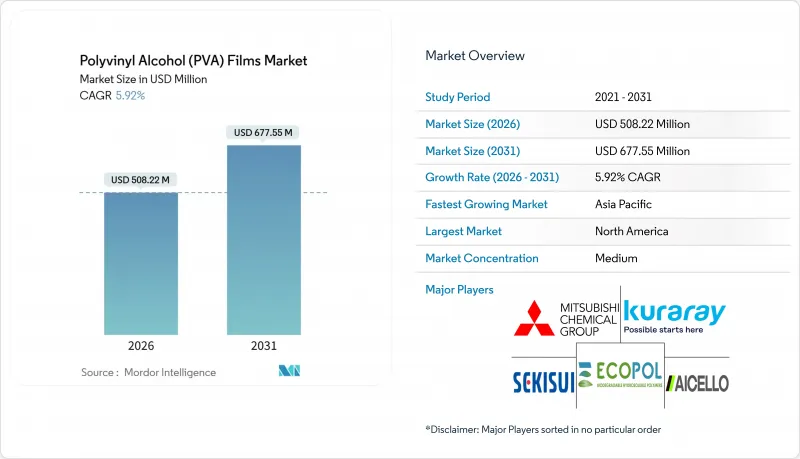
根據 Mordor Intelligence 估計,聚乙烯醇薄膜市場在 2026 年的價值為 5.0822 億美元,預計到 2031 年將達到 6.7755 億美元,在預測期(2026-2031 年)內以 5.92% 的複合年成長率成長。
本報告按等級(完全水解、部分水解等)、應用(單劑量包裝、洗衣袋等)、終端用戶行業(家用和工業清潔、電子和光電子等)以及地區(亞太地區、北美地區、歐洲地區、南美地區、中東和非洲地區)進行細分。市場預測以美元計價。
全球聚乙烯醇(PVA)薄膜市場趨勢及洞察
北美和歐洲冷水溶解型清潔劑膠囊銷量激增
完全溶解溫度低於15 度C的洗衣凝珠旨在滿足節能洗衣的需求,預計到2025年,節能洗衣凝珠在兩個地區的洗衣總量中佔比將超過60%。為了符合EN 13432標準中更嚴格的零殘留標準,化合物生產商已將聚乙烯醇(PVA)的水解率調整至87%至92%的範圍內。這導致清潔劑工廠的薄膜訂單激增,這些工廠已將凝珠的生產能力提升至每分鐘1000個以上。預計到2025年,水溶性洗衣凝珠的市場銷售額將達到3.337億美元,2034年將超過12.3億美元。因此,這一高成長的凝珠細分市場是預測期內聚乙烯醇薄膜市場絕對銷量成長的主要驅動力。
亞太地區的塑膠禁令指令正在加速水溶性農業包裝的推廣應用。
中國的《農業薄膜管理辦法》強制要求回收或經認證可生物分解,促使農藥生產商從聚乙烯袋轉向可在噴霧罐中溶解的一次性聚乙烯醇(PVA)薄膜包裝。自2023年4月起,相關法規的執行力度進一步加強,當時三個部會在播種高峰期開始聯合檢查。印度的農藥廢棄物管理規定也持類似立場,禁止將空容器重複用於食品接觸用途。這些政策共同解釋了為什麼亞太地區是聚乙烯醇薄膜市場成長最快的地區。
醋酸乙烯單體(VAM)價格波動
2025年,乙烯和乙酸價格飆升導致乙烯-醋酸共聚物(VAM)現貨價格每噸上漲100美元,為KURARAY CO. LTD.和三菱化學等一體化生產商提供了明確的利潤對沖手段。同時,由於價格上漲導致進口VAM被轉用於中國的黏合劑產業,拉丁美洲的獨立加工商的利潤率下降了200-300個基點。長期合約和對自有VAM工廠的直接投資仍然是他們唯一可靠的緩衝手段。
細分市場分析
到2025年,部分水解薄膜將佔聚乙烯醇薄膜市場54.19%的佔有率,預計到2031年仍將是主要的收入來源,因為其87-92%的水解度使其具有快速溶解性和優異的拉伸強度。這些等級的薄膜在20 度C下可在30-90秒內溶解,因此可運作速度超過每分鐘1000個的高速膠囊填充機。完全水解薄膜的水解度超過98%,其氧氣阻隔值低於0.02 cc m² day,是優異的光學偏光材料,有助於延長背板的使用壽命,但由於其在冷水中會快速分解,因此不適用於清潔劑應用。預計到2031年,乙烯接枝共聚物產品將成長6.50%,這主要得益於其在洗衣袋和刺繡襯裡等領域的應用,這些應用需要延遲溶解,從而提高熱封強度和防潮性能。此外,針對纖維上漿和膠帶應用的低黏度和高黏度特種產品也呈現穩定但適度的成長。
聚乙烯醇薄膜在各等級產品中的市佔率清晰地展現了其因部分水解而帶來的高通用性。 Polyva公司透過採用線上薄膜調溫技術,將水解度提高至90%,流延速度提升了60%。這使得脆性降低了30%,工廠運轉率提升至85%。三菱化學正持續擴大其全水解產品的產能,以滿足更大尺寸電視面板的需求,目標是在2027會計年度實現年產量1.54億平方米。儘管其成長速度較半水解產品有所放緩,但已確立了穩固的市場地位。
區域分析
預計到2025年,北美將佔全球銷售額的35.87%,這主要得益於洗衣凝珠的高滲透率以及墨西哥偏光片出口到顯示器組裝製造商。同時,亞太地區正以6.88%的複合年成長率快速成長,這得益於中國農業薄膜回收法的實施以及印度二線城市洗衣凝珠銷售網路的擴張。歐洲的成長率為5.5%,這主要得益於義大利、德國和土耳其在歐洲綠色交易框架下建立的循環纖維上漿加工廠。南美洲的成長率為5.2%,主要歸功於巴西消費者轉向使用清潔劑。而中東和非洲的成長率為4.8%,因為農業用洗衣凝珠的應用仍處於起步階段。
2023年,中國洗衣凝珠消費量成長約30%,促使安徽萬維迅速推出生物聚乙烯醇(bio-PVA)生產線,以確保國內外訂單。日本KURARAY CO. LTD.和三菱化學是光學薄膜的主導出口商,其中三菱化學計畫在2027年下半年前於大垣市新增一條年產2700萬平方公尺的生產線。在印度,農藥廢棄物處理法規禁止容器重複使用,推動了水溶性包裝袋的穩定需求。韓國住友化學計畫在2025年將其偏光膜產能提高25%,以掌握迷你LED的市場成長動能。在北美,預計醫療保健薄膜而非洗衣凝珠(目前已有超過40%的家庭使用)將成為市場成長的主要動力。
其他好處:
- Excel格式的市場預測(ME)表
- 3個月的分析師支持
目錄
第1章:引言
- 研究假設和市場定義
- 調查範圍
第2章:調查方法
第3章執行摘要
第4章 市場狀況
- 市場概覽
- 市場促進因素
- 北美和歐洲冷水溶解型清潔劑膠囊銷量激增
- 亞太地區禁止使用塑膠的政策正在加速水溶性農藥包裝的普及。
- 清潔劑包裝的需求不斷成長
- 政府政策和向環保材料的過渡
- 擴大綠色新政對可生物分解食品包裝的獎勵
- 市場限制因素
- 醋酸乙烯單體(VAM)價格波動
- 成本上升和應用受限
- 是否有合適的替代方案
- 價值鏈分析
- 波特五力模型
第5章 市場規模與成長預測
- 等級類型
- 完全水解
- 部分水解
- 取代/共聚物聚乙烯醇
- 其他年級
- 透過使用
- 單劑量包裝
- 清潔劑
- 農業化學品
- 消毒劑
- 其他單劑量包裝
- 洗衣袋
- 刺繡
- 偏光面板
- 其他用途(醫療保健、食品飲料包裝)
- 單劑量包裝
- 按最終用戶行業分類
- 家庭和工業清潔
- 農業
- 電子學和光電子學
- 醫療和藥品
- 紡織品和刺繡
- 食品/飲料
- 其他
- 按地區
- 亞太地區
- 中國
- 印度
- 日本
- 韓國
- 其他亞太國家
- 北美洲
- 美國
- 加拿大
- 墨西哥
- 歐洲
- 德國
- 英國
- 法國
- 義大利
- 其他歐洲國家
- 南美洲
- 巴西
- 阿根廷
- 其他南美國家
- 中東和非洲
- 沙烏地阿拉伯
- 南非
- 其他中東和非洲國家
- 亞太地區
第6章 競爭情勢
- 市場集中度
- 策略趨勢
- 市佔率和排名分析
- 公司簡介
- Aicello Corporation
- Amtrex Nature Care Pvt. Ltd.
- Anhui Dingzheng Packing Material Co., Ltd.
- Arrow Coated Products Ltd.
- Cangzhou Water Supply and Drainage Group Co., Ltd.
- Cortec Corporation
- Ecopol SpA
- Guangzhou Plastic Industrial Group Co., Ltd.
- Jiangmen Proudly Water-Soluble Plastic Co., Ltd.
- Joyforce Chemical Industrial Co., Ltd.
- Kuraray Co., Ltd.
- LG Chem
- Mitsubishi Chemical Group Corporation
- Nippon Chemical Industrial CO., LTD.
- Nitto Denko Corporation
- Noble Industries
- SEKISUI CHEMICAL CO., LTD.
- Sumitomo Chemical Co., Ltd.
- UNITIKA LTD.
- WATERSOL
第7章 市場機會與未來展望
According to Mordor Intelligence, the polyvinyl alcohol films market size is estimated at USD 508.22 million in 2026, and is expected to reach USD 677.55 million by 2031, at a CAGR of 5.92% during the forecast period (2026-2031).
This report is Segmented by Grade Type (Fully Hydrolyzed, Partially Hydrolyzed, and More), Application (Unit-Dose Packaging, Laundry Bags, and More), End-User Industry (Household and Industrial Cleaning, Electronics and Optoelectronics, and More), and Geography (Asia-Pacific, North America, Europe, South America, and the Middle East and Africa). The Market Forecasts are Provided in Terms of Value (USD).
Global Polyvinyl Alcohol (PVA) Films Market Trends and Insights
Surge in Cold-Water-Soluble Detergent Pods Across North America and Europe
Pods that dissolve completely below 15°C meet energy-saving wash cycles that represented more than 60% of loads in both regions during 2025. Formulators aligned PVA hydrolysis between 87% and 92% to meet the stricter residue-free benchmarks embedded in EN 13432, prompting a surge in film call-offs from detergent plants that switched pod throughput to over 1,000 units per minute. Market revenue for water-soluble laundry pods climbed to USD 333.7 million in 2025 and is projected to top USD 1.23 billion by 2034. The high-growth pod segment, therefore, underpins the largest absolute volume gain expected in the polyvinyl alcohol films market over the outlook period.
Asia-Pacific Plastic-Ban Directives Accelerating Water-Soluble Agro-Packs
China's Agricultural Film Management Measures require recovery or certified biodegradation, moving pesticide formulators away from polyethylene sachets toward unit-dose PVA film packs that dissolve in spray tanks. Enforcement intensified after April 2023 when three ministries launched joint inspections during peak planting seasons . India's pesticide-waste rules echo this stance, disallowing reuse of emptied containers for any food contact. Together, these policies explain why Asia-Pacific is the fastest advancing geography in the polyvinyl alcohol films market.
Volatility in Vinyl-Acetate-Monomer Pricing
Spot VAM rose by USD 100 per ton in 2025 after ethylene and acetic acid rallied, handing integrated producers such as Kuraray and Mitsubishi Chemical a clear margin hedge. Independent converters in Latin America documented 200-300 basis-point margin erosion because imported VAM was rerouted to China's adhesives sector during the spike. Long-term contracts and direct investment in captive VAM units remain the only credible buffer.
Other drivers and restraints analyzed in the detailed report include:
- Expanded Optical-Grade Polarizer Production for OLED and Mini-LED Displays
- Growing Demand for Unit-Dose Detergent Packaging in Emerging Economies
- Higher Cost and Limited Heat Resistance Versus PE and PET Films
For complete list of drivers and restraints, kindly check the Table Of Contents.
Segment Analysis
Partially hydrolyzed films supplied 54.19% of the polyvinyl alcohol films market in 2025 and are forecast to remain the dominant revenue stream through 2031 because the 87-92% hydrolysis window delivers quick dissolution and robust tensile strength. These grades dissolve in 30-90 seconds at 20°C, enabling high-speed pod fillers that run beyond 1,000 units per minute. Fully hydrolyzed films, with hydrolysis above 98%, excel as optical polarizers where oxygen barrier values below 0.02 cc m2 day align with long back-plane service life, yet they break down too rapidly in cold water for detergent use. Copolymer grades that graft ethylene improve hot-seal strength and moisture resistance, growing at 6.50% to 2031 by serving laundry bags and embroidery backing where delayed dissolution is desired. Specialty low-viscosity and high-viscosity grades cater to textile sizing and adhesive tapes, posting stable but modest expansion.
Polyvinyl alcohol films market share at the grade level illustrates the versatility premium of partial hydrolysis. Polyva upgraded casting speed by 60% when it refined hydrolysis to 90% alongside in-line film tempering, cutting brittleness events by 30% and lifting plant utilization to 85%. Mitsubishi Chemical continues to lift fully hydrolyzed capacity, targeting 154 million m2 per year by fiscal 2027 in response to television panel enlargement, thereby securing its foothold despite slower growth relative to pods.
Complete Report Scope:
- By Grade Type
- Fully Hydrolyzed
- Partially Hydrolyzed
- Substituted / Copolymer PVA
- Other Grades
- By Application
- Unit-Dose Packaging
- Detergents
- Agrochemicals
- Disinfectants
- Other Unit Dose Packaging
- Laundry Bags
- Embroidery
- Polarizing Panels
- Other Applications(Medical and Healthcare,Food and Beverage Packaging)
- Unit-Dose Packaging
- By End-user Industry
- Household and Industrial Cleaning
- Agriculture
- Electronics and Optoelectronics
- Healthcare and Pharmaceuticals
- Textile and Embroidery
- Food and Beverage
- Others
- By Geography
- Asia-Pacific
- China
- India
- Japan
- South Korea
- Rest of Asia-Pacific
- North America
- United States
- Canada
- Mexico
- Europe
- Germany
- United Kingdom
- France
- Italy
- Rest of Europe
- South America
- Brazil
- Argentina
- Rest of South America
- Middle East and Africa
- Saudi Arabia
- South Africa
- Rest of Middle East and Africa
- Asia-Pacific
Geography Analysis
North America commanded 35.87% revenue in 2025 through high pod penetration and polarizer exports to Mexico based display assemblers. Asia-Pacific, however, gathers velocity at a 6.88% CAGR given China's agro-film recovery laws and India's widening retail network that sells pods in tier-two cities. Europe advances 5.5% as circular textile sizing plants spring up in Italy, Germany, and Turkey under the European Green Deal. South America grows at 5.2% with Brazil's detergent shift, and the Middle East & Africa hit 4.8% where agricultural sachets are early in the adoption curve.
China's pod consumption climbed about 30% in 2023, prompting Anhui Wanwei to fast-track a bio-PVA line that will secure both domestic and export orders. Japan's Kuraray and Mitsubishi Chemical dominate optical film exports, with the latter adding a 27 million m2 annual line at Ogaki by H2 2027. India leverages pesticide-waste rules that forbid container reuse, driving volume-secure demand for water-soluble sachets. South Korea's Sumitomo Chemical raised polarizer capacity by 25% in 2025 to ride mini-LED momentum. North America sees incremental upside from healthcare films rather than laundry pods, whose penetration already exceeds 40% of households.
- Aicello Corporation
- Amtrex Nature Care Pvt. Ltd.
- Anhui Dingzheng Packing Material Co., Ltd.
- Arrow Coated Products Ltd.
- Cangzhou Water Supply and Drainage Group Co., Ltd.
- Cortec Corporation
- Ecopol SpA
- Guangzhou Plastic Industrial Group Co., Ltd.
- Jiangmen Proudly Water-Soluble Plastic Co., Ltd.
- Joyforce Chemical Industrial Co., Ltd.
- Kuraray Co., Ltd.
- LG Chem
- Mitsubishi Chemical Group Corporation
- Nippon Chemical Industrial CO., LTD.
- Nitto Denko Corporation
- Noble Industries
- SEKISUI CHEMICAL CO., LTD.
- Sumitomo Chemical Co., Ltd.
- UNITIKA LTD.
- WATERSOL
Additional Benefits:
- The market estimate (ME) sheet in Excel format
- 3 months of analyst support
TABLE OF CONTENTS
1 Introduction
- 1.1 Study Assumptions and Market Definition
- 1.2 Scope of the Study
2 Research Methodology
3 Executive Summary
4 Market Landscape
- 4.1 Market Overview
- 4.2 Market Drivers
- 4.2.1 Surge in Cold-Water Soluble Detergent Pods across North America and Europe
- 4.2.2 Asia-Pacific Plastic-Ban Directives Accelerating Water-Soluble Agrochemical Packs
- 4.2.3 Growing Demand for Detergent Packaging
- 4.2.4 Government Policies and Shift Toward Eco-friendly Materials
- 4.2.5 Increasing Green-Deal Incentives for Biodegradable Food Packaging
- 4.3 Market Restraints
- 4.3.1 Volatility in Vinyl Acetate Monomer (VAM) Pricing
- 4.3.2 Higher Cost and Limited Applications
- 4.3.3 Availability of Suitable Substitutes
- 4.4 Value Chain Analysis
- 4.5 Porter's Five Forces
- 4.5.1 Bargaining Power of Suppliers
- 4.5.2 Bargaining Power of Buyers
- 4.5.3 Threat of New Entrants
- 4.5.4 Threat of Substitute Products
- 4.5.5 Degree of Competition
5 Market Size and Growth Forecasts (Value)
- 5.1 By Grade Type
- 5.1.1 Fully Hydrolyzed
- 5.1.2 Partially Hydrolyzed
- 5.1.3 Substituted / Copolymer PVA
- 5.1.4 Other Grades
- 5.2 By Application
- 5.2.1 Unit-Dose Packaging
- 5.2.1.1 Detergents
- 5.2.1.2 Agrochemicals
- 5.2.1.3 Disinfectants
- 5.2.1.4 Other Unit Dose Packaging
- 5.2.2 Laundry Bags
- 5.2.3 Embroidery
- 5.2.4 Polarizing Panels
- 5.2.5 Other Applications(Medical and Healthcare,Food and Beverage Packaging)
- 5.2.1 Unit-Dose Packaging
- 5.3 By End-user Industry
- 5.3.1 Household and Industrial Cleaning
- 5.3.2 Agriculture
- 5.3.3 Electronics and Optoelectronics
- 5.3.4 Healthcare and Pharmaceuticals
- 5.3.5 Textile and Embroidery
- 5.3.6 Food and Beverage
- 5.3.7 Others
- 5.4 By Geography
- 5.4.1 Asia-Pacific
- 5.4.1.1 China
- 5.4.1.2 India
- 5.4.1.3 Japan
- 5.4.1.4 South Korea
- 5.4.1.5 Rest of Asia-Pacific
- 5.4.2 North America
- 5.4.2.1 United States
- 5.4.2.2 Canada
- 5.4.2.3 Mexico
- 5.4.3 Europe
- 5.4.3.1 Germany
- 5.4.3.2 United Kingdom
- 5.4.3.3 France
- 5.4.3.4 Italy
- 5.4.3.5 Rest of Europe
- 5.4.4 South America
- 5.4.4.1 Brazil
- 5.4.4.2 Argentina
- 5.4.4.3 Rest of South America
- 5.4.5 Middle East and Africa
- 5.4.5.1 Saudi Arabia
- 5.4.5.2 South Africa
- 5.4.5.3 Rest of Middle East and Africa
- 5.4.1 Asia-Pacific
6 Competitive Landscape
- 6.1 Market Concentration
- 6.2 Strategic Moves
- 6.3 Market Share(%)/Ranking Analysis
- 6.4 Company Profiles (includes Global Level Overview, Market Level Overview, Core Segments, Financials as available, Strategic Information, Products and Services, Recent Developments)
- 6.4.1 Aicello Corporation
- 6.4.2 Amtrex Nature Care Pvt. Ltd.
- 6.4.3 Anhui Dingzheng Packing Material Co., Ltd.
- 6.4.4 Arrow Coated Products Ltd.
- 6.4.5 Cangzhou Water Supply and Drainage Group Co., Ltd.
- 6.4.6 Cortec Corporation
- 6.4.7 Ecopol SpA
- 6.4.8 Guangzhou Plastic Industrial Group Co., Ltd.
- 6.4.9 Jiangmen Proudly Water-Soluble Plastic Co., Ltd.
- 6.4.10 Joyforce Chemical Industrial Co., Ltd.
- 6.4.11 Kuraray Co., Ltd.
- 6.4.12 LG Chem
- 6.4.13 Mitsubishi Chemical Group Corporation
- 6.4.14 Nippon Chemical Industrial CO., LTD.
- 6.4.15 Nitto Denko Corporation
- 6.4.16 Noble Industries
- 6.4.17 SEKISUI CHEMICAL CO., LTD.
- 6.4.18 Sumitomo Chemical Co., Ltd.
- 6.4.19 UNITIKA LTD.
- 6.4.20 WATERSOL
7 Market Opportunities and Future Outlook
- 7.1 White-space and Unmet-Need Assessment

 LCD PVA薄膜市場:全球市場預測,2026-2032年
 聚乙烯醇薄膜市場報告:趨勢、預測及競爭分析(至2035年)
 聚乙烯醇:市佔率分析、產業趨勢與統計、成長預測(2026-2031)聚乙烯醇薄膜市場:2026-2032年全球市場預測(依產品類型、厚度範圍、形狀、製造技術、材料類型、銷售管道和應用分類)
 聚乙烯醇(PVA)市場報告:按等級、最終用途產業和地區分類(2026-2034 年)
 全球聚乙烯醇薄膜市場:依應用、材料等級、產品類型及地區分類-預測至2031年聚乙烯醇市場:依水解類型、形態、等級、通路和最終用途分類-2026-2032年全球市場預測
 全球聚乙烯醇市場:市場規模、佔有率和趨勢分析(按最終用途和地區分類),細分市場預測(2026-2033 年)
 聚乙烯醇市場規模、佔有率及成長分析(按類型、應用和地區分類)-2026-2033年產業預測
 聚乙烯醇(PVA)薄膜市場規模、佔有率和成長分析(按等級、薄膜類型、性能、通路、應用和地區分類)-2026-2033年產業預測