


 |
市場調查報告書
商品編碼
2122370
層壓黏合劑:市場佔有率分析、行業趨勢和統計數據、成長預測(2026-2031)Laminating Adhesives - Market Share Analysis, Industry Trends & Statistics, Growth Forecasts (2026 - 2031) |
||||||

※ 本網頁內容可能與最新版本有所差異。詳細情況請與我們聯繫。
據 Mordor Intelligence 稱,層壓黏合劑的市場規模預計在 2026 年達到 40.9 億美元,高於 2025 年的 38.5 億美元,預計到 2031 年將達到 54.9 億美元。
預計從 2026 年到 2031 年,其複合年成長率將達到 6.12%。
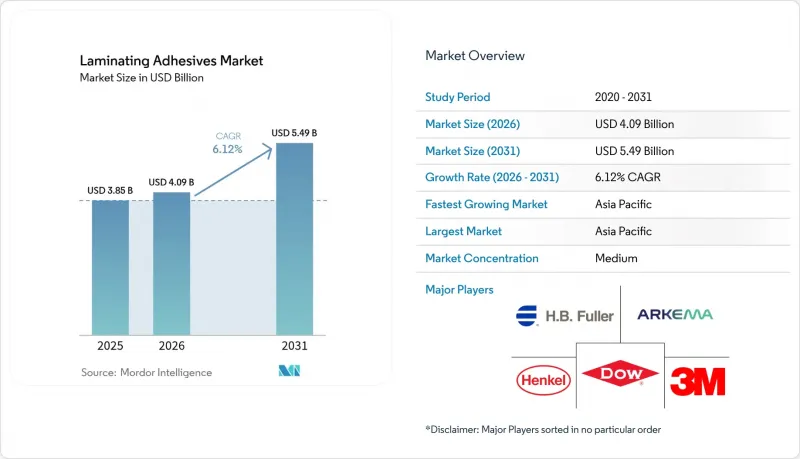
本報告按類型(溶劑型、水性、其他)、樹脂化學成分(聚氨酯、丙烯酸酯、其他)、應用領域(包裝、工業層壓、其他)和地區(亞太地區、北美地區、南美地區、歐洲、中東和非洲)進行細分。市場預測以美元計價。
全球層壓黏合劑市場趨勢及洞察
軟食品包裝市場強勁成長
預計到2028年,軟包裝市場將以每年3.2%的速度成長,達到3,416億美元。這一成長推動了對符合FDA 21 CFR Part 175和中國國家食品接觸黏合劑標準GB 4806.15-2024的抗遷移複合黏合劑的持續需求。加工者需要精確的熱活化曲線,以防止風味物質在多層結構中遷移,同時確保在高壓蒸餾過程中的密封強度。領先的供應商透過提供低於歐盟二異氰酸酯閾值的低單體PUR等級產品來脫穎而出,從而縮短了符合法規要求的交付前置作業時間。全球食品品牌越來越重視定量遷移測試,並優先選擇擁有內部分析能力和全球法規文件的供應商。黏合劑市場正抓住這一機遇,致力於擴展無溶劑生產線,以降低能耗並提高職場的安全性。
醫用軟袋和輸液袋用層壓材料的需求正在激增。
流延擠出薄膜可實現靜脈輸液袋目視檢查所需的晶瑩剔透度,而吹塑薄膜複合材料則可增強藥品包裝袋的抗穿刺性。 ISO 10993 生物相容性測試是高進入門檻,限制了新進入者,並鞏固了經檢驗等級產品的高價位。穿戴式醫療設備正在推動親膚型黏合劑的創新,以兼顧黏合性和無痛釋放。監管機構要求產品在伽瑪射線、電子束和環氧乙烷滅菌製程中保持滅菌穩定性,促使研發工作致力於開發滅菌後仍能維持機械強度的化學成分。北美製造商利用符合 GMP 標準的生產設施和成熟的文檔,與醫院簽訂長期合約。
加強對傳統溶劑的VOC和PFAS法規
美國環保署 (EPA) 的《聯邦法規》第 59 部分 (40 CFR Part 59) 對工業黏合劑的揮發性有機化合物 (VOC) 含量設定了嚴格的限制,迫使長期以來使用的溶劑型產品進行改革。在加州,根據 65 號提案,醋酸乙烯酯將被列入受管制物質清單,該提案將於 2025 年 12 月生效,這將增加全部區域的標籤標註和改革成本。同時,歐盟法規將食品包裝中全氟烷基和多氟烷基物質 (PFAS) 的總含量限制在 250 ppb 以內,並於 2026 年 8 月前實施,這將加速向無 PFAS 化學品的快速轉型。合規成本和重新認證檢查正在給研發預算帶來壓力,對中小型加工商的影響尤其嚴重,並加速層壓黏合劑市場的產業結構調整。
細分市場分析
2025年,溶劑型產品在層壓黏合劑市場仍佔45.10%的佔有率。這反映了其優異的粘合性能和加工商長期以來對其的熟悉程度。儘管該細分市場呈現溫和成長,但日益嚴格的VOC法規迫使加工商重新考慮高能耗的乾燥隧道。因此,預計到2031年,無溶劑型產品將以7.36%的複合年成長率強勁成長,因為加工商將採用高速串聯生產線,無需烘箱,從而降低高達40%的能源成本。水性分散體佔據中間細分市場,降低了從溶劑型產品轉型企業的進入門檻,同時也具有環境效益。新興的紫外光固化和電子束固化系統則針對需要即時初始強度和低遷移率的特定應用領域。
這一轉變的驅動力在於加工經濟性。反應型聚氨酯熱熔膠兼具熱熔膠的易操作性和熱固膠的最終強度,使其成為雙層和三層貼合機的理想選擇。希伯來大學的研究人員展示了微波活化光固化黏合劑,這種膠合劑代表了一種可實現按需回收的下一代固化機制。擁有廣泛技術組合的供應商透過分階段的設備升級為加工商提供支持,同時確保產品在包裝、工業和運輸應用領域表現的一致性,從而獲得戰略優勢。
區域分析
預計到2025年,亞太地區將佔據層壓黏合劑市場48.70%的佔有率,並在2031年之前以6.95%的複合年成長率成長。中國在丙烯酸(以丙烷為原料)領域投資16億美元,凸顯了成本創新的綜效。在印度,中產階級的壯大和基礎設施項目的推進,以及漢高位於馬哈拉斯特拉邦拉邦的樂泰工廠的擴建,都為該地區的產能提供了支撐。日本和韓國憑藉其緊密的供應鏈和強大的智慧財產權保護,為電子產品和電動車電池模組提供精密複合技術。
在北美,完善的研發系統和嚴格的法律規範正在加速永續配方技術的突破性發展。該地區在醫療器材和製藥製造領域的主導地位,推動了對符合美國醫療設備管理局 (FDA) 要求的特殊黏合劑的需求。加拿大對多環芳烴 (PAH) 密封劑的監管規定,凸顯了北美對全球供應商的監管影響力。墨西哥具有成本競爭力的工廠為北美自由貿易協定(北美自由貿易組織(NAFTA)成員國在汽車內飾和消費性包裝領域的供應鏈提供了支持。
歐洲持續引領全球標準。隨著歐盟收緊對再生材料含量的要求,加工商的投資正轉向可回收的聚氨酯(PUR)和丙烯酸系統。德國的工程技術基礎推動著製程的持續改進,而法國和義大利則擁有大規模的加工產業叢集,這些集群依賴於向無溶劑製程的轉型。南美洲和中東及非洲地區雖然目前規模較小,但在基礎建設和消費市場的擴張推動下,正呈現出高於平均的成長。聖戈班以10.25億美元收購福斯羅克,凸顯了這些地區對建築和工業領域日益成長的興趣。
其他好處
- Excel格式的市場預測(ME)表
- 3個月的分析師支持
目錄
第1章:引言
- 研究假設和市場定義
- 調查範圍
第2章:調查方法
第3章執行摘要
第4章 市場狀況
- 市場概覽
- 市場促進因素
- 軟食品包裝市場強勁成長
- 醫用軟袋和輸液袋用層壓材料的需求正在激增。
- 電子商務小包裹的激增導致對高性能郵件覆膜材料的需求增加。
- 在高速串聯生產線中採用無溶劑聚氨酯系統
- 品牌所有者正在推廣採用單一材料、可回收的層壓板。
- 市場限制因素
- 加強對傳統溶劑的VOC和PFAS法規
- 生物基多元醇成本不斷上漲阻礙了綠色產品的轉型。
- 限制熱敏性永續薄膜的熱平衡
- 價值鏈分析
- 波特五力模型
第5章 市場規模與成長預測
- 按類型
- 溶劑型
- 水溶液
- 無溶劑型
- 其他類型(UV/EB固化型)
- 通過樹脂化學
- 聚氨酯
- 丙烯酸纖維
- 環氧樹脂
- 其他樹脂化學(EVA、聚烯、丁腈)
- 透過使用
- 包裝
- 食物
- 醫療保健
- 其他
- 工業層壓
- 運輸
- 其他用途(紡織品、圖形)
- 包裝
- 按地區
- 亞太地區
- 中國
- 印度
- 日本
- 韓國
- 其他亞太國家
- 北美洲
- 美國
- 加拿大
- 墨西哥
- 南美洲
- 巴西
- 阿根廷
- 其他南美國家
- 歐洲
- 德國
- 英國
- 義大利
- 法國
- 其他歐洲國家
- 中東和非洲
- 沙烏地阿拉伯
- 南非
- 其他中東和非洲國家
- 亞太地區
第6章 競爭情勢
- 市場集中度
- 策略趨勢
- 市佔率分析
- 公司簡介
- 3M
- Arkema(Bostik)
- Ashland
- BASF
- Chemline India
- Coim Group
- Covestro
- DIC Corporation
- Dow
- Evonik
- Flint Group
- HB Fuller
- Henkel AG & Co. KGaA
- hubergroup
- INX International Coatings & Adhesives Co.
- LD Davis
- Paramelt
- SAPICI
- Sika AG
- Sun Chemical
- Toyochem
- Toyo-Morton
第7章 市場機會與未來展望
According to Mordor Intelligence, laminating adhesives market size in 2026 is estimated at USD 4.09 billion, growing from 2025 value of USD 3.85 billion with 2031 projections showing USD 5.49 billion, growing at 6.12% CAGR over 2026-2031.
This report is Segmented by Type (Solvent-Borne, Water-Borne, and More), Resin Chemistry (Polyurethane, Acrylic, and More), Application (Packaging, Industrial Laminations, and More), and Geography (Asia-Pacific, North America, South America, Europe, Middle East and Africa). The Market Forecasts are Provided in Terms of Value (USD).
Global Laminating Adhesives Market Trends and Insights
Robust Growth in Flexible Food Packaging
Flexible packaging's 3.2% annual expansion toward a projected USD 341.6 billion by 2028 continues to lift demand for migration-resistant laminating adhesives that comply with FDA 21 CFR Part 175 and China's GB 4806.15-2024 national food-contact adhesive standard. Converter requirements for precise thermal activation profiles ensure seal integrity during high-retort processes while preventing flavor transfer across multilayer structures. Leading suppliers differentiate through low-monomer PUR grades that fall beneath EU diisocyanate thresholds, shortening compliance lead times. Global food brands increasingly mandate quantitative migration testing, favoring vendors with in-house analytics and global regulatory dossiers. The laminating adhesives market capitalizes on this shift by scaling solvent-less lines that cut energy use and elevate workplace safety.
Surge in Medical Flexible Pouches & IV-Bag Laminations
Cast-extruded films deliver crystal clarity vital for IV-bag visual inspection, whereas blown-film laminates boost puncture resistance for pharmaceutical pouches. ISO 10993 biocompatibility testing poses high barriers, restricting new entrants and reinforcing premium pricing for validated grades. Wearable medical devices drive innovation in skin-friendly adhesives that balance adhesion and painless removal. Regulatory bodies demand sterilization stability across gamma, e-beam and ethylene oxide processes, pushing R&D toward chemistries that retain mechanical strength post-sterilization. North American producers leverage GMP facilities and track-record documentation to secure long-term hospital contracts.
VOC & PFAS Regulatory Tightening on Legacy Solvents
The US EPA's 40 CFR Part 59 sets stringent VOC ceilings for industrial adhesives, forcing reformulation of long-standing solvent products. California's listing of vinyl acetate under Proposition 65 effective December 2025 increases labeling and reformulation costs across the region. Concurrently, EU rules cap total PFAS to 250 ppb in food packaging by August 2026, catalyzing rapid migration toward PFAS-free chemistries. Compliance expenditures and re-qualification testing stretch R&D budgets, disproportionately affecting smaller converters and accelerating consolidation within the laminating adhesives market.
Other drivers and restraints analyzed in the detailed report include:
- E-Commerce Parcel Boom Demanding High-Performance Mailer Laminates
- Brand-Owner Push for Mono-Material Recycle-Ready Laminates
- Cost-Inflation of Bio-Based Polyols Limiting Green Transition
For complete list of drivers and restraints, kindly check the Table Of Contents.
Segment Analysis
Solvent-borne products retained a 45.10% share of the laminating adhesives market in 2025, reflecting versatile adhesion and entrenched converter familiarity. The segment expands modestly, yet regulatory clampdowns on VOCs spur processors to reassess energy-intensive drying tunnels. Solvent-less grades are therefore registering a vigorous 7.36% CAGR toward 2031 as converters adopt high-speed tandem lines that eliminate ovens and curb energy bills by up to 40%. Water-borne dispersions occupy an intermediary niche, easing the learning curve for firms transitioning away from solvents while offering environmental benefits. Emerging UV- and electron-beam-curable systems target niche applications requiring instant green-strength and low migration.
Processing economics underpin this migration. Reactive PUR hot-melts supply the handling simplicity of hot-melts and the final strength of thermosets, making them prime candidates on duplex and triplex laminators. Microwave-triggered light-activated adhesives demonstrated by Hebrew University researchers hint at next-generation cure mechanisms that could enable on-demand recycling. Suppliers with broad technology portfolios gain strategic leverage by supporting converters through phased equipment upgrades while guaranteeing consistent performance across packaging, industrial and transportation end uses.
Complete Report Scope:
- By Type
- Solvent-borne
- Water-borne
- Solvent-less
- Other Types (UV/EB-curable)
- By Resin Chemistry
- Polyurethane
- Acrylic
- Epoxy
- Other Resin Chemistries (EVA, Polyolefin, Nitrile)
- By Application
- Packaging
- Food
- Medical
- Other Packaging
- Industrial Laminations
- Transportation
- Other Applications (Textiles, Graphics)
- Packaging
- By Geography
- Asia-Pacific
- China
- India
- Japan
- South Korea
- Rest of Asia-Pacific
- North America
- United States
- Canada
- Mexico
- South America
- Brazil
- Argentina
- Rest of South America
- Europe
- Germany
- United Kingdom
- Italy
- France
- Rest of Europe
- Middle East and Africa
- Saudi Arabia
- South Africa
- Rest of Middle East and Africa
- Asia-Pacific
Geography Analysis
Asia-Pacific commanded 48.70% of laminating adhesives market share in 2025 and is forecast to grow at a 6.95% CAGR through 2031. China's USD 1.6 billion acrylic acid investment leveraging propane feedstock underlines cost-innovation synergies. India's growing middle class and infrastructure projects, coupled with Henkel's Loctite facility expansion in Maharashtra, anchor regional capacity. Japan and South Korea contribute high-precision formulations for electronics and EV battery modules, benefiting from tight supply chains and robust IP protections.
North America leverages advanced R&D ecosystems and stringent regulatory oversight that accelerate sustainable-formulation breakthroughs. The region's leading role in medical device and pharmaceutical manufacturing drives specialized adhesive demand aligned with FDA requirements. Canada's restriction on polycyclic aromatic hydrocarbon (PAH) sealants highlights the continent's regulatory influence on global suppliers. Mexico's cost-competitive plants support NAFTA supply chains in automotive interiors and consumer packaging.
Europe continues to shape global standards. The EU's escalating recycled-content mandates steer converter investments toward recyclable PUR and acrylic systems. Germany's engineering base fosters continuous process improvements, while France and Italy retain sizable converting clusters that rely on solvent-less upgrades. South America and Middle East & Africa, though smaller today, display above-average growth as infrastructure and consumer markets expand. Saint-Gobain's USD 1.025 billion FOSROC deal underscores rising interest in these regions' construction and industrial segments.
- 3M
- Arkema (Bostik)
- Ashland
- BASF
- Chemline India
- Coim Group
- Covestro
- DIC Corporation
- Dow
- Evonik
- Flint Group
- H.B. Fuller
- Henkel AG & Co. KGaA
- hubergroup
- INX International Coatings & Adhesives Co.
- LD Davis
- Paramelt
- SAPICI
- Sika AG
- Sun Chemical
- Toyochem
- Toyo-Morton
Additional Benefits:
- The market estimate (ME) sheet in Excel format
- 3 months of analyst support
TABLE OF CONTENTS
1 Introduction
- 1.1 Study Assumptions & Market Definition
- 1.2 Scope of the Study
2 Research Methodology
3 Executive Summary
4 Market Landscape
- 4.1 Market Overview
- 4.2 Market Drivers
- 4.2.1 Robust growth in flexible food packaging
- 4.2.2 Surge in medical flexible pouches & IV-bag laminations
- 4.2.3 E-commerce parcel boom demanding high-performance mailer laminates
- 4.2.4 Adoption of solvent-free PUR systems in high-speed tandem lines
- 4.2.5 Brand-owner push for mono-material recycle-ready laminates
- 4.3 Market Restraints
- 4.3.1 VOC & PFAS regulatory tightening on legacy solvents
- 4.3.2 Cost-inflation of bio-based polyols limiting green transition
- 4.3.3 Thermal-budget limits with heat-sensitive sustainable films
- 4.4 Value Chain Analysis
- 4.5 Porter's Five Forces
- 4.5.1 Threat of New Entrants
- 4.5.2 Bargaining Power of Suppliers
- 4.5.3 Bargaining Power of Buyers
- 4.5.4 Threat of Substitutes
- 4.5.5 Degree of Competition
5 Market Size & Growth Forecasts (Value)
- 5.1 By Type
- 5.1.1 Solvent-borne
- 5.1.2 Water-borne
- 5.1.3 Solvent-less
- 5.1.4 Other Types (UV/EB-curable)
- 5.2 By Resin Chemistry
- 5.2.1 Polyurethane
- 5.2.2 Acrylic
- 5.2.3 Epoxy
- 5.2.4 Other Resin Chemistries (EVA, Polyolefin, Nitrile)
- 5.3 By Application
- 5.3.1 Packaging
- 5.3.1.1 Food
- 5.3.1.2 Medical
- 5.3.1.3 Other Packaging
- 5.3.2 Industrial Laminations
- 5.3.3 Transportation
- 5.3.4 Other Applications (Textiles, Graphics)
- 5.3.1 Packaging
- 5.4 By Geography
- 5.4.1 Asia-Pacific
- 5.4.1.1 China
- 5.4.1.2 India
- 5.4.1.3 Japan
- 5.4.1.4 South Korea
- 5.4.1.5 Rest of Asia-Pacific
- 5.4.2 North America
- 5.4.2.1 United States
- 5.4.2.2 Canada
- 5.4.2.3 Mexico
- 5.4.3 South America
- 5.4.3.1 Brazil
- 5.4.3.2 Argentina
- 5.4.3.3 Rest of South America
- 5.4.4 Europe
- 5.4.4.1 Germany
- 5.4.4.2 United Kingdom
- 5.4.4.3 Italy
- 5.4.4.4 France
- 5.4.4.5 Rest of Europe
- 5.4.5 Middle East and Africa
- 5.4.5.1 Saudi Arabia
- 5.4.5.2 South Africa
- 5.4.5.3 Rest of Middle East and Africa
- 5.4.1 Asia-Pacific
6 Competitive Landscape
- 6.1 Market Concentration
- 6.2 Strategic Moves
- 6.3 Market Share Analysis
- 6.4 Company Profiles (includes Global level overview, Market level overview, Core Segments, Financials as available, Strategic Information, Market Rank/Share, Products & Services, Recent Developments)
- 6.4.1 3M
- 6.4.2 Arkema (Bostik)
- 6.4.3 Ashland
- 6.4.4 BASF
- 6.4.5 Chemline India
- 6.4.6 Coim Group
- 6.4.7 Covestro
- 6.4.8 DIC Corporation
- 6.4.9 Dow
- 6.4.10 Evonik
- 6.4.11 Flint Group
- 6.4.12 H.B. Fuller
- 6.4.13 Henkel AG & Co. KGaA
- 6.4.14 hubergroup
- 6.4.15 INX International Coatings & Adhesives Co.
- 6.4.16 LD Davis
- 6.4.17 Paramelt
- 6.4.18 SAPICI
- 6.4.19 Sika AG
- 6.4.20 Sun Chemical
- 6.4.21 Toyochem
- 6.4.22 Toyo-Morton
7 Market Opportunities & Future Outlook
- 7.1 White-space & Unmet-need Assessment

 無溶劑覆膜機市場:全球市場預測(2026-2032年)無溶劑層壓黏合劑市場:全球市場預測(2026-2032年)木材層壓黏合劑市場-2026-2032年全球市場預測黏合劑機器類型、黏合劑類型、速度範圍、應用和最終用途產業分類-全球預測,2026-2032年
 層壓黏合劑市場報告:按樹脂、技術、應用和地區分類(2026-2034 年)
 全球木材層壓黏合劑市場規模、佔有率、趨勢和成長分析報告(2026-2034年)層壓黏合劑市場規模、佔有率、成長及全球產業分析:按類型、應用和地區分類,並預測至2026-2034年
 2026年全球層壓黏合劑市場報告2026年全球溶劑黏合劑市場報告軟性包裝貼合黏劑市場:按技術、複合材料、應用和最終用途產業分類-2026-2032年全球預測