


 |
市場調查報告書
商品編碼
2122322
威脅情報保全服務:市場佔有率分析、產業趨勢與統計資料、成長預測(2026-2031 年)Threat Intelligence Security Services - Market Share Analysis, Industry Trends & Statistics, Growth Forecasts (2026 - 2031) |
||||||

※ 本網頁內容可能與最新版本有所差異。詳細情況請與我們聯繫。
據 Mordor Intelligence 稱,2025 年威脅情報保全服務市場價值為 32.7 億美元,預計到 2031 年將從 2026 年的 36.7 億美元成長至 65.6 億美元,預測期(2026-2031 年)的複合年成長率為 12.31%。
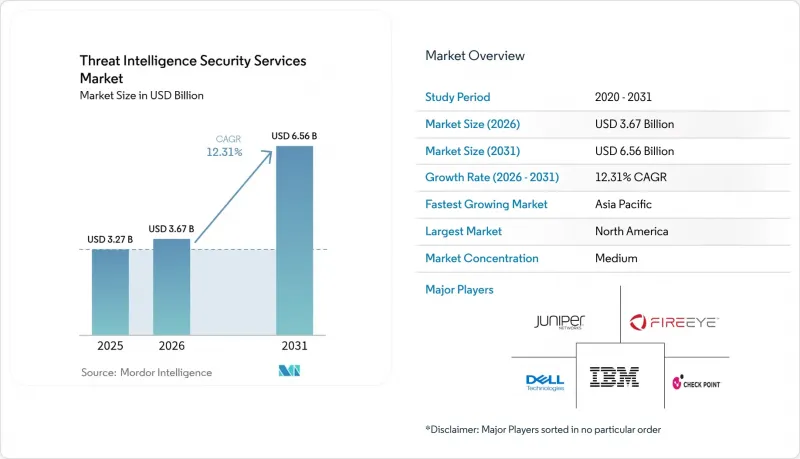
本報告按部署類型(雲端、本地部署)、服務類型(託管偵測與回應、專業諮詢、其他)、組織規模(大型企業、中小企業)、最終用戶產業(銀行和金融服務、醫療保健、其他)以及地區進行細分。市場預測以美元計價。
全球威脅情報保全服務市場趨勢與洞察
國家支持的APT宣傳活動迅速擴張
像Volt Typhoon和Salt Typhoon這樣的國家支持的組織正在加強對關鍵基礎設施的攻擊力度,迫使各機構優先考慮戰術性情報和事件前溯源能力。網路安全與基礎設施安全局(CISA)在2024年發布了3,368份勒索軟體預警通知,凸顯了複雜入侵嘗試的普遍性。攻擊不再局限於間諜活動,現在還包括破壞性的預先部署,這需要持續監控和專家搜尋。伊朗攻擊者同時將目標對準醫療保健和金融服務,使得威脅情報成為各行業的戰略必需品。這些趨勢正在加速對託管偵測、進階惡意軟體分析和上下文溯源服務的投入。
雲端工作負載激增和 API 攻擊面擴大
向雲端遷移使攻擊入侵管道的數量加倍,企業在多重雲端環境中運行數千個 API。 2024 年報告的大多數雲端安全漏洞都源自於 API 故障,凸顯了東西向流量可見度的不足。傳統的網路監控無法捕捉瞬態工作負載的上下文訊息,因此推動了雲端原生威脅情報的普及,後者能夠即時映射依賴關係。微服務架構進一步增加了資產清單的複雜性,提高了對自動化檢測和持續風險評分的依賴。因此,市場對專為無伺服器和容器化環境量身定做的雲端交付分析引擎和風險管理模組的需求持續旺盛。
一級威脅獵人和分析師短缺
高階取證分析和惡意軟體逆向工程的需求遠超供給。掌握國家支持的攻擊者的策略需要多年的培訓,但安全團隊卻面臨人才流失和薪資上漲的雙重困境。這種人才缺口正在推動產業重組,小型供應商難以招攬專家,而客戶則轉向託管偵測與回應 (MDR) 服務,尋求承包解決方案。供應商需要實現日常故障排查的自動化,以便將有限的專業知識分配到更高價值的任務上,這導致人們對人工智慧驅動的分析模組越來越感興趣。
細分市場分析
雲端部署已佔威脅情報保全服務市場57.35%的佔有率。預計到2031年,該細分市場將以18.03%的複合年成長率成長,進一步凸顯雲原生分析引擎的重要性。彈性運算和分散式儲存使服務提供者無需客戶側硬體即可處理Petabyte遙測資料。隨著威脅情報保全服務市場規模在2031年成長至65.6億美元,這一點至關重要。在需要本地資料處理的主權雲端和國防領域,本地部署仍然普遍存在,但目前的開發藍圖優先考慮混合連接器而非獨立設備。混合部署在受監管企業中越來越受歡迎,這些企業採用雲端來實現擴展,同時出於合規性目的在國內保留特定資料集。以API為中心的攻擊向量進一步凸顯了雲的重要性,因為傳統感測器缺乏容器流量的上下文資訊。 Palo Alto Networks報告稱,其人工智慧驅動的年度經常性收入(ARR)已超過2億美元,年成長四倍,凸顯了市場對透過雲端交付的機器學習模組的強勁需求。因此,雲端技術的統治地位穩固,但供應商需要解決延遲、加密和本地化等問題,以加速雲端技術的進一步普及。
預計到2025年,託管偵測與回應 (MDR) 將佔據威脅情報保全服務市場55.40%的佔有率,年均成長率達18.12%。企業青睞MDR,因為它結合了技術、遙測和專家經驗,能夠在不增加人員需求的情況下縮短平均偵測時間 (MTDR)。 MDR合約的激增顯示威脅情報保全服務市場正向基於結果的交付模式轉變。專業服務在成熟度評估、框架設計以及持續威脅暴露管理 (CTEM) 的實施中繼續發揮著至關重要的作用。
雖然基於訂閱的資訊流正在成為商品化的基礎,但它們正朝著包含攻擊者畫像和風險評分等上下文資訊豐富的打包方式發展。 Fortinet累計,其安全營運部門在 2025 年第一季的年度經常性收入 (ARR) 為 4.345 億美元,年增 30.3%。這表明整合式 MDR 和編配組合正蓬勃發展。隨著工具整合的不斷深入,那些將精心策劃的遙測資料與自動化隔離工作流程相結合的供應商正在建立強大的競爭優勢。
區域分析
北美地區佔全球整體收入的37.60%,這得益於美國到2025年為網路安全投入的275億美元預算。該預算包括向美國網路安全和基礎設施安全局(CISA)提供的30億美元津貼,用於擴展資訊共用網路。該地區高度創業融資以及雲端原生供應商生態系統,共同鞏固了其領先地位。聯邦政府第14028號總統令要求政府機構將威脅情報整合到保全行動中,相關產業正在效倣此模式,以確保供應鏈的完整性。加拿大正在與美國的資訊揭露標準接軌,而墨西哥金融監管機構正在擴大事件報告範圍,將金融科技納入其中,從而創造了新的需求來源。
亞太地區預計將以18.55%的複合年成長率成長,成為全球成長最快的地區。在中國,隨著政府加強國內安全管控,網路安全市場預計2029年將達到236.6億美元。日本的戰略文件呼籲將國內網路安全收入增加兩倍,並將國家預算提高50%,這推動了對工業級威脅情報的需求。印度正在經歷快速的數位轉型,CERT-IN指令要求即時報告特定事件,刺激了服務使用量的成長。澳洲5.86億澳元的網路彈性計畫正在支持對託管情報的需求,區域電信業者也正在加大跨境遙測交換的投資。
在歐洲,NIS2指令和各國資料保護條例正推動網路安全領域的穩定成長。在德國,為保護工業自動化免受干擾,預計到2025年網路安全支出將超過100億歐元。英國已為其情報機構爭取到額外的6億英鎊預算,並計劃在2035年將GDP的5%用於國家安全,這增強了供應商的長期前景。資料主權的要求正在推動區域安全營運中心的發展,這些中心能夠在國界內處理遙測資料。因此,能夠提供資料居住感知雲端架構和多語言分析師支援的供應商更受青睞。
其他好處
- Excel格式的市場預測(ME)表
- 3個月的分析師支持
目錄
第1章:引言
- 研究假設和市場定義
- 調查範圍
第2章:調查方法
第3章執行摘要
第4章 市場狀況
- 市場概覽
- 市場促進因素
- 國家支持的APT宣傳活動迅速擴張
- 雲端工作負載激增和 API 攻擊面擴大
- CISO 的零信任與 XDR 平台化
- 關於強制通報資料外洩的法律(美國、歐盟、亞太地區)
- 通用人工智慧程式碼助理相關的內部風險(常被忽略的因素)
- 在連續控制驗證 (CCV) 中採用 CTEM*(一個經常被忽略的因素)
- 市場限制因素
- 一級威脅獵人和分析師短缺
- 中小企業預算削減
- 跨境遙測資料共用中資料主權面臨的障礙(常被忽略的因素)
- 攻擊者利用虛假 TI 資訊來源造成的警報疲勞(一個經常被忽略的因素)
- 價值供應鏈分析
- 監理情勢
- 技術展望
- 波特五力分析
第5章 市場規模與成長預測
- 按實現類型
- 雲
- 現場
- 按服務類型
- 託管偵測和回應
- 專業諮詢
- 基於定期訂閱的資料饋送
- 按組織規模
- 大公司
- 小型企業
- 按最終用戶行業分類
- 銀行和金融服務
- 衛生保健
- 資訊科技/通訊
- 零售與電子商務
- 生命科學與製藥
- 政府/國防
- 按地區
- 北美洲
- 美國
- 加拿大
- 墨西哥
- 歐洲
- 英國
- 德國
- 法國
- 義大利
- 其他歐洲國家
- 亞太地區
- 中國
- 日本
- 印度
- 韓國
- 其他亞太國家
- 中東
- 以色列
- 沙烏地阿拉伯
- 阿拉伯聯合大公國
- 土耳其
- 其他中東國家
- 非洲
- 南非
- 埃及
- 其他非洲國家
- 南美洲
- 巴西
- 阿根廷
- 南美洲其他地區
- 北美洲
第6章 競爭情勢
- 市場集中度
- 策略趨勢
- 市佔率分析
- 公司簡介
- Google LLC(Mandiant)
- Recorded Future Inc.
- CrowdStrike Holdings Inc.
- Fortinet Inc.
- Cisco Systems Inc.
- International Business Machines Corporation
- Palo Alto Networks Inc.
- Dell Technologies Inc.
- Check Point Software Technologies Ltd.
- Trellix LLC(McAfee Enterprise)
- Broadcom Inc.(Symantec)
- LogRhythm Inc.
- Juniper Networks Inc.
- F-Secure Corporation
- LookingGlass Cyber Solutions Inc.
- Rapid7 Inc.
- Arctic Wolf Networks Inc.
- Trend Micro Incorporated
- Elastic NV(Security)
- Kaspersky Lab JSC
第7章 市場機會與未來展望
According to Mordor Intelligence, the threat intelligence security services market size was valued at USD 3.27 billion in 2025 and estimated to grow from USD 3.67 billion in 2026 to reach USD 6.56 billion by 2031, at a CAGR of 12.31% during the forecast period (2026-2031).
This report is Segmented by Deployment Mode (Cloud, On-Premises), Service Type (Managed Detection & Response, Professional/Consulting and More), Organization Size (Large Enterprises, Small & Medium Enterprises), End-User Industry (Banking & Financial Services, Healthcare and More), and Geography. The Market Forecasts are Provided in Terms of Value (USD).
Global Threat Intelligence Security Services Market Trends and Insights
Rapid Escalation in State-Sponsored APT Campaigns
Nation-state groups such as Volt Typhoon and Salt Typhoon have intensified operations against critical infrastructure, prompting organizations to prioritize tactical intelligence and pre-incident attribution capabilities. The Cybersecurity and Infrastructure Security Agency issued 3,368 pre-ransomware notifications in 2024, underscoring the volume of advanced intrusion attempts. Attacks now go beyond espionage to include destructive pre-positioning, which demands continuous monitoring and specialized hunting. Iranian actors are simultaneously targeting healthcare and financial services, turning threat intelligence into a strategic imperative across sectors. These developments have accelerated spending on managed detection, enriched malware analysis, and contextual attribution services.
Proliferation of Cloud Workloads & API Attack-Surface
Cloud migration has multiplied attack entry points, with organizations operating thousands of APIs across multi-cloud settings. API failures contributed to a majority of cloud breaches reported in 2024, revealing visibility gaps in east-west traffic. Traditional network monitoring lacks context for ephemeral workloads, fuelling adoption of cloud-native threat intelligence that can map dependencies in real time. Microservices architectures further complicate asset inventories, increasing reliance on automated discovery and continuous risk scoring. The outcome is sustained momentum for cloud-delivered analytics engines and exposure management modules tailored to serverless and container environments.
Shortage of Tier-1 Threat-Hunters & Analysts
Demand for deep forensics and malware reverse-engineering outpaces supply. Years of training are needed to master nation-state adversary tactics, yet security teams face attrition and wage inflation. The gap is driving consolidation as smaller vendors struggle to retain experts, and clients turn to Managed Detection and Response for turnkey coverage. Providers must now automate routine triage to free scarce specialists for higher-value pursuits, heightening interest in AI-assisted analysis modules.
Other drivers and restraints analyzed in the detailed report include:
- Zero-Trust & XDR Platformisation by CISOs
- Mandatory Breach-Notification Laws
- Budget Compression in SME Segment
For complete list of drivers and restraints, kindly check the Table Of Contents.
Segment Analysis
Cloud deployment already commands 57.35% of the threat intelligence security services market share. The segment is projected to expand at an 18.03% CAGR through 2031, reinforcing the centrality of cloud-native analytics engines. Elastic compute and distributed storage enable providers to process petabytes of telemetry without customer-side hardware, which is critical as threat intelligence security services market size grows to USD 6.56 billion in 2031. On-premises deployments persist in sovereign cloud and defense contexts that require local data processing, although development roadmaps now prioritize hybrid connectors rather than standalone appliances. Hybrid adoption is rising among regulated firms that embrace the cloud for scale yet retain select data sets in country for compliance. API-centric attack vectors accentuate cloud resonance since traditional sensors lack context for container traffic. Palo Alto Networks reported AI-centric Annual Recurring Revenue above USD 200 million with 4x year-over-year growth, validating appetite for cloud-delivered machine learning modules. Cloud superiority is therefore entrenched, but vendors must address latency, encryption, and locality factors to accelerate further penetration.
Managed Detection and Response own 55.40% of the threat intelligence security services market share as of 2025 and are forecast to grow 18.12% annually. Enterprises favour MDR because it fuses technology, telemetry, and human expertise, reducing mean time to detect without staffing burdens. The surge in MDR contracts underlines how the threat intelligence security services market pivots toward outcome-based delivery. Professional services remain vital for maturity assessments, framework design, and Continuous Threat Exposure Management rollouts.
Subscription feeds form a commodity base but are evolving toward context-rich packages with actor profiling and risk scoring. Fortinet posted Security Operations ARR of USD 434.5 million in Q1 2025, up 30.3% year on year, signalling that integrated MDR plus orchestration gains momentum. Vendors blending curated telemetry with automated containment workflows are building defensible differentiation as tool consolidation continues.
Complete Report Scope:
- By Deployment Mode
- Cloud
- On-premise
- By Service Type
- Managed Detection and Response
- Professional / Consulting
- Subscription Data-feeds
- By Organization Size
- Large Enterprises
- Small and Medium Enterprises
- By End-user Industry
- Banking and Financial Services
- Healthcare
- IT and Telecom
- Retail and e-Commerce
- Life Sciences / Pharma
- Government and Defense
- By Geography
- North America
- United States
- Canada
- Mexico
- Europe
- United Kingdom
- Germany
- France
- Italy
- Rest of Europe
- Asia-Pacific
- China
- Japan
- India
- South Korea
- Rest of Asia-Pacific
- Middle East
- Israel
- Saudi Arabia
- United Arab Emirates
- Turkey
- Rest of Middle East
- Africa
- South Africa
- Egypt
- Rest of Africa
- South America
- Brazil
- Argentina
- Rest of South America
- North America
Geography Analysis
North America controls 37.60% of global revenue, supported by the United States' USD 27.5 billion cybersecurity allocation for 2025, which includes USD 3 billion for CISA grants that expand intelligence sharing networks. High adoption of zero-trust, robust venture funding, and an ecosystem of cloud-native vendors sustain regional leadership. Federal Executive Order 14028 compels government agencies to integrate threat intelligence into security operations, and adjacent industries replicate the model for supply-chain assurance. Canada is harmonizing with U.S. disclosure norms, while Mexico's financial regulator extends incident reporting to fintech, adding new demand vectors.
Asia-Pacific is projected to grow at an 18.55% CAGR, the fastest worldwide. China's cybersecurity market is on track to reach USD 23.66 billion by 2029 as government programs enforce in-country security controls. Japan's strategic documents call for tripling domestic cybersecurity sales and boosting national budgets by 50%, which elevates appetite for industry-grade threat intelligence. India continues rapid digitization; its CERT-IN directives oblige real-time reporting for specified incidents, driving service uptake. Australia's AUD 586 million cyber resilience package underpins managed intelligence demand, and regional telecom providers are investing in cross-border telemetry exchanges.
Europe maintains steady growth propelled by the NIS2 directive and local data protection mandates. Germany expects cybersecurity spending beyond €10 billion in 2025 to shield industrial automation from sabotage. The United Kingdom earmarked an extra £600 million for intelligence agencies and plans to devote 5% of GDP to national security by 2035 reinforce long-term visibility for vendors. Data-sovereignty requirements stimulate growth of regional security operations centers capable of processing telemetry within national borders. Providers offering residency-aware cloud fabrics and multilingual analyst support are therefore preferred.
- Google LLC (Mandiant)
- Recorded Future Inc.
- CrowdStrike Holdings Inc.
- Fortinet Inc.
- Cisco Systems Inc.
- International Business Machines Corporation
- Palo Alto Networks Inc.
- Dell Technologies Inc.
- Check Point Software Technologies Ltd.
- Trellix LLC (McAfee Enterprise)
- Broadcom Inc. (Symantec)
- LogRhythm Inc.
- Juniper Networks Inc.
- F-Secure Corporation
- LookingGlass Cyber Solutions Inc.
- Rapid7 Inc.
- Arctic Wolf Networks Inc.
- Trend Micro Incorporated
- Elastic N.V. (Security)
- Kaspersky Lab JSC
Additional Benefits:
- The market estimate (ME) sheet in Excel format
- 3 months of analyst support
TABLE OF CONTENTS
1 INTRODUCTION
- 1.1 Study Assumptions and Market Definition
- 1.2 Scope of the Study
2 RESEARCH METHODOLOGY
3 EXECUTIVE SUMMARY
4 MARKET LANDSCAPE
- 4.1 Market Overview
- 4.2 Market Drivers
- 4.2.1 Rapid escalation in state-sponsored APT campaigns
- 4.2.2 Proliferation of cloud workloads and API attack-surface
- 4.2.3 Zero-trust and XDR platformisation by CISOs
- 4.2.4 Mandatory breach-notification laws (US, EU, APAC)
- 4.2.5 Insider-risk from Gen-AI code-assistants (under-radar)
- 4.2.6 Adoption of CTEM* for continuous controls validation (under-radar)
- 4.3 Market Restraints
- 4.3.1 Shortage of Tier-1 threat-hunters and analysts
- 4.3.2 Budget compression in SME segment
- 4.3.3 Data-sovereignty barriers to cross-border telemetry sharing (under-radar)
- 4.3.4 Adversary abuse of spoofed TI feeds causing alert fatigue (under-radar)
- 4.4 Value / Supply-Chain Analysis
- 4.5 Regulatory Landscape
- 4.6 Technological Outlook
- 4.7 Porter's Five Forces Analysis
- 4.7.1 Threat of New Entrants
- 4.7.2 Bargaining Power of Buyers
- 4.7.3 Bargaining Power of Suppliers
- 4.7.4 Threat of Substitutes
- 4.7.5 Intensity of Rivalry
5 MARKET SIZE AND GROWTH FORECASTS (VALUE)
- 5.1 By Deployment Mode
- 5.1.1 Cloud
- 5.1.2 On-premise
- 5.2 By Service Type
- 5.2.1 Managed Detection and Response
- 5.2.2 Professional / Consulting
- 5.2.3 Subscription Data-feeds
- 5.3 By Organization Size
- 5.3.1 Large Enterprises
- 5.3.2 Small and Medium Enterprises
- 5.4 By End-user Industry
- 5.4.1 Banking and Financial Services
- 5.4.2 Healthcare
- 5.4.3 IT and Telecom
- 5.4.4 Retail and e-Commerce
- 5.4.5 Life Sciences / Pharma
- 5.4.6 Government and Defense
- 5.5 By Geography
- 5.5.1 North America
- 5.5.1.1 United States
- 5.5.1.2 Canada
- 5.5.1.3 Mexico
- 5.5.2 Europe
- 5.5.2.1 United Kingdom
- 5.5.2.2 Germany
- 5.5.2.3 France
- 5.5.2.4 Italy
- 5.5.2.5 Rest of Europe
- 5.5.3 Asia-Pacific
- 5.5.3.1 China
- 5.5.3.2 Japan
- 5.5.3.3 India
- 5.5.3.4 South Korea
- 5.5.3.5 Rest of Asia-Pacific
- 5.5.4 Middle East
- 5.5.4.1 Israel
- 5.5.4.2 Saudi Arabia
- 5.5.4.3 United Arab Emirates
- 5.5.4.4 Turkey
- 5.5.4.5 Rest of Middle East
- 5.5.5 Africa
- 5.5.5.1 South Africa
- 5.5.5.2 Egypt
- 5.5.5.3 Rest of Africa
- 5.5.6 South America
- 5.5.6.1 Brazil
- 5.5.6.2 Argentina
- 5.5.6.3 Rest of South America
- 5.5.1 North America
6 COMPETITIVE LANDSCAPE
- 6.1 Market Concentration
- 6.2 Strategic Moves
- 6.3 Market Share Analysis
- 6.4 Company Profiles (includes Global level Overview, Market level overview, Core Segments, Financials as available, Strategic Information, Market Rank/Share for key companies, Products and Services, and Recent Developments)
- 6.4.1 Google LLC (Mandiant)
- 6.4.2 Recorded Future Inc.
- 6.4.3 CrowdStrike Holdings Inc.
- 6.4.4 Fortinet Inc.
- 6.4.5 Cisco Systems Inc.
- 6.4.6 International Business Machines Corporation
- 6.4.7 Palo Alto Networks Inc.
- 6.4.8 Dell Technologies Inc.
- 6.4.9 Check Point Software Technologies Ltd.
- 6.4.10 Trellix LLC (McAfee Enterprise)
- 6.4.11 Broadcom Inc. (Symantec)
- 6.4.12 LogRhythm Inc.
- 6.4.13 Juniper Networks Inc.
- 6.4.14 F-Secure Corporation
- 6.4.15 LookingGlass Cyber Solutions Inc.
- 6.4.16 Rapid7 Inc.
- 6.4.17 Arctic Wolf Networks Inc.
- 6.4.18 Trend Micro Incorporated
- 6.4.19 Elastic N.V. (Security)
- 6.4.20 Kaspersky Lab JSC
7 MARKET OPPORTUNITIES AND FUTURE OUTLOOK
- 7.1 White-space and Unmet-need Assessment

 網路威脅情報市場規模、佔有率和成長分析:按組件、部署模式、組織規模、威脅類型、情報類型、最終用戶和地區分類-2026-2033年產業預測
 網路威脅情報共用平台:市場佔有率分析、產業趨勢與統計、成長預測(2026-2031)
 銀行業網路安全與金融威脅情報市場預測至2034年-按安全類型、威脅類型、部署模式、技術、應用、最終用戶和地區分類的全球分析
 內部威脅防禦市場規模、佔有率和成長分析:按組件、部署模式、組織規模、產業和地區分類-2026-2033年產業預測
 2026-2030年全球人工智慧驅動的內部威脅偵測市場
 專業威脅分析與防護 (STAP) 市場:按類型、應用和地區分類 2026-2034 年
 威脅狩獵市場:按組件、服務類型、技術、部署模式、組織規模和產業分類-2026年至2032年全球市場預測
 網路威脅情報市場:按類型和地區分類
 2026年全球網路威脅情報市場報告
 威脅狩獵市場規模、佔有率和趨勢分析:按組件、部署模式、企業規模、最終用途、地區和細分市場預測(2026-2033 年)