


 |
市場調查報告書
商品編碼
2122311
雙電層電容器(EDLC):市場佔有率分析、行業趨勢和統計數據以及成長預測(2026-2031 年)Electric Double-layer Capacitor (EDLC) - Market Share Analysis, Industry Trends & Statistics, Growth Forecasts (2026 - 2031) |
||||||

※ 本網頁內容可能與最新版本有所差異。詳細情況請與我們聯繫。
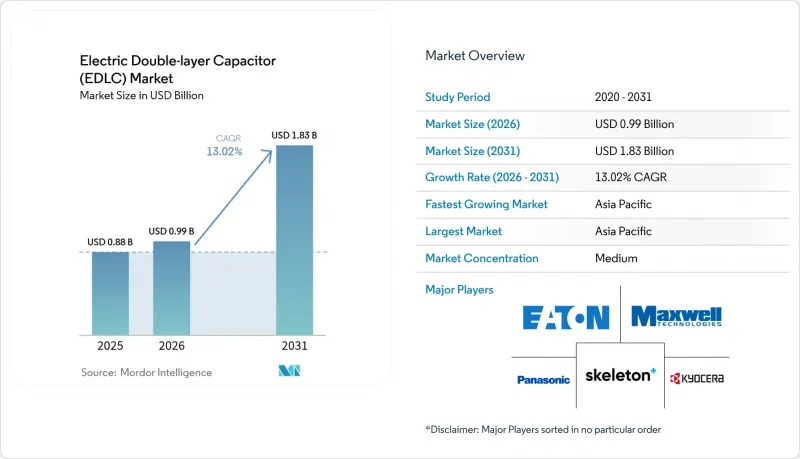
據 Mordor Intelligence 稱,2025 年雙電層電容器市值為 8.8 億美元,預計到 2031 年將達到 18.3 億美元,而 2026 年為 9.9458 億美元,預測期(2026-2031 年)的複合年成長率為 13.02%。
本報告按產品外形規格(圓柱形電池、其他)、組件電壓(10V以下、10-25V、其他)、電極材料(活性碳、石墨烯/石墨烯複合材料、其他)、終端用戶產業(消費電子、能源和公共產業、其他)以及地區(北美、南美、其他)進行細分。市場預測以美元計價。
全球雙電層電容器(EDLC)市場趨勢及洞察
電動車/混合動力車中再生煞車技術的快速普及
汽車製造商正將雙電層電容器(EDLC)市場解決方案整合到其48V輕度混合動力平台中,以回收鋰離子電池無法快速吸收的煞車能量。 EDLC模組可捕捉毫秒級的充電脈衝,從而將都市區的燃油效率提高15-20%,並使車輛無需轉型為全混合動力即可達到歐洲的二氧化碳排放目標。公車和輕軌營運商則優先考慮能夠減少與煞車磨損相關的維護成本並透過減輕重量來提高負載容量經濟性的技術。
對電網級頻率調節和可再生能源平滑的需求日益成長
電力公司正在提高太陽能和風能的佔比,這降低了電網慣性並加劇了頻率波動。 Skeleton Technologies 的「SkelGrid 2.0」配電櫃可在不到一秒的時間內提供高達 3 兆瓦的功率,其往返效率高達 99%。亞秒級響應速度在美國和德國的輔助服務競標中備受青睞,而基於雙電層電容 (EDLC) 的高速頻率響應資產可在三年內收回成本。
與鋰離子電池相比,每瓦時成本(以美元計)較高
儘管EDLC電池組的價格仍維持在每千瓦時800至1200美元,但鋰離子電池的基準價格低於每千瓦時150美元,這限制了EDLC在能量密度是經濟可行性關鍵因素的領域的應用。由於EDLC僅在高循環應用中展現出總擁有成本(TCO)優勢,供應商不得不強調其在整個生命週期內降低的維護成本以及即將訂定的歐盟法規下的回收積分。
細分市場分析
2025年,圓柱形電容器的銷售額佔比將達到35.42%,主要得益於其在汽車起動模組和工業UPS電源系統中久經考驗的可靠性。預計到2031年,圓柱形雙電層電容器(EDLC)的市場規模將達到6.52億美元,主要得益於48V輕度混合動力車的普及。標準化的機械尺寸簡化了與現有電池托盤的整合,從而減輕了設計負擔。同時,由於穿戴式裝置、智慧型貼片和胎壓感測器等應用對亞毫米級厚度的要求,紐扣式和晶片式電容器的年複合成長率(CAGR)將達到14.88%。製造商正在採用雷射圖形化的集電器和固體電解質來提高每立方公分的能量密度。在整個預測期內,隨著組裝外形規格分析(DFA)轉向以棱柱形鋰離子核心為核心、EDLC層嵌入其中的混合電池-電容器共封裝結構,不同尺寸電容器的邊界將變得模糊。
圓柱形電池供應商正致力於冷卻技術創新,例如採用鋁擠型外殼,可將熱阻降低30%。紐扣電池創新者正在推廣卷對卷電極印刷技術以降低成本。軟包和棱柱形電池產品正在彌補設計人員在處理不規則空腔方面的不足,尤其是在航太航太電子設備和受寬度限制的自動導引運輸車(AGV) 領域。模組和系統整合商正專注於即插即用的匯流排佈局和電池級熔斷保護,以滿足 IEC 62040 C 級 UPS 安全標準。
2025年,額定電壓為10-25V的模組佔據了40.12%的市場佔有率,這得益於它們與12V汽車子系統和24V工業控制系統的兼容性。設計人員透過利用現有的線束標準並避免高壓間隙要求,在雙電層電容器(EDLC)市場中確立了主導。隨著商用貨車從鉛酸啟動電池過渡到能夠承受100萬次循環的EDLC啟動增壓器,市場成長仍在持續。預計100V以上的高壓電池組將以14.63%的複合年成長率加速成長,以滿足電網對可再生能源的緩衝需求並支持電動公車的運作。 Skeleton的162V模組具有安全熱插拔功能、電氣隔離和熱失控保護隔板,符合電力公司的採購規範。
低壓(10V 或更低)微型模組是智慧卡、輸液幫浦和植入式醫療設備的基礎,這些設備出於安全考量需要對接觸安全限值做出規定。中壓(25-50V)模組則用於資料中心配電盤,將 48V匯流排連接到伺服器主機板。產品藍圖的重點是整合主動平衡電路和透過 CANopen 實現的健康狀態 (SOH) 分析,以支援預測性維護。
區域分析
預計到2025年,亞太地區將維持全球42.10%的銷售額。這主要得益於中國電網級調頻試點計畫、日本消費性電子產品的微型化以及韓國電池生態系統的整合。區域各國政府正為國內儲能價值鏈提供資金補貼,增強了該地區的製造成本優勢。供應商利用其在印尼和越南活性碳加工廠的地理優勢,最佳化物流並縮短前置作業時間。本地汽車製造商構成了採購量的主要來源,從而實現了規模經濟,並在出口市場中保持了價格競爭力。
在北美,電力傳輸營運商正在部署雙電層電容器(EDLC)陣列,以在創紀錄的太陽能發電裝置下穩定電網,從而擴大其在該地區的市場佔有率。美國資料中心營運商更傾向於選擇48V EDLC機架而非飛輪式逆變器,因為EDLC機架維修需求低,待機損耗也極小。國防領域的採購正在支持用於定向能原型機的碳奈米管(奈米碳管)填充脈衝功率模組的研發資金。加拿大正在推動採礦業改革,以支持國內石墨精煉,並正努力將自身打造成為其供應鏈多元化策略中的替代原料來源。
在歐洲,受《電池法規2023/1542》嚴格的生命週期合規要求推動,EDLC技術的應用正在加速發展。該法規也將製造商的責任範圍擴大到雙電層電容器(EDLC)市場產品。汽車製造商正在採用EDLC模組以獲得生態設計積分,而電力公司正在測試和運行滿足能量和電能品質要求的混合電池-超級電容器儲能模組。製造商正在投資建造自動化報廢產品拆解生產線,以實現2030年90%的材料回收目標。中東和非洲市場仍蘊藏著巨大的潛力。在這些地區,較高的環境溫度使得EDLC系統成為通訊塔的理想備用電源,因此無需使用由HVAC(高真空空調)冷卻的貨櫃式鋰離子電池組。
其他好處
- Excel格式的市場預測(ME)表
- 3個月的分析師支持
目錄
第1章:引言
- 研究假設和市場定義
- 調查範圍
第2章:調查方法
第3章執行摘要
第4章 市場狀況
- 市場概覽
- 市場促進因素
- 電動車/混合動力車中再生煞車技術的快速普及
- 對電網級頻率調節和可再生能源平滑的需求日益成長
- 家用電器小型化趨勢需要突發功率緩衝器
- 快速部署需要處理峰值功率的 5G大型基地台和微基地台。
- 48V邊緣資料中心備份架構的出現。
- 向國防領域高脈衝定向能平台的過渡
- 市場限制因素
- 與鋰離子電池相比,每瓦時成本(以美元計)較高
- 由於標準分散,設計變得複雜。
- 活性碳原料價格波動很大。
- 將歐盟「電池回收」計畫擴展到包括 EDLC 模組的前景。
- 產業價值鏈分析
- 監理情勢
- 技術展望
- 波特五力分析
- 投資分析
- 宏觀經濟因素對市場的影響
第5章 市場規模與成長預測
- 按產品外形規格
- 圓柱形單元格
- 囊式棱鏡電池
- 硬幣晶片電池
- 模組(10F 或更高)
- 包裝系統
- 按模組電壓
- 10伏特或更低
- 10~25V
- 25~50V
- 50~100V
- 超過100伏
- 透過電極材料
- 活性碳
- 石墨烯及石墨烯複合材料
- 奈米碳管(CNTs)
- 導電聚合物
- 金屬氧化物增強型
- 按最終用戶行業分類
- 家用電子產品
- 能源與公共產業
- 產業
- 汽車和交通運輸
- 巴士和卡車
- 鐵路和路面電車
- 48V輕度混合動力車
- 微型混合動力汽車和其他乘用車
- 大型車輛
- 按地區
- 北美洲
- 美國
- 加拿大
- 墨西哥
- 南美洲
- 巴西
- 阿根廷
- 其他南美國家
- 歐洲
- 德國
- 英國
- 法國
- 義大利
- 其他歐洲國家
- 亞太地區
- 中國
- 日本
- 韓國
- 印度
- 其他亞太國家
- 中東
- 沙烏地阿拉伯
- 阿拉伯聯合大公國
- 其他中東國家
- 非洲
- 南非
- 其他非洲地區
- 北美洲
第6章 競爭情勢
- 市場集中度
- 策略趨勢
- 市佔率分析
- 公司簡介
- Tesla Inc.-Maxwell Technologies
- Skeleton Technologies OU
- Panasonic Holdings Corporation
- LS Mtron Ltd.
- Nippon Chemi-Con Corp.
- Eaton Corporation
- Kyocera Corporation
- CAP-XX Ltd.
- Supreme Power Solutions Ltd.
- Cornell Dubilier Electronics Inc.
- TDK Corporation
- Vishay Intertechnology Inc.
- Seiko Instruments Inc.
- Taiyo Yuden Co., Ltd.
- Yunasko Ltd.
- Tavrima Canada Inc.
- Shanghai Aowei Technology Development Co., Ltd.
- Nantong Jianghai Capacitor Co., Ltd.
- Jinzhou Kaimei Power Co., Ltd.
- Beijing HCC Energy Tech Co., Ltd.
第7章 市場機會與未來展望
According to Mordor Intelligence, the electric double-layer capacitor market size was valued at USD 0.88 billion in 2025 and estimated to grow from USD 994.58 million in 2026 to reach USD 1.83 billion by 2031, at a CAGR of 13.02% during the forecast period (2026-2031).
This report is Segmented by Product Form Factor (Cylindrical Cell, and More), Module Voltage (Less Than 10V, 10-25V, and More), Electrode Material (Activated Carbon, Graphene/Graphene Composite, and More), End-User Industry (Consumer Electronics, Energy and Utilities, and More), and Geography (North America, South America, and More). The Market Forecasts are Provided in Terms of Value (USD).
Global Electric Double-layer Capacitor (EDLC) Market Trends and Insights
Surging adoption of regenerative braking in EV/HEV
Automakers integrate Electric Double-layer Capacitor market solutions into 48V mild-hybrid platforms to harvest braking energy that lithium-ion cells cannot absorb quickly. EDLC modules capture millisecond-scale charge pulses, raising urban fuel efficiency by 15-20% and allowing compliance with European CO2 targets without requiring a shift to full hybrids. Fleet operators of buses and light-rail vehicles prioritize technology to reduce brake-wear maintenance and unlock weight reductions that improve payload economics.
Growing demand for grid-scale frequency regulation and renewable smoothing
Utilities increase their share of solar and wind energy, lowering inertia and intensifying frequency volatility. Skeleton Technologies' SkelGrid 2.0 cabinets supply up to 3 MW within one second, delivering synthetic inertia with 99% round-trip efficiency. Ancillary-service auctions in the United States and Germany reward sub-second response, enabling paybacks under three years for EDLC-based fast-frequency-response assets.
Higher USD-per-Wh cost versus Li-ion batteries
EDLC packs remain priced at USD 800-1,200/kWh, compared with lithium-ion's sub-USD 150/kWh benchmark, which restricts adoption where energy density dominates the economic calculus. The total-cost-of-ownership argument only prevails in high-cycle applications, compelling suppliers to emphasize lifecycle maintenance savings and recycling credits under forthcoming EU regulations.
Other drivers and restraints analyzed in the detailed report include:
- Miniaturization trend in consumer electronics requiring burst-power buffers
- Rapid roll-out of 5 G macro and micro-cells needing peak-power support
- Design-in complexity owing to standards fragmentation
For complete list of drivers and restraints, kindly check the Table Of Contents.
Segment Analysis
Cylindrical units held 35.42% of 2025 revenue, underpinned by proven reliability in automotive starter modules and industrial UPS banks. The Electric Double-layer Capacitor market size for cylindrical designs is projected to reach USD 652 million by 2031, expanding in line with the adoption of 48 V mild-hybrid vehicles. Standardized mechanical dimensions simplify integration with existing battery trays, curbing engineering overhead. Meanwhile, coin and chip formats scale at a 14.88% CAGR as wearables, smart patches, and tire-pressure sensors require sub-millimeter profiles. Manufacturers deploy laser-patterned current collectors and solid-state electrolytes to elevate energy per cubic centimeter. Over the forecast horizon, form-factor boundaries blur as design-for-assembly shifts to co-packaged battery-capacitor hybrids that embed EDLC layers around prismatic lithium-ion cores.
Cylindrical suppliers focus on cooling innovations, such as aluminum extrusion housings, which reduce thermal resistance by 30%. Coin-cell innovators scale roll-to-roll electrode printing to control costs. Pouch and prismatic options play a bridging role where designers manage irregular cavities, notably in aerospace avionics and automated-guided vehicles navigating width constraints. Module and system integrators emphasize plug-and-play busbar layouts and fused cell-level protection to meet IEC 62040 class-C UPS safety levels.
Modules rated 10-25 V captured 40.12% 2025 share thanks to compatibility with 12 V automotive subsystems and 24 V industrial controls. Designers achieve leadership in the Electric Double-layer Capacitor market by leveraging existing wiring harness standards and avoiding high-voltage clearance requirements. Growth persists as commercial delivery vans migrate from lead-acid starting batteries to EDLC cranking boosters that survive million-cycle duty. High-voltage stacks above 100 V are expected to accelerate at a 14.63% CAGR to meet renewable grid buffers and support electric-bus traction. Skeleton's 162 V modules highlight safe hot-swapping, galvanic isolation, and thermal-runaway-proof separators, addressing utility procurement specs.
Low-voltage (<10 V) micro-modules underpin smartcards, drug-delivery pumps, and implantables where safety dictates touch-safe limits. Mid-voltage (25-50 V) units populate data-center power distribution units, bridging 48 V busbars and server motherboards. The product roadmap focuses on integrating active balancing circuits and State-of-Health analytics via CANopen to support predictive maintenance.
Complete Report Scope:
- By Product Form Factor
- Cylindrical Cell
- Pouch / Prismatic Cell
- Coin / Chip Cell
- Module (Greater than equal to 10 F)
- Pack / System
- By Module Voltage
- Less than 10 V
- 10 - 25 V
- 25 - 50 V
- 50 - 100 V
- Greater than 100 V
- By Electrode Material
- Activated Carbon
- Graphene / Graphene Composite
- Carbon Nanotube (CNT)
- Conductive Polymer
- Metal-Oxide-Enhanced
- By End-user Industry
- Consumer Electronics
- Energy and Utilities
- Industrial
- Automotive / Transportation
- Bus and Truck
- Rail and Tram
- 48 V Mild Hybrid Car
- Micro-hybrids and Other Cars
- Heavy Vehicles
- By Geography
- North America
- United States
- Canada
- Mexico
- South America
- Brazil
- Argentina
- Rest of South America
- Europe
- Germany
- United Kingdom
- France
- Italy
- Rest of Europe
- Asia-Pacific
- China
- Japan
- South Korea
- India
- Rest of Asia-Pacific
- Middle East
- Saudi Arabia
- United Arab Emirates
- Rest of Middle East
- Africa
- South Africa
- Rest of Africa
- North America
Geography Analysis
Asia-Pacific maintained 42.10% of global revenue in 2025, underpinned by China's grid-scale frequency-regulation pilots, Japan's consumer-electronics miniaturization, and South Korea's battery-ecosystem clustering. Regional governments allocate capital-subsidy pools for domestic energy-storage value chains, reinforcing manufacturing cost leadership. Suppliers benefit from proximity to activated-carbon processing hubs in Indonesia and Vietnam, which streamlines logistics and reduces lead times. Local automakers anchor procurement volumes, fostering economies of scale that sustain price competitiveness for export markets.
North America is capturing a rising share as transmission operators deploy EDLC arrays to stabilize networks that are dealing with record solar installations. Data-center operators in the United States prefer 48 V EDLC racks over flywheels due to their zero maintenance requirements and lower standby losses. Defense procurement underpins R&D funding for CNT-loaded pulse-power modules used in directed-energy prototypes. Canada champions mining reforms to support domestic graphite purification, positioning itself as an alternative raw material source amid supply chain diversification strategies.
Europe advances adoption driven by stringent lifecycle compliance under Battery Regulation 2023/1542, which extends producer responsibility to Electric Double-layer Capacitor market products. Automakers incorporate EDLC modules to secure eco-design credits, while utilities pilot hybrid battery-supercapacitor storage blocks that satisfy both energy and power-quality mandates. Manufacturers invest in automated end-of-life disassembly lines to meet mandated 90% material-recovery targets by 2030. The Middle East and Africa present nascent potential, where high ambient temperatures make EDLC systems attractive for telecom tower backup, eliminating the need for HVAC-cooled containerized lithium-ion banks.
- Tesla Inc. - Maxwell Technologies
- Skeleton Technologies OU
- Panasonic Holdings Corporation
- LS Mtron Ltd.
- Nippon Chemi-Con Corp.
- Eaton Corporation
- Kyocera Corporation
- CAP-XX Ltd.
- Supreme Power Solutions Ltd.
- Cornell Dubilier Electronics Inc.
- TDK Corporation
- Vishay Intertechnology Inc.
- Seiko Instruments Inc.
- Taiyo Yuden Co., Ltd.
- Yunasko Ltd.
- Tavrima Canada Inc.
- Shanghai Aowei Technology Development Co., Ltd.
- Nantong Jianghai Capacitor Co., Ltd.
- Jinzhou Kaimei Power Co., Ltd.
- Beijing HCC Energy Tech Co., Ltd.
Additional Benefits:
- The market estimate (ME) sheet in Excel format
- 3 months of analyst support
TABLE OF CONTENTS
1 INTRODUCTION
- 1.1 Study Assumptions and Market Definition
- 1.2 Scope of the Study
2 RESEARCH METHODOLOGY
3 EXECUTIVE SUMMARY
4 MARKET LANDSCAPE
- 4.1 Market Overview
- 4.2 Market Drivers
- 4.2.1 Surging adoption of regenerative braking in EV/HEV
- 4.2.2 Growing demand for grid-scale frequency regulation and renewable smoothing
- 4.2.3 Miniaturisation trend in consumer electronics requiring burst-power buffers
- 4.2.4 Rapid roll-out of 5G macro and micro-cells needing peak-power support
- 4.2.5 Emergence of 48 V edge-data-centre backup architectures
- 4.2.6 Defence transition to high-pulse directed-energy platforms
- 4.3 Market Restraints
- 4.3.1 Higher USD-per-Wh cost v. Li-ion batteries
- 4.3.2 Design-in complexity owing to standards fragmentation
- 4.3.3 Volatile activated-carbon feed-stock pricing
- 4.3.4 Prospective EU "battery-take-back" extension to EDLC modules
- 4.4 Industry Value Chain Analysis
- 4.5 Regulatory Landscape
- 4.6 Technological Outlook
- 4.7 Porter's Five Forces Analysis
- 4.7.1 Threat of New Entrants
- 4.7.2 Bargaining Power of Suppliers
- 4.7.3 Bargaining Power of Buyers
- 4.7.4 Threat of Substitutes
- 4.7.5 Intensity of Competitive Rivalry
- 4.8 Investment Analysis
- 4.9 Impact of Macroeconomic Factors on the Market
5 MARKET SIZE AND GROWTH FORECASTS (VALUE)
- 5.1 By Product Form Factor
- 5.1.1 Cylindrical Cell
- 5.1.2 Pouch / Prismatic Cell
- 5.1.3 Coin / Chip Cell
- 5.1.4 Module (Greater than equal to 10 F)
- 5.1.5 Pack / System
- 5.2 By Module Voltage
- 5.2.1 Less than 10 V
- 5.2.2 10 - 25 V
- 5.2.3 25 - 50 V
- 5.2.4 50 - 100 V
- 5.2.5 Greater than 100 V
- 5.3 By Electrode Material
- 5.3.1 Activated Carbon
- 5.3.2 Graphene / Graphene Composite
- 5.3.3 Carbon Nanotube (CNT)
- 5.3.4 Conductive Polymer
- 5.3.5 Metal-Oxide-Enhanced
- 5.4 By End-user Industry
- 5.4.1 Consumer Electronics
- 5.4.2 Energy and Utilities
- 5.4.3 Industrial
- 5.4.4 Automotive / Transportation
- 5.4.4.1 Bus and Truck
- 5.4.4.2 Rail and Tram
- 5.4.4.3 48 V Mild Hybrid Car
- 5.4.4.4 Micro-hybrids and Other Cars
- 5.4.4.5 Heavy Vehicles
- 5.5 By Geography
- 5.5.1 North America
- 5.5.1.1 United States
- 5.5.1.2 Canada
- 5.5.1.3 Mexico
- 5.5.2 South America
- 5.5.2.1 Brazil
- 5.5.2.2 Argentina
- 5.5.2.3 Rest of South America
- 5.5.3 Europe
- 5.5.3.1 Germany
- 5.5.3.2 United Kingdom
- 5.5.3.3 France
- 5.5.3.4 Italy
- 5.5.3.5 Rest of Europe
- 5.5.4 Asia-Pacific
- 5.5.4.1 China
- 5.5.4.2 Japan
- 5.5.4.3 South Korea
- 5.5.4.4 India
- 5.5.4.5 Rest of Asia-Pacific
- 5.5.5 Middle East
- 5.5.5.1 Saudi Arabia
- 5.5.5.2 United Arab Emirates
- 5.5.5.3 Rest of Middle East
- 5.5.6 Africa
- 5.5.6.1 South Africa
- 5.5.6.2 Rest of Africa
- 5.5.1 North America
6 COMPETITIVE LANDSCAPE
- 6.1 Market Concentration
- 6.2 Strategic Moves
- 6.3 Market Share Analysis
- 6.4 Company Profiles (includes Global Level Overview, Market Level Overview, Core Segments, Financials as available, Strategic Information, Market Rank/Share, Products and Services, Recent Developments)
- 6.4.1 Tesla Inc. - Maxwell Technologies
- 6.4.2 Skeleton Technologies OU
- 6.4.3 Panasonic Holdings Corporation
- 6.4.4 LS Mtron Ltd.
- 6.4.5 Nippon Chemi-Con Corp.
- 6.4.6 Eaton Corporation
- 6.4.7 Kyocera Corporation
- 6.4.8 CAP-XX Ltd.
- 6.4.9 Supreme Power Solutions Ltd.
- 6.4.10 Cornell Dubilier Electronics Inc.
- 6.4.11 TDK Corporation
- 6.4.12 Vishay Intertechnology Inc.
- 6.4.13 Seiko Instruments Inc.
- 6.4.14 Taiyo Yuden Co., Ltd.
- 6.4.15 Yunasko Ltd.
- 6.4.16 Tavrima Canada Inc.
- 6.4.17 Shanghai Aowei Technology Development Co., Ltd.
- 6.4.18 Nantong Jianghai Capacitor Co., Ltd.
- 6.4.19 Jinzhou Kaimei Power Co., Ltd.
- 6.4.20 Beijing HCC Energy Tech Co., Ltd.
7 MARKET OPPORTUNITIES AND FUTURE OUTLOOK
- 7.1 White-space and Unmet-need Assessment

 2026-2030年全球雙電層電容器(EDLC)市場
 全球電容器市場:以產品類型、電壓、安裝方式、極性、最終用戶、國家及地區分類的全球產業分析、市場規模、市場佔有率及2026年至2033年預測電雙層電容器(EDLC)市場:依產品類型、應用、通路、模組電壓、國家及地區分類-全球產業分析、市場規模、市場佔有率及2026年至2033年預測
 高壓電容器市場分析及預測(至2035年):類型、產品、應用、技術、組件、最終用戶、材質類型、功能、安裝類型
 2026年全球軸向引線電容器市場報告
 全球雙電層電容器市場(按類型、電壓範圍、應用和分銷管道分類)預測(2026-2032年)雙電層電容器隔膜市場:2026-2032年全球預測(依產品類型、材質、厚度範圍及最終用途產業分類)
 家用電子電器產品用高壓電容器市場:機會、成長要素、產業趨勢分析及2026年至2035年預測
 全球高壓電容器市場全球電容器市場