


 |
市場調查報告書
商品編碼
2122306
電子商務包裝:市場佔有率分析、產業趨勢與統計、成長預測(2026-2031)E-commerce Packaging - Market Share Analysis, Industry Trends & Statistics, Growth Forecasts (2026 - 2031) |
||||||

※ 本網頁內容可能與最新版本有所差異。詳細情況請與我們聯繫。
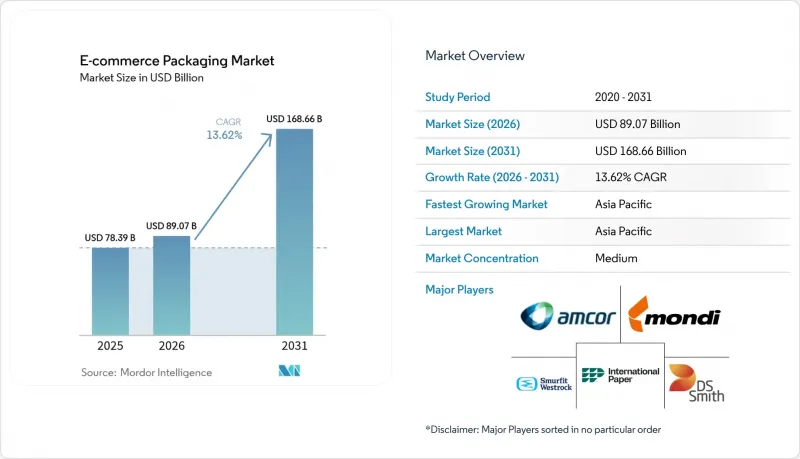
根據 Mordor Intelligence 預測,電子商務包裝市場規模將從 2025 年的 783.9 億美元成長到 2026 年的 890.7 億美元,然後在 2031 年達到 1,686.6 億美元,2026 年至 2031 年的複合年成長率為 13.62%。
本報告按材料類型(塑膠、紙/紙板、瓦楞紙板、軟性薄膜/郵寄袋、其他)、包裝類型(盒子/紙箱、郵寄袋/信封、保護性包裝、其他)、最終用戶(時尚/服裝、消費電子產品、食品/飲料、個人護理/化妝品、雜貨/速賣通、其他線上零售商)和地區進行分類。
全球電子商務包裝市場趨勢及洞察
線上零售商品交易總額 (GMV) 呈現爆炸性成長
全球電子商務的商品交易總額(GMV)持續以兩位數的速度成長,隨著訂單量的增加,產品需要使用保護性包裝進行運輸,這導致包裝材料的成長速度高於平均水平。預計到2024年,光是中國165個跨境電商試點區每天就將處理約2,000萬個包裹,凸顯了國家層級GMV的成長如何直接推動紙箱和郵寄包裝袋的消費。印度都市區的快消業者正致力於將生鮮食品的配送時間縮短至10-15分鐘,易碎的生鮮食品也開始單獨包裝運輸,而非使用大批量木箱,這提高了包裝材料與商品的比例。訂閱制電商透過每月定期配送品牌產品和品牌包裝盒,進一步擴大了其業務規模。跨境電商的運輸路線更長,從深圳的履約中心到歐美消費者的運輸,這推動了對更厚的瓦楞紙板和特殊設計的緩衝材料的需求,這些材料能夠承受多模態。數量和性能的這些變化正在推動全球電子商務包裝市場的成長軌跡。
過渡到更輕、更靈活的形式,以降低DIM重量成本。
在宅配業者以體積收費系統下,半空的瓦楞紙箱價格更高,迫使賣家採用尺寸合適的郵寄信封、折疊式包裝袋和風琴式包裝袋,以減少空隙並降低運輸成本。亞馬遜的按需包裝舉措結合了機器學習軟體和自動裝袋機,用薄膜密封每個訂單,已將運輸過程中的損壞率降低了24%,運輸成本降低了5%。利潤率較低的品類,例如快時尚,依靠軟性聚乙烯郵寄袋將包裝成本控制在產品價值的5%以下,而單一材料薄膜在滿足可回收性法規的同時,又不犧牲密度。美國和歐洲的早期應用最為成熟,但這一趨勢正在亞太地區加速發展,因為該地區的最後一公里成本可能超過物流總成本的30%。隨著宅配業者收緊體積計費,預計更輕的包裝形式將在電子商務包裝市場中佔據越來越大的佔有率。
全球塑膠法規更加嚴格,加上生產者責任延伸(EPR)費用導致的合規成本增加。
在生產者延伸責任制(EPR)下,費用根據每種材料的實際可回收性收取,這使得一些歐盟市場難以回收的多層包裝袋的成本加倍。加州的《塑膠污染防治法》對每公斤包裝徵收固定費率,迫使品牌大幅調整產品線,否則將面臨罰款。缺乏專門合規負責人的小規模線上經銷商難以應對費用申報流程,這使得能夠將合規固定成本分攤到大額交易中的綜合性企業獲得了競爭優勢。預計這些不利因素將在未來兩年內降低電子商務包裝市場的潛在複合年成長率(CAGR)。
細分市場分析
由於瓦楞紙板具有成本效益高、承重能力強以及幾乎所有地區均可作為生活垃圾回收利用等優點,預計到2025年,瓦楞紙板將佔據電商包裝市場50.35%的佔有率。中國全國性的宅配包裝品質標準正式定義了國內和出口貨物瓦楞紙板的等級,這將持續推動瓦楞紙板市場的發展。同時,生質塑膠(PLA)與再生材料混合,生產符合歐盟30%再生材料含量標準的郵寄信封,且不會降低其抗張強度。預計東南亞地區對可擴展發酵設施的投資將逐步降低生物塑膠的價格溢價,使其應用範圍擴展到高階化妝品和有機食品經銷商以外的更廣泛領域。
品牌擁有者在減少範圍 3 排放的同時,也努力平衡瓦楞紙板可靠的防護性能與可再生替代品之間的關係。儘管瓦楞紙板的需求依然旺盛,但生質塑膠卻展現出競爭優勢。 D2C(直接面對消費者)電子產品經銷商正在推廣可堆肥薄膜收縮套標,將其作為顯而易見的永續性改進措施。傳統的 PE 和 PP 製造商則透過開發可機械回收的單一材料產品來應對這項挑戰,力求維持其市場佔有率。可再生和化石基聚合物的共存表明,這並非一蹴可幾的替代,而是一個過渡階段,確保了這兩種材料在電商包裝市場中都將繼續發揮重要作用。
區域分析
預計到2025年,亞太地區將以51.30%的市佔率引領電商包裝市場,並在2031年之前維持15.39%的複合年成長率。中國國家標準GB 43352-2023規定了宅配包裝材料的關鍵性能指標,旨在為600萬活躍的線上經銷商提供統一的品質標準。同時,預計2025年至2030年間,印度的電商銷售額將成長兩倍,這將推動對輕便耐用、即使在季風潮濕環境下也能保持良好性能的包裝袋的需求成長。東南亞市場也正在推行類似的法規,利用紙質緩衝材料減少塑膠廢棄物,進一步推動全部區域的市場發展。
北美位居第二。加州的塑膠減排目標和加拿大對難以回收的發泡聚苯乙烯的禁令,正在加速包裝材料的轉型。履約中心正在投資人工智慧驅動的紙箱選擇工具,有助於減少12%的紙板使用量,從而降低成本並實現永續性目標。在美國,隨著線上食品雜貨市場滲透率預計到2025年將達到16%,冷鏈領域的創新蓬勃發展,食品和製藥業對耐溫內襯的需求也不斷成長。
歐洲仍然是循環經濟的全球示範區,其《塑膠包裝法規》(PPWR) 中強制性的再生材料含量和再利用要求正在塑造一種最終將在全球範圍內推廣的模式。德國零售商正在人口稠密的都市區測試並推廣使用可回收的木箱包裝線上食品雜貨,從而減少了80%的一次性包裝。同時,中東和非洲的普及速度相對較慢,但隨著跨境平台擴展其物流網路,這些地區的成長速度也達到了兩位數。基礎設施的匱乏和複雜的海關程序限制了市場規模,但智慧型手機普及率的不斷提高正在釋放長期成長潛力,並將這些新興地區納入未來電子商務包裝市場的擴張之中。
其他好處
- Excel格式的市場預測(ME)表
- 3個月的分析師支持
目錄
第1章:引言
- 研究假設和市場定義
- 調查範圍
第2章:調查方法
第3章執行摘要
第4章 市場狀況
- 市場概覽
- 市場促進因素
- 線上零售商品交易總額 (GMV) 呈現爆炸性成長
- 過渡到更輕、更靈活的形式,以降低DIM重量成本。
- 由於永續性法規,紙製品和生物基產品的使用速度加快。
- 將「開箱體驗」作為品牌互動管道。
- 透過人工智慧驅動的「產品客製化」自動化減少材料浪費。
- 快速商業的快速崛起以及訂閱零售帶來的配送頻率的增加。
- 市場限制因素
- 全球塑膠法規更加嚴格,加上生產者責任延伸(EPR)費用導致的合規成本增加。
- 牛皮紙和樹脂價格的波動給加工商的利潤率帶來了壓力。
- 跨境履約。
- 由於數據和知識方面的不足,需要根據碳足跡審計結果對產品進行重新設計。
- 價值供應鏈分析
- 監理情勢
- 技術展望
- 波特五力分析
- 投資分析
第5章 市場規模與成長預測
- 依材料類型
- 塑膠
- 紙張和紙板
- 紙板
- 軟性薄膜郵寄
- 生質塑膠
- 其他
- 按包裝類型
- 盒子/紙箱
- 郵件和信封
- 保護性包裝(填充填充材、緩衝材料、襯墊)
- 標籤、膠帶、瓶蓋
- 專業可回收系統
- 最終用戶
- 時尚與服裝
- 家用電子產品
- 飲食
- 個人護理和化妝品
- 食品雜貨和快餐
- 家居、生活、家具
- 其他線上零售商
- 按地區
- 北美洲
- 美國
- 加拿大
- 墨西哥
- 南美洲
- 巴西
- 阿根廷
- 其他南美國家
- 歐洲
- 英國
- 德國
- 法國
- 義大利
- 其他歐洲國家
- 亞太地區
- 中國
- 印度
- 日本
- 韓國
- 其他亞太國家
- 中東和非洲
- 阿拉伯聯合大公國
- 沙烏地阿拉伯
- 南非
- 其他中東和非洲國家
- 北美洲
第6章 競爭情勢
- 市場集中度
- 策略性舉措(併購、產能、技術)
- 市佔率分析
- 公司簡介
- Amcor plc
- Mondi plc
- International Paper
- Smurfit Kappa Group
- DS Smith plc
- WestRock Company
- Georgia-Pacific LLC
- Sealed Air Corporation
- Ranpak Holdings Corp.
- Pregis LLC
- Klabin SA
- Rengo Co. Ltd
- Stora Enso Oyj
- Nippon Paper Industries
- Oji Holdings
- Ranpak Holdings Corp
- Packhelp SA
- Shorr Packaging Corp.
- Packsize Intl.
- Packsize International
第7章 市場機會與未來展望
According to Mordor Intelligence, the e-commerce packaging market size is expected to grow from USD 78.39 billion in 2025 to USD 89.07 billion in 2026 and is forecast to reach USD 168.66 billion by 2031 at 13.62% CAGR over 2026-2031.
This report is Segmented by Material (Plastic, Paper and Paperboard, Corrugated Board, Flexible Films and Mailers, and More), Packaging Format (Boxes and Cartons, Mailers and Envelopes, Protective Packaging, and More), End-User Vertical (Fashion and Apparel, Consumer Electronics, Food and Beverages, Personal Care and Cosmetics, Grocery and Quick-Commerce, and Other End Users), and Geography.
Global E-commerce Packaging Market Trends and Insights
Explosive Online Retail GMV Growth
E-commerce gross merchandise value continues to climb in double digits worldwide, and every incremental order ships in its protective pack, multiplying packaging demand faster than headline retail sales. China's 165 cross-border pilot zones alone processed nearly 20 million packages daily in 2024, underscoring how country-level GMV expansion directly fuels corrugated and mailer consumption. Urban India's quick-commerce operators now target 10-to-15-minute grocery delivery windows, raising packaging-to-product ratios because fragile fresh items ship individually rather than in bulk crates. Subscription commerce further amplifies volumes as recurring shipments deliver monthly replenishments in branded cartons. Longer trade lanes in cross-border commerce, from Shenzhen fulfilment hubs to Western consumers, elevate the need for thicker flute grades and engineered cushioning that can withstand multi-modal handling. These volume and performance shifts anchor the growth trajectory of the global e-commerce packaging market.
Shift Toward Lightweight and Flexible Formats
Courier dimensional-weight pricing penalizes half-empty cartons, pushing sellers to adopt right-sized mailers, collapsible pouches, and gusseted bags that shave airspace and freight spend. Amazon's on-demand packaging initiative trimmed shipping damage 24% and cut outbound freight costs 5% by pairing machine-learning software with auto-baggers that seal film around each order. Lower-margin categories such as fast-fashion rely on flexible poly-mailers to keep packaging costs below 5% of product value, while mono-material films answer recyclability rules without sacrificing density gains. Early adoption is strongest in the United States and Europe, but the trend accelerates in Asia Pacific, where last-mile costs can exceed 30% of total logistics spend. As couriers tighten volumetric pricing, lightweight formats are likely to capture an increasing share of the e-commerce packaging market.
Stringent Plastics Bans and EPR Fees Inflate Costs
Extended Producer Responsibility schemes levy fees that vary with each material's real-world recyclability, doubling the cost of difficult-to-recycle multilayer pouches in some EU markets. California's Plastic Pollution Prevention Act tags flat fees on every kilogram of packaging sold, compelling brands to overhaul portfolios or absorb penalties. Smaller online sellers lacking regulatory staff struggle to complete fee filings, tilting competitive advantage toward integrated players that can spread compliance fixed costs across higher volumes. These financial headwinds pare back the potential CAGR of the e-commerce packaging market over the next two years.
Other drivers and restraints analyzed in the detailed report include:
- Sustainability Regulations Accelerating Paper and Bio-Based Adoption
- Unboxing Experience as a Brand Channel
- Kraft Paper and Resin Price Volatility Squeezes Margins
For complete list of drivers and restraints, kindly check the Table Of Contents.
Segment Analysis
Corrugated board captured 50.35% of the e-commerce packaging market in 2025 thanks to cost efficiency, high stacking strength, and near-universal curbside recyclability. The segment continues to benefit from China's national express-packaging quality standard, which formalizes corrugate flute grades for domestic and export shipments. Meanwhile, bioplastics form the fastest-growing material group at a 14.72% CAGR through 2031, reflecting both regulatory tailwinds and shifting consumer sentiment. Converters blend PLA with post-consumer recyclate to create mailers that meet EU 30% recycled-content thresholds without compromising tensile performance. Investments in scalable fermentation facilities across Southeast Asia will gradually lower bio-resin premiums, enabling wider uptake beyond premium cosmetics and organic food sellers.
Brand owners balance corrugated's reliable protection with renewable alternatives to reduce Scope 3 emissions. Although corrugate commands volume, bioplastics bring differentiation; D2C electronics sellers tout compostable film shrink sleeves as a visible sustainability upgrade. Traditional PE and PP operators respond by designing mono-material variants compatible with mechanical recycling, seeking to defend their share. The coexistence of renewable and fossil-based polymers signals a transition, not an overnight swap, ensuring both material clusters remain essential to the e-commerce packaging market.
Complete Report Scope:
- By Material Type
- Plastic
- Paper and Paperboard
- Corrugated Board
- Flexible Films and Mailers
- Bioplastics
- Others
- By Packaging Format
- Boxes and Cartons
- Mailers and Envelopes
- Protective Packaging (void-fill, cushioning, liners)
- Labels, Tapes and Closures
- Specialty/Returnable Systems
- By End User
- Fashion and Apparel
- Consumer Electronics
- Food and Beverage
- Personal Care and Cosmetics
- Grocery and Quick-Commerce
- Home and Living/Furniture
- Other Online Retailers
- By Geography
- North America
- United States
- Canada
- Mexico
- South America
- Brazil
- Argentina
- Rest of South America
- Europe
- United Kingdom
- Germany
- France
- Italy
- Rest of Europe
- Asia-Pacific
- China
- India
- Japan
- South Korea
- Rest of Asia-Pacific
- Middle East and Africa
- United Arab Emirates
- Saudi Arabia
- South Africa
- Rest of Middle East and Africa
- North America
Geography Analysis
Asia Pacific led the e-commerce packaging market with a 51.30% revenue share in 2025 and is scaling at a 15.39% CAGR through 2031. China's national standard GB 43352-2023 defines mandatory performance metrics for express packs, driving uniform quality expectations across 6 million active online sellers. Concurrently, India's quick-commerce sales triple between 2025 and 2030, elevating demand for lightweight yet durable bags that perform in monsoon humidity. Southeast Asian marketplaces adopt similar rules, leveraging paper cushioning to cut plastic waste, reinforcing regional momentum.
North America ranks second. California's plastic-source-reduction targets and Canada's ban on difficult-to-recycle foam prompt accelerated substrate shifts. Fulfilment centers invest in AI-driven box-selection tools that trim corrugated usage by 12%, supporting both cost and sustainability goals. The United States also incubates cold-chain innovations as online grocery penetration touches 16% in 2025, spurring demand for temperature-stable liners across food and pharma.
Europe remains the global test bed for circularity, with the PPWR's recycled-content and reuse mandates shaping formats that eventually scale worldwide. Retailers in Germany pilot returnable e-grocery crates that cut single-use packs by 80% in dense urban districts. Elsewhere, the Middle East and Africa trail in adoption but record double-digit gains as cross-border platforms extend logistics footprints. Infrastructure gaps and customs complexities temper volume, yet rising smartphone penetration unlocks long-run upside, embedding emerging regions in future expansion of the e-commerce packaging market.
- Amcor plc
- Mondi plc
- International Paper
- Smurfit Kappa Group
- DS Smith plc
- WestRock Company
- Georgia-Pacific LLC
- Sealed Air Corporation
- Ranpak Holdings Corp.
- Pregis LLC
- Klabin SA
- Rengo Co. Ltd
- Stora Enso Oyj
- Nippon Paper Industries
- Oji Holdings
- Ranpak Holdings Corp
- Packhelp SA
- Shorr Packaging Corp.
- Packsize Intl.
- Packsize International
Additional Benefits:
- The market estimate (ME) sheet in Excel format
- 3 months of analyst support
TABLE OF CONTENTS
1 INTRODUCTION
- 1.1 Study Assumptions and Market Definition
- 1.2 Scope of the Study
2 RESEARCH METHODOLOGY
3 EXECUTIVE SUMMARY
4 MARKET LANDSCAPE
- 4.1 Market Overview
- 4.2 Market Drivers
- 4.2.1 Explosive growth of online retail GMV
- 4.2.2 Shift toward lightweight and flexible formats to lower DIM-weight costs
- 4.2.3 Sustainability regulations accelerating paper and bio-based adoption
- 4.2.4 "Unboxing experience" as a brand-engagement channel
- 4.2.5 AI-enabled fit-to-product automation reducing material waste
- 4.2.6 Rapid rise of quick-commerce/subscription retail raising shipment frequency
- 4.3 Market Restraints
- 4.3.1 Stringent global plastics bans and EPR fees inflate compliance costs
- 4.3.2 Kraft paper and resin price volatility squeezes converter margins
- 4.3.3 Cross-border fulfilment damage/return rates erode ROI on packaging
- 4.3.4 Carbon-footprint audits forcing redesigns amid data-knowledge gaps
- 4.4 Value/Supply-Chain Analysis
- 4.5 Regulatory Landscape
- 4.6 Technological Outlook
- 4.7 Porter's Five Forces Analysis
- 4.7.1 Bargaining Power of Suppliers
- 4.7.2 Bargaining Power of Buyers
- 4.7.3 Threat of New Entrants
- 4.7.4 Threat of Substitutes
- 4.7.5 Intensity of Competitive Rivalry
- 4.8 Investment Analysis
5 MARKET SIZE AND GROWTH FORECASTS (VALUE)
- 5.1 By Material Type
- 5.1.1 Plastic
- 5.1.2 Paper and Paperboard
- 5.1.3 Corrugated Board
- 5.1.4 Flexible Films and Mailers
- 5.1.5 Bioplastics
- 5.1.6 Others
- 5.2 By Packaging Format
- 5.2.1 Boxes and Cartons
- 5.2.2 Mailers and Envelopes
- 5.2.3 Protective Packaging (void-fill, cushioning, liners)
- 5.2.4 Labels, Tapes and Closures
- 5.2.5 Specialty/Returnable Systems
- 5.3 By End User
- 5.3.1 Fashion and Apparel
- 5.3.2 Consumer Electronics
- 5.3.3 Food and Beverage
- 5.3.4 Personal Care and Cosmetics
- 5.3.5 Grocery and Quick-Commerce
- 5.3.6 Home and Living/Furniture
- 5.3.7 Other Online Retailers
- 5.4 By Geography
- 5.4.1 North America
- 5.4.1.1 United States
- 5.4.1.2 Canada
- 5.4.1.3 Mexico
- 5.4.2 South America
- 5.4.2.1 Brazil
- 5.4.2.2 Argentina
- 5.4.2.3 Rest of South America
- 5.4.3 Europe
- 5.4.3.1 United Kingdom
- 5.4.3.2 Germany
- 5.4.3.3 France
- 5.4.3.4 Italy
- 5.4.3.5 Rest of Europe
- 5.4.4 Asia-Pacific
- 5.4.4.1 China
- 5.4.4.2 India
- 5.4.4.3 Japan
- 5.4.4.4 South Korea
- 5.4.4.5 Rest of Asia-Pacific
- 5.4.5 Middle East and Africa
- 5.4.5.1 United Arab Emirates
- 5.4.5.2 Saudi Arabia
- 5.4.5.3 South Africa
- 5.4.5.4 Rest of Middle East and Africa
- 5.4.1 North America
6 COMPETITIVE LANDSCAPE
- 6.1 Market Concentration
- 6.2 Strategic Moves (MandA, capacity, tech)
- 6.3 Market Share Analysis
- 6.4 Company Profiles (includes Global level Overview, Market level overview, Core Segments, Financials as available, Strategic Information, Market Rank/Share, Products and Services, Recent Developments)
- 6.4.1 Amcor plc
- 6.4.2 Mondi plc
- 6.4.3 International Paper
- 6.4.4 Smurfit Kappa Group
- 6.4.5 DS Smith plc
- 6.4.6 WestRock Company
- 6.4.7 Georgia-Pacific LLC
- 6.4.8 Sealed Air Corporation
- 6.4.9 Ranpak Holdings Corp.
- 6.4.10 Pregis LLC
- 6.4.11 Klabin SA
- 6.4.12 Rengo Co. Ltd
- 6.4.13 Stora Enso Oyj
- 6.4.14 Nippon Paper Industries
- 6.4.15 Oji Holdings
- 6.4.16 Ranpak Holdings Corp
- 6.4.17 Packhelp SA
- 6.4.18 Shorr Packaging Corp.
- 6.4.19 Packsize Intl.
- 6.4.20 Packsize International
7 MARKET OPPORTUNITIES AND FUTURE OUTLOOK
- 7.1 White-space and Unmet-Need Assessment

 包裝網際網路市場:策略分析與預測(2026-2031)
 零售電商包裝市場預測至2034年-全球包裝類型、材料、包裝功能、包裝特性、通路、最終用戶和區域分析
 電子商務塑膠包裝市場 - 全球市場預測(2026-2032年)電子商務包裝市場:按材料、包裝類型、應用和分銷管道分類-2026-2032年全球市場預測
 印度電子商務包裝:市場佔有率分析、產業趨勢與統計及成長預測(2026-2031)
 電子商務永續包裝市場:市場機會、成長要素、產業趨勢分析及2026-2035年預測
 電子商務包裝市場:按產品類型、材料、應用和地區分類電子商務包裝市場規模、佔有率、成長及全球產業分析:按類型和應用、地區的洞察,2026-2034年的預測全球電子商務包裝市場規模、佔有率、趨勢和成長分析報告(2026-2034)
 2026年全球零售與電子商務包裝市場報告