


 |
市場調查報告書
商品編碼
2100635
印度電子商務包裝:市場佔有率分析、產業趨勢與統計及成長預測(2026-2031)India E-commerce Packaging - Market Share Analysis, Industry Trends & Statistics, Growth Forecasts (2026 - 2031) |
||||||

※ 本網頁內容可能與最新版本有所差異。詳細情況請與我們聯繫。
據 Mordor Intelligence 稱,印度電子商務包裝市場預計到 2026 年價值 42.2 億美元,高於 2025 年的 37.5 億美元,預計到 2031 年將達到 75.9 億美元。
預計 2026 年至 2031 年的複合年成長率為 12.48%。
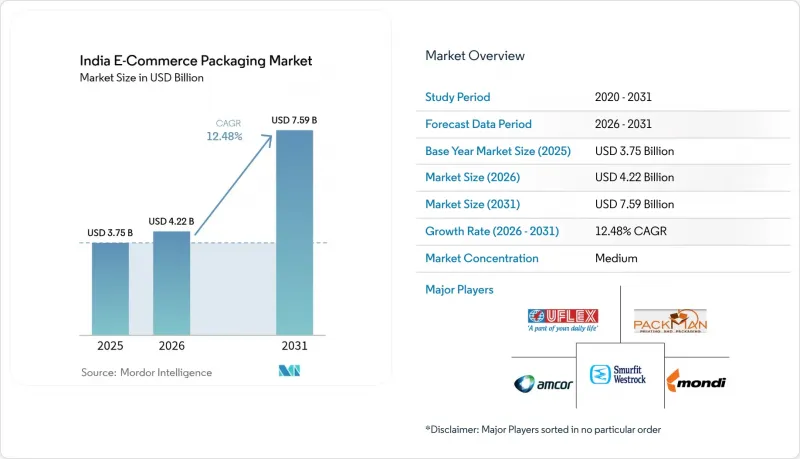
本報告按材料(紙/紙板、可生物分解/可堆肥材料、其他)、包裝類型(瓦楞紙箱、保護性包裝、郵寄信封、其他)、包裝等級(初級包裝、二級包裝、三級包裝/運輸包裝、可回收包裝)和最終用戶行業(時尚/服裝、消費性電子產品、其他)進行分類。市場預測以美元計價。
印度電子商務包裝市場的趨勢與洞察
線上零售和全通路履約的快速擴張
全通路策略要求包裝既能在宅配運輸過程中保護產品,又能保持產品在商店陳列時的良好銷售狀態。品牌所有者正在重新設計瓶蓋、內袋和外包裝,以防止洩漏和損壞。例如,ITC重新設計了沐浴凝膠瓶蓋,Parle為餅乾套裝增加了外包裝。隨著QR碼的整合,包裝盒成為忠誠度計畫的入口,使企業能夠直接獲取消費者行為資料。隨著產品線的多樣化,包裝的SKU數量也在增加,這使得能夠提供模組化、即時解決方案並最大限度減少倉儲空間的供應商更具優勢。
政府針對一次性塑膠製品的法規正在加速紙質解決方案的普及。
中央和地方政府目前正對不合規的塑膠製品處以罰款,採購趨勢也正轉向可回收和可堆肥的紙製品。加工商正在增加牛皮紙的生產,這種牛皮紙帶有阻隔塗層,其性能可與聚乙烯媲美,但可作為生活垃圾回收。能夠在產品生命週期的最後階段對其加工流程進行認證的公司,正在獲得主要電商平台的優先供應商地位。國內造紙企業受惠於進口依賴的減少,這符合「印度製造」的目標,同時也降低了買家的外匯風險。
牛皮紙襯裡和再生紙的價格波動
2024年,牛皮紙襯紙價格飆升達20%,反映全球紙漿供應趨緊和該地貨幣貶值。許多加工商缺乏期貨採購計劃,被迫每季重新談判,這給它們的毛利率帶來了壓力。不穩定的再生纖維回收率迫使造紙商持有過多的安全庫存,增加了營運資本,並在需求激增時擠壓資產回報率。大型企業開始投資上游產業,以確保纖維供應並穩定成本曲線。
細分市場分析
到2025年,紙張和紙板在印度電商包裝市場佔據50.83%的市場。這一地位得益於其可回收性以及消費者對其天然來源的認知。目前,可生物分解和可堆肥產品仍屬於小眾市場,但預計將以14.08%的複合年成長率成長,這反映了PBAT(聚苯並噻吩、苯並噻吩、丙烯酸酯)混合技術的進步正在縮小其與聚乙烯的成本差距。隨著大都會圈塑膠禁令的加強,預計到2031年,這些環保材料在印度電商包裝市場的規模將會翻倍。
塑膠仍然發揮著至關重要的作用,尤其是在對濕度敏感的產品中,阻隔性能比處置問題更為重要。單一材料的聚乙烯(PE)和聚丙烯(PP)複合材料因其簡化的機械回收流程而日益普及。黃麻等纖維基材在高級禮品領域需求旺盛,但銷售量仍較低。印度國防研究與發展組織(DRDO)研發並授權給40多家公司的PBAT薄膜可在三個月內分解,這表明國內創新可能很快就能在性能和價格方面挑戰進口可堆肥產品。
到2025年,瓦楞紙箱將佔印度電商包裝市場45.73%的佔有率。這主要歸功於其統一的形狀,非常適合大規模履約中心的輸送機自動化作業。然而,軟包裝袋預計將以13.42%的複合年成長率成長,因為它們可以減少非耐用品的體積和運輸成本。尺寸合適的包裝袋還可以減少填充填充材的使用,從而降低每筆訂單的材料用量。
模塑紙漿和氣墊等保護性內襯適用於電子設備和易碎品。 Iinkclip Print and Cartons 的無膠帶鎖扣紙盒顯著縮短了第三方物流供應商 (3PL) 的封口時間,同時減少了黏合劑的廢棄物。 Bottle Buddie 的零售包裝兼顧了電商通路的耐用性和商店的可見性,顯示包裝加工商可以透過模組化設計滿足線上和線下通路的需求。
其他好處:
- Excel格式的市場預測(ME)表
- 3個月的分析師支持
目錄
第1章:引言
- 研究假設和市場定義
- 調查範圍
第2章:調查方法
第3章執行摘要
第4章 市場狀況
- 市場概覽
- 市場促進因素
- 線上零售和全通路履約的快速發展
- 政府針對一次性塑膠製品的法規正在加速紙質解決方案的普及。
- 第三方物流和最後一公里網路的擴展縮短了包裝前置作業時間。
- 快速交易(15 分鐘以內)模式需要微型倉配包裝。
- 人工智慧助力 D2C 品牌最佳化,並擴大客製印刷盒的採用率。
- 市場限制因素
- 牛皮紙襯紙和再生紙的價格波動
- 與生產者延伸責任制 (EPR) 目標相關的合規負擔
- 加工能力的分散導致了品質的差異。
- 國內阻隔性單層材料薄膜的供應有限。
- 產業價值鏈分析
- 監理情勢
- 技術展望
- 波特五力分析
- 宏觀經濟因素對市場的影響
第5章 市場規模與成長預測
- 材料
- 紙張和紙板
- 塑膠
- 可生物分解和可堆肥
- 紡織材質(黃麻、棉花)
- 其他材料
- 按包裝類型
- 瓦楞紙箱
- 保護性包裝
- 郵寄信封和信封
- 軟包裝
- 標籤和膠帶
- 其他包裝類型
- 按封裝級別
- 初級包裝
- 二級包裝
- 三級包裝/運輸包裝
- 可回收/可重複使用的包裝
- 按最終用戶行業分類
- 時尚與服裝
- 家用電子產品
- 食品/飲料
- 個人護理化妝品
- 居家與廚房
- 藥品和醫療保健
- 其他終端用戶產業
第6章 競爭情勢
- 市場集中度
- 策略趨勢
- 市佔率分析
- 公司簡介
- Amcor plc
- International Paper Company
- Smurfit WestRock
- Mondi plc
- Uflex Limited
- Jindal Poly Films Limited
- Cosmo Films Limited
- Manjushree Technopack Limited
- Packman Packaging Private Limited
- Total Packaging Services Private Limited
- Astron Packaging Limited
- Band B Triplewall Containers Limited
- TGI Packaging Private Limited
- Kapco Packaging Industries Private Limited
- Avon Pacfo Services LLP
- Storopack India Private Limited
- Oji India Packaging Private Limited
- Securement Packaging Private Limited
- Marudhar Packaging Private Limited
第7章 市場機會與未來展望
According to Mordor Intelligence, India e-commerce packaging market size in 2026 is estimated at USD 4.22 billion, growing from 2025 value of USD 3.75 billion with 2031 projections showing USD 7.59 billion, growing at 12.48% CAGR over 2026-2031.
This report is Segmented by Material (Paper and Paperboard, Biodegradable and Compostable, and More), Packaging Type (Corrugated Boxes, Protective Packaging, Mailers and Envelopes, and More), Packaging Level (Primary, Secondary, and Tertiary/Transit, Returnable), End-User Industry (Fashion and Apparel, Consumer Electronics, and More). The Market Forecasts are Provided in Terms of Value (USD).
India E-commerce Packaging Market Trends and Insights
Rapid Proliferation of Online Retail and Omnichannel Fulfillment
Omnichannel strategies oblige packaging that safeguards goods during courier shipment yet still looks retail-ready on shelf. Brand owners are re-engineering closures, liners, and outer formats to prevent leakage or scuffing, illustrated by ITC's redesigned shower-gel caps and Parle's extra outer wraps for bundled cookies. QR-code integration turns boxes into gateways for loyalty programs, giving companies unmediated access to consumer behavior data. As product assortments multiply, packaging SKU counts rise, favoring suppliers able to offer modular, just-in-time solutions that minimize warehouse space.
Government Ban on Single-Use Plastics Accelerating Paper Solutions
Central and state authorities now penalize non-compliant polymers, tilting procurement toward recyclable and compostable papers. Converters are scaling barrier-coated kraft that mimics polyethylene performance yet qualifies for curbside recycling. Firms that can certify end-of-life pathways gain preferred-supplier status among large e-commerce portals. Domestic paper mills benefit from reduced import dependence, aligning with Make-in-India objectives and improving currency exposure for buyers
Volatility in Kraft Liner and Recycled Paper Prices
Kraft liner spiked by up to 20% in 2024, reflecting global pulp squeezes and local currency depreciation. Many converters lack forward-buying programs, forcing quarterly renegotiations that erode gross margins. Irregular recycled fiber collection compels mills to hold extra safety stock, bloating working capital and compressing ROA during demand surges. Integrated players have started investing upstream to lock in fiber supply and stabilize cost curves.
Other drivers and restraints analyzed in the detailed report include:
- Expansion of 3PL and Last-Mile Networks Lowering Packaging Lead-Times
- Quick-Commerce (<= 15-min) Models Demanding Micro-Fulfillment Packaging
- Compliance Burden of Extended Producer Responsibility Targets
For complete list of drivers and restraints, kindly check the Table Of Contents.
Segment Analysis
Paper and paperboard accounted for 50.83% of India E-commerce Packaging Market share in 2025, a position underpinned by recyclability and consumer perception of natural credentials. Biodegradable and compostable variants, though currently niche, are set to grow at a 14.08% CAGR, reflecting advances in PBAT blends whose cost gap with polyethylene is narrowing. The India E-commerce Packaging Market size for these green materials is expected to double by 2031 as enforcement of plastic bans tightens in metropolitan jurisdictions.
Plastics retain relevance where barrier performance overrides disposal concerns, particularly for moisture-sensitive SKUs. Mono-material PE and PP laminates gain favor because they simplify mechanical recycling streams. Textile substrates like jute cater to premium gifting but remain volume-light. The Defense Research and Development Organisation's PBAT film that degrades within three months is being licensed to more than 40 companies, suggesting domestic innovation could soon challenge imported compostables on both performance and price
Corrugated cartons delivered 45.73% of India E-commerce Packaging Market size in 2025 as their uniform form factor dovetailed with conveyor automation in large fulfillment hubs. Yet flexible mailers are projected to climb at a 13.42% CAGR because they save cubic space and freight cost for soft goods. Right-sized pouches also cut void fill, lowering the per-order material footprint.
Protective inserts such as molded pulp and air cushions cater to electronics and fragile categories. Tape-free locking cartons from Iinkclip Print and Cartons slash sealing time for 3PLs while eliminating adhesive waste. Bottle Buddie retail-ready packs marry e-commerce resilience with shelf visibility, proving converters can satisfy both digital and brick-and-mortar channels through modular designs.
Complete Report Scope:
- By Material
- Paper and Paperboard
- Plastics
- Biodegradable and Compostable
- Textile-based Materials (Jute, Cotton)
- Other Materials
- By Packaging Type
- Corrugated Boxes
- Protective Packaging
- Mailers and Envelopes
- Flexible Packaging
- Labels and Tapes
- Other Packaging Types
- By Packaging Level
- Primary Packaging
- Secondary Packaging
- Tertiary / Transit Packaging
- Returnable / Re-usable Packaging
- By End-user Industry
- Fashion and Apparel
- Consumer Electronics
- Food and Beverage
- Personal Care and Cosmetics
- Home and Kitchen
- Pharmaceuticals and Healthcare
- Other End-user Industries
List of Companies Covered in this Report:
- Amcor plc
- International Paper Company
- Smurfit WestRock
- Mondi plc
- Uflex Limited
- Jindal Poly Films Limited
- Cosmo Films Limited
- Manjushree Technopack Limited
- Packman Packaging Private Limited
- Total Packaging Services Private Limited
- Astron Packaging Limited
- Band B Triplewall Containers Limited
- TGI Packaging Private Limited
- Kapco Packaging Industries Private Limited
- Avon Pacfo Services LLP
- Storopack India Private Limited
- Oji India Packaging Private Limited
- Securement Packaging Private Limited
- Marudhar Packaging Private Limited
Additional Benefits:
- The market estimate (ME) sheet in Excel format
- 3 months of analyst support
TABLE OF CONTENTS
1 INTRODUCTION
- 1.1 Study Assumptions and Market Definition
- 1.2 Scope of the Study
2 RESEARCH METHODOLOGY
3 EXECUTIVE SUMMARY
4 MARKET LANDSCAPE
- 4.1 Market Overview
- 4.2 Market Drivers
- 4.2.1 Rapid proliferation of online retail and omnichannel fulfilment
- 4.2.2 Government ban on single-use plastics accelerating paper solutions
- 4.2.3 Expansion of 3PL and last-mile networks lowering packaging lead-times
- 4.2.4 Quick-commerce (<=15-min) models demanding micro-fulfilment packaging
- 4.2.5 AI-driven right-sizing/print-on-demand boxes adopted by D2C brands
- 4.3 Market Restraints
- 4.3.1 Volatility in kraft liner and recycled paper prices
- 4.3.2 Compliance burden of Extended Producer Responsibility (EPR) targets
- 4.3.3 Fragmented converting capacity causing quality variability
- 4.3.4 Limited domestic supply of high-barrier mono-material films
- 4.4 Industry Value Chain Analysis
- 4.5 Regulatory Landscape
- 4.6 Technological Outlook
- 4.7 Porter's Five Forces Analysis
- 4.7.1 Bargaining Power of Suppliers
- 4.7.2 Bargaining Power of Buyers
- 4.7.3 Threat of New Entrants
- 4.7.4 Threat of Substitute Products
- 4.7.5 Intensity of Competitive Rivalry
- 4.8 The Impact of Macroeconomic Factors on the Market
5 MARKET SIZE AND GROWTH FORECASTS (VALUE)
- 5.1 By Material
- 5.1.1 Paper and Paperboard
- 5.1.2 Plastics
- 5.1.3 Biodegradable and Compostable
- 5.1.4 Textile-based Materials (Jute, Cotton)
- 5.1.5 Other Materials
- 5.2 By Packaging Type
- 5.2.1 Corrugated Boxes
- 5.2.2 Protective Packaging
- 5.2.3 Mailers and Envelopes
- 5.2.4 Flexible Packaging
- 5.2.5 Labels and Tapes
- 5.2.6 Other Packaging Types
- 5.3 By Packaging Level
- 5.3.1 Primary Packaging
- 5.3.2 Secondary Packaging
- 5.3.3 Tertiary / Transit Packaging
- 5.3.4 Returnable / Re-usable Packaging
- 5.4 By End-user Industry
- 5.4.1 Fashion and Apparel
- 5.4.2 Consumer Electronics
- 5.4.3 Food and Beverage
- 5.4.4 Personal Care and Cosmetics
- 5.4.5 Home and Kitchen
- 5.4.6 Pharmaceuticals and Healthcare
- 5.4.7 Other End-user Industries
6 COMPETITIVE LANDSCAPE
- 6.1 Market Concentration
- 6.2 Strategic Moves
- 6.3 Market Share Analysis
- 6.4 Company Profiles (includes Global level Overview, Market level overview, Core Segments, Financials as available, Strategic Information, Market Rank/Share for key companies, Products and Services, and Recent Developments)
- 6.4.1 Amcor plc
- 6.4.2 International Paper Company
- 6.4.3 Smurfit WestRock
- 6.4.4 Mondi plc
- 6.4.5 Uflex Limited
- 6.4.6 Jindal Poly Films Limited
- 6.4.7 Cosmo Films Limited
- 6.4.8 Manjushree Technopack Limited
- 6.4.9 Packman Packaging Private Limited
- 6.4.10 Total Packaging Services Private Limited
- 6.4.11 Astron Packaging Limited
- 6.4.12 Band B Triplewall Containers Limited
- 6.4.13 TGI Packaging Private Limited
- 6.4.14 Kapco Packaging Industries Private Limited
- 6.4.15 Avon Pacfo Services LLP
- 6.4.16 Storopack India Private Limited
- 6.4.17 Oji India Packaging Private Limited
- 6.4.18 Securement Packaging Private Limited
- 6.4.19 Marudhar Packaging Private Limited
7 MARKET OPPORTUNITIES AND FUTURE OUTLOOK
- 7.1 White-space and Unmet-need Assessment

 包裝網際網路市場:策略分析與預測(2026-2031)
 零售電商包裝市場預測至2034年-全球包裝類型、材料、包裝功能、包裝特性、通路、最終用戶和區域分析
 電子商務包裝:市場佔有率分析、產業趨勢與統計、成長預測(2026-2031)
 電子商務塑膠包裝市場 - 全球市場預測(2026-2032年)電子商務包裝市場:按材料、包裝類型、應用和分銷管道分類-2026-2032年全球市場預測
 電子商務永續包裝市場:市場機會、成長要素、產業趨勢分析及2026-2035年預測
 電子商務包裝市場:按產品類型、材料、應用和地區分類電子商務包裝市場規模、佔有率、成長及全球產業分析:按類型和應用、地區的洞察,2026-2034年的預測全球電子商務包裝市場規模、佔有率、趨勢和成長分析報告(2026-2034)
 2026年全球零售與電子商務包裝市場報告