


 |
市場調查報告書
商品編碼
2122303
隱私過濾器:市場佔有率分析、行業趨勢和統計數據、成長預測(2026-2031 年)Privacy Filters - Market Share Analysis, Industry Trends & Statistics, Growth Forecasts (2026 - 2031) |
||||||

※ 本網頁內容可能與最新版本有所差異。詳細情況請與我們聯繫。
根據 Mordor Intelligence 預測,隱私過濾器市場規模將從 2025 年的 13.8 億美元成長到 2026 年的 15.5 億美元,到 2031 年將達到 28.3 億美元,2026 年至 2031 年的複合年成長率為 12.68%。
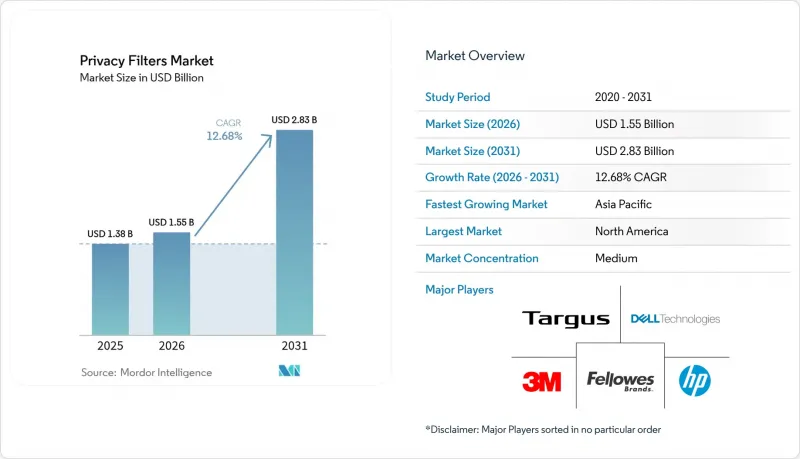
本報告按產品類型(例如,雙向隱私過濾器)、材料技術(例如,微百葉窗薄膜過濾器)、設備尺寸(例如,15-24英寸螢幕、24英寸及以上螢幕)、最終用戶(例如,企業辦公室、金融服務機構)、配銷通路(線上零售、線下零售、OEM直接整合)和地區進行細分。市場預測以美元(USD)計價。
全球隱私過濾器市場趨勢與洞察
加強企業環境中的資料隱私法規
2024年,歐盟監管機構對違反GDPR的行為處以41億歐元(約44億美元)的罰款,其中18%與螢幕資料外洩有關。美國聯邦貿易委員會(FTC)修訂了《美國金融服務業現代化法》(GLB法案)的保障規則,強制要求企業採取書面控制措施來防止螢幕窺探。加拿大、墨西哥和阿拉伯聯合大公國等國的監管機構也頒布了類似的法規,促使跨國公司在全球各地的辦公室部署隱私過濾器,以確保審計的一致性。採購部門現在累計光學螢幕與加密和多因素身份驗證一起列入安全預算。隨著這些監管措施的調整導致罰款金額增加和審計週期縮短,隱私過濾器市場持續快速成長。
遠距辦公和混合辦公模式擴展趨勢
混合辦公模式模糊了安全邊界,員工需要在咖啡館、火車和共用空間處理敏感資料。雖然在公共場所長時間使用螢幕會增加風險,但只有三分之一的雇主提供視覺隱私配件,這導致員工自行購買此類配件,從而引發了第二波需求。網路零售業正在迎合這些分散的訂單,預計到2024年將保持45.63%的通路佔有率。航空公司、鐵路營運商和連鎖飯店也開始在座椅靠背和飯店大廳自助服務終端上加裝內置隱私面板,這表明行動辦公正在將隱私濾鏡市場從傳統的辦公桌環境擴展到更廣泛的領域。
在已開發國家市場,桌上型顯示器的更換週期正在延長。
顯示器使用壽命的延長降低了以往推動隱私濾鏡更換的因素,這一趨勢在24吋以上的大更換螢幕大小尤為明顯。企業優先為行動團隊配備筆記型電腦,從而推遲了桌上型電腦的部署,導致近期目標市場規模縮小。儘管供應商正透過附加套件和用於老舊設備的磁性邊框來應對這一問題,但向行動裝置的結構性轉變正在減緩傳統隱私濾鏡市場的成長。
細分市場分析
四向透視設計可實現全方位遮擋,滿足開放式辦公室、交易大廳和公共資訊亭的需求。隨著全方位遮擋視線的重要性日益凸顯,四向透視隱私濾鏡的市場規模預計將迅速成長。儘管預計到2025年,雙向透視濾鏡仍將佔據49.10%的市場佔有率,但隨著共享辦公室模式的普及,其無固定辦公桌正在逐漸減弱。供應商正透過觸控螢幕相容性和符合人體工學標準且保持影像亮度的藍光過濾塗層等功能來凸顯自身優勢。
雖然電致變色技術目前仍處於小眾領域,但它能簡化安裝流程,並實現協作模式和隱私模式之間的即時切換。國防和金融業是該技術的早期採用者,這也解釋了其高昂的價格,其價格可達傳統產品的三倍。隨著原始設備製造商(OEM)開始在面板組裝過程中整合微百葉窗和電致變色層,預計售後市場的附加產品將從廣泛兼容各種設備轉向針對特定應用場景的專業化,從而重塑隱私濾鏡市場的未來銷售管道結構。
基於3M專有光控技術的微百葉窗薄膜預計到2025年將佔市佔率的60.73%。在權衡螢幕亮度後,這仍然是清晰度的標竿。然而,奈米結構超表面已成功在保持對比度的同時將厚度減少30%,這對於超薄筆記型電腦和折疊式設備而言是一項優勢。奈米技術的應用預計年複合成長率將接近13.35%,有望帶來更輕的設備並簡化回收流程,從而解決歐盟循環經濟行動計畫中強調的聚碳酸酯廢棄物問題。
電致變色聚合物能夠實現動態透明度控制,但也帶來了與電路相關的廢棄物問題。目前,材料選擇與環境政策密切相關,生物基聚碳酸酯正吸引尋求符合生產者延伸責任制(EPR)指令的歐洲買家的注意。這些變化為光學薄膜製造商和顯示器製造廠之間的上游合作創造了機遇,從而為長期供應合約奠定了基礎,進而穩定了整個隱私濾鏡市場的組件價格。
區域分析
預計到2025年,北美將佔全球銷售額的33.20%,這主要得益於《健康保險流通與責任法案》(HIPAA)的強制性要求以及修訂後的《美國金融服務業現代化法)的實施,後者將視覺隱私作為一項必要的安全保障措施。高設備普及率和零信任網路安全技術的採用進一步擴大了基本需求。聯邦機構正在其辦事處推廣使用隱私屏,而各州的隱私權法,例如《加州隱私權法案》(California Privacy Rights Act),也鼓勵私人企業購買此類產品,以避免執法部門的處罰。
預計到2031年,亞太地區將錄得13.62%的最高成長率,主要得益於中國《個人資料保護法》和印度《數位個人資料保護法》實施後合規標準的提高。IT基礎設施的快速部署、筆記型電腦普及率的提高以及政府主導的數位化專案都在推動部署量的成長。在台灣和韓國設有製造工廠的原始設備製造商(OEM)正在將隱私保護層整合到其組裝流程中,從而降低該地區買家的進口成本。
在歐洲,由於《一般資料保護規範》(GDPR) 的嚴格處罰措施生效,隱私權過濾器被視為一種避免數百萬歐元罰款的保障。顯示器人體工學的 ISO 標準,以及倡導使用可回收材料的環保政策,正推動採購標準轉向奈米結構薄膜。在阿拉伯聯合大公國和沙烏地阿拉伯等中東國家,GDPR 框架已得到體現,加速了銀行和公共部門在數位服務領域的應用。非洲和南美洲也正在湧現新的需求。南非的《個人資訊保護法》(POPIA) 和巴西的《一般資料保護法》(LGPD) 確立了跨國公司必須遵守的法律標準,促進了這些技術的早期應用。
其他好處:
- Excel格式的市場預測(ME)表
- 3個月的分析師支持
目錄
第1章:引言
- 研究假設和市場定義
- 調查範圍
第2章:調查方法
第3章執行摘要
第4章 市場狀況
- 市場概覽
- 市場促進因素
- 加強企業環境中的資料隱私法規
- 遠距辦公和混合辦公模式的發展趨勢
- 全球筆記型電腦和平板電腦出貨量成長
- 增加對醫療保健資訊科技的投資
- 將隱私過濾器整合到 OEM 顯示器生產線中
- 智慧電致變色隱私技術在國防應用的應用
- 市場限制因素
- 縮短已開發國家桌上型顯示器的更換週期
- 消費者群體對價格的敏感度
- 曲面和折疊式顯示器的兼容性挑戰
- 聚碳酸酯過濾器處置引發的環境問題
- 產業價值鏈分析
- 監理情勢
- 技術展望
- 宏觀經濟因素的影響
- 波特五力分析
第5章 市場規模與成長預測
- 依產品類型
- 雙向隱私過濾器
- 四向隱私濾鏡
- 針對觸控螢幕最佳化的過濾器
- 整合式OEM隱私顯示螢幕
- 透過材料技術
- 微百葉窗膜過濾器
- 利用奈米科技的過濾器
- 電致變色可切換濾光片
- 按設備尺寸
- 螢幕大小: 15吋或更小
- 15-24吋螢幕
- 螢幕大小為 24 吋或更大
- 按最終用戶行業分類
- 公司總部
- 醫療機構
- 金融服務
- 政府機構
- 教育機構
- 透過分銷管道
- 線上零售
- 線下零售
- 與原始設備製造商直接合作
- 按地區
- 北美洲
- 美國
- 加拿大
- 墨西哥
- 歐洲
- 德國
- 英國
- 法國
- 俄羅斯
- 其他歐洲國家
- 亞太地區
- 中國
- 日本
- 印度
- 韓國
- 澳洲
- 其他亞太國家
- 中東和非洲
- 中東
- 沙烏地阿拉伯
- 阿拉伯聯合大公國
- 其他中東國家
- 非洲
- 南非
- 埃及
- 其他非洲國家
- 中東
- 南美洲
- 巴西
- 阿根廷
- 其他南美國家
- 北美洲
第6章 競爭情勢
- 市場集中度
- 策略趨勢
- 市佔率分析
- 公司簡介
- 3M Company
- Targus International LLC
- Kensington Computer Products Group, a division of ACCO Brands Corporation
- Fellowes Inc.
- HP Inc.
- Dell Technologies Inc.
- V7-Ingram Micro Inc.
- ViewSonic Corporation
- Lenovo Group Limited
- ZAGG Inc.
- PanzerGlass A/S
- Tech Armor LLC
- Amazon Basics(Amazon.com Inc.)
- Belkin International Inc.
- DMC Co. Ltd.
- Dicota GmbH
- Klear Screen LLC
- GlareGuard Screen Protectors LLC
- MOSISO(Mosiso LAB, Inc.)
- JCPal Technology Ltd.
第7章 市場機會與未來展望
According to Mordor Intelligence, the privacy filters market size is expected to grow from USD 1.38 billion in 2025 to USD 1.55 billion in 2026 and is forecast to reach USD 2.83 billion by 2031 at 12.68% CAGR over 2026-2031.
This report is Segmented by Product Type (2-Way Privacy Filters, and More), Material Technology (Microlouver Film Filters, and More), Device Size (15-24 Inch Screens, Above 24 Inch Screens, and More), End-User (Corporate Offices, Financial Services, and More), Distribution Channel (Online Retail, Offline Retail, Direct OEM Integration), and Geography. The Market Forecasts are Provided in Terms of Value (USD).
Global Privacy Filters Market Trends and Insights
Growing Data Privacy Regulations in Corporate Environments
European Union regulators imposed fines of EUR 4.1 billion (USD 4.4 billion) in 2024 for GDPR violations, with 18% of cases involving visual data exposure. The U.S. Federal Trade Commission revised the Gramm-Leach-Bliley Safeguards Rule to require documented controls against screen eavesdropping. Canada, Mexico, and UAE authorities enacted parallel mandates, prompting multinational firms to adopt privacy filters across global offices for audit uniformity. Procurement teams now list optical screens alongside encryption and multifactor authentication in security budgets. This regulatory alignment keeps the privacy filters market on a steep adoption curve as fines escalate and audit cycles shorten.
Rising Remote and Hybrid Working Trends
Hybrid work blurs the perimeter; employees handle sensitive data in cafes, on trains, and in shared spaces. Screen exposure in public venues heightens the risk, yet only one-third of employers supply visual privacy accessories, creating a secondary demand wave from staff who self-purchase. Online retail fulfills these fragmented orders, sustaining 45.63% channel share in 2024. Airlines, rail operators, and hospitality chains have begun adding embedded privacy panels to seat-backs and lobby kiosks, demonstrating how mobility expands the privacy filters market beyond the traditional desk environment.
Declining Desktop Monitor Refresh Cycles in Developed Markets
Extended monitor lifespans cut replacement-trigger events that historically drove privacy-filter sales, especially for screens larger than 24 inches. Organizations prioritizing laptops for mobile teams defer desktop rollouts, shrinking the immediate addressable base. Vendors respond with retrofit kits and magnetic frames aimed at aging fleets; however, the structural tilt toward mobile devices tempers growth in the legacy segment of the privacy filter market.
Other drivers and restraints analyzed in the detailed report include:
- Increasing Laptop and Tablet Shipments Globally
- Expanding Healthcare IT Investments
- Price Sensitivity Among Consumer Buyers
For complete list of drivers and restraints, kindly check the Table Of Contents.
Segment Analysis
4-way designs enable omnidirectional shielding, meeting the demands of open-plan offices, trading floors, and public kiosks. The privacy filters market size for 4-way products is poised to expand rapidly because viewing angles from all sides require protection. In 2025, two-way models still accounted for 49.10% of revenue, yet their dominance is waning as hot desking grows. Vendors differentiate through touch-screen compatibility and blue-light reduction coatings that preserve image brightness while meeting ergonomic norms.
Electrochromic implementations, though currently niche, reduce attachment friction and support instant toggling between collaboration and privacy modes. The defense and finance sectors are early adopters, validating premium price points that reach three times the cost of conventional units. As OEMs embed microlouver or electrochromic layers at panel assembly, aftermarket clip-on demand is expected to shift toward specialized use cases rather than broad fleet coverage, reshaping future channel mix in the privacy filters market.
Microlouver film, underpinned by 3M's proprietary light-control technology, captured 60.73% revenue in 2025. It remains the benchmark for clarity versus the trade-off of dimming. However, nanostructure metasurfaces demonstrated 30% thickness reduction while sustaining contrast, an advantage for ultrathin laptops and foldables. Nanotech adoption, with a forecast near 13.35% CAGR, promises lighter devices and simplified recycling pathways, addressing polycarbonate waste concerns highlighted in the EU Circular Economy Action Plan.
Electrochromic polymers introduce dynamic opacity control but also pose disposal issues related to circuitry. Material selection now intertwines with environmental policy; bio-based polycarbonates are attracting European buyers seeking to comply with extended producer responsibility directives. Such shifts create opportunities for upstream partnerships between optical-film makers and display fabs, anchoring long-term supply agreements that stabilize component pricing across the privacy filter market.
Complete Report Scope:
- By Product Type
- 2-Way Privacy Filters
- 4-Way Privacy Filters
- Touch-Screen Optimized Filters
- Integrated OEM Privacy Displays
- By Material Technology
- Microlouver Film Filters
- Nanotechnology-Based Filters
- Electrochromic Switchable Filters
- By Device Size
- Less than or equal to 15 Inch Screens
- 15-24 Inch Screens
- Above 24 Inch Screens
- By End-User Industry
- Corporate Offices
- Healthcare Facilities
- Financial Services
- Government Agencies
- Educational Institutions
- By Distribution Channel
- Online Retail
- Offline Retail
- Direct OEM Integration
- By Geography
- North America
- United States
- Canada
- Mexico
- Europe
- Germany
- United Kingdom
- France
- Russia
- Rest of Europe
- Asia-Pacific
- China
- Japan
- India
- South Korea
- Australia
- Rest of Asia-Pacific
- Middle East and Africa
- Middle East
- Saudi Arabia
- United Arab Emirates
- Rest of Middle East
- Africa
- South Africa
- Egypt
- Rest of Africa
- Middle East
- South America
- Brazil
- Argentina
- Rest of South America
- North America
Geography Analysis
North America commanded 33.20% of 2025 revenue, propelled by HIPAA mandates and updated Gramm-Leach-Bliley rules that classify visual privacy as a required safeguard. High device ownership and the adoption of zero-trust cybersecurity amplify baseline demand. Federal agencies standardize privacy screens across their field offices, and state privacy statutes, such as the California Privacy Rights Act, spur private-sector purchases to avoid enforcement penalties.
The Asia-Pacific region is expected to register the fastest growth at 13.62% through 2031, as the implementation of China's Personal Information Protection Law and India's Digital Personal Data Protection Act raises compliance thresholds. Rapid IT infrastructure rollouts, increasing laptop penetration, and government digitization projects expand the install base. OEMs with fabs in Taiwan and South Korea integrate privacy layers during assembly, reducing import costs for regional buyers.
Europe enforces stringent GDPR penalties, positioning privacy filters as a form of insurance against multi-million-euro fines. ISO standards on display ergonomics converge with green policy pushes for recyclable materials, influencing procurement criteria toward nanostructured films. Middle East nations, such as the UAE and Saudi Arabia, mirror GDPR frameworks, fueling adoption in banking and public-sector digital services. Africa and South America exhibit emerging demand; South Africa's POPIA and Brazil's LGPD establish legal baselines that multinational firms must adhere to, facilitating early-stage deployments.
List of Companies Covered in this Report:
- 3M Company
- Targus International LLC
- Kensington Computer Products Group, a division of ACCO Brands Corporation
- Fellowes Inc.
- HP Inc.
- Dell Technologies Inc.
- V7 - Ingram Micro Inc.
- ViewSonic Corporation
- Lenovo Group Limited
- ZAGG Inc.
- PanzerGlass A/S
- Tech Armor LLC
- Amazon Basics (Amazon.com Inc.)
- Belkin International Inc.
- DMC Co. Ltd.
- Dicota GmbH
- Klear Screen LLC
- GlareGuard Screen Protectors LLC
- MOSISO (Mosiso LAB, Inc.)
- JCPal Technology Ltd.
Additional Benefits:
- The market estimate (ME) sheet in Excel format
- 3 months of analyst support
TABLE OF CONTENTS
1 INTRODUCTION
- 1.1 Study Assumptions and Market Definition
- 1.2 Scope of the Study
2 RESEARCH METHODOLOGY
3 EXECUTIVE SUMMARY
4 MARKET LANDSCAPE
- 4.1 Market Overview
- 4.2 Market Drivers
- 4.2.1 Growing Data Privacy Regulations in Corporate Environments
- 4.2.2 Rising Remote and Hybrid Working Trends
- 4.2.3 Increasing Laptop and Tablet Shipments Globally
- 4.2.4 Expanding Healthcare IT Investments
- 4.2.5 Integration of Privacy Filters into OEM Display Manufacturing Lines
- 4.2.6 Adoption of Smart Electrochromic Privacy Technologies for Defense Applications
- 4.3 Market Restraints
- 4.3.1 Declining Desktop Monitor Refresh Cycles in Developed Markets
- 4.3.2 Price Sensitivity Among Consumer Buyers
- 4.3.3 Compatibility Challenges with Curved and Foldable Displays
- 4.3.4 Environmental Concerns Over Disposal of Polycarbonate-Based Filters
- 4.4 Industry Value Chain Analysis
- 4.5 Regulatory Landscape
- 4.6 Technological Outlook
- 4.7 Impact of Macroeconomic Factors
- 4.8 Porter's Five Forces Analysis
- 4.8.1 Threat of New Entrants
- 4.8.2 Bargaining Power of Buyers
- 4.8.3 Bargaining Power of Suppliers
- 4.8.4 Threat of Substitute Products
- 4.8.5 Competitive Rivalry
5 MARKET SIZE AND GROWTH FORECASTS (VALUE)
- 5.1 By Product Type
- 5.1.1 2-Way Privacy Filters
- 5.1.2 4-Way Privacy Filters
- 5.1.3 Touch-Screen Optimized Filters
- 5.1.4 Integrated OEM Privacy Displays
- 5.2 By Material Technology
- 5.2.1 Microlouver Film Filters
- 5.2.2 Nanotechnology-Based Filters
- 5.2.3 Electrochromic Switchable Filters
- 5.3 By Device Size
- 5.3.1 Less than or equal to 15 Inch Screens
- 5.3.2 15-24 Inch Screens
- 5.3.3 Above 24 Inch Screens
- 5.4 By End-User Industry
- 5.4.1 Corporate Offices
- 5.4.2 Healthcare Facilities
- 5.4.3 Financial Services
- 5.4.4 Government Agencies
- 5.4.5 Educational Institutions
- 5.5 By Distribution Channel
- 5.5.1 Online Retail
- 5.5.2 Offline Retail
- 5.5.3 Direct OEM Integration
- 5.6 By Geography
- 5.6.1 North America
- 5.6.1.1 United States
- 5.6.1.2 Canada
- 5.6.1.3 Mexico
- 5.6.2 Europe
- 5.6.2.1 Germany
- 5.6.2.2 United Kingdom
- 5.6.2.3 France
- 5.6.2.4 Russia
- 5.6.2.5 Rest of Europe
- 5.6.3 Asia-Pacific
- 5.6.3.1 China
- 5.6.3.2 Japan
- 5.6.3.3 India
- 5.6.3.4 South Korea
- 5.6.3.5 Australia
- 5.6.3.6 Rest of Asia-Pacific
- 5.6.4 Middle East and Africa
- 5.6.4.1 Middle East
- 5.6.4.1.1 Saudi Arabia
- 5.6.4.1.2 United Arab Emirates
- 5.6.4.1.3 Rest of Middle East
- 5.6.4.2 Africa
- 5.6.4.2.1 South Africa
- 5.6.4.2.2 Egypt
- 5.6.4.2.3 Rest of Africa
- 5.6.4.1 Middle East
- 5.6.5 South America
- 5.6.5.1 Brazil
- 5.6.5.2 Argentina
- 5.6.5.3 Rest of South America
- 5.6.1 North America
6 COMPETITIVE LANDSCAPE
- 6.1 Market Concentration
- 6.2 Strategic Moves
- 6.3 Market Share Analysis
- 6.4 Company Profiles (includes Global Level Overview, Market Level Overview, Core Segments, Financials as available, Strategic Information, Market Rank/Share for key companies, Products and Services, and Recent Developments)
- 6.4.1 3M Company
- 6.4.2 Targus International LLC
- 6.4.3 Kensington Computer Products Group, a division of ACCO Brands Corporation
- 6.4.4 Fellowes Inc.
- 6.4.5 HP Inc.
- 6.4.6 Dell Technologies Inc.
- 6.4.7 V7 - Ingram Micro Inc.
- 6.4.8 ViewSonic Corporation
- 6.4.9 Lenovo Group Limited
- 6.4.10 ZAGG Inc.
- 6.4.11 PanzerGlass A/S
- 6.4.12 Tech Armor LLC
- 6.4.13 Amazon Basics (Amazon.com Inc.)
- 6.4.14 Belkin International Inc.
- 6.4.15 DMC Co. Ltd.
- 6.4.16 Dicota GmbH
- 6.4.17 Klear Screen LLC
- 6.4.18 GlareGuard Screen Protectors LLC
- 6.4.19 MOSISO (Mosiso LAB, Inc.)
- 6.4.20 JCPal Technology Ltd.
7 MARKET OPPORTUNITIES AND FUTURE OUTLOOK
- 7.1 White-space and Unmet-Need Assessment

 機密計算 (CC) 與其他隱私增強技術 (PET) 的整合
 2026-2030年全球資料主權管理市場
 隱私增強技術(PET)市場:預測至2034年-按技術、組件、部署模式、應用、最終用戶和地區分類的全球分析
 員工資料隱私與合規平台:市場佔有率分析、產業趨勢與統計、成長預測(2026-2031)隱私技術(PET)市場預測至2034年-按部署類型、組織規模、技術、應用、最終用戶和地區分類的全球分析
 2026年全球筆記型電腦隱私螢幕市場報告2026年HIPAA(健康保險流通與責任法案)合規服務全球市場報告人工智慧資料隱私市場預測至2034年-按隱私解決方案類型、組件、部署模式、技術、最終用戶和地區分類的全球分析主權資料中心主權資料中心:市場資料概覽(2026 年第二季)