


 |
市場調查報告書
商品編碼
2097476
員工資料隱私與合規平台:市場佔有率分析、產業趨勢與統計、成長預測(2026-2031)Employee Data Privacy and Compliance Platform - Market Share Analysis, Industry Trends & Statistics, Growth Forecasts (2026 - 2031) |
||||||

※ 本網頁內容可能與最新版本有所差異。詳細情況請與我們聯繫。
根據 Mordor Intelligence 預測,員工資料隱私和合規平台市場規模預計將在 2025 年達到 30.4 億美元,2026 年達到 34.2 億美元,到 2031 年達到 63.1 億美元,2026 年至 2031 年的複合年成長率為 13.02%。
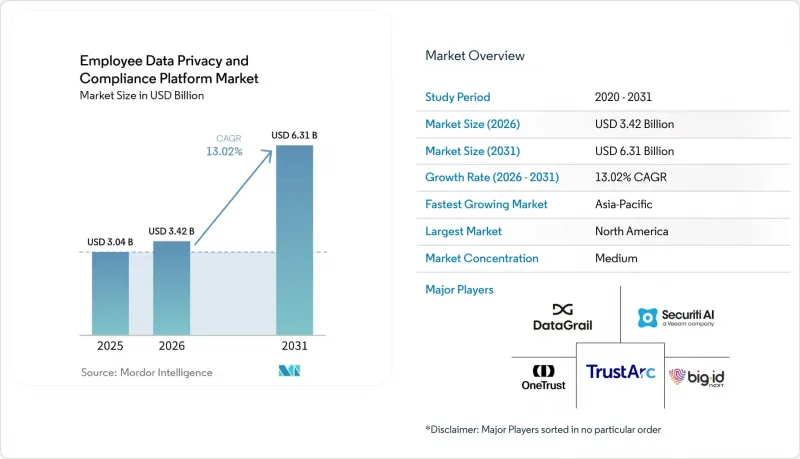
本報告按組件(平台和服務)、部署類型(雲端、本地部署、混合部署)、組織規模(大型企業和中小企業)、最終用戶行業(醫療保健和生命科學、資訊技術和電信、其他)以及地區進行細分。市場預測以美元計價。
全球員工資料隱私與合規平台市場趨勢及洞察
擴大員工跨越司法管轄區的隱私權
員工資料隱私和合規平台市場最強勁的結構性推動力來自於雇主必須控制和記錄的內容的法律定義不斷擴展。如今,當企業在多個國家處理員工資訊時,它們在準確性、通知、申訴處理、資料保留和資料外洩應對方面面臨更廣泛的義務。合規挑戰不僅源自於規則數量的增加,還源自於不同司法管轄區的規則並不完全一致,導致標準化的手動流程失效。這種情況已將隱私合規從單純的法律審查任務轉變為人力資源、法務、安全和IT團隊的日常營運要求。因此,員工資料隱私和合規平台市場正受益於預算分配決策的優先考慮,即優先考慮專用工作流程系統而非電子表格和通用管理工具。對於在兩到三個司法管轄區運作的雇主而言,這種轉變尤其重要,因為他們必須管理在同意、使用限制、文件記錄和員工權利主張方面不重疊的義務。
人工智慧驅動的招募、監控和 ADMT管治的要求
關於人工智慧驅動的招聘、績效監控和僱用決策的相關規則正成為推動員工資料隱私和合規平台市場支出成長的直接因素。當自動化系統影響招募和員工管理時,雇主必須記錄風險、提供通知、評估公平性並保持監督。 2026年3月,英國資訊專員辦公室 (ICO) 基於招募調查發布了近300項建議,指出在招募中使用自動化決策工具時,很可能需要進行資料保護影響評估 (DPIA)。由於雇主需要在實施後建立可重複的工作流程、追蹤證據並進行持續的重新評估,因此僅靠法律審查難以履行這些義務。因此,員工資料隱私和合規平台市場的供應商正從單純關注政策庫轉向強調內建評估工具、自動觸發器和可管治的文件。在人工智慧已應用於招募、生產力評估、勞動力分析和員工監控等場景中,需求成長最為顯著,因為這些場景會帶來直接的治理風險。
人力資源、身分管理和IT系統之間的複雜整合。
員工資料隱私和合規平台市場面臨的主要營運限制因素是,員工資料很少儲存在單一系統中。資料分散在人力資源管理系統 (HRMS)、薪資核算工具、身分管理平台、協作軟體、監控工具以及具有不同模式和存取控制的區域資料庫中。將隱私平台連接到這種環境通常需要 API 整合、資料規範化、權限重構以及跨部門專案時間,而買家往往在初期低估了這些成本。對於在不同業務部門和國家/地區運作獨立系統的大型企業而言,這項挑戰更為突出,因為單一的合規工作流程可能依賴多個不相連的資訊來源。這會增加實施成本並延長價值實現時間,可能會延遲中型企業的採購決策,並使跨國公司的部署更加複雜。因此,擁有預先建置連接器、認證整合能力和 API 優先產品設計的供應商在員工資料隱私和合規平台市場中具有顯著的執行優勢。
細分市場分析
預計到2025年,平台將佔市場68.31%的佔有率,這表明買家仍然傾向於整合系統而非分散的單一功能工具。這一佔有率反映了他們對單一營運層的偏好,該營運層能夠連接資料發現、權限管理、同意處理、隱私評估和跨境合規管理。這在員工資料隱私和合規平台產業尤其重要,因為底層工作流程相互依賴,如果團隊在不同的應用程式中管理這些工作流程,其價值就會降低。資料發現和分類仍然至關重要,因為如果組織不了解員工資訊的儲存位置,就無法維護可靠的記錄或進行影響評估。此外,隨著人工智慧工具帶來新的通知和透明度要求,同意和偏好工作流程在就業環境中的重要性日益凸顯。
員工身分和存取管治工具正日益受到關注,因為如今對員工記錄的存取已被視為安全和隱私問題。此外,對隱私風險和影響評估模組的需求也在不斷成長,尤其是在企業必須記錄高風險流程並保留證據以備內部審計和監管審查的情況下。服務業是成長最快的領域,預計從2026年到2031年將以14.98%的複合年成長率成長。這表明,許多買家在初始軟體部署後仍然需要外部支援。員工資料隱私和合規平台市場的這一細分領域正在擴張,因為客戶擴大將配置、策略調整、工作流程設計和持續監控等任務外包,而不是自行建立。這種需求在中小型企業和受嚴格監管的公司中尤為突出,因為它們面臨的法規複雜性往往限制了其隱私團隊的人員配置。 BigID將於2026年3月發布用於員工人工智慧使用的整合式人工智慧管治,這也顯示了向服務主導交付模式的轉變,即供應商將監控、存取控制和策略執行整合到更廣泛的企業專案中。這項變化凸顯了企業越來越重視採用綜合解決方案來滿足其人工智慧管治需求。
預計到2025年,基於雲端的部署將佔市場佔有率的66.23%,這反映了人力資源和合規系統領域向SaaS環境的整體轉變。供應商發現,買家更傾向於雲端部署,因為與傳統的本地部署模式相比,雲端部署能夠更快地提供監管更新、改進連接器並最佳化工作流程。員工資料隱私和合規平台市場也受益於雲端交付帶來的維護負擔減輕。這對於需要在法律、人力資源、隱私和安全團隊之間進行分散式存取的組織而言尤其有利。在國防、某些金融機構和公共部門等高度監管的環境中,本地部署仍然至關重要,因為在這些環境中,本地控制仍然不可或缺。然而,隨著基於雲端的管理能夠實現更強大的監控、更便捷的升級以及對全球隱私計畫更清晰的可見性,本地部署的角色正在逐漸減弱。
混合部署是成長最快的模式,到2031年複合年成長率將達到14.56%,這種成長反映的是務實的折衷方案,而非暫時的過渡。跨國公司正在利用混合模式,在本地環境中維護敏感且受居住限制的數據,同時透過雲端控制層管理策略、報告和工作流程的協調。這種架構對於在亞太地區和歐洲營運的組織尤其有用,居住要求和營運柔軟性之間取得平衡。混合環境下的員工資料隱私和合規平台市場需求旺盛,主要源自於雇主希望在不犧牲對員工記錄和日誌的國別控制權的前提下,實現集中式管治。混合模式也與人工智慧相關合規工作流程的日益普及相契合,因為雇主可能希望在本地處理推理記錄,同時在全球範圍內協調評估和文件編制。正是這種柔軟性和控制力的融合,使得混合模式從一種小眾的部署選項發展成為全球員工隱私計畫的強大架構選擇。
區域分析
到2025年,北美將佔據員工資料隱私和合規平台市場37.29%的佔有率,成為最大的區域市場。這一主導地位主要得益於企業技術買家的高度集中、雲端人力資源系統的廣泛應用,以及與州級隱私框架相關的日益成長的合規負擔。美國雇主也面臨著圍繞著人工智慧驅動的招募、晉升和監控決策而產生的更積極的管治挑戰,這促使政策修訂轉向系統層面的投資。這些趨勢提升了跨多個司法管轄區管理工作流程的價值,而非依賴孤立的法律解釋,尤其對於在多個州運營的雇主而言更是如此。因此,員工資料隱私和合規平台市場仍然以北美為中心,因為該地區的買家通常需要能夠協調通知、文件、風險評估和員工權利流程,並能應對重疊法律要求的平台。
歐洲仍然是第二大區域叢集,主要由英國、德國、法國、義大利和西班牙推動。由於雇主對監控、比例原則和集體協議等方面的具體期望,以及通用資料保護條例,歐洲對員工隱私的需求仍然強勁。全部區域對文件記錄、必要性證明和管治標準的執行力度越來越大,對於考慮部署人工智慧驅動的生產力和監控工具的雇主而言,法律環境正變得日益嚴格。這使得歐洲繼續處於員工資料隱私和合規平台市場的中心地位,這不僅是因為執法部門的壓力,還因為雇主需要能夠幫助他們保留證據、適應當地法規並確保長期內部課責的系統。
預計到2031年,亞太地區將以14.09%的複合年成長率成長,並有望成為員工資料隱私和合規平台市場成長最快的地區。這一成長主要得益於印度、日本、韓國和澳洲實施了更嚴格的隱私保護要求,這促使當地雇主和在該地區設有交付中心的跨國公司增加了採購需求。印度尤其重要,因為執法和實施方面的進步迫使雇主正式確認員工資料同意、處理申訴並應對資料外洩事件。日本也是一個關鍵市場,隱私改革加重了職場員工資訊和生物識別資料的合規負擔。南美洲仍處於起步階段,但巴西的大型企業對此類平台的需求日益成長,這些企業必須在更規範的隱私規則下管理員工資料。中東和非洲也在崛起,隨著在地化和國內託管要求影響著企業的採用選擇,這些地區對此類平台的興趣也日益濃厚。在全部區域,員工資料隱私和合規平台市場都受益於一些通用的發展趨勢。換句話說,雇主希望建立一個既能適應當地需求又不損害中央監管的系統。
其他好處:
- Excel格式的市場預測(ME)表
- 3個月的分析師支持
目錄
第1章:引言
- 研究假設和市場定義
- 調查範圍
第2章:調查方法
第3章執行摘要
第4章 市場狀況
- 市場概覽
- 市場促進因素
- 各司法管轄區擴大員工隱私權
- 向雲端原生隱私營運遷移
- RoPA、DPIA 和保留期管理工作流程的自動化
- 跨境資料傳輸和資料居住的合規要求
- 人工智慧應用、監控和ADMT管治的要求
- 員工權益索賠的數量和複雜程度都在增加。
- 市場限制因素
- 人力資源、身分識別和資訊技術系統之間的複雜整合。
- 預算競爭涉及更廣泛的 GRC 和安全平台
- 對員工監控的擔憂以及勞工委員會的反對
- 快速變化的地方法規會帶來結構性和責任風險。
- 產業價值鏈分析
- 監理情勢
- 技術展望
- 宏觀經濟因素對市場的影響
- 波特五力分析
第5章 市場規模與成長預測
- 按組件
- 平台
- 資料發現與分類平台
- 同意和偏好管理平台
- 員工身分識別和存取管治平台
- 隱私風險和影響評估平台
- 資料居住要求和跨境合規平台
- 其他平台
- 服務
- 專業服務
- 託管服務
- 平台
- 部署模式
- 基於雲端的
- 現場
- 混合
- 按組織規模
- 大公司
- 小型企業
- 按最終用戶行業分類
- 銀行業、金融服務業及保險業
- 醫療保健和生命科學
- 資訊科技/通訊
- 零售與電子商務
- 政府/公共部門
- 製造業
- 其他終端用戶產業
- 按地區
- 北美洲
- 美國
- 加拿大
- 墨西哥
- 南美洲
- 巴西
- 阿根廷
- 智利
- 其他南美國家
- 歐洲
- 英國
- 德國
- 法國
- 義大利
- 西班牙
- 俄羅斯
- 其他歐洲國家
- 亞太地區
- 中國
- 日本
- 印度
- 韓國
- 澳洲和紐西蘭
- 其他亞太國家
- 中東
- 阿拉伯聯合大公國
- 沙烏地阿拉伯
- 土耳其
- 其他中東國家
- 非洲
- 南非
- 奈及利亞
- 其他非洲國家
- 北美洲
第6章 競爭情勢
- 市場集中度
- 策略趨勢
- 市佔率分析
- 公司簡介
- OneTrust LLC
- BigID, Inc.
- TrustArc Inc.
- Securiti, LLC
- DataGrail, Inc.
- Transcend Inc.
- Relyance Inc.
- Osano, Inc., a Public Benefit Corporation
- Ketch Kloud, Inc.
- Didomi SAS
- Usercentrics GmbH
- DataCo GmbH
- ComplyCloud ApS
- 2B Advice GmbH
- Smart Global Governance
- PrivacyAgent BV
- SayMine Technologies Ltd.
- Privado Inc.
- Syrenis Limited
- Enzuzo Inc.
- Proteus-Cyber Ltd.
第7章 市場機會與未來展望
According to Mordor Intelligence, the employee data privacy and compliance platform market size is projected to be USD 3.04 billion in 2025, USD 3.42 billion in 2026, and reach USD 6.31 billion by 2031, growing at a CAGR of 13.02% from 2026 to 2031.
This report is Segmented by Component (Platforms, and Services), Deployment Mode (Cloud-Based, On-Premises, and Hybrid), Organization Size (Large Enterprises, and Small and Medium-Sized Enterprises), End-User Industry (Healthcare and Life Sciences, Information Technology and Telecommunications, and More), and Geography. The Market Forecasts are Provided in Terms of Value (USD).
Global Employee Data Privacy and Compliance Platform Market Trends and Insights
Expansion of Employee Privacy Rights Across Jurisdictions
The strongest structural support for the employee data privacy and compliance platform market comes from the widening legal definition of what employers must govern and document. Organizations now face a broader set of obligations regarding accuracy, notice, grievance handling, retention, and breach response when processing employee information across multiple countries. The compliance challenge is not only that more rules exist, but also that they do not align neatly across jurisdictions, which makes standardized manual processes less effective. This has pushed privacy compliance from a legal review exercise into a daily operational requirement for HR, legal, security, and IT teams. As a result, the employee data privacy and compliance platform market is benefiting from budget decisions that increasingly favor dedicated workflow systems over spreadsheets or general controls tooling. The change is especially important for employers operating across 2 or 3 jurisdictions, because they must now manage non-overlapping obligations on consent, purpose limitation, documentation, and employee rights requests.
AI Hiring, Monitoring, and ADMT Governance Requirements
Rules for AI-assisted hiring, performance monitoring, and employment decision-making are becoming a direct driver of spending in the employee data privacy and compliance platform market. Employers are being asked to document risk, provide notice, assess fairness, and maintain oversight when automated systems influence recruitment or worker management. The UK Information Commissioner's Office reported in March 2026 that its recruitment review led to nearly 300 recommendations and stated that DPIAs are likely required when automated decision-making tools are used in hiring. These obligations are difficult to manage through legal review alone because employers need repeatable workflows, evidence trails, and ongoing reassessment after deployment. That is why vendors in the employee data privacy and compliance platform market are emphasizing embedded assessment tools, automated triggers, and audit-ready documentation, rather than focusing solely on policy libraries. The demand uplift is strongest where AI is already active in hiring, productivity scoring, workforce analytics, and employee monitoring, because those use cases generate immediate governance exposure.
Complex Integration Across HR, Identity, and IT Systems
The main operational restraint in the employee data privacy and compliance platform market is that employee data is rarely stored in one system. It spans HRMS environments, payroll tools, identity platforms, collaboration software, monitoring tools, and regional databases with varying schemas and access controls. Connecting a privacy platform to this environment often requires API work, normalization, permissions review, and cross-functional project time that buyers may underestimate at the start. The challenge becomes more severe in large enterprises that operate separate systems across business units or countries, as a single compliance workflow may depend on multiple disconnected sources. This increases implementation costs and slows time to value, which can delay buying decisions in the mid-market and complicate rollouts in multinational organizations. Vendors with pre-built connectors, certified integrations, and API-first product design, therefore, hold a meaningful execution advantage in the employee data privacy and compliance platform market.
Other drivers and restraints analyzed in the detailed report include:
- Automation of RoPA, DPIA, and Retention Workflows
- Shift toward Cloud-Native Privacy Operations
- Fast-Changing Local Rules Create Configuration and Liability Risk
For complete list of drivers and restraints, kindly check the Table Of Contents.
Segment Analysis
Platforms accounted for 68.31% of the 2025 market, indicating that buyers still favor integrated systems over fragmented point tools. That share reflects a preference for a single operating layer that connects data discovery, rights management, consent handling, privacy assessments, and cross-border compliance controls. In the employee data privacy and compliance platform industry, this matters because the underlying workflows are interdependent, and value drops when teams manage them in separate applications. Data discovery and classification remain the foundation because organizations cannot maintain reliable records or trigger impact assessments without knowing where employee information resides. Consent and preference workflows are also becoming more relevant inside employment settings as AI-supported tools create new notice and transparency requirements.
Workforce identity and access governance tools are gaining traction because access to employee records is now treated as both a security and a privacy issue. Privacy risk and impact assessment modules are also in stronger demand, especially where organizations must document high-risk processing and maintain evidence for internal review or regulator scrutiny. The services segment is the fastest-growing component, with a 14.98% CAGR from 2026 to 2031, indicating that many buyers still need external support after the initial software purchase. This segment of the employee data privacy and compliance platform market is expanding because clients often outsource configuration, policy tuning, workflow design, and ongoing monitoring rather than building those capabilities internally. Demand is especially evident among SMEs and highly regulated enterprises, where privacy teams are often lean due to the complexity of the rules they face. BigID's March 2026 launch of integrated AI governance for employee AI use also showed how product vendors are moving closer to service-led delivery by packaging monitoring, access controls, and policy enforcement into broader enterprise programs. This shift highlights the growing emphasis on comprehensive solutions to address enterprise AI governance needs.
Cloud-based deployment accounted for 66.23% of the 2025 market, confirming that this category has moved in step with the broader migration of HR and compliance systems to SaaS environments. Buyers favor cloud deployment because vendors can issue regulatory updates, connector improvements, and workflow enhancements more quickly than in traditional on-premises models. The employee data privacy and compliance platform market also benefits from the lower maintenance burden of cloud delivery, especially for organizations that need distributed access across legal, HR, privacy, and security teams. On-premises deployment still matters in some regulated settings, including defense, certain financial institutions, and public sector environments where localized control remains non-negotiable. Even so, its role is narrowing because cloud-based administration now offers stronger oversight, easier upgrades, and better visibility across global privacy programs.
Hybrid deployment is the fastest-growing model with a 14.56% CAGR through 2031, and that growth reflects a practical compromise rather than a temporary transition stage. Multinationals are using hybrid models to keep sensitive or residency-bound data in local environments while managing policies, reporting, and workflow coordination through cloud control layers. This architecture is especially useful when organizations operate across APAC and Europe, where residency requirements and operational flexibility must coexist. The employee data privacy and compliance platform market for hybrid environments is being driven by employers seeking centralized governance without sacrificing country-level control over employee records and logs. Hybrid also aligns with the growing use of AI-related compliance workflows, as employers may want local handling of inference records while still coordinating assessments and documentation globally. That mix of flexibility and control is why hybrid is evolving from a niche deployment option into a durable architecture choice for global workforce privacy programs.
Complete Report Scope:
- By Component
- Platforms
- Data Discovery and Classification Platforms
- Consent and Preference Management Platforms
- Workforce Identity and Access Governance Platforms
- Privacy Risk and Impact Assessment Platforms
- Data Residency and Cross-Border Compliance Platforms
- Other Platforms
- Services
- Professional services
- Managed services
- Platforms
- By Deployment Mode
- Cloud-based
- On-premises
- Hybrid
- By Organization Size
- Large enterprises
- Small and Medium-Sized Enterprises
- By End-user Industry
- Banking, Financial Services and Insurance
- Healthcare and Life Sciences
- Information Technology and Telecommunications
- Retail and E-Commerce
- Government and Public Sector
- Manufacturing
- Other End-User Industries
- By Geography
- North America
- United States
- Canada
- Mexico
- South America
- Brazil
- Argentina
- Chile
- Rest of South America
- Europe
- United Kingdom
- Germany
- France
- Italy
- Spain
- Russia
- Rest of Europe
- Asia-Pacific
- China
- Japan
- India
- South Korea
- Australia and New Zealand
- Rest of Asia-Pacific
- Middle East
- United Arab Emirates
- Saudi Arabia
- Turkey
- Rest of Middle East
- Africa
- South Africa
- Nigeria
- Rest of Africa
- North America
Geography Analysis
North America held 37.29% of the employee data privacy and compliance platform market share in 2025, making it the largest regional market. The region's lead came from its dense base of enterprise technology buyers, broad use of cloud HR systems, and an expanding compliance burden tied to state-level privacy frameworks. Employers in the United States are also dealing with a more active governance agenda around AI-supported hiring, promotion, and monitoring decisions, which is turning policy review into system-level spending. That dynamic has made multi-jurisdictional workflow management more valuable than one-off legal interpretation, especially for employers operating across several states. The employee data privacy and compliance platform market, therefore, remains anchored in North America, where buyers often need platforms that can coordinate notices, documentation, risk assessments, and employee rights processes across overlapping legal requirements.
Europe remained the second-largest regional cluster, led by the United Kingdom, Germany, France, Italy, and Spain. Regional demand stayed strong because both general data protection rules and employment-specific expectations around monitoring, proportionality, and collective arrangements shape workforce privacy in Europe. The legal environment has become more exacting for employers seeking to use AI-supported productivity or monitoring tools, as documentation, necessity, and governance standards are being applied more tightly across the region. This keeps Europe central to the employee data privacy and compliance platform market, not only because of enforcement pressure, but also because employers need systems that can sustain evidence, local adaptation, and internal accountability over time.
Asia-Pacific is projected to expand at a 14.09% CAGR through 2031, giving the region the fastest growth rate in the employee data privacy and compliance platform market. Growth is being driven by the rollout of tighter privacy expectations across India, Japan, South Korea, and Australia, which is increasing procurement among both local employers and multinationals with regional delivery centers. India is important because enforcement and implementation are pushing employers to formalize consent, grievance handling, and breach response for employee data. Japan also matters because privacy reform is broadening the compliance load around employee information and biometric data in workplace settings. South America is still at an earlier stage, but Brazil is generating demand among large employers that must govern workforce data under more structured privacy rules. The Middle East and Africa are also emerging, with interest rising as localization and sovereign hosting requirements shape deployment choices. Across these geographies, the employee data privacy and compliance platform market is gaining from the same pattern: employers want systems that can adapt locally without losing central oversight.
- OneTrust LLC
- BigID, Inc.
- TrustArc Inc.
- Securiti, LLC
- DataGrail, Inc.
- Transcend Inc.
- Relyance Inc.
- Osano, Inc., a Public Benefit Corporation
- Ketch Kloud, Inc.
- Didomi SAS
- Usercentrics GmbH
- DataCo GmbH
- ComplyCloud ApS
- 2B Advice GmbH
- Smart Global Governance
- PrivacyAgent B.V.
- SayMine Technologies Ltd.
- Privado Inc.
- Syrenis Limited
- Enzuzo Inc.
- Proteus-Cyber Ltd.
Additional Benefits:
- The market estimate (ME) sheet in Excel format
- 3 months of analyst support
TABLE OF CONTENTS
1 INTRODUCTION
- 1.1 Study Assumptions and Market Definition
- 1.2 Scope of the Study
2 RESEARCH METHODOLOGY
3 EXECUTIVE SUMMARY
4 MARKET LANDSCAPE
- 4.1 Market Overview
- 4.2 Market Drivers
- 4.2.1 Expansion of Employee Privacy Rights across Jurisdictions
- 4.2.2 Shift toward Cloud-Native Privacy Operations
- 4.2.3 Automation of RoPA, DPIA, and Retention Workflows
- 4.2.4 Cross-Border Transfer and Data Residency Compliance Needs
- 4.2.5 AI Hiring, Monitoring, and ADMT Governance Requirements
- 4.2.6 Rising Volume and Complexity of Employee Rights Requests
- 4.3 Market Restraints
- 4.3.1 Complex Integration Across HR, Identity, and IT Systems
- 4.3.2 Budget Competition with Broader GRC and Security Platforms
- 4.3.3 Employee Surveillance Sensitivities and Works Council Pushback
- 4.3.4 Fast-Changing Local Rules Create Configuration and Liability Risk
- 4.4 Industry Value Chain Analysis
- 4.5 Regulatory Landscape
- 4.6 Technological Outlook
- 4.7 Impact of Macroeconomic Factors on the Market
- 4.8 Porter's Five Forces Analysis
- 4.8.1 Threat of New Entrants
- 4.8.2 Bargaining Power of Buyers
- 4.8.3 Bargaining Power of Suppliers
- 4.8.4 Threat of Substitutes
- 4.8.5 Intensity of Competitive Rivalry
5 MARKET SIZE AND GROWTH FORECASTS (VALUE)
- 5.1 By Component
- 5.1.1 Platforms
- 5.1.1.1 Data Discovery and Classification Platforms
- 5.1.1.2 Consent and Preference Management Platforms
- 5.1.1.3 Workforce Identity and Access Governance Platforms
- 5.1.1.4 Privacy Risk and Impact Assessment Platforms
- 5.1.1.5 Data Residency and Cross-Border Compliance Platforms
- 5.1.1.6 Other Platforms
- 5.1.2 Services
- 5.1.2.1 Professional services
- 5.1.2.2 Managed services
- 5.1.1 Platforms
- 5.2 By Deployment Mode
- 5.2.1 Cloud-based
- 5.2.2 On-premises
- 5.2.3 Hybrid
- 5.3 By Organization Size
- 5.3.1 Large enterprises
- 5.3.2 Small and Medium-Sized Enterprises
- 5.4 By End-user Industry
- 5.4.1 Banking, Financial Services and Insurance
- 5.4.2 Healthcare and Life Sciences
- 5.4.3 Information Technology and Telecommunications
- 5.4.4 Retail and E-Commerce
- 5.4.5 Government and Public Sector
- 5.4.6 Manufacturing
- 5.4.7 Other End-User Industries
- 5.5 By Geography
- 5.5.1 North America
- 5.5.1.1 United States
- 5.5.1.2 Canada
- 5.5.1.3 Mexico
- 5.5.2 South America
- 5.5.2.1 Brazil
- 5.5.2.2 Argentina
- 5.5.2.3 Chile
- 5.5.2.4 Rest of South America
- 5.5.3 Europe
- 5.5.3.1 United Kingdom
- 5.5.3.2 Germany
- 5.5.3.3 France
- 5.5.3.4 Italy
- 5.5.3.5 Spain
- 5.5.3.6 Russia
- 5.5.3.7 Rest of Europe
- 5.5.4 Asia-Pacific
- 5.5.4.1 China
- 5.5.4.2 Japan
- 5.5.4.3 India
- 5.5.4.4 South Korea
- 5.5.4.5 Australia and New Zealand
- 5.5.4.6 Rest of Asia-Pacific
- 5.5.5 Middle East
- 5.5.5.1 United Arab Emirates
- 5.5.5.2 Saudi Arabia
- 5.5.5.3 Turkey
- 5.5.5.4 Rest of Middle East
- 5.5.6 Africa
- 5.5.6.1 South Africa
- 5.5.6.2 Nigeria
- 5.5.6.3 Rest of Africa
- 5.5.1 North America
6 COMPETITIVE LANDSCAPE
- 6.1 Market Concentration
- 6.2 Strategic Moves
- 6.3 Market Share Analysis
- 6.4 Company Profiles (includes Global Level Overview, Market Level Overview, Core Segments, Financials as available, Strategic Information, Market Rank/Share, Products and Services, Recent Developments)
- 6.4.1 OneTrust LLC
- 6.4.2 BigID, Inc.
- 6.4.3 TrustArc Inc.
- 6.4.4 Securiti, LLC
- 6.4.5 DataGrail, Inc.
- 6.4.6 Transcend Inc.
- 6.4.7 Relyance Inc.
- 6.4.8 Osano, Inc., a Public Benefit Corporation
- 6.4.9 Ketch Kloud, Inc.
- 6.4.10 Didomi SAS
- 6.4.11 Usercentrics GmbH
- 6.4.12 DataCo GmbH
- 6.4.13 ComplyCloud ApS
- 6.4.14 2B Advice GmbH
- 6.4.15 Smart Global Governance
- 6.4.16 PrivacyAgent B.V.
- 6.4.17 SayMine Technologies Ltd.
- 6.4.18 Privado Inc.
- 6.4.19 Syrenis Limited
- 6.4.20 Enzuzo Inc.
- 6.4.21 Proteus-Cyber Ltd.
7 MARKET OPPORTUNITIES AND FUTURE OUTLOOK
- 7.1 White-space and unmet-need assessment

 機密計算 (CC) 與其他隱私增強技術 (PET) 的整合
 2026-2030年全球資料主權管理市場
 隱私過濾器:市場佔有率分析、行業趨勢和統計數據、成長預測(2026-2031 年)
 隱私增強技術(PET)市場:預測至2034年-按技術、組件、部署模式、應用、最終用戶和地區分類的全球分析隱私技術(PET)市場預測至2034年-按部署類型、組織規模、技術、應用、最終用戶和地區分類的全球分析
 2026年全球筆記型電腦隱私螢幕市場報告2026年HIPAA(健康保險流通與責任法案)合規服務全球市場報告人工智慧資料隱私市場預測至2034年-按隱私解決方案類型、組件、部署模式、技術、最終用戶和地區分類的全球分析主權資料中心主權資料中心:市場資料概覽(2026 年第二季)