


 |
市場調查報告書
商品編碼
2122298
海上油氣通訊:市場佔有率分析、產業趨勢與統計、成長預測(2026-2031)Offshore Oil And Gas Communications - Market Share Analysis, Industry Trends & Statistics, Growth Forecasts (2026 - 2031) |
||||||

※ 本網頁內容可能與最新版本有所差異。詳細情況請與我們聯繫。
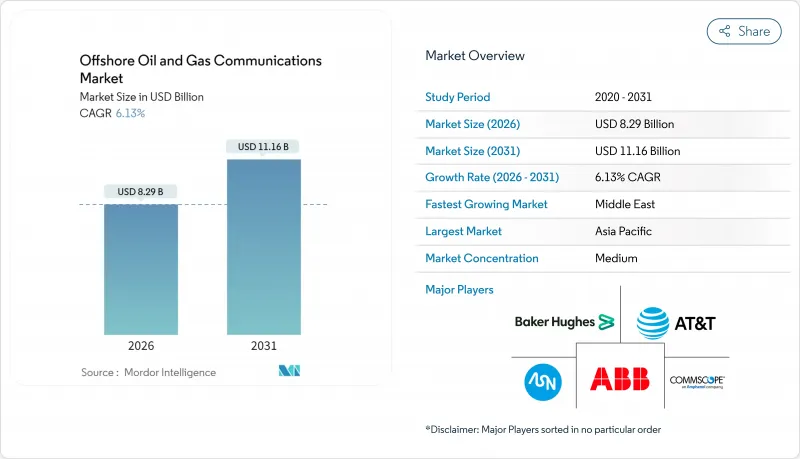
根據 Mordor Intelligence 預測,海上油氣通訊市場規模預計將在 2026 年達到 82.9 億美元,到 2031 年將擴大到 111.6 億美元,複合年成長率為 6.13%。
本報告依解決方案(例如,上游通訊系統)、通訊網路技術(例如,VSAT通訊網路、5G/專用LTE)、元件(例如,硬體、軟體、服務)、服務類型(例如,專業服務)、海上設備類型(例如,鑽井鑽機)和地區進行細分。市場預測以美元(USD)計價。
全球海上石油、天然氣和電信市場的趨勢和洞察。
鑽井鑽機即時監控的頻寬需求日益成長
目前,鑽井平台每天產生數Terabyte的數據,遠超過2Mbit/s VSAT線路的容量。在馬士基整合商號等資產上部署專用5G基地台,到2025年將實現50Mbps的上傳,從而可以在幾秒鐘內將4K視訊和水下遙測資料傳輸到陸上中心。即時可視性已將深水井的非生產時間減少了高達20%,並且透過在非尖峰時段時段將福利頻寬提高一倍,提高了船員的留任率。服務供應商現在正在提供分級頻寬套餐,優先處理營運流量,從而確保成本和利用率之間的良好平衡。
擴大深度超過2500公尺的深海工程項目
在超深水油田,控制海底防噴器(BOP)和動態定位系統需要低於50毫秒的延遲。巴西石油公司(Petrobras)的Mero FPSO專案採用可管理的光纖環路來確保低延遲,而殼牌公司的Whale平台在2025年增加了三重冗餘鏈路,以保障日產10萬桶的產能。因此,隨著深水油田的擴張,混合拓撲結構(衛星和光纖)以及與陸上高效能叢集同步的邊緣伺服器的訂單正在加速成長。
惡劣天氣條件下Ka波段電路的訊號劣化
雖然Ka波段的吞吐量比Ku波段高出十倍,但它在強風暴期間容易受到雨致衰減的影響,導致運轉率低於95%。在北海平台上, Ku波段的年停機時間歷來為120小時,而Ka波段波段僅30小時。目前,營運商正在部署站點分集閘道器和多軌道終端來維持網路連續性,但仍存在的風險阻礙了對延遲敏感的工作負載從Ku波段。
細分市場分析
到2025年,海上石油通訊市場的上游領域將佔市場規模的47.34%。這反映出大量資金正投入探勘和生產資產中,而即時數據能夠直接提高鑽井效率。目前,60%的新深海井都採用了智慧完井技術,該技術支援邊緣遙測,從而滿足了對高頻寬鏈路的持續需求。
目前規模較小的下游設備預計到2031年將以6.77%的複合年成長率成長,因為煉油廠將部署配備1萬個感測器的無線網路來監測排放氣體和洩漏,使其通訊負載接近上游設備。中游業者也正在部署光纖感測電纜來即時偵測管道入侵,將海上油氣通訊市場擴展到管線健康監測這一細分領域。
VSAT 可以在幾天內安裝 1.2 公尺拋物面天線,實現新鑽機的快速運作,即使到 2025 年,其收入仍保持 39.77% 的領先優勢。因此,這項技術為探勘油井的遠端推出計畫奠定了基礎,鞏固了其在海上石油通訊市場的主導地位。
然而,隨著5G和專用LTE網路以6.96%的複合年成長率快速擴張,其主導地位正在減弱。這主要得益於授權頻寬的分配,使得安全迴路和工業IoT能夠實現可預測的延遲。同時,在經濟條件允許的情況下,光纖仍然是頻寬的瓶頸。 Equinor公司120公里長的約翰·斯維爾德普海底光纜就是一個典型的例子,它完全取代了VSAT線路。
區域分析
亞太地區在2025年貢獻了28.82%的收入。這主要得益於馬來西亞國家石油公司(Petronas)、印度石油天然氣公司(ONGC)和中國海洋石油總公司(CNOOC)對其老舊的升降式鑽井船隊維修,採用光纖到鑽井平台(FTTR)鏈路和專用LTE網路連接到吉隆坡、孟買和深圳的遠端營運中心。在馬來西亞,政府大幅簡化了頻段核准流程,使得試點計畫能夠在六個月內從實驗室階段過渡到實際應用階段。北美地區繼續保持其作為技術示範基地的地位。雪佛龍公司位於墨西哥灣的Anchor平台將低地球軌道衛星與5G網狀網路相結合,透過蜂窩網路傳輸高優先級安全通訊,同時透過VSAT網路分發不太重要的資料。颶風抵禦能力仍然是主要驅動力,雙軌道天線的安裝工作正在穩步推進,以維持近99.9%的運轉率。
在歐洲,海底光纖網路維修的投資仍在持續。 Equinor公司位於約翰·斯維爾德魯普(Johann Sverdrup)油田的120公里海底光纜已於2024年底竣工,使該公司得以停用地球靜止軌道鏈路,並降低其年度頻寬成本60%。將於2024年生效的NIS2指令將進一步鼓勵營運商採用託管安全服務,以監控營運技術流量並偵測異常情況。中東是成長最快的區域市場,預計年複合成長率將達到7.11%。沙烏地阿美公司在2025年訂購了價值1.8億美元的15個天然氣平台專用5G契約,這表明該地區對依賴Gigabit級連續通訊線路的無人平台概念的需求日益成長。阿布達比國家石油公司(ADNOC)也在其Zakum和Khair專案中採取了類似措施,整合網路安全閘道以符合IEC 62443標準。
南美洲正受惠於巴西鹽層下油氣開發的蓬勃發展。巴西石油公司 (Petrobras) 與 Speedcast 簽訂了一份為期七年、價值 1.2 億美元的契約,涵蓋 12 艘浮式生產儲卸油船 (FPSO),這些 FPSO 將即時向陸上分析中心傳輸儲存數據,從而確保長期業務收益。圭亞那和蘇利南的小規模營運商正在使用 Starlink Maritime 的服務,以避免與固定 VSAT 合約相關的資本支出 (CAPEX)。非洲的情況則各不相同。由於沿海地區陸上光纖基地台稀缺,安哥拉的營運商仍依賴傳統的Ku波段VSAT,而奈及利亞的獨立營運商正在試用 Kymeta 平板指向平板天線,以減少甲板上的設備面積。關於海上頻段的法規仍未明確,這仍然是一個瓶頸,可能會導致奈及利亞和安哥拉的部署計劃延誤長達 12 個月。
其他好處:
- Excel格式的市場預測(ME)表
- 3個月的分析師支持
目錄
第1章:引言
- 研究假設和市場定義
- 調查範圍
第2章:調查方法
第3章執行摘要
第4章 市場狀況
- 市場概覽
- 市場促進因素
- 即時鑽井平台監控的頻寬需求不斷成長
- 擴大深度超過2500公尺的深海工程項目
- 在浮體式資產上部署支援 5G 的專用 LTE 網路
- 擴大邊緣人工智慧在預測性維護的應用
- 加強能源和工業領域的網路安全監管
- 鮮為人知的是:一個提供低延遲連結的衛星巨型衛星群
- 市場限制因素
- Ka波段線路上的訊號因惡劣天氣劣化
- 對海底光纖骨幹網路的大量資本投資
- 近海採礦區的頻寬分配有限。
- 一個未通報的問題:願意出國工作的射頻工程師短缺。
- 產業價值鏈分析
- 宏觀經濟因素對市場的影響
- 監理情勢
- 技術展望
- 波特五力分析
第5章 市場規模與成長預測
- 透過解決方案
- 上游通訊系統
- 中游通訊系統
- 下游通訊系統
- 透過通訊網路技術
- 行動電話通訊網路
- VSAT通訊網路
- 光纖通訊網路
- 微波通訊網路
- 5G/專用LTE
- 按組件
- 硬體
- 軟體
- 服務
- 按服務類型
- 託管服務
- 專業服務
- 維護和支援服務
- 整合服務
- 按海上設備類型分類
- 鑽井鑽機
- 浮體式生產儲貨運設施(FPSO)
- 固定生產平台
- 支援艦和補給艦
- 海底生產系統
- 按地區
- 北美洲
- 美國
- 加拿大
- 墨西哥
- 歐洲
- 德國
- 英國
- 法國
- 俄羅斯
- 其他歐洲國家
- 亞太地區
- 中國
- 日本
- 印度
- 韓國
- 澳洲
- 其他亞太國家
- 中東和非洲
- 中東
- 沙烏地阿拉伯
- 阿拉伯聯合大公國
- 其他中東國家
- 非洲
- 南非
- 埃及
- 其他非洲國家
- 中東
- 南美洲
- 巴西
- 阿根廷
- 其他南美國家
- 北美洲
第6章 競爭情勢
- 市場集中度
- 策略趨勢
- 市佔率分析
- 公司簡介
- ABB Ltd
- Alcatel-Lucent Submarine Networks
- AT&T Inc.
- Baker Hughes Co.
- CommScope Holding Co. Inc.
- Redline Communications Group Inc.
- Harris CapRock Communications Inc.
- Hughes Network Systems LLC
- Huawei Technologies Co. Ltd.
- Siemens AG
- Inmarsat Group Holdings Ltd.
- Speedcast International Ltd.
- Oceaneering International Inc.
- Subsea 7 SA
- NEC Corp.
- RigNet Inc.
- Kongsberg Gruppen ASA
- Fortinet Inc.
- Ericsson AB
- L3Harris Technologies Inc.
第7章 市場機會與未來展望
According to Mordor Intelligence, the offshore oil and gas communications market size reached USD 8.29 billion in 2026 and is projected to rise to USD 11.16 billion by 2031, reflecting a 6.13% CAGR.
This report is Segmented by Solution (Upstream Communication Systems, and More), Communication Network Technology (VSAT Communication Network, 5G/Private LTE, and More), Component (Hardware, Software, and Services), Service Type (Professional Services, and More), Offshore Installation Type (Drilling Rigs, and More), and Geography. The Market Forecasts are Provided in Terms of Value (USD).
Global Offshore Oil And Gas Communications Market Trends and Insights
Rising Bandwidth Needs for Real-Time Rig Monitoring
Drilling units now generate multi-terabyte datasets each day, far exceeding the capacity of 2 Mbit/s VSAT links. The adoption of private 5G cells on assets such as the Maersk Integrator delivered 50 Mbps uplinks in 2025, enabling 4K video and downhole telemetry to reach onshore centers in seconds. Real-time visibility reduced non-productive time on deepwater wells by up to 20% and improved crew retention by doubling welfare bandwidth during off-peak periods. Providers now bundle tiered bandwidth that prioritizes operational traffic, aligning cost with utilization.
Expansion of Deepwater Projects Beyond 2,500 m
Ultra-deep fields require sub-50-ms latency for subsea blowout preventer controls and dynamic positioning systems. Petrobras's Mero FPSO program relies on managed fiber rings that guarantee low latency, while Shell's Whale platform added triple-redundant links in 2025 to protect 100,000 barrels-per-day output. The scaling of deepwater acreage is therefore accelerating orders for hybrid satellite-fiber topologies and edge servers that synchronize with onshore high-performance clusters.
Harsh-Weather Signal Degradation on Ka-Band Links
Ka-band delivers ten-fold throughput improvements but experiences rain fade that drops uptime below 95% during severe storms. North Sea platforms historically logged 120 hours of Ka-band outages each year versus 30 hours on Ku-band. Operators now deploy site-diversity gateways and multi-orbit terminals to maintain continuity, yet residual risks deter fully latency-sensitive workloads from migrating off Ku-band.
Other drivers and restraints analyzed in the detailed report include:
- 5G-Enabled Private LTE Roll-Outs on Floating Assets
- Growing Use of Edge-Based AI for Predictive Maintenance
- High CAPEX of Subsea Fiber Backbones
For complete list of drivers and restraints, kindly check the Table Of Contents.
Segment Analysis
The upstream portion of the offshore oil and gas communications market accounted for 47.34% of the market size in 2025, reflecting heavy capital allocation to exploration and production assets, where real-time data directly improves drilling efficiency. Edge telemetry from intelligent well completions, now embedded in 60% of new deepwater wells, anchors demand for continuous high-bandwidth links.
Downstream installations, although smaller today, are forecast to grow at a 6.77% CAGR through 2031 as refineries add 10,000-sensor wireless networks for emissions and leak monitoring, creating communication loads approaching those of upstream installations. Midstream operators are also commissioning fiber-optic sensing cables that detect pipe intrusion events in real time, extending the offshore oil and gas communications market into pipeline integrity-monitoring niches.
VSAT maintained a 39.77% revenue lead in 2025 because a 1.2 m dish can be installed in a few days, enabling rapid commissioning of new rigs. The technology, therefore, anchors remote start-up schedules for wildcat wells, cementing its dominance in the offshore oil and gas communications market.
That grip is loosening as 5G and private LTE networks expand at a 6.96% CAGR, enabled by licensed-spectrum allocations that provide predictable latency for safety loops and industrial IoT. Meanwhile, fiber remains the bandwidth ceiling where economics allow, as exemplified by Equinor's 120 km Johan Sverdrup cable, which replaced VSAT links altogether.
Complete Report Scope:
- By Solution
- Upstream Communication Systems
- Midstream Communication Systems
- Downstream Communication Systems
- By Communication Network Technology
- Cellular Communication Network
- VSAT Communication Network
- Fiber Optic-based Communication Network
- Microwave Communication Network
- 5G/Private LTE
- By Component
- Hardware
- Software
- Services
- By Service Type
- Managed Services
- Professional Services
- Maintenance and Support Services
- Integration Services
- By Offshore Installation Type
- Drilling Rigs
- Floating Production Storage and Offloading (FPSO)
- Fixed Production Platforms
- Support Vessels and Supply Ships
- Subsea Production Systems
- By Geography
- North America
- United States
- Canada
- Mexico
- Europe
- Germany
- United Kingdom
- France
- Russia
- Rest of Europe
- Asia-Pacific
- China
- Japan
- India
- South Korea
- Australia
- Rest of Asia-Pacific
- Middle East and Africa
- Middle East
- Saudi Arabia
- United Arab Emirates
- Rest of Middle East
- Africa
- South Africa
- Egypt
- Rest of Africa
- Middle East
- South America
- Brazil
- Argentina
- Rest of South America
- North America
Geography Analysis
Asia-Pacific generated 28.82% of 2025 revenue, driven by Petronas, ONGC, and CNOOC, which are retrofitting aging jack-up fleets with fiber-to-the-rig links and private LTE that feed remote operations centers in Kuala Lumpur, Mumbai, and Shenzhen. Government spectrum approvals are generally streamlined in Malaysia, allowing trials to move from the lab to the field in under 6 months. North America retains its status as a technology testbed. Chevron's Anchor platform in the Gulf of Mexico combines low-Earth-orbit satellites with 5G meshing that routes high-priority safety traffic across cellular links while relegating non-critical data to VSAT circuits. Hurricane resilience remains a central driver, leading to dual-orbit antenna installations that keep uptime near 99.9%.
Europe continues to invest in subsea fiber retrofits. Equinor's 120 km cable to Johan Sverdrup, completed in late 2024, enabled the operator to decommission geostationary links and cut annual bandwidth costs by 60%. The NIS2 Directive, effective in 2024, further pushes operators to adopt managed security services that monitor operational technology traffic for anomalies. The Middle East is the fastest-growing regional market with a 7.11% CAGR outlook. Saudi Aramco's 2025 award of USD 180 million in private 5G contracts for 15 gas platforms signals regional appetite for unmanned platform concepts that rely on continuous gigabit-class links. ADNOC is following suit on the Zakum and Hail projects, embedding cybersecurity gateways to comply with IEC 62443.
South America rides on Brazil's pre-salt boom. Petrobras's seven-year, USD 120 million deal with Speedcast covers 12 FPSOs that stream real-time reservoir data to onshore analytics hubs, locking in long-duration service revenues. Smaller operators in Guyana and Suriname use Starlink Maritime to avoid the CAPEX of fixed VSAT contracts. Africa remains fragmented. Angolan operators still rely on traditional Ku-band VSAT because near-shore fiber landing stations are sparse, while Nigerian independents are testing flat-panel antennas from Kymeta to reduce deck footprint. Regulatory clarity on offshore spectrum remains a bottleneck that can add up to 12 months to deployment timelines in Nigeria and Angola.
- ABB Ltd
- Alcatel-Lucent Submarine Networks
- AT&T Inc.
- Baker Hughes Co.
- CommScope Holding Co. Inc.
- Redline Communications Group Inc.
- Harris CapRock Communications Inc.
- Hughes Network Systems LLC
- Huawei Technologies Co. Ltd.
- Siemens AG
- Inmarsat Group Holdings Ltd.
- Speedcast International Ltd.
- Oceaneering International Inc.
- Subsea 7 SA
- NEC Corp.
- RigNet Inc.
- Kongsberg Gruppen ASA
- Fortinet Inc.
- Ericsson AB
- L3Harris Technologies Inc.
Additional Benefits:
- The market estimate (ME) sheet in Excel format
- 3 months of analyst support
TABLE OF CONTENTS
1 INTRODUCTION
- 1.1 Study Assumptions and Market Definition
- 1.2 Scope of the Study
2 RESEARCH METHODOLOGY
3 EXECUTIVE SUMMARY
4 MARKET LANDSCAPE
- 4.1 Market Overview
- 4.2 Market Drivers
- 4.2.1 Rising Bandwidth Needs for Real-time Rig Monitoring
- 4.2.2 Expansion of Deep-water Projects Beyond 2,500 m
- 4.2.3 5G-Enabled Private LTE Roll-outs on Floating Assets
- 4.2.4 Growing Use of Edge-Based AI for Predictive Maintenance
- 4.2.5 Energy-Industry Cybersecurity Regulations Tightening
- 4.2.6 Under-reported: Satellite Mega-Constellations Providing Low-Latency Links
- 4.3 Market Restraints
- 4.3.1 Harsh-weather Signal Degradation on Ka-band Links
- 4.3.2 High CAPEX of Subsea Fiber Backbones
- 4.3.3 Limited Spectrum Allocation in Offshore Blocks
- 4.3.4 Under-reported: Shortage of RF Technicians Willing to Work Offshore
- 4.4 Industry Value Chain Analysis
- 4.5 Impact of Macroeconomic Factors on the Market
- 4.6 Regulatory Landscape
- 4.7 Technological Outlook
- 4.8 Porter's Five Forces Analysis
- 4.8.1 Threat of New Entrants
- 4.8.2 Bargaining Power of Buyers
- 4.8.3 Bargaining Power of Suppliers
- 4.8.4 Threat of Substitute Products
- 4.8.5 Intensity of Competitive Rivalry
5 MARKET SIZE AND GROWTH FORECASTS (VALUE)
- 5.1 By Solution
- 5.1.1 Upstream Communication Systems
- 5.1.2 Midstream Communication Systems
- 5.1.3 Downstream Communication Systems
- 5.2 By Communication Network Technology
- 5.2.1 Cellular Communication Network
- 5.2.2 VSAT Communication Network
- 5.2.3 Fiber Optic-based Communication Network
- 5.2.4 Microwave Communication Network
- 5.2.5 5G/Private LTE
- 5.3 By Component
- 5.3.1 Hardware
- 5.3.2 Software
- 5.3.3 Services
- 5.4 By Service Type
- 5.4.1 Managed Services
- 5.4.2 Professional Services
- 5.4.3 Maintenance and Support Services
- 5.4.4 Integration Services
- 5.5 By Offshore Installation Type
- 5.5.1 Drilling Rigs
- 5.5.2 Floating Production Storage and Offloading (FPSO)
- 5.5.3 Fixed Production Platforms
- 5.5.4 Support Vessels and Supply Ships
- 5.5.5 Subsea Production Systems
- 5.6 By Geography
- 5.6.1 North America
- 5.6.1.1 United States
- 5.6.1.2 Canada
- 5.6.1.3 Mexico
- 5.6.2 Europe
- 5.6.2.1 Germany
- 5.6.2.2 United Kingdom
- 5.6.2.3 France
- 5.6.2.4 Russia
- 5.6.2.5 Rest of Europe
- 5.6.3 Asia-Pacific
- 5.6.3.1 China
- 5.6.3.2 Japan
- 5.6.3.3 India
- 5.6.3.4 South Korea
- 5.6.3.5 Australia
- 5.6.3.6 Rest of Asia-Pacific
- 5.6.4 Middle East and Africa
- 5.6.4.1 Middle East
- 5.6.4.1.1 Saudi Arabia
- 5.6.4.1.2 United Arab Emirates
- 5.6.4.1.3 Rest of Middle East
- 5.6.4.2 Africa
- 5.6.4.2.1 South Africa
- 5.6.4.2.2 Egypt
- 5.6.4.2.3 Rest of Africa
- 5.6.4.1 Middle East
- 5.6.5 South America
- 5.6.5.1 Brazil
- 5.6.5.2 Argentina
- 5.6.5.3 Rest of South America
- 5.6.1 North America
6 COMPETITIVE LANDSCAPE
- 6.1 Market Concentration
- 6.2 Strategic Moves
- 6.3 Market Share Analysis
- 6.4 Company Profiles (includes Global Level Overview, Market Level Overview, Core Segments, Financials as Available, Strategic Information, Market Rank/Share for Key Companies, Products and Services, and Recent Developments)
- 6.4.1 ABB Ltd
- 6.4.2 Alcatel-Lucent Submarine Networks
- 6.4.3 AT&T Inc.
- 6.4.4 Baker Hughes Co.
- 6.4.5 CommScope Holding Co. Inc.
- 6.4.6 Redline Communications Group Inc.
- 6.4.7 Harris CapRock Communications Inc.
- 6.4.8 Hughes Network Systems LLC
- 6.4.9 Huawei Technologies Co. Ltd.
- 6.4.10 Siemens AG
- 6.4.11 Inmarsat Group Holdings Ltd.
- 6.4.12 Speedcast International Ltd.
- 6.4.13 Oceaneering International Inc.
- 6.4.14 Subsea 7 SA
- 6.4.15 NEC Corp.
- 6.4.16 RigNet Inc.
- 6.4.17 Kongsberg Gruppen ASA
- 6.4.18 Fortinet Inc.
- 6.4.19 Ericsson AB
- 6.4.20 L3Harris Technologies Inc.
7 MARKET OPPORTUNITIES AND FUTURE OUTLOOK
- 7.1 White-space and Unmet-Need Assessment

 歐洲海上能源:市場佔有率分析、產業趨勢與統計及成長預測(2026-2031 年)
 海上石油與天然氣市場規模、佔有率、成長、全球產業分析、區域趨勢及2026-2034年預測全球海上油氣焊接市場規模、佔有率、趨勢和成長分析報告(2026-2034年)
 海上油氣鑽井鑽機市場-全球產業規模、佔有率、趨勢、機會、預測:按類型、深度、地區和競爭格局分類,2021-2031年
 2026-2030年全球海上油氣通訊市場
 海上能源市場規模、佔有率和成長分析(按能源來源、應用、儲能系統、最終用戶、公司規模和地區分類)-2026-2033年產業預測
 船舶油氣塗料市場規模、佔有率及成長分析(依應用、樹脂類型、固化機制、功能、表面處理及地區分類)-2026-2033年產業預測
 海上石油通訊市場規模、佔有率和成長分析(按解決方案、網路技術和地區分類)—產業預測(2026-2033 年)
 海上模組:全球市場佔有率和排名、總銷售額和需求預測(2025-2031 年)