


 |
市場調查報告書
商品編碼
2122285
Wi-Fi增程器:市場佔有率分析、產業趨勢與統計及成長預測(2026-2031 年)Wi-Fi Range Extender - Market Share Analysis, Industry Trends & Statistics, Growth Forecasts (2026 - 2031) |
||||||

※ 本網頁內容可能與最新版本有所差異。詳細情況請與我們聯繫。
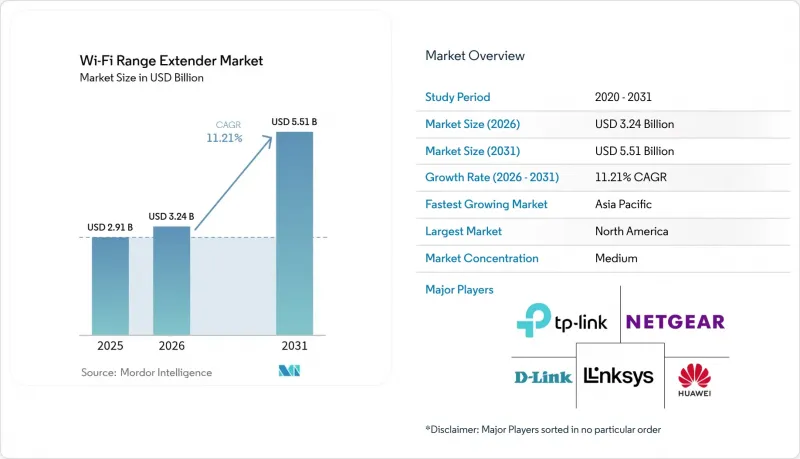
據 Mordor Intelligence 稱,2025 年 Wi-Fi增程器市值為 29.1 億美元,預計到 2031 年將從 2026 年的 32.4 億美元成長至 55.1 億美元,預測期(2026-2031 年)的複合年成長率為 11.21%。
本報告按類型(室內 Wi-Fi、室外 Wi-Fi)、產品(擴展器、中繼器、網路基地台、其他)、技術標準(Wi-Fi 5 (802.11ac)、Wi-Fi 6/6E (802.11ax)、其他)、最終用戶(住宅、中小企業、其他)、分銷、線上(電子商務下、D2C)。
全球Wi-Fi增程器市場趨勢與洞察
智慧家庭設備的爆炸性成長
隨著Wi-Fi設備年出貨量達到41億台,預計2024年部署量將增加至211億台,單一路由器已無法滿足需求。多層住宅、厚牆以及不斷擴展的物聯網生態系統,使得家庭用戶必須配備額外的擴展器,以確保自動化系統的穩定運作和安全防護。企業用戶也面臨類似的密集環境,需要廣泛的網路覆蓋來支援感測器驅動的建築管理系統。由於延遲的增加會降低使用者體驗,家庭和企業都在增加預算,用於擴展網路覆蓋範圍。
自備設備辦公室 (BYOD) / 混合辦公模式
英國連鎖飯店Mitchells & Butlers已在英國1700個地點安裝了8000個網路基地台。這清晰地表明,混合辦公模式和客戶期望正在擴大Wi-Fi覆蓋範圍。金融和醫療保健相關企業面臨安全行動存取的監管要求,並且在無法進行結構化佈線的改造和臨時空間中,對專業管理的擴展器和網路基地台的需求日益成長。
網狀Wi-Fi對現有產品的市佔率侵蝕
TP-Link 的新款 Wi-Fi 7 網狀網路套件正在「普及」無縫漫遊和即時管理功能,削弱單節點擴展器的價值提案。企業用戶傾向於使用網狀網路進行統一控制,而消費者廣告則強調其即插即用的優勢,這模糊了產品類別之間的界限,並加速了價格的下降。
細分市場分析
到2031年,戶外部署將以12.94%的複合年成長率成長,這主要得益於市政Wi-Fi和校園覆蓋計畫的推進。但到2025年,室內安裝仍將佔據Wi-Fi增程器市場規模的70.35%。體育場館和交通樞紐對配備定向天線的堅固型擴展器的需求日益成長,以應對人流密集區域。儘管室內市場仍然是主要的收入來源,但由於許多家庭已經擁有至少一個擴展器,其銷售成長正在趨於平緩。新興市場智慧家庭的普及持續推動市場發展,用戶在家中添加連網安防和娛樂設備,帶動了現有設備的改造需求激增。
在「WiFi4EU」框架下,市政項目以及法國和丹麥的城市安全網路正在採用耐候型Wi-Fi 6和Wi-Fi 7相容設備,這為供應商拓展了商機。這也提振了擁有環境防護技術專長的供應商。相較之下,室內設備的更換週期則依賴經濟高效的Wi-Fi 5或Wi-Fi 6升級,維持了對傳統晶片的需求。
到2025年,擴展器和中繼器仍將保持主導地位,佔53.25%的銷售額,但由於企業向基於控制器的架構轉型,網路基地台市場正以16.12%的複合年成長率快速成長。企業高度重視接入點設計內建的遠端韌體管理和基於角色的存取安全功能。同時,在消費通路,即插即用、可快速部署的中繼器更受青睞。
瑞士零售商 Conforama 採用了 Aruba 的 WLAN 解決方案來簡化全通路庫存盤點流程,這顯示集中式 AP 管理如何減少營運摩擦。同時,在租戶無法安裝乙太回程傳輸的公寓中,中距離中繼器仍然是首選。結合 AP 和網狀衛星的混合產品線使供應商能夠滿足這兩種需求,從而保持 Wi-Fi增程器市場的多樣性。
區域分析
北美地區在2025年仍將維持39.45%的市場佔有率,這主要得益於寬頻普及率高和智慧家庭的早期應用。儘管隨著市場飽和度的提高,成長速度有所放緩,但混合辦公模式和獨棟住宅的盛行支撐著設備更換週期。加拿大對農村地區的寬頻補貼以及墨西哥的數位包容津貼繼續推動銷售成長。美國監管機構的監管,例如對TP-Link的反壟斷調查,可能會重塑市場競爭動態,但鑑於無線連接的強大依賴性,不太可能削弱整體需求。
亞太地區是成長最快的地區,預計到2031年複合年成長率將達到13.32%。在中國,由於光纖幾乎已鋪設到每家每戶,人們對室內Wi-Fi的期望很高,但厚厚的混凝土牆等結構性障礙會阻礙無線電波的傳播,導致Wi-Fi擴展器的銷售增加。印度的「智慧城市計畫」和智慧型手機的快速普及正在推動市政主導的Wi-Fi項目,而日本和韓國則在工廠自動化和身臨其境型媒體領域主導著Wi-Fi 7的企業先導計畫。經濟發展階段的差異要求供應商同時提供入門級Wi-Fi 5和旗艦級Wi-Fi 7產品。
在歐洲,嚴格的監管與適度的市場成長並存。有關能源效率和網路安全的法規提高了合規成本,但也為現有營運商設定了有利的進入門檻。法國擁有全球最高的Wi-Fi 7部署密度,將其在光纖通訊速度的優勢轉化為差異化的使用者體驗。德國和英國則專注於為工業4.0和金融服務業打造安全的企業級無線區域網,從而形成穩定的更新周期。歐盟的補貼政策,例如WiFi4EU,繼續為農村和市政地區的部署提供保障,確保公共部門的持續需求。
其他好處
- Excel格式的市場預測(ME)表
- 3個月的分析師支持
目錄
第1章:引言
- 研究假設和市場定義
- 調查範圍
第2章:調查方法
第3章執行摘要
第4章 市場狀況
- 市場概覽
- 市場促進因素
- 智慧家庭設備的爆炸性成長
- 自備設備辦公室 (BYOD) / 混合辦公模式
- 影片串流品質競爭
- 需求由 Wi-Fi 7 升級週期驅動
- 戶外通訊需要實現「隨時隨地辦公」。
- 歐盟法規強制要求在建築物內提供Wi-Fi。
- 市場限制因素
- 網狀Wi-Fi對現有產品的市佔率侵蝕
- 網路安全和隱私問題
- 遵守能源效率標準的相關成本
- 對主要供應商的反壟斷審查
- 價值鏈分析
- 監理情勢
- 技術趨勢(Wi-Fi 6/6E/7、EasyMesh、MLO)
- 波特五力分析
第5章 市場規模與成長預測
- 按類型
- 室內無線網路
- 室外無線網路
- 依產品
- 擴展器/中繼器
- 網路基地台
- 電力線 Wi-Fi 整合單元
- 高增益天線
- 依技術標準
- Wi-Fi 5(802.11ac)
- Wi-Fi 6/6E(802.11ax)
- Wi-Fi 7(802.11be)
- 最終用戶
- 住宅
- 小型企業
- 大型企業和校園
- 公共/市政
- 透過分銷管道
- 線上(電子商務、D2C)
- 線下零售
- B2B企業整合商
- 按地區
- 北美洲
- 美國
- 加拿大
- 墨西哥
- 南美洲
- 巴西
- 阿根廷
- 歐洲
- 德國
- 英國
- 法國
- 義大利
- 西班牙
- 俄羅斯
- 亞太地區
- 中國
- 印度
- 日本
- 韓國
- ASEAN
- 其他亞太國家
- 中東
- 沙烏地阿拉伯
- 阿拉伯聯合大公國
- 土耳其
- 其他中東國家
- 非洲
- 南非
- 奈及利亞
- 其他非洲地區
- 北美洲
第6章 競爭情勢
- 市場集中度
- 策略趨勢
- 市佔率分析
- 公司簡介
- TP-Link Technologies Co. Ltd
- NETGEAR Inc.
- D-Link Corporation
- Linksys Group Inc.(Belkin)
- Huawei Technologies Co. Ltd
- Shenzhen Tenda Technology Co. Ltd
- AsusTek Computer Inc.
- Aruba Networks(HPE)
- Juniper Networks Inc.
- Ruckus Networks(CommScope)
- Motorola Solutions Inc.
- Ubiquiti Inc.
- Zyxel Communications Corp.
- Devolo GmbH
- Amped Wireless(Newo Corp.)
- Xiaomi Inc.
- Edimax Technology Co. Ltd
- Comfast(Shenzhen CF-Tech)
- Netis Systems Co. Ltd
- Belkin International
第7章 市場機會與未來展望
According to Mordor Intelligence, the wi-Fi range extender market size was valued at USD 2.91 billion in 2025 and estimated to grow from USD 3.24 billion in 2026 to reach USD 5.51 billion by 2031, at a CAGR of 11.21% during the forecast period (2026-2031).
This report is Segmented by Type (Indoor Wi-Fi and Outdoor Wi-Fi), Product (Extenders and Repeaters, Access Points, and More), Technology Standard (Wi-Fi 5 [802. 11ac], Wi-Fi 6 / 6E [802. 11ax], and More), End User (Residential, Small and Medium Enterprises, and More), Sales Channel (Online [e-Commerce, D2C], Offline Retail, and More), and Geography.
Global Wi-Fi Range Extender Market Trends and Insights
Smart-home Device Explosion
Annual shipments of 4.1 billion Wi-Fi devices in 2024 pushed the installed base to 21.1 billion and overloaded single-router footprints. Multi-story homes, thick walls and growing IoT ecosystems force households to add extenders for consistent automation and security performance. Corporate facilities mirror this density, requiring blanket coverage for sensor-driven building-management systems. As user experience degrades when latency spikes, both homeowners and enterprises allocate incremental budgets to coverage extension solutions.
BYOD and Hybrid Work Models
Hospitality chain Mitchells & Butlers installed 8,000 access points across 1,700 UK venues, underscoring how hybrid labor and guest expectations broaden Wi-Fi footprints. Finance and healthcare firms face regulatory imperatives for secure mobile access, driving demand for professionally managed extenders and access points in re-purposed or temporary spaces that lack structured cabling.
Mesh-Wi-Fi Cannibalisation
TP-Link's new Wi-Fi 7 mesh kits "democratize" seamless roaming and real-time management, eroding the value proposition of single-node extenders.Enterprises favor mesh for unified control while mass-market advertising stresses plug-and-play benefits, accelerating category blurring and price compression.
Other drivers and restraints analyzed in the detailed report include:
- Video-streaming Quality Race
- Wi-Fi 7 Upgrade Cycle Pull-through
- Cyber-security and Privacy Fears
For complete list of drivers and restraints, kindly check the Table Of Contents.
Segment Analysis
Outdoor deployments are growing at a 12.94% CAGR through 2031, reflecting municipal Wi-Fi and campus-wide coverage projects, yet indoor installs still account for 70.35% of the Wi-Fi range extender market size in 2025. Stadiums and transport hubs increasingly demand ruggedized extenders with directional antennas to manage dense crowds. The indoor segment's scale continues to anchor revenue, but volume growth is plateauing as many homes already own at least one extender. Smart-home adoption in emerging markets provides residual tailwinds, and retrofit demand spikes when families add connected security or entertainment gadgets.
Municipal projects under the WiFi4EU banner and city safety networks across France and Denmark favor weather-sealed Wi-Fi 6 and Wi-Fi 7 units, broadening supplier opportunities. Vendors with environmental-hardening expertise therefore gain traction. In contrast, indoor refresh cycles hinge on cost-effective Wi-Fi 5 or Wi-Fi 6 upgrades, sustaining legacy chip demand.
Extenders and repeaters retained 53.25% revenue leadership in 2025, yet enterprise migrations toward controller-based architectures are pushing access points at a 16.12% CAGR. Businesses appreciate remote firmware orchestration and role-based access security embedded in AP-centric designs. Consumer channels, however, favor plug-and-play repeaters for quick fixes.
Retailer Conforama Switzerland adopted Aruba WLAN solutions to streamline omnichannel inventory checks, illustrating how centralized AP management reduces operational friction. Conversely, mid-priced repeaters remain preferred in apartments where tenants cannot install Ethernet backhaul. Hybrid portfolios that couple APs with mesh satellites help vendors address both camps, keeping the Wi-Fi range extender market diversified.
Complete Report Scope:
- By Type
- Indoor Wi-Fi
- Outdoor Wi-Fi
- By Product
- Extenders and Repeaters
- Access Points
- Powerline/Wi-Fi Combo Units
- High-gain Antennas
- By Technology Standard
- Wi-Fi 5 (802.11ac)
- Wi-Fi 6 / 6E (802.11ax)
- Wi-Fi 7 (802.11be)
- By End User
- Residential
- Small and Medium Enterprises
- Large Enterprises and Campuses
- Public and Municipal
- By Sales Channel
- Online (e-commerce, D2C)
- Offline Retail
- B2B/Enterprise Integrators
- By Geography
- North America
- United States
- Canada
- Mexico
- South America
- Brazil
- Argentina
- Europe
- Germany
- United Kingdom
- France
- Italy
- Spain
- Russia
- Asia Pacific
- China
- India
- Japan
- South Korea
- ASEAN
- Rest of Asia Pacific
- Middle East
- Saudi Arabia
- United Arab Emirates
- Turkey
- Rest of Middle East
- Africa
- South Africa
- Nigeria
- Rest of Africa
- North America
Geography Analysis
North America retained 39.45% revenue share in 2025, building on mature broadband penetration and early smart-home uptake. Growth is moderating as saturation sets in, yet hybrid-work adoption and extensive single-family housing sustain replacement cycles. Canada's rural broadband subsidies and Mexico's digital-inclusion grants continue to lift volume. U.S. regulatory scrutiny, exemplified by the TP-Link antitrust probe, may re-shape competitive dynamics but is unlikely to dent overall demand given ingrained dependence on wireless connectivity.
Asia Pacific is the fastest-growing region with a 13.32% CAGR through 2031. China's near-universal fiber-to-the-home creates high expectations for in-unit Wi-Fi, yet structural barriers such as thick concrete walls constrain signal propagation, boosting extender sales. India's Smart Cities Mission and rapid smartphone adoption propel municipal Wi-Fi projects, while Japan and South Korea spearhead Wi-Fi 7 enterprise pilots focused on factory automation and immersive media. The diversity of economic stages requires suppliers to offer both entry-level Wi-Fi 5 and flagship Wi-Fi 7 skus.
Europe blends advanced regulation with moderate volume growth. Energy-efficiency and cybersecurity rules raise compliance costs but erect entry barriers that benefit incumbents. France posts the world's highest Wi-Fi 7 deployment density, translating fiber speed leadership into user-experience differentiation. Germany and the UK emphasize secure enterprise WLANs for Industry 4.0 and financial services, generating steady refresh cycles. EU subsidies such as WiFi4EU remain a cornerstone of rural and municipal roll-outs, ensuring durable public-sector demand.
- TP-Link Technologies Co. Ltd
- NETGEAR Inc.
- D-Link Corporation
- Linksys Group Inc. (Belkin)
- Huawei Technologies Co. Ltd
- Shenzhen Tenda Technology Co. Ltd
- AsusTek Computer Inc.
- Aruba Networks (HPE)
- Juniper Networks Inc.
- Ruckus Networks (CommScope)
- Motorola Solutions Inc.
- Ubiquiti Inc.
- Zyxel Communications Corp.
- Devolo GmbH
- Amped Wireless (Newo Corp.)
- Xiaomi Inc.
- Edimax Technology Co. Ltd
- Comfast (Shenzhen CF-Tech)
- Netis Systems Co. Ltd
- Belkin International
Additional Benefits:
- The market estimate (ME) sheet in Excel format
- 3 months of analyst support
TABLE OF CONTENTS
1 INTRODUCTION
- 1.1 Study Assumptions and Market Definition
- 1.2 Scope of the Study
2 RESEARCH METHODOLOGY
3 EXECUTIVE SUMMARY
4 MARKET LANDSCAPE
- 4.1 Market Overview
- 4.2 Market Drivers
- 4.2.1 Smart-home device explosion
- 4.2.2 BYOD and hybrid work models
- 4.2.3 Video-streaming quality race
- 4.2.4 Wi-Fi 7 upgrade cycle pull-through
- 4.2.5 "Work-from-anywhere" outdoor coverage needs
- 4.2.6 Mandatory in-building Wi-Fi coverage codes (EU)
- 4.3 Market Restraints
- 4.3.1 Mesh-Wi-Fi cannibalisation
- 4.3.2 Cyber-security and privacy fears
- 4.3.3 Energy-efficiency compliance costs
- 4.3.4 Antitrust scrutiny on leading vendors
- 4.4 Value Chain Analysis
- 4.5 Regulatory Landscape
- 4.6 Technological Outlook (Wi-Fi 6/6E/7, EasyMesh, MLO)
- 4.7 Porter's Five Forces Analysis
- 4.7.1 Threat of New Entrants
- 4.7.2 Bargaining Power of Buyers
- 4.7.3 Bargaining Power of Suppliers
- 4.7.4 Threat of Substitutes
- 4.7.5 Intensity of Competitive Rivalry
5 MARKET SIZE AND GROWTH FORECASTS (VALUE)
- 5.1 By Type
- 5.1.1 Indoor Wi-Fi
- 5.1.2 Outdoor Wi-Fi
- 5.2 By Product
- 5.2.1 Extenders and Repeaters
- 5.2.2 Access Points
- 5.2.3 Powerline/Wi-Fi Combo Units
- 5.2.4 High-gain Antennas
- 5.3 By Technology Standard
- 5.3.1 Wi-Fi 5 (802.11ac)
- 5.3.2 Wi-Fi 6 / 6E (802.11ax)
- 5.3.3 Wi-Fi 7 (802.11be)
- 5.4 By End User
- 5.4.1 Residential
- 5.4.2 Small and Medium Enterprises
- 5.4.3 Large Enterprises and Campuses
- 5.4.4 Public and Municipal
- 5.5 By Sales Channel
- 5.5.1 Online (e-commerce, D2C)
- 5.5.2 Offline Retail
- 5.5.3 B2B/Enterprise Integrators
- 5.6 By Geography
- 5.6.1 North America
- 5.6.1.1 United States
- 5.6.1.2 Canada
- 5.6.1.3 Mexico
- 5.6.2 South America
- 5.6.2.1 Brazil
- 5.6.2.2 Argentina
- 5.6.3 Europe
- 5.6.3.1 Germany
- 5.6.3.2 United Kingdom
- 5.6.3.3 France
- 5.6.3.4 Italy
- 5.6.3.5 Spain
- 5.6.3.6 Russia
- 5.6.4 Asia Pacific
- 5.6.4.1 China
- 5.6.4.2 India
- 5.6.4.3 Japan
- 5.6.4.4 South Korea
- 5.6.4.5 ASEAN
- 5.6.4.6 Rest of Asia Pacific
- 5.6.5 Middle East
- 5.6.5.1 Saudi Arabia
- 5.6.5.2 United Arab Emirates
- 5.6.5.3 Turkey
- 5.6.5.4 Rest of Middle East
- 5.6.6 Africa
- 5.6.6.1 South Africa
- 5.6.6.2 Nigeria
- 5.6.6.3 Rest of Africa
- 5.6.1 North America
6 COMPETITIVE LANDSCAPE
- 6.1 Market Concentration
- 6.2 Strategic Moves
- 6.3 Market Share Analysis
- 6.4 Company Profiles (includes Global level Overview, Market level overview, Core Segments, Financials as available, Strategic Information, Market Rank/Share for key companies, Products and Services, and Recent Developments)
- 6.4.1 TP-Link Technologies Co. Ltd
- 6.4.2 NETGEAR Inc.
- 6.4.3 D-Link Corporation
- 6.4.4 Linksys Group Inc. (Belkin)
- 6.4.5 Huawei Technologies Co. Ltd
- 6.4.6 Shenzhen Tenda Technology Co. Ltd
- 6.4.7 AsusTek Computer Inc.
- 6.4.8 Aruba Networks (HPE)
- 6.4.9 Juniper Networks Inc.
- 6.4.10 Ruckus Networks (CommScope)
- 6.4.11 Motorola Solutions Inc.
- 6.4.12 Ubiquiti Inc.
- 6.4.13 Zyxel Communications Corp.
- 6.4.14 Devolo GmbH
- 6.4.15 Amped Wireless (Newo Corp.)
- 6.4.16 Xiaomi Inc.
- 6.4.17 Edimax Technology Co. Ltd
- 6.4.18 Comfast (Shenzhen CF-Tech)
- 6.4.19 Netis Systems Co. Ltd
- 6.4.20 Belkin International
7 MARKET OPPORTUNITIES AND FUTURE OUTLOOK
- 7.1 White-space and Unmet-need Assessment

 EasyMesh認證閘道器市場規模、佔有率和成長分析:按閘道器類型、連接方式、應用、最終用戶和地區分類-2026-2033年產業預測
 Wi-Fi增程器市場-2026-2032 年全球市場預測
 全球Wi-Fi增程器市場規模、佔有率、趨勢及成長分析報告(2026-2034年)
 Wi-Fi增程器市場規模、佔有率和趨勢分析報告:按類型、產品類型、技術、銷售管道、最終用途、地區和細分市場預測(2026-2033 年)
 2026年全球EasyMesh認證閘道器市場報告
 Wi-Fi 訊號擴展器市場 - 全球產業規模、佔有率、趨勢、機會、預測:按類型、技術、應用、地區和競爭格局分類,2021-2031 年Wi-Fi訊號增強器市場-全球產業規模、佔有率、趨勢、機會和預測,按類型(室內、室外)、服務(支援、維護)、解決方案(住宅、企業)、地區和競爭格局分類,2020-2030年預測
 全球Wi-Fi增強器市場
 Wi-Fi 擴展器市場機會、成長動力、產業趨勢分析與 2025 - 2034 年預測
 全球 Wi-Fi 擴展器市場 (2024-2028)