


 |
市場調查報告書
商品編碼
2122284
能源產業的預測性維護:市場佔有率分析、產業趨勢和統計數據以及成長預測(2026-2031 年)Predictive Maintenance In The Energy - Market Share Analysis, Industry Trends & Statistics, Growth Forecasts (2026 - 2031) |
||||||

※ 本網頁內容可能與最新版本有所差異。詳細情況請與我們聯繫。
根據 Mordor Intelligence 預測,能源市場預測性維護的市場規模預計將從 2025 年的 22.5 億美元成長到 2026 年的 28.1 億美元,並將從 2026 年到 2031 年以 25.05% 的複合年成長,到 2031 億美元達到 86.1 億美元。
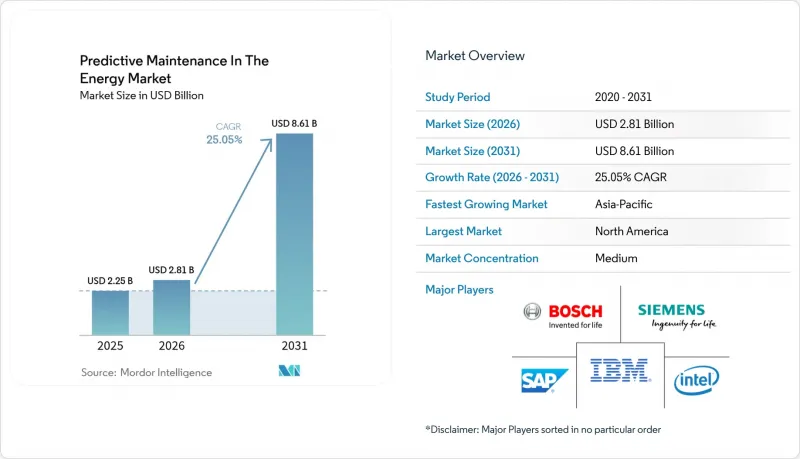
本報告按產品/服務(解決方案和服務)、部署模式(雲端、本地部署)、終端用戶產業(發電、可再生能源、石油天然氣及其他)、資產類型(渦輪機和旋轉設備、變壓器和變電站及其他)以及地區進行細分。市場預測以美元計價。
全球能源市場預測性維護的趨勢與見解
工業物聯網、人工智慧和巨量資料分析的融合
低成本感測器與人工智慧模式識別演算法的融合,正將渦輪機機組和壓縮機站的維護方式從被動式轉變為主動式。西門子的Senseye平台能夠自動產生數位行為模型,在解決嚴重的勞動力短缺問題的同時,將維護成本降低高達40%。雪佛龍的即時異常偵測洩漏預防技術,保障了高耗能資料中心叢集的持續供電。邊緣節點在本地處理海量的振動和溫度數據,然後傳輸匯總的分析結果傳輸到雲端,進行全系統模式挖掘,從而構建一個近乎自動化的生態系統,無需人工干預即可安排維護工作。這些進步使預測性維護在能源市場中成為資產密集型公共產業數位轉型藍圖的核心。
降低意外停機時間的成本壓力
由於電力中斷處罰力度加大,以及人工智慧工作負載帶來的電力需求激增,停機時間已成為經營團隊必須承擔的風險,預測性維護也從一項可有可無的支出轉變為一項關鍵的營運要求。 NextEra Energy 的燃氣渦輪機專案已將停電次數減少了 23%,每年節省成本 2,500 萬美元。這充分證明了預測性維護在能源市場中具有顯著的投資報酬率。領先的油氣公司透過最佳化檢查週期,將資產壽命延長了 20% 至 40%,從而在長達數十年的設備生命週期中不斷提升價值。而落後的公司則面臨著客戶體驗下降和能源供應成本上升的雙重困境,因為競爭對手能夠以更少的備件庫存維持較高的資產運轉率。
實施和整合的初始成本較高
對於大型公共產業而言,全面維修感測器、部署邊緣閘道器和實施雲端協作等項目,其預算往往高達數千萬美元,這給開發中國家的營運商帶來了融資障礙。 GE Vernova 在美國耗資約 6 億美元的工廠維修項目,清楚地展現了在資產集群層面釋放預測價值所需的現代化規模。銅和稀土元素價格的上漲,預計將推動硬體支出在 2024 年以後成長高達 25%。領先採用者可在兩年內收回投資,隨著供應商部署與效能保證掛鉤的訂閱模式,財務障礙也逐漸降低。這進一步凸顯了能源市場對預測性維護的長期競爭態勢。
細分市場分析
到2025年,解決方案將佔能源產業預測性維護市場64.72%的佔有率,這反映出營運商傾向於選擇整合分析、視覺化和工作流程自動化的統一平台。雖然能夠每天處理TB級Terabyte和變壓器數據的軟體套件仍然是核心,但具備設備端推理能力的嵌入式感測器正在增強邊緣智慧,減少不必要的數據溢出,並加速洞察提取。服務業雖然絕對收入規模較小,但以25.3%的複合年成長率快速成長,因為公共產業和獨立發電企業依賴供應商進行整合、變更管理和全天候監控。
服務供應商正受益於資料科學和旋轉機械物理學領域日益嚴重的人才短缺。隨著營運商將傳統歷史資料庫遷移到雲端資料湖而不中斷運作,整合和實施的價值尤為突出。託管服務通常以基本契約構建,可確保可用性指標,從而使供應商的獎勵與資產性能保持一致。隨著客戶將結果置於工具包之上,能源產業的預測性維護正穩步轉型為以服務為導向的市場,在這個市場中,卓越營運比功能清單更為重要。
預計到2025年,能源市場預測性維護領域採用雲端運算的市場佔有率將達到72.05%,並且隨著演算法複雜性和資料量超過本地運算能力,這一趨勢預計將會加劇。目前,單一離岸風力發電每天會產生數十Terabyte的SCADA和LiDAR資料。雲端原生架構憑藉即時可擴展性和持續重新訓練模型的能力,正逐漸獲得優勢。邊緣雲端混合配置可降低負載削減和葉片槳距調整的延遲,在本地保持關鍵任務控制迴路的運行,同時集中執行大規模分析處理。
在對網路主權和延遲要求極為嚴格的偏遠盆地和核能發電廠,本地部署系統仍然在使用,但大多數供應商在捆綁雲端連接器時都考慮到了未來的遷移需求。霍尼韋爾與Verizon合作開發的5G智慧電錶部署就是這項轉變的例證。安全的蜂窩回程傳輸可在不到一秒的時間內將遙測數據聚合到人工智慧引擎中,從而提前數天預測變壓器熱點。這些用例凸顯了能源市場預測性維護與更廣泛的電網數位化舉措密切相關的原因,而這些計畫依賴於無所不在的低延遲連接。
區域分析
北美地區保持主導地位,在聯邦基礎設施發展計畫、電力公司積極投資以及人工智慧平台早期應用的支持下,預計2025年將佔全球收入的27.55%。美國能源資訊署(EIA)預測,到2030年,國內電力需求將成長15%至20%,部分原因是超大規模資料中心的影響,這將進一步提高人們對預防停電的重視程度。雲端原生法規環境和充裕的創業投資資金正在加速新技術試點部署,鞏固該地區在能源市場預測性維護的領先地位。
在歐洲,在「綠色交易」的脫碳目標和嚴格的停電處罰制度的推動下,電力可靠性指標持續提升,發展勢頭良好。 「企業永續性報告指令(CSRD)」要求電力公司揭露即時排放和能源效率關鍵績效指標(KPI),而預測性維護資料集與此具有強烈的綜效。大規模車輛營運商正在將數位孿生技術和基於衛星的植被監測相結合,以實現合規性和韌性的雙重目標。
亞太地區是成長最快的地區,複合年成長率高達25.95%,這主要得益於中國政府的數位電網計畫和東南亞的快速電氣化。中國南方電網的端到端數位轉型展現了「突破性技術」的巨大潛力,這些技術能夠繞過舊有系統的瓶頸,並將預測性工作流程直接整合到新的基礎設施中。同時,印度和印尼正大力投資升級其電網,從而催生了對雲端分析服務的新需求。中東和非洲雖然規模較小,但隨著「2030願景」及類似舉措下的大型企劃需要在嚴酷的沙漠環境中實現完美的運作,預測性維護在能源市場的應用範圍也日益擴大,因此也越來越受到關注。
其他好處
- Excel格式的市場預測(ME)表
- 3個月的分析師支持
目錄
第1章:引言
- 研究假設和市場定義
- 調查範圍
第2章:調查方法
第3章執行摘要
第4章 市場狀況
- 市場概覽
- 市場促進因素
- 關注老舊能源基礎設施和電網的可靠性(主流)
- 工業物聯網、人工智慧和巨量資料分析的融合(主流)
- 降低意外停機時間的成本壓力(主流)
- 安全和排放氣體法規(主流)
- 無人機與衛星在遙感探測的融合
- 利用數位孿生進行基於風險的維護
- 市場限制因素
- 實施和整合(主流)的初始成本較高
- 網路安全漏洞日益增多(主流觀點)
- 能源領域資料科學人才短缺
- 多方資產中資料所有權和責任的爭議
- 供應鏈分析
- 監理情勢
- 技術展望
- 波特五力模型
- 市場宏觀經濟因素的評估
第5章 市場規模及成長預測(價值,2024-2030 年)
- 透過提供
- 解決方案
- 軟體平台
- 嵌入式硬體感測器
- 服務
- 整合與實施
- 託管服務
- 解決方案
- 按部署模式
- 雲
- 現場
- 按最終用戶行業分類
- 發電(火力發電、核能、水力)
- 可再生能源(風能、太陽能、儲能)
- 石油和天然氣(上游、中游、下游)
- 公共產業/輸配電
- 採礦和礦產
- 依資產類型
- 渦輪機和旋轉機械
- 變壓器和變電站
- 管道壓縮機
- 泵浦和閥門
- 按地區
- 北美洲
- 美國
- 加拿大
- 墨西哥
- 南美洲
- 巴西
- 阿根廷
- 其他南美國家
- 歐洲
- 德國
- 英國
- 法國
- 荷蘭
- 其他歐洲國家
- 亞太地區
- 中國
- 日本
- 印度
- 韓國
- 澳洲和紐西蘭
- 其他亞太國家
- 中東和非洲
- 中東
- 阿拉伯聯合大公國
- 沙烏地阿拉伯
- 土耳其
- 其他中東國家
- 非洲
- 南非
- 奈及利亞
- 其他非洲地區
- 中東
- 北美洲
第6章 競爭情勢
- 市場集中度
- 策略趨勢
- 市佔率分析
- 公司簡介
- IBM Corporation
- SAP SE
- Siemens AG
- GE Digital
- ABB Ltd
- Schneider Electric SE
- Intel Corporation
- Robert Bosch GmbH
- Accenture plc
- Honeywell International Inc.
- Hitachi Energy Ltd.
- Emerson Electric Co.
- Aspen Technology, Inc.
- AVEVA Group plc
- Uptake Technologies Inc.
- SparkCognition, Inc.
- Senseye Ltd.
- SKF Group
- Bentley Systems, Inc.
- Mitsubishi Electric Corporation
- Caterpillar Inc.(Asset Intelligence)
- DNV AS
- KONUX GmbH
第7章 市場機會與未來展望
According to Mordor Intelligence, the predictive maintenance in the energy market size is expected to grow from USD 2.25 billion in 2025 to USD 2.81 billion in 2026 and is forecast to reach USD 8.61 billion by 2031 at 25.05% CAGR over 2026-2031.
This report is Segmented by Offering (Solutions and Services), Deployment Model (Cloud, On-Premise), End-User Industry (Power Generation, Renewables, Oil and Gas, and More), Asset Type (Turbines and Rotating Equipment, Transformers and Sub-Stations, and More), and Geography. The Market Forecasts are Provided in Terms of Value (USD)
Global Predictive Maintenance In The Energy Market Trends and Insights
Integration of IIoT, AI and Big-Data Analytics
The fusion of low-cost sensors with AI pattern-recognition algorithms is recasting maintenance from reactive to prescriptive modes across turbine decks and compressor stations.Siemens' Senseye platform now generates digital behavior models automatically, slicing maintenance spend by up to 40% while addressing acute workforce shortages. Chevron's real-time anomaly detection for leak prevention safeguards continuous power delivery to energy-intensive data-center clusters. Edge nodes process torrents of vibration and temperature data locally before forwarding condensed insights to the cloud for fleet-wide pattern mining, creating near-autonomous ecosystems that schedule interventions without human prompts. These developments place predictive maintenance in the energy market squarely at the center of digital-transformation roadmaps for asset-heavy utilities.
Cost Pressure to Cut Unplanned Downtime
Escalating outage penalties and demand spikes from AI workloads are making downtime a board-level risk, moving predictive maintenance from a discretionary line item to an operational imperative. NextEra Energy's gas-turbine program delivered a 23% outage reduction and USD 25 million in annual savings, validating the hard ROI underpinning the predictive maintenance in the energy market. Large oil-and-gas operators have documented 20-40% asset-life extension through optimized service intervals, compounding value over decades-long equipment cycles. Firms that lag on adoption face customer-experience erosion and higher delivered-energy costs as competitors sustain higher asset availability with leaner spares inventories.
High Upfront Implementation and Integration Cost
Comprehensive sensor retrofits, edge gateways, and cloud orchestration commonly push project budgets into eight figures for large utilities, deterring cash-constrained operators in developing economies. GE Vernova's nearly USD 600 million U.S. factory upgrades illustrate the scale of modernization needed to unlock predictive value at fleet level. Rising copper and rare-earth prices have inflated hardware outlays by up to 25% since 2024. Nonetheless, leading adopters recuperate capital within two years, and financial barriers are softening as vendors roll out subscription models linked to performance guarantees, reiterating the long-term competitiveness of the predictive maintenance in the energy market.
Other drivers and restraints analyzed in the detailed report include:
- Aging Energy Infrastructure and Grid Reliability Focus
- Regulatory Mandates on Safety / Emissions
- Rising Cyber-Security Vulnerabilities
For complete list of drivers and restraints, kindly check the Table Of Contents.
Segment Analysis
Solutions controlled 64.72% of the predictive maintenance in the energy market in 2025, reflecting operators' preference for unified platforms that amalgamate analytics, visualization, and workflow automation. Software suites capable of ingesting terabytes of turbine and transformer data per day remain central, while embedded sensors equipped with on-device inference augment edge intelligence, reducing unnecessary data egress and accelerating insights. Services, although smaller in absolute revenue, sprint ahead at 25.3% CAGR as utilities and independent power producers rely on vendors for integration, change management, and 24X7 monitoring.
Service providers benefit from widening talent gaps in data science and rotating-machinery physics. Integration and implementation are especially valued when operators migrate legacy historian databases into cloud data lakes without production interruptions. Managed services, often structured as outcome-based contracts, guarantee availability metrics that align vendor incentives with asset performance. As clients prioritize outcomes over toolkits, the predictive maintenance in the energy industry is steadily morphing into a service-oriented market where operational excellence overrides feature checklists.
Cloud deployments represented 72.05% share of the predictive maintenance in the energy market in 2025, a position expected to strengthen as algorithm complexity and data volumes outstrip on-premise compute capacity. A single offshore wind farm now generates tens of terabytes of SCADA and lidar data daily; instant scalability and continuous model retraining favor cloud-native architectures. Edge-cloud hybrids mitigate latency for load-shedding or blade-pitch adjustments, keeping mission-critical loops local while bulk analytics run centrally.
On-premise systems persist in remote basins and nuclear sites with stringent sovereignty or latency requirements, yet most vendors bundle cloud connectors for future migration. Honeywell's 5G-enabled smart-meter roll-out with Verizon exemplifies the shift: secure cellular backhaul funnels sub-second telemetry into an AI engine that forecasts transformer hot-spots days in advance. Such use cases underscore why the predictive maintenance in the energy market is entwined with broader grid-digitalization initiatives premised on ubiquitous, low-latency connectivity.
Complete Report Scope:
- By Offering
- Solutions
- Software Platforms
- Embedded Hardware and Sensors
- Services
- Integration and Implementation
- Managed Services
- Solutions
- By Deployment Model
- Cloud
- On-premise
- By End-user Industry
- Power Generation (Thermal, Nuclear, Hydro)
- Renewables (Wind, Solar, Storage)
- Oil and Gas (Upstream, Mid, Downstream)
- Utilities and TandD
- Mining and Minerals
- By Asset Type
- Turbines and Rotating Equipment
- Transformers and Sub-stations
- Pipelines and Compressors
- Pumps and Valves
- By Geography
- North America
- United States
- Canada
- Mexico
- South America
- Brazil
- Argentina
- Rest of South America
- Europe
- Germany
- United Kingdom
- France
- Netherlands
- Rest of Europe
- Asia-Pacific
- China
- Japan
- India
- South Korea
- Australia and New Zealand
- Rest of Asia-Pacific
- Middle East and Africa
- Middle East
- United Arab Emirates
- Saudi Arabia
- Turkey
- Rest of Middle East
- Africa
- South Africa
- Nigeria
- Rest of Africa
- Middle East
- North America
Geography Analysis
North America retained leadership with 27.55% of 2025 revenue, supported by federal infrastructure programs, aggressive utility spending, and early adoption of AI platforms. The Energy Information Administration projects domestic electricity demand to rise 15-20% by 2030, partly due to hyperscale data centers, intensifying the focus on outage prevention. Cloud-native regulatory environments and ample venture financing further accelerate new-tech pilots, anchoring regional dominance in the predictive maintenance in the energy market.
Europe maintains steady momentum driven by the Green Deal's decarbonization targets and strict outage-penalty regimes that elevate reliability metrics. The Corporate Sustainability Reporting Directive obliges utilities to disclose real-time emissions and energy-efficiency KPIs, for which predictive-maintenance datasets are highly synergistic. Large fleet operators are combining digital twins with satellite-based vegetation monitoring to meet both compliance and resilience goals.
Asia-Pacific is the fastest-growing territory at 25.95% CAGR, buoyed by China's state-backed digital-grid blueprint and Southeast Asia's rapid electrification. China Southern Power Grid's end-to-end digital transformation shows how leapfrog technology can embed predictive workflows directly into new infrastructure, bypassing legacy bottlenecks. Concurrently, India and Indonesia invest heavily in transmission upgrades, creating greenfield demand for cloud-delivered analytics. The Middle East and Africa, though smaller, show rising interest as mega-projects under Vision 2030 and similar initiatives demand flawless uptime under harsh desert conditions, expanding the predictive maintenance in the energy market footprint.
- IBM Corporation
- SAP SE
- Siemens AG
- GE Digital
- ABB Ltd
- Schneider Electric SE
- Intel Corporation
- Robert Bosch GmbH
- Accenture plc
- Honeywell International Inc.
- Hitachi Energy Ltd.
- Emerson Electric Co.
- Aspen Technology, Inc.
- AVEVA Group plc
- Uptake Technologies Inc.
- SparkCognition, Inc.
- Senseye Ltd.
- SKF Group
- Bentley Systems, Inc.
- Mitsubishi Electric Corporation
- Caterpillar Inc. (Asset Intelligence)
- DNV AS
- KONUX GmbH
Additional Benefits:
- The market estimate (ME) sheet in Excel format
- 3 months of analyst support
TABLE OF CONTENTS
1 INTRODUCTION
- 1.1 Study Assumptions and Market Definition
- 1.2 Scope of the Study
2 RESEARCH METHODOLOGY
3 EXECUTIVE SUMMARY
4 MARKET LANDSCAPE
- 4.1 Market Overview
- 4.2 Market Drivers
- 4.2.1 Aging energy infrastructure and grid reliability focus (mainstream)
- 4.2.2 Integration of IIoT, AI and big-data analytics (mainstream)
- 4.2.3 Cost pressure to cut unplanned downtime (mainstream)
- 4.2.4 Regulatory mandates on safety / emissions (mainstream)
- 4.2.5 Drone- and satellite-enabled remote sensing fusion (under-the-radar)
- 4.2.6 Digital-twin-driven risk-based maintenance (under-the-radar)
- 4.3 Market Restraints
- 4.3.1 High upfront implementation and integration cost (mainstream)
- 4.3.2 Rising cyber-security vulnerabilities (mainstream)
- 4.3.3 Scarcity of energy-domain data-science talent (under-the-radar)
- 4.3.4 Data-ownership and liability disputes in multi-party assets (under-the-radar)
- 4.4 Supply-Chain Analysis
- 4.5 Regulatory Landscape
- 4.6 Technological Outlook
- 4.7 Porter's Five Forces
- 4.7.1 Threat of New Entrants
- 4.7.2 Bargaining Power of Buyers
- 4.7.3 Bargaining Power of Suppliers
- 4.7.4 Threat of Substitute Products
- 4.7.5 Intensity of Competitive Rivalry
- 4.8 Assessment of Macroeconomic Factors on the Market
5 MARKET SIZE AND GROWTH FORECASTS (VALUE, 2024-2030)
- 5.1 By Offering
- 5.1.1 Solutions
- 5.1.1.1 Software Platforms
- 5.1.1.2 Embedded Hardware and Sensors
- 5.1.2 Services
- 5.1.2.1 Integration and Implementation
- 5.1.2.2 Managed Services
- 5.1.1 Solutions
- 5.2 By Deployment Model
- 5.2.1 Cloud
- 5.2.2 On-premise
- 5.3 By End-user Industry
- 5.3.1 Power Generation (Thermal, Nuclear, Hydro)
- 5.3.2 Renewables (Wind, Solar, Storage)
- 5.3.3 Oil and Gas (Upstream, Mid, Downstream)
- 5.3.4 Utilities and TandD
- 5.3.5 Mining and Minerals
- 5.4 By Asset Type
- 5.4.1 Turbines and Rotating Equipment
- 5.4.2 Transformers and Sub-stations
- 5.4.3 Pipelines and Compressors
- 5.4.4 Pumps and Valves
- 5.5 By Geography
- 5.5.1 North America
- 5.5.1.1 United States
- 5.5.1.2 Canada
- 5.5.1.3 Mexico
- 5.5.2 South America
- 5.5.2.1 Brazil
- 5.5.2.2 Argentina
- 5.5.2.3 Rest of South America
- 5.5.3 Europe
- 5.5.3.1 Germany
- 5.5.3.2 United Kingdom
- 5.5.3.3 France
- 5.5.3.4 Netherlands
- 5.5.3.5 Rest of Europe
- 5.5.4 Asia-Pacific
- 5.5.4.1 China
- 5.5.4.2 Japan
- 5.5.4.3 India
- 5.5.4.4 South Korea
- 5.5.4.5 Australia and New Zealand
- 5.5.4.6 Rest of Asia-Pacific
- 5.5.5 Middle East and Africa
- 5.5.5.1 Middle East
- 5.5.5.1.1 United Arab Emirates
- 5.5.5.1.2 Saudi Arabia
- 5.5.5.1.3 Turkey
- 5.5.5.1.4 Rest of Middle East
- 5.5.5.2 Africa
- 5.5.5.2.1 South Africa
- 5.5.5.2.2 Nigeria
- 5.5.5.2.3 Rest of Africa
- 5.5.5.1 Middle East
- 5.5.1 North America
6 COMPETITIVE LANDSCAPE
- 6.1 Market Concentration
- 6.2 Strategic Moves
- 6.3 Market Share Analysis
- 6.4 Company Profiles (includes Global level Overview, Market level overview, Core Segments, Financials as available, Strategic Information, Market Rank/Share for key companies, Products and Services, and Recent Developments)
- 6.4.1 IBM Corporation
- 6.4.2 SAP SE
- 6.4.3 Siemens AG
- 6.4.4 GE Digital
- 6.4.5 ABB Ltd
- 6.4.6 Schneider Electric SE
- 6.4.7 Intel Corporation
- 6.4.8 Robert Bosch GmbH
- 6.4.9 Accenture plc
- 6.4.10 Honeywell International Inc.
- 6.4.11 Hitachi Energy Ltd.
- 6.4.12 Emerson Electric Co.
- 6.4.13 Aspen Technology, Inc.
- 6.4.14 AVEVA Group plc
- 6.4.15 Uptake Technologies Inc.
- 6.4.16 SparkCognition, Inc.
- 6.4.17 Senseye Ltd.
- 6.4.18 SKF Group
- 6.4.19 Bentley Systems, Inc.
- 6.4.20 Mitsubishi Electric Corporation
- 6.4.21 Caterpillar Inc. (Asset Intelligence)
- 6.4.22 DNV AS
- 6.4.23 KONUX GmbH
7 MARKET OPPORTUNITIES AND FUTURE OUTLOOK
- 7.1 White-space and Unmet-need Assessment

 2026年全球工業預測性維護市場報告
 2026-2030年全球預測性維護(PDM)市場
 生產監測:市場佔有率分析、產業趨勢與統計、成長預測(2026-2031)
 鐵路預測性維護市場預測至2034年—全球解決方案、資產類型、技術、部署模式、最終用戶和區域分析
 製造業預測性維護市場-2026-2032年全球市場預測汽車預測性維護市場預測至2034年—按組件、部署模式、技術、動力系統、應用、最終用戶和地區分類的全球分析預測性維護平台市場:2034 年預測-按組件、部署模式、技術、應用、最終用戶和地區分類的全球分析預測維修系統市場預測至2034年-按組件、部署模式、組織規模、技術、應用、最終用戶和地區分類的全球分析預測性維護:市場佔有率分析、產業趨勢與統計、成長預測(2026-2031 年)
 電力產業預測性維護:市場機會、成長要素、產業趨勢分析及2026-2035年預測