


 |
市場調查報告書
商品編碼
2122239
堆垛機:市場佔有率分析、行業趨勢和統計數據、成長預測(2026-2031)Palletizer - Market Share Analysis, Industry Trends & Statistics, Growth Forecasts (2026 - 2031) |
||||||

※ 本網頁內容可能與最新版本有所差異。詳細情況請與我們聯繫。
根據 Mordor Intelligence 預測,堆垛機市場規模將從 2025 年的 33.4 億美元成長到 2026 年的 35.4 億美元,然後在 2031 年達到 47.7 億美元,2026 年至 2031 年的複合年成長率為 6.12%。
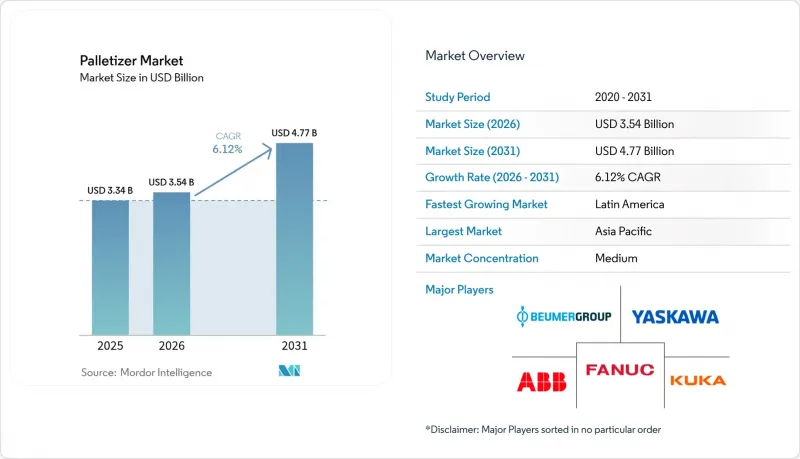
本報告按產品類型(傳統堆垛機、機器人堆垛機)、有效載荷能力(輕型、中型、重型)、終端用戶行業(食品飲料、製藥、化學、電子商務和第三方物流等)、銷售管道(直接銷售給原始設備製造商、系統整合商等)和地區進行細分。市場預測以美元計價。
全球堆垛機市場趨勢與洞察
電子商務中的SKU(庫存單位)正變得越來越複雜。
目前,履約中心每年處理超過 1,800 億箱貨物,單一地點處理超過 5 萬個 SKU。這相當於傳統零售中心 SKU 多樣性的 10 倍。固定模式的設備已無法滿足需求,因此,人工智慧驅動的系統(例如 Lucas 倉庫最佳化套件)正在被應用。這些系統透過即時平衡重量、易碎性和堆疊性,將托盤堆疊效率提高 15-20%。雖然高階平台可帶來 30-40% 的更高利潤率,但由於貨物最佳化可減少高達 30% 的拖車空置空間,整體運輸成本仍然更低。
人手不足正在加速倉庫自動化進程。
在中國,41個工廠職位類別正面臨嚴重的勞動力短缺;北美倉庫的空缺率高達15%至20%,這使得自動化投資的回收期縮短至不到18個月。在中型工廠,即使是每小時僅生產100件產品的生產線,自動化也在不斷推進;協作系統使員工能夠重新部署到更安全、更有價值的工作崗位,從而推動了堆垛機市場的擴張。
高產負載容量機械臂需要較高的初始資本支出(CAPEX)。
額定負載超過 150 公斤的系統部署成本通常超過 50 萬美元,這對於日出貨量低於 500 個托盤的製造商來說構成了一大障礙。雖然像 Formic 這樣機器人即服務 (RaaS) 的先驅公司透過每月 3,975 美元的套餐計劃解決了這一難題,但在客製化和所有權方面仍然存在權衡取捨。
細分市場分析
即使到了2025年,傳統機械仍將佔銷售額的47.62%。這是因為每小時產能超過1000箱的高速生產線依賴成熟的疊層設備。然而,在堆垛機市場,協作式設備正以6.09%的複合年成長率加速成長,吸引對新建小型面積的投資,這些廠房需要符合安全認證標準且無需圍籬。機械手臂機器人佔據了中端市場,兼顧了加工能力和換型柔軟性,以適應多樣化的產品系列。結合疊層機和機器人揀選機的混合系統正在小眾飲料和個人護理用品生產單元中湧現,但它們的成本仍然較高。
供應商正透過全端生態系實現差異化競爭。例如,將 Dusan 的「P 系列」系統與 Rocketfarm 的「Pally」軟體結合,可縮短部署時間並提高使用者自主性。隨著客戶越來越重視一站式服務而非獨立硬體,提供視覺、模擬和生命週期服務的供應商正在堆垛機市場拓展商機。
中型負載解決方案佔40.88%的市場佔有率,這反映了消費品產業對50-150公斤包裝箱的偏好。然而,隨著大型運輸公司擴大整合貨物以降低人事費用和運輸成本,重型負載堆垛機市場預計將以7.18%的複合年成長率成長。節能伺服架構和先進的安全掃描器使得180千噸的協作機器人能夠與員工並肩運作,如Bob's Red Mill的案例所示。雖然這些功能導致其價格比中型產品高出40-60%,但用戶認為,減少堆高機作業次數和降低勞工賠償索賠是物有所值的。
重量低於 50 公斤的輕型碼垛單元主要面向製藥和電子行業,在這些行業中,無塵室標準的要求和精度遠比簡單的人工操作更為重要。針對此細分堆垛機室認證的防護罩和真空吸盤來保護高價值產品,從而實現了穩定但相對緩慢的成長。
區域分析
到2025年,亞太地區將佔全球銷售額的37.84%。到2022年,全球新增機器人中有52%已在中國安裝。目前,國內供應商佔據了36%的國內市場佔有率,這正在拉低價格水平,並加速二線工廠對機器人的採用。日本生產了全球45%的機器人,並在政府393億美元(437億美元)供應鏈基金的支持下,預計2024年將在物流、食品和製藥業訂單。印度的生產連結獎勵計畫計劃正在促進汽車和學名藥工廠的自動化,但由於技能差距,自動化普及程度仍然不均衡。
預計2031年,南美洲將呈現最強勁的成長勢頭,年複合成長率將達到7.86%。巴西的食品和汽車產業正在推進托盤組裝自動化,以符合出口限制。墨西哥正順應近岸外包趨勢,向美國市場供應免稅商品,推動了對符合北美安全標準的機器人的需求。儘管宏觀經濟波動,阿根廷的糧食加工商仍在安裝堆垛機,以穩定一噸重的散裝袋,使其能夠承受長途海運。
預計北美和歐洲市場將保持溫和成長,主要動力來自現有設備的升級改造,而非產能擴張。即將生效的歐盟法規2023/1230將強制要求供應商加強網路安全,這將使擁有認證軟體堆疊的公司更具優勢。美國的回流計畫正在重振堆垛機市場,因為中小製造商正在尋求能夠應對頻繁的SKU變更並緩解農村老化人手不足的靈活協作機器人。
其他好處:
- Excel格式的市場預測(ME)表
- 3個月的分析師支持
目錄
第1章:引言
- 研究假設和市場定義
- 調查範圍
第2章:調查方法
第3章執行摘要
第4章 市場狀況
- 市場概覽
- 市場促進因素
- 電子商務中的SKU(庫存單位)正變得越來越複雜。
- 人手不足正在加速倉庫自動化進程。
- 利用即插即用的協作機器人提高包裝線的投資報酬率
- 快速消費品產業對永續性要求的激增正在推動機器人混合裝載和堆疊技術的應用。
- 人工智慧視覺系統正在提高堆垛機的運轉率。
- 加強北美和歐盟的供應鏈韌性和生產回流
- 市場限制因素
- 高產負載容量機械臂的初始資本支出(CAPEX)很高。
- 與傳統MES/WMS整合的複雜性
- 歐盟協作機器人安全評估和認證的延誤
- 鋼材和伺服馬達價格的波動延長了投資回收期。
- 價值供應鏈分析
- 監理情勢
- 技術展望
- 波特五力模型
- 價格分析
第5章 市場規模與成長預測
- 依產品類型
- 傳統堆垛機
- 高位碼堆垛機
- 低位碼堆垛機
- 機器人堆垛機
- 笛卡兒/龍門式
- 關節
- SCARA
- 協作機器人(cobots)
- 混合式碼堆垛機
- 傳統堆垛機
- 按有效載荷能力
- 小型(小於50公斤)
- 中型(50-150公斤)
- 大型(超過150公斤)
- 按最終用戶行業分類
- 食品/飲料
- 製藥
- 個人護理化妝品
- 化學品
- 電子商務與第三方物流
- 其他行業
- 按銷售管道
- 直接OEM銷售
- 系統整合商
- 售後改裝與升級
- 出租/租賃
- 按地區
- 北美洲
- 美國
- 加拿大
- 墨西哥
- 南美洲
- 巴西
- 阿根廷
- 其他南美國家
- 歐洲
- 德國
- 英國
- 法國
- 義大利
- 俄羅斯
- 其他歐洲國家
- 亞太地區
- 中國
- 日本
- 印度
- 韓國
- 其他亞太國家
- 中東和非洲
- 阿拉伯聯合大公國
- 沙烏地阿拉伯
- 南非
- 其他中東和非洲國家
- 北美洲
第6章 競爭情勢
- 市場集中度
- 策略趨勢
- 市佔率分析
- 公司簡介
- ABB Ltd.
- FANUC Corp.
- KUKA AG
- Yaskawa Electric Corp.
- BEUMER Group GmbH and Co. KG
- Honeywell Intelligrated
- Krones AG
- Sidel Group
- ABC Packaging
- Schneider Packaging
- Barry-Wehmiller(BW Packaging)
- Premier Tech Chronos
- MMCI Robotics
- Columbia Machine
- Fuji Yusoki
- Brenton Engineering
- Kawasaki Robotics
- Okura Yusoki
- Regal Rexnord Automation
- Sealed Air AUTOBAG
第7章 市場機會與未來展望
According to Mordor Intelligence, the palletizer market size is expected to grow from USD 3.34 billion in 2025 to USD 3.54 billion in 2026 and is forecast to reach USD 4.77 billion by 2031 at 6.12% CAGR over 2026-2031.
This report is Segmented by Product (Conventional Palletizer, Robotic Palletizer), by Payload Capacity (Light-Duty, Medium-Duty, and Heavy-Duty), by End-User Vertical (Food & Beverages, Pharmaceuticals, Chemicals, E-Commerce and 3PL, and More), by Sales Channel (Direct OEM Sales, System Integrators, and More) and by Geography. The Market Forecasts are Provided in Terms of Value (USD).
Global Palletizer Market Trends and Insights
Growing e-commerce SKU complexity
Fulfilment centres now handle volumes that exceed 180 billion cases yearly, with single sites processing more than 50,000 SKUs-ten times the diversity typical of legacy retail hubs.Fixed-pattern equipment cannot keep up, prompting adoption of AI-powered systems such as the Lucas Warehouse Optimization Suite, which lifts palletizing efficiency 15-20% by balancing weight, fragility, and stackability in real time. Premium platforms fetch 30-40% higher margins but still lower total shipping cost as optimized loads cut empty trailer space by up to 30%.
Labor shortages accelerating warehouse automation
Critical staffing gaps across 41 factory occupations in China and 15-20% vacancy rates in North American warehouses have compressed automation payback to under 18 months. Mid-market plants now automate runs of just 100 units per hour, unlocking a broader palletizer market as collaborative systems redeploy employees to safer, higher-value roles.
High upfront CAPEX for heavy-payload robotic arms
Installations rated above 150 kg often top USD 500,000, a hurdle for manufacturers shipping fewer than 500 pallets daily. Robotics-as-a-service pioneers such as Formic counter this barrier with USD 3,975 monthly bundles, yet tradeoffs around customisation and ownership persist.
Other drivers and restraints analyzed in the detailed report include:
- Packaging-line ROI improvements from plug-and-play cobots
- Surge in FMCG sustainability mandates favouring robotic mixed-load palletizing
- Integration complexity with legacy MES/WMS
For complete list of drivers and restraints, kindly check the Table Of Contents.
Segment Analysis
Conventional machines retained 47.62% revenue in 2025 as high-speed lines exceeding 1,000 cases per hour depend on proven layer devices. Yet the palletizer market sees collaborative units outpace at 6.09% CAGR, capturing greenfield investments in small-footprint sites that crave safety-certified, fence-free operation. Robotic articulated arms occupy the mid-performance tier, balancing throughput against changeover flexibility for mixed product portfolios. Hybrid systems, blending layer formers with robotic pickers, emerge in niche beverage and personal-care cells but remain cost-intensive.
Vendors differentiate through full-stack ecosystems: Doosan's P-SERIES coupled with Rocketfarm's Pally software reduces deployment time and elevates user autonomy. As customers prioritise single-source accountability over stand-alone hardware, suppliers bundling vision, simulation, and lifecycle services widen addressable opportunities inside the palletizer market.
Medium-duty solutions dominated with 40.88% share, reflecting consumer goods' bias toward 50-150 kg boxes. However the palletizer market size for heavy-duty systems is slated to expand at a 7.18% CAGR as bulk shippers consolidate loads to curb labour and freight costs. Energy-efficient servo architectures and advanced safety scanners now let 180 kg cobots operate alongside staff, as seen in Bob's Red Mill installations. These capabilities command 40-60% price uplifts compared with mid-tier peers, yet users justify the premium through reduced forklift moves and lower workers' compensation claims.
Light-duty cells under 50 kg address pharmaceuticals and electronics, where cleanroom compliance and precision trump brute force. Vendors targeting this end of the palletizer market leverage class-10-rated enclosures and vacuum grippers to protect high-value items, maintaining a stable but slower growth profile.
Complete Report Scope:
- By Product Type
- Conventional Palletizer
- High-Level Palletizer
- Low-Level Palletizer
- Robotic Palletizer
- Cartesian/Gantry
- Articulated
- SCARA
- Collaborative (Cobot)
- Hybrid Palletizer
- Conventional Palletizer
- By Payload Capacity
- Light-Duty (<50 kg)
- Medium-Duty (50-150 kg)
- Heavy-Duty (>150 kg)
- By End-user Vertical
- Food & Beverages
- Pharmaceuticals
- Personal Care and Cosmetics
- Chemicals
- E-commerce and 3PL
- Other Verticals
- By Sales Channel
- Direct OEM Sales
- System Integrators
- After-market Retrofits and Upgrades
- Rental / Leasing
- By Geography
- North America
- United States
- Canada
- Mexico
- South America
- Brazil
- Argentina
- Rest of South America
- Europe
- Germany
- United Kingdom
- France
- Italy
- Russia
- Rest of Europe
- APAC
- China
- Japan
- India
- South Korea
- Rest of APAC
- Middle East & Africa
- United Arab Emirates
- Saudi Arabia
- South Africa
- Rest of Middle East and Africa
- North America
Geography Analysis
APAC held 37.84% of 2025 revenue, with China alone installing 52% of new global robots by 2022. Domestic suppliers now secure 36% of their home market, pushing price points lower and accelerating diffusion among tier-two factories. Japan built 45% of the world's robots and channelled USD 7.35 billion in 2024 orders into logistics, food, and pharma lines, backed by a USD 39.3 billion (USD 43.7 billion) government supply-chain fund . India's Production-Linked Incentive schemes spark automation across automotive and generics plants, though adoption pockets remain uneven due to skill gaps.
South America records the strongest 7.86% CAGR trajectory to 2031 as Brazil's food and auto sectors automate pallet building for export compliance. Mexico rides near-shoring trends to supply the US market with tariff-proof goods, intensifying demand for robots certified to North American safety codes. Argentina's grain processors install palletizers that stabilise 1-tonne bulk bags for long ocean voyages despite macroeconomic volatility.
North America and Europe show measured growth driven by replacement rather than capacity additions. Upcoming Regulation (EU) 2023/1230 compels vendors to harden cybersecurity, advantaging those with certified software stacks. US reshoring programs lift the palletizer market as SMB manufacturers seek flexible cobots that accommodate frequent SKU changeovers and mitigate labour constraints in ageing rural workforces.
- ABB Ltd.
- FANUC Corp.
- KUKA AG
- Yaskawa Electric Corp.
- BEUMER Group GmbH and Co. KG
- Honeywell Intelligrated
- Krones AG
- Sidel Group
- A-B-C Packaging
- Schneider Packaging
- Barry-Wehmiller (BW Packaging)
- Premier Tech Chronos
- MMCI Robotics
- Columbia Machine
- Fuji Yusoki
- Brenton Engineering
- Kawasaki Robotics
- Okura Yusoki
- Regal Rexnord Automation
- Sealed Air AUTOBAG
Additional Benefits:
- The market estimate (ME) sheet in Excel format
- 3 months of analyst support
TABLE OF CONTENTS
1 INTRODUCTION
- 1.1 Study Assumptions and Market Definition
- 1.2 Scope of the Study
2 RESEARCH METHODOLOGY
3 EXECUTIVE SUMMARY
4 MARKET LANDSCAPE
- 4.1 Market Overview
- 4.2 Market Drivers
- 4.2.1 Growing e-commerce SKU complexity
- 4.2.2 Labor shortages accelerating warehouse automation
- 4.2.3 Packaging-line ROI improvements from plug-and-play cobots
- 4.2.4 Surge in FMCG sustainability mandates favouring robotic mixed-load palletizing
- 4.2.5 AI-driven vision systems boosting palletizer uptime
- 4.2.6 Resilience re-shoring of supply chains in North America and EU
- 4.3 Market Restraints
- 4.3.1 High upfront CAPEX for heavy-payload robotic arms
- 4.3.2 Integration complexity with legacy MES/WMS
- 4.3.3 Safety-rating certification delays for cobots in EU
- 4.3.4 Volatile steel & servo-motor prices widening payback periods
- 4.4 Value / Supply-Chain Analysis
- 4.5 Regulatory Landscape
- 4.6 Technological Outlook
- 4.7 Porter's Five Forces
- 4.7.1 Bargaining Power of Suppliers
- 4.7.2 Bargaining Power of Buyers
- 4.7.3 Threat of New Entrants
- 4.7.4 Threat of Substitutes
- 4.7.5 Intensity of Competitive Rivalry
- 4.8 Pricing Analysis
5 MARKET SIZE AND GROWTH FORECASTS (VALUE)
- 5.1 By Product Type
- 5.1.1 Conventional Palletizer
- 5.1.1.1 High-Level Palletizer
- 5.1.1.2 Low-Level Palletizer
- 5.1.2 Robotic Palletizer
- 5.1.2.1 Cartesian/Gantry
- 5.1.2.2 Articulated
- 5.1.2.3 SCARA
- 5.1.2.4 Collaborative (Cobot)
- 5.1.3 Hybrid Palletizer
- 5.1.1 Conventional Palletizer
- 5.2 By Payload Capacity
- 5.2.1 Light-Duty (<50 kg)
- 5.2.2 Medium-Duty (50-150 kg)
- 5.2.3 Heavy-Duty (>150 kg)
- 5.3 By End-user Vertical
- 5.3.1 Food & Beverages
- 5.3.2 Pharmaceuticals
- 5.3.3 Personal Care and Cosmetics
- 5.3.4 Chemicals
- 5.3.5 E-commerce and 3PL
- 5.3.6 Other Verticals
- 5.4 By Sales Channel
- 5.4.1 Direct OEM Sales
- 5.4.2 System Integrators
- 5.4.3 After-market Retrofits and Upgrades
- 5.4.4 Rental / Leasing
- 5.5 By Geography
- 5.5.1 North America
- 5.5.1.1 United States
- 5.5.1.2 Canada
- 5.5.1.3 Mexico
- 5.5.2 South America
- 5.5.2.1 Brazil
- 5.5.2.2 Argentina
- 5.5.2.3 Rest of South America
- 5.5.3 Europe
- 5.5.3.1 Germany
- 5.5.3.2 United Kingdom
- 5.5.3.3 France
- 5.5.3.4 Italy
- 5.5.3.5 Russia
- 5.5.3.6 Rest of Europe
- 5.5.4 APAC
- 5.5.4.1 China
- 5.5.4.2 Japan
- 5.5.4.3 India
- 5.5.4.4 South Korea
- 5.5.4.5 Rest of APAC
- 5.5.5 Middle East & Africa
- 5.5.5.1 United Arab Emirates
- 5.5.5.2 Saudi Arabia
- 5.5.5.3 South Africa
- 5.5.5.4 Rest of Middle East and Africa
- 5.5.1 North America
6 COMPETITIVE LANDSCAPE
- 6.1 Market Concentration
- 6.2 Strategic Moves
- 6.3 Market Share Analysis
- 6.4 Company Profiles
- 6.4.1 ABB Ltd.
- 6.4.2 FANUC Corp.
- 6.4.3 KUKA AG
- 6.4.4 Yaskawa Electric Corp.
- 6.4.5 BEUMER Group GmbH and Co. KG
- 6.4.6 Honeywell Intelligrated
- 6.4.7 Krones AG
- 6.4.8 Sidel Group
- 6.4.9 A-B-C Packaging
- 6.4.10 Schneider Packaging
- 6.4.11 Barry-Wehmiller (BW Packaging)
- 6.4.12 Premier Tech Chronos
- 6.4.13 MMCI Robotics
- 6.4.14 Columbia Machine
- 6.4.15 Fuji Yusoki
- 6.4.16 Brenton Engineering
- 6.4.17 Kawasaki Robotics
- 6.4.18 Okura Yusoki
- 6.4.19 Regal Rexnord Automation
- 6.4.20 Sealed Air AUTOBAG
7 MARKET OPPORTUNITIES AND FUTURE OUTLOOK
- 7.1 White-space and Unmet-need Assessment

 2026年全球自動化托盤儲存系統市場報告
 堆垛機市場:全球市場預測,2026-2032年
 機器人堆棧與卸棧機市場規模、佔有率、成長、全球產業分析、區域洞察及2026-2034年預測
 自動化堆垛機和堆垛機市場:按類型、產品、技術、應用、最終用戶和地區分類(2026-2034 年)
 自動化堆垛機和堆垛機市場規模、佔有率和成長分析(按設備類型、最終用戶產業、操作模式、系統配置和地區分類)-2026-2033年產業預測2026年全球堆垛機市場報告
 歐洲堆垛機:市場佔有率分析、產業趨勢與統計、成長預測(2026-2031)
 堆垛機市場規模、佔有率和成長分析(按技術、產品類型、裝載能力、產業垂直領域、銷售管道和地區分類)-2026-2033年產業預測
 堆垛機:全球市場佔有率和排名、總收入和需求預測(2025-2031年)機器人碼高機和卸載機:全球市場佔有率和排名、總收入和需求預測(2025-2031年)