


 |
市場調查報告書
商品編碼
2122235
過氧化氫:市場佔有率分析、產業趨勢與統計、成長預測(2026-2031)Hydrogen Peroxide - Market Share Analysis, Industry Trends & Statistics, Growth Forecasts (2026 - 2031) |
||||||

※ 本網頁內容可能與最新版本有所差異。詳細情況請與我們聯繫。
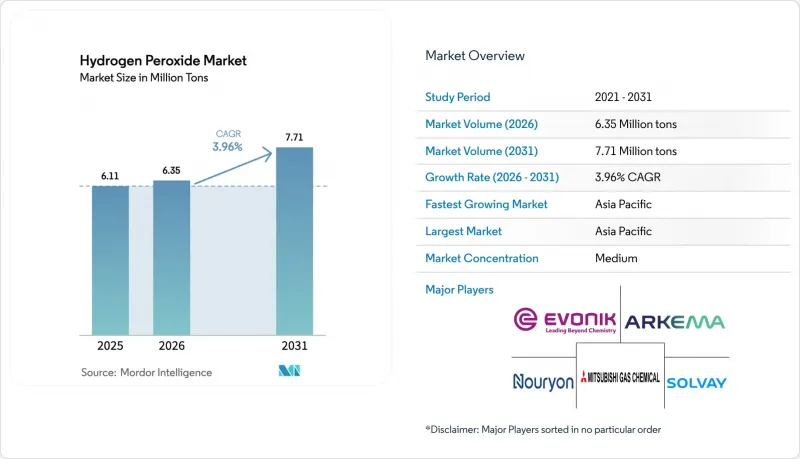
根據 Mordor Intelligence 預測,過氧化氫市場預計將從 2025 年的 611 萬噸成長到 2026 年的 635 萬噸,到 2031 年達到 771 萬噸,2026 年至 2031 年的複合年成長率預計為 3.96%。
本報告按產品功能(例如消毒劑)、等級(例如標準級)、濃度/形態(例如水溶液)、終端用戶行業(例如紙漿和造紙、化學合成、污水處理、採礦)以及地區(亞太地區、北美地區、歐洲地區、南美地區、中東和非洲)進行細分。市場預測以銷售量(噸)為基礎。
全球過氧化氫市場趨勢及洞察
半導體製造廠對波長小於5奈米的超高純度H2O2的需求激增
主要半導體製造商正在收緊晶圓清洗過程中金屬含量的容差,使其低於兆分之一,僅為7奈米節點水準的十分之一。為了達到這項標準,索爾維將於2025年將其鎮江工廠的電子級產品產量加倍,而三菱瓦斯化學已擴大其在日本的生產規模,以適應亞利桑那州和德克薩斯州的新生產線。現貨價格超過每公斤2.50美元,是漂白級產品價格的三倍,足以彌補這一細分市場佔有率不足3%的事實。贏創的樂山合資企業將於2026年運作,新增3萬噸特種產品產能,該公司將持有多數股權以進行技術管理。貿易摩擦風險仍然存在,因為對極紫外線(EUV)設備的出口限制可能會阻礙東北亞以外地區半導體製造廠的建設,從而可能導致需求地域集中,並增加供應鏈風險。符合 ISO 14644 1 級無塵室標準的供應商可獲得轉換成本保證,這可以起到阻止後進入者的作用。
分散式污水處理中現場電氧化處理的激增。
在加工設施內利用空氣和水生成過氧化氫的貨櫃式裝置可降低運輸風險並縮短供應鏈。BASF於2025年在德國啟動了一個利用綠色氫氣為工業園區提供高級氧化反應器的試點項目,並在路德維希港運作了一台54兆瓦的質子交換膜電解。在印度,紡織產業叢集在污染監管機構於2025年設定微量污染物排放基準值後採用了這項技術。雖然在超過500公里的距離內,交付成本可降低20-30%,但一台100立方米/小時的撬裝式裝置的初始投資約為150萬美元,這限制了該技術的部署範圍,使其僅適用於人口超過5萬的城市。由於電氧化可以分解傳統生物過程無法分解的藥物、全氟烷基和多氟烷基物質(PFAS)以及染料分子,企業無需進行大規模的土木工程即可滿足更嚴格的排放標準。
歐盟對爆炸物前驅物的更嚴格規定,導致重量百分比超過 35% 的等級產品的分銷成本增加。
2019/1148號法規強制要求對重量濃度超過35%的過氧化氫進行最終用戶檢驗、安全儲存和交易報告,導致物流成本每公斤增加0.11至0.17歐元。阿科瑪公司投資320萬歐元對其位於傑瑞(Jarry)的工廠進行設備升級以符合該法規,但這項支出導致其2024年的帳面價值下降了18% 。小規模紡織品和化妝品買家為了避免繁瑣的文書工作,轉而購買重量濃度低於35%的過氧化氫,導致高利潤桶裝產品的銷售量下降。海關檢查也延誤了經由安特衛普和鹿特丹的再出口,導致從2024年起,運往北非和海灣國家的重量濃度超過35%的過氧化氫的歐洲貨運量下降了12%。不受該法規約束的亞洲生產商正在這些市場擴大其市場佔有率。
細分市場分析
到2025年,漂白應用仍將佔出貨量的61.76%,這主要得益於紙漿廠每噸風乾紙漿消耗8-12公斤過氧化氫。但由於再生纖維和酵素預處理技術限制了其使用,漂白應用的成長速度正在放緩。相較之下,作為消毒劑的使用量正以4.44%的複合年成長率成長,因為食品加工商、飲料填充商和市政水質淨化廠更傾向於使用過氧化氫,以避免產生氯基副產物。氧化劑發揮著至關重要的作用,尤其是在透過HPPO(過氧化氫-環氧丙烷)合成環氧丙烷的過程中,這與隔熱材料和汽車座椅應用中對聚氨酯的需求密切相關。此外,半導體和製藥業無塵室清潔劑中氧化劑的使用也受到純度要求和價格趨勢的影響。由於缺水地區選擇使用過氧化氫消毒,這種方法不需要供應鹽,也不會有違反氯酸鹽標準的風險,因此過氧化氫市場從中受益。
消毒劑市場在南亞和中東地區成長最為顯著,這些地區的海水淡化系統需要無氯病原體屏障。在東南亞,隨著12家新的再生纖維紙漿廠在2024年至2025年間投產,漂白水的需求仍然強勁。紡織廠正在轉向酵素漂白槽,以減少過氧化氫的使用,這導致過氧化氫在織物整理領域的市場佔有率不斷萎縮。萊昂內爾·巴塞爾位於休士頓的47萬噸級工廠已簽訂了18.8萬噸的銷售量,這從根本上提振了對HPPO(過氧化氫)的需求。在電子清洗領域,雖然銷量不大,但附加價值很高,一條5奈米製程的晶圓廠產生的過氧化氫銷量就相當於多條紙漿生產線的產量。
至2025年,工業級(35-50%)將佔42.27%的市場佔有率,主要供應紙漿、紡織和污水處理行業。半導體製造、藥物合成和航太單推進劑等行業正在推動純度超過50%(重量百分比)的高純度級產品的成長。純度低於35%(重量百分比)的標準級產品,由於金屬含量接受度較小且每公斤成本較低,滿足了泳池和家用應用的需求。索爾維鎮江工廠擴建計畫新增了2.5萬噸光伏級產品,其磷和硼含量均低於0.1 ppb。這凸顯了當污染物排放標準與太陽能電池的效率目標相符時,可以實現的高利潤率。
贏創樂山計畫於2026年將電子級過氧化氫的產量提高3萬噸,凸顯了高純度市場擴張的潛力。由於紙漿廠引進氧脫木素工藝,導致每噸用量減少,工業級過氧化氫的市佔率逐漸萎縮。在成熟經濟體,標準級過氧化氫的成長趨於平緩,但在疫情後家庭消毒習慣依然盛行的印度和東南亞國協,其成長率達到了6%。進入高純度市場面臨高昂的成本障礙。氟聚合物內襯的ISO容器和即時ICP-MS監測會使物流成本增加0.10美元/公斤,而無塵室填充線的成本則高達每條800萬至1200萬美元。
區域分析
預計到2025年,亞太地區將佔全球產量的52.28%,並將在2031年之前維持4.33%的複合年成長率。中國仍然是主要生產國,但由於Anthracene價格上漲和煤焦油法規的實施,自2025年初以來,生產成本已顯著上升。印度正經歷穩定成長,這主要得益於對醫藥中間體和紡織品漂白劑需求的成長,以及對新的當地標準的遵守。日本和韓國透過建立新的半導體製造工廠來滿足對高純度產品的需求,當地化學品供應商也已達到嚴格的金屬含量限制認證標準。同時,印尼、越南和泰國近年來引進了再生纖維紙漿生產線,進一步增強了該地區對漂白應用的需求。
在北美,萊昂內爾·巴塞爾位於休士頓的高壓過氧化氫(HPPO)工廠和陶氏位於弗里波特的工廠合計每年可生產25萬至28萬噸的內部用量,從而穩定市場價格。目前,索爾維位於迪爾帕克的工廠和其位於亞利桑那州的半導體製造廠透過一個專用的ISO儲罐連接,形成一條超純供應鏈。在歐洲,向低碳等級產品的轉型正在推進,BASF位於路德維希港的54兆瓦電解正向過氧化氫循環系統供應可再生氫氣。由於歐盟法規2019/1148規定,濃度超過35%(重量比)的產品物流成本增加,一些客戶正在降低濃度或轉向從亞洲進口。
南美洲預計將實現年成長,這主要得益於巴西桉樹紙漿產量的擴張以及阿根廷一項正在試點使用無氰過氧化氫浸出法的採礦項目。中東和非洲市場也呈現成長態勢,儘管基數小規模,低於18萬噸。沙烏地阿拉伯污水處理廠的維修以及南非金礦的開採正在推動需求成長。總體而言,亞洲在過氧化氫市場銷售量方面佔據主導地位,而歐洲和北美則在電子產品和低碳供應鏈領域擁有高利潤率的細分市場。
其他好處:
- Excel格式的市場預測(ME)表
- 3個月的分析師支持
目錄
第1章:引言
- 研究假設和市場定義
- 調查範圍
第2章:調查方法
第3章執行摘要
第4章 市場狀況
- 市場概覽
- 市場促進因素
- 生產尺寸小於 5 奈米半導體的半導體製造廠對超高純度 H2O2 的需求激增。
- 分散式廢水處理的現場電氧化系統激增
- 擴大東南亞再生纖維紙漿廠的生產能力
- 歐洲和中國HPPO(過氧化氫製環氧丙烷)工廠的擴建
- 醫療機構強制實施感染控制措施,導致VHP滅菌器的銷售量增加。
- 低碳 H2O2 生產路線(可再生氫和 PEM電解)正在獲得 ESG 溢價。
- 市場限制因素
- 歐盟對「爆炸物前驅物」的更嚴格規定,導致相關等級產品的分銷成本增加了 35% 及以上。
- 由於煤焦油供應中斷,蒽醌原料價格波動。
- 高純度物流(金屬含量限制在ppb級)需要昂貴的一次性罐體。
- 改進的製程安全(LOPA/SIL)使我們能夠增加濃度高於 70% 的新工廠的資本支出。
- 價值鏈分析
- 波特五力模型
- 價格分析
- 交易場景
- 供應情景
第5章 市場規模與成長預測
- 按功能分類的產品
- 消毒劑
- 漂
- 氧化劑
- 其他產品功能(例如清潔劑)
- 按年級
- 標準等級(低於35% w/w)
- 工業級(35-50%)
- 高純度等級(50%或以上)
- 按濃度/形式
- 水溶液(70%或以下)
- 無水(90%以上)
- 粉末狀和顆粒狀添加物(過硼酸鹽和過碳酸鹽)
- 按最終用戶行業分類
- 紙漿和造紙
- 化學合成
- 污水處理
- 礦業
- 食品/飲料
- 化妝品和醫療保健
- 紡織品
- 其他終端用戶產業(電子及半導體、運輸、無菌包裝、火箭)
- 按地區
- 亞太地區
- 中國
- 印度
- 日本
- 韓國
- 馬來西亞
- 泰國
- 印尼
- 越南
- 其他亞太國家
- 北美洲
- 美國
- 加拿大
- 墨西哥
- 歐洲
- 德國
- 英國
- 法國
- 義大利
- 西班牙
- 北歐國家
- 土耳其
- 俄羅斯
- 其他歐洲國家
- 南美洲
- 巴西
- 阿根廷
- 哥倫比亞
- 其他南美國家
- 中東和非洲
- 沙烏地阿拉伯
- 卡達
- 阿拉伯聯合大公國
- 南非
- 埃及
- 奈及利亞
- 其他中東和非洲國家
- 亞太地區
第6章 競爭情勢
- 市場集中度
- 策略趨勢
- 市佔率和排名分析
- 公司簡介
- Arkema
- BASF
- Chang Chun Group
- Dow
- Engro Corporation Limited.
- Evonik Industries AG
- FMC Corporation
- Guangdong Zhongcheng Chemicals Inc.
- Gujarat Alkalies & Chemicals Limited
- Hodogaya Chemical Co. Ltd.
- Indian Peroxide Ltd.
- Kemira
- Kingboard Chemical Holdings Ltd.
- Luxi Chemical Group
- Mitsubishi Gas Chemical Company Inc.
- National Peroxide Ltd.
- Nippon Paper Chemicals Co. Ltd.
- Nouryon
- OCI Peroxygens LLC
- PQ Corporation
- Qingdao LaSheng Co. Ltd.
- Sichuan Hebang Biotechnology Co. Ltd.
- Solvay
- Thai Peroxide Company Ltd.
第7章 市場機會與未來展望
According to Mordor Intelligence, the hydrogen peroxide market size is expected to increase from 6.11 Million tons in 2025 to 6.35 Million tons in 2026 and reach 7.71 Million tons by 2031, growing at a CAGR of 3.96% over 2026-2031.
This report is Segmented by Product Function (Disinfectant, and More), Grade (Standard Grade, and More), Concentration/Form (Aqueous Solution and More), End-User Industry (Pulp and Paper, Chemical Synthesis, Wastewater, Mining, and More), and Geography (Asia-Pacific, North America, Europe, South America, and the Middle East and Africa). Market Forecasts are Provided in Terms of Volume (tons).
Global Hydrogen Peroxide Market Trends and Insights
Surging Ultra-High-Purity H2O2 Demand In Sub-5 nm Semiconductor Fabs
Leading chipmakers have tightened metal limits to below 10 parts-per-trillion for wafer cleaning, a ten-fold reduction from 7 nm nodes. Solvay doubled electronic-grade output at Zhenjiang in 2025 to meet this bar, while Mitsubishi Gas Chemical expanded in Japan to serve new lines in Arizona and Texas. Spot prices above USD 2.50 per kilogram, three times bleaching-grade levels, more than offset the niche's sub-3% volume share. Evonik's Leshan joint venture will come on stream in 2026, adding 30 kilotons of specialty capacity and securing the firm majority ownership for know-how control. Trade-tension risks linger because extreme-ultraviolet tool export restrictions could stall fabs outside Northeast Asia, concentrating demand geographically and raising supply-chain exposure. Suppliers that meet ISO 14644 Class 1 clean-room protocols enjoy switching-cost protection that discourages late entrants.
Sharp Rise In On-Site Electro-Oxidation For Decentralized Wastewater Treatment
Containerized units that make hydrogen peroxide from air and water at the treatment plant reduce transport risk and shorten supply chains. BASF put a 54 MW proton-exchange-membrane electrolyzer online in 2025 at Ludwigshafen, using green hydrogen for pilot advanced-oxidation reactors serving German industrial parks. In India, textile clusters adopted the technology after the pollution regulator set micropollutant limits in 2025. Delivered cost falls 20%-30% when haulage exceeds 500 km, yet the capital of about USD 1.5 million for a 100 m3 h-1 skid limits uptake to cities above 50,000 people. Electro-oxidation degrades pharmaceuticals, PFAS, and dye molecules that conventional biology cannot, giving operators a route to meet tighter discharge standards without major civil works.
EU Explosives-Precursor Tightening Lifts Distribution Costs For >35 wt% Grades
Regulation 2019/1148 requires end-user vetting, secure storage, and transaction reports for hydrogen peroxide above 35 wt%, lifting logistics cost by EUR 0.11-0.17 kg-1. Arkema spent EUR 3.2 million on compliance upgrades at its Jarrie site, an outlay that trimmed book value by 18% in 2024. Many small textile and cosmetics buyers have downshifted to 35 wt% grades to avoid paperwork, eroding high-margin drum sales. Customs checks now delay re-exports via Antwerp and Rotterdam, prompting a 12% drop in European shipments of >35 wt% peroxide to North Africa and the Gulf since 2024. Asian producers exempt from the rule have gained share in these destinations.
Other drivers and restraints analyzed in the detailed report include:
- Healthcare Infection-Control Mandates Boosting VHP Sterilization
- Low-Carbon H2O2 Routes Attracting ESG Premiums
- Anthraquinone Feedstock Volatility Tied To Coal-Tar Disruptions
For complete list of drivers and restraints, kindly check the Table Of Contents.
Segment Analysis
Bleaching still supplied 61.76% of 2025 volume, anchored in pulp mills that consume 8-12 kg per air-dried ton, yet growth trails as recycled fiber and enzyme pretreatments curb dosage. Disinfectant usage, by contrast, rises at a 4.44% CAGR because food processors, beverage fillers, and municipal water plants favor peroxide to avoid chlorinated by-products. Oxidants play a key role, particularly in HPPO propylene oxide synthesis, which aligns with polyurethane demand in insulation and automotive seating applications. Additionally, the use of oxidants in cleaning agents for semiconductor and pharmaceutical cleanrooms is influenced by purity requirements and pricing dynamics. The hydrogen peroxide market benefits from water-scarce regions opting for peroxide disinfection, which neither salts supply nor risks chlorate violation.
Disinfectant growth is most pronounced in South Asia and the Middle East, where desalinated water systems need a chlorine-free pathogen barrier. Bleaching remains robust in Southeast Asia, where 12 new recycled-fiber pulp mills started between 2024 and 2025. Textile mills pivot to enzymatic bleach bath setups that reduce peroxide input, trimming the hydrogen peroxide market share of fabric finishing. HPPO demand received a structural lift from LyondellBasell's 470 kiloton plant in Houston, locking in 188 kilotons of contract offtake. Electronics cleaning gains modest volume but high value, as a single 5 nm fab can generate peroxide revenue equivalent to many pulp lines.
Industrial Grade (35-50%) held a 42.27% share in 2025, serving pulp, textile, and wastewater. Chip fabs, pharma synthesis, and aerospace monopropellants support high-purity grades above 50 wt%'s growth. Standard grades below 35 wt% fill swimming-pool and household needs where metal tolerance is lenient, and the cost per kilogram is low. Solvay's Zhenjiang expansion added 25 kilotons of photovoltaic-grade product with phosphorus and boron below 0.1 ppb, underscoring the margin available when contamination specs align with solar-cell efficiency targets.
Evonik's Leshan project will add 30 kilotons of electronic-grade peroxide in 2026, confirming the hydrogen peroxide market size upside in the high-purity tier. Industrial-grade share erodes slowly as pulp mills install oxygen delignification, cutting usage per ton. Standard-grade growth is flat in mature economies but 6% in India and ASEAN, where household disinfection remains a growth habit post-pandemic. The cost barrier to enter the high-purity arena is steep: fluoropolymer-lined ISO containers and real-time ICP-MS monitoring add USD 0.10 kg-1 to logistics, while clean-room bottling lines cost USD 8-12 million each.
Complete Report Scope:
- By Product Function
- Disinfectant
- Bleaching
- Oxidant
- Other Product Function (Cleaning Agent, etc.)
- By Grade
- Standard Grade (less than 35% w/w)
- Industrial Grade (35-50%)
- High-Purity Grade (more than 50%)
- By Concentration / Form
- Aqueous Solution (less than or equal to 70%)
- Anhydrous (more than 90%)
- Powder/Granular Adducts (Perborate and Percarbonate)
- By End-user Industry
- Pulp and Paper
- Chemical Synthesis
- Wastewater Treatment
- Mining
- Food and Beverage
- Cosmetics and Healthcare
- Textiles
- Other End-user Industries (Electronics and Semiconductors, Transportation, Aseptic Packaging, and Rocketry)
- By Geography
- Asia-Pacific
- China
- India
- Japan
- South Korea
- Malaysia
- Thailand
- Indonesia
- Vietnam
- Rest of Asia-Pacific
- North America
- United States
- Canada
- Mexico
- Europe
- Germany
- United Kingdom
- France
- Italy
- Spain
- NORDIC Countries
- Turkey
- Russia
- Rest of Europe
- South America
- Brazil
- Argentina
- Colombia
- Rest of South America
- Middle East and Africa
- Saudi Arabia
- Qatar
- United Arab Emirates
- South Africa
- Egypt
- Nigeria
- Rest of Middle East and Africa
- Asia-Pacific
Geography Analysis
Asia-Pacific controlled 52.28% of the 2025 volume and is forecast to post a 4.33% CAGR to 2031. China remains a leading producer, but increasing anthracene costs and coal-tar restrictions have significantly raised production expenses since early 2025. India is witnessing steady growth, driven by rising demand for pharmaceutical intermediates, textile bleaching, and compliance with new municipal standards. Japan and South Korea are supporting high-purity demand through the establishment of new semiconductor fabrication facilities, with local chemical suppliers already meeting stringent metal limit certifications. Meanwhile, Indonesia, Vietnam, and Thailand have introduced recycled-fiber pulp lines in recent years, reinforcing regional demand for bleaching applications.
In North America, LyondellBasell's Houston HPPO unit and Dow's Freeport plant together commit 250-280 kilotons of captive offtake, stabilizing merchant pricing. Ultra-pure supply chains now link Solvay's Deer Park site with Arizona fabs by dedicated ISO tanks. Europe is shifting to low-carbon grades; BASF's 54 MW electrolyzer at Ludwigshafen feeds renewable hydrogen into peroxide loops. EU Regulation 2019/1148 lifts logistics cost for >35 wt% strengths, prompting some customers to downgrade concentration or import from Asia.
South America sees annual growth, tied to Brazil's eucalyptus-pulp expansions and Argentina's mining projects that test cyanide-free peroxide leaching. The Middle East and Africa post growth albeit from a small base under 180 kilotons. Saudi wastewater upgrades and South African gold mines drive incremental demand. Overall, the hydrogen peroxide market sees Asia dominating volume, while Europe and North America host margin-rich niches in electronics and low-carbon supply.
- Arkema
- BASF
- Chang Chun Group
- Dow
- Engro Corporation Limited.
- Evonik Industries AG
- FMC Corporation
- Guangdong Zhongcheng Chemicals Inc.
- Gujarat Alkalies & Chemicals Limited
- Hodogaya Chemical Co. Ltd.
- Indian Peroxide Ltd.
- Kemira
- Kingboard Chemical Holdings Ltd.
- Luxi Chemical Group
- Mitsubishi Gas Chemical Company Inc.
- National Peroxide Ltd.
- Nippon Paper Chemicals Co. Ltd.
- Nouryon
- OCI Peroxygens LLC
- PQ Corporation
- Qingdao LaSheng Co. Ltd.
- Sichuan Hebang Biotechnology Co. Ltd.
- Solvay
- Thai Peroxide Company Ltd.
Additional Benefits:
- The market estimate (ME) sheet in Excel format
- 3 months of analyst support
TABLE OF CONTENTS
1 Introduction
- 1.1 Study Assumptions & Market Definition
- 1.2 Scope of the Study
2 Research Methodology
3 Executive Summary
4 Market Landscape
- 4.1 Market Overview
- 4.2 Market Drivers
- 4.2.1 Surging ultra-high-purity H2O2 demand in sub-5 nm semiconductor fabs
- 4.2.2 Sharp rise in onsite electro-oxidation systems for decentralised wastewater treatment
- 4.2.3 Capacity expansion of recycled-fibre pulp mills in SE-Asia
- 4.2.4 Growth of HPPO (hydrogen-peroxide-to-propylene-oxide) plants in Europe and China
- 4.2.5 Healthcare infection-control mandates boosting VHP sterilisation equipment sales
- 4.2.6 Low-carbon H2O2 routes (renewable H2 and PEM electrolysis) gaining ESG premiums
- 4.3 Market Restraints
- 4.3.1 EU "explosives-precursor" tightening lifts distribution costs for more than 35% grades
- 4.3.2 Anthraquinone feedstock volatility linked to coal-tar supply disruptions
- 4.3.3 High-purity logistics (ppb metal limits) require costly single-use canisters
- 4.3.4 Process safety upgrades (LOPA/SIL) raising CAPEX for new more than and equal to 70% plants
- 4.4 Value Chain Analysis
- 4.5 Porter's Five Forces
- 4.5.1 Bargaining Power of Suppliers
- 4.5.2 Bargaining Power of Buyers
- 4.5.3 Threat of New Entrants
- 4.5.4 Threat of Substitutes
- 4.5.5 Degree of Competition
- 4.6 Pricing Analysis
- 4.7 Trade Scenario
- 4.8 Supply Scenario
5 Market Size & Growth Forecasts (Volume)
- 5.1 By Product Function
- 5.1.1 Disinfectant
- 5.1.2 Bleaching
- 5.1.3 Oxidant
- 5.1.4 Other Product Function (Cleaning Agent, etc.)
- 5.2 By Grade
- 5.2.1 Standard Grade (less than 35% w/w)
- 5.2.2 Industrial Grade (35-50%)
- 5.2.3 High-Purity Grade (more than 50%)
- 5.3 By Concentration / Form
- 5.3.1 Aqueous Solution (less than or equal to 70%)
- 5.3.2 Anhydrous (more than 90%)
- 5.3.3 Powder/Granular Adducts (Perborate and Percarbonate)
- 5.4 By End-user Industry
- 5.4.1 Pulp and Paper
- 5.4.2 Chemical Synthesis
- 5.4.3 Wastewater Treatment
- 5.4.4 Mining
- 5.4.5 Food and Beverage
- 5.4.6 Cosmetics and Healthcare
- 5.4.7 Textiles
- 5.4.8 Other End-user Industries (Electronics and Semiconductors, Transportation, Aseptic Packaging, and Rocketry)
- 5.5 By Geography
- 5.5.1 Asia-Pacific
- 5.5.1.1 China
- 5.5.1.2 India
- 5.5.1.3 Japan
- 5.5.1.4 South Korea
- 5.5.1.5 Malaysia
- 5.5.1.6 Thailand
- 5.5.1.7 Indonesia
- 5.5.1.8 Vietnam
- 5.5.1.9 Rest of Asia-Pacific
- 5.5.2 North America
- 5.5.2.1 United States
- 5.5.2.2 Canada
- 5.5.2.3 Mexico
- 5.5.3 Europe
- 5.5.3.1 Germany
- 5.5.3.2 United Kingdom
- 5.5.3.3 France
- 5.5.3.4 Italy
- 5.5.3.5 Spain
- 5.5.3.6 NORDIC Countries
- 5.5.3.7 Turkey
- 5.5.3.8 Russia
- 5.5.3.9 Rest of Europe
- 5.5.4 South America
- 5.5.4.1 Brazil
- 5.5.4.2 Argentina
- 5.5.4.3 Colombia
- 5.5.4.4 Rest of South America
- 5.5.5 Middle East and Africa
- 5.5.5.1 Saudi Arabia
- 5.5.5.2 Qatar
- 5.5.5.3 United Arab Emirates
- 5.5.5.4 South Africa
- 5.5.5.5 Egypt
- 5.5.5.6 Nigeria
- 5.5.5.7 Rest of Middle East and Africa
- 5.5.1 Asia-Pacific
6 Competitive Landscape
- 6.1 Market Concentration
- 6.2 Strategic Moves
- 6.3 Market Share(%)/Ranking Analysis
- 6.4 Company Profiles {(includes Global level Overview, Market level overview, Core Segments, Financials as available, Strategic Information, Products & Services, Recent Developments)}
- 6.4.1 Arkema
- 6.4.2 BASF
- 6.4.3 Chang Chun Group
- 6.4.4 Dow
- 6.4.5 Engro Corporation Limited.
- 6.4.6 Evonik Industries AG
- 6.4.7 FMC Corporation
- 6.4.8 Guangdong Zhongcheng Chemicals Inc.
- 6.4.9 Gujarat Alkalies & Chemicals Limited
- 6.4.10 Hodogaya Chemical Co. Ltd.
- 6.4.11 Indian Peroxide Ltd.
- 6.4.12 Kemira
- 6.4.13 Kingboard Chemical Holdings Ltd.
- 6.4.14 Luxi Chemical Group
- 6.4.15 Mitsubishi Gas Chemical Company Inc.
- 6.4.16 National Peroxide Ltd.
- 6.4.17 Nippon Paper Chemicals Co. Ltd.
- 6.4.18 Nouryon
- 6.4.19 OCI Peroxygens LLC
- 6.4.20 PQ Corporation
- 6.4.21 Qingdao LaSheng Co. Ltd.
- 6.4.22 Sichuan Hebang Biotechnology Co. Ltd.
- 6.4.23 Solvay
- 6.4.24 Thai Peroxide Company Ltd.
7 Market Opportunities & Future Outlook
- 7.1 White-space and Unmet-Need Assessment
- 7.2 Emerging Opportunities in Advanced Oxidation and Semiconductor Cleaning

 過氧化氫消毒濕紙巾市場:全球市場預測,2026-2032年用於半導體的高純度度過氧化氫:2026-2032年全球市場預測
 印度過氧化氫:市場佔有率分析、產業趨勢與統計及成長預測(2026-2031)過氧化氫市場:2026-2032年全球市場預測(依等級、濃度、形態、生產流程、最終用途及分銷通路分類)
 過氧化氫市場報告:按應用、最終用途和地區分類(2026-2034 年)
 過氧化氫市場:按產品類型、功能、應用和地區分類
 全球過氧化氫市場規模、佔有率、趨勢和成長分析報告(2026-2034年)
 過氧化氫市場規模、佔有率和趨勢分析報告:按等級、應用、地區和細分市場預測(2026-2033 年)
 2026年全球過氧化氫市場報告全球蒸氣和過氧化氫滅菌用生物指示劑市場:市場規模、佔有率、成長率、產業分析、依類型、應用和地區劃分的分析以及未來預測(2026-2034)