


 |
市場調查報告書
商品編碼
2122225
高級認證:市場佔有率分析、行業趨勢和統計數據、成長預測(2026-2031 年)Advanced Authentication - Market Share Analysis, Industry Trends & Statistics, Growth Forecasts (2026 - 2031) |
||||||

※ 本網頁內容可能與最新版本有所差異。詳細情況請與我們聯繫。
據 Mordor Intelligence 稱,高級身份驗證市場預計將從 2025 年的 177.1 億美元成長到 2026 年的 205.6 億美元,到 2031 年達到 382.3 億美元,2026 年至 2031 年的複合年成長率為 13.21%。
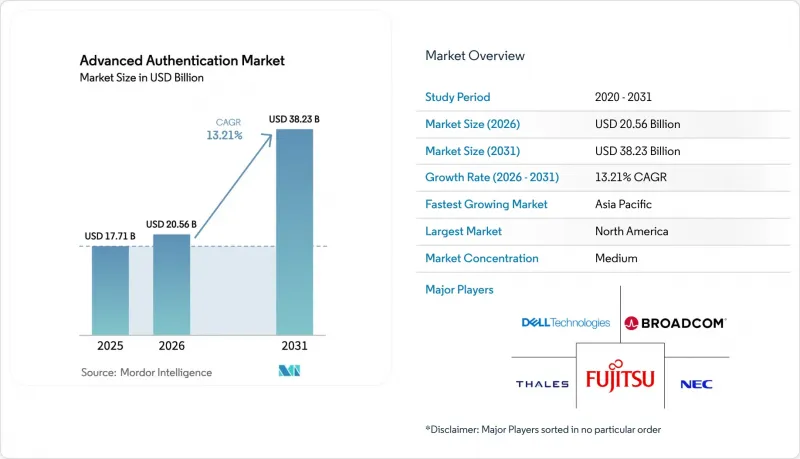
本報告按組件(硬體、軟體、服務)、認證方法(智慧卡、生物識別等)、認證模型(雙因素認證(2FA)、基於風險的認證等)、部署模式(本地部署、雲端部署)、最終用戶產業(政府(政府(私人)、國防等)和地區進行細分。市場預測以美元計價。
全球高級認證市場趨勢及洞察
雲端運算的普及推動了零信任架構的發展。
隨著企業將工作負載遷移到公共雲端,他們意識到傳統的網路邊界防禦已不再有效,身份驗證成為首要的控制點。美國網路安全與基礎設施安全局 (CISA) 於 2024 年發布了零信任成熟度模型,將防釣魚憑證和持續檢驗作為其基礎。雲端供應商透過閘道器提供身份驗證,這些閘道器會在每次存取敏感資源時觸發逐步身份驗證請求,根據微軟的《2025 年數位防禦報告》,這可以將攻擊期間的橫向移動減少 70%。多租戶軟體即服務 (SaaS) 應用程式進一步推動了這項需求,因為每個租戶都需要細粒度的、基於策略的身份驗證,而無需單獨配置。身分驗證平台與雲端存取安全仲介(CASB) 的整合正逐漸成為主流,從而在身分層和網路層創建統一的使用者情境視圖。因此,採購決策越來越傾向於能夠將風險訊號直接整合到雲端應用程式工作流程中的供應商,而不是依賴單獨的本地閘道器。
安全漏洞和網路保險費用不斷上漲
2024年,資料外洩的平均成本達到488萬美元,其中16%的事件涉及憑證外洩。為此,網路保險承保人已強制要求在簽發或續保保單前,對特權帳戶和遠端帳戶啟用多因素身份驗證,使身份驗證從一項可選功能轉變為承保的強制性要求。企業目前正在權衡身份驗證方面的投資與潛在的保費上漲和監管罰款。根據2024年《一般資料保護規則》(GDPR),後者最高可達16億歐元(17億美元)。財務計算結果顯而易見:未能實現身分驗證現代化不僅會增加資料外洩的風險,還會導致直接成本增加。因此,即使是先前因預算限制而推遲升級的中型企業,也正在加快採用新系統,以確保獲得保險資格並符合相關法規。
高昂的升等和代幣兌換成本
用現代憑證取代傳統的動態密碼(OTP) 令牌,每個使用者的成本可能在 50 到 100 美元之間,其中包括採購、註冊和支援費用。遷移通常需要諮詢契約,即使是中等規模的部署也可能耗資約 20 萬美元,這給對成本敏感的行業帶來了預算壓力。根據身分定義安全聯盟 (Identity Defined Security Alliance) 的數據,儘管意識到資料外洩的風險,但仍有 38% 的公司將成本視為採用新系統的主要障礙。雖然基於訂閱的雲端服務可以抵消部分資本支出,但初始遷移成本仍然是短期預算負擔,尤其是在 IT 支出受到嚴格限制的新興經濟體。
細分市場分析
預計到2031年,高級身分驗證市場業務收益將以每年13.83%的速度成長。這反映出買家傾向於將策略設計、整合和全天候監控外包,使內部團隊擺脫複雜任務的趨勢。到2025年,軟體仍將佔營收的47.89%,因為雲端身分套件將身分驗證、管治和分析功能整合到單一主機中。智慧卡讀卡機和生物識別掃描器等硬體對於空氣間隙防禦和關鍵基礎設施仍然至關重要,但隨著無密碼行動憑證的普及,其成長速度正在放緩。醫院正在明顯地轉向服務模式,實施託管運營,由顧問將複雜的臨床操作映射到最小權限存取規則,並確保產生可審計的報告。隨著企業的發展成熟,他們發現持續最佳化比初始技術授權更有價值,因此將支出轉向資安管理服務提供者。
這一趨勢表明,附加價值服務在高級身份驗證市場中的佔有率將持續擴大。雲端供應商透過提供模組化訂閱服務(包含支援工時、合規模板和編配手冊)加速了這一轉變,模糊了產品和服務之間的界限。系統整合商也將身分驗證與更廣泛的零信任部署結合,進一步刺激了對服務的需求。另一方面,硬體升級具有週期性且範圍有限,因此其在總支出中的佔有率保持穩定,並未成長。因此,競爭優勢不在於單一功能,而在於專業知識和基於結果的合約。
生物識別在2025年佔總收入的55.72%,但由於區域隱私法規和市場飽和,成長放緩,阻礙了新用戶的採用。另一方面,行為分析技術發展勢頭強勁,複合年成長率高達14.47%。這是因為諸如擊鍵、滑鼠移動和導航分析等被動方法可以在不中斷工作流程的情況下持續驗證使用者身分。銀行正在將行為風險評分整合到詐欺偵測引擎中,以即時防止帳戶盜用並提高客戶維繫。指紋感應器在智慧型手機中仍然廣泛應用,但在工業和醫療環境中,手套佩戴、潮濕和環境光線會降低其準確性,因此人們對多模態和行為認證的興趣日益濃厚。臉部認證的市場接受度不一,亞太地區的一些地區享有監管優勢,而另一些地區則面臨歐洲《一般資料保護規則》(GDPR)的阻力。
因此,隨著企業尋求能夠最大限度減少服務台諮詢的「無摩擦」安全方案,行為分析在高階身分驗證市場中正佔據越來越大的市場佔有率。供應商正透過專有的機器學習模型來脫穎而出,這些模型能夠快速個人化基準並適應使用者行為的細微變化,從而提升安全性和使用者體驗。隨著採用率的提高,通用生物識別硬體的價格壓力日益增大,促使供應商將分析和編配服務捆綁銷售。長期趨勢表明,二者之間存在一種共生關係:生物識別支撐著高信任度的應用場景,而行為分析則彌補了持續檢驗方面的不足。
區域分析
2025年,北美地區佔全球收入的38.91%,這主要得益於早期零信任舉措的推廣,這些計劃從聯邦機構擴展到私人企業。美國管理和預算辦公室(OMB)發布的M-22-09號備忘錄強制要求政府機構實施防釣魚身份驗證,各省和地方政府也很快在採購慣例。加拿大2024年對其《隱私法》的修訂,引入了對資料外洩的懲罰性罰款,鼓勵企業投資多因素身份驗證和無密碼解決方案。在墨西哥,金融科技監管加速了銀行業的採用,但儘管資料外洩事件不斷增加,預算限制仍減緩了其他產業的部署。
在歐洲,由於《一般資料保護規則》(GDPR) 的課責原則(該原則要求實施可驗證的技術措施)以及《數位營運彈性法案》(DORA)(該法案明確規定金融服務必須採用自適應身分驗證),自適應身分驗證仍然至關重要。德國針對關鍵基礎設施的技術指南以及英國對無密碼身份驗證的推廣進一步推動了這項需求。在俄羅斯,將身份驗證資訊儲存在本地伺服器上的要求阻礙了跨國公司採用雲端技術。
預計到2031年,亞太地區將以14.24%的年均成長率成長,成為所有地區中成長最快的地區。中國《網路安全法》的修訂強制要求關鍵資訊基礎設施業者採用多因素身份驗證。同時,印度的Aadhaar計畫每月處理超過20億次生物識別,無密碼登入在公共和私營部門正日益普及。日本《個人資訊保護法》和韓國金融準則的修訂加強了當地的合規要求,迫使企業採用符合當地實際情況的解決方案。澳洲的“基本八項”框架已將多因素身份驗證從“建議”升級為“強制”,這將對政府和關鍵基礎設施支出產生影響。
在中東和非洲,安全措施的採用情況各不相同。阿拉伯聯合大公國(阿拉伯聯合大公國)對政府入口網站實施身分驗證標準,而沙烏地阿拉伯的「基本網路安全控制」則強制要求在關鍵領域採用多因素身分驗證。南非在其《個人資料保護法》中規定了合理的安全措施,但各行業的實施情況卻不盡相同。在南美洲,巴西走在前列,其開放銀行法規強制要求對客戶進行強身份驗證,但其他經濟體則因金融逆風而落後。
其他好處:
- Excel格式的市場預測(ME)表
- 3個月的分析師支持
目錄
第1章:引言
- 研究假設和市場定義
- 調查範圍
第2章:調查方法
第3章執行摘要
第4章 市場狀況
- 市場概覽
- 市場促進因素
- 雲端運算的普及推動了零信任架構的興起。
- 安全漏洞造成的損失和網路保險費上漲
- 2025年起加速遠距辦公
- 遵守受監管行業的強制性多因素身份驗證
- 嵌入家用電子電器中的硬體信任根
- 政府對抗量子密碼技術的投資
- 市場限制因素
- 高昂的升級成本和代幣更換成本
- 傳統基礎設施的互通性差距
- 使用者體驗摩擦導致身份驗證疲勞
- 熟練的身份與訪問管理 (IAM) 專業人員短缺
- 產業價值鏈分析
- 宏觀經濟因素對市場的影響
- 監理情勢
- 技術展望
- 波特五力分析
第5章 市場規模與成長預測
- 按組件
- 硬體
- 軟體
- 服務
- 身份驗證方法
- 智慧卡
- 生物識別
- 指紋認證
- 虹膜和視網膜識別
- 臉部認證
- 語音辨識
- 行動智慧憑證
- 令牌
- 使用者型公鑰基礎設施
- 行為分析
- 通過認證模型
- 雙因素認證(2FA)
- 多因素身份驗證 (MFA)
- 持續性和適應性認證
- 基於風險的認證
- 部署模式
- 現場
- 雲
- 按最終用戶行業分類
- 銀行、金融服務和保險(BFSI)
- 醫療保健和生命科學
- 政府(私人)
- 防禦
- 資訊科技/通訊
- 零售與電子商務
- 能源公用事業
- 運輸/物流
- 其他終端用戶產業
- 按地區
- 北美洲
- 美國
- 加拿大
- 墨西哥
- 歐洲
- 德國
- 英國
- 法國
- 俄羅斯
- 其他歐洲國家
- 亞太地區
- 中國
- 日本
- 印度
- 韓國
- 澳洲
- 其他亞太國家
- 中東和非洲
- 中東
- 沙烏地阿拉伯
- 阿拉伯聯合大公國
- 其他中東國家
- 非洲
- 南非
- 埃及
- 其他非洲國家
- 中東
- 南美洲
- 巴西
- 阿根廷
- 其他南美國家
- 北美洲
第6章 競爭情勢
- 市場集中度
- 策略趨勢
- 市佔率分析
- 公司簡介
- Thales SA
- NEC Corporation
- Broadcom Inc.
- Fujitsu Limited
- Dell Technologies Inc.
- Cisco Systems, Inc.
- Microsoft Corporation
- Google LLC
- Okta, Inc.
- Ping Identity Holding Corp.
- OneSpan Inc.
- Yubico AB
- IDEMIA Identity & Security France SAS
- HID Global Corporation
- Entrust Corporation
- ForgeRock, Inc.
- SecureAuth Corporation
- CyberArk Software Ltd.
- ValidSoft(Ireland)Limited
- SecurEnvoy Limited
- PistolStar, Inc.
- BioCatch Ltd.
第7章 市場機會與未來展望
According to Mordor Intelligence, the advanced authentication market size is expected to increase from USD 17.71 billion in 2025 to USD 20.56 billion in 2026 and reach USD 38.23 billion by 2031, growing at a CAGR of 13.21% over 2026-2031.
This report is Segmented by Component (Hardware, Software, Services), Authentication Method (Smart Cards, Biometrics, and More), Authentication Model (Two-Factor Authentication (2FA), Risk-Based Authentication, and More), Deployment Mode (On-Premise, and Cloud), End-User Industry (Government (Civil), Defense, and More), and Geography. The Market Forecasts are Provided in Terms of Value (USD).
Global Advanced Authentication Market Trends and Insights
Surging Cloud Adoption Driving Zero-Trust Architectures
Enterprises shifting workloads into public clouds discovered that traditional network perimeter defenses no longer apply, so identity verification became the primary control point. The U.S. Cybersecurity and Infrastructure Security Agency issued a zero-trust maturity model in 2024, positioning phishing-resistant credentials and continuous validation as foundational pillars. Cloud providers expose authentication through gateways that trigger step-up challenges whenever sensitive resources are requested, trimming lateral movement in breaches by 70% according to Microsoft's 2025 Digital Defense Report. Multi-tenant software-as-a-service applications further amplify demand, as each tenant requires granular, policy-driven authentication without bespoke configuration. Integration between authentication platforms and cloud access security brokers is becoming mainstream, creating a unified view of user context across identity and network layers. As a result, purchase decisions increasingly favor vendors that can embed risk signals directly into cloud application workflows rather than rely on separate on-premise gateways.
Rising Security Breach Costs and Cyber-Insurance Premiums
The average data breach cost hit USD 4.88 million in 2024, with compromised credentials implicated in 16% of incidents. Cyber-insurance underwriters reacted by mandating multi-factor authentication on privileged and remote accounts before issuing or renewing policies, transforming authentication from an optional enhancement into a prerequisite for coverage. Enterprises now weigh authentication investments against potential premium surcharges and regulatory fines, the latter totaling EUR 1.6 billion (USD 1.7 billion) under the General Data Protection Regulation in 2024. The financial calculus is clear: failing to modernize authentication not only elevates breach risk but also drives direct cost increases. Consequently, mid-market organizations that once delayed upgrades due to budget limitations are accelerating adoption to maintain insurability and compliance.
High Upgrade and Token Replacement Costs
Replacing legacy one-time-password tokens with modern credentials can cost USD 50-100 per user when procurement, enrollment, and support are factored in. Migration often requires consulting engagements priced at around USD 200,000 for mid-sized deployments, putting pressure on budgets in cost-sensitive sectors. Survey data from the Identity Defined Security Alliance showed that 38% of enterprises cited cost as the main barrier to adoption, despite recognizing breach risks. Subscription cloud services offset some capital outlay, yet the initial transition still weighs on short-term budgets, particularly in emerging economies where IT spend is tightly constrained.
Other drivers and restraints analyzed in the detailed report include:
- Accelerated Remote Workforce After 2025
- Mandatory Multi-Factor Authentication Compliance in Regulated Sectors
- Interoperability Gaps Across Legacy Infrastructure
For complete list of drivers and restraints, kindly check the Table Of Contents.
Segment Analysis
Services revenue within the advanced authentication market is projected to expand at 13.83% annually through 2031, reflecting buyers' preference for outsourced policy design, integration, and 24/7 monitoring that relieve internal teams of the complexity. Software still accounted for 47.89% of 2025 revenue because cloud identity suites embed authentication, governance, and analytics into a single console. Hardware, including smart-card readers and biometric scanners, remains essential for air-gapped defense and critical infrastructure, yet its growth lags as passwordless mobile credentials proliferate. Hospitals illustrate the pivot toward services: consultants map intricate clinical roles to least-privilege access rules, then run managed operations that guarantee audit-ready reporting. As enterprises mature, they see incremental value in continuous optimization rather than in the initial technology license, shifting wallet share to managed security service providers.
This tilt underscores how the advanced authentication market share for value-added services will keep widening. Cloud vendors encourage the shift by offering modular subscriptions that bundle support hours, compliance templates, and orchestration playbooks, blurring the line between product and service. Systems integrators also package authentication with broader zero-trust rollouts, further accelerating demand for services. Meanwhile, hardware refreshes stay cyclical and narrowly scoped, sustaining but not expanding their portion of total spend. The competitive edge, therefore, lies in domain expertise and outcome-based contracts rather than point features.
Biometrics accounted for 55.72% of 2025 revenue, yet growth is decelerating as regional privacy constraints and market saturation curb new deployments. Behavioral analytics adds momentum, recording the fastest 14.47% CAGR, as passive keystroke, mouse movement, and navigation analysis authenticate users continuously without interrupting workflow. Banks integrate behavioral risk scores into fraud engines, preventing account takeover in real time and improving customer retention. Fingerprint sensors remain ubiquitous on smartphones, but gloves, moisture, and ambient light reduce accuracy in industrial and healthcare settings, prompting interest in multimodal or behavioral options. Facial recognition divides markets, enjoying favorable regulation in parts of the Asia-Pacific while meeting resistance under Europe's General Data Protection Regulation.
Behavioral analytics, therefore, captures a growing share of the advanced authentication market as enterprises seek frictionless security that minimizes helpdesk calls. Vendors differentiate through proprietary machine-learning models that quickly personalize baselines and adapt to subtle user shifts, enhancing both security and the user experience. As adoption climbs, pricing pressure on commodity biometric hardware intensifies, nudging suppliers to bundle analytics and orchestration services. The long-term trajectory suggests coexistence, with biometrics anchoring high-assurance use cases and behavior filling continuous verification gaps.
Complete Report Scope:
- By Component
- Hardware
- Software
- Services
- By Authentication Method
- Smart Cards
- Biometrics
- Fingerprint Recognition
- Iris and Retina Recognition
- Facial Recognition
- Voice Recognition
- Mobile Smart Credentials
- Tokens
- User-based Public Key Infrastructure
- Behavioral Analytics
- By Authentication Model
- Two-Factor Authentication (2FA)
- Multi-Factor Authentication (MFA)
- Continuous and Adaptive Authentication
- Risk-Based Authentication
- By Deployment Mode
- On-Premise
- Cloud
- By End-user Industry
- Banking, Financial Services and Insurance (BFSI)
- Healthcare and Life Sciences
- Government (Civil)
- Defense
- IT and Telecom
- Retail and eCommerce
- Energy and Utilities
- Transportation and Logistics
- Other End-user Industries
- By Geography
- North America
- United States
- Canada
- Mexico
- Europe
- Germany
- United Kingdom
- France
- Russia
- Rest of Europe
- Asia-Pacific
- China
- Japan
- India
- South Korea
- Australia
- Rest of Asia-Pacific
- Middle East and Africa
- Middle East
- Saudi Arabia
- United Arab Emirates
- Rest of Middle East
- Africa
- South Africa
- Egypt
- Rest of Africa
- Middle East
- South America
- Brazil
- Argentina
- Rest of South America
- North America
Geography Analysis
North America contributed 38.91% of 2025 revenue as early zero-trust initiatives rippled from federal agencies to commercial enterprises. The Office of Management and Budget memorandum M-22-09 required government entities to deploy phishing-resistant authentication, and state and local administrations soon mirrored federal procurement practices. Canada updated its privacy law in 2024, introducing punitive breach fines that boosted enterprise investment in multi-factor and passwordless solutions. Although Mexico's fintech regulations accelerated adoption in banking, budget constraints slowed rollouts in other sectors despite rising breach activity.
Europe maintains a meaningful presence as the General Data Protection Regulation's accountability principle obliges the implementation of demonstrable technical controls, and the Digital Operational Resilience Act explicitly prescribes adaptive authentication for financial services. Germany's technical guidelines for critical infrastructure and the United Kingdom's push toward passwordless verification further anchor demand. Russia enforces local-server requirements for credential storage, complicating multinationals' cloud adoption.
Asia-Pacific is projected to grow at 14.24% through 2031, the highest regional rate. China's Cybersecurity Law amendments mandate multi-factor authentication for critical information infrastructure operators, while India's Aadhaar program processes over 2 billion biometric verifications monthly, normalizing passwordless login across public and private sectors. Japan's privacy amendments and South Korea's financial guidelines intensify local compliance requirements, driving enterprises toward adaptive solutions. Australia's Essential Eight framework upgraded multi-factor authentication from recommended to mandatory, influencing government and critical-infrastructure spending.
The Middle East and Africa show uneven adoption. The United Arab Emirates imposed authentication standards for government portals, while Saudi Arabia's Essential Cybersecurity Controls require multi-factor authentication in critical sectors. South Africa enforces reasonable security measures under the Protection of Personal Information Act, yet implementation varies across industries. South America centers on Brazil, where open banking regulations mandate strong customer authentication, while other economies lag due to fiscal headwinds.
- Thales S.A.
- NEC Corporation
- Broadcom Inc.
- Fujitsu Limited
- Dell Technologies Inc.
- Cisco Systems, Inc.
- Microsoft Corporation
- Google LLC
- Okta, Inc.
- Ping Identity Holding Corp.
- OneSpan Inc.
- Yubico AB
- IDEMIA Identity & Security France SAS
- HID Global Corporation
- Entrust Corporation
- ForgeRock, Inc.
- SecureAuth Corporation
- CyberArk Software Ltd.
- ValidSoft (Ireland) Limited
- SecurEnvoy Limited
- PistolStar, Inc.
- BioCatch Ltd.
Additional Benefits:
- The market estimate (ME) sheet in Excel format
- 3 months of analyst support
TABLE OF CONTENTS
1 INTRODUCTION
- 1.1 Study Assumptions and Market Definition
- 1.2 Scope of the Study
2 RESEARCH METHODOLOGY
3 EXECUTIVE SUMMARY
4 MARKET LANDSCAPE
- 4.1 Market Overview
- 4.2 Market Drivers
- 4.2.1 Surging Cloud Adoption Driving Zero-Trust Architectures
- 4.2.2 Rising Security Breach Costs and Cyber-Insurance Premiums
- 4.2.3 Accelerated Remote Workforce After 2025
- 4.2.4 Mandatory Multi-Factor Authentication Compliance in Regulated Sectors
- 4.2.5 Device-Embedded Hardware Roots of Trust in Consumer Electronics
- 4.2.6 Quantum-Resistant Cryptography Investments by Governments
- 4.3 Market Restraints
- 4.3.1 High Upgrade and Token Replacement Costs
- 4.3.2 Interoperability Gaps Across Legacy Infrastructure
- 4.3.3 User Friction Leading to Authentication Fatigue
- 4.3.4 Shortage of Skilled IAM Professionals
- 4.4 Industry Value Chain Analysis
- 4.5 Impact of Macroeconomic Factors on the Market
- 4.6 Regulatory Landscape
- 4.7 Technological Outlook
- 4.8 Porter's Five Forces Analysis
- 4.8.1 Threat of New Entrants
- 4.8.2 Bargaining Power of Buyers
- 4.8.3 Bargaining Power of Suppliers
- 4.8.4 Threat of Substitute Products
- 4.8.5 Intensity of Competitive Rivalry
5 MARKET SIZE AND GROWTH FORECASTS (VALUE)
- 5.1 By Component
- 5.1.1 Hardware
- 5.1.2 Software
- 5.1.3 Services
- 5.2 By Authentication Method
- 5.2.1 Smart Cards
- 5.2.2 Biometrics
- 5.2.2.1 Fingerprint Recognition
- 5.2.2.2 Iris and Retina Recognition
- 5.2.2.3 Facial Recognition
- 5.2.2.4 Voice Recognition
- 5.2.3 Mobile Smart Credentials
- 5.2.4 Tokens
- 5.2.5 User-based Public Key Infrastructure
- 5.2.6 Behavioral Analytics
- 5.3 By Authentication Model
- 5.3.1 Two-Factor Authentication (2FA)
- 5.3.2 Multi-Factor Authentication (MFA)
- 5.3.3 Continuous and Adaptive Authentication
- 5.3.4 Risk-Based Authentication
- 5.4 By Deployment Mode
- 5.4.1 On-Premise
- 5.4.2 Cloud
- 5.5 By End-user Industry
- 5.5.1 Banking, Financial Services and Insurance (BFSI)
- 5.5.2 Healthcare and Life Sciences
- 5.5.3 Government (Civil)
- 5.5.4 Defense
- 5.5.5 IT and Telecom
- 5.5.6 Retail and eCommerce
- 5.5.7 Energy and Utilities
- 5.5.8 Transportation and Logistics
- 5.5.9 Other End-user Industries
- 5.6 By Geography
- 5.6.1 North America
- 5.6.1.1 United States
- 5.6.1.2 Canada
- 5.6.1.3 Mexico
- 5.6.2 Europe
- 5.6.2.1 Germany
- 5.6.2.2 United Kingdom
- 5.6.2.3 France
- 5.6.2.4 Russia
- 5.6.2.5 Rest of Europe
- 5.6.3 Asia-Pacific
- 5.6.3.1 China
- 5.6.3.2 Japan
- 5.6.3.3 India
- 5.6.3.4 South Korea
- 5.6.3.5 Australia
- 5.6.3.6 Rest of Asia-Pacific
- 5.6.4 Middle East and Africa
- 5.6.4.1 Middle East
- 5.6.4.1.1 Saudi Arabia
- 5.6.4.1.2 United Arab Emirates
- 5.6.4.1.3 Rest of Middle East
- 5.6.4.2 Africa
- 5.6.4.2.1 South Africa
- 5.6.4.2.2 Egypt
- 5.6.4.2.3 Rest of Africa
- 5.6.4.1 Middle East
- 5.6.5 South America
- 5.6.5.1 Brazil
- 5.6.5.2 Argentina
- 5.6.5.3 Rest of South America
- 5.6.1 North America
6 COMPETITIVE LANDSCAPE
- 6.1 Market Concentration
- 6.2 Strategic Moves
- 6.3 Market Share Analysis
- 6.4 Company Profiles (includes Global Level Overview, Market Level Overview, Core Segments, Financials as available, Strategic Information, Market Rank/Share for key companies, Products and Services, and Recent Developments)
- 6.4.1 Thales S.A.
- 6.4.2 NEC Corporation
- 6.4.3 Broadcom Inc.
- 6.4.4 Fujitsu Limited
- 6.4.5 Dell Technologies Inc.
- 6.4.6 Cisco Systems, Inc.
- 6.4.7 Microsoft Corporation
- 6.4.8 Google LLC
- 6.4.9 Okta, Inc.
- 6.4.10 Ping Identity Holding Corp.
- 6.4.11 OneSpan Inc.
- 6.4.12 Yubico AB
- 6.4.13 IDEMIA Identity & Security France SAS
- 6.4.14 HID Global Corporation
- 6.4.15 Entrust Corporation
- 6.4.16 ForgeRock, Inc.
- 6.4.17 SecureAuth Corporation
- 6.4.18 CyberArk Software Ltd.
- 6.4.19 ValidSoft (Ireland) Limited
- 6.4.20 SecurEnvoy Limited
- 6.4.21 PistolStar, Inc.
- 6.4.22 BioCatch Ltd.
7 MARKET OPPORTUNITIES AND FUTURE OUTLOOK
- 7.1 White-Space and Unmet-Need Assessment

 FIDO認證全球市場規模、佔有率、趨勢和成長分析報告(2026-2034年)
 FIDO(快速線上識別)市場 - 2026-2032年全球市場預測
 醫療產業高級認證:市場佔有率分析、產業趨勢與統計、成長預測(2026-2031)
 進階身分驗證市場報告:按身分驗證方法、部署模型、解決方案、最終用戶產業和地區分類(2026-2034 年)
 先進公共運輸系統市場:商業機會、成長要素、產業趨勢分析及2026-2035年預測
 2026年全球國防高級認證市場報告高階身分驗證市場:2026-2032 年全球預測,依身分驗證方法、元件、產業、部署類型和企業規模分類2026年金融服務領域高階身分驗證全球市場報告
 2035 年健康記錄高級生物識別市場分析與預測:按類型、產品類型、服務、技術、組件、應用、部署類型和最終用戶分類FIDO認證市場分析及預測(至2035年):依類型、產品、服務、技術、組件、應用、部署、最終用戶及解決方案分類