


 |
市場調查報告書
商品編碼
2122223
微波裝置:市場佔有率分析、產業趨勢與統計、成長預測(2026-2031)Microwave Devices - Market Share Analysis, Industry Trends & Statistics, Growth Forecasts (2026 - 2031) |
||||||

※ 本網頁內容可能與最新版本有所差異。詳細情況請與我們聯繫。
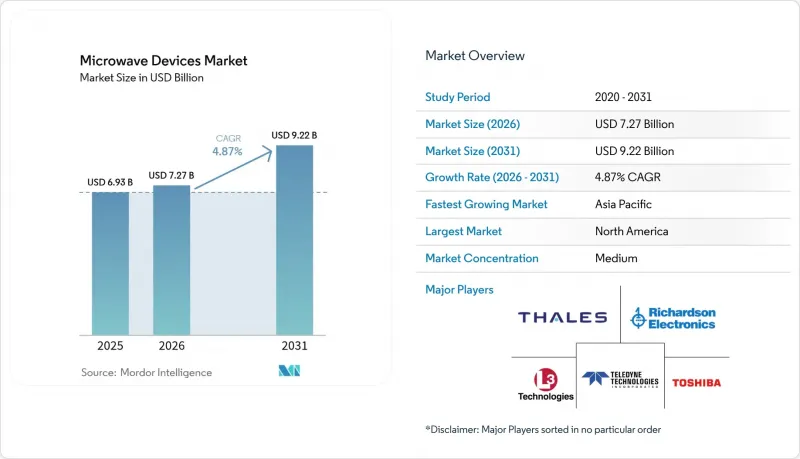
根據 Mordor Intelligence 估計,微波設備市場規模從 2025 年的 69.3 億美元成長到 2026 年的 72.7 億美元,預計到 2031 年將達到 92.2 億美元。
預計從 2026 年到 2031 年,其複合年成長率將達到 4.87%。
本報告按元件類型(主動元件[固體、真空電子元件]和被動元件[濾波器、耦合器等])、頻段(L波段和S波段、C波段和X波段等)、應用(空間和通訊、國防[雷達、電子戰、定向能量武器]、醫療[消融、成像]等)和地區進行分類。
全球微波裝置市場趨勢及洞察
對安全軍用衛星通訊(SATCOM)的需求激增
現代軍事網路需要抗干擾的通訊鏈路和多頻段通用性。美國陸軍近期部署了模組化VSAT終端,並與L3Harris公司簽訂了一份價值6000萬美元的契約,這表明軍事領域正朝著兼具高速數據傳輸和快速部署能力的緊湊型系統發展。氮化鎵(GaN)放大器能夠實現目前所需的功率等級和頻寬,加速了真空管的淘汰。同時,中國在吉瓦級高功率微波(HPM)武器方面的同步投資,正在推動一場技術競賽,使國防採購管道保持活躍。
在E頻段和V頻段部署5G和FWA回程傳輸
在光纖成本仍然高漲的地區,固定無線回程傳輸可提供Gigabit級吞吐量。美國聯邦通訊委員會 (FCC) 90 億美元的農村 5G 基金正在支撐對 E 波段和 V 波段鏈路的短期需求。衛星也是推動需求的重要力量。 SpaceX 公司訂單1,970 萬美元的 E 波段固體功率放大器,證實了高頻微波有效載荷的商業化部署。
寬能隙裝置的研發成本很高
用於氮化鎵和碳化矽的外延反應器市場價值數千萬美元,這造成了很高的進入門檻。主要供應商將15-20%的收入用於製程最佳化,這使得新參與企業很難克服這一障礙。
細分市場分析
截至2025年,主動元件將佔微波元件市場61.75%的佔有率,並將在2031年之前以7.42%的複合年成長率成長。尺寸、重量和可靠性方面的優勢正在加速氮化鎵(GaN)固體功率放大器取代真空電子裝置。預計到2031年,微波元件市場中被動元件的市場規模將達到65.6億美元。整合化趨勢使得波束成形和增益控制邏輯能夠整合到放大器晶片中,從而實現軟體定義無線電(SDR)平台。真空管產品仍在高功率雷達中使用,但隨著固體模組在國防專案中成為標準配置,其市場佔有率正在下降。
次生效應也波及到被動元件領域,隨著功能整合到晶片上,分立濾波器和耦合器面臨價格壓力。在醫療消融平台中,能夠實現毫秒級輸出調製的主動解決方案更受青睞,這進一步鞏固了該領域的長期成長勢頭。產品平臺顯示,為支援新興的5G宏無線電架構,市場對24V和28V氮化鎵裝置的需求不斷成長。
區域分析
即使到了2025年,北美仍將維持37.60%的市佔率。這得益於聯邦政府90億美元的5G補貼和強勁的美國國防預算。微波裝置市場持續受益於定向能量武器項目和遍遠地區寬頻發展。儘管遵守出口許可法規會帶來成本方面的阻力,但主要廠商仍在堅持在地採購策略,以降低供應中斷的風險。
預計到2031年,亞太地區的複合年成長率將達到7.01%,位居全球之首。中國控制全球98%的鎵礦開採,使得國內晶圓廠擁有成本優勢,同時也使海外系統整合商面臨價格波動風險。該地區各國政府正在資助興建300毫米功率半導體晶圓廠,而印度新成立的設計公司正在壯大射頻前端創新人才隊伍。韓國和日本則透過提供先進的測試和封裝能力,不斷強化其自給自足的價值鏈。
在歐洲,各國正努力在國防需求與商業通訊發展之間尋求平衡。歐盟的政策獎勵旨在實現氮化鎵(GaN)外延和封裝能力的在地化。跨大西洋夥伴關係有助於降低地緣政治風險,因為歐洲的射頻設計將在北美晶圓廠進行試生產,之後才會大規模生產回流到國內生產線。永續性指令正在進一步加速網路營運商向節能型氮化鎵平台轉型,以應用於新的5G和未來的6G節點。
其他好處:
- Excel格式的市場預測(ME)表
- 3個月的分析師支持
目錄
第1章:引言
- 研究假設和市場定義
- 調查範圍
第2章:調查方法
第3章執行摘要
第4章 市場狀況
- 市場概覽
- 市場促進因素
- 對安全軍用衛星通訊(SATCOM)的需求正在激增。
- 在E頻段和V頻段部署5G和FWA回程傳輸
- 醫用微波消融術的應用現狀
- 基於氮化鎵的固體功率放大器的成本正在下降。
- 農村地區寬頻監管獎勵
- 高功率定向能武器系統的需求
- 市場限制因素
- 寬能隙裝置的研發成本很高
- 關鍵射頻組件的出口限制
- 100 GHz 以上的溫度控管限制
- 在X-haul領域與光子鏈路的競爭
- 價值鏈分析
- 監理情勢
- 技術展望
- 波特五力分析
第5章 市場規模與成長預測
- 依設備類型
- 主動式(固體、真空電子)
- 被動元件(濾波器、耦合器等)
- 按頻段
- L波段和S波段
- C波段和X波段
- Ku 和 Ka
- V 和 E(毫米波)
- 透過使用
- 空間與通訊
- 防禦(雷達、電子戰、防禦性武器)
- 藥物治療(消融術、影像學檢查)
- 商業和工業供暖
- 按地區
- 北美洲
- 美國
- 加拿大
- 墨西哥
- 南美洲
- 巴西
- 阿根廷
- 其他南美國家
- 歐洲
- 英國
- 法國
- 德國
- 義大利
- 其他歐洲國家
- 亞太地區
- 中國
- 日本
- 印度
- 韓國
- 其他亞太國家
- 中東和非洲
- 阿拉伯聯合大公國
- 沙烏地阿拉伯
- 南非
- 其他中東和非洲國家
- 北美洲
第6章 競爭情勢
- 市場集中度
- 策略趨勢
- 市佔率分析
- 公司簡介
- Communications and Power Industries(CPI)
- Teledyne Technologies
- Thales Group
- L3Harris Technologies
- Toshiba Corporation
- Qorvo Inc.
- Analog Devices Inc.
- Keysight Technologies
- TMD Technologies Ltd.
- Richardson Electronics Ltd.
- Northrop Grumman
- Raytheon Technologies
- MACOM Technology
- Microchip Technology
- Cobham Advanced Electronic Solutions
- NXP Semiconductors
- API Technologies(AEA Investors LP)
- Smiths Interconnect
- Ampleon
- MicroWave Technology Inc.
第7章 市場機會與未來展望
According to Mordor Intelligence, microwave devices market size in 2026 is estimated at USD 7.27 billion, growing from 2025 value of USD 6.93 billion with 2031 projections showing USD 9.22 billion, growing at 4.87% CAGR over 2026-2031.
This report is Segmented by Device Type (Active [Solid-State, Vacuum Electron] and Passive [Filters, Couplers, Etc. ]), Frequency Band (L and S, C and X, and More), Application (Space and Communication, Defense [Radar, EW, DEW], , Medical [Ablation, Imaging] and More), and Geography.
Global Microwave Devices Market Trends and Insights
Surge in Secure Military SATCOM Demand
Modern armed-forces networks require jam-resilient links and multi-band versatility. Recent U.S. Army fielding of modular VSAT terminals, backed by a USD 60 million contract with L3Harris, illustrates the shift toward compact systems that merge high data rates with quick deployment. GaN amplifiers enable the power levels and bandwidth now specified, speeding the retirement of vacuum tubes. Parallel Chinese investment in gigawatt-class high-power microwave (HPM) weapons fuels a technology race that keeps defense procurement pipelines active.
5G and FWA Backhaul Deployment in E- and V-Bands
Fixed-wireless backhaul offers gigabit-class throughput where fiber costs remain prohibitive. The FCC's USD 9 billion 5G Fund for Rural America anchors near-term demand for E- and V-band links. Satellites add another pull: a USD 19.7 million order from SpaceX for E-band solid-state power amplifiers affirms commercial scale for high-frequency microwave payloads.
High R&D Cost of Wide-Bandgap Devices
Epitaxial reactors for GaN and SiC run into the tens of millions of dollars, creating high entry barriers. Leading suppliers devote 15-20% of turnover to process optimization, a hurdle few new entrants can clear.
Other drivers and restraints analyzed in the detailed report include:
- Medical Microwave Ablation Adoption
- GaN-Based Solid-State PA Cost Declines
- Export Controls on Critical RF Components
For complete list of drivers and restraints, kindly check the Table Of Contents.
Segment Analysis
Active devices accounted for 61.75% of the microwave devices market in 2025 and advanced at a 7.42% CAGR to 2031. Size, weight, and reliability advantages are accelerating the swap from vacuum electron devices to GaN solid-state power amplifiers. The Microwave devices market size for active devices is on track to reach USD 6.56 billion by 2031. Integration trends fold beam-forming and gain-control logic into the amplifier die, enabling software-defined radio platforms. Vacuum tube products still serve ultra-high-power radar, but cede volume share as defense programs standardize on solid-state modules.
Second-level effects cascade into the passive segment, where discrete filters and couplers face pricing pressure as functions move on-chip. Medical ablation platforms prefer active solutions for millisecond-scale power modulation, reinforcing the segment's long-term growth trajectory. Product pipelines show rising demand for 24 V and 28 V GaN devices that align with emerging 5G macro radio architectures.
Complete Report Scope:
- By Device Type
- Active (Solid-state, Vacuum Electron)
- Passive (Filters, Couplers, etc.)
- By Frequency Band
- L and S
- C and X
- Ku and Ka
- V and E (mmWave)
- By Application
- Space and Communication
- Defense (Radar, EW, DEW)
- Medical (Ablation, Imaging)
- Commercial and Industrial Heating
- By Geography
- North America
- United States
- Canada
- Mexico
- South America
- Brazil
- Argentina
- Rest of South America
- Europe
- United Kingdom
- France
- Germany
- Italy
- Rest of Europe
- Asia Pacific
- China
- Japan
- India
- South Korea
- Rest of Asia Pacific
- Middle East and Africa
- United Arab Emirates
- Saudi Arabia
- South Africa
- Rest of Middle East and Africa
- North America
Geography Analysis
North America retained a 37.60% stake in 2025, anchored by USD 9 billion in federal 5G subsidies and strong U.S. defense budgets. The microwave devices market continues to benefit from directed-energy weapon programs and rural broadband build-outs. Export-license compliance introduces cost friction, but established primes sustain local sourcing strategies that cushion supply disruptions.
Asia Pacific delivers the highest 7.01% CAGR to 2031. China controls 98% of mined gallium, giving domestic fabs cost leverage while exposing foreign integrators to price volatility. Regional governments fund 300 mm power-semiconductor fabs, and India's newly opened design houses add talent depth for RF front-end innovation. South Korea and Japan supply advanced test and packaging capacity, reinforcing a self-contained value chain.
Europe balances sovereign defense needs with commercial telecom expansion. EU policy incentives aim to localize GaN epitaxy and packaging capacity. Cross-Atlantic partnerships send European RF designs to North American fabs for pilot runs, then bring volume back to domestic lines, mitigating geopolitical risk. Sustainability directives further nudge network operators toward energy-efficient GaN platforms in new 5G and future 6G nodes.
- Communications and Power Industries (CPI)
- Teledyne Technologies
- Thales Group
- L3Harris Technologies
- Toshiba Corporation
- Qorvo Inc.
- Analog Devices Inc.
- Keysight Technologies
- TMD Technologies Ltd.
- Richardson Electronics Ltd.
- Northrop Grumman
- Raytheon Technologies
- MACOM Technology
- Microchip Technology
- Cobham Advanced Electronic Solutions
- NXP Semiconductors
- API Technologies (AEA Investors LP)
- Smiths Interconnect
- Ampleon
- MicroWave Technology Inc.
Additional Benefits:
- The market estimate (ME) sheet in Excel format
- 3 months of analyst support
TABLE OF CONTENTS
1 INTRODUCTION
- 1.1 Study Assumptions and Market Definition
- 1.2 Scope of the Study
2 RESEARCH METHODOLOGY
3 EXECUTIVE SUMMARY
4 MARKET LANDSCAPE
- 4.1 Market Overview
- 4.2 Market Drivers
- 4.2.1 Surge in secure military SATCOM demand
- 4.2.2 5G and FWA backhaul deployment in E- and V-bands
- 4.2.3 Medical microwave ablation adoption
- 4.2.4 GaN-based solid-state PA cost declines
- 4.2.5 Regulatory incentives for rural broadband
- 4.2.6 Demand for high-power DEW systems
- 4.3 Market Restraints
- 4.3.1 High RandD cost of wide-bandgap devices
- 4.3.2 Export controls on critical RF components
- 4.3.3 Thermal management limits at >100 GHz
- 4.3.4 Competition from photonic links in X-haul
- 4.4 Value Chain Analysis
- 4.5 Regulatory Landscape
- 4.6 Technological Outlook
- 4.7 Porter's Five Forces Analysis
- 4.7.1 Threat of New Entrants
- 4.7.2 Bargaining Power of Buyers
- 4.7.3 Bargaining Power of Suppliers
- 4.7.4 Threat of Substitutes
- 4.7.5 Competitive Rivalry
5 MARKET SIZE AND GROWTH FORECASTS (VALUE)
- 5.1 By Device Type
- 5.1.1 Active (Solid-state, Vacuum Electron)
- 5.1.2 Passive (Filters, Couplers, etc.)
- 5.2 By Frequency Band
- 5.2.1 L and S
- 5.2.2 C and X
- 5.2.3 Ku and Ka
- 5.2.4 V and E (mmWave)
- 5.3 By Application
- 5.3.1 Space and Communication
- 5.3.2 Defense (Radar, EW, DEW)
- 5.3.3 Medical (Ablation, Imaging)
- 5.3.4 Commercial and Industrial Heating
- 5.4 By Geography
- 5.4.1 North America
- 5.4.1.1 United States
- 5.4.1.2 Canada
- 5.4.1.3 Mexico
- 5.4.2 South America
- 5.4.2.1 Brazil
- 5.4.2.2 Argentina
- 5.4.2.3 Rest of South America
- 5.4.3 Europe
- 5.4.3.1 United Kingdom
- 5.4.3.2 France
- 5.4.3.3 Germany
- 5.4.3.4 Italy
- 5.4.3.5 Rest of Europe
- 5.4.4 Asia Pacific
- 5.4.4.1 China
- 5.4.4.2 Japan
- 5.4.4.3 India
- 5.4.4.4 South Korea
- 5.4.4.5 Rest of Asia Pacific
- 5.4.5 Middle East and Africa
- 5.4.5.1 United Arab Emirates
- 5.4.5.2 Saudi Arabia
- 5.4.5.3 South Africa
- 5.4.5.4 Rest of Middle East and Africa
- 5.4.1 North America
6 COMPETITIVE LANDSCAPE
- 6.1 Market Concentration
- 6.2 Strategic Moves
- 6.3 Market Share Analysis
- 6.4 Company Profiles (includes Global level Overview, Market level overview, Core Segments, Financials as available, Strategic Information, Market Rank/Share for key companies, Products and Services, and Recent Developments)
- 6.4.1 Communications and Power Industries (CPI)
- 6.4.2 Teledyne Technologies
- 6.4.3 Thales Group
- 6.4.4 L3Harris Technologies
- 6.4.5 Toshiba Corporation
- 6.4.6 Qorvo Inc.
- 6.4.7 Analog Devices Inc.
- 6.4.8 Keysight Technologies
- 6.4.9 TMD Technologies Ltd.
- 6.4.10 Richardson Electronics Ltd.
- 6.4.11 Northrop Grumman
- 6.4.12 Raytheon Technologies
- 6.4.13 MACOM Technology
- 6.4.14 Microchip Technology
- 6.4.15 Cobham Advanced Electronic Solutions
- 6.4.16 NXP Semiconductors
- 6.4.17 API Technologies (AEA Investors LP)
- 6.4.18 Smiths Interconnect
- 6.4.19 Ampleon
- 6.4.20 MicroWave Technology Inc.
7 MARKET OPPORTUNITIES AND FUTURE OUTLOOK
- 7.1 White-space and Unmet-need Assessment

 高功率微波裝置市場報告:趨勢、預測與競爭分析(至2035年)
 微波裝置市場-2026-2032年全球市場預測
 全球工業微波市場(2027-2037 年)
 微波裝置市場規模、佔有率、趨勢和預測:按產品類型、頻率、應用和地區分類,2026-2034年全球微波裝置市場規模、佔有率、趨勢和成長分析報告(2026-2034)微波裝置市場規模、佔有率、成長及全球產業分析:按類型、應用和地區的洞察,2026-2034年的預測頻率合成器市場:按類型、技術、頻率範圍、應用和銷售管道分類-2026-2032年全球市場預測
 微波裝置市場分析及預測(至2035年):依類型、產品、技術、組件、應用、最終用戶、功能、安裝類型及設備分類
 2026年全球微波元件市場報告
 微波裝置市場-全球產業規模、佔有率、趨勢、機會及預測(按類型、頻率、應用、地區及競爭格局分類,2021-2031年)