


 |
市場調查報告書
商品編碼
2122051
超吸收性聚合物(SAP):市場佔有率分析、產業趨勢與統計、成長預測(2026-2031)Super Absorbent Polymers (SAP) - Market Share Analysis, Industry Trends & Statistics, Growth Forecasts (2026 - 2031) |
||||||

※ 本網頁內容可能與最新版本有所差異。詳細情況請與我們聯繫。
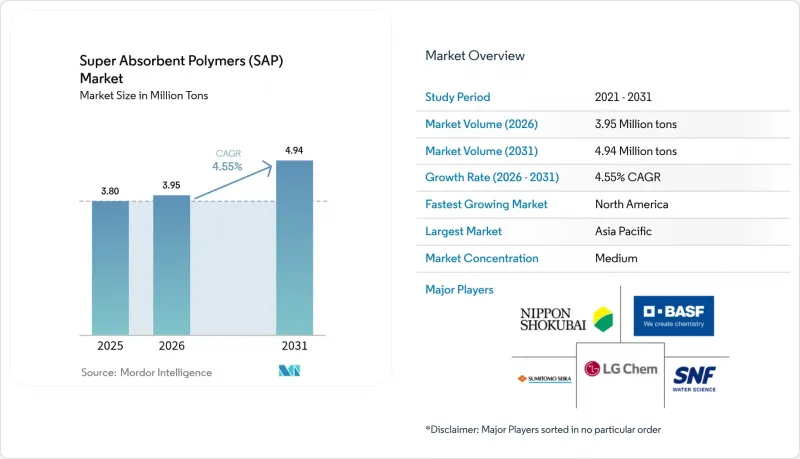
根據 Mordor Intelligence 預測,超吸收性聚合物 (SAP) 的市場規模預計將從 2025 年的 380 萬噸成長到 2026 年的 395 萬噸,到 2031 年達到 494 萬噸,2026 年至 2031 年的複合年成長率為 4.5%。
本報告按產品類型(聚丙烯醯胺、丙烯酸基及其他)、聚合工藝(溶液聚合及其他)、應用領域(嬰兒尿布及其他)、終端用戶行業(個人護理和衛生用品製造商、農產品供應商及其他)以及地區(亞太地區、北美地區及其他)進行細分。市場預測以噸為單位。
全球超吸收性聚合物(SAP)市場趨勢與洞察
中國和印度人均一次性尿布支出增加
在印度,隨著嬰兒護理產品商品和服務稅(GST)在2024年降至18%,預計到2025年,一次性尿布的消費將達到17.4億美元。這將使品牌尿布即使在二、三線城市也能更實惠。在中國,由於大型電商平台將訂閱服務與會員折扣結合,預計到2025年,嬰兒尿布的普及率將達到70%。這將使每片尿布的平均吸水樹脂(聚丙烯醯胺)用量從8克增加到12克,這一成長主要得益於超薄芯材的普及。國內供應商,例如衛星化學,正在擴大其特殊聚丙烯醯胺生產線,以滿足這一高階市場的需求。同時,跨國公司正在廣東和江蘇省的尿布工廠附近安裝新的吸水樹脂反應器,以縮短前置作業時間並減少庫存。這些協同效應,加上亞洲消費者越來越傾向於選擇每張紙含 SAP 含量較高的產品,使得超吸收性聚合物市場維持長期擴張的趨勢。
高吸水性成人尿墊在亞洲和歐洲迅速普及
2024年,日本65歲及以上人口比例超過29.1%,韓國擴大了國民健康保險對失禁用品的覆蓋範圍,使消費者自付費用減少了約40%。歐洲國家也面臨類似的人口老化趨勢,德國和義大利的老年人口比例都超過20%。製造商紛紛推出含有15-20克高吸收性聚合物(SAP)並採用表面交聯技術、可吸收800毫升以上液體的「活力生活方式」型尿墊。這種設計便於夜間使用,並減少了更換頻率。雖然降低殘餘單體含量目標(低於300ppm)增加了生產流程的複雜性,但也使品牌能夠獲得10-15%的溢價。因此,這一人口趨勢正推動高吸收性聚合物市場向更高價值的成人護理等級發展。
丙烯酸原料價格波動
2024年,受裂解裝置意外停產的影響,東北亞丙烯酸現貨價格在每噸1,200美元至1,600美元之間波動。此外,2025年初,由於煉油廠削減丙烯的特定產品產量,歐洲合約價格較上季上漲8%。非一體化SAP加工商缺乏談判能力,難以簽訂多年單體契約,導致其利潤率每季下降150-200個基點。由此引發的產業重組導致贏創將其SAP業務部門出售給ICIG,三洋化學於2024年退出該領域。這表明,擴大規模和後向整合對於超吸收性聚合物市場的生存至關重要。
細分市場分析
丙烯酸基超吸水聚合物(SAP)的溶脹能力超過300 g/g,且與高速尿布生產線完美相容,預計2025年將佔出貨量的72.54%。聚丙烯醯胺類超吸水聚合物預計將持續成長,年複合成長率(CAGR)為6.67%,直到2031年,這主要得益於農業供應商對交聯網路的需求,這種網路即使在長期乾旱條件下也能保持水分。澱粉接枝和纖維素水凝膠由於凝膠強度較低且酵素預處理成本較高,在尿布領域的應用有限,因此仍屬於小眾市場。印度和澳洲的政府補貼政策正在促進聚丙烯醯胺土壤改良劑的使用,進一步拓展了超吸水聚合物的需求基礎。
在高階市場,化學融合技術正蓬勃發展。日本紙尿褲品牌指定使用表面交聯的丙烯酸類高吸水性聚合物(SAP),並添加少量天然多醣,以增強吸液性能並減少殘留單體。隨著功能性的不斷改進,供應商能夠獲得更高的利潤率並加強客戶忠誠度,從而使高吸水性聚合物市場免受純粹的大宗商品價格波動的影響。
預計到2025年,凝膠聚合將佔總產能的60.64%,因為它只需一步即可生產高溶脹性顆粒,避免了成本高昂的研磨工序。然而,溶液聚合正以5.18%的複合年成長率穩步成長,因為衛生棉和薄型尿布的生產商需要粒徑小於150微米的顆粒,以實現均勻的芯材結構且不產生粉塵。此外,溶液聚合反應器可在生產過程中將殘留單體濃度控制在200 ppm以下,無需額外的清洗步驟,從而滿足嬰幼兒產品更嚴格的安全標準。
資本投資規模存在差異。例如,建造一條年產3萬噸的水平帶式凝膠生產線需要超過5000萬美元的投資,而改用溶液法製程雖然可以使用現有的間歇式反應器,但會增加溶劑回收所需的能源消耗。這種權衡取捨正在影響超吸收性聚合物市場的競爭格局,企業需要在規模經濟和柔軟性之間做出選擇。
區域分析
亞太地區佔據市場主導地位,預計2025年將佔全球產量的42.59%,這主要得益於中國尿布需求的成長以及日本養老產業的蓬勃發展。在印度,隨著都市區核心家庭對便利的育兒產品的接受度提高,一次性尿布零售市場規模擴大至17.4億美元。儘管該地區的複合年成長率較過去十年有所放緩,但由於每片尿布的吸水性成分(SAP)使用量增加,即使出生率持平,市場依然保持強勁成長。
到2025年,歐洲市佔率將維持在20%左右。從《廢棄物框架指令》到各國生產者延伸責任制(EPR)收費等監管趨勢,正迫使加工商轉向使用可堆肥的芯材和可回收的包裝材料。儘管研發成本不斷增加,但超吸收性聚合物(SAP)市場正準備分階段向生物基等級過渡。在老年照護覆蓋率接近100%的北歐國家,一些試點計畫正在研發將SAP與透氣內襯相結合的高階成人紙尿褲,以兼顧皮膚健康,這反映出市場越來越重視產品的附加價值而非數量。
在北美,預計到2031年複合年成長率將達到5.59%,美國玉米帶精密農業的普及正在推動市場成長。玉米田間試驗證實,SAP土壤改良劑可減少30%至50%的灌溉用水。生物製藥冷鏈的擴展也進一步促進了市場成長,吸水墊已成為藥品「最後一公里」配送的標準配置。雖然南美洲、中東和非洲的市場佔有率仍處於個位數,但部分地區已呈現顯著成長。在巴西,中產階級的崛起帶動了尿布需求的成長;在沙烏地阿拉伯,光纖網路的擴展也增加了對防水線的需求。在南非,SAP正在試驗應用於保護易受乾旱影響的玉米種植區。
其他好處:
- Excel格式的市場預測(ME)表
- 3個月的分析師支持
目錄
第1章:引言
- 研究假設和市場定義
- 調查範圍
第2章:調查方法
第3章執行摘要
第4章 市場狀況
- 市場概覽
- 市場促進因素
- 中國和印度人均一次性尿布支出增加
- 高吸水性成人尿墊在亞洲和歐洲迅速普及
- 受電子商務的推動,對吸水性冷鏈墊的需求激增。
- 5G光纜的鋪設推動了對SAP防潮紗線的需求。
- 利用SAP水凝膠的垂直農業種植介質
- 市場限制因素
- 丙烯酸原料價格波動
- 嬰兒尿布中殘留單體的安全隱患
- 由於其生物分解性有限,它給掩埋帶來了越來越大的負擔。
- 價值鏈分析
- 波特五力模型
第5章 市場規模與成長預測
- 依產品類型
- 聚丙烯醯胺
- 丙烯酸基
- 其他
- 透過聚合過程
- 溶液聚合
- 懸浮聚合/反向懸浮聚合
- 凝膠聚合
- 透過使用
- 嬰兒尿布
- 成人失禁護理產品
- 女性用衛生用品
- 農業支持
- 其他用途
- 按最終用戶行業分類
- 個人護理和衛生用品製造商
- 農業材料供應商
- 醫療服務提供方
- 其他終端用戶產業(電信和電力電纜製造商、食品和藥品冷鏈物流)
- 按地區
- 亞太地區
- 中國
- 日本
- 印度
- 韓國
- 其他亞太國家
- 北美洲
- 美國
- 加拿大
- 墨西哥
- 歐洲
- 德國
- 英國
- 法國
- 義大利
- 西班牙
- 北歐的
- 其他歐洲國家
- 南美洲
- 巴西
- 阿根廷
- 其他南美國家
- 中東和非洲
- 沙烏地阿拉伯
- 南非
- 埃及
- 奈及利亞
- 其他中東和非洲國家
- 亞太地區
第6章 競爭情勢
- 市場集中度
- 策略趨勢
- 市佔率和排名分析
- 公司簡介
- ADM
- BASF
- Braskem
- Chase Corp.
- Chemtex Speciality Limited
- Formosa Plastics Group
- LG Chem
- NIPPON SHOKUBAI CO., LTD.
- SANYO CHEMICAL INDUSTRIES, LTD.
- SAP SE
- Satellite Chemical
- SNF
- SONGWON
- SUMITOMO SEIKA CHEMICALS CO.,LTD.
- TOYO BOEKI Co.,Ltd.
- Wanhua
- Yixing Danson Technology
第7章 市場機會與未來展望
According to Mordor Intelligence, the super absorbent polymers market size is projected to grow from 3.80 million tons in 2025 to 3.95 million tons in 2026, and reach 4.94 million tons by 2031, growing at a CAGR of 4.55% from 2026 to 2031.
This report is Segmented by Product Type (Polyacrylamide, Acrylic Acid Based, and Others), Polymerization Process (Solution, and More), Application (Baby Diapers, and More), End-User Industry (Personal Care and Hygiene Manufacturers, Agriculture Input Suppliers, and More), and Geography (Asia-Pacific, North America, and More). Market Forecasts are Provided in Terms of Volume (Tons).
Global Super Absorbent Polymers (SAP) Market Trends and Insights
Rising Per-Capita Diaper Spend in China and India
India's disposable diaper outlays reached USD 1.74 billion in 2025 after the Goods and Services Tax on baby-care items was cut to 18% in 2024, making branded diapers more affordable for tier-two and tier-three cities. China's infant-diaper penetration rose to 70% in 2025 as leading e-commerce platforms bundled subscription deliveries with loyalty discounts that raised average SAP loading per diaper from 8 grams to 12 grams, a jump driven by the shift to ultra-thin cores. Domestic suppliers such as Satellite Chemical have been scaling specialty polyacrylamide lines to serve this premium segment, while multinationals co-locate new SAP reactors next to diaper plants in Guangdong and Jiangsu to shorten lead times and cut inventory. The combined effect keeps the Super absorbent polymers market on a secular expansion path as Asian consumers trade up to higher SAP weights per article.
Rapid Adoption of High-SAP Adult Incontinence Pads in Asia and Europe
Japan's population aged 65 plus crossed 29.1% in 2024, and South Korea widened National Health Insurance reimbursement for incontinence supplies, trimming consumer out-of-pocket expense by roughly 40%. European nations face a parallel aging trend, with Germany and Italy crossing the 20% threshold of seniors. Manufacturers are rolling out "active-lifestyle" pads containing 15-20 grams of SAP and using surface-cross-linking to hold more than 800 milliliters without leakage, a design that supports overnight use and fewer changes. Lower residual monomer targets-below 300 ppm-add process complexity yet allow brands to command 10-15% price premiums. This demographic tide is therefore steering the super absorbent polymers market toward higher-value adult-care grades.
Volatile Acrylic-Acid Feedstock Prices
Northeast Asian acrylic-acid spot quotes swung between USD 1,200 and USD 1,600 per ton in 2024 after unplanned cracker outages, and European contracts climbed 8% quarter-on-quarter in early 2025 as refiners throttled propylene co-product output. Non-integrated SAP converters lack bargaining power for multi-year monomer deals, so margin compression reaches 150-200 basis points in a single quarter. The resulting shake-out saw Evonik sell its SAP unit to ICIG and Sanyo Chemical exit the field in 2024, evidence that scale and backward integration are prerequisites for survival in the super absorbent polymers market.
Other drivers and restraints analyzed in the detailed report include:
- E-Commerce-Led Demand Spike for Absorbent Cold-Chain Pads
- 5G Cable Roll-Outs Driving SAP Water-Blocking Yarn Demand
- Residual-Monomer Safety Concerns in Infant Diapers
For complete list of drivers and restraints, kindly check the Table Of Contents.
Segment Analysis
Acrylic-acid SAP captured 72.54% shipment share in 2025, owing to swelling capacity above 300 g/g and seamless fit with high-speed diaper lines. Polyacrylamide grades are pacing ahead at 6.67% CAGR to 2031 as agriculture suppliers seek cross-linked networks that hold water through extended droughts. Starch-graft and cellulose hydrogels remain niche because lower gel strength limits diaper use, and enzyme pretreatment inflates cost. Government subsidies in India and Australia encourage polyacrylamide soil conditioners, reinforcing a diversified demand base for the super absorbent polymers market.
Blended chemistries are emerging at the premium end: Japanese diaper brands specify surface-cross-linked acrylic SAP interspersed with natural polysaccharides to speed fluid uptake and lower residual monomer. With each functional tweak, suppliers secure higher margins and deepen customer lock-in, cushioning the Super absorbent polymers market from pure commodity pricing cycles.
Gel polymerization held 60.64% of 2025 capacity because it produces high-swelling particles in a single pass and avoids costly grinding. Yet solution polymerization is on a 5.18% CAGR trajectory as feminine-pad and thin-diaper makers request sub-150 micron particles that deliver uniform cores without dusting. Solution reactors also hit residual monomer below 200 ppm in-process, saving an extra washing step and aligning with tighter safety targets for infant products.
Capital profiles diverge: horizontal belt gel plants require more than USD 50 million for a 30 kt/yr line, whereas solution retrofits can leverage existing batch reactors but consume more energy due to solvent recovery. This trade-off sets the competitive tempo as firms choose between scale economies and flexibility within the superabsorbent polymers market.
Complete Report Scope:
- By Product Type
- Polyacrylamide
- Acrylic Acid Based
- Others
- By Polymerization Process
- Solution Polymerization
- Suspension/Inverse-Suspension Polymerization
- Gel Polymerization
- By Application
- Baby Diapers
- Adult Incontinence Products
- Feminine Hygiene
- Agriculture Support
- Other Application
- By End-User Industry
- Personal Care and Hygiene Manufacturers
- Agriculture Input Suppliers
- Healthcare Providers
- Other End-use Industries (Telecom and Power Cable Makers and Food and Pharmaceutical Cold-Chain Logistics)
- Geography
- Asia-Pacific
- China
- Japan
- India
- South Korea
- Rest of Asia-Pacific
- North America
- United States
- Canada
- Mexico
- Europe
- Germany
- United Kingdom
- France
- Italy
- Spain
- Nordics
- Rest of Europe
- South America
- Brazil
- Argentina
- Rest of South America
- Middle-East and Africa
- Saudi Arabia
- South Africa
- Egypt
- Nigeria
- Rest of Middle-East and Africa
- Asia-Pacific
Geography Analysis
Asia-Pacific dominated with 42.59% of 2025 volume, led by China's diaper uptick and Japan's elderly-care boom. India's disposable diaper retail climbed toward USD 1.74 billion as urban nuclear families adopted convenient baby-care products. Regional CAGR moderated versus the last decade, yet remains solid because SAP intensity per diaper rises even as birth rates flatten.
Europe held a mid-twenties share in 2025. Regulatory momentum-from the Waste Framework Directive to national EPR fees-pushes converters toward compostable cores and recycled packaging, adding research and development cost but positioning the super absorbent polymers market for a gradual pivot to bio-based grades. Nordic countries, with near-universal senior-care coverage, are testing premium adult pads that blend SAP with breathable back-sheets for skin health, reinforcing value over volume.
North America, forecast at 5.59% CAGR through 2031, benefits from precision-ag training in the U.S. Corn Belt where SAP soil conditioners cut irrigation 30-50% in maize field trials. Biologics cold-chain expansion adds another tailwind as absorbent pads become standard in last-mile pharmaceutical parcels. South America and the Middle East and Africa represent single-digit shares yet are notable for pockets of high growth: Brazil's rising middle class lifts diaper uptake, Saudi Arabia's fiber-optic expansion needs water-blocking yarns, and South Africa trials SAPs to buffer drought-prone maize zones.
- ADM
- BASF
- Braskem
- Chase Corp.
- Chemtex Speciality Limited
- Formosa Plastics Group
- LG Chem
- NIPPON SHOKUBAI CO., LTD.
- SANYO CHEMICAL INDUSTRIES, LTD.
- SAP SE
- Satellite Chemical
- SNF
- SONGWON
- SUMITOMO SEIKA CHEMICALS CO.,LTD.
- TOYO BOEKI Co.,Ltd.
- Wanhua
- Yixing Danson Technology
Additional Benefits:
- The market estimate (ME) sheet in Excel format
- 3 months of analyst support
TABLE OF CONTENTS
1 Introduction
- 1.1 Study Assumptions and Market Definition
- 1.2 Scope of the Study
2 Research Methodology
3 Executive Summary
4 Market Landscape
- 4.1 Market Overview
- 4.2 Market Drivers
- 4.2.1 Rising per-capita diaper spend in China and India
- 4.2.2 Rapid adoption of high-SAP adult incontinence pads in Asia and Europe
- 4.2.3 E-commerce-led demand spike for absorbent cold-chain pads
- 4.2.4 5G cable roll-outs driving SAP water-blocking yarn demand
- 4.2.5 Vertical-farming substrates seeking SAP hydrogels
- 4.3 Market Restraints
- 4.3.1 Volatile acrylic-acid feedstock prices
- 4.3.2 Residual-monomer safety concerns in infant diapers
- 4.3.3 Limited biodegradability adding landfill pressure
- 4.4 Value Chain Analysis
- 4.5 Porter's Five Forces
- 4.5.1 Bargaining Power of Suppliers
- 4.5.2 Bargaining Power of Buyers
- 4.5.3 Threat of New Entrants
- 4.5.4 Threat of Substitutes
- 4.5.5 Intensity of Rivalry
5 Market Size and Growth Forecasts (Volume)
- 5.1 By Product Type
- 5.1.1 Polyacrylamide
- 5.1.2 Acrylic Acid Based
- 5.1.3 Others
- 5.2 By Polymerization Process
- 5.2.1 Solution Polymerization
- 5.2.2 Suspension/Inverse-Suspension Polymerization
- 5.2.3 Gel Polymerization
- 5.3 By Application
- 5.3.1 Baby Diapers
- 5.3.2 Adult Incontinence Products
- 5.3.3 Feminine Hygiene
- 5.3.4 Agriculture Support
- 5.3.5 Other Application
- 5.4 By End-User Industry
- 5.4.1 Personal Care and Hygiene Manufacturers
- 5.4.2 Agriculture Input Suppliers
- 5.4.3 Healthcare Providers
- 5.4.4 Other End-use Industries (Telecom and Power Cable Makers and Food and Pharmaceutical Cold-Chain Logistics)
- 5.5 Geography
- 5.5.1 Asia-Pacific
- 5.5.1.1 China
- 5.5.1.2 Japan
- 5.5.1.3 India
- 5.5.1.4 South Korea
- 5.5.1.5 Rest of Asia-Pacific
- 5.5.2 North America
- 5.5.2.1 United States
- 5.5.2.2 Canada
- 5.5.2.3 Mexico
- 5.5.3 Europe
- 5.5.3.1 Germany
- 5.5.3.2 United Kingdom
- 5.5.3.3 France
- 5.5.3.4 Italy
- 5.5.3.5 Spain
- 5.5.3.6 Nordics
- 5.5.3.7 Rest of Europe
- 5.5.4 South America
- 5.5.4.1 Brazil
- 5.5.4.2 Argentina
- 5.5.4.3 Rest of South America
- 5.5.5 Middle-East and Africa
- 5.5.5.1 Saudi Arabia
- 5.5.5.2 South Africa
- 5.5.5.3 Egypt
- 5.5.5.4 Nigeria
- 5.5.5.5 Rest of Middle-East and Africa
- 5.5.1 Asia-Pacific
6 Competitive Landscape
- 6.1 Market Concentration
- 6.2 Strategic Moves
- 6.3 Market Share(%)/Ranking Analysis
- 6.4 Company Profiles (includes Global Overview, Market Overview, Core Segments, Financials, Strategic Info, Products and Services, Recent Developments)
- 6.4.1 ADM
- 6.4.2 BASF
- 6.4.3 Braskem
- 6.4.4 Chase Corp.
- 6.4.5 Chemtex Speciality Limited
- 6.4.6 Formosa Plastics Group
- 6.4.7 LG Chem
- 6.4.8 NIPPON SHOKUBAI CO., LTD.
- 6.4.9 SANYO CHEMICAL INDUSTRIES, LTD.
- 6.4.10 SAP SE
- 6.4.11 Satellite Chemical
- 6.4.12 SNF
- 6.4.13 SONGWON
- 6.4.14 SUMITOMO SEIKA CHEMICALS CO.,LTD.
- 6.4.15 TOYO BOEKI Co.,Ltd.
- 6.4.16 Wanhua
- 6.4.17 Yixing Danson Technology
7 Market Opportunities and Future Outlook
- 7.1 White-space and Unmet-Need Assessment
- 7.2 Commercial Scale-up of 100 % Bio-Based SAP

 亞太地區超吸收性聚合物(SAP):市場佔有率分析、產業趨勢與統計及成長預測(2026-2031)
 超吸收性聚合物市場:2026-2032年全球市場預測(依產品、產品類型、形態、應用及銷售管道)
 2026-2030年全球超吸收性聚合物市場
 超吸收性聚合物(SAP)市場規模、佔有率、趨勢和預測:按類型、應用、製造方法和地區分類,2026-2034年
 超吸收性材料市場規模、佔有率和成長分析:按材料類型、製造流程、應用、產品形式、分銷管道和地區分類-2026-2033年產業預測
 超吸收性聚合物市場:按類型、應用和地區分類
 超吸收性聚合物技術市場分析及預測(至2035年):按類型、產品、應用、最終用戶、技術、形態、材料類型、功能和製程分類
 全球超吸收性聚合物市場規模、佔有率、趨勢和成長分析報告(2026-2034年)
 2026年全球超吸收性聚合物市場報告
 可吸收聚合物市場-全球產業規模、佔有率、趨勢、機會、預測:按類型、應用、區域和競爭格局分類,2021-2031年