


 |
市場調查報告書
商品編碼
2113429
亞太地區超吸收性聚合物(SAP):市場佔有率分析、產業趨勢與統計及成長預測(2026-2031)Asia-Pacific Superabsorbent Polymers (SAP) - Market Share Analysis, Industry Trends & Statistics, Growth Forecasts (2026 - 2031) |
||||||

※ 本網頁內容可能與最新版本有所差異。詳細情況請與我們聯繫。
根據 Mordor Intelligence 預測,亞太地區超吸收性聚合物市場預計將從 2025 年的 188 萬噸成長到 2026 年的 200 萬噸,到 2031 年將達到 275 萬噸,2026 年至 2031 年的複合年成長率為 6.51%。
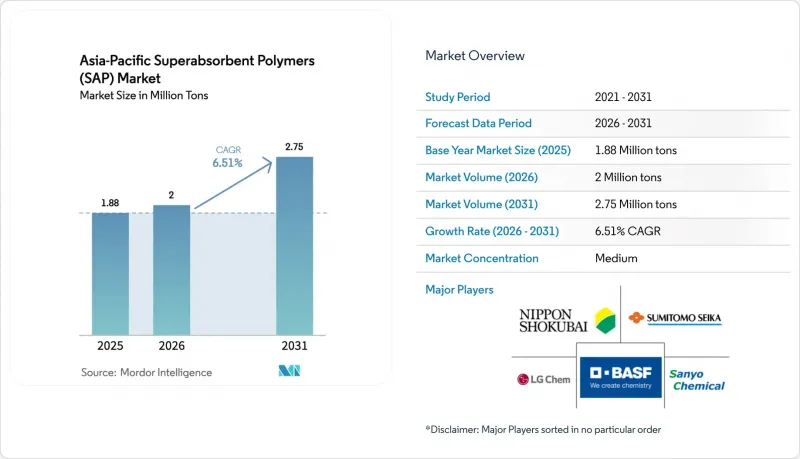
本報告按產品類型(聚丙烯醯胺基、丙烯酸基及其他)、應用領域(嬰兒尿布、成人失禁用品、女性用衛生用品、農業材料及其他)和地區(中國、印度、日本、韓國、澳洲和紐西蘭以及其他亞太地區)進行細分。市場預測以噸為單位。
亞太地區超吸收性聚合物(SAP)市場趨勢及洞察。
衛生意識的提高和可支配收入的增加
在中國和印度的農村地區,家庭收入的成長正推動著人們從使用布製品轉向使用拋棄式紙尿褲。雖然在許多三線城市,一次性紙尿褲的普及率仍低於15%,但正迅速趕上沿海地區90%以上的平均值。Unicharm Corp在古吉拉突邦新建的工廠預計將使其在印度的國內產量提高50%。同時,金佰利公司投資5,000萬美元的南京三期專案計畫於2025年9月竣工,屆時將新增四條生產線以滿足內陸需求。政府進行的衛生意識宣傳活動鞏固了農村地區紙尿褲的使用,根據1.2至1.5的收入彈性估計值,GDP成長將直接轉化為超吸收性聚合物消費量的增加。跨國公司為了享受稅收優惠而將生產本地化,但仍依賴本地採購的、針對更薄核心材料客製化的超吸收性聚合物。儘管存在短期宏觀經濟週期波動,但這種成長要素在中期內依然強勁。
人口快速老化正在推高成人失禁用品的需求。
在日本這個成熟市場,成人拉拉褲的銷售量已經超過了嬰兒紙尿褲;而在韓國,預計到2070年,65歲及以上人口的比例將達到46.4%。成人拉拉褲的單價比嬰兒紙尿褲高出30%至50%,這為擁有卓越防滲漏和除臭化學技術的SAP供應商創造了有利條件。隨著人口老化加劇,類似的趨勢也開始在大都會圈出現。這種需求結構的轉變更有利於擁有先進表面處理技術的製造商,而非通用型產品製造商。著眼長遠,現有企業可以將研發資源投入高利潤率的產品上,同時維持嬰兒紙尿褲的銷售量。
丙烯酸原料價格波動
中國丙烯酸現貨價格從2022年2月的每噸15,800元人民幣跌至2022年12月的每噸6,550元人民幣,擠壓了與尿布固定合約掛鉤的SAP生產商的利潤空間。BASF和長虹聚合物新建的丙烯酸酯生產設施將在2026年前新增超過45萬噸的產能,或許能緩解價格飆升,但在產業整合完成之前,價格波動帶來的風險仍然顯著。三洋化學在2024年3月因虧損16億日圓而退出市場,凸顯了非整合生產商的脆弱性。儘管避險策略和丙烷基丙烯酸生產路線或許能減輕短期負面影響,但價格波動仍將使預期成長下調1.1個百分點。
細分市場分析
預計到2025年,聚丙烯醯胺將佔亞太地區總產量的25.74%,複合年成長率達6.08%,成為亞太地區超吸收性聚合物市場中成長最快的化學品。丙烯酸類產品憑藉其卓越的吸水性和保水性,目前仍主導著高階嬰幼兒及成人紙尿褲市場,但在價格敏感的農業和女性用衛生用品等細分市場,其市場佔有率正被聚丙烯醯胺蠶食。
製造商正在改進丙烯酸基吸水樹脂(SAP)的表面處理技術,以減少凝膠堵塞並實現更薄的尿布芯。這對於旨在降低單片尿布成本的平價品牌至關重要。日本觸媒株式會社(Nippon Shokubai)於2022年進行的全球工廠維修,使工廠生產率提高了約10%,這清楚地表明,成熟企業正致力於提高製程效率以鞏固其市場佔有率。在BAYSE等試驗計畫的推動下,生物基或纖維素接枝吸水樹脂正實現兩位數的成長。這一趨勢表明,配方將逐步轉變而非快速替換,未來十年,傳統化學品和新興化學品的供應鏈將並存。
其他好處:
- Excel格式的市場預測(ME)表
- 3個月的分析師支持
目錄
第1章:引言
- 研究假設和市場定義
- 調查範圍
第2章:調查方法
第3章執行摘要
第4章 市場狀況
- 市場概覽
- 市場促進因素
- 衛生意識的提高和可支配收入的增加
- 由於人口老化速度加快,對成人失禁用品的需求正在擴大。
- 擴大亞太地區(APAC)尿布產能
- 政府鼓勵使用SAP水凝膠的節水農業
- 向生物基SAP化學技術過渡
- 市場限制因素
- 丙烯酸原料價格波動
- 石油衍生SAP的環境與處置問題
- 關於吸收性衛生用品中微塑膠的法規即將訂定。
- 價值鏈分析
- 波特五力模型
第5章 市場規模與成長預測
- 依產品類型
- 聚丙烯醯胺
- 丙烯酸基
- 其他
- 透過使用
- 嬰兒尿布
- 成人失禁護理產品
- 女性用衛生用品
- 農業支持
- 其他
- 按地區
- 中國
- 印度
- 日本
- 韓國
- 澳洲和紐西蘭
- 其他亞太國家
第6章 競爭情勢
- 市場集中度
- 策略趨勢
- 市佔率/排名分析
- 公司簡介
- ADM
- BASF SE
- Chemtex Speciality Limited
- Evonik Industries AG
- Formosa Plastics Group(Nan Ya Plastics)
- Gel Frost Packs Kalyani Enterprises
- Kao Corporation
- LG Chem
- NIPPON SHOKUBAI CO.,LTD.
- Qingdao SOCO New Material Co.,Ltd.
- SANYO CHEMICAL, LTD.
- Satellite Chemical Co., Ltd.
- Shandong Nuoer Biological Technology
- SNF Floerger
- SUMITOMO SEIKA CHEMICALS CO.,LTD.
- Wanhua Chemical Group Co., Ltd.
- Yixing Danson Technology
- Zhejiang Satellite Petrochemical
第7章 市場機會與未來展望
According to Mordor Intelligence, the Asia-Pacific superabsorbent polymers market size is expected to grow from 1.88 million tons in 2025 to 2 million tons in 2026 and is forecast to reach 2.75 million tons by 2031 at a 6.51% CAGR over 2026-2031.
This report is Segmented by Product Type (Polyacrylamide, Acrylic Acid Based, and Others), Application (Baby Diapers, Adult Incontinence Products, Feminine Hygiene, Agriculture Support, and Others), and Geography (China, India, Japan, South Korea, Australia and New Zealand, and Rest of Asia-Pacific). The Market Forecasts are Provided in Terms of Volume (Tons).
Asia-Pacific Superabsorbent Polymers (SAP) Market Trends and Insights
Rising Hygiene Awareness And Disposable Incomes
Lower-tier cities in China and India are switching from cloth to disposables as household incomes rise, keeping penetration below 15% in many Tier-3 districts but creating a steep catch-up path to coastal averages above 90%. Unicharm's new Gujarat plant will lift its Indian output by 50%, while Kimberly-Clark's USD 50 million Nanjing Phase III project, due September 2025, adds four lines aimed at inland demand. Government sanitation campaigns have normalized diaper use even in rural settings, and income elasticity estimates between 1.2 and 1.5 signal that GDP expansion translates directly into superabsorbent polymer offtake. Multinationals localize production for fiscal advantages, yet still rely on regionally sourced SAP grades customized for thinner cores. The driver's medium-term runway remains intact despite near-term macro cycles.
Rapid Aging Population Boosting Adult Incontinence Product Demand
Japan's mature market already sells more adult pants than baby diapers, and South Korea's 65-plus cohort is on track to hit 46.4% by 2070. Adult briefs command unit prices 30%-50% higher than baby products, rewarding SAP suppliers capable of low-rewet, odor-control chemistries. Chinese urban centers are beginning to shift in the same direction as population aging accelerates. This demand mix change favors producers with advanced surface-treatment know-how over commodity players. Long-term visibility allows incumbents to allocate research and development toward high-margin grades even while defending baby-diaper volumes.
Volatile Acrylic Acid Feedstock Pricing
Spot acrylic acid in China fell from CNY 15,800 per ton in February 2022 to CNY 6,550 by December 2022, squeezing margins for SAP makers tied to fixed diaper contracts. New acrylate units from BASF and Changhong Polymer will add more than 450 kilotons of capacity by 2026, potentially tempering spikes, but exposure remains acute until integration spreads. Sanyo Chemical's March 2024 exit after a JPY 1.6 billion loss spotlights how non-integrated producers are most vulnerable. Hedging strategies and propane-based acrylic routes may mitigate the short-term drag, yet pricing volatility still subtracts 1.1 percentage points from forecast growth.
Other drivers and restraints analyzed in the detailed report include:
- Expansion Of Diaper Manufacturing Capacity Within APAC
- Government Incentives For Water-Saving Agriculture Using SAP Hydrogels
- Environmental And End-Of-Life Concerns For Petro-Based SAP
For complete list of drivers and restraints, kindly check the Table Of Contents.
Segment Analysis
Polyacrylamide captured 25.74% of regional volume in 2025 and is on track for a 6.08% CAGR, giving it the fastest growth among established chemistries in the Asia-Pacific superabsorbent polymers market. Acrylic-acid grades still dominate premium baby and adult briefs thanks to superior absorption and retention, but they concede price-sensitive agricultural and feminine-care niches to polyacrylamide.
Producers enhance acrylic-acid SAP through surface-treatment upgrades that cut gel-blocking and enable thinner diaper cores, a key requirement for value brands pushing down gram-per-piece costs. Nippon Shokubai's 2022 global retrofit that lifted plant productivity by roughly 10% underscores how incumbents lean on process gains to defend share. Bio-based or cellulose-grafted SAP posts double-digit growth, helped by pilot launches such as BAYSE. The trajectory suggests a gradual mix shift rather than a sudden displacement, so supply chains for both legacy and emerging chemistries will coexist through the decade.
Complete Report Scope:
- By Product Type
- Polyacrylamide
- Acrylic Acid based
- Others
- By Application
- Baby Diapers
- Adult Incontinence Products
- Feminine Hygiene
- Agriculture Support
- Others
- By Geography
- China
- India
- Japan
- South Korea
- Australia and New Zealand
- Rest of Asia-Pacific
List of Companies Covered in this Report:
- ADM
- BASF SE
- Chemtex Speciality Limited
- Evonik Industries AG
- Formosa Plastics Group (Nan Ya Plastics)
- Gel Frost Packs Kalyani Enterprises
- Kao Corporation
- LG Chem
- NIPPON SHOKUBAI CO.,LTD.
- Qingdao SOCO New Material Co.,Ltd.
- SANYO CHEMICAL, LTD.
- Satellite Chemical Co., Ltd.
- Shandong Nuoer Biological Technology
- SNF Floerger
- SUMITOMO SEIKA CHEMICALS CO.,LTD.
- Wanhua Chemical Group Co., Ltd.
- Yixing Danson Technology
- Zhejiang Satellite Petrochemical
Additional Benefits:
- The market estimate (ME) sheet in Excel format
- 3 months of analyst support
TABLE OF CONTENTS
1 Introduction
- 1.1 Study Assumptions and Market Definition
- 1.2 Scope of the Study
2 Research Methodology
3 Executive Summary
4 Market Landscape
- 4.1 Market Overview
- 4.2 Market Drivers
- 4.2.1 Rising hygiene awareness and disposable incomes
- 4.2.2 Rapid ageing population boosting adult-incontinence product demand
- 4.2.3 Expansion of diaper manufacturing capacity within APAC
- 4.2.4 Government incentives for water-saving agriculture using SAP hydrogels
- 4.2.5 Shift toward bio-based SAP chemistries
- 4.3 Market Restraints
- 4.3.1 Volatile acrylic-acid feedstock pricing
- 4.3.2 Environmental and end-of-life concerns for petro-based SAP
- 4.3.3 Looming micro-plastics regulations on absorbent hygiene products
- 4.4 Value Chain Analysis
- 4.5 Porter's Five Forces
- 4.5.1 Bargaining Power of Suppliers
- 4.5.2 Bargaining Power of Buyers
- 4.5.3 Threat of New Entrants
- 4.5.4 Threat of Substitutes
- 4.5.5 Degree of Competition
5 Market Size and Growth Forecasts (Volume)
- 5.1 By Product Type
- 5.1.1 Polyacrylamide
- 5.1.2 Acrylic Acid based
- 5.1.3 Others
- 5.2 By Application
- 5.2.1 Baby Diapers
- 5.2.2 Adult Incontinence Products
- 5.2.3 Feminine Hygiene
- 5.2.4 Agriculture Support
- 5.2.5 Others
- 5.3 By Geography
- 5.3.1 China
- 5.3.2 India
- 5.3.3 Japan
- 5.3.4 South Korea
- 5.3.5 Australia and New Zealand
- 5.3.6 Rest of Asia-Pacific
6 Competitive Landscape
- 6.1 Market Concentration
- 6.2 Strategic Moves
- 6.3 Market Share/Ranking Analysis
- 6.4 Company Profiles (includes Global level Overview, Market level overview, Core Segments, Financials as available, Strategic Information, Market Rank/Share for key companies, Products and Services, and Recent Developments)
- 6.4.1 ADM
- 6.4.2 BASF SE
- 6.4.3 Chemtex Speciality Limited
- 6.4.4 Evonik Industries AG
- 6.4.5 Formosa Plastics Group (Nan Ya Plastics)
- 6.4.6 Gel Frost Packs Kalyani Enterprises
- 6.4.7 Kao Corporation
- 6.4.8 LG Chem
- 6.4.9 NIPPON SHOKUBAI CO.,LTD.
- 6.4.10 Qingdao SOCO New Material Co.,Ltd.
- 6.4.11 SANYO CHEMICAL, LTD.
- 6.4.12 Satellite Chemical Co., Ltd.
- 6.4.13 Shandong Nuoer Biological Technology
- 6.4.14 SNF Floerger
- 6.4.15 SUMITOMO SEIKA CHEMICALS CO.,LTD.
- 6.4.16 Wanhua Chemical Group Co., Ltd.
- 6.4.17 Yixing Danson Technology
- 6.4.18 Zhejiang Satellite Petrochemical
7 Market Opportunities and Future Outlook
- 7.1 White-space and unmet-need assessment

 超吸收性聚合物(SAP):市場佔有率分析、產業趨勢與統計、成長預測(2026-2031)
 超吸收性聚合物市場:2026-2032年全球市場預測(依產品、產品類型、形態、應用及銷售管道)
 2026-2030年全球超吸收性聚合物市場
 超吸收性聚合物(SAP)市場規模、佔有率、趨勢和預測:按類型、應用、製造方法和地區分類,2026-2034年
 超吸收性材料市場規模、佔有率和成長分析:按材料類型、製造流程、應用、產品形式、分銷管道和地區分類-2026-2033年產業預測
 超吸收性聚合物市場:按類型、應用和地區分類
 超吸收性聚合物技術市場分析及預測(至2035年):按類型、產品、應用、最終用戶、技術、形態、材料類型、功能和製程分類
 全球超吸收性聚合物市場規模、佔有率、趨勢和成長分析報告(2026-2034年)
 2026年全球超吸收性聚合物市場報告
 可吸收聚合物市場-全球產業規模、佔有率、趨勢、機會、預測:按類型、應用、區域和競爭格局分類,2021-2031年