


 |
市場調查報告書
商品編碼
2122044
數位行銷軟體:市場佔有率分析、產業趨勢與統計、成長預測(2026-2031)Digital Marketing Software - Market Share Analysis, Industry Trends & Statistics, Growth Forecasts (2026 - 2031) |
||||||

※ 本網頁內容可能與最新版本有所差異。詳細情況請與我們聯繫。
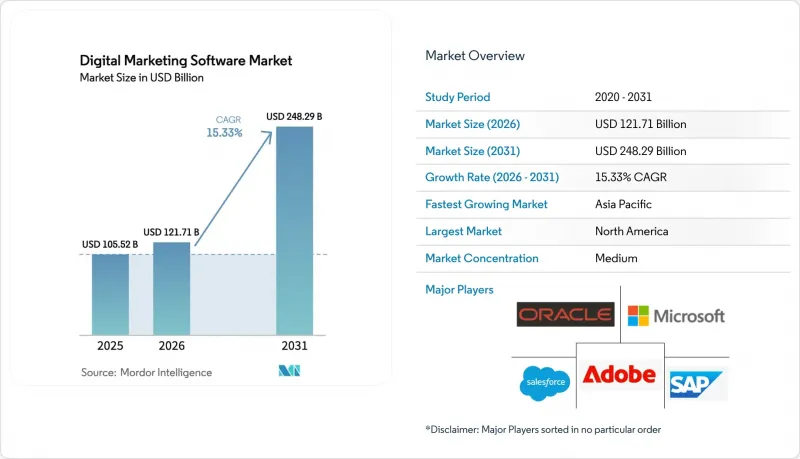
根據 Mordor Intelligence 預測,數位行銷軟體市場預計將從 2025 年的 1,055.2 億美元成長到 2026 年的 1,217.1 億美元,到 2031 年達到 2,482.9 億美元,2026 年至 2031 年的複合年成長率預計為 15.33%。
本報告按部署類型(雲端和本地部署)、組件(軟體和服務)、最終用戶公司規模(大型企業和中小企業)、最終用戶產業(IT與電信、媒體與娛樂等)以及地區(北美、歐洲、亞太、南美、中東和非洲)進行細分。市場預測以美元計價。
全球數位行銷軟體市場趨勢與洞察
人工智慧驅動的內容和宣傳活動最佳化
生成式模型將創新製作前置作業時間從數週縮短至數小時,使行銷人員能夠大規模創建在地化廣告、電子郵件序列和落地頁,而無需相應增加人員。 Adobe 計劃於 2025 年將 Firefly 引擎整合到 Experience Cloud 中,並表示早期採用者可降低 20-30% 的創新成本。 Salesforce 正在銷售團隊 Cloud 中提供 Einstein GPT,在與零售和金融服務客戶的試驗計畫中,郵件開啟率提高了 15-25%。擁有龐大產品目錄的行業,例如服裝、食品雜貨和消費電子產品行業,受益最大,因為一旦 SKU 數量超過一定限度,手動創建素材將變得十分困難。然而,資料科學技能仍然稀缺,促使供應商將平台進入許可權與 AI 策略研討會打包,並透過託管服務實現盈利。這些服務的附加價值解釋了為什麼業務收益的成長速度超過了純軟體訂閱收入。
零方資料和無 Cookie 個人化
隨著 Chrome 計畫在 2026 年下半年徹底淘汰 Cookie,行銷人員被迫將重點轉移到透過偏好中心、問卷調查和忠誠度計畫收集的自願資料上。像 Sephora 和 Nike 這樣的零售商在 2025 年增強了其偏好中心,與基於 Cookie 的用戶群組相比,電子郵件點擊率提高了 18% 至 22%。歐洲《數位市場法案》的實施規範了使用者同意的語言。雖然這增加了合規成本,但也為統一的資料收集流程提供了法律基礎。將同意管理與客戶資料平台 (CDP) 功能整合的平台(例如 OneTrust、TrustArc、Adobe 和 Salesforce)的合約續約率有所提高,而缺乏原生同意管理流程的獨立解決方案則存在延遲風險,從而阻礙了即時個人化。
與傳統行銷技術(Martech)堆疊整合的複雜性。
企業通常經營 15 到 30 個獨立的行銷工具,每增加一個 API 或架構不一致,都會增加維護負擔。十年前建置的單體套件往往缺乏模組化、API 優先的設計,迫使 IT 團隊創建脆弱的連接器,這些連接器會隨著供應商的更新而失效。金融服務和醫療保健機構面臨的挑戰更大,因為審計追蹤和資料處理歷程追蹤必須涵蓋所有系統。 Segment 和 mParticle 等供應商提供的可組合 CDP 架構為標準資料管道鋪平了道路,但由於現有的 ERP 和 CRM 部署抵制結構性變革,這些架構的採用速度緩慢。因此,高昂的整合成本成為切換供應商的障礙,這也支撐了現有供應商的續約率,即使他們在功能豐富度方面落後於新參與企業。
細分市場分析
到2025年,雲端服務將佔據數位行銷軟體市場69.47%的佔有率,預計到2031年將以15.41%的複合年成長率成長。這反映了新買家傾向減少自身資產的趨勢。微軟在2025年新增了5000多個Dynamics 365 Marketing帳戶,其中許多帳戶是從本地系統遷移過來的。雖然在資料居住至關重要的監管行業中,本地部署仍然佔據一席之地,但混合架構正在模糊傳統系統與雲端之間的界限:敏感標識符保留在本地,而分析和宣傳活動執行則外包給雲端。
邊緣部署正在形成新的第三大支柱,尤其是在對延遲高度敏感的個人化場景中,例如自助銷售團隊終端建議和應用程式內優惠,這些場景下網路往返延遲是不可接受的。 Salesforce 和 Adobe 都在試點邊緣快取技術,將輕量級客戶資料儲存在本地,並有望在真實的互動環境中實現毫秒級的決策。隨著邊緣部署的普及,由邊緣節點驅動的數位行銷軟體市場規模預計在五年內形成獨立的收入來源。
到2025年,軟體授權收入仍將佔總收入的60.13%,但部署、整合、培訓和行銷宣傳活動管理等服務領域正以16.13%的複合年成長率快速成長。為了滿足Adobe、 銷售團隊和Oracle等公司的部署需求,Accenture在2025年新增2,000名行銷技術領域的專家。由於模型調優、特徵工程和MLOps監管等工作超出了傳統專案的範圍,因此高度依賴人工智慧的專案定價更高。
供應商正擴大將客戶引導和成功經理服務納入訂閱計劃,將一次性費用轉化為經常性服務收入。這種模式穩定了每月經常性收入,並簡化了偏好單一發票客戶的採購流程。從長遠來看,服務附加合約或許能夠降低毛利率的波動,但對於缺乏全球服務交付網路的供應商而言,也增加了產能管理的風險。
區域分析
到2025年,北美將佔全球銷售額的35.54%。由於市場日趨成熟,許多財富500強企業正將原本分散的系統架構精簡為兩到三個核心平台。目前的成長趨勢正轉向最佳化模組,例如人工智慧驅動的資產生成、即時客戶數據平台(CDP)和旅程分析,以及在加拿大和墨西哥的中型企業部署。加州的《加州隱私權法案》(CPRA)已將隱私權工程列為首要任務,即將推出的《美國資料隱私和保護法案》有望加強聯邦監管。在美墨加走廊內,跨境資料流動仍然相對順暢,這加速了區域供應商的部署。
亞太地區預計到2031年將以16.27%的複合年成長率成長,增速超過其他任何地區,這主要得益於印度、印尼、越南和菲律賓等國「行動優先」的商務模式。隨著智慧型手機普及率超過70%,可支配收入不斷成長,廣告預算正從社群網路競標轉向能夠最大化依賴風險的自有行銷雲端平台。在中國,由於《個人資訊保護法》(PIPL)的在地化要求,本土供應商佔據市場主導地位;而日本和韓國企業則擴大採用具有更強合規能力的全球套件。東協新創公司傾向於「按需付費」的定價收費,這使得該地區成為分階段推廣模式的試驗場,這些模式最終可能會滲透到成熟市場。
預計到2025年,歐洲將佔全球支出的約28%。由於GDPR(一般資料保護規則)嚴格的同意要求,對具備審計追蹤和地理資料隔離功能的平台的需求仍然強勁。德國、法國和英國仍然是最大的貢獻者,而北歐國家相對於其人口而言,人工智慧模組的採用率非常高。南歐國家由於基礎設施陳舊和IT預算有限而落後,但得益於旅遊和零售業的數位化項目,這一差距正在縮小。中東和土耳其正根據各自的多元化發展計畫進行投資,而巴西儘管面臨貨幣波動,但仍是南美市場需求的主要驅動力。新興的非洲市場依靠行動支付基礎設施參與數位商務,為輕量級、雲端原生套件產品提供了巨大的成長潛力。
其他好處:
- Excel格式的市場預測(ME)表
- 3個月的分析師支持
目錄
第1章:引言
- 研究假設和市場定義
- 調查範圍
第2章:調查方法
第3章執行摘要
第4章 市場狀況
- 市場概覽
- 市場促進因素
- 「數位化優先」客戶旅程的激增
- 雲端原生SaaS的成本優勢
- 人工智慧驅動的內容和宣傳活動最佳化
- B2C 和 B2B 對全通路互動的需求
- 零方資料和無 Cookie 個人化
- 將「一鍵式」行銷整合到垂直產業SaaS和付款管道中
- 市場限制因素
- 與傳統行銷技術堆疊整合的複雜性。
- 與資料隱私和同意管理相關的合規成本
- 豐富第一方資料的單位成本不斷上升
- 人工智慧驅動的宣傳活動設計領域客戶體驗人才短缺
- 產業價值鏈分析
- 監理情勢
- 技術展望
- 宏觀經濟因素對市場的影響
- 波特五力分析
第5章 市場規模與成長預測
- 不同的發展
- 雲
- 現場
- 按組件
- 軟體
- 服務
- 按最終用戶公司規模分類
- 大公司
- 小型企業
- 按最終用戶行業分類
- IT/通訊
- 媒體與娛樂
- BFSI
- 零售與電子商務
- 製造業
- 醫療保健和生命科學
- 其他終端用戶產業
- 按地區
- 北美洲
- 美國
- 加拿大
- 墨西哥
- 歐洲
- 德國
- 英國
- 法國
- 義大利
- 西班牙
- 俄羅斯
- 其他歐洲國家
- 亞太地區
- 中國
- 日本
- 印度
- 韓國
- ASEAN
- 澳洲和紐西蘭
- 其他亞太國家
- 南美洲
- 巴西
- 阿根廷
- 其他南美國家
- 中東
- 沙烏地阿拉伯
- UAE
- 土耳其
- 其他中東國家
- 非洲
- 南非
- 奈及利亞
- 其他非洲國家
- 北美洲
第6章 競爭情勢
- 市場集中度
- 策略趨勢
- 市佔率分析
- 公司簡介
- Adobe Inc.
- Salesforce Inc.
- Oracle Corporation
- SAP SE
- Microsoft Corporation
- Google LLC
- IBM Corporation
- HubSpot Inc.
- SAS Institute Inc.
- Teradata Corp.
- Criteo SA
- Infor Inc.
- ActiveCampaign LLC
- Klaviyo Inc.
- Intuit Inc.
- Brevo SAS
- Zoho Corporation
- Constant Contact
- Sitecore
- Acoustic, LP
- Insider Inc.
- Sprinklr
- Braze Inc.
- Shopify Inc.
- Hootsuite Inc.
- Block, Inc.
- GoDaddy Inc.
第7章 市場機會與未來展望
According to Mordor Intelligence, the digital marketing software market size is expected to increase from USD 105.52 billion in 2025 to USD 121.71 billion in 2026 and reach USD 248.29 billion by 2031, growing at a CAGR of 15.33% over 2026-2031.
This report is Segmented by Deployment (Cloud, and On-Premise), Component (Software, and Services), End-User Enterprise Size (Large Enterprises, and Small and Mid-Sized Enterprises), End-User Industry (IT and Telecom, Media and Entertainment, and More), and Geography (North America, Europe, Asia Pacific, South America, Middle East, Africa). The Market Forecasts are Provided in Terms of Value (USD).
Global Digital Marketing Software Market Trends and Insights
AI-Powered Content and Campaign Optimization
Generative models are collapsing creative-production timelines from weeks to hours, letting marketers spin up localized ads, email sequences, and landing pages at scale without proportional headcount increases. Adobe embedded its Firefly engine into Experience Cloud in 2025 and reported 20-30% lower creative costs among early enterprise adopters. Salesforce exposed Einstein GPT across Marketing Cloud, boosting open rates 15-25% during pilots with retail and financial-services clients. Sectors with extensive product catalogs, including apparel, grocery, and consumer electronics, gain the most because manual asset creation breaks down past certain SKU counts. Yet data-science skills remain scarce, so vendors are monetizing managed services that package platform access with AI-strategy workshops. This services overlay explains why services revenue is rising faster than pure software subscriptions.
Zero-Party Data and Cookieless Personalization
Full Chrome cookie deprecation slated for late 2026 is forcing marketers to pivot toward volunteered data captured through preference centers, quizzes, and loyalty programs. Retailers such as Sephora and Nike deepened preference-center functionality in 2025, lifting email click-through rates 18-22% versus cookie-based cohorts. European enforcement of the Digital Markets Act standardized consent language, increasing compliance costs but also giving legal cover for uniform data-collection flows. Platforms that bundle consent orchestration with CDP capabilities (OneTrust, TrustArc, Adobe, Salesforce) see stronger renewals, while point solutions without native consent pipes risk latency that undercuts real-time personalization.
Integration Complexity with Legacy Martech Stacks
Enterprises commonly run 15-30 discrete marketing tools, and every additional API or schema mismatch compounds maintenance overhead. Monolithic suites built a decade ago often lack modular, API-first design, forcing IT teams to craft brittle connectors that break on vendor updates. Financial-services and healthcare organizations face added hurdles because audit trails and lineage tracking must span every system. Composable CDP architectures from providers such as Segment and mParticle offer a path to standard data pipes, yet uptake is slow where entrenched ERP or CRM deployments resist structural change. High integration cost therefore acts as a switching deterrent, bolstering incumbent renewal rates even when feature depth lags newer entrants.
Other drivers and restraints analyzed in the detailed report include:
- Surge in Digital-First Customer Journeys
- Embedded One-Click Marketing in Vertical SaaS Platforms
- Data-Privacy and Consent-Management Compliance Costs
For complete list of drivers and restraints, kindly check the Table Of Contents.
Segment Analysis
Cloud-based offerings accounted for 69.47% of digital marketing software market share in 2025 and are on track for a 15.41% CAGR through 2031, reinforcing the asset-light preference of new buyers. Microsoft added more than 5,000 net-new Dynamics 365 Marketing accounts during 2025, many of which were migrating from on-premise systems. On-premise stacks linger in regulated verticals that mandate data residency, but hybrid architectures now route analytics and campaign execution to the cloud while retaining sensitive identifiers on-site, blurring historical boundaries.
Edge deployments form a nascent third pillar, particularly for latency-sensitive personalization scenarios such as kiosk recommendations or in-app offers that cannot tolerate round-trip network delays. Salesforce and Adobe both pilot edge caches that store lightweight customer profiles locally, promising millisecond-level decisioning at point of interaction. If adoption broadens, the digital marketing software market size attributable to edge nodes could carve out a distinct revenue stream within five years.
Software licenses still generated 60.13% of revenue in 2025, yet services lines such as implementation, integration, training, and managed campaigns are accelerating at a 16.13% CAGR. Accenture scaled its marketing-technology workforce by 2,000 specialists during 2025 to meet demand for Adobe, Salesforce, and Oracle rollouts. AI-heavy engagements command premiums because model tuning, feature engineering, and MLOps oversight exceed traditional configuration scope.
Vendors increasingly embed onboarding and success managers inside subscription tiers, converting one-time fees into recurring services annuities. This format stabilizes monthly recurring revenue and simplifies procurement for customers that prefer a single invoice. Over time, service-attached contracts could lift gross margin volatility, though they also raise capacity-management risk for vendors that lack global delivery footprints.
Complete Report Scope:
- By Deployment
- Cloud
- On-Premise
- By Component
- Software
- Services
- By End-User Enterprise Size
- Large Enterprises
- Small and Mid-Sized Enterprises
- By End-User Industry
- IT and Telecom
- Media and Entertainment
- BFSI
- Retail and E-Commerce
- Manufacturing
- Healthcare and Life Sciences
- Other End-User Industries
- By Geography
- North America
- United States
- Canada
- Mexico
- Europe
- Germany
- United Kingdom
- France
- Italy
- Spain
- Russia
- Rest of Europe
- Asia Pacific
- China
- Japan
- India
- South Korea
- ASEAN
- Australia and New Zealand
- Rest of Asia Pacific
- South America
- Brazil
- Argentina
- Rest of South America
- Middle East
- Saudi Arabia
- UAE
- Turkey
- Rest of Middle East
- Africa
- South Africa
- Nigeria
- Rest of Africa
- North America
Geography Analysis
North America contributed 35.54% of global revenue in 2025. Market maturity means most Fortune 500 companies have already rationalized sprawling stacks into two or three core platforms. Growth now pivots on optimization modules AI asset generation, real-time CDPs, and journey analytics and on mid-market rollouts in Canada and Mexico. California's CPRA keeps privacy engineering top of mind, while the pending American Data Privacy and Protection Act may add federal oversight. Cross-border data flows remain relatively smooth inside the United States-Mexico-Canada corridor, accelerating regional vendor deployments.
Asia Pacific is expanding at a 16.27% CAGR through 2031, faster than any other region, propelled by mobile-first commerce across India, Indonesia, Vietnam, and the Philippines. Smartphone penetration above 70% and rising disposable income are steering ad budgets from social-network auctions toward owned marketing clouds that minimize dependency risk. Domestic Chinese vendors dominate inside mainland borders due to PIPL localization mandates, yet Japanese and South Korean enterprises exhibit high adoption of global suites with localized compliance extensions. ASEAN startups gravitate to pay-as-you-grow pricing, making the region a laboratory for tiered usage models that could eventually filter into mature markets.
Europe accounted for roughly 28% of 2025 spend. GDPR enforces strict consent regimes, prompting steady demand for platforms with built-in audit trails and geographic data fences. Germany, France, and the United Kingdom remain the largest contributors, while the Nordics display outsized AI module uptake relative to population. Southern European adoption trails because of legacy infrastructure and smaller IT budgets, although tourism and retail digitization programs are narrowing the gap. The Middle East and Turkey are investing under national diversification plans, and Brazil anchors South American demand despite currency volatility. Africa's nascent markets rely on mobile-money rails to join digital commerce, offering greenfield upside for light-weight, cloud-native suites.
- Adobe Inc.
- Salesforce Inc.
- Oracle Corporation
- SAP SE
- Microsoft Corporation
- Google LLC
- IBM Corporation
- HubSpot Inc.
- SAS Institute Inc.
- Teradata Corp.
- Criteo SA
- Infor Inc.
- ActiveCampaign LLC
- Klaviyo Inc.
- Intuit Inc.
- Brevo SAS
- Zoho Corporation
- Constant Contact
- Sitecore
- Acoustic, L.P.
- Insider Inc.
- Sprinklr
- Braze Inc.
- Shopify Inc.
- Hootsuite Inc.
- Block, Inc.
- GoDaddy Inc.
Additional Benefits:
- The market estimate (ME) sheet in Excel format
- 3 months of analyst support
TABLE OF CONTENTS
1 INTRODUCTION
- 1.1 Study Assumptions and Market Definition
- 1.2 Scope of the Study
2 RESEARCH METHODOLOGY
3 EXECUTIVE SUMMARY
4 MARKET LANDSCAPE
- 4.1 Market Overview
- 4.2 Market Drivers
- 4.2.1 Surge in Digital-First Customer Journeys
- 4.2.2 Cloud-Native SaaS Cost Advantages
- 4.2.3 AI-Powered Content and Campaign Optimization
- 4.2.4 Omnichannel Engagement Demand from B2C and B2B
- 4.2.5 Zero-Party Data and Cookieless Personalization
- 4.2.6 Embedded "One-Click" Marketing in Vertical SaaS and Payments Platforms
- 4.3 Market Restraints
- 4.3.1 Integration Complexity with Legacy Martech Stacks
- 4.3.2 Data-Privacy and Consent-Management Compliance Costs
- 4.3.3 Rising Unit Prices for First-Party Data Enrichment
- 4.3.4 CX Talent Shortage for AI-Led Campaign Design
- 4.4 Industry Value Chain Analysis
- 4.5 Regulatory Landscape
- 4.6 Technological Outlook
- 4.7 Impact of Macroeconomic Factors on the Market
- 4.8 Porter's Five Forces Analysis
- 4.8.1 Threat of New Entrants
- 4.8.2 Bargaining Power of Buyers
- 4.8.3 Bargaining Power of Suppliers
- 4.8.4 Threat of Substitute Products
- 4.8.5 Intensity of Competitive Rivalry
5 MARKET SIZE AND GROWTH FORECASTS (VALUE)
- 5.1 By Deployment
- 5.1.1 Cloud
- 5.1.2 On-Premise
- 5.2 By Component
- 5.2.1 Software
- 5.2.2 Services
- 5.3 By End-User Enterprise Size
- 5.3.1 Large Enterprises
- 5.3.2 Small and Mid-Sized Enterprises
- 5.4 By End-User Industry
- 5.4.1 IT and Telecom
- 5.4.2 Media and Entertainment
- 5.4.3 BFSI
- 5.4.4 Retail and E-Commerce
- 5.4.5 Manufacturing
- 5.4.6 Healthcare and Life Sciences
- 5.4.7 Other End-User Industries
- 5.5 By Geography
- 5.5.1 North America
- 5.5.1.1 United States
- 5.5.1.2 Canada
- 5.5.1.3 Mexico
- 5.5.2 Europe
- 5.5.2.1 Germany
- 5.5.2.2 United Kingdom
- 5.5.2.3 France
- 5.5.2.4 Italy
- 5.5.2.5 Spain
- 5.5.2.6 Russia
- 5.5.2.7 Rest of Europe
- 5.5.3 Asia Pacific
- 5.5.3.1 China
- 5.5.3.2 Japan
- 5.5.3.3 India
- 5.5.3.4 South Korea
- 5.5.3.5 ASEAN
- 5.5.3.6 Australia and New Zealand
- 5.5.3.7 Rest of Asia Pacific
- 5.5.4 South America
- 5.5.4.1 Brazil
- 5.5.4.2 Argentina
- 5.5.4.3 Rest of South America
- 5.5.5 Middle East
- 5.5.5.1 Saudi Arabia
- 5.5.5.2 UAE
- 5.5.5.3 Turkey
- 5.5.5.4 Rest of Middle East
- 5.5.6 Africa
- 5.5.6.1 South Africa
- 5.5.6.2 Nigeria
- 5.5.6.3 Rest of Africa
- 5.5.1 North America
6 COMPETITIVE LANDSCAPE
- 6.1 Market Concentration
- 6.2 Strategic Moves
- 6.3 Market Share Analysis
- 6.4 Company Profiles (includes Global Level Overview, Market Level Overview, Core Segments, Financials as available, Strategic Information, Market Rank/Share for Key Companies, Products and Services, and Recent Developments)
- 6.4.1 Adobe Inc.
- 6.4.2 Salesforce Inc.
- 6.4.3 Oracle Corporation
- 6.4.4 SAP SE
- 6.4.5 Microsoft Corporation
- 6.4.6 Google LLC
- 6.4.7 IBM Corporation
- 6.4.8 HubSpot Inc.
- 6.4.9 SAS Institute Inc.
- 6.4.10 Teradata Corp.
- 6.4.11 Criteo SA
- 6.4.12 Infor Inc.
- 6.4.13 ActiveCampaign LLC
- 6.4.14 Klaviyo Inc.
- 6.4.15 Intuit Inc.
- 6.4.16 Brevo SAS
- 6.4.17 Zoho Corporation
- 6.4.18 Constant Contact
- 6.4.19 Sitecore
- 6.4.20 Acoustic, L.P.
- 6.4.21 Insider Inc.
- 6.4.22 Sprinklr
- 6.4.23 Braze Inc.
- 6.4.24 Shopify Inc.
- 6.4.25 Hootsuite Inc.
- 6.4.26 Block, Inc.
- 6.4.27 GoDaddy Inc.
7 MARKET OPPORTUNITIES AND FUTURE OUTLOOK
- 7.1 White-Space and Unmet-Need Assessment

 數位行銷平台市場:按行銷功能、部署類型、應用程式、最終用戶和地區分類
 2026-2030年全球數位行銷軟體(DMS)市場
 媒體測量軟體:市場佔有率分析、產業趨勢與統計、成長預測(2026-2031)
 重定向軟體市場-2026-2032年全球市場預測
 數位行銷軟體市場報告:按解決方案、服務、部署類型、企業規模、最終用途和地區分類(2026-2034 年)數位行銷軟體市場:按設備、收費類型、最終用戶產業、部署類型、組織規模分類,全球預測(2026-2032 年)
 2026年全球數位行銷軟體市場報告
 公關分析軟體市場分析及預測(至2035年):依類型、產品類型、服務、技術、元件、應用、部署類型、最終使用者及解決方案分類數位行銷軟體市場分析及預測(至 2035 年):按類型、產品類型、服務、技術、組件、應用、部署方式、最終用戶、解決方案分類
 全球數位行銷軟體市場規模、佔有率、趨勢和成長分析報告(2026-2034)