


 |
市場調查報告書
商品編碼
2117585
媒體測量軟體:市場佔有率分析、產業趨勢與統計、成長預測(2026-2031)Media Measurement Software - Market Share Analysis, Industry Trends & Statistics, Growth Forecasts (2026 - 2031) |
||||||

※ 本網頁內容可能與最新版本有所差異。詳細情況請與我們聯繫。
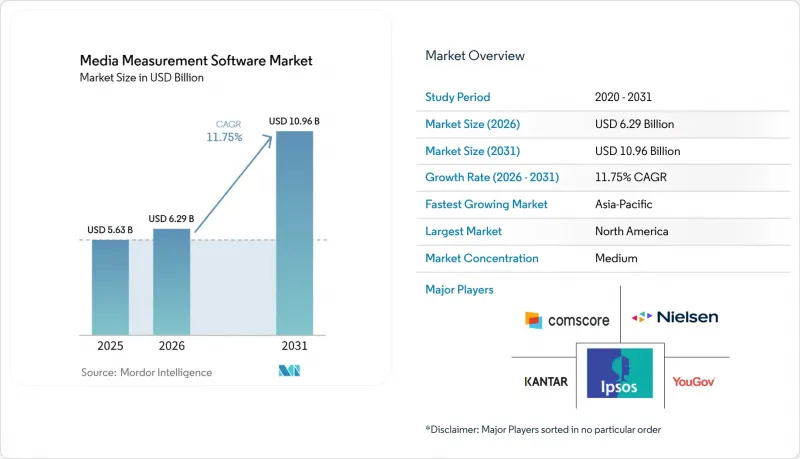
根據 Mordor Intelligence 預測,媒體測量軟體市場規模預計將在 2025 年達到 56.3 億美元,2026 年達到 62.9 億美元,並從 2026 年到 2031 年以 11.75% 的複合年成長率成長,到 2031 年達到 109.6 億美元。
本報告按部署類型(雲端部署和本地部署)、組織規模(大型企業和中小企業)、應用領域(受眾測量與分析、媒體規劃等)、最終用戶行業(廣告公司等)以及地區進行細分。市場預測以美元計價。
全球媒體測量軟體市場趨勢與洞察
對跨通路歸因和整合報告的需求日益成長。
在媒體測量軟體市場,能夠提供涵蓋線性電視、聯網電視、數位視訊、社群媒體和零售媒體的單一報告視圖的平台需求日益成長。分散的報告會拖慢決策速度,並降低跨管道的可比較性,因此買家不再需要單獨的系統來進行受眾報告、歸因分析和宣傳活動評估。聯合產業委員會 (JIC) 於 2025 年 7 月進行的期中審核再次確認了 Comscore、iSpot 和 VideoAmp 的全面認證和最新認證等級,增強了人們對經認證的跨平台測量系統的信心。同樣在 2025 年 7 月,尼爾森透過 Outcomes Marketplace 擴展了其整合報告範圍,將合作夥伴的品牌、銷售、關注度和轉換率指標整合到 Nielsen ONE 環境中。在日本,博報堂 DY 集團將Google Meridian 框架與分析 AaaS 整合的案例表明,廣告代理商也在建立整合的測量框架,將跨通路 ROI 分析與預算規劃更緊密地連結起來。
人工智慧驅動的受眾洞察和自動化洞察生成
媒體測量軟體市場正從靜態儀錶板轉向能夠解讀受眾訊號並產生直接影響決策的輸出結果的系統。 2026年4月,Adobe推出了Brand Intelligence,整合了Semrush的功能,將測量範圍擴展到人工智慧驅動的搜尋可見性,並將這一觀點融入宣傳活動管理工作流程中。 2026年6月,NIQ推出了NIQ Cadence,這是一款用於行銷效果測量的混合型人工智慧作業系統,顯示市場正從孤立的分析工具轉向持續決策環境。 Meltwater和Sprout Social都在2026年擴展了其基於代理的人工智慧功能,顯示自動化報告、訊號提取和引導式操作不再是可選的附加元件,而是其產品的核心功能。 Cision於2026年7月發布的AI可見性儀錶板進一步增強了這項功能,幫助傳播團隊監控其品牌在整個人工智慧回應螢幕上的呈現方式。這表明,受眾洞察的生成正在超越傳統媒體管道。
企業級套件總體擁有成本高昂
媒體測量軟體市場對企業級買家而言仍然是一項重大的營運負擔。這是因為部署通常需要整合規劃、受眾、報告和內部資料系統。部署不僅僅是購買軟體,平台還必須融入現有的媒體工作流程和決策結構。尼爾森於2026年6月與Mediaocean Prisma的整合表明,企業級買家希望測量系統能夠直接與現有的購買平台協同工作,而不是獨立於平台之外。 Adobe於2026年4月推出的Brand Intelligence透過整合Semrush的功能,也反映了類似的趨勢,其價值在於將鄰近的智慧層連接到更廣泛的營運環境。這有利於擁有更廣泛實施能力的大型供應商,使得媒體測量軟體市場的小規模組織採購流程更加緩慢和繁瑣。
細分市場分析
至2025年,雲端細分市場將佔媒體測量軟體市場規模的82.36%,預計到2031年將以13.06%的複合年成長率成長。由於買家希望能夠從串流媒體平台、聯網電視、零售媒體、社交管道和網路環境等管道大規模地獲取訊號,而無需依賴緩慢的發布週期,因此雲端已成為預設架構。 Adobe、Sprout Social、Meltwater和Sision在2026年推出的產品均採用持續更新的軟體環境,能夠近乎即時地添加人工智慧功能、報告視圖和品牌視覺化工具。這種部署模式還支援更廣泛的基於API的互通性,鑑於媒體測量軟體市場目前依賴跨多個系統的受眾數據、規劃工具和績效分析的整合,這一點至關重要。
本地部署仍然有其存在的意義,尤其是在內部安全標準和資料駐留要求限制外部處理的情況下。因此,儘管雲端是媒體測量軟體市場的首選模式,但它並不能消除本地管理的需求。 W3C 和 FTC 提出的隱私趨勢也支持這種混合觀點,因為買家需要靈活的架構,以便在不影響報告連續性的前提下,適應用戶許可限制和本地法規。雲端平台也能夠很好地支援頻繁的 AI 功能發布,從而鞏固其在媒體測量軟體市場下一階段的主要產品模式地位。最終,市場呈現雲端成為標準、混合模式仍然重要,而純粹的本地部署環境則越來越局限於特定用例的趨勢。
到2025年,大型企業將佔據媒體測量軟體市場66.57%的佔有率,這反映出他們需要跨地區、通路、品牌和報告團隊管理宣傳活動。大型客戶通常需要高階系統整合、廣泛的受眾覆蓋範圍以及眾多內部相關人員之間一致的報告定義。尼爾森於2026年6月與Mediaocean Prisma的整合,清楚地展現了這些買家對供應商工作流程整合水準的期望。這些客戶也更重視採購的穩定性、調查方法的透明度和管治控制,這使得擁有長期業績記錄和全面產品組合的供應商在媒體測量軟體市場中更具優勢。
預計到2031年,中小企業(SME)市場將以13.64%的複合年成長率成長,這表明市場准入門檻正在降低,儘管大型企業的需求在收入方面仍然佔據主導地位。在媒體測量軟體產業,隨著人工智慧驅動的工作流程和SaaS產品減少了部署過程中對大規模內部分析團隊的需求,目標基本客群正在擴大。 Sprout Social於2026年5月在其關鍵工作流程中擴展了Trellis的應用,並於2026年7月開始向所有客戶提供該引擎,加速了向更易於使用的自動化轉型。 Meltwater和Cision也在2026年擴展了其人工智慧主導的監控和報告功能,使小規模企業能夠以最少的人工投入獲得更具可操作性的結果。這為中小企業在其成長週期的早期階段進入媒體測量軟體市場創造了空間,儘管最大的預算仍然集中在大型企業。
區域分析
2025年,北美仍將是最大的市場區域,佔據媒體測量軟體市場34.97%的佔有率。該地區受益於全國性電視廣告主的高度集中、成熟的程序化採購生態系統以及比其他地區更先進的多幣種電視測量體系。美國聯合產業委員會2025年7月的期中審計再次確認了Comscore、iSpot和VideoAmp的全面認證,凸顯了美國測量系統的製度穩健性。北美也繼續成為連接測量和媒體運營的產品發布中心,包括與尼爾森Mediaocean Prisma的整合以及Predictive Sales Lift的推出。歐洲仍然是強勁的第二大市場,因為隱私法規和同意處理流程正在持續影響平台架構和採購標準,影響遠超過美國。
預計到2031年,亞太地區將以16.83%的複合年成長率成長,成為媒體測量軟體市場成長最快的地區。該地區的特點是行動優先的廣告行為、不斷擴張的零售媒體活動,以及對與廣告規模相匹配的更完善的跨平台測量工具的迫切需求。尼爾森於2026年6月在日本推出「四螢幕廣告去重」服務,顯示全球供應商不僅將該地區視為銷售市場,更將其視為產品開發的重點區域。博報堂DY集團於2025年1月宣布推出基於Meridian的分析AaaS服務,也顯示區域代理商正在建立自己的測量基礎設施,而不是只依賴進口框架。儘管中國由於其主要數位平台以「圍牆花園」的形式運營,結構仍然較為複雜,但印度、韓國、澳洲和東南亞對基於雲端的歸因和受眾工具的需求正在成長。
儘管南美洲、中東和非洲的需求仍處於發展初期,但這些地區對媒體測量軟體市場的長期前景至關重要。巴西在南美洲引領潮流,建構了更規範的隱私和合規環境,鼓勵廣告商評估可審計的測量系統。在中東,沙烏地阿拉伯和阿拉伯聯合大公國正圍繞媒體和娛樂產業的擴張創造新的需求,從而推動了受眾測量和宣傳活動分析的需求。非洲整體而言仍相對不成熟,但行動優先的使用模式以及南非較發達的廣告生態系統,為媒體測量軟體市場的未來成長提供了切實可行的起點。
其他好處:
- Excel格式的市場預測(ME)表
- 3個月的分析師支持
目錄
第1章:引言
- 研究假設和市場定義
- 調查範圍
第2章:調查方法
第3章執行摘要
第4章 市場狀況
- 市場概覽
- 市場促進因素
- 對跨通路歸因和整合報告的需求日益成長。
- 人工智慧驅動的受眾洞察和自動化洞察生成
- 過渡到以隱私為導向的第一方測量
- 對即時宣傳活動最佳化的需求日益成長
- 企業向雲端原生測量平台遷移
- 媒體日益碎片化,涵蓋串流媒體、社群媒體和零售媒體。
- 市場限制因素
- 企業套件的總擁有成本 (TCO) 相對較高。
- 關於資料隱私和同意的合規性限制
- API依賴性和平台存取波動
- 「圍牆花園」之間測量結果的碎片化
- 產業價值鏈分析
- 科技趨勢
- 監理情勢
- 波特五力分析
- 宏觀經濟因素對市場的影響
第5章 市場規模與成長預測
- 部署模式
- 基於雲端的
- 現場
- 按組織規模
- 大公司
- 小型企業
- 透過使用
- 受眾測量與分析
- 媒體策劃與宣傳活動最佳化
- 歸因分析和行銷成效衡量
- 競爭資訊和基準分析
- 跨平台媒體監測
- 其他用途
- 按最終用戶行業分類
- 廣告公司
- 媒體與娛樂
- 出版商和廣播公司
- 零售與消費品牌
- 銀行、金融服務和保險(BFSI)
- 醫療保健和生命科學
- IT/通訊
- 其他終端用戶產業
- 按地區
- 北美洲
- 美國
- 加拿大
- 墨西哥
- 南美洲
- 巴西
- 阿根廷
- 其他南美國家
- 歐洲
- 英國
- 德國
- 法國
- 義大利
- 西班牙
- 俄羅斯
- 其他歐洲國家
- 亞太地區
- 中國
- 印度
- 日本
- 韓國
- 澳洲
- 其他亞太國家
- 中東和非洲
- 中東
- 土耳其
- 沙烏地阿拉伯
- 阿拉伯聯合大公國
- 其他中東國家
- 非洲
- 南非
- 埃及
- 其他非洲國家
- 中東
- 北美洲
第6章 競爭情勢
- 市場集中度
- 策略趨勢
- 市佔率分析
- 公司簡介
- Nielsen Holdings plc
- Kantar Group Ltd.
- Ipsos Group SA
- Comscore, Inc.
- YouGov plc
- Similarweb Ltd.
- Talkwalker SA
- Sprinklr, Inc.
- Meltwater NV
- Cision Ltd.
- NetBase Quid, Inc.
- Sprout Social, Inc.
- HubSpot, Inc.
- Adobe Inc.
- The Trade Desk, Inc.
- Oracle Corporation
- IBM Corporation
- Microsoft Corporation
- VideoAmp, Inc.
- iSpot.tv, Inc.
- Zappi Ltd.
- Innovid Corp.
第7章 市場機會與未來展望
According to Mordor Intelligence, the media measurement software market size was USD 5.63 billion in 2025, and USD 6.29 billion in 2026, and is forecast to reach USD 10.96 billion by 2031, at a CAGR of 11.75% during 2026-2031.
This report is Segmented by Deployment Mode (Cloud-Based, and On-Premises), Organization Size (Large Enterprises, and Small and Medium Enterprises), Application (Audience Measurement and Analytics, Media Planning, and More), End User Industry (Advertising Agencies, and More), and Geography. The Market Forecasts are Provided in Terms of Value (USD).
Global Media Measurement Software Market Trends and Insights
Rising Demand for Cross-Channel Attribution and Unified Reporting
The media measurement software market is seeing stronger demand for platforms that can present one reporting view across linear TV, connected TV, digital video, social media, and retail media. Buyers no longer want separate systems for audience reporting, attribution, and campaign evaluation because fragmented reporting slows decision-making and weakens comparability across channels. The U.S. Joint Industry Committee's July 2025 mid-term audit reaffirmed full certification and currency-grade readiness for Comscore, iSpot, and VideoAmp, which strengthened confidence in accredited cross-platform measurement systems. Nielsen also widened the scope of unified reporting in July 2025 through its Outcomes Marketplace, which brought partner metrics for brand, sales, attention, and conversion into the Nielsen ONE environment. In Japan, Hakuhodo DY Group's Analytics AaaS integration with Google's Meridian framework showed that agencies are also building unified measurement frameworks that tie cross-channel ROI work more closely to budget planning.
AI-Enabled Audience Insights and Automated Insight Generation
The media measurement software market is moving from static dashboards toward systems that interpret audience signals and return decision-ready outputs. Adobe introduced Brand Intelligence in April 2026 after integrating Semrush capabilities, extending measurement to AI-powered search visibility and connecting that view to campaign management workflows. NIQ introduced NIQ Cadence in June 2026 as a compound AI operating system for marketing effectiveness, signaling a broader shift from isolated analytics tools to continuous decision environments. Meltwater and Sprout Social both expanded agentic AI features in 2026, showing that automated reporting, signal extraction, and guided action are now core product expectations rather than optional add-ons. Cision's July 2026 AI Visibility Dashboard added another layer by helping communications teams monitor how brands appear across AI answer surfaces, which shows how audience insight generation is expanding beyond traditional media channels.
High Total Cost of Ownership for Enterprise-Grade Suites
The media measurement software market still carries a heavy operating burden for enterprise buyers because adoption usually requires integration across planning, audience, reporting, and internal data systems. This makes deployment more than a software purchase, because the platform must fit existing media workflows and decision-making structures. Nielsen's June 2026 integration with Mediaocean Prisma shows how enterprise buyers expect measurement systems to connect directly with established buying platforms rather than sit outside them. Adobe's April 2026 Brand Intelligence launch, built after integrating Semrush capabilities, points to the same pattern, where value depends on tying adjacent intelligence layers into a broader operating environment. This favors larger vendors with broader implementation depth and makes procurement slower and heavier for smaller organizations in the media measurement software market.
Other drivers and restraints analyzed in the detailed report include:
- Shift Toward Privacy-Safe First-Party Measurement
- Growing Need for Real-Time Campaign Optimization
- Data Privacy and Consent Compliance Constraints
For complete list of drivers and restraints, kindly check the Table Of Contents.
Segment Analysis
The cloud-based segment accounted for 82.36% of the media measurement software market size in 2025 and is projected to grow at 13.06% CAGR through 2031. Cloud has become the default architecture because buyers want scalable ingestion of signals from streaming platforms, connected TV, retail media, social channels, and web environments without relying on slow release cycles. Product launches in 2026 from Adobe, Sprout Social, Meltwater, and Cision all pointed to continuously updated software environments where AI features, reporting views, and brand visibility tools can be added in near real time. This deployment model also supports broader API-based interoperability, which matters because the media measurement software market now depends on linking audience data, planning tools, and outcome analysis across more than one system.
On-premises deployments still have a place, especially where internal security standards or data residency demands limit external processing. That is why cloud does not eliminate local control requirements, even though it has become the preferred model in the media measurement software market. The privacy direction signaled by the W3C and FTC supports this mixed view because buyers want flexible architectures that can handle consent limits and regional rules without losing reporting continuity. Cloud-based platforms are also better positioned to support frequent AI feature releases, which strengthens their role as the main delivery model for the next phase of the media measurement software market. The result is a market where cloud is standard, hybrid models remain relevant, and pure on-premises setups are increasingly limited to narrower use cases.
Large enterprises held 66.57% of the media measurement software market in 2025, which reflected their need to manage campaigns across geographies, channels, brands, and reporting teams. Large accounts usually require deep systems integration, broad audience coverage, and consistent reporting definitions across many internal stakeholders. Nielsen's June 2026 integration with Mediaocean Prisma illustrates the level of workflow connection these buyers expect from their vendors. These clients also place greater value on procurement stability, methodological transparency, and governance controls, which tends to favor providers with longer operating histories and deeper product stacks in the media measurement software market.
SMEs are projected to expand at 13.64% CAGR through 2031, which shows how access barriers are easing even though enterprise demand still dominates revenue. The media measurement software industry is widening its addressable base because AI-supported workflows and SaaS delivery reduce the need for large in-house analyst teams at the point of adoption. Sprout Social expanded Trellis across key workflows in May 2026 and made the engine available to all customers from July 2026, which supports the move toward more accessible automation. Meltwater and Cision also expanded AI-led monitoring and reporting features in 2026, which helps smaller organizations get more usable outputs from fewer manual steps. This creates room for SMEs to adopt the media measurement software market earlier in their growth cycle, even if the largest budgets still sit with enterprises.
Complete Report Scope:
- By Deployment Mode
- Cloud-Based
- On-Premises
- By Organization Size
- Large Enterprises
- Small and Medium Enterprises
- By Application
- Audience Measurement and Analytics
- Media Planning and Campaign Optimization
- Attribution and Marketing Performance Measurement
- Competitive Intelligence and Benchmarking
- Cross Platform Media Monitoring
- Other Applications
- By End User Industry
- Advertising Agencies
- Media and Entertainment
- Publishers and Broadcasters
- Retail and Consumer Brands
- Banking, Financial Services, and Insurance (BFSI)
- Healthcare and Life Sciences
- IT and Telecommunication
- Other End User Industries
- By Geography
- North America
- United States
- Canada
- Mexico
- South America
- Brazil
- Argentina
- Rest of South America
- Europe
- United Kingdom
- Germany
- France
- Italy
- Spain
- Russia
- Rest of Europe
- Asia-Pacific
- China
- India
- Japan
- South Korea
- Australia
- Rest of Asia-Pacific
- Middle East and Africa
- Middle East
- Turkey
- Saudi Arabia
- United Arab Emirates
- Rest of Middle East
- Africa
- South Africa
- Egypt
- Rest of Africa
- Middle East
- North America
Geography Analysis
North America held 34.97% of the media measurement software market share in 2025, which kept it as the largest regional position. The region benefits from a dense base of national TV advertisers, mature programmatic buying ecosystems, and a more developed multi-currency television measurement structure than other regions. The U.S. Joint Industry Committee's July 2025 mid-term audit reaffirmed full certification for Comscore, iSpot, and VideoAmp, which underscored the institutional depth of the U.S. measurement environment. North America also remains central to product launches that connect measurement to media execution, including Nielsen's integration with Mediaocean Prisma and its rollout of Predictive Sales Lift. Europe remained a strong secondary region because privacy regulation and consent handling there continue to shape platform architecture and procurement standards far beyond the region itself.
Asia-Pacific is projected to grow at 16.83% CAGR through 2031, which makes it the fastest-growing geography in the media measurement software market. The region combines mobile-first advertising behavior, expanding retail media activity, and a clear need for better cross-platform measurement relative to advertising scale. Nielsen's June 2026 Four-Screen Ad Deduplication launch in Japan showed that global vendors are treating the region as a product priority rather than only a sales market. Hakuhodo DY Group's January 2025 Meridian-based Analytics AaaS also showed that regional agencies are building proprietary measurement infrastructure instead of relying only on imported frameworks. China remains structurally complex because major digital platforms operate as walled gardens, while India, South Korea, Australia, and Southeast Asia are creating more demand for cloud-based attribution and audience tools.
South America, the Middle East, and Africa represent an earlier-stage demand profile, but they still matter to the long-term outlook for the media measurement software market. Brazil leads South America through a more formal privacy and compliance environment that encourages advertisers to evaluate auditable measurement setups. In the Middle East, Saudi Arabia and the UAE are building new demand around media and entertainment expansion, which supports audience measurement and campaign analytics needs. Africa remains less mature overall, but mobile-first usage patterns and South Africa's more developed advertising ecosystem create a practical starting point for future growth in the media measurement software market.
- Nielsen Holdings plc
- Kantar Group Ltd.
- Ipsos Group S.A.
- Comscore, Inc.
- YouGov plc
- Similarweb Ltd.
- Talkwalker S.A.
- Sprinklr, Inc.
- Meltwater N.V.
- Cision Ltd.
- NetBase Quid, Inc.
- Sprout Social, Inc.
- HubSpot, Inc.
- Adobe Inc.
- The Trade Desk, Inc.
- Oracle Corporation
- IBM Corporation
- Microsoft Corporation
- VideoAmp, Inc.
- iSpot.tv, Inc.
- Zappi Ltd.
- Innovid Corp.
Additional Benefits:
- The market estimate (ME) sheet in Excel format
- 3 months of analyst support
TABLE OF CONTENTS
1 INTRODUCTION
- 1.1 Study Assumptions and Market Definition
- 1.2 Scope of the Study
2 RESEARCH METHODOLOGY
3 EXECUTIVE SUMMARY
4 MARKET LANDSCAPE
- 4.1 Market Overview
- 4.2 Market Drivers
- 4.2.1 Rising Demand for Cross-Channel Attribution and Unified Reporting
- 4.2.2 AI-Enabled Audience Insights and Automated Insight Generation
- 4.2.3 Shift Toward Privacy-Safe First-Party Measurement
- 4.2.4 Growing Need for Real-Time Campaign Optimization
- 4.2.5 Enterprise Migration to Cloud-Native Measurement Platforms
- 4.2.6 Increasing Media Fragmentation Across Streaming, Social, and Retail Media
- 4.3 Market Restraints
- 4.3.1 High Total Cost of Ownership for Enterprise-Grade Suites
- 4.3.2 Data Privacy and Consent Compliance Constraints
- 4.3.3 API Dependency and Platform Access Volatility
- 4.3.4 Measurement Fragmentation Across Walled Gardens
- 4.4 Industry Value-Chain Analysis
- 4.5 Technology Outlook
- 4.6 Regulatory Landscape
- 4.7 Porter's Five Forces Analysis
- 4.7.1 Bargaining Power of Buyers
- 4.7.2 Bargaining Power of Suppliers
- 4.7.3 Threat of New Entrants
- 4.7.4 Threat of Substitutes
- 4.7.5 Intensity of Competitive Rivalry
- 4.8 Impact of Macroeconomic Factors on the Market
5 MARKET SIZE AND GROWTH FORECASTS (VALUE)
- 5.1 By Deployment Mode
- 5.1.1 Cloud-Based
- 5.1.2 On-Premises
- 5.2 By Organization Size
- 5.2.1 Large Enterprises
- 5.2.2 Small and Medium Enterprises
- 5.3 By Application
- 5.3.1 Audience Measurement and Analytics
- 5.3.2 Media Planning and Campaign Optimization
- 5.3.3 Attribution and Marketing Performance Measurement
- 5.3.4 Competitive Intelligence and Benchmarking
- 5.3.5 Cross Platform Media Monitoring
- 5.3.6 Other Applications
- 5.4 By End User Industry
- 5.4.1 Advertising Agencies
- 5.4.2 Media and Entertainment
- 5.4.3 Publishers and Broadcasters
- 5.4.4 Retail and Consumer Brands
- 5.4.5 Banking, Financial Services, and Insurance (BFSI)
- 5.4.6 Healthcare and Life Sciences
- 5.4.7 IT and Telecommunication
- 5.4.8 Other End User Industries
- 5.5 By Geography
- 5.5.1 North America
- 5.5.1.1 United States
- 5.5.1.2 Canada
- 5.5.1.3 Mexico
- 5.5.2 South America
- 5.5.2.1 Brazil
- 5.5.2.2 Argentina
- 5.5.2.3 Rest of South America
- 5.5.3 Europe
- 5.5.3.1 United Kingdom
- 5.5.3.2 Germany
- 5.5.3.3 France
- 5.5.3.4 Italy
- 5.5.3.5 Spain
- 5.5.3.6 Russia
- 5.5.3.7 Rest of Europe
- 5.5.4 Asia-Pacific
- 5.5.4.1 China
- 5.5.4.2 India
- 5.5.4.3 Japan
- 5.5.4.4 South Korea
- 5.5.4.5 Australia
- 5.5.4.6 Rest of Asia-Pacific
- 5.5.5 Middle East and Africa
- 5.5.5.1 Middle East
- 5.5.5.1.1 Turkey
- 5.5.5.1.2 Saudi Arabia
- 5.5.5.1.3 United Arab Emirates
- 5.5.5.1.4 Rest of Middle East
- 5.5.5.2 Africa
- 5.5.5.2.1 South Africa
- 5.5.5.2.2 Egypt
- 5.5.5.2.3 Rest of Africa
- 5.5.5.1 Middle East
- 5.5.1 North America
6 COMPETITIVE LANDSCAPE
- 6.1 Market Concentration
- 6.2 Strategic Moves
- 6.3 Market Share Analysis
- 6.4 Company Profiles (includes Global Level Overview, Market Level Overview, Core Segments, Financials as available, Strategic Information, Market Rank/Share, Products and Services, Recent Developments)
- 6.4.1 Nielsen Holdings plc
- 6.4.2 Kantar Group Ltd.
- 6.4.3 Ipsos Group S.A.
- 6.4.4 Comscore, Inc.
- 6.4.5 YouGov plc
- 6.4.6 Similarweb Ltd.
- 6.4.7 Talkwalker S.A.
- 6.4.8 Sprinklr, Inc.
- 6.4.9 Meltwater N.V.
- 6.4.10 Cision Ltd.
- 6.4.11 NetBase Quid, Inc.
- 6.4.12 Sprout Social, Inc.
- 6.4.13 HubSpot, Inc.
- 6.4.14 Adobe Inc.
- 6.4.15 The Trade Desk, Inc.
- 6.4.16 Oracle Corporation
- 6.4.17 IBM Corporation
- 6.4.18 Microsoft Corporation
- 6.4.19 VideoAmp, Inc.
- 6.4.20 iSpot.tv, Inc.
- 6.4.21 Zappi Ltd.
- 6.4.22 Innovid Corp.
7 MARKET OPPORTUNITIES AND FUTURE OUTLOOK
- 7.1 White-Space and Unmet-Need Assessment

 數位行銷平台市場:按行銷功能、部署類型、應用程式、最終用戶和地區分類
 2026-2030年全球數位行銷軟體(DMS)市場
 數位行銷軟體:市場佔有率分析、產業趨勢與統計、成長預測(2026-2031)
 重定向軟體市場-2026-2032年全球市場預測
 數位行銷軟體市場報告:按解決方案、服務、部署類型、企業規模、最終用途和地區分類(2026-2034 年)數位行銷軟體市場:按設備、收費類型、最終用戶產業、部署類型、組織規模分類,全球預測(2026-2032 年)
 2026年全球數位行銷軟體市場報告
 公關分析軟體市場分析及預測(至2035年):依類型、產品類型、服務、技術、元件、應用、部署類型、最終使用者及解決方案分類數位行銷軟體市場分析及預測(至 2035 年):按類型、產品類型、服務、技術、組件、應用、部署方式、最終用戶、解決方案分類
 全球數位行銷軟體市場規模、佔有率、趨勢和成長分析報告(2026-2034)